
Life, 1901-02-28 · page 7 of 20
Life — February 28, 1901 — page 7: what you’re looking at
What you’re looking at
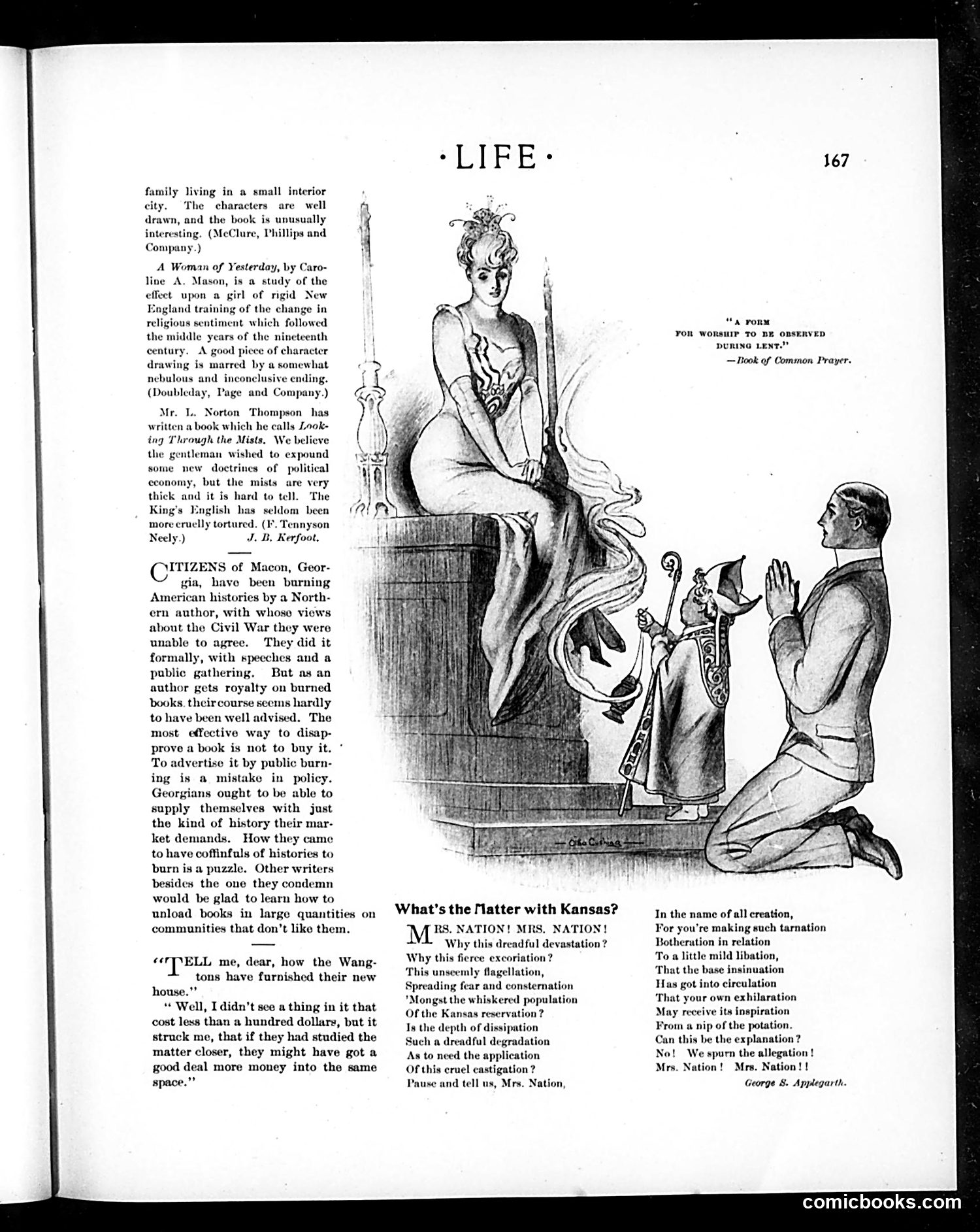
This page contains a satirical poem titled "What's the Matter with Kansas?" by George S. Ade. The accompanying illustration depicts a woman (representing Kansas) seated on a pedestal, appearing distressed or agitated, while a man kneels before her in a pleading or apologetic posture. The poem addresses Kansas as "Mrs. Nation," likely referencing Carrie Nation, the famous temperance activist and Kansas resident known for her militant anti-alcohol campaigns. The satire criticizes the "dreadful devastation" and "fierce execration" afflicting Kansas, suggesting the state's upheaval stems from Nation's prohibitionist crusade and its social consequences. The cartoon mocks both the activist and Kansas's turmoil through this personified, dramatic confrontation.
📄 Transcribed text from this page (OCR, searchable)
Machine-transcribed from the original scan — historical spelling and the odd misread are preserved.
family living in a small interior city. The characters are well 4 drawn, and the book is unusually , interesting. (McClure, Phillips and Mf Company.) 4 A Woman of Yesterday, by Caro- line A. Mason, is a study of the effect upon a girl of rigid New England training of the change in religious sentiment which followed the middle years of the nineteenth centur, . A good picce of character drawing is marred by a somewhat nebulous and inconclusive ending. (Doubleday, Page and Company.) Mr. L. Norton Thompson has written a book which he calls Look- ing Through the Mists, We believe the gentleman wished to expound some new doctrines of political economy, but the mists are very th nd it is hard to tell. The King’s English has seldom been more cruelly tortured. (I°. Tennyson Neely.) J.B. Kerfoot. CTIZENS: of Macon, Geor- gia, have been burning American histories by a North- ern author, with whose views about the Civil War they were unable to agree. They did it formally, with speeches and a public gathering. But as an author gets royalty on burned books. theircourse seems hardly to have been well advised. The most effective way to disap- prove a book is not to buy it. * To advertise it by public burn- ing is a mistake in policy. Georgians ought to be able to supply themselves with just the kind of history their mar- ket demands. How they came to have coffinfuls of histories to burn is a puzzle. Other writers besides the one they condemn would be glad to learn how to unload books in large quantities on communities that don’t like them. “«TPELL me, dear, how the Wang- tons have furnished their new house."” “ Well, I didn’t see a thing in it that cost less than a hundred dollars, but it struck me, that if they had studied the matter closer, they might have got a good deal more money into the same space.”” What's the [Matter with Kansas? N RS. NATION! MRS, NATION! Why this dreadful devastation? Why this fierce exeor ‘This unseemly flagellation, Spreading fear and consternation ’Mongst the whiskered population Of the Kansas reservation? Is the depth of dissipation Such a dreadful degradation As to need the application Of this cruel castigation ? Pause and tell us, Mrs. Nation, 167 “a ronw YOR WORSUIP TO DE ODSERVED DURING LENT.” — Took of Common Prayer. In the name of all creation, For you're making such tarnation Botheration in relation To a little mild libation, That the base insinuation Has got into circulation ‘That your own exhilaration May receive its inspiration From a nip of the potation. Can this be the explanation ? No! We spurn the allegation! Mrs. Nation! Mrs. Nation! ! George 8. Applegarth. comicbooks.com