
Life, 1901-02-28 · page 4 of 20
Life — February 28, 1901 — page 4: what you’re looking at
What you’re looking at
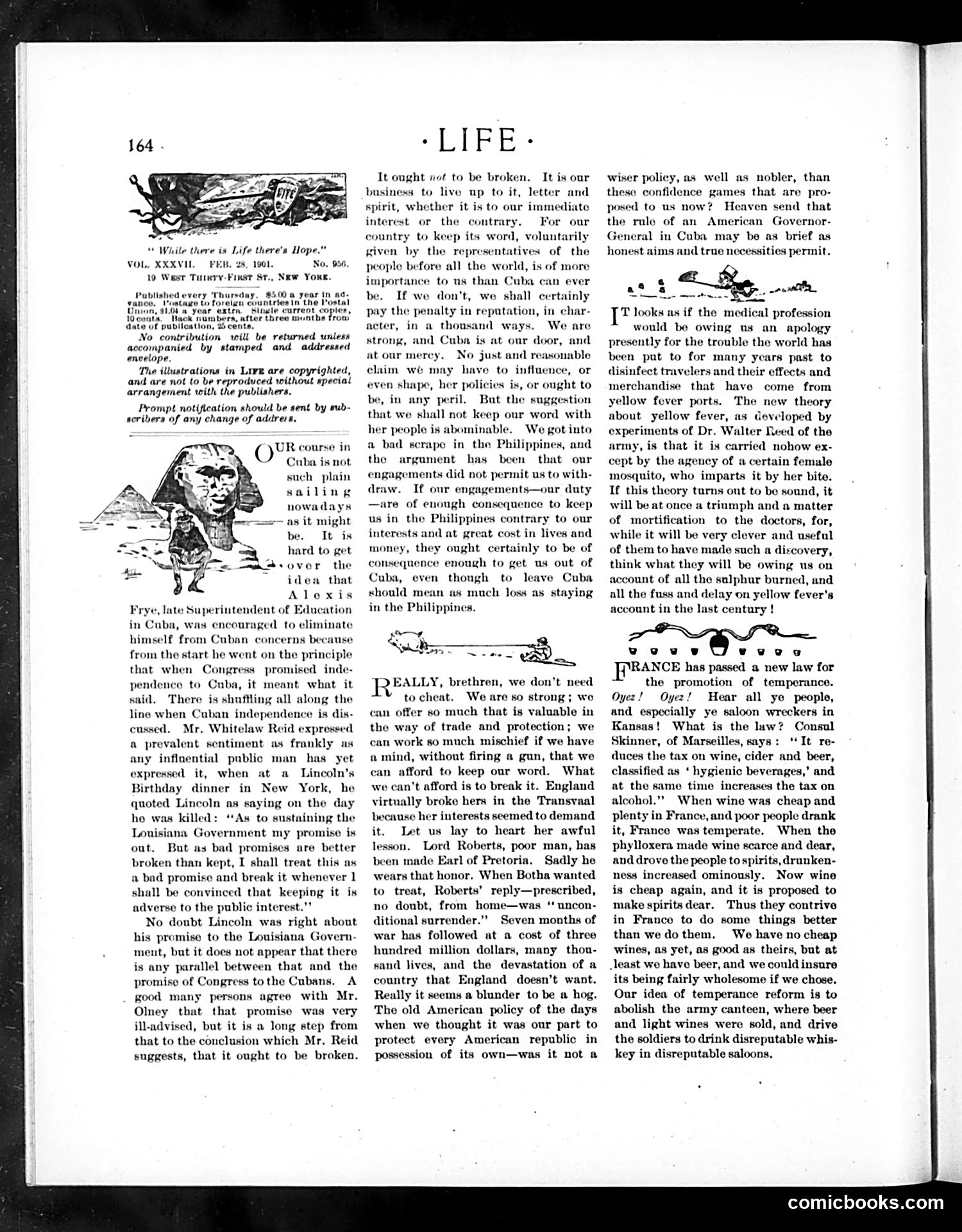
This page contains political commentary on American foreign policy, specifically debating whether the U.S. should maintain its involvement in Cuba and the Philippines. The left illustration shows a caricatured figure labeled as relating to Cuba policy debates. The text argues against breaking America's word to Cuba, citing honor and reputation while acknowledging the costly nature of such commitments. The right section discusses yellow fever research, appearing to reference Dr. Walter Reed's experiments with mosquito transmission of the disease. The bottom section satirizes temperance reform efforts, mocking Kansas's prohibition laws and their unintended consequences—creating more sophisticated drinking in saloons while increasing taxes on alcohol. The overall tone criticizes inconsistent American policies and their practical failures.
📄 Transcribed text from this page (OCR, searchable)
Machine-transcribed from the original scan — historical spelling and the odd misread are preserved.
“ While there ix Life there's Hope. VOL, XXXVI. FEB. 28, 1901. 19 Waar Tu1ery-Finst St., New YoR«. ‘ablished every ‘Thursday. $500 a year tn ad. oI ¢ to foreign countries in the Postal xtrn Sinwle curreot copl a, after three munths froa ents. will be returned unless accompanied by stamped and addressed envelope. The illustrations in Lire are copyrighted, and are not to be reproduced without special arrangement with the publishers. Prompt notification should be sent by sub- scribers of any change of address. UR course in Cuba is not such plain sailing nowadays fer as it might be. It is hard to get idea that Aloxis Frye, late Superintendent of Education in Cuba, was encouraged to eliminate himself from Cuban concerns because from the start he went on the principle that when Congress promised inde- pendence to Cuba, it meant what it said. There is shuffling all along the line when Cuban independence is dis- cussed. Mr. Whitelaw Reid expressed a prevalent sentiment as frankly as any influential public man has yet expressed it, when at a Lincoln's Birthday dinner in New York, he quoted Lincoln as saying on the day ho was killed: ‘As to sustaining the Louisiana Government my promise is out, But as bad promises are better broken than kept, I shall treat this as a bad promise and break it whenever 1 shall be convinced that keeping it is adverse to the public interest.”” No doubt Lincoln was right about his promise to the Louisiana Govern- ment, but it does not appear that there is any parallel between that and the promise of Congress tothe Cubans. A good many persons agree with Mr. Olney that that promise was very ill-advised, but it is a long step from that to the conclusion which Mr. Reid suggests, that it ought to be broken. * LIFE - It ought not to be broken, It is our business to live up to it, letter and spirit, whether it is to our immediate interest or the contrary. For our country to keep its word, voluntarily xy the representatives of the ple before all the world, to us than Cuba can ever If we don't, we shall certainly pay the penalty in reputation, in char- acter, in a thousand ways. We are strong, and Cuba is at our door, and at our mercy, No just and reasonable claim we may have to influence, or even shape, her policies is, or ought to be, in any peril. But the suggestion that we shall not keep our word with her people is abominable. We got into a bad scrape in the Philippines, and the argument has been that our engagements did not permit us to with- draw. If our engagements—our duty —are of enongh consequence to keep us in the Philippines contrary to our interests and at great cost in lives and money, they ought certainly to be of consequence enough to get us out of Cuba, even though to leave Cuba should mean as much loss as staying in the Philippines. T EALLY, brethren, we don’t need to cheat. We are so strong; we can offer so much that is valuable in the way of trade and protection; we can work so much mischief if we have a mind, without firing a gun, that we can afford to keep our word. What we can’t afford is to break it. England virtually broke hers in the Transvaal because her interests seemed to demand it. Let us lay to heart her awful lesson, Lord Roberts, poor man, has been made Earl of Pretoria. Sadly he wears that honor. When Botha wanted to treat, Roberts’ reply—prescribed, no doubt, from home—was ‘ uncon- ditional surrender.” Seven months of war has followed at a cost of three hundred million dollars, many thou- sand lives, and the devastation of a country that England doesn't want. Really it seems a blunder to be a hog. The old American policy of the days when we thought it was our part to protect every American republic in possession of its own—was it not a be. wiser policy, as well as nobler, than these confidence games that are pro- posed to us now? Heaven send that the rule of an American Governor- General in Cuba may be as brief as honest aims and true necessities permit. ore T looks as if the medical profession would be owing us an apology presently for the trouble the world has been put to for many years past to disinfect travelers and their effects and merchandise that have come from yellow fever ports. The new theory about yellow fever, as developed by experiments of Dr. Walter Reed of the army, is that it is carried nohow ex- cept by the agency of a certain female mosquito, who imparts it by her bite. If this theory turns ont to be sound, it will be at once a triumph and a matter of mortification to the doctors, for, while it will be very clever and useful of them to have made such a discovery, think what they will be owing us on account of all the sulphur burned, and all the fuss and delay on yellow fever's account in the last century ! PPRANCE has passed a new law for the promotion of temperance. Oyez! Oyez! Hear all ye people, and especially ye saloon wreckers in Kansas! What is the law? Consul Skinner, of Marseilles, says: ‘It re- duces the tax on wine, cider and beer, classified as ‘ hygienic beverages,’ and at the same time increases the tax on alcohol.” When wine was cheap and plenty in France, and poor people drank it, France was temperate. When the phylloxera made wine scarce and dear, and drove the people to spirits, dranken- ness increased ominously. Now wine is cheap again, and it is proposed to make spirits dear. Thus they contrive in France to do some things better than we do them. We have no cheap wines, as yet, a8 good as theirs, but at .least we have beer, and we could insure its being fairly wholesome if we chose. Our idea of temperance reform is to abolish the army canteen, where beer and light wines were sold, and drive the soldiers to drink disreputable whis- key in disreputable saloons, comicbooks.com