
A complete issue · 20 pages · 1901
Life — January 17, 1901
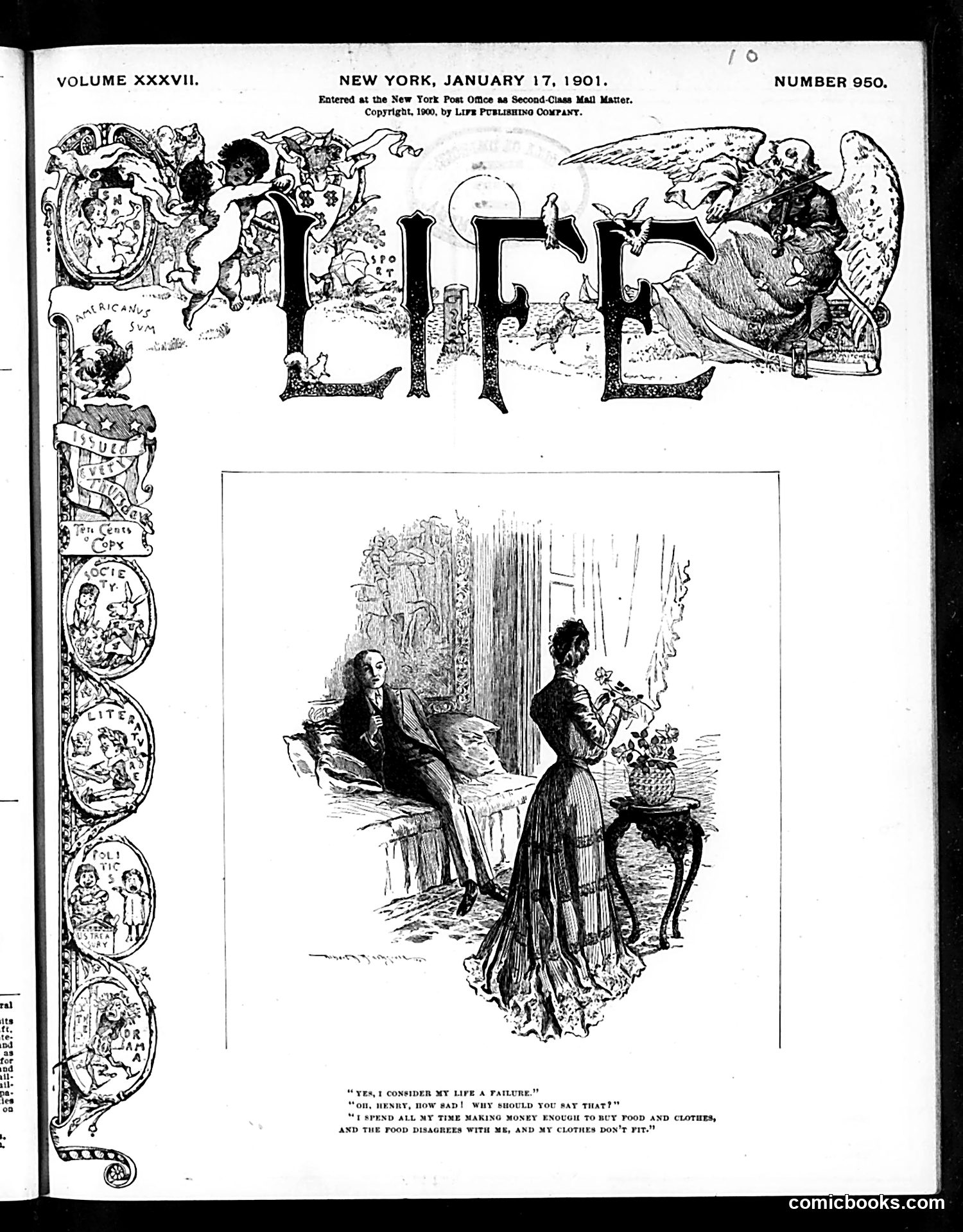
This page features a satirical cartoon about marital financial conflict. The illustration shows a woman holding flowers confronting a man seated on a bed, with the caption quoting their argument: **"Yes, I consider my life a failure."** **"Oh, Henry, how sad! Why should you say that?"** **"I spend all my time making money enough to buy food and clothes, and the food disagrees with me, and my clothes don't fit."** The satire targets the absurdity of the husband's complaint—he's making enough money for necessities, yet still feels unsuccessful because of trivial physical discomforts. It's commentary on male financial anxiety and the disconnect between earning adequately and emotional satisfaction, likely reflecting early 1900s anxieties about masculine success and middle-class expectations.
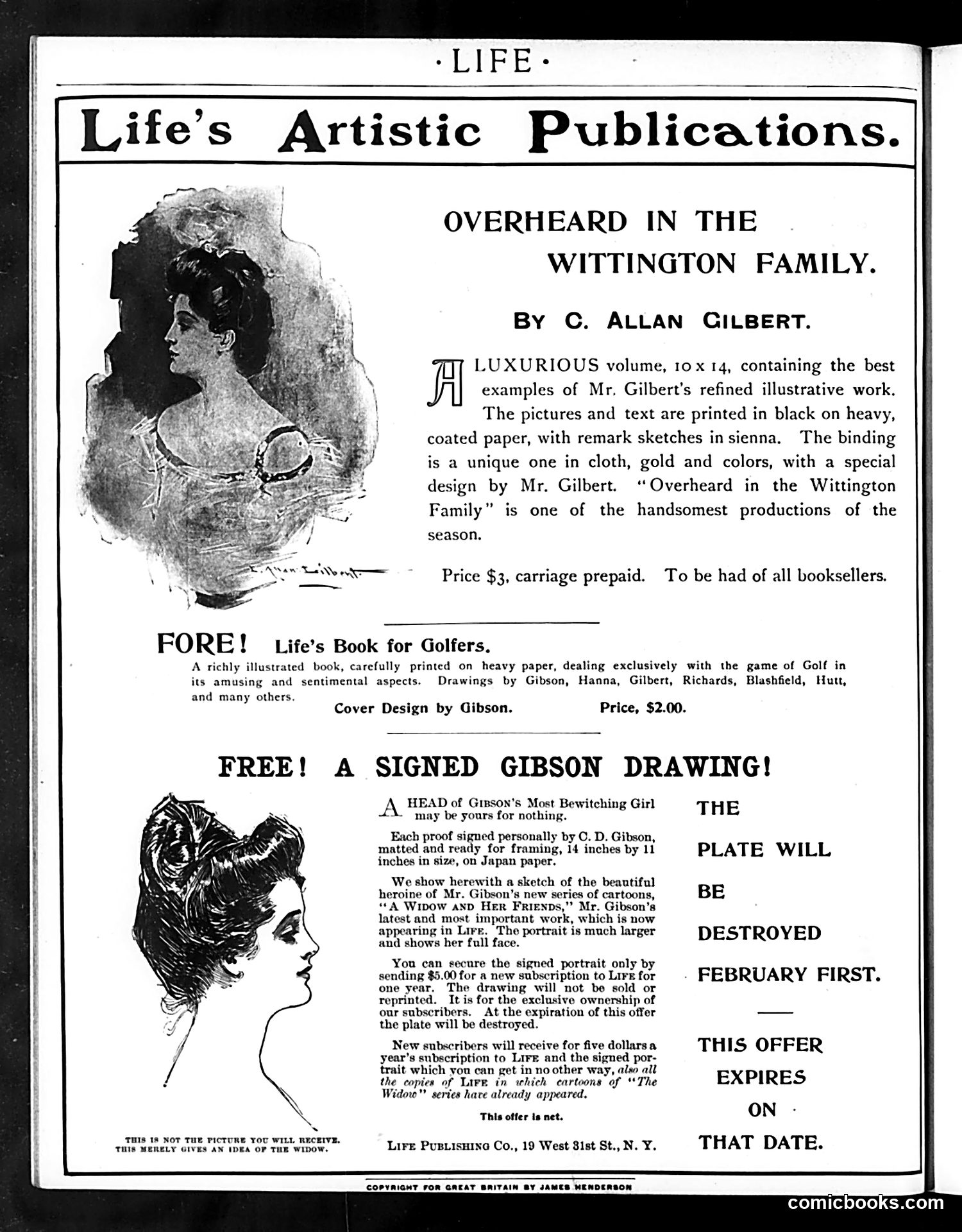
This page is primarily **advertising**, not satire or political commentary. It showcases three publications by Life's publishing house, all featuring artwork by C. Allan Gilbert, a popular illustrator of the era: 1. **"Overheard in the Wittington Family"** — a $3 luxury volume of Gilbert's illustrations 2. **"Fore! Life's Book for Golfers"** — a $2 illustrated book about golf 3. A promotional offer for a **signed Gibson drawing** (a portrait of "Gibson's Most Bewitching Girl") — free with a $5 one-year subscription to Life The advertisements emphasize the exclusivity and artistic quality of these publications, targeting affluent readers. The Gibson drawing offer creates urgency by noting the plate will be "destroyed February First," making the subscription a limited-time collectible. This represents typical early 20th-century magazine marketing strategies.
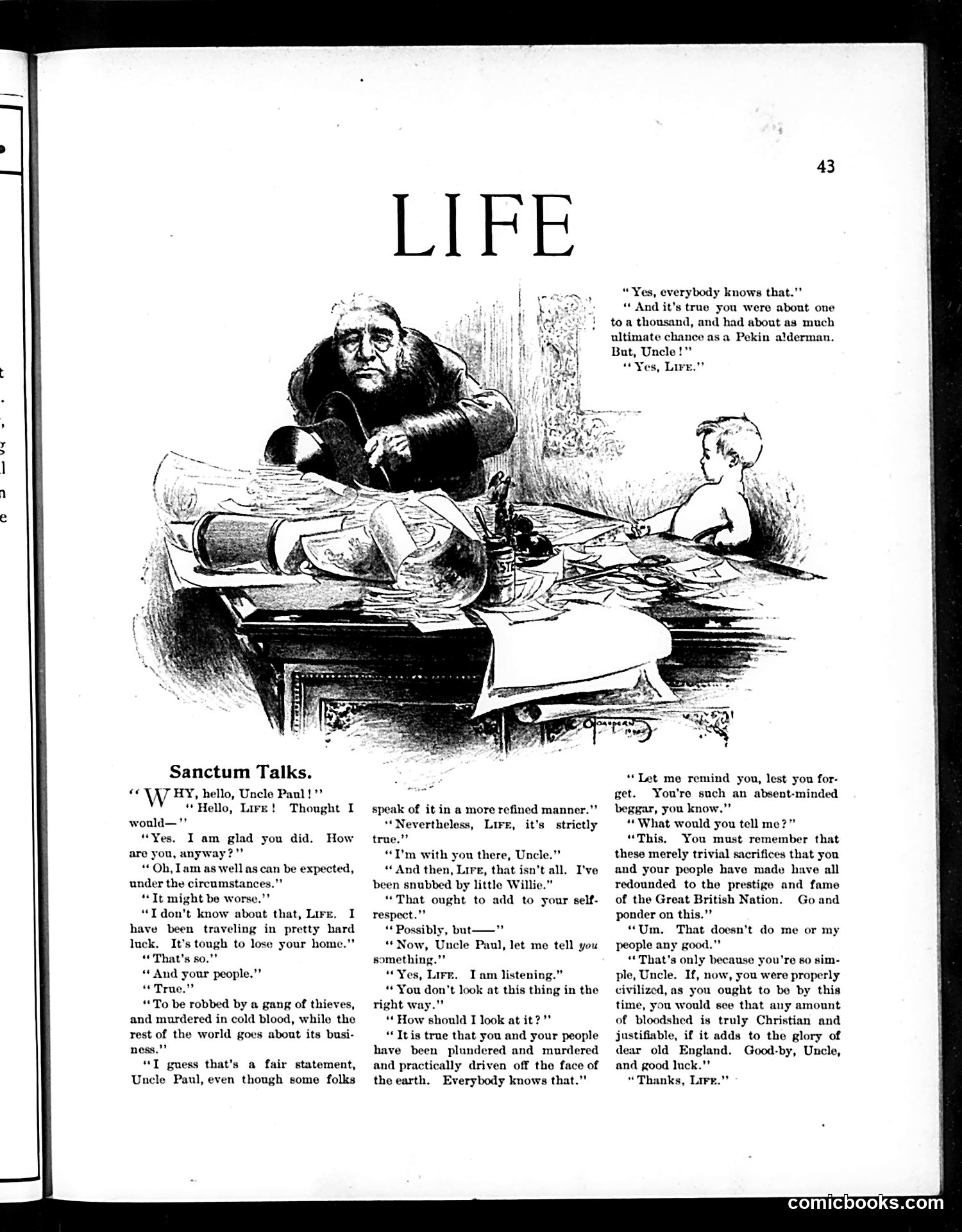
This satirical dialogue features "Uncle Paul" (an older man with a stern expression) lecturing "Life" (represented as a young child) about British imperialism and national sacrifice. The cartoon mocks Uncle Paul's self-righteous justification of colonial violence. He argues that Britain's imperial conquests—despite involving plunder and murder—are justified because they advance "the prestige and fame of the Great British Nation." Life responds skeptically, challenging whether such "bloodshed is truly Christian and justifiable" merely because it benefits England's glory. The satire criticizes imperial apologists who rationalize colonial brutality through nationalist rhetoric. The generational dynamic (elder instructing child) suggests the author views such arguments as outdated moral sophistry being passed to the next generation.
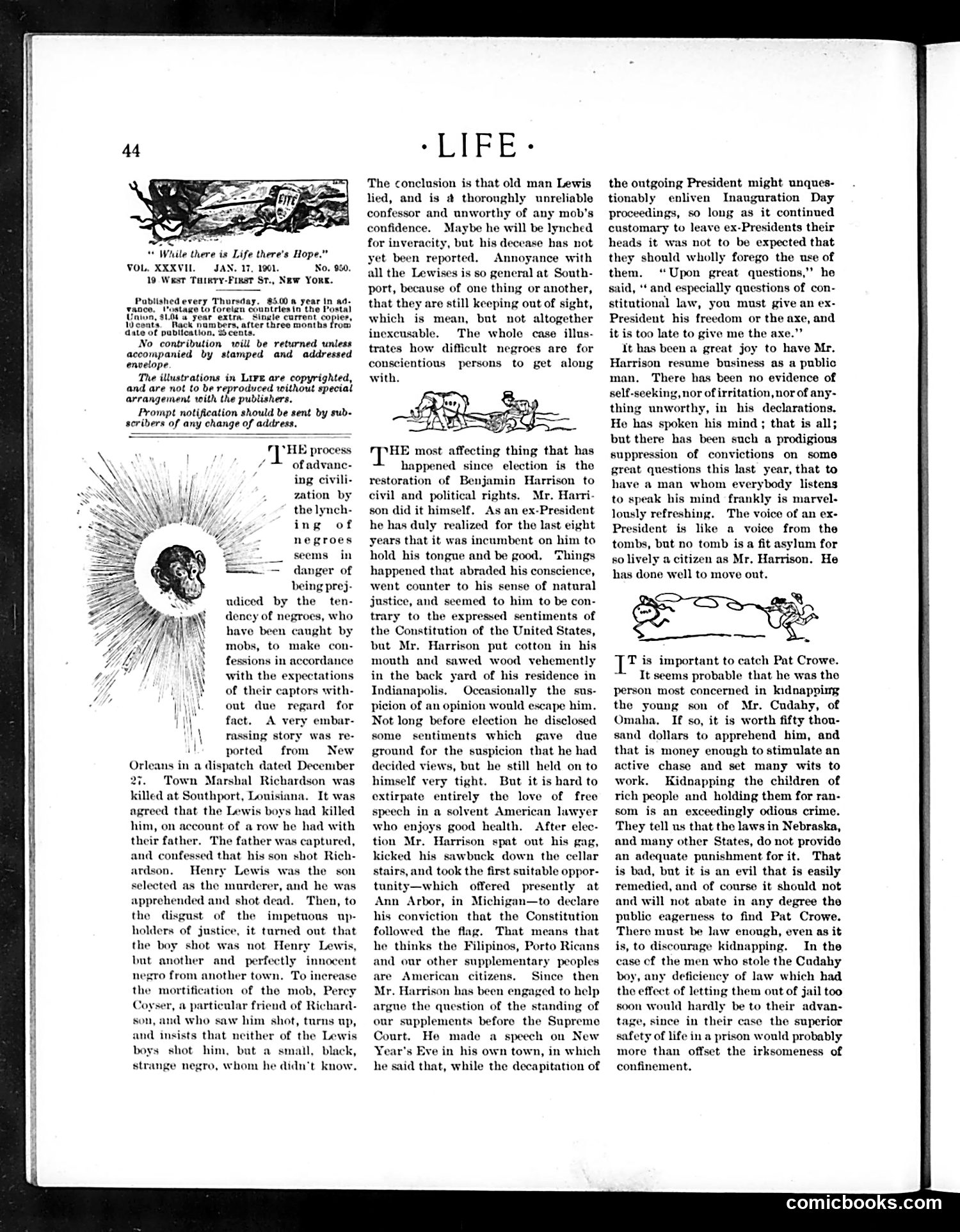
This page discusses Benjamin Harrison's restoration to "civil and political rights" after his presidency, using the lynching of an innocent Black man named Henry Lewis as a dark counterpoint. The text critiques Harrison's inconsistency: as ex-President, he advocated constitutional protections for supplementary peoples (likely referring to Filipino sovereignty), yet remained silent on American racial violence. The central illustration depicts a Black man's face radiating light—likely symbolizing innocence or moral clarity. The satire suggests Harrison's concern for distant colonial subjects rang hollow given his indifference to domestic racial murder. This juxtaposes his "freedom" as a private citizen against the fatal absence of freedom for Black Americans facing mob violence.
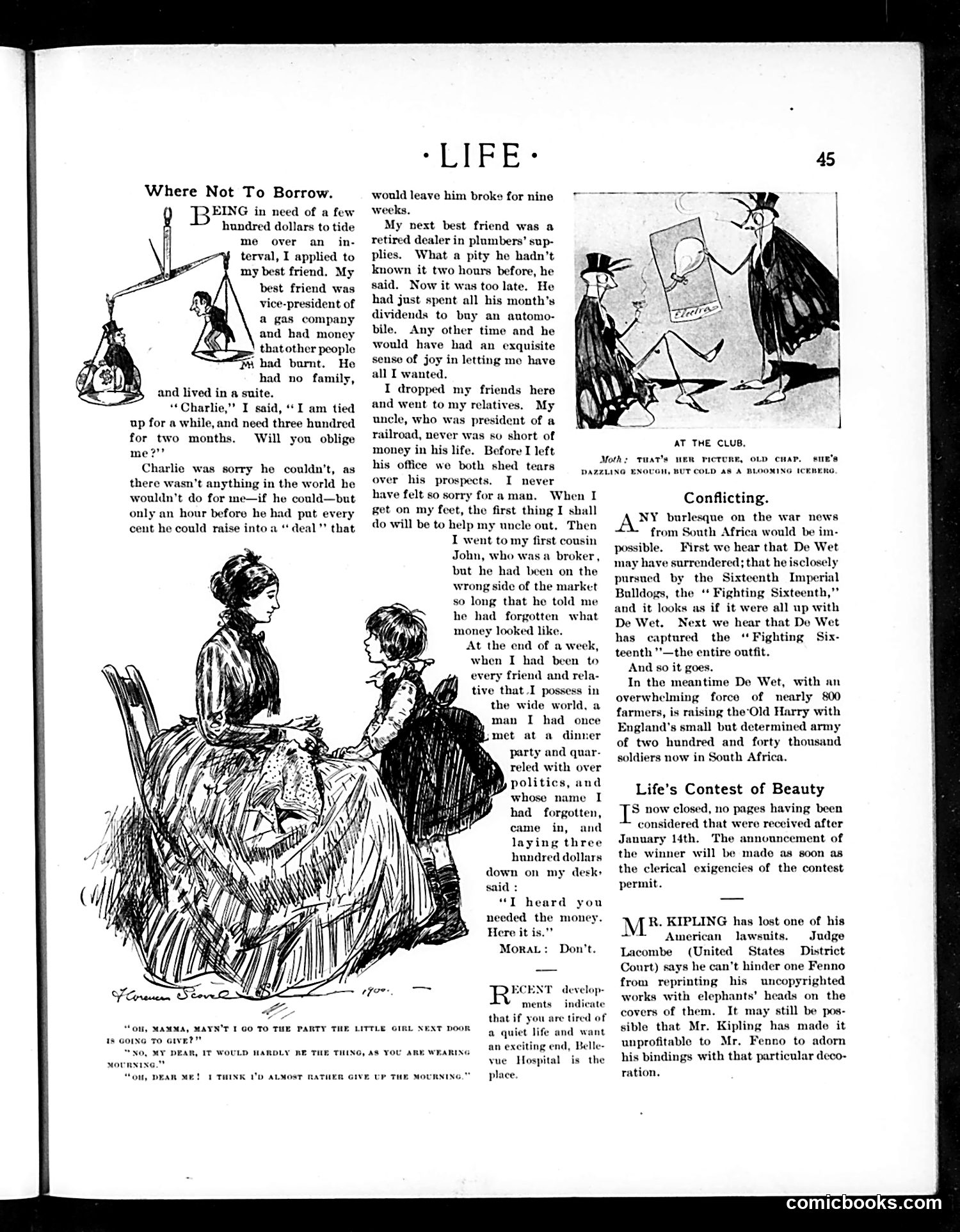
**Main Content: "Where Not To Borrow"** This is a satirical essay about borrowing money from friends. The author describes repeatedly asking different friends for loans—a gas company vice-president, a plumbers' supplies dealer, a railroad president, and a broker—each time with disappointing results. The central joke is that friends consistently refuse loans or can't help, leaving the narrator broke. The accompanying illustration shows a woman with a child, depicting the domestic consequence of financial desperation. The dialogue beneath emphasizes the social awkwardness: the woman won't attend a party without proper clothing, but the man considers giving up "mourning" (formal dress) rather than his morning routine. The satire targets both the foolishness of expecting loans from friends and the class-conscious social pressures of the era.
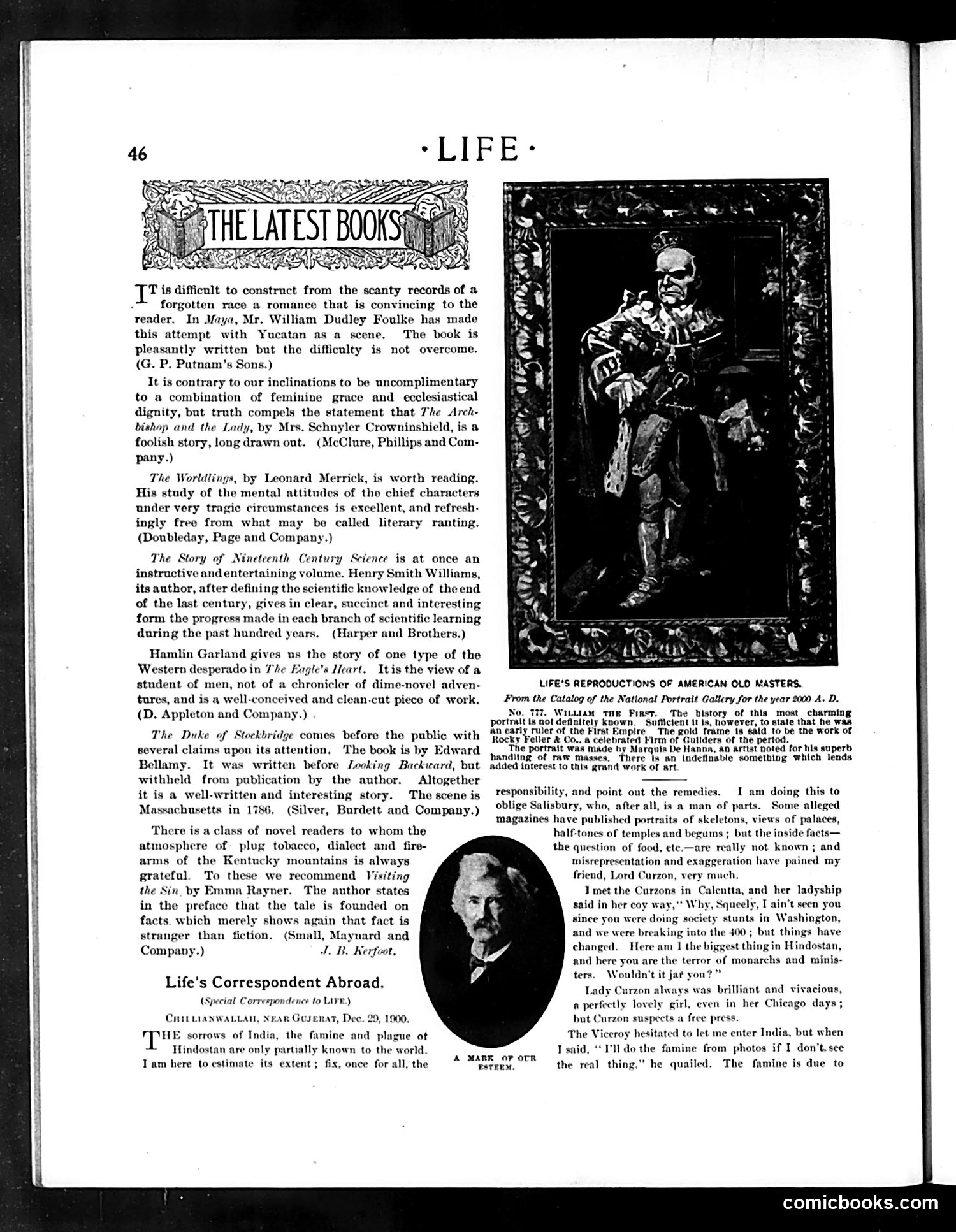
This page contains **book reviews** under "The Latest Books" header, not political cartoons. The two images are: 1. **Upper right**: An illustration titled "Life's Reproductions of American Old Masters" - appears to be a portrait of a figure in ornate period clothing, likely meant to evoke classical or historical artistic styles. 2. **Lower left**: A photographic portrait labeled "A Mark of Our Esteem" accompanying a section titled "Life's Correspondent Abroad," featuring a dispatch from Chitianswalah, near Gujerat (Dec. 23, 1900) about Indian famine conditions. The page primarily discusses literary works rather than containing satire. The "Old Masters" reference suggests Life was satirizing American art pretensions by showcasing classical portraiture styles.
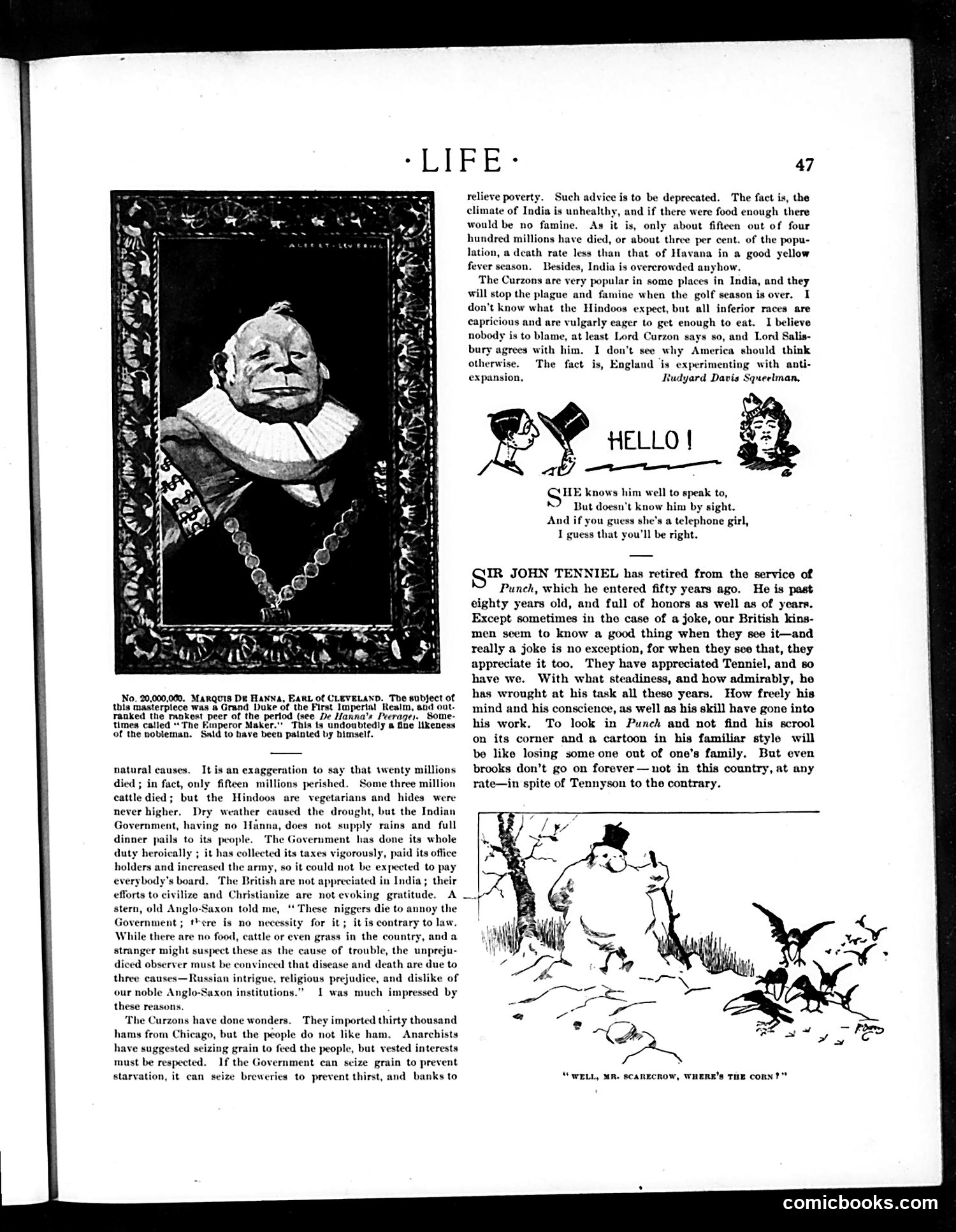
**Portrait (left):** A historical figure in elaborate Renaissance dress with ornate collar and chain. The caption indicates this is a "Grand Duke of the First Imperial Realm" painted by someone named Velasquez—likely a Old Master artwork being reproduced. **"Hello!" Cartoon (top right):** A brief joke about someone who "knows him well" but "doesn't know him by sight" and might recognize him as a telephone caller. This is a mild pun on recognizing voice versus appearance. **Sir John Tenniel Article (main text):** Discusses the retirement of Tenniel, who worked fifty years for *Punch* magazine. The text celebrates his career and influence on British humor and art. **Bottom Cartoon:** Shows a scarecrow in a field with a farmer asking "Well, Mr. Scarecrow, where's the corn?"—a straightforward visual gag about a scarecrow's failure at its job. The page mixes art history, biographical tribute, and light humor typical of *Life's* format.
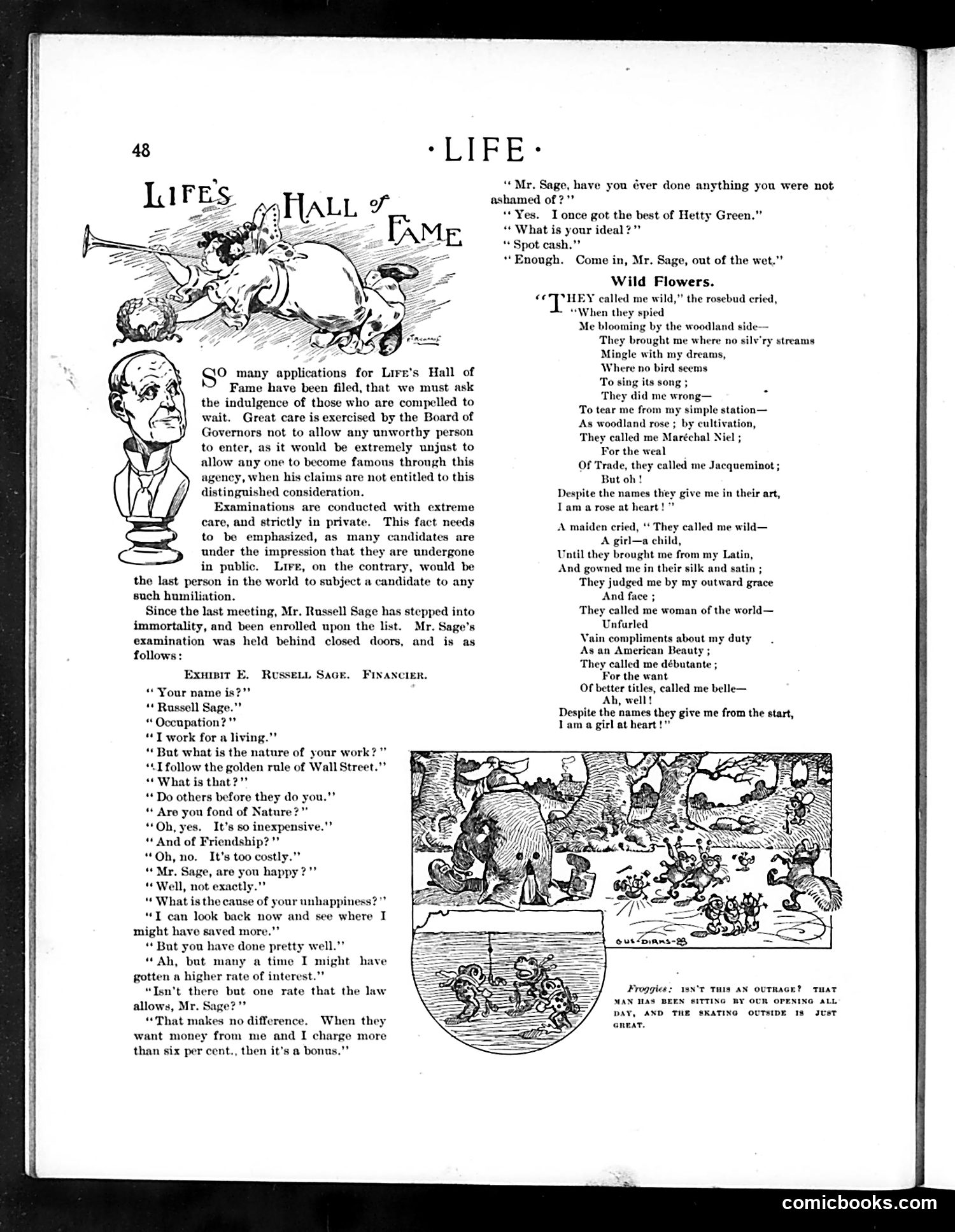
This page satirizes the pretensions of wealth and social climbing through Russell Sage, a real financier of the Gilded Age. The left column mocks Sage's candidacy for "Life's Hall of Fame" by presenting an absurd interview where he boasts of following "the golden rule of Wall Street" (doing unto others before they do unto you) and admits to charging extra fees—calling it a "bonus." The poem "Wild Flowers" on the right ironically contrasts a girl's natural, wild nature with attempts to civilize and rename her, paralleling how society constrains authentic identity. The illustrations below depict pastoral scenes, likely mocking Sage's pretense to cultured sophistication. The satire targets late-19th-century robber-baron hypocrisy—wealthy men claiming moral virtue while openly admitting to exploitative business practices.
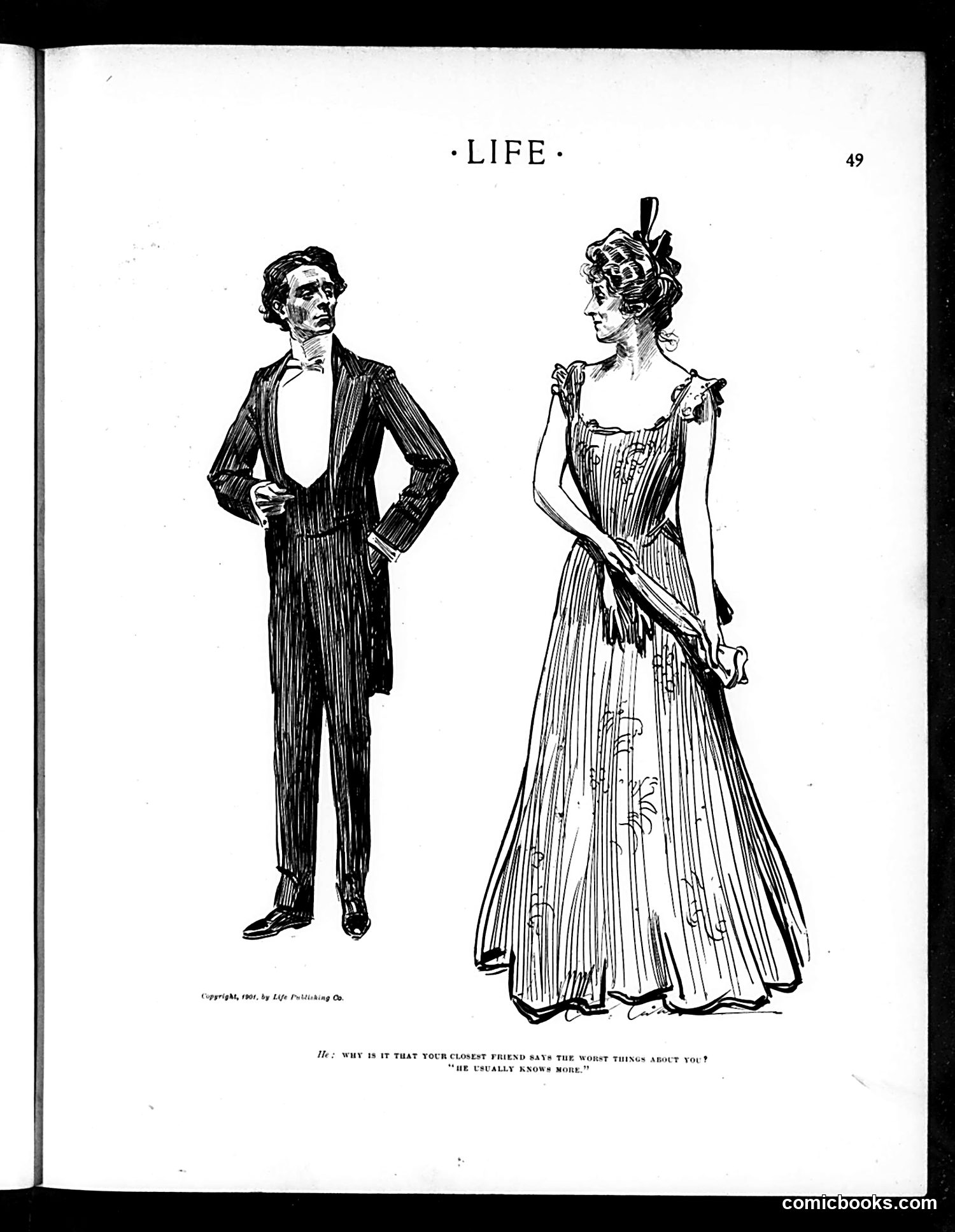
This page from *Life* magazine (copyright 1907) presents a single satirical cartoon about social relationships and gossip. The illustration shows a well-dressed man and woman in formal early-1900s attire. The caption reads: "He: WHY IS IT THAT YOUR CLOSEST FRIEND SAYS THE WORST THINGS ABOUT YOU? / 'HE USUALLY KNOWS MORE.'" **The satire:** The joke plays on the observation that intimate friends possess detailed knowledge of our flaws and secrets, making them uniquely positioned to criticize us effectively. The cartoon satirizes both human nature (our tendency to confide weaknesses to close friends) and the irony that those nearest to us can wound us most deeply through their informed criticism. It's a commentary on friendship's double-edged nature—closeness brings both loyalty and vulnerability to betrayal or harsh judgment.
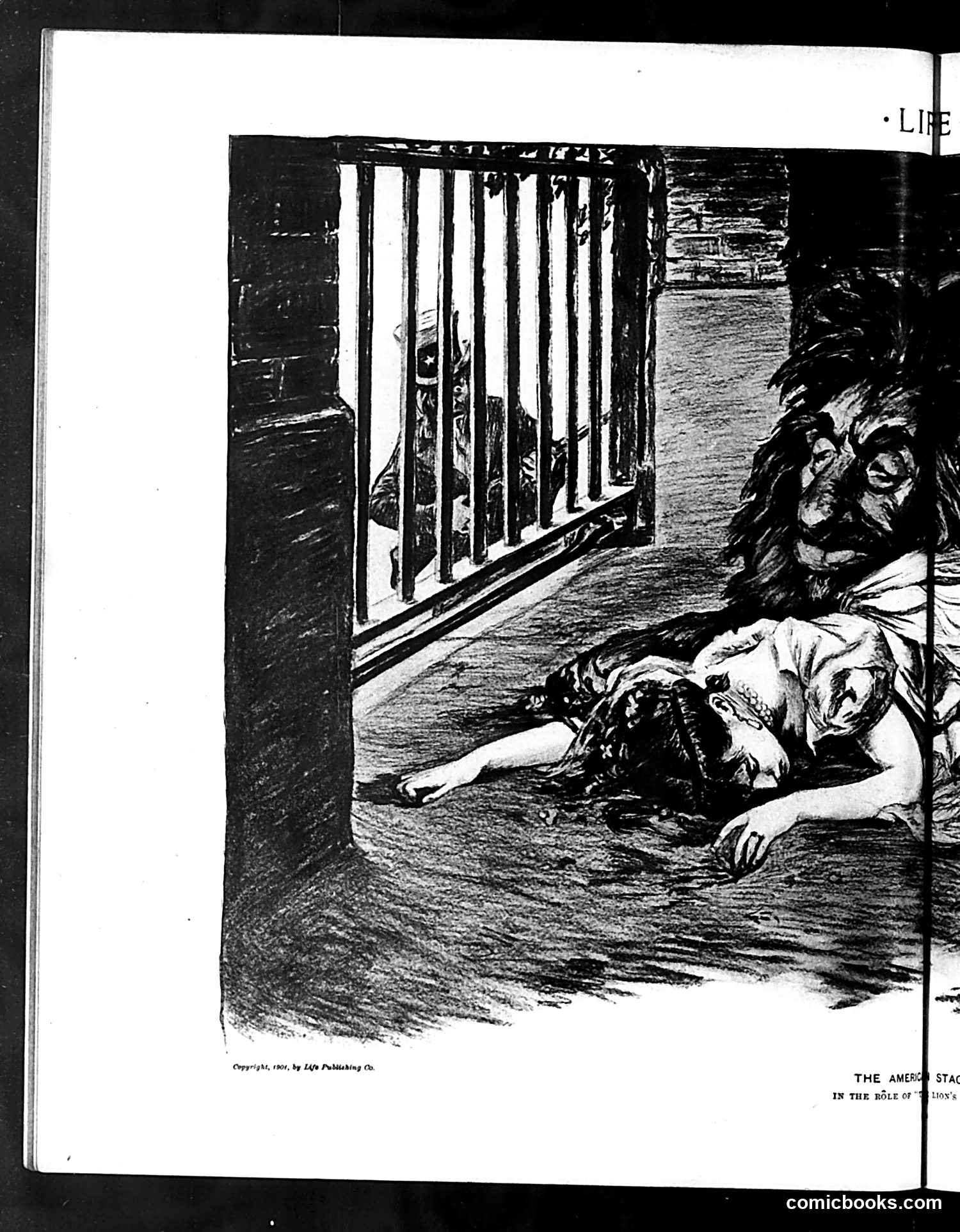
This appears to be a dramatic illustration from Life magazine (copyright 1907, per the visible mark). The image shows a disheveled woman lying on a floor in what seems to be a corridor or hallway, with a concerned man's face visible in the background. A barred window or gate is visible in the distance. The caption references "THE AMERICAN STAGE IN THE ROLE OF LION'S" (text is partially cut off, making complete interpretation difficult). Without the full caption and headline, the precise satirical target is unclear. However, given Life's focus on social commentary, this likely critiques either theatrical practices, women's treatment in theater, or broader social conditions. The dramatic, noir-like rendering suggests commentary on serious social issues rather than lighthearted satire. The specific reference to "the American stage" suggests theatrical or entertainment industry criticism.
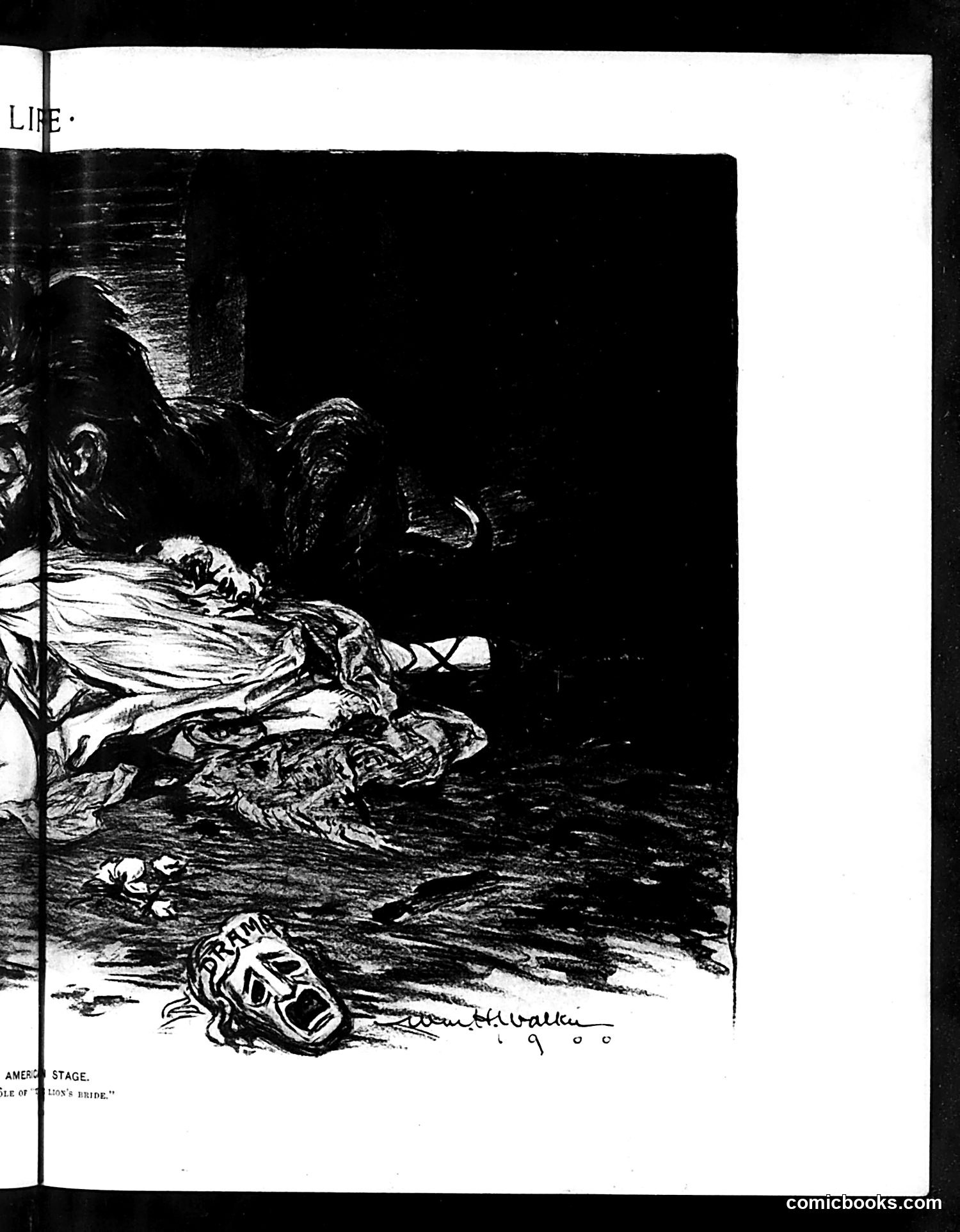
This appears to be a satirical illustration from *Life* magazine, likely from around 1900 (based on the signature date visible). The image depicts a dramatic scene on what appears to be a theatrical stage, showing figures in classical or dramatic dress in an apparently tragic moment. The text reference to "AMERICAN STAGE" and partial text mentioning "LION'S BRIDE" suggests this satirizes a theatrical production. The darkly rendered figures and prone body positioned in the foreground create a melodramatic atmosphere typical of turn-of-the-century stage productions. Without clearer OCR text or additional context, the specific political or social critique remains unclear, though *Life*'s satirical tradition suggests commentary on either theatrical excess, contemporary drama, or possibly the pretensions of American stagecraft of that era.
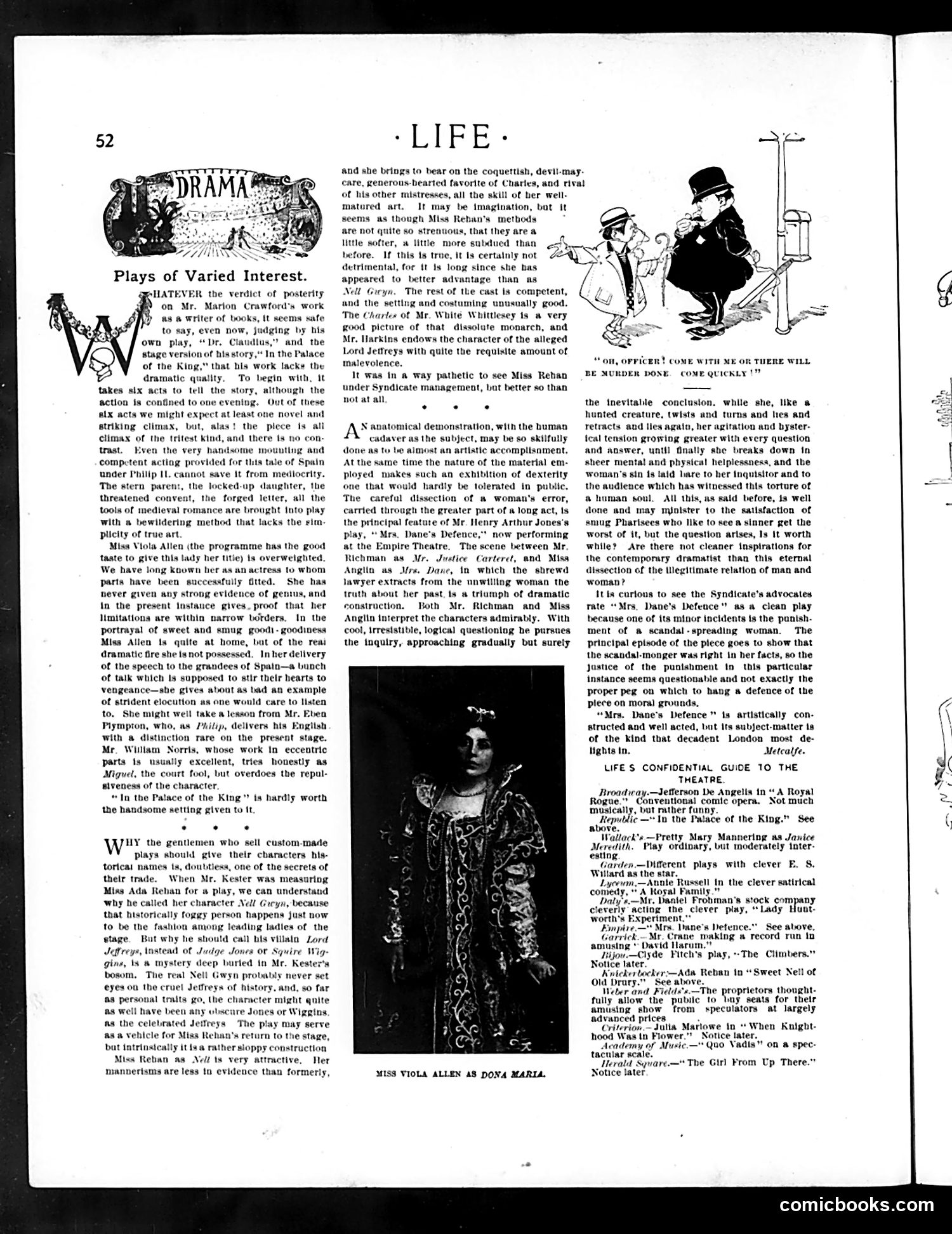
This page contains theatrical drama criticism rather than political cartoons. The main illustration shows **Miss Viola Allen as Doña Maria**, a character from a play being reviewed. The text discusses several theatrical productions, including works by Shakespeare and contemporary playwrights. The critic praises Miss Rehan's acting ability while critiquing the construction of certain plays. There's particular discussion of *Nell Gwyn* and *The Charles of Mr White Thackeray*. The page also includes "Life's Confidential Guide to the Theatre"—a listing of Broadway productions with brief commentary on their merits and performers. This appears to be standard theater criticism and entertainment coverage from an early 20th-century American magazine, not political satire. The satirical humor, if present, relates to theatrical quality rather than political content.
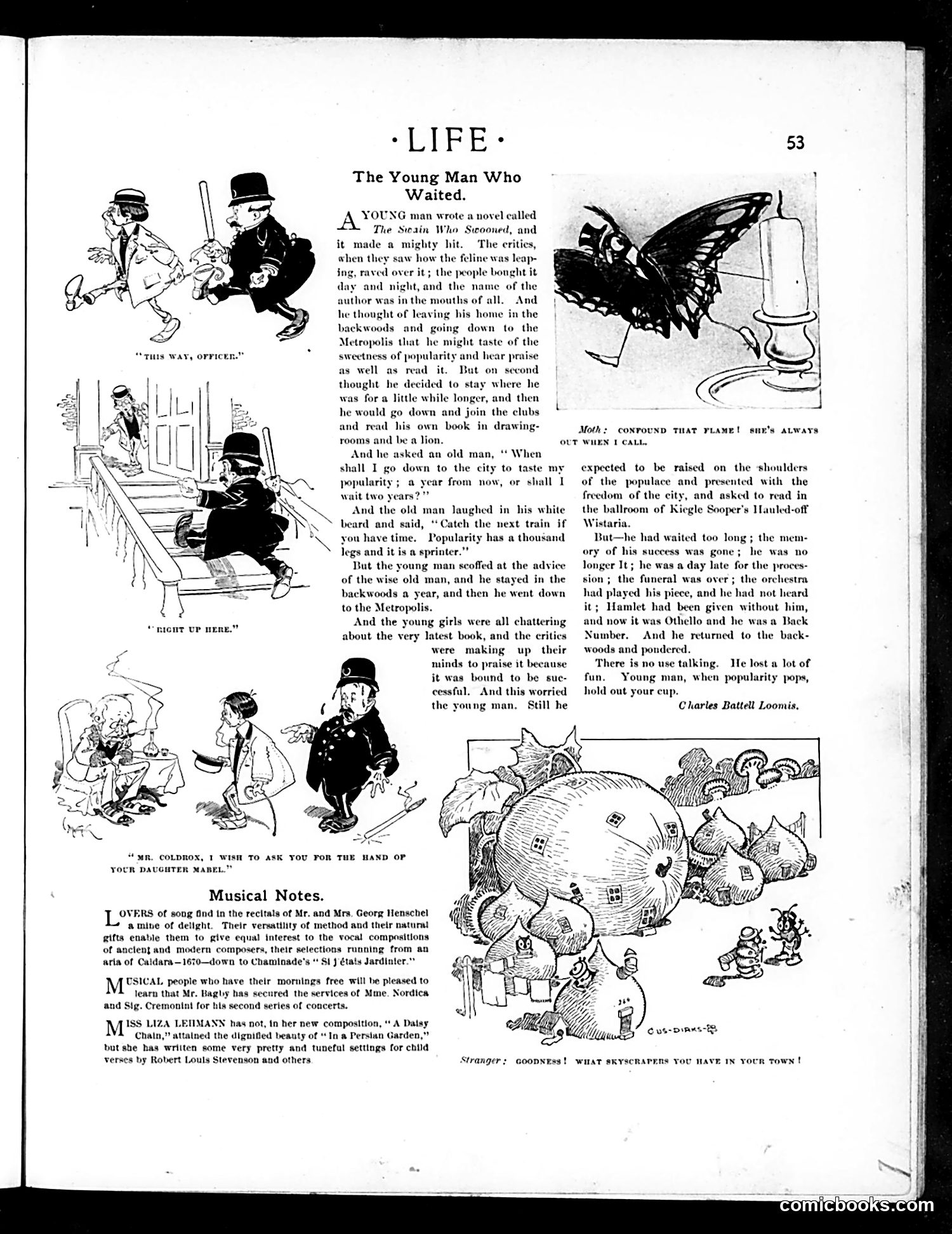
This satirical story warns against delaying success. A young author writes a hit novel called *The Swain Who Swooned* and becomes famous overnight. An old man advises him to capitalize immediately: "Popularity has a thousand legs and it is a sprinter." But the author delays, staying in the backwoods an extra year, expecting to enjoy his fame later. When he finally arrives in the city, his moment has passed. His book is forgotten, replaced by newer sensations—other authors are being celebrated, his work has been staged without him. He's "a day late for the procession; the funeral was over." The moral, by Charles Battell Loomis: don't assume popularity waits. It's fleeting and moves to the next sensation quickly. The illustrations show the young man's optimistic delusions contrasted with his later disappointment—a commentary on how rapidly fame fades in popular culture and the foolishness of assuming success is permanent.
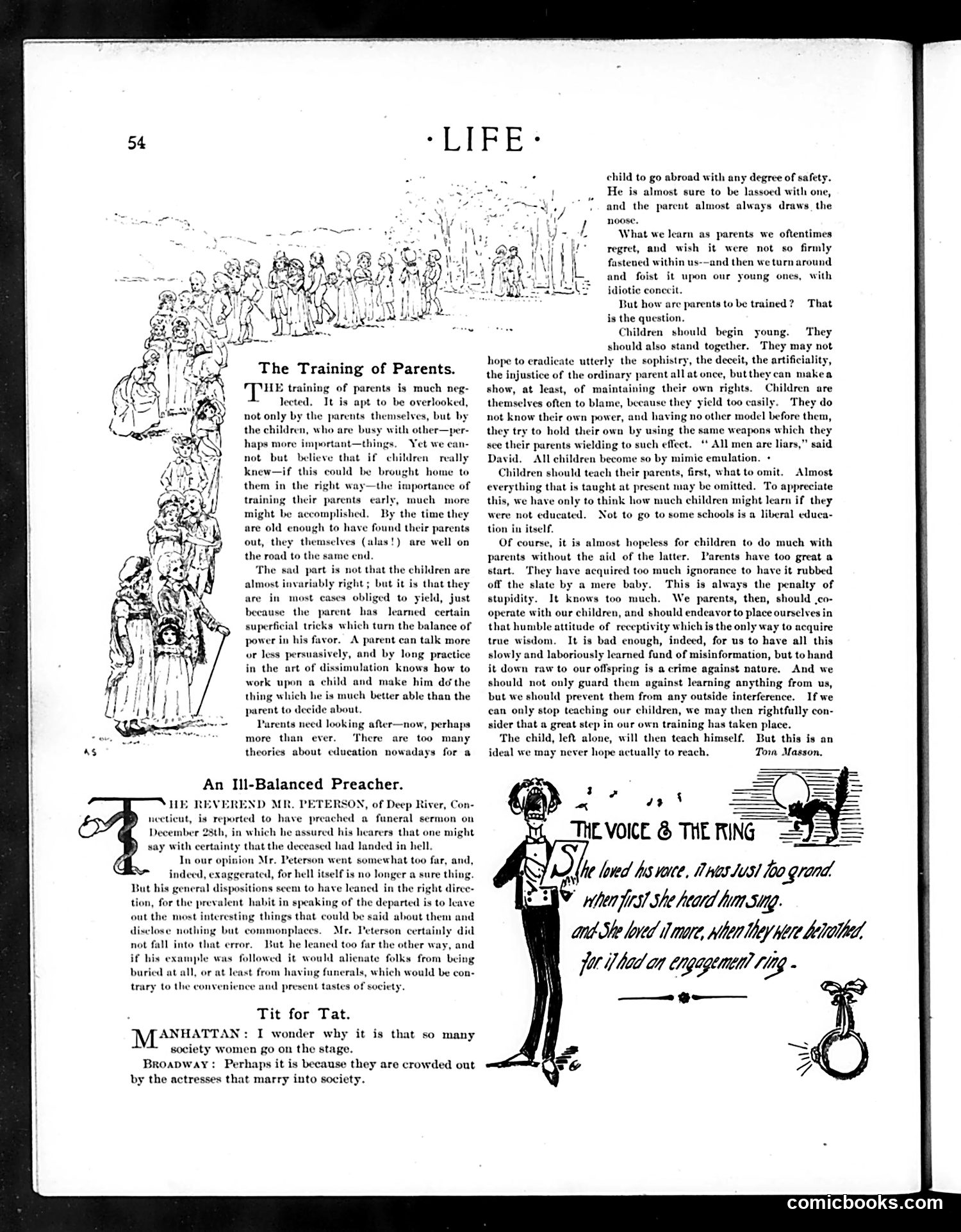
This page contains three satirical pieces critiquing early 20th-century American society: **"The Training of Parents"** argues that children should train their parents rather than vice versa. The author contends parents use manipulation and sophistry to maintain power over children who often possess better judgment. The satire suggests parents perpetuate ignorance and "idiotic conceit" by forcing their own flawed lessons onto the next generation. **"An Ill-Balanced Preacher"** mocks Reverend Peterson of Connecticut for delivering an overly harsh funeral sermon declaring the deceased damned to hell. The satire criticizes both his certainty about damnation and his violation of social convention—funeral eulogies should omit unflattering truths, not broadcast them. Peterson's candor threatens the funeral industry's social utility. **"Tit for Tat"** is a brief exchange joke: a Manhattan socialite asks why society women become actresses; Broadway replies they're crowded out by actresses who marry into society. This satirizes the social permeability between theater and high society.
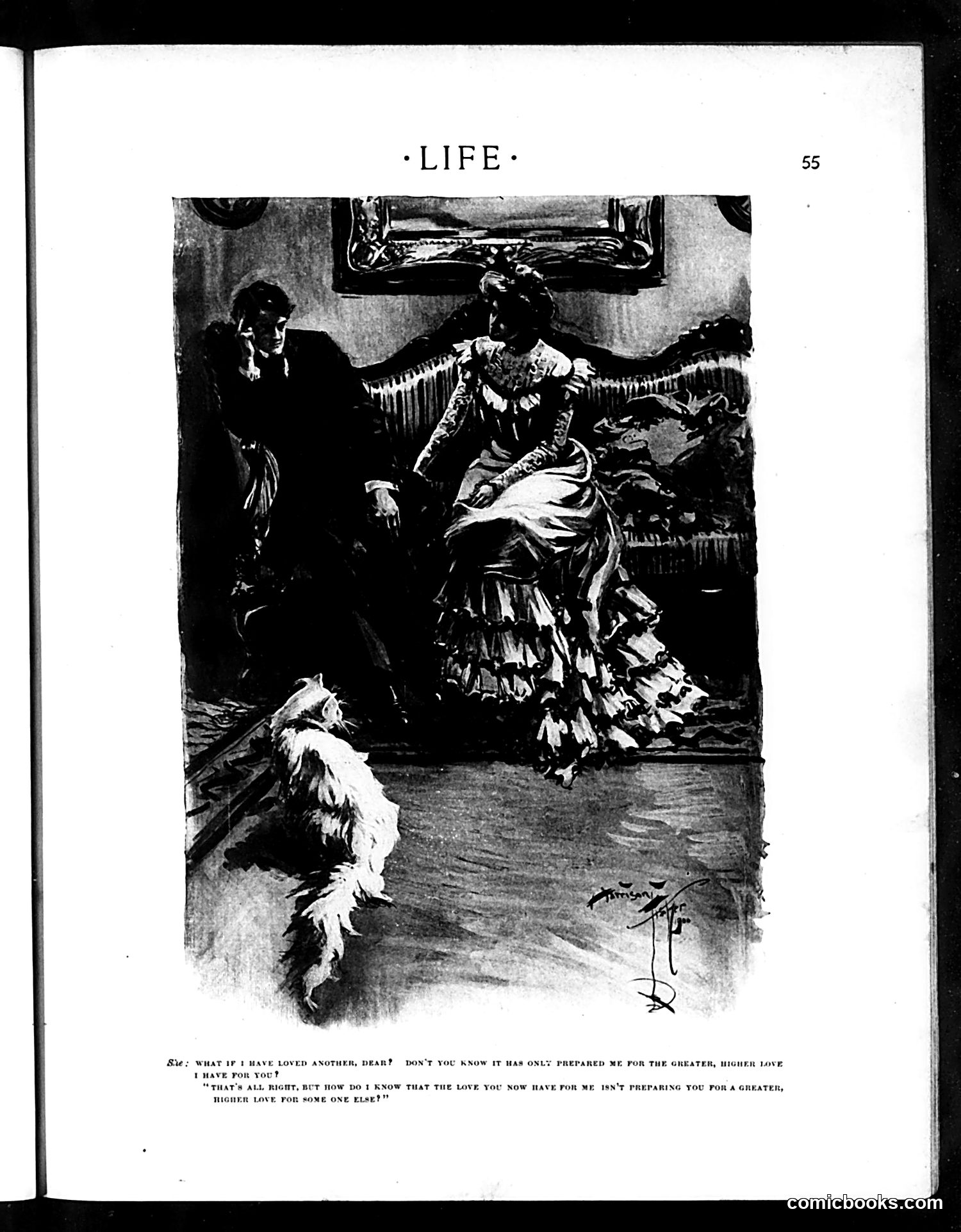
This illustration depicts a domestic scene with romantic/marital tension. A woman in an elaborate dress sits with a man, while a small dog observes. The dialogue explores jealousy and the nature of love. The woman's character argues that her past love prepared her for greater love with him. The man's response—a clever reversal—questions whether his current love for her might similarly be merely preparation for an even greater love with someone else in the future. The satire mocks romantic rationalization and the logical absurdity of using "practice love" as justification for past infidelity. It's a commentary on self-serving emotional arguments people make to excuse romantic history. The small dog serves as a bemused witness to human relationship complications. This represents early 20th-century Life magazine's typical domestic humor—sophisticated, witty commentary on middle-class romantic conventions.
This is primarily a **text-heavy page of humor and anecdotes** from Life magazine, not a political cartoon page. The content consists of three humorous stories: 1. **Judge Colquitt anecdote**: A Georgia judge who multitasks—holding court, giving political speeches, whipping hecklers, and preaching—all in one day. The humor relies on the absurdity of his versatility. 2. **Cyrus Clark story**: A darkly comic tale about a failed expressman reduced to living in a hotel he once owned. When his friend Palmer drives him to cheer him up, Clark becomes fixated on a rope in the wagon for self-harm, ultimately requesting to buy "half interest" in it. The gallows humor satirizes frontier economic collapse and desperation. 3. **Mountain Echo**: A brief anecdote about an old man with field glasses who explains he's the "Echo" employee—paid to yodel and amplify sounds for tourists. It's absurdist humor about theatrical mountain tourism. The page reflects **turn-of-century American satire** mocking rural characters, frontier life, and economic misfortune through exaggerated storytelling rather than visual caricature.
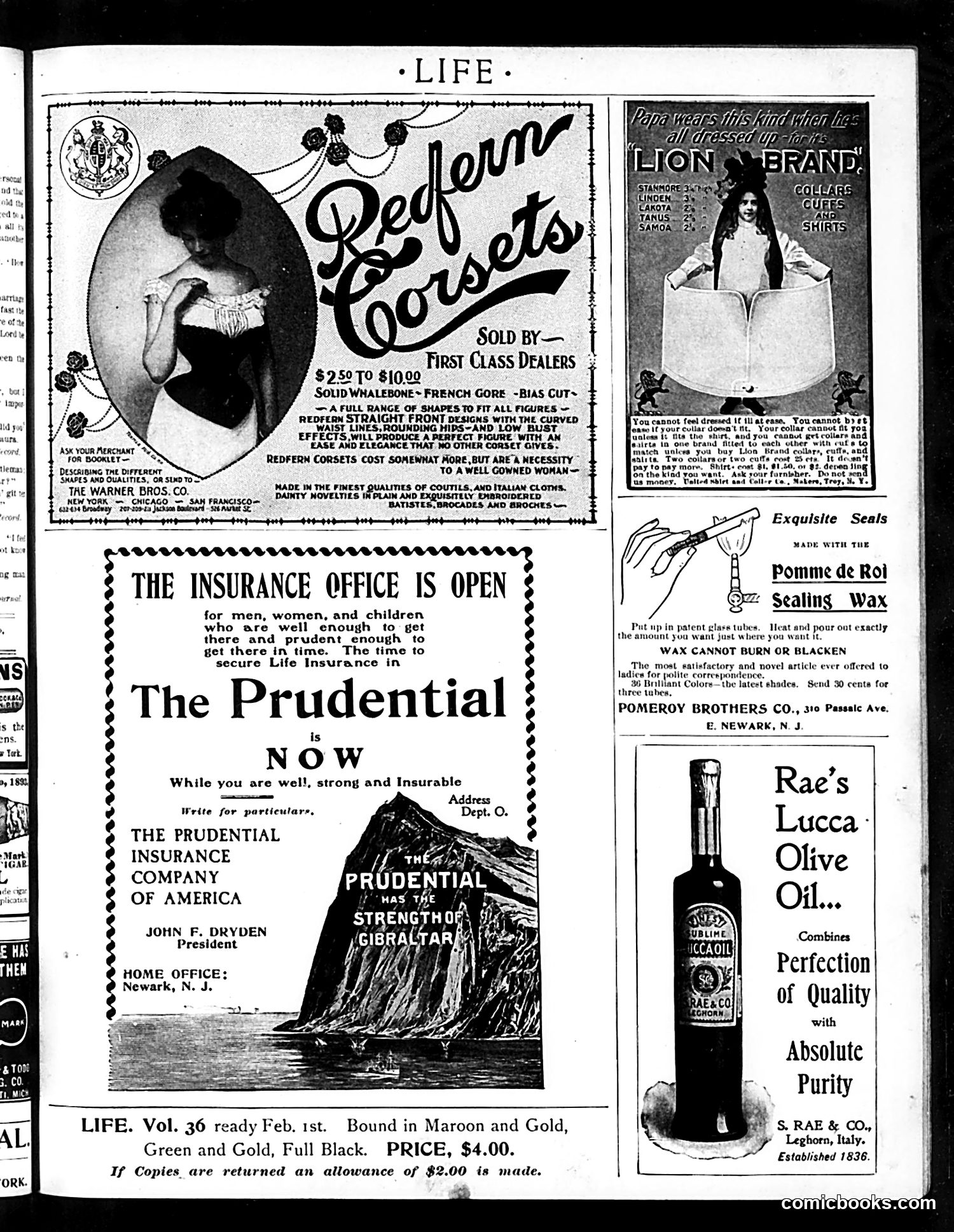
This page is primarily **advertising**, not political satire. It contains four distinct ads: 1. **Redfern Corsets** (top left): A corset advertisement emphasizing quality construction—whalebone, French gore, bias-cut design—to flatter "all figures" with "ease and elegance." Typical early-20th-century women's fashion marketing. 2. **Lion Brand Collars** (top right): Sells detachable collars and cuffs for men's shirts, highlighting durability and style. 3. **The Prudential Insurance** (center-left): An insurance company advertisement using the Rock of Gibraltar as a symbol of strength and security, urging readers to buy life insurance while healthy. 4. **Miscellaneous** (right side): Ads for sealing wax, olive oil, and other household products. The page footer indicates this is *Life* Vol. 36, priced at $4.00—a high-circulation publication from the early 1900s. There is no discernible political cartoon or satire on this particular page.
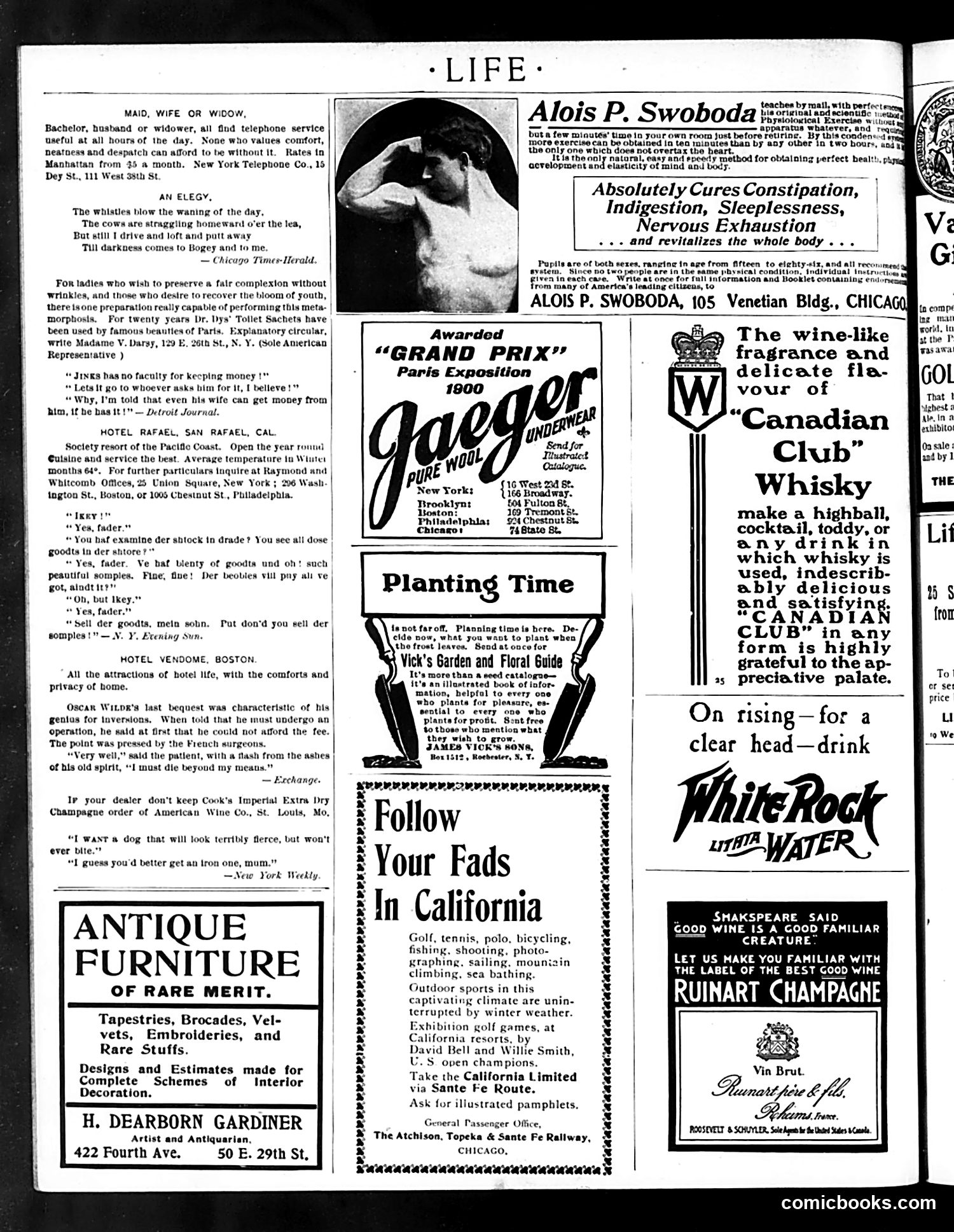
This page is primarily **advertising and light humor**, not political satire. The content includes: **Humor pieces**: Short jokes about absent-minded husbands losing money, a Yiddish-dialect dialogue about a merchant's son, and Oscar Wilde's quip about dying "beyond his means." **Advertisements**: For telephone service, beauty products, hotels, champagne, whiskey, furniture, and medicinal tonics—typical of early 1900s *Life* magazine. **Notable ad**: Alois P. Swoboda promotes a health treatment claiming to cure constipation, insomnia, and "nervous exhaustion" through unspecified methods—representative of the era's dubious patent medicine marketing. The page reflects **early 20th-century consumer culture** and humor conventions: mild ethnic stereotypes, financial jokes about marriage, and unregulated health claims. There is no significant political cartoon or social commentary visible.
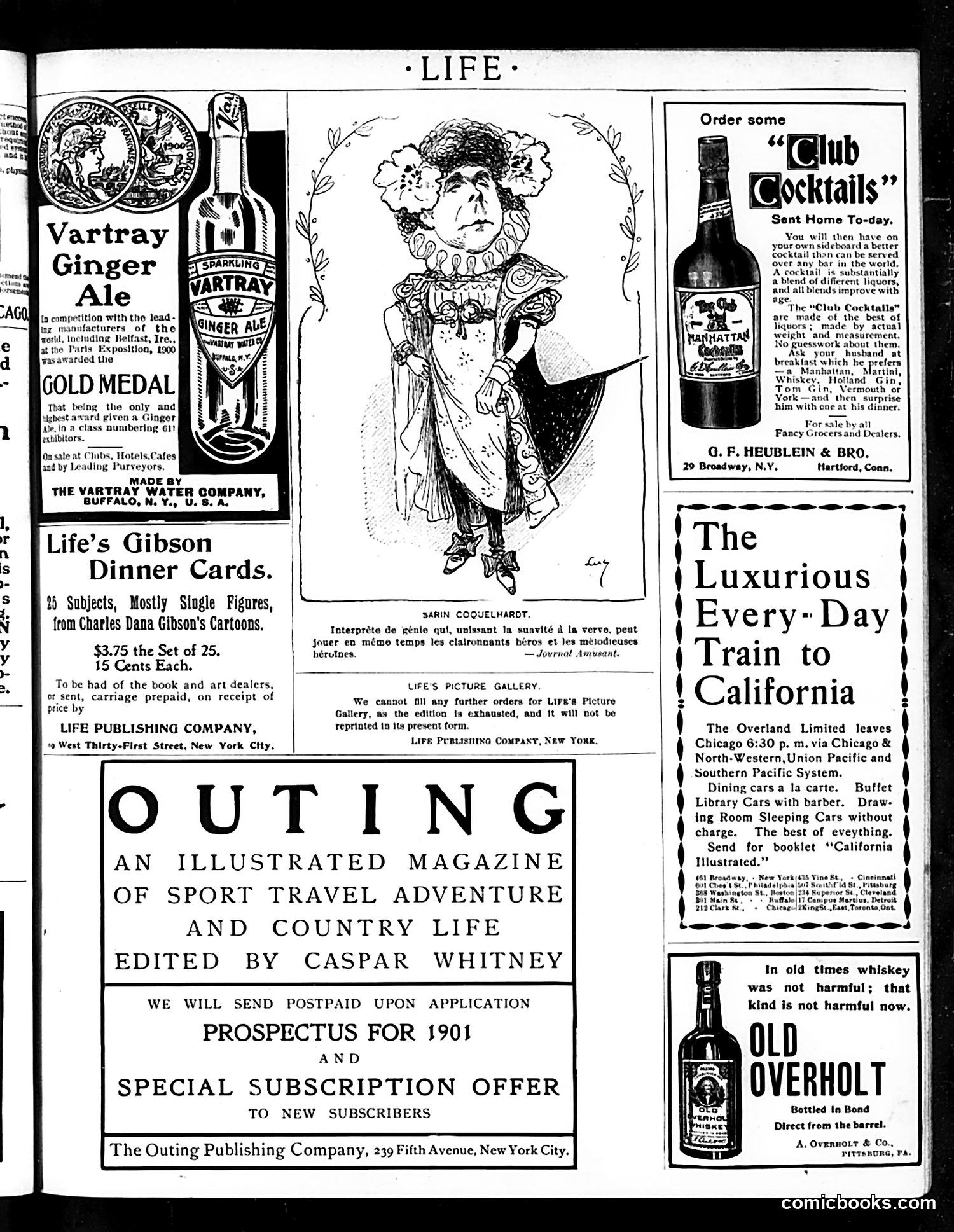
This is primarily an advertising and promotional page from *Life* magazine, with one satirical illustration at center. The main cartoon depicts a figure labeled "SARIN COQUELHARDT," rendered in exaggerated caricature with elaborate Renaissance costume and affected posture. The French caption translates roughly to mocking interpretation of a genius who unites suavity with verve, able to play both heroic roles and melodious heroines. This appears to be satire of pretentious European theatrical or artistic affectation—mocking someone (identity unclear to modern readers) who affects grandiose Continental sophistication. The page otherwise contains advertisements for Vartray Ginger Ale, Gibson dinner cards, Club Cocktails, the Overland Limited train to California, and Old Overholt whiskey, alongside promotional material for *Outing* magazine and *Life's* Picture Gallery. The satirical point: ridicule of artificial European posturing, a common *Life* magazine theme of the era.
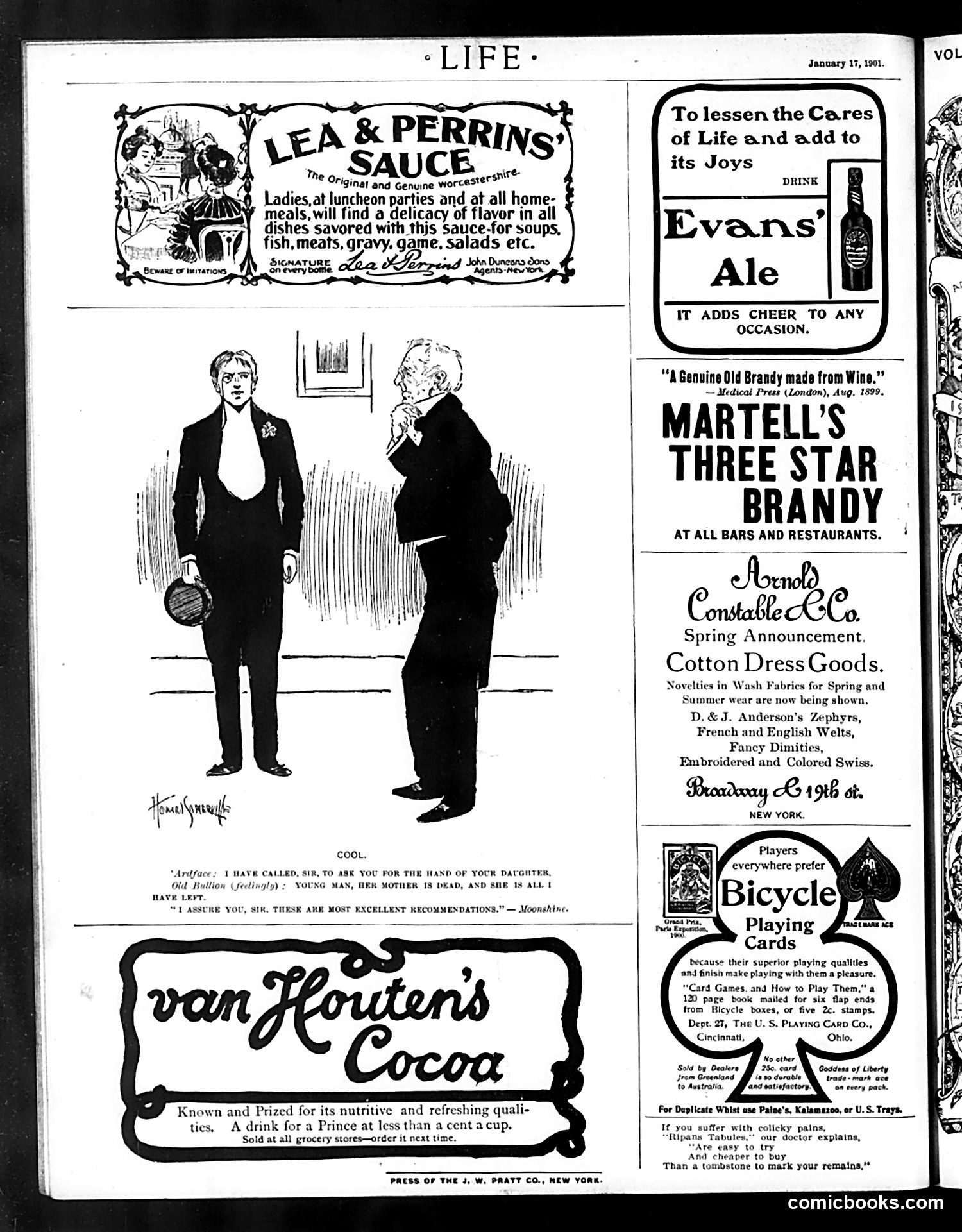
This page is primarily **advertisements** for consumer goods, with one cartoon. The cartoon ("COOL.") depicts two gentlemen in formal dress. The caption quotes a father responding to a suitor's request for his daughter's hand: the father says he's called to ask this—that the mother is dead and "she is all I have left," then adds "these are most excellent recommendations." **The satire:** This mocks the shallow materialism and poor priorities of courtship in Gilded Age society. The joke is that a suitor's "excellent recommendations" for marriage are financial/practical (the girl is the father's only remaining asset/heir) rather than based on love, character, or the daughter's own worth. It's dark humor about how women were treated as property transfers between men, and how economic desperation could masquerade as romantic interest. The surrounding ads (sauce, ale, brandy, fabric, cocoa, playing cards) represent typical turn-of-the-century consumer marketing aimed at middle and upper-class readers.