
Life, 1901-01-17 · page 5 of 20
Life — January 17, 1901 — page 5: what you’re looking at
What you’re looking at
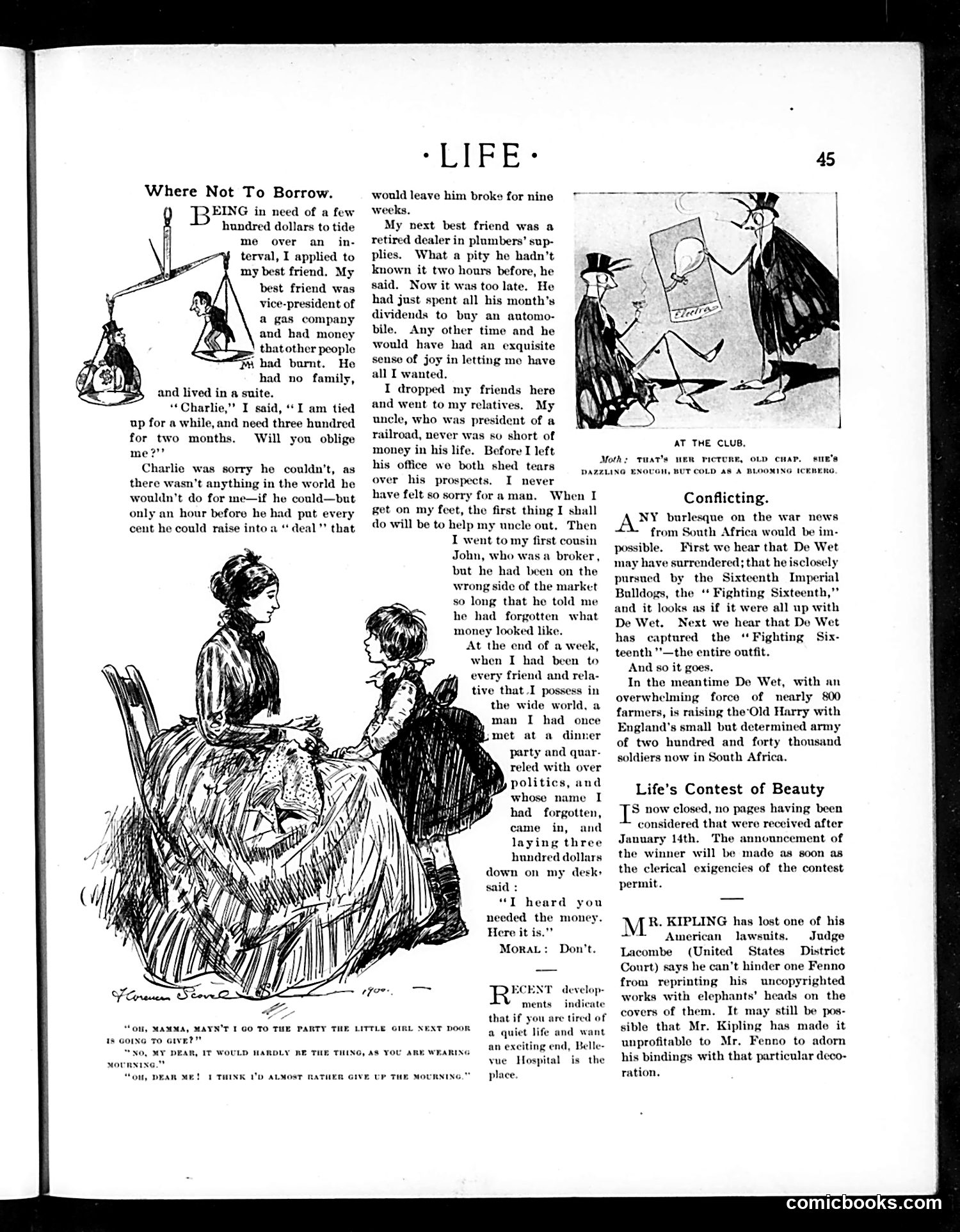
**Main Content: "Where Not To Borrow"** This is a satirical essay about borrowing money from friends. The author describes repeatedly asking different friends for loans—a gas company vice-president, a plumbers' supplies dealer, a railroad president, and a broker—each time with disappointing results. The central joke is that friends consistently refuse loans or can't help, leaving the narrator broke. The accompanying illustration shows a woman with a child, depicting the domestic consequence of financial desperation. The dialogue beneath emphasizes the social awkwardness: the woman won't attend a party without proper clothing, but the man considers giving up "mourning" (formal dress) rather than his morning routine. The satire targets both the foolishness of expecting loans from friends and the class-conscious social pressures of the era.
📄 Transcribed text from this page (OCR, searchable)
Machine-transcribed from the original scan — historical spelling and the odd misread are preserved.
Where Not To Borrow. EING in need of a few hundred dollars to tide me over an in- terval, I applied to my best friend. My best friend was vice-president of a gas company and had money thatother people 4 had burnt. He had no family, and lived in a suite. “Charlie,” I said, ‘I am tied up for a while, and need three hundred for two months. Will you oblige me?’ Charlie was sorry he couldn't, as there wasn’t anything in the world he wouldn’t do for me—if he could—but only an hour before he had put every cent he could raise into a “ deal’ that. afor “OU, MAMMA, MAYN'T 1 GO TO THE PARTY THE LITTLE OIRL NEXT DOOR 18 GOING TO Give?” “NO, MY DEAR, IT WOULD HARDLY RE THE THING, AS YOU ARE WEARING MourNixe.” “ou, DEAR ME! 1 THINK I'D ALMOST RATHER GIVE UP THE MOURNING.” ‘ LIPE* would leave him broke for nine weeks. My next best friend was a retired dealer in plumbers’ sup- plies. What a pity he hadn’t known it two hours before, he said. Now it was too late. He had just spent all his month’s dividends to buy an automo- bile. Any other time and he would have had an exquisite sense of joy in letting mo have all I wanted. I dropped my friends here and went to my relatives. My uncle, who was president of a railroad, never was sv short of money in his life. Before I left his office we both shed tears over his prospects. I never have felt so sorry fora man. When I get on my feet, the first thing I shall do will be to help my uncle out, Then I went to my first cousin John, who was a broker, but he had been on the wrong side of the market so long that he told me he had forgotten what money looked like. At the end of a week, when I had been to every friend and rela- LI tive that.1 possess in the wide world, a man I had once met at a dinner party and quar- reled with over politics, and whose name I had forgotten, came in, and laying three hundred dollars down on my desk: said : “T heard you money. MoraL: Don’t. develop- ments — indie that if are tired ¢ a quiet life and want an exciting end, Belle- yue Hospital is the place. DAZZLING ENOUGN, BUT COLD AS A AT THE CLUB, Moth; Tuat's MER PICTURE, OLD cHaP. #iE's ING ICEBERG Conflicting. ANY burlesque on the war news from South Africa would be im- possible. First we hear that De Wet may have surrendered; that he iscle pursned by the Sixteenth Imperial Bulldogs, the ‘‘ Fighting Sixteenth,” and it looks as if it were all up with De Wet. Next we hear that De Wet has captured the ‘Fighting Six- teenth "'—the entire outfit. And so it goes. In the meantime De Wet, with an overwhelming force of nearly 800 farmers, is raising the‘Old Harry with England's small but determined army of two hundred and forty thousand soldiers now in South Africa. Life’s Contest of Beauty S now closed, no pages having been considered that were received after January 14th, The announcement of the winner will be made as soon as the clerical exigencies of the contest permit. WM R. KIPLING has lost one of his + American lawsuits. Judge Lacombe (United States District Court) says he can't hinder one Fenno from reprinting his uncopyrighted works with elephants’ heads on the covers of them. It may still be pos- sible that Mr. Kipling has made it unprofitable to Mr. Fenno to adorn his bindings with that particular deco- ration. comicbooks.com