
Life, 1901-01-17 · page 7 of 20
Life — January 17, 1901 — page 7: what you’re looking at
What you’re looking at
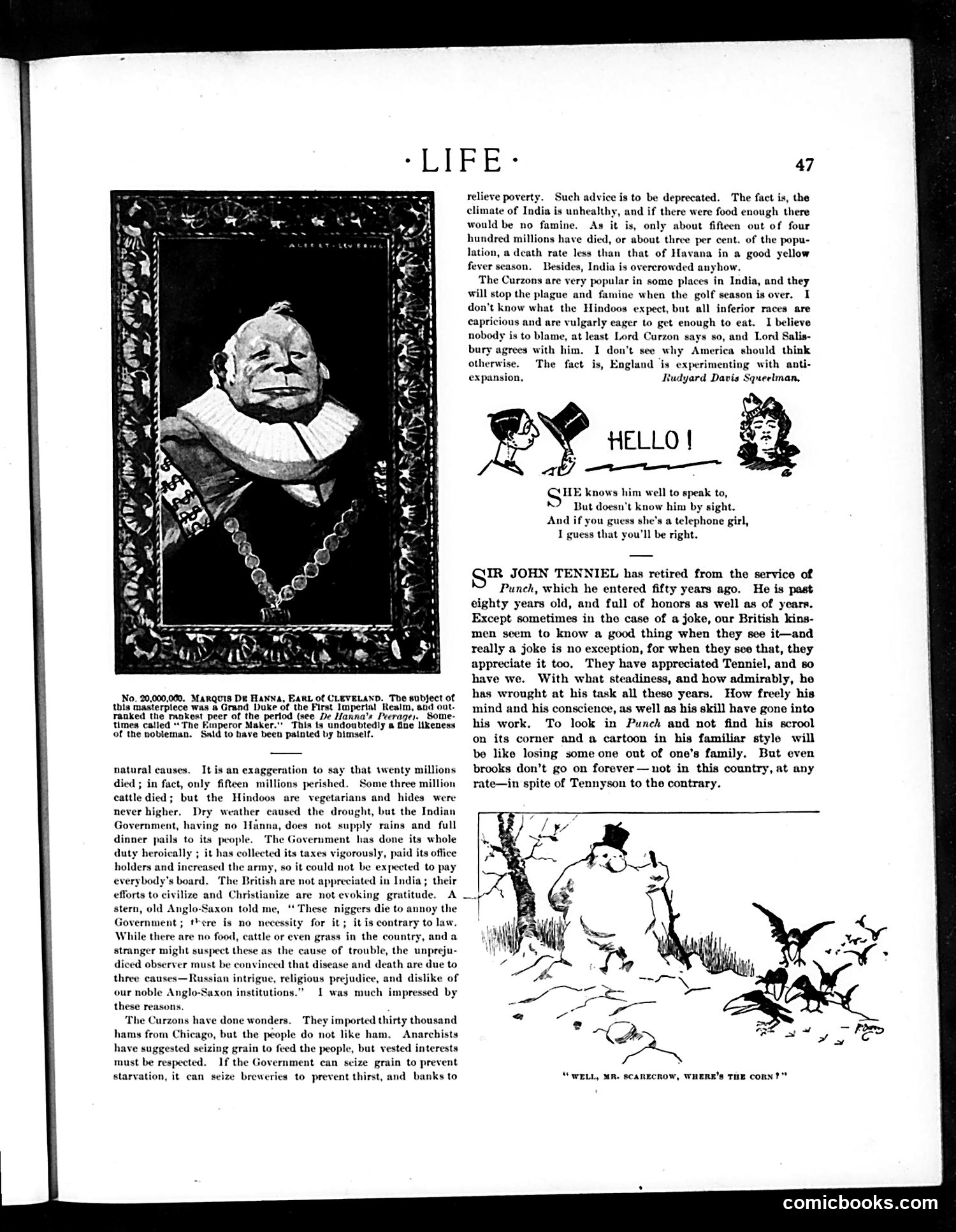
**Portrait (left):** A historical figure in elaborate Renaissance dress with ornate collar and chain. The caption indicates this is a "Grand Duke of the First Imperial Realm" painted by someone named Velasquez—likely a Old Master artwork being reproduced. **"Hello!" Cartoon (top right):** A brief joke about someone who "knows him well" but "doesn't know him by sight" and might recognize him as a telephone caller. This is a mild pun on recognizing voice versus appearance. **Sir John Tenniel Article (main text):** Discusses the retirement of Tenniel, who worked fifty years for *Punch* magazine. The text celebrates his career and influence on British humor and art. **Bottom Cartoon:** Shows a scarecrow in a field with a farmer asking "Well, Mr. Scarecrow, where's the corn?"—a straightforward visual gag about a scarecrow's failure at its job. The page mixes art history, biographical tribute, and light humor typical of *Life's* format.
📄 Transcribed text from this page (OCR, searchable)
Machine-transcribed from the original scan — historical spelling and the odd misread are preserved.
-LIPE* aS = te AT my Bt e = “A Be ror > mod & 6 i.e No. 20,000,000. MARQUIS De HANNA, EARL of CLEVELAND. The subject of this masterplece was a Grand Duke of the First Imperial Realm, and out- ranked the rankest peer of the period (see De Hanna's Peerage). Some- times called “The Einperor Maker." This ts undoubtedly a fue likeness of the nobleman, Sald to have been painted by himself. natural cau: It is an exaggeration to say that wwenty millions died ; in fact, only fifteen millions perished. Some three million cattle died; but the Hindoos are vegetarians and hides were never higher. Dry weather caused the drought, but the Indian Government, having no Hanna, does not supply rains and full dinner pails to its people. The Government has done its whole duty heroically ; it has collected its taxes vigorously, paid its office holders and increased the army, so it could not be expected to pay everybody's board. ‘The British are not appreciated in India; their efforts to civilize and Christianize are not evokit stern, old Anglo-Saxon told me, “These niggers die to annoy the Government; tere is no necessity for it; itis contrary to law. While there are no food, cattle or even grass in the country, and a stranger might suspect these as the cause of trouble, the unpreju- diced observer must be convinced that disease and death are due to three causes—Russian intrigue, religious prejudice, and dislike of our noble Anglo-Saxon institutions.” 1 was much impressed by these reasons, The Curzons have done wonders. They imported thirty thousand hams from Ch , but the people do not like ham. Anarchists have suggested seizing grain to feed the people, but vested interests must be respected. If the Government can seize grain to prevent starvation, it can seize breweries to prevent thirst, and bar gy gratitude. A _ 47 relieve poverty. Such advice is to be deprecated. ‘The fact is, the climate of India is unhealthy, and if there were food enough there would be no famine. As it is, only about fifteen out of four hundred millions have died, or about three per cent. of the popu- lation, a death rate less than that of Havana in a good yellow fever season. Besides, India is overcrowded anyhow. ‘The Curzons are very popular in some places in India, and they will stop the plague and famine when the golf season is over. I don’t know what the Hindoos expect, but all inferior races are capricious and are vulgarly eager to get enough to eat. I believe nobody is to blame, at least Lord Curzon says so, and Lord Salis- bury agrees with him. I don’t see why America should think otherwise. The fact is, England is experimenting with anti- expansion. Rudyard Davis Squeelman. HELLO ! et oe el Tm HE knows him well to speak to, But doesn’t know him by sight. And if you guess she’s a telephone girl, I guess that you'll be right. Kn IR JOHN TENNIEL has retired from the service of Punch, which he entered fifty years ago. He is past eighty years old, and full of honors as well as of years. Except sometimes in the case of a joke, our British kins- men seem to know a good thing when they see it—and really a joke is no exception, for when they see that, they appreciate it too. They have appreciated Tenniel, and so have we. With what steadiness, and how admirably, ho has wrought at his task all these years. How freely his mind and his conscience, as well as his skill have gone into his work. To look in Punch and not find his scrool on its corner and a cartoon in his familiar style will be like losing some one out of one’s family. But even brooks don’t go on forever — not in this country, at any rate—in spite of Tennyson to the contrary. “WELL, MR. SCARECROW, WHERE'S THE CORN?” comicbooks.com