
Life, 1901-01-17 · page 4 of 20
Life — January 17, 1901 — page 4: what you’re looking at
What you’re looking at
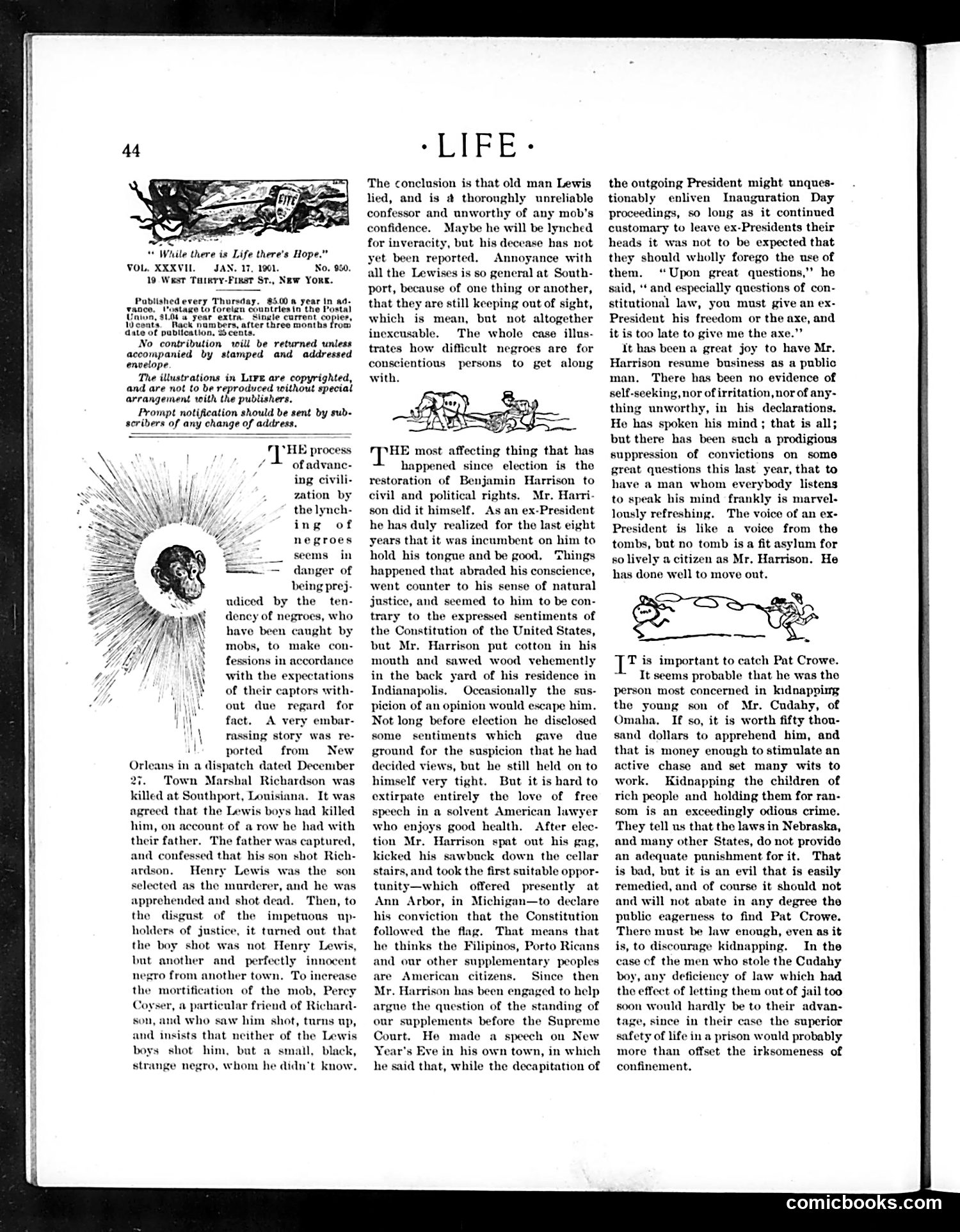
This page discusses Benjamin Harrison's restoration to "civil and political rights" after his presidency, using the lynching of an innocent Black man named Henry Lewis as a dark counterpoint. The text critiques Harrison's inconsistency: as ex-President, he advocated constitutional protections for supplementary peoples (likely referring to Filipino sovereignty), yet remained silent on American racial violence. The central illustration depicts a Black man's face radiating light—likely symbolizing innocence or moral clarity. The satire suggests Harrison's concern for distant colonial subjects rang hollow given his indifference to domestic racial murder. This juxtaposes his "freedom" as a private citizen against the fatal absence of freedom for Black Americans facing mob violence.
📄 Transcribed text from this page (OCR, searchable)
Machine-transcribed from the original scan — historical spelling and the odd misread are preserved.
SSE ee “ While here is Life there's Hope.” VOL. XXXVIL. JAN. 17, 1901. No, 19 West Tarrry-Fixst St., New Yorn. Pablished every Thursday. 85.00 a year in ad. vance. lostage to foreign countries in the Postal Union, $1.04 4 year extra. Single current copier, \Weonts. “Rack nambers, after three months from date of publication, % cents. No contribution will be returned unless accompanied by stamped and addressed envelope. The illustrations in Lure are copyrighted, and are not to be reproduced without special arrangement with the publishers. Prompt notification should be sent by sub- scribers of any change of address. ~TP*HE process zation by the lynch- ing of negroes seems in danger of being prej- udiced by the ten- dency of negroes, who have been caught by mobs, to make con- fessions in accordance with the expectations of their captors with- out due regard for fact. A very embar- rassing story was re- ported from New Orleans in a dispatch dated December 27. Town Marshal Richardson was killed at Southport, Louisiana. It was agreed that the Lewis boys had killed him, on account of a row he had with their father. The father was captured, and confessed that his son shot Rich- dson. Henry Lewis was the son selected as the murderer, and he was apprehended and shot dead. Then, to the disgust of the impetuous up- holders of justice, it turned out that the boy shot was not Henry Lewis, but another and perfectly innocent negro from another town. To increase the mortification of the mob, Percy Coyser, a particular friend of Richard- son, and who saw him shot, turns up, and insists that neither of the Lewis boys shot him, but a small, black, strange negro, whom he didn't know. ~LIFE - The conclusion is that old man Lewis lied, and is @ thoroughly unreliable confessor and anworthy of any mob’s confidence. Maybe he will be lynched for inveracity, but his decease has not yet been reported. Annoyance with all the Lewises is so general at South- port, because of one thing or another, that they are still keeping out of sight, which is mean, but not altogether inexcusable. The whole case illus- trates how difficult negroes are for conscientious persons to get along THE most affecting thing that has happened since election is the restoration of Benjamin Harrison to civil and political rights. Mr. Harri- son did it himself, As an ex-President he has duly realized for the last eight years that it was incumbent on him to hold his tongue and be good. Things happened that abraded his conscience, went counter to his sense of natural justice, and seemed to him to be con- trary to the expressed sentiments of the Constitution of the United States, but Mr. Harrison put cotton in his mouth and sawed wood vehemently in the back yard of his residence in Indianapolis. Occasionally the sus- picion of an opinion would escape him. Not long before election he disclosed some sentiments which gave due ground for the suspicion that he had decided views, but he still held on to himself very tight. But it is hard to extirpate entirely the love of free speech in a solvent American lawyer who enjoys good health. After elec- tion Mr. Harrison spat out his gag, kicked his sawbuck down the cellar stairs, and took the first suitable oppor- Which offered presently at ‘bor, in Michigan—to declare his conviction that the Constitution followed the flag. That means that he thinks the Filipinos, Porto Ricans and our other supplementary peoples are American citizens. Since then Mr. Harrison has been engaged to help argue the question of the standing of our supplements before the Supreme Court. He made a speech on New Year's Eve in his own town, in which he said that, while the decapitation of the outgoing President might unques- tionably enliven Inauguration Day proceedings, so long as it continued customary to leave ex-Presidents their heads it was not to be expected that they should wholly forego the use of them. ‘Upon great questions,’’ he said, ‘ and especially questions of con- stitutional law, you must give an ex- President his freedom or the axe, and it is too late to give me the axe.”” It has been a great joy to have Mr. Harrison resume business as a public man. There has been no evidence of self-seeking, nor of irritation, nor of any- thing unworthy, in his declarations. He has spoken his mind ; that is all; but there has been such a prodigious suppression of convictions on some great questions this last year, that to have a man whom everybody listens to speak his mind frankly is marvel- lously refreshing. The voice of an ex- President is like a voice from the tombs, but no tomb is a fit asylum for so lively a citizen as Mr, Harrison. He has done well to move out. It is important to catch Pat Crowe. It seems probable that he was the person most concerned in kidnappimg the young son of Mr. Cudahy, of Omaha, If so, it is worth fifty thou- sand dollars to apprehend him, and that is money enough to stimulate an active chase and set many wits to work, Kidnapping the children of rich people and holding them for ran- som is an exceedingly odious crime. They tell us that the laws in Nebraska, and many other States, do not provide an adequate punishment for it. That is bad, but it is an evil that is easily remedied, and of course it should not and will not abate in any degree the public eagerness to find Pat Crowe. There must be law enough, even as it is, to discourage kidnapping. In the case cf the men who stole the Cudahy boy, any deficiency of law which had the effect of letting them out of jail too soon would hardly be to their advan- tage, since in their case the superior safety of life in a prison would probably more than offset the irksomeness of confinement. comicbooks.com