
Life, 1901-01-17 · page 12 of 20
Life — January 17, 1901 — page 12: what you’re looking at
What you’re looking at
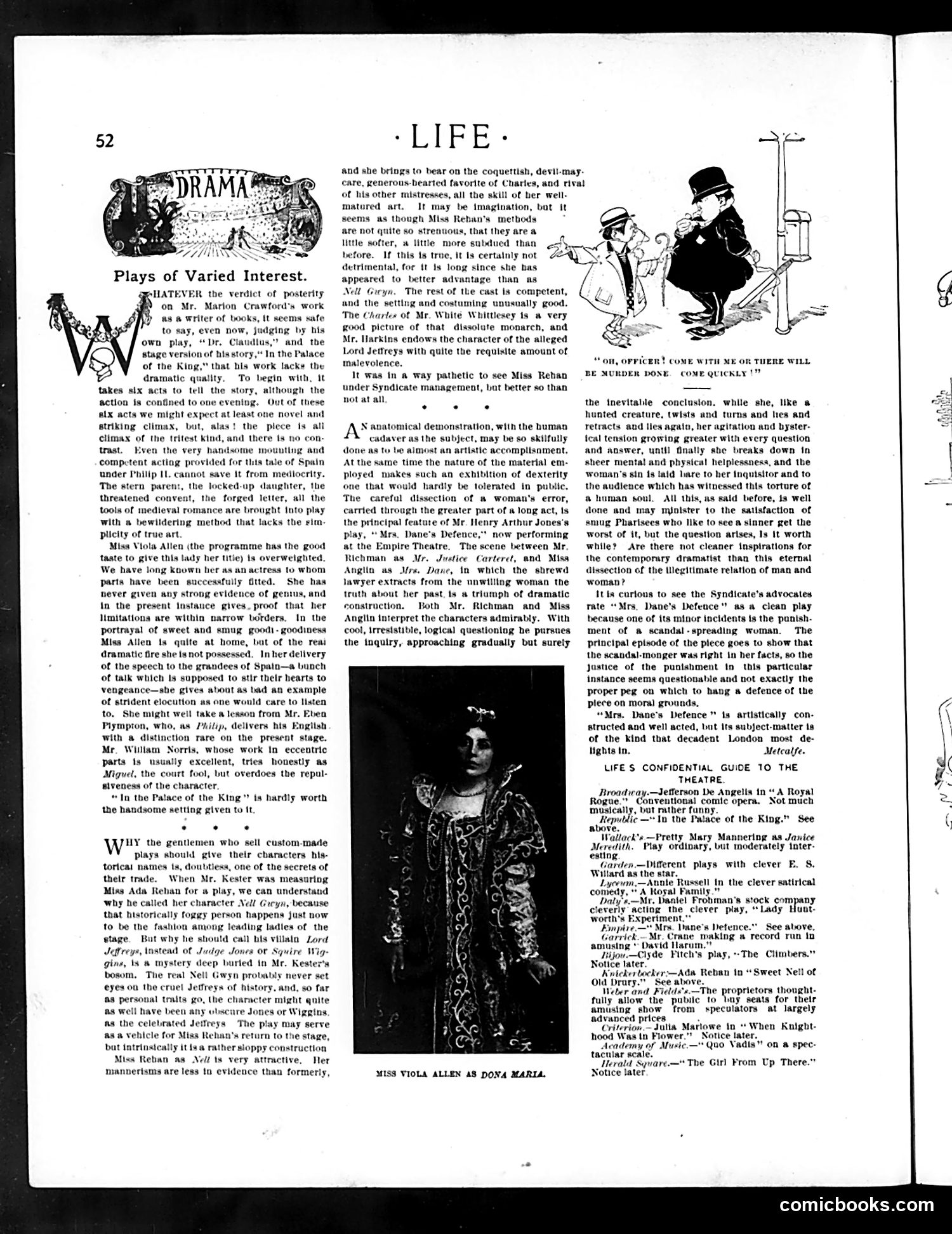
This page contains theatrical drama criticism rather than political cartoons. The main illustration shows **Miss Viola Allen as Doña Maria**, a character from a play being reviewed. The text discusses several theatrical productions, including works by Shakespeare and contemporary playwrights. The critic praises Miss Rehan's acting ability while critiquing the construction of certain plays. There's particular discussion of *Nell Gwyn* and *The Charles of Mr White Thackeray*. The page also includes "Life's Confidential Guide to the Theatre"—a listing of Broadway productions with brief commentary on their merits and performers. This appears to be standard theater criticism and entertainment coverage from an early 20th-century American magazine, not political satire. The satirical humor, if present, relates to theatrical quality rather than political content.
📄 Transcribed text from this page (OCR, searchable)
Machine-transcribed from the original scan — historical spelling and the odd misread are preserved.
Plays of Varied Interest. HATEVER the verdict of posterity on Mr. Marion Crawford's work } asa writer of books, It seems safe to say, even now, judging by bis own play, “Dr. Claudius,” and the stage version of his story," In the Palace of the King,” that his work lacks the dramatic quality, To begin with, tt takes six acts to tell the story, although the Action is confined to one evening. Out of these alx acts we might expect at least one novel and striking climax, but, alas! the plece is all climax of the tritest kind, and there ts no con- trast. Even the very handsome mouuting and competent acting provided for thts tale of Spain under Philip Il. cannot save tt from mediocrity. The stern parent, the locked-up daughter, the threatened convent, the forged letter, all the tools of medieval romance are brought {nto play with @ bewildering method that lacks the sim. plicity of true art. Miss Viola Allen (the programme has the good taste to give this lady her titie) ts overweighted We have long known ber as an actress to whom parts have been successfully fitted. She has hever given any strong evidence of gentus, and in the present Instance gives. proof that her Imitattons are within narrow borders. In the portrayal of sweet and smug goodt- goodiness Miss Allen ix qalte at home, bat of the reai dramatic fire she Is not possessed. Inher delivery of the speech to the grandees of Spain—a bunch of talk which 1s supposed to stir their hearts to vengeance—she gives about as bad an example of strident elocution as one would care to listen to. She might weil take a lesson from Mr. Ebea Plympton, who, as Philip, delivers his Engitsh with @ distinction rare on the present stage. Mr, Wiillam Norris, whose work In eccentric parts is usually excellent, tries honestly as Miguel, the court fool, but overdoes the repul- siveness of the character. “In the Patace of the King"? ts hardly worth the handsome setting given to It . 8 6 V HY the gentlemen who sell custom-made plays should give their characters his- torica! names ts, doubtless, one of the secrets of thelr trade. When Mr. Kester was measuring Mins Ada Rehan for # play, we can understand why he called her character Vell Grryn, because that historically foggy person happens just now to be the fashion among leading ladies of the étage. But why he should call bis villain Lord Jeffreys tnstend of Judge Jones oF Squire Wig- gins, Is ® mystery deep buried in Mr. Kester's bosom. The real Nell Gwyn probably never set eyes ou the cruel Jetfreys of history, and, so far 8 personal trults go, the character might quite as well have been any obscure Jones or Wiggins. ‘Ag the celebrated Jeifress The play may serve as a vehicle for Miss Rehan’s return to the stage, but intrinsically it 14a rather sloppy construction Miss Reban as Avi ts very attractive, Mer mannerisms are less tn evidence than forme! * LIFE « of his other mistresses, all the skill of ber well- matured art, It may be tmagination, but It seems as though Miss Rehan’s methods * are not quite so strenuous, that they are a little softer, a little more subdued than re. If this ts true, it Is certainly not detrimental, for it Is long since she bas Appeared to better advantage than as Nell Gicyn. The rest of the cast is competent, and the setting and costuming unusually good. ‘The Charles of Mr. White Whittlesey 1s a very good picture of that dissolute monarch, and Mr. Harkins endows the character of the alleged Lord Jeffreys with quite the requisite amount of malevolence, It was In a way pathetic to see Miss Reban under Syndicate management, bat better so than not at all. . . . N anatomical demonstration, with the human cadaver as the subject, may be so skilfully done as to be almost an artiatic accomplisnment, At the same time the nature of the material em- ployed makes such an exhibition of dexterity one that would hardly be tolerated in pubite. The careful dissection of a woman's error, carried throagh the greater part of a long act, 1s he principal feature of Mr. Henry Arthur Jones's play, “Mrs, Dane's Defence,” now performing at the Empire Theatre, The scene between Mr, Richman as Mr. Justice Carteret, and Misa Anglin as Mre. Dane, in which the shrewd lawyer extracts from the unwilling woman the truth about her past, 1s a triumph of dramatic construction. Both Mr. Richman and Miss Anglin interpret the characters admirably. With cool, Irresistible, logical questioning be pursues the inquiry, approaching gradually but surely MISS VIOLA ALLEN 48 DONA MARIA. and she brings to bear on the coquettish, devil-may- care, generous-bearted favorite of Charles, and rival “on, opricen? Come WITH ME Of THERE WILL BE MURDER DONE. come QUICKLY!” the tnevitalle conclusion, while she, ike @ hunted creature, twists and turns and les and retracts and Iles again, her agitation and byster- {cal tension growing greater with every question and answer, untill finally she breaks down in sheer mental and physical helplessness, and the woman’s sin 18 tald bare to her inqutsitor and to the audience which has witnessed this torture of & human soul. All this, as sald before, is well done and may myolster to the satisfaction of smug Pharisees who Ilke to see a sinner get the worst of it, but the question arises, Is 1t worth while? Are there not cleaner inspirations for the contemporary dramatist than this eternal dissection of the illegitimate relation of man and woman? Itt curtous to see the Syndicate's advocates rate “Mrs, Dane's Defence” as a clean play because one of its minor incidents ts the pantsh- ment of @ scandal-spreading woman. The Principal eptsode of the plece goes to show that the scandal-monger was right in her facts, 0 the Justice of the punishment In this particalar instance seems questionable and not exactly the proper peg on which to hang a defence of the plece on moral grounds, Mra. Dane's Defence" 1s artistically con- structed and well acted, but Its subject-matter 1a of the kind that decadent London most de- lights in, Metcalfe. LIFE S CONFIDENTIAL GUIDE 10 THE THEATRE, Broadway.—Jetferson De Angelis in “A Royal Rogue. Conventional comic opera, Not much musically, but rather funny. Republic —" In the Palace of the King.” See above. Wallack's —Pretty Mary Mannering as Janice Meredith. Play ordinary, but moderately inter: esting. Garden.—Ditferent plays with clever E. 8. Wiltard as the star. Lycerm.—Aunte Russell in the clever satirical comedy, “A Royal Family.” Daly ¢.—Mr. Dantel Frohman’s stock company cleverly acting the clever play, “Lady Hunt- worth’s Experiment.” Empire.—* Mrs. ane’s Netence." See above, Garrick. Mr. Crane taking # record ran to amusing © David Haram.” Hijou.—Ciyde Fitch's’ plas, “The Climbers." Notice tater. . Koickertocker:—Ada Reban tn “Sweet Nell of Old Drury.” See above. Weber and Fields's—The proprietors thought: fully allow the pubilc to buy seats for thelr amusing show from xpeculators at largely advanced prices 5 . Criferion.— Julia Marlowe in“ When Knight- hood Was tn Flower.” Notice later. ‘ademy of Music.—" Quo Vadis" on a spec- tactiar scale. . Herald Sqvare.—* The Girl From Up There.” Notice later comicbooks.com