
Life, 1901-01-17 · page 6 of 20
Life — January 17, 1901 — page 6: what you’re looking at
What you’re looking at
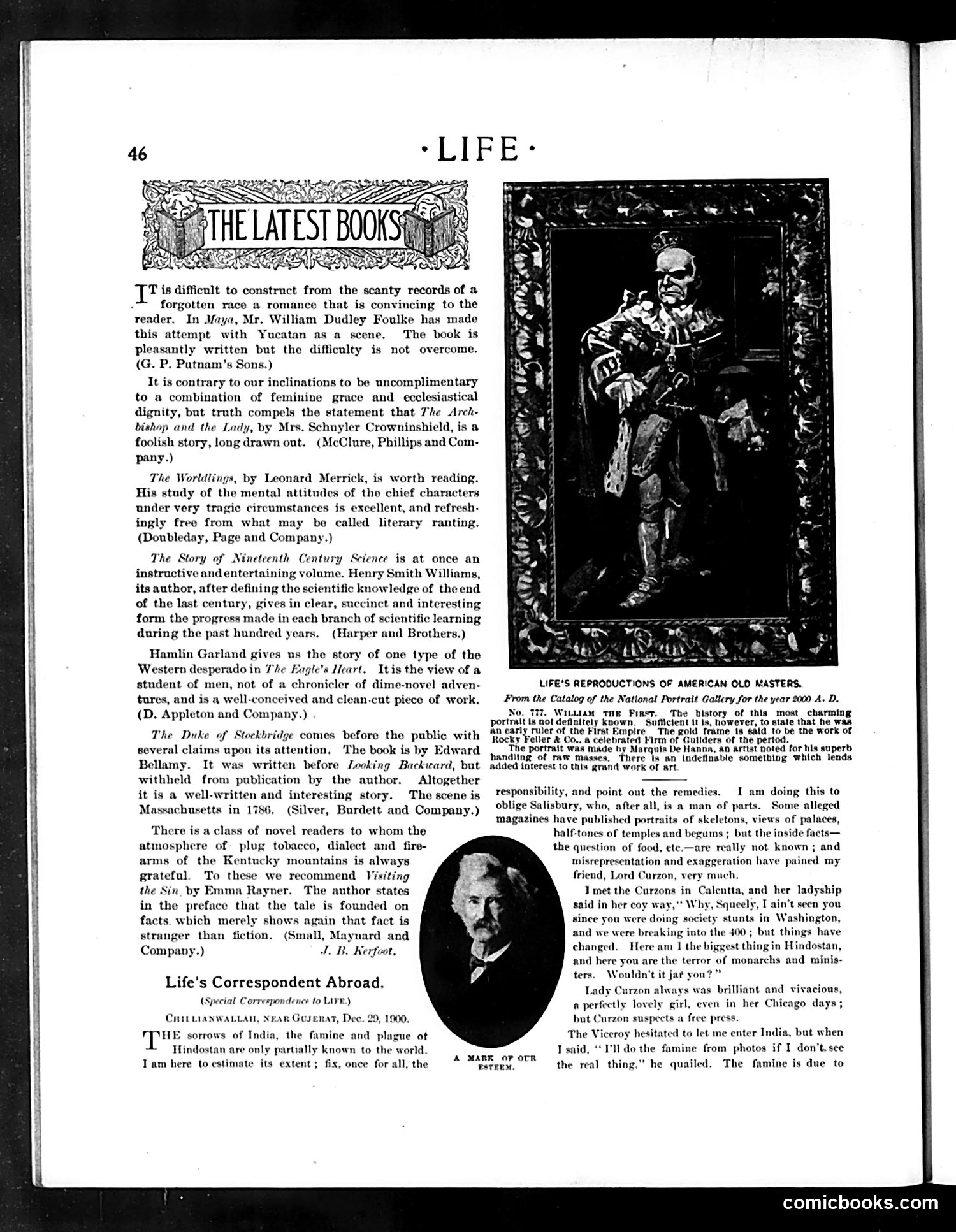
This page contains **book reviews** under "The Latest Books" header, not political cartoons. The two images are: 1. **Upper right**: An illustration titled "Life's Reproductions of American Old Masters" - appears to be a portrait of a figure in ornate period clothing, likely meant to evoke classical or historical artistic styles. 2. **Lower left**: A photographic portrait labeled "A Mark of Our Esteem" accompanying a section titled "Life's Correspondent Abroad," featuring a dispatch from Chitianswalah, near Gujerat (Dec. 23, 1900) about Indian famine conditions. The page primarily discusses literary works rather than containing satire. The "Old Masters" reference suggests Life was satirizing American art pretensions by showcasing classical portraiture styles.
📄 Transcribed text from this page (OCR, searchable)
Machine-transcribed from the original scan — historical spelling and the odd misread are preserved.
qT" is difficult to construct from the scanty records of a + forgotten race a romance that is convincing to the reader. In Maya, Mr. William Dudley Foulke has made this attempt with Yucatan as a scene. The book is pleasantly written but the difficulty is not overcome. (G. P. Putnam’s Sons.) It is contrary to our inclinations to be uncomplimentary to a combination of feminine grace and ecclesiastical dignity, but truth compels the statement that The <Arch- bishop and the Lady, by Mrs. Schuyler Crowninshield, is a foolish story, long drawn out. (McClure, Phillips and Com- pany.) The Worldlings, by Leonard Merrick, is worth reading. His study of the mental attitudes of the chief characters under very tragic circumstances is excellent, and refresh- ingly free from what may be called literary ranting. (Doubleday, Page and Company.) The Story of Nineteenth Century Science is at once an instractive andentertaining volume. Henry Smith Williams, its author, after defining the scientific knowledge of the end of the last century, gives in clear, succinct and interesting form the progress made in each branch of scientific learning during the past hundred years. (Harper and Brothers.) Hamlin Garland gives us the story of one type of the Western desperadoin The Eagle's Heart. Itis the view of a student of men, not of a chronicler of dime-novel adven- tures, and is a well-conceived and clean-cut piece of work. (D. Appleton and Company.) The Duke of Stockbridge comes before the public with several claims upon its attention, The book is by Edward Bellamy. It was written before Looking Backward, but withheld from publication by the author. Altogether it is a well-written and interesting story. The scene is Massachusetts in 1786, (Silver, Burdett and Company.) There is a class of novel readers to whom the atmosphere of plug tobacco, dialect and fire- arms of the Kentucky mountains is always grateful. To these we recommend Visiting the Sin. by Emma Rayner. The author states in the preface that the tale is founded on facts. which merely shows again that fact is stranger than fiction. (Small, Maynard and Company.) J.B. Kerfoot. Life’s Correspondent Abroad. (Special Correspondence to Live.) CHITLIANWALLATL, NEAR Gusenat, Dec. 29, 1900. HE sorrows of India, the famine and plague ot Hindostan are only part Tam here to estimate its exten y known to the world fix, once for all, the rere ¢ J, REE =a We. LIFE'S REPRODUCTIONS OF AMERICAN OLD MASTERS. From the Catalog of the National Portrait Galtery for the year 2000 A. D. No. 777. Witttam THe First. The bistory of this most charming portrait is not deflaitely known. Sufficient tt ts, however, to state that he was an early ruler of the First Empire The gold frame ts sald to be the work of Rocky Feller & Co.. a celebrated Firm of Gullders of the period. The portrait was made by Marquis De Hanna, an artist noted for his superb bandiing of raw masses. There Is an indeflnable something which lends added interest to this grand work of art responsibility, and point out the remedies. I am doing this to oblige Salisbury, who, after all, is a man of parts. Some alleged magazines have published portraits of skeletons, views of palaces, half-tones of temples and begums ; but the inside facts— the question of food, ete.—are really not known ; and misrepresentation and exaggeration have pained my friend, Lord Curzon, very much. Imet the Curzons in Calcutta, and her ladyship said in her coy way,'' Why, Squeely, [ain't seen you since you were doing society stunts in Washington, and we were breaking into the 400 ; but things have changed. Here am I the biggest thing in Hindostan, and here you are the terror of monarchs and minis- ters. Wouldn't it jat you?” Lady Curzon always was brilliant and vivacio a perfectly lovely girl, even in her Chicago days; but Curzon suspects a free press. The Viceroy hesitated to let me enter India, but when Tsaid, “I'll do the famine from photos if I don’t. see the real thing,” he quailed. A MARK oF ocr ESTEEM. The famine is due to comicbooks.com