
A complete issue · 20 pages · 1900
Life — December 6, 1900
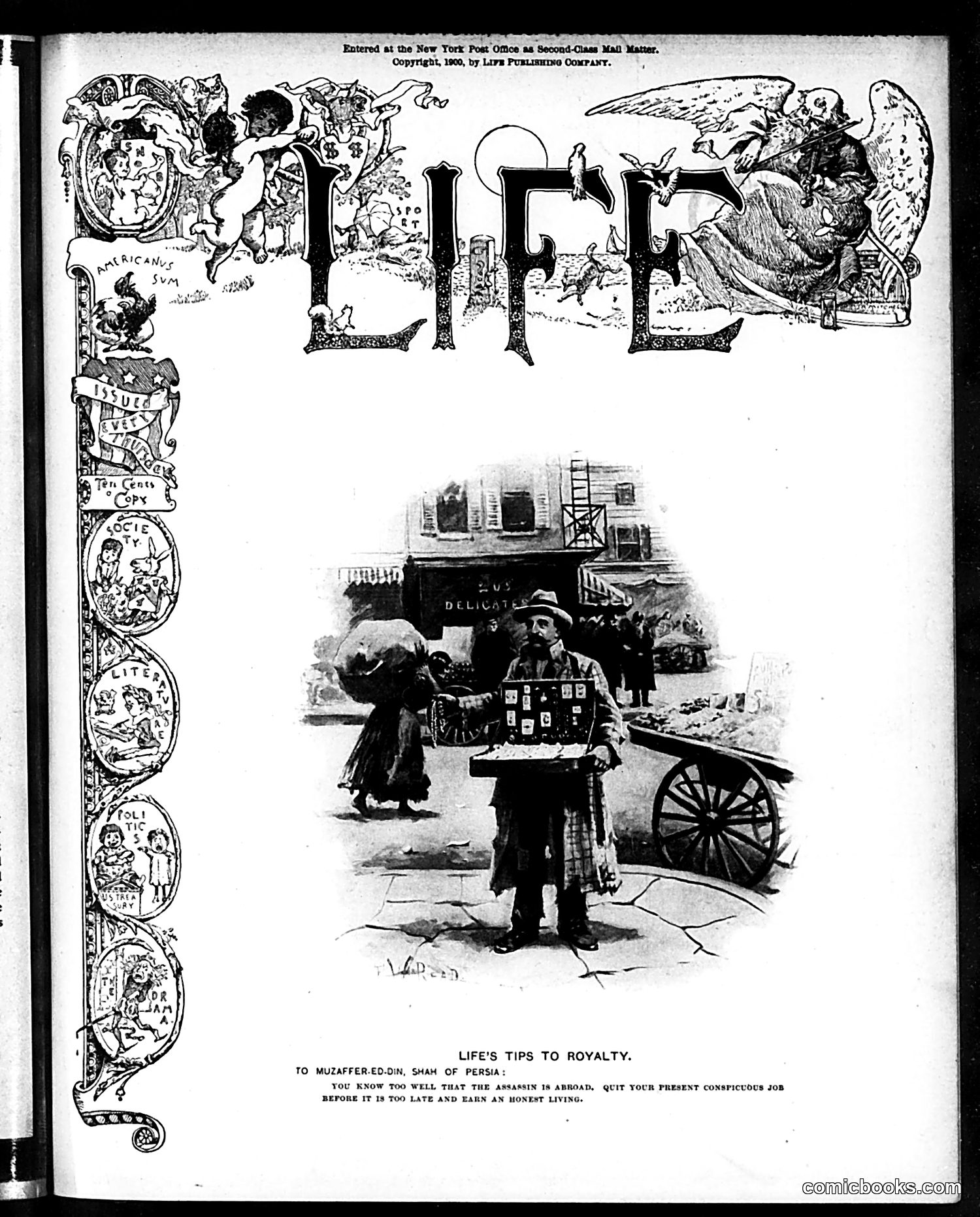
This page presents a satirical cartoon titled "Life's Tips to Royalty," specifically addressing Muzaffer-ed-Din, Shah of Persia. The central illustration depicts a street vendor or peddler selling what appears to be toy buildings or model structures to a child, likely representing the Shah. The accompanying text warns: "You know too well that the assassin is abroad. Quit your present conscious job before it is too late and earn an honest living." The satire suggests the Shah should abandon his royal position due to assassination threats—implying his rule is so unstable or unpopular that death is imminent. By proposing he become a street vendor, the magazine mocks both the Shah's precarious political situation and the fundamental instability of Persian governance during this period.
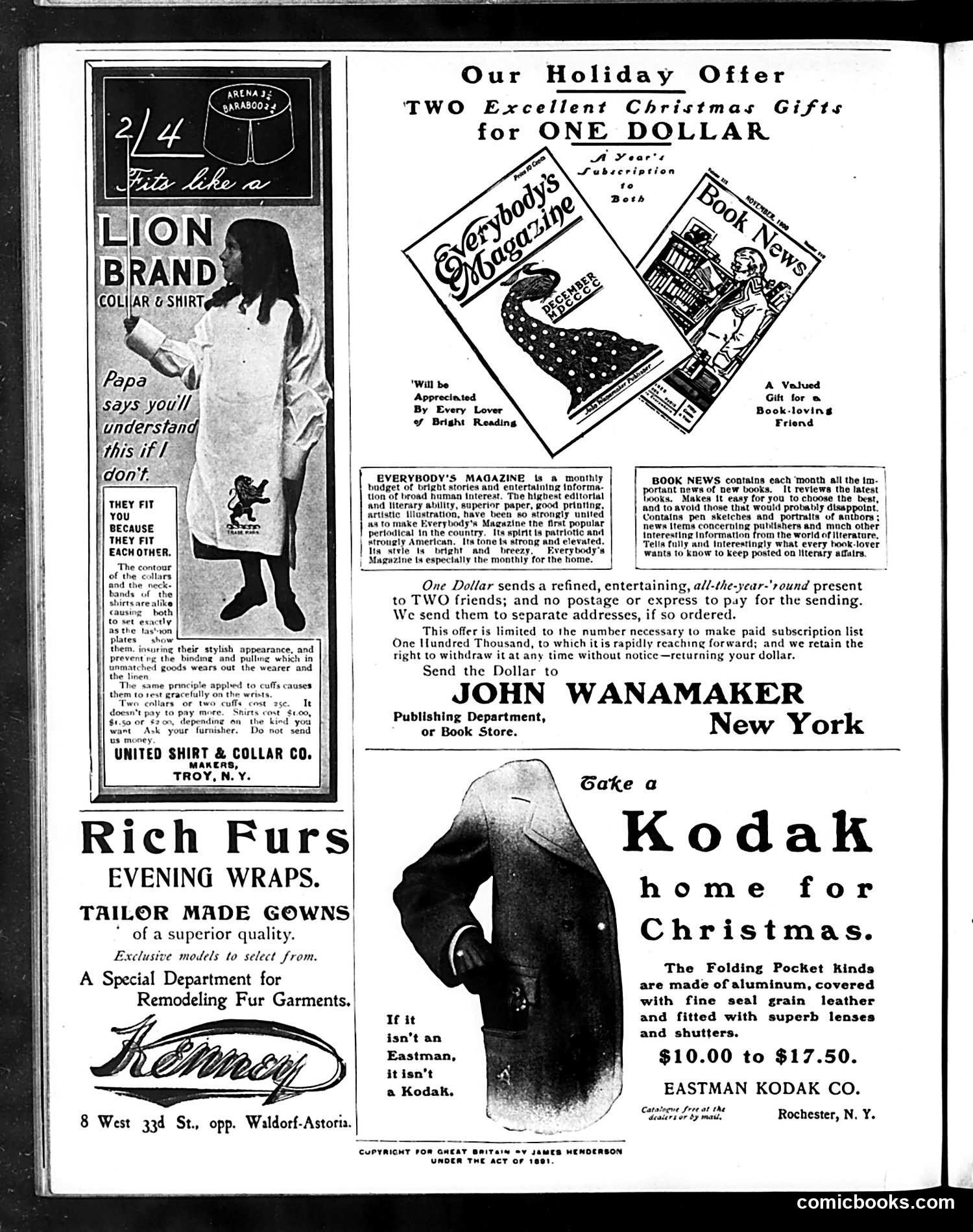
This page is **primarily advertising** with no political cartoons or satirical content. The ads include: - **Lion Brand Collar & Shirt**: Features a woman modeling menswear, with copy "Papa says you'll understand this if I don't" — suggesting confusion about why women would wear men's collars, likely reflecting early 20th-century gender norms around clothing. - **Wanamaker Publishing**: Holiday gift offer combining "Everybody's Magazine" and "Book News" subscriptions for one dollar. - **Hennessy Furs**: Evening wraps and tailor-made gowns with fur remodeling services. - **Kodak Camera**: Christmas gift advertisement for folding pocket cameras ($10-$17.50). The page reflects period advertising conventions targeting middle/upper-class consumers, with no identifiable satire or political commentary.
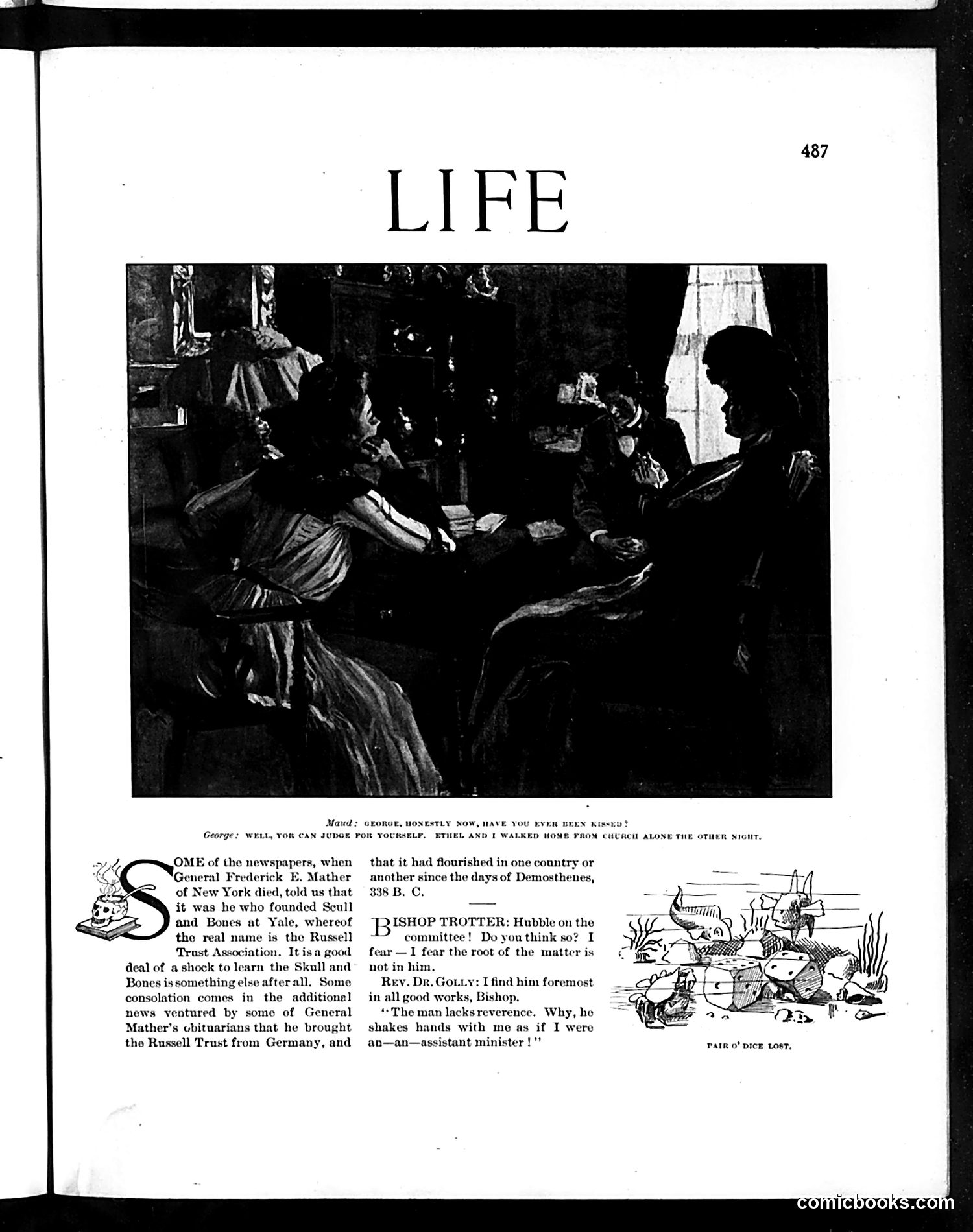
The main photograph shows a social scene with women in early 20th-century dress, likely depicting a conversation about romantic encounters. The caption reads: "Well, you can judge for yourself. Ethel and I walked home from church alone the other night." Below, a humorous dialogue involves newspaper figures discussing General Frederick E. Mather, founder of the Russell Trust Association at Yale. Bishop Trotter expresses concern about Mather's character and propriety, while Rev. Dr. Golly defends him as lacking reverence but being hardworking. The small illustration labeled "Pair of Dice Lost" appears to be a visual pun playing on "paradise lost." The satire mocks social pretension, institutional pomposity, and the gap between public reputation and private conduct among prominent figures of the era.
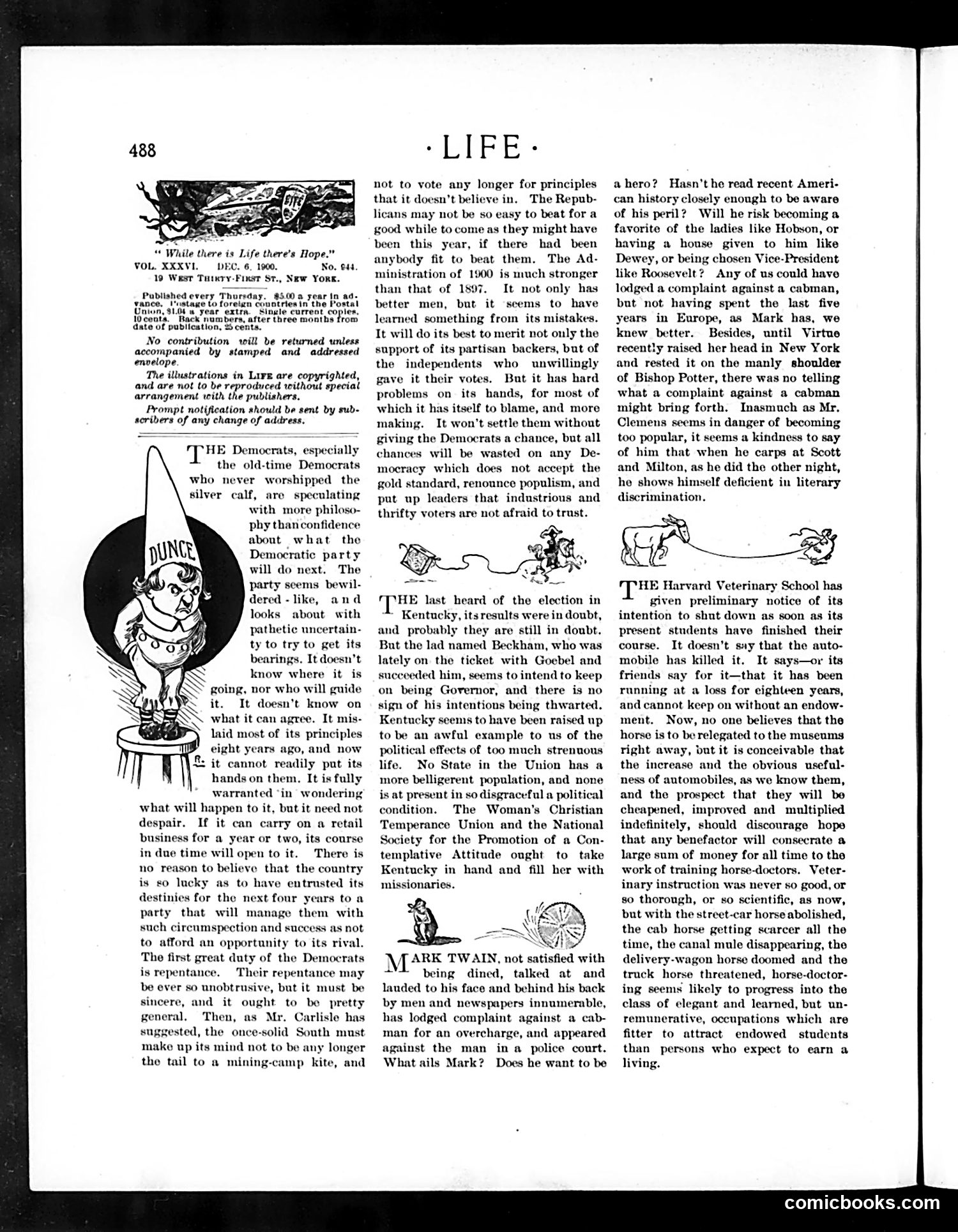
This page contains political commentary on the 1900 U.S. election. The main cartoon depicts a donkey (symbol of the Democratic Party) sitting atop a stool labeled "OUNCE," suggesting the Democrats are precariously balanced on a small foundation. The text discusses Democratic uncertainty about their party's future direction and leadership. It criticizes the party for potentially nominating weak candidates and suggests they've lost public confidence due to past mistakes. References include commentary on Kentucky election results, Mark Twain's complaint against a cabman (a humorous aside), and criticism of Harvard's veterinary school closing—used metaphorically to discuss the decline of useful institutions. The satire mocks Democratic Party instability and poor prospects heading into the 1900 election cycle.
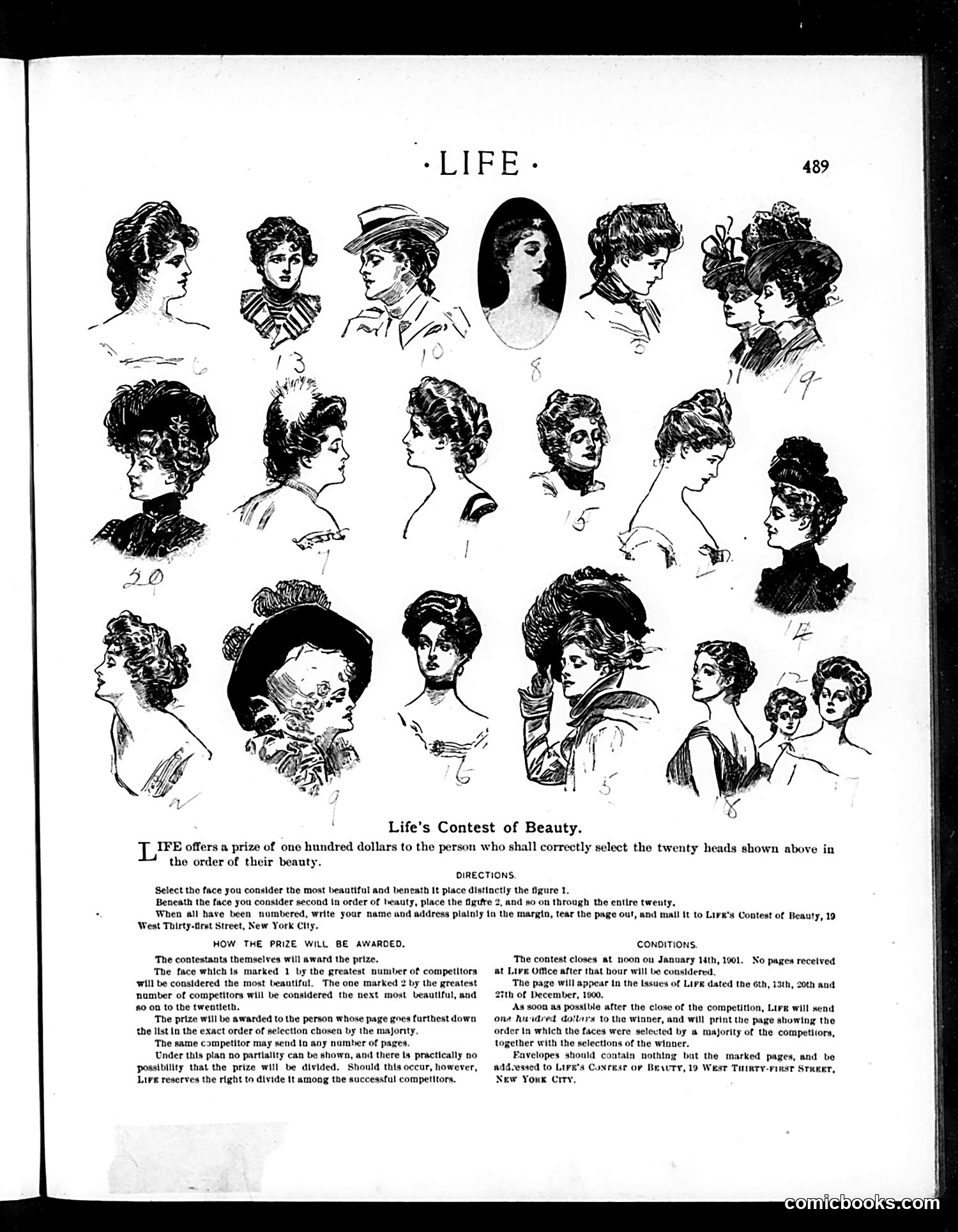
This page presents "Life's Contest of Beauty," a reader-participation contest where Life magazine invited subscribers to rank twenty illustrated female heads by attractiveness. Contestants would number the faces 1-20 in order of perceived beauty, submit their answers, and the winner would receive $100—a substantial prize in 1900. The contest reflects early-20th-century popular culture's preoccupation with female beauty as measurable and rankable. The illustrations show various hairstyles and fashion details typical of the Gibson Girl era. The contest closes January 14, 1901, and winners would be announced in subsequent issues. This appears designed primarily as entertainment and circulation-building rather than satire, though modern readers might find the premise of quantifying women's beauty somewhat problematic.
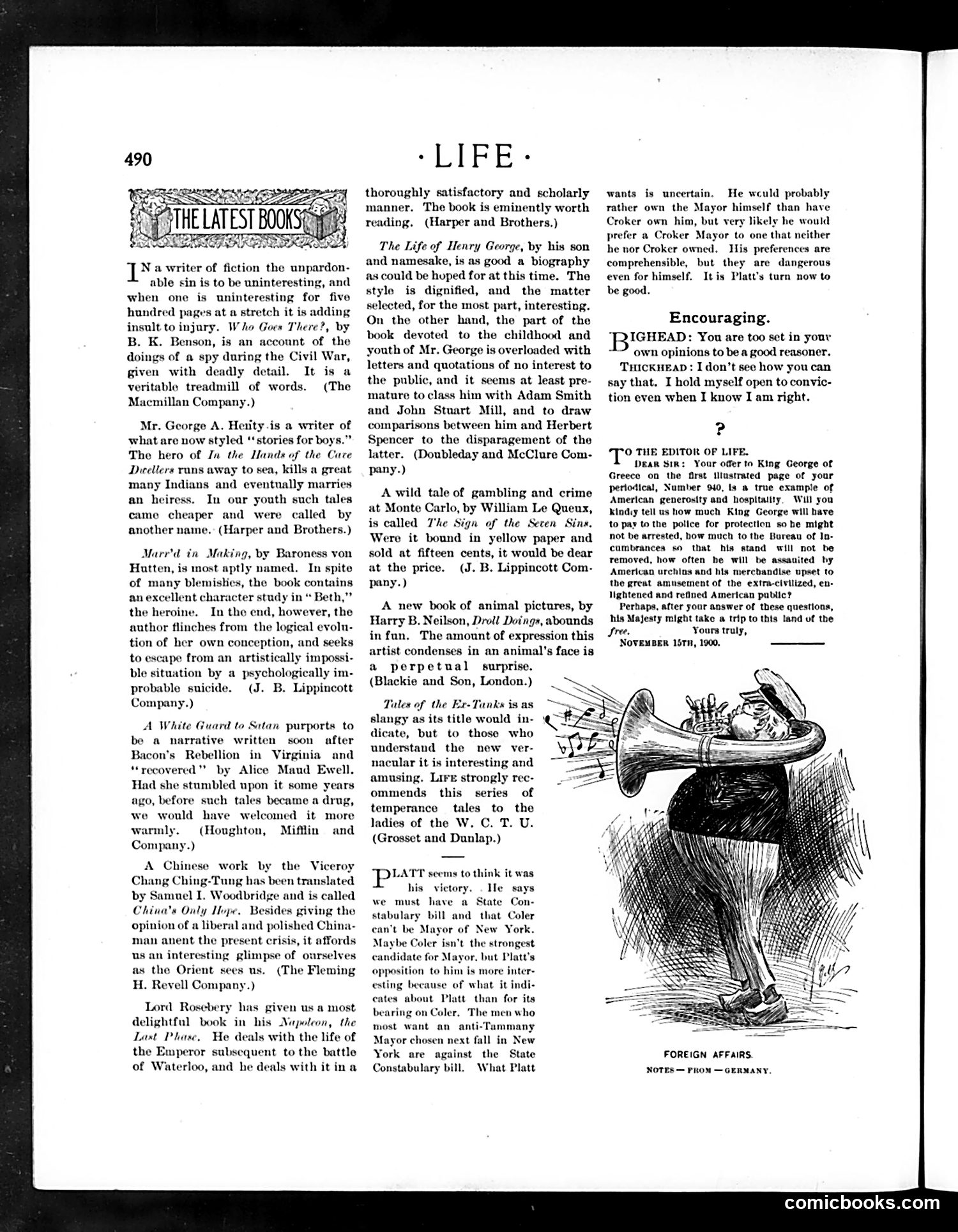
This page is primarily **book reviews** rather than political cartoons. The one illustration shows a figure playing a trumpet with musical notes, accompanying a review section titled "Foreign Affairs: Notes from Germany." The satirical content is textual rather than visual. A letter to the editor mocks a previous article about King George offering to pay for American war damages. The writer sarcastically suggests King George's generosity might "lighten and redden American pride"—implying skepticism about British benevolence. The reviews discuss various books including works on Indians, crime at Monte Carlo, and animal pictures. The "Encouraging" dialogue section offers lighthearted banter between characters named Bighead and Thickhead. The date is November 18th, 1920.
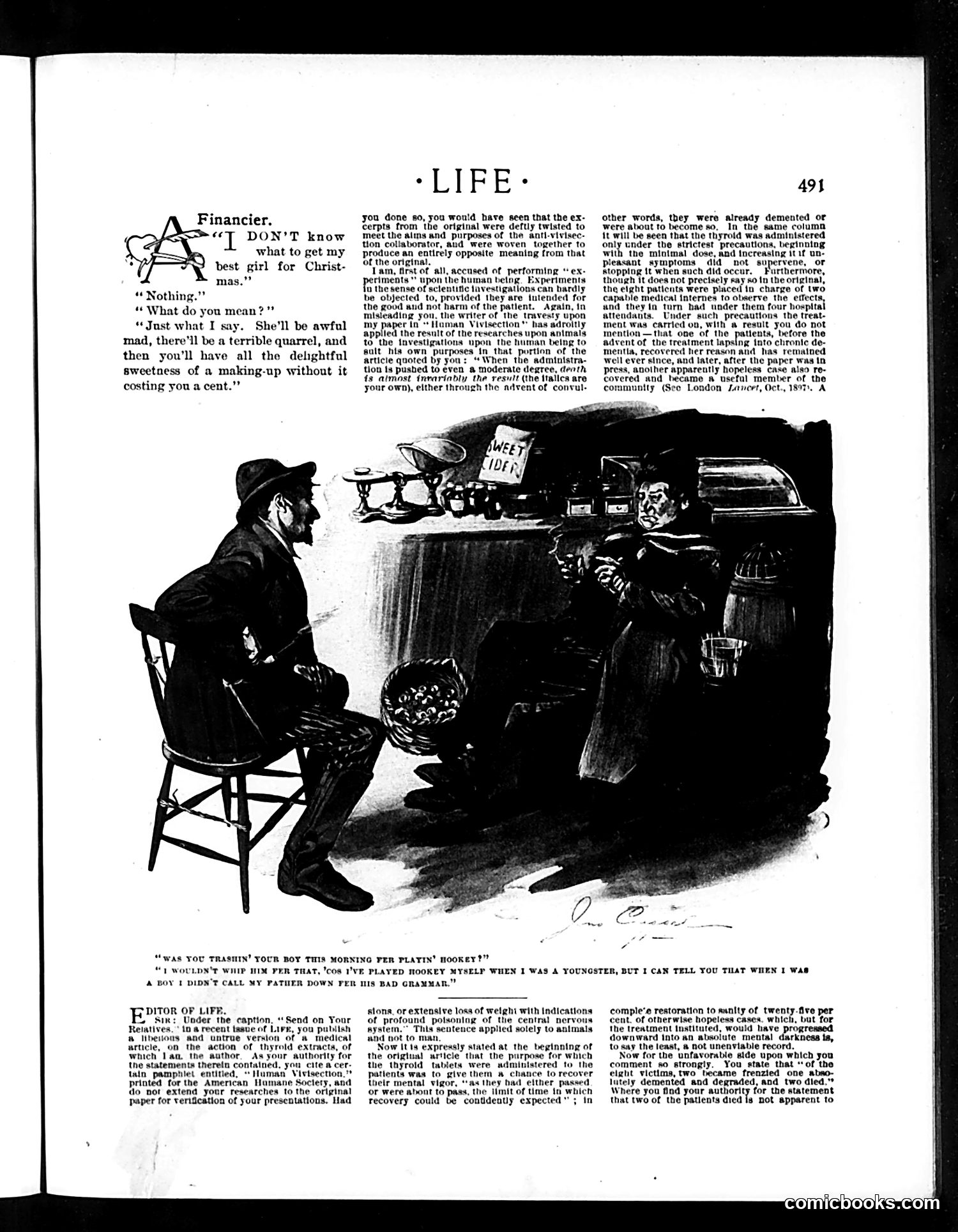
This page from *Life* magazine contains a cartoon satirizing medical ethics and research practices. The illustration shows a man sitting casually while a doctor or researcher performs an examination, with medical equipment visible on a desk behind them. The caption quotes the man saying he wouldn't whip his boy for bad grammar, citing his own childhood hockey playing as an excuse. The accompanying editorial text discusses scientific investigations and medical procedures, criticizing how excerpts from original research are distorted or misrepresented to support predetermined conclusions. The satire targets the manipulation of scientific findings and the use of selective evidence to justify questionable medical or parental practices. It appears to critique both medical researchers who twist their data and parents who excuse poor discipline through flawed reasoning.
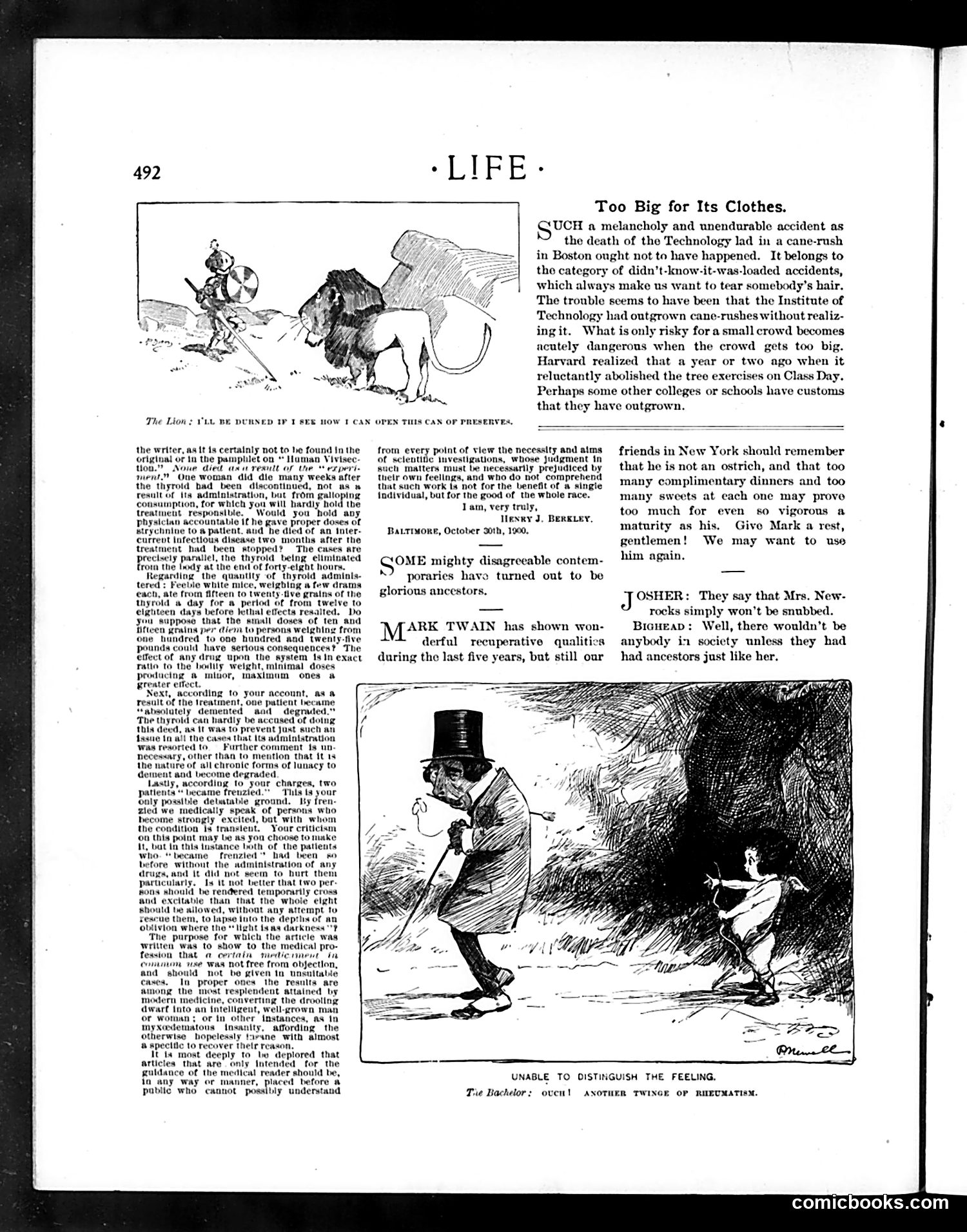
This *Life* magazine page contains two distinct pieces: **Top cartoon**: Shows a lion attempting to open a can of preserves while a soldier watches. The caption reads "I'LL BE BURNED IF I SEE HOW I CAN OPEN THIS CAN OF PRESERVES." This appears to be a humorous commentary on military logistics or problem-solving, using the absurd image of a lion struggling with modern convenience goods. **Bottom cartoon**: Titled "UNABLE TO DISTINGUISH THE FEELING," depicts a man in a top hat apparently experiencing severe rheumatism or gout, with caption suggesting confusion between rheumatism and other ailments. This satirizes the wealthy gentleman's physical ailments and inability to distinguish between different types of pain—a common satirical target in early 20th-century humor magazines. Both reflect *Life*'s tradition of visual satire mocking contemporary social situations.
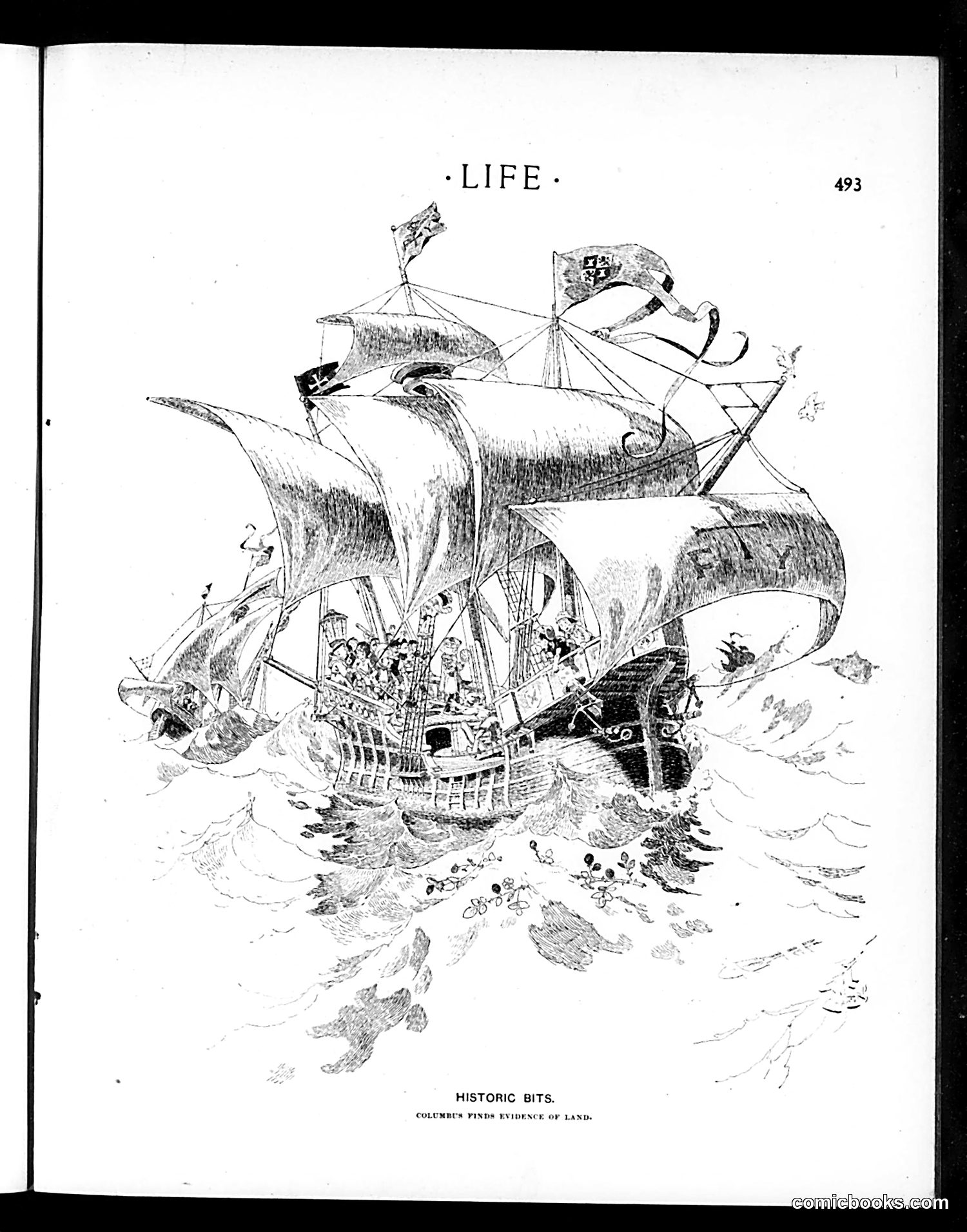
This page from *Life* magazine (page 493) features a satirical illustration titled "Historic Bits: Colombus Finds Evidence of Land." The cartoon depicts Christopher Columbus's ship encountering land, visualized through a detailed engraving of a period vessel with full sails. The humor appears to rest on the phrase "finds evidence of land"—likely a contemporary political or social joke, though the specific reference is unclear without additional context. The illustration style is typical of *Life*'s late 19th or early 20th-century satirical content. Columbus's voyage provides the historical framework, but the satirical point—whether mocking discovery narratives, contemporary politics, or something else—cannot be definitively determined from the image and caption alone.
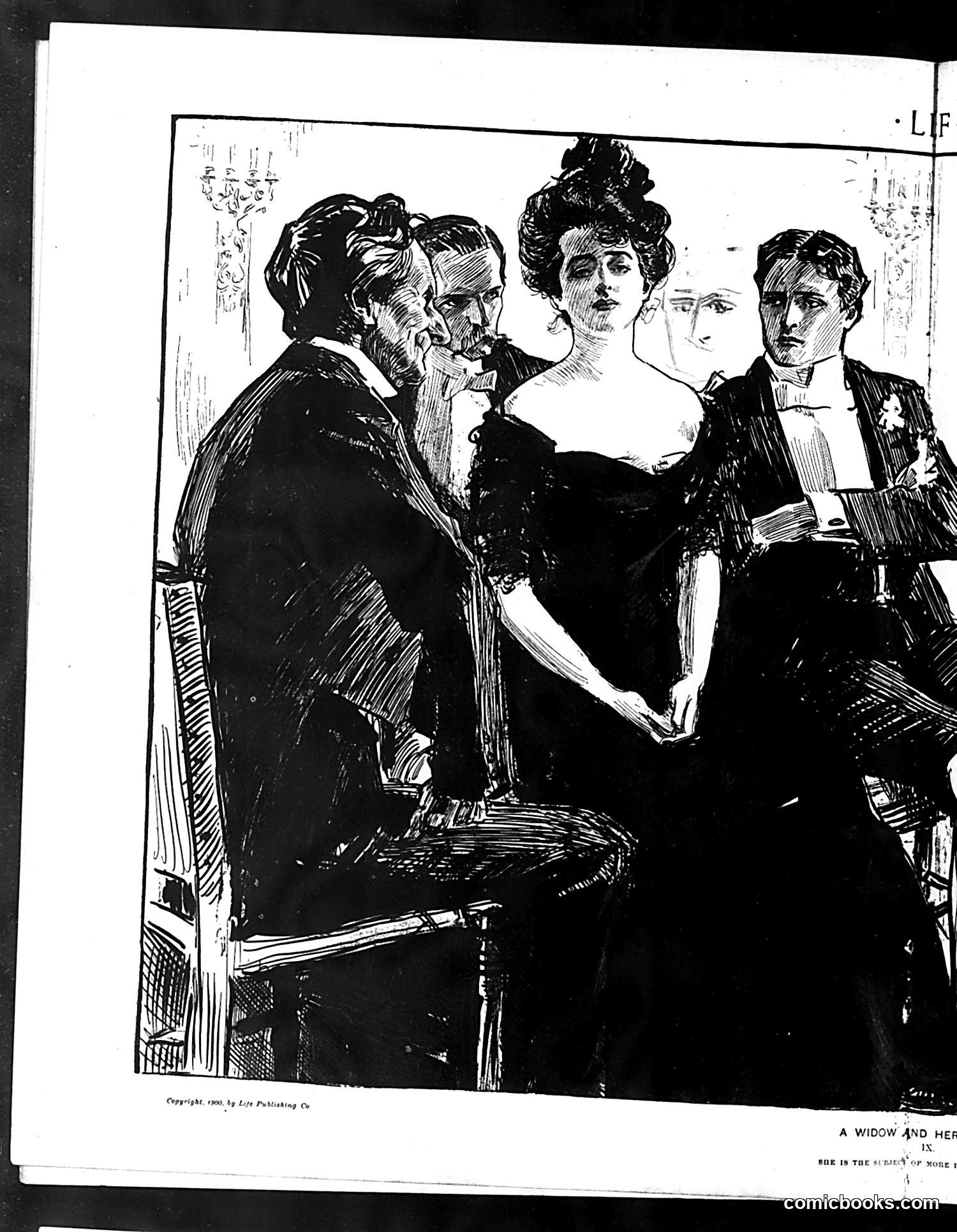
This appears to be a satirical illustration titled "A Widow and Her" (title cut off). The sketch shows five figures in formal evening dress in what appears to be an elegant interior with a chandelier—likely depicting high society. The image satirizes social dynamics of wealthy circles, possibly mocking courtship rituals or romantic entanglements among the upper class. The central woman in black (the "widow" of the title) is surrounded by men in formal attire, suggesting she is the focus of attention or interest. Without the complete caption or publication date visible, I cannot identify specific historical figures or events referenced. However, the style and subject matter suggest commentary on turn-of-the-century social customs and the behavior of wealthy widows navigating society's expectations.
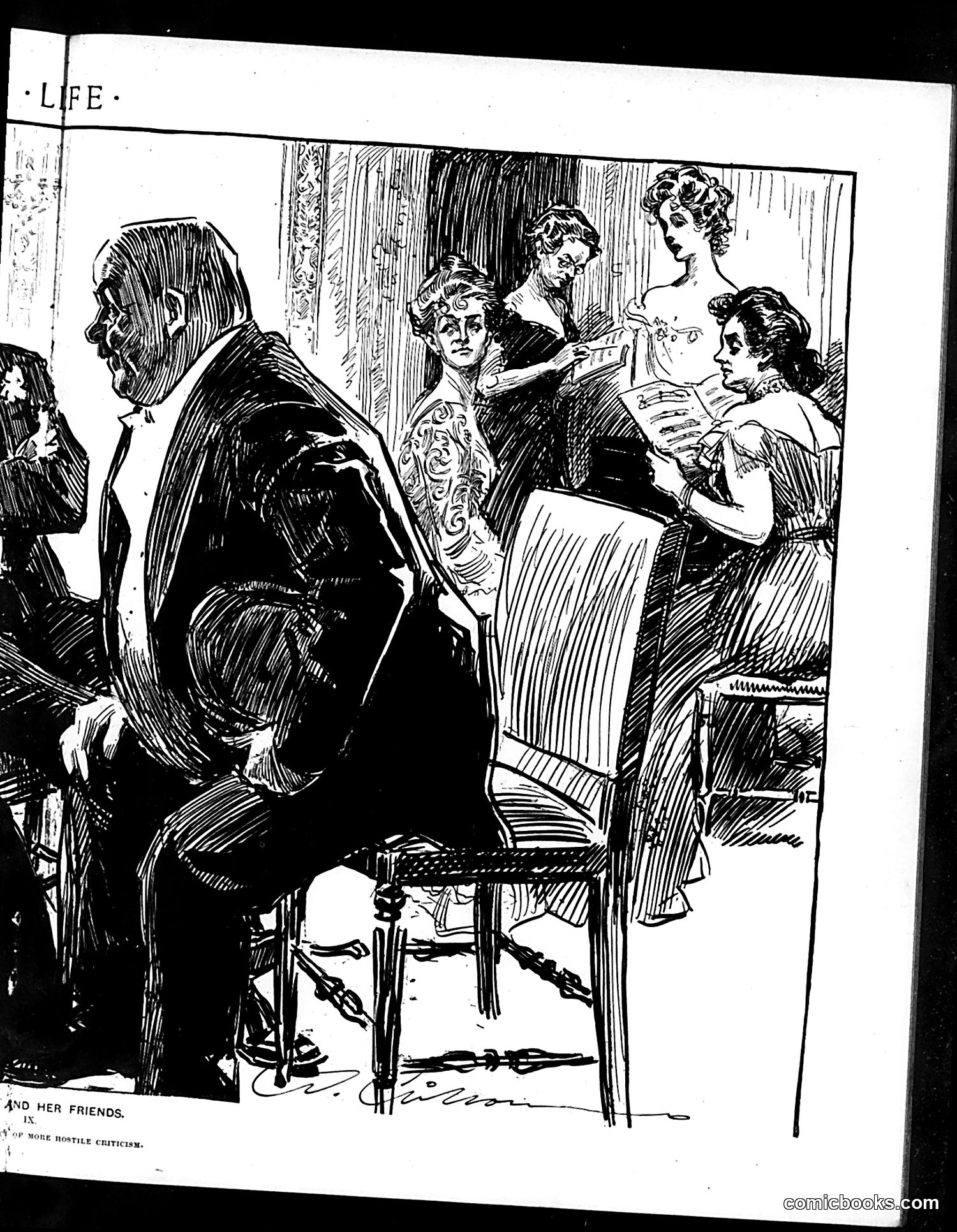
This appears to be a satirical illustration titled "AND HER FRIENDS" with a subtitle referencing "A OF MORE HOSTILE CRITICISM" (text partially unclear). The image depicts a social scene where an older, heavyset man in formal dress is being presented to or critiqued by several fashionably dressed women. The sketch style and composition suggest mockery of either: - A man of prominence receiving critical judgment from society women - Social pretension or awkward introductions in high society - Possibly an artist or public figure facing hostile female critics The "hostile criticism" reference suggests the women are evaluating or disparaging the man. Without clearer text or additional context, the specific target and exact satirical point remain uncertain, though the scene clearly ridicules some aspect of social interaction or public scrutiny in early 20th-century American life.
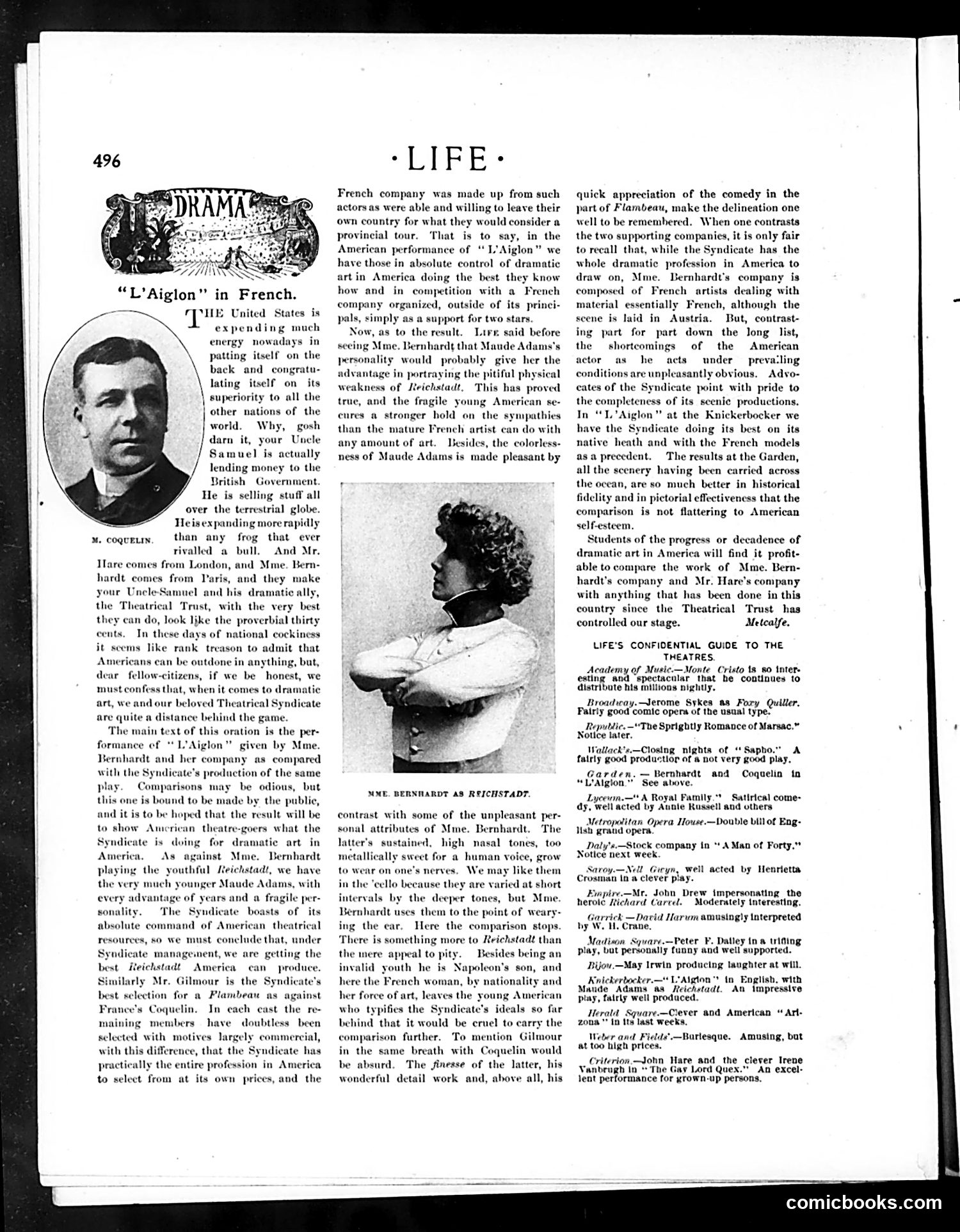
This page discusses a French theatrical production of "L'Aiglon" (The Eagle), comparing American and French dramatic traditions. The article critiques the Theatrical Syndicate's American productions by praising the superior artistry of French performers like Mme. Bernhardt (pictured in the photograph as "Reichstadt"). The text argues that American theater, controlled by commercial interests, lacks the sophistication of European productions. It notes that Bernhardt's company—featuring mature French artists—provides better dramatic work than American actors, despite American audiences' preference for younger performers like Maude Adams. The review essentially defends European theatrical excellence against American commercial theater's dominance, suggesting American dramatic art suffers from prioritizing profit over artistic merit.
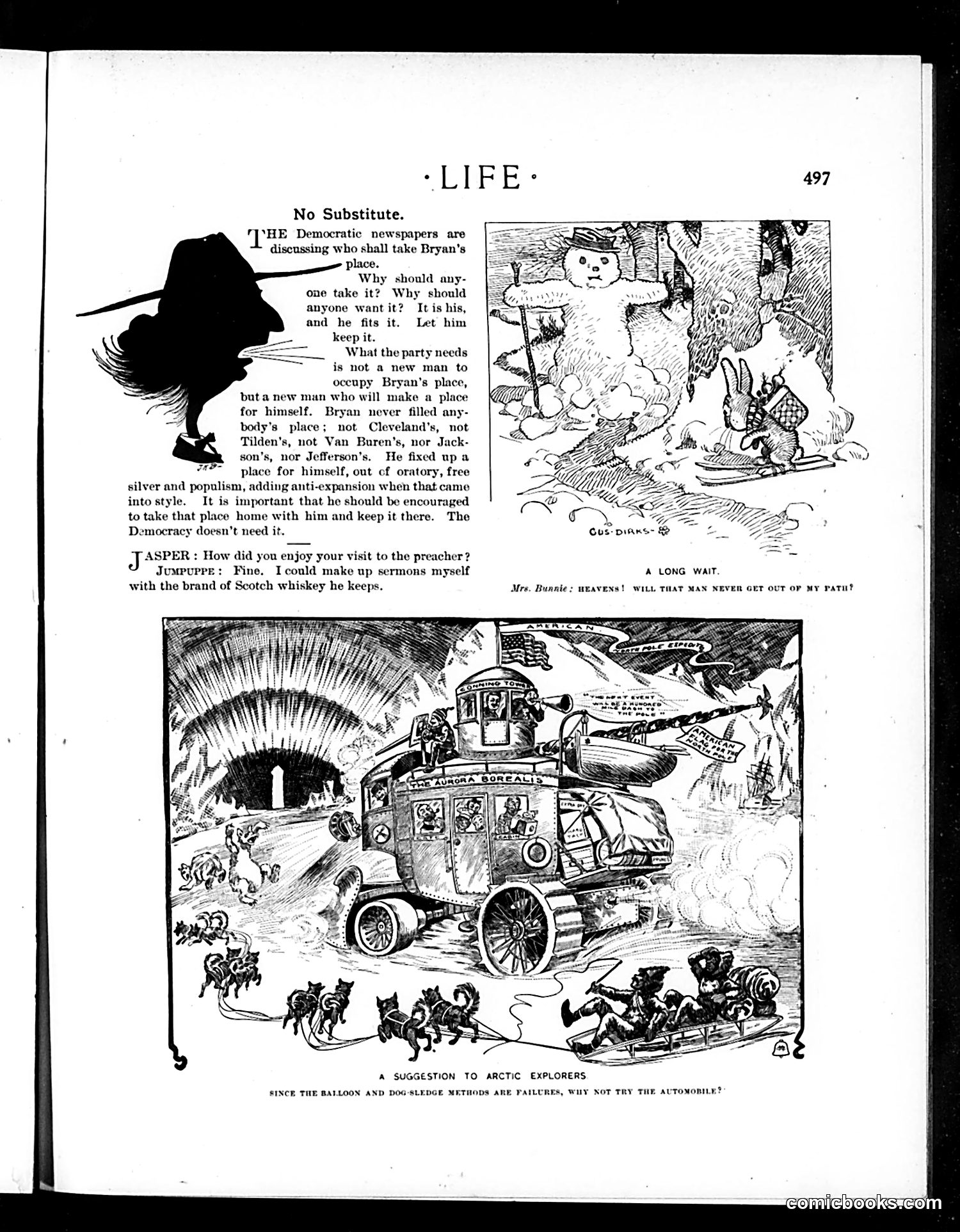
**Top Editorial ("No Substitute"):** This mocks Democratic Party discussions about replacing William Jennings Bryan as their political leader. The piece argues Bryan shouldn't be replaced—he carved his own unique political niche through "oratory, free silver and populism," rather than filling someone else's role. The satire suggests the party needs new leaders who create their own platforms, not Bryan substitutes. **Middle Joke:** A simple gag about a preacher whose sermons could be replicated by someone drinking his Scotch whiskey—satirizing either the preacher's quality or suggesting alcohol-fueled religiosity. **Bottom Cartoon:** "A Long Wait" shows a rabbit (Mrs. Bunnie) frustrated at a turtle blocking her path—likely a tortoise-and-hare reference, with the slow creature humorously obstructing the naturally speedy one. **Lower Cartoon:** "A Suggestion to Arctic Explorers" depicts a fantastical motorized vehicle with dogs pulling it toward an ice cave, sarcastically proposing automobiles replace failed balloon and dog-sledge exploration methods—poking fun at early automotive technology's reliability.
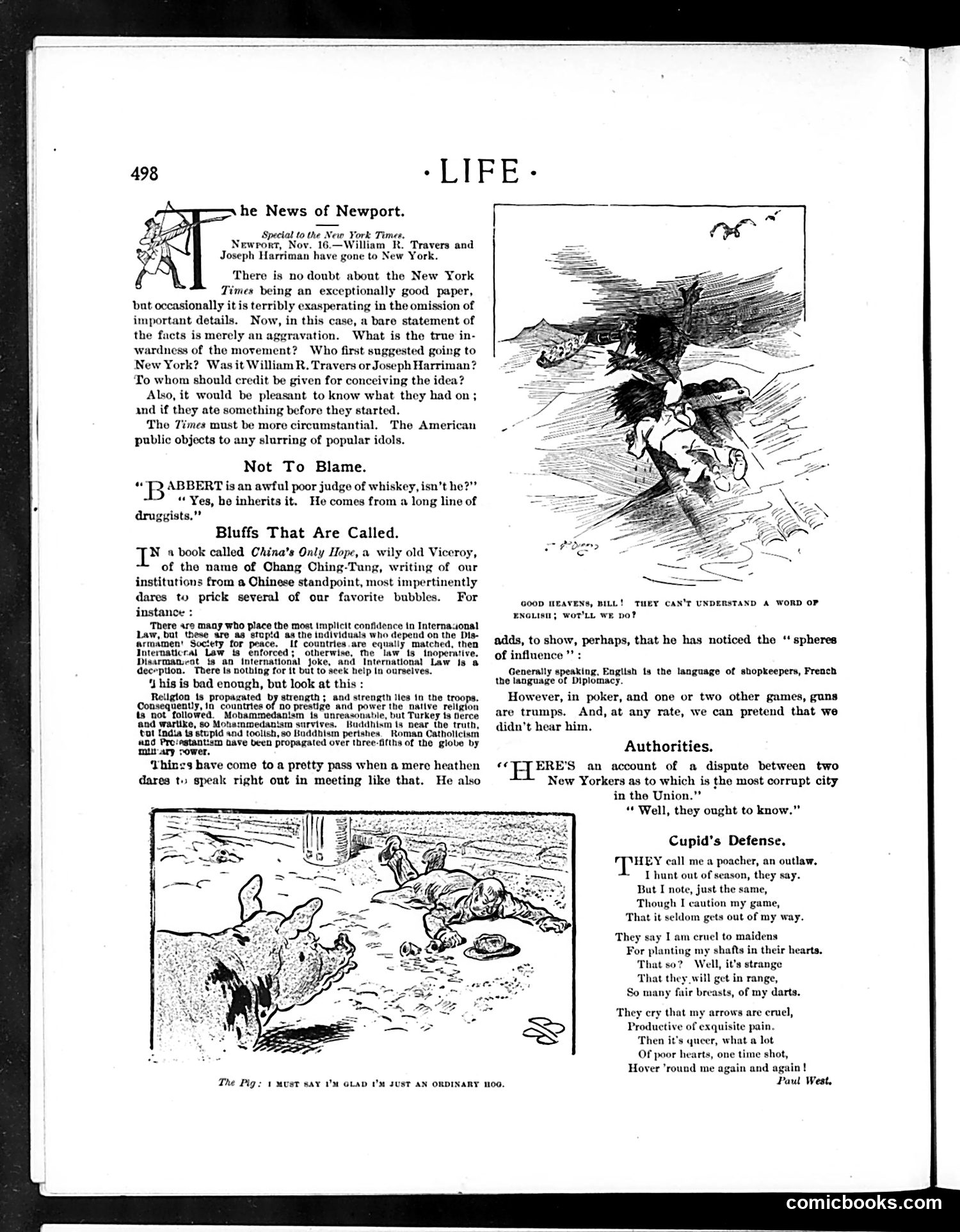
This *Life* magazine page contains multiple satirical pieces mocking American society and institutions: **"The News of Newport"** ridicules the *New York Times* for sparse reporting about wealthy Newport socialites—the joke being that trivial details about idle rich people deserve exhaustive coverage. **"Not to Blame"** is a brief joke about inheriting poor judgment (a drunk's son becomes a drunk). **"Bluffs That Are Called"** quotes a Chinese viceroy (Chang Ching-Tung) sarcastically exposing American hypocrisy: that International Law only works when nations are equally matched, and that religions spread through military power, not truth. The cartoonist mocks American pretensions to moral authority while nations use "gunboat diplomacy." **The pig cartoon** shows foreigners unable to understand English, suggesting American arrogance about language dominance. **"Cupid's Defense"** is a poem where Cupid defends himself against charges of cruelty in love, claiming his victims keep returning—a lighthearted commentary on romantic folly. The overall tone: satirizing American vanity, imperial power politics, and the absurdities of high society.
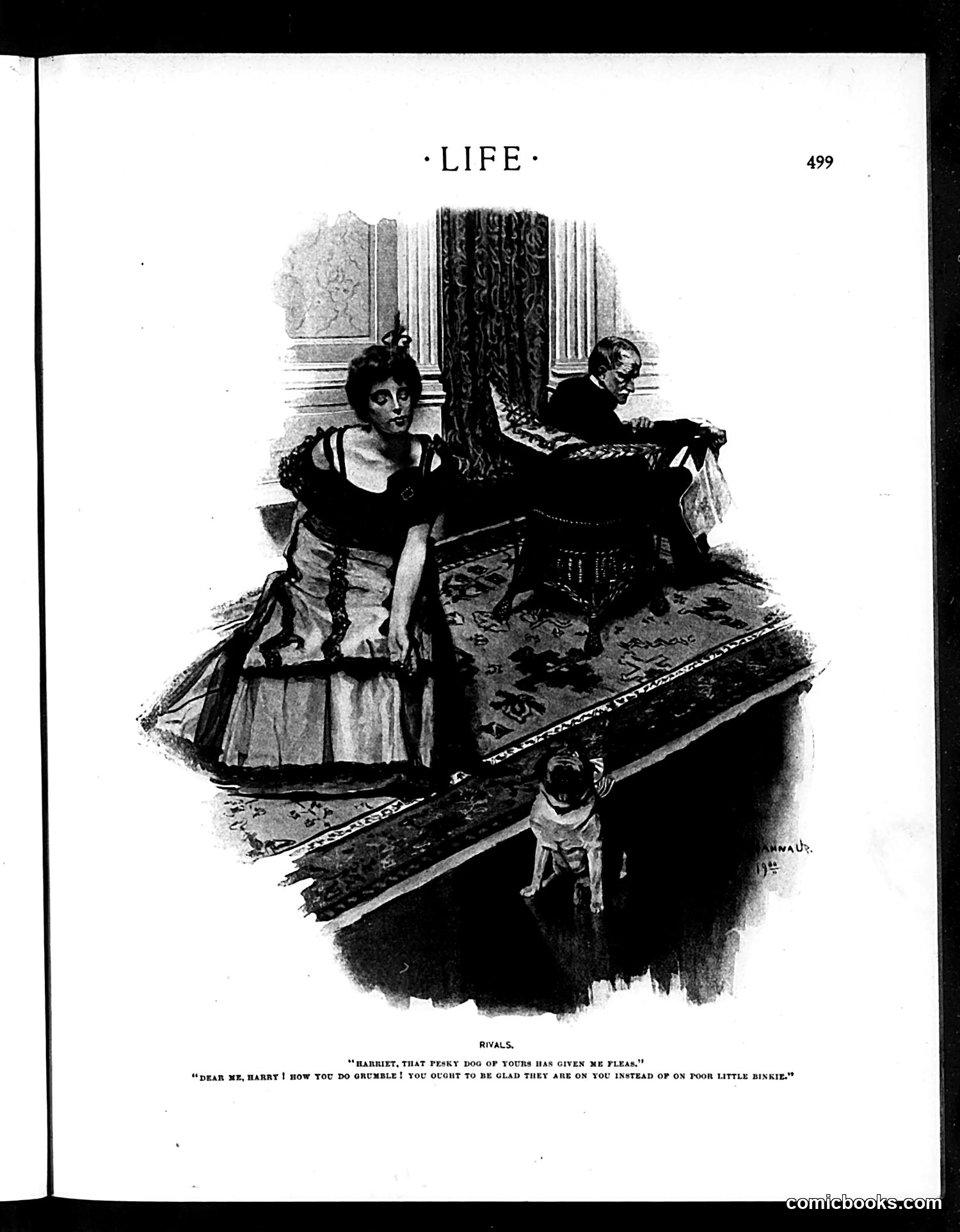
This Life magazine cartoon depicts a domestic dispute between a man (Harry) and woman (Harriet) over a dog. Harry complains that Harriet's dog has given him fleas. Harriet dismissively responds that he should be grateful the fleas are on him rather than on "poor little Binkie" (the dog's name). The satire targets the common domestic dynamic where a wife prioritizes her pet's comfort over her husband's legitimate complaints. It mocks both Harry's ineffectual griping and Harriet's illogical priorities—suggesting she'd rather her husband suffer than her beloved dog. The small dog illustrated at the bottom emphasizes the absurdity of a grown man being ranked below a pet in household importance. This reflects period attitudes about spoiled pets and henpecked husbands.
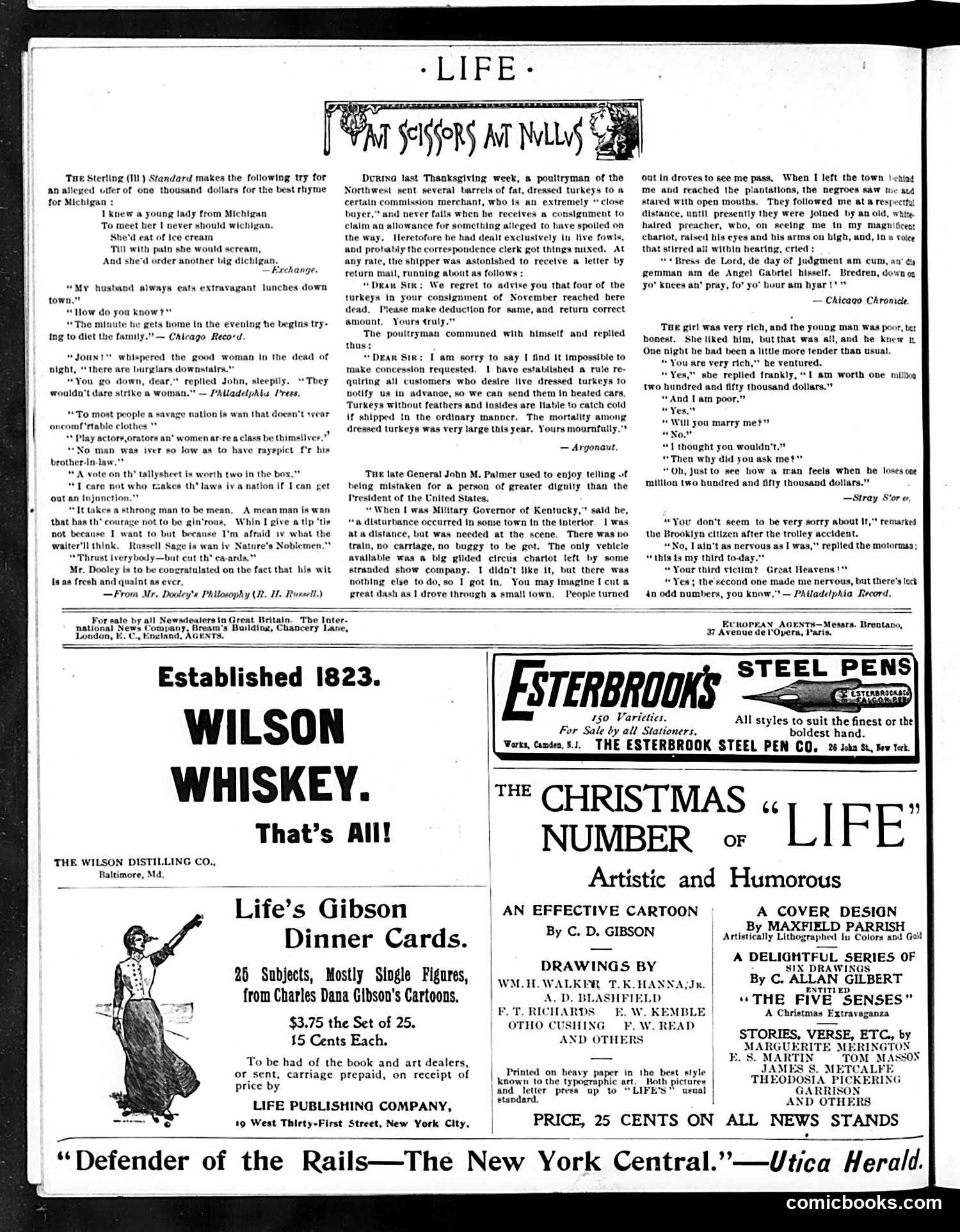
This page is primarily **advertising and announcements** for Life magazine's Christmas issue, with minimal actual satirical content visible. The upper portion contains **humorous anecdotes and jokes** typical of Life's format—brief, lighthearted pieces about everyday domestic and social situations (a husband's expensive lunches, burglars, etc.). These require no specialized historical knowledge to appreciate. The most substantial narrative is a story about **General John M. Palmer**, a real Civil War-era figure, recounting an amusing incident when he was mistaken for someone of greater importance while riding through Kentucky in a circus chariot during his governorship. The humor derives from the physical comedy of his ornate vehicle impressing onlookers. The page advertises **Esterbrook steel pens, Wilson Whiskey, Gibson dinner cards, and Life's upcoming Christmas issue** (25 cents). There is **no identifiable political cartoon** on this page—it functions primarily as an advertisement and content sampler for Life magazine's offerings rather than as political satire.
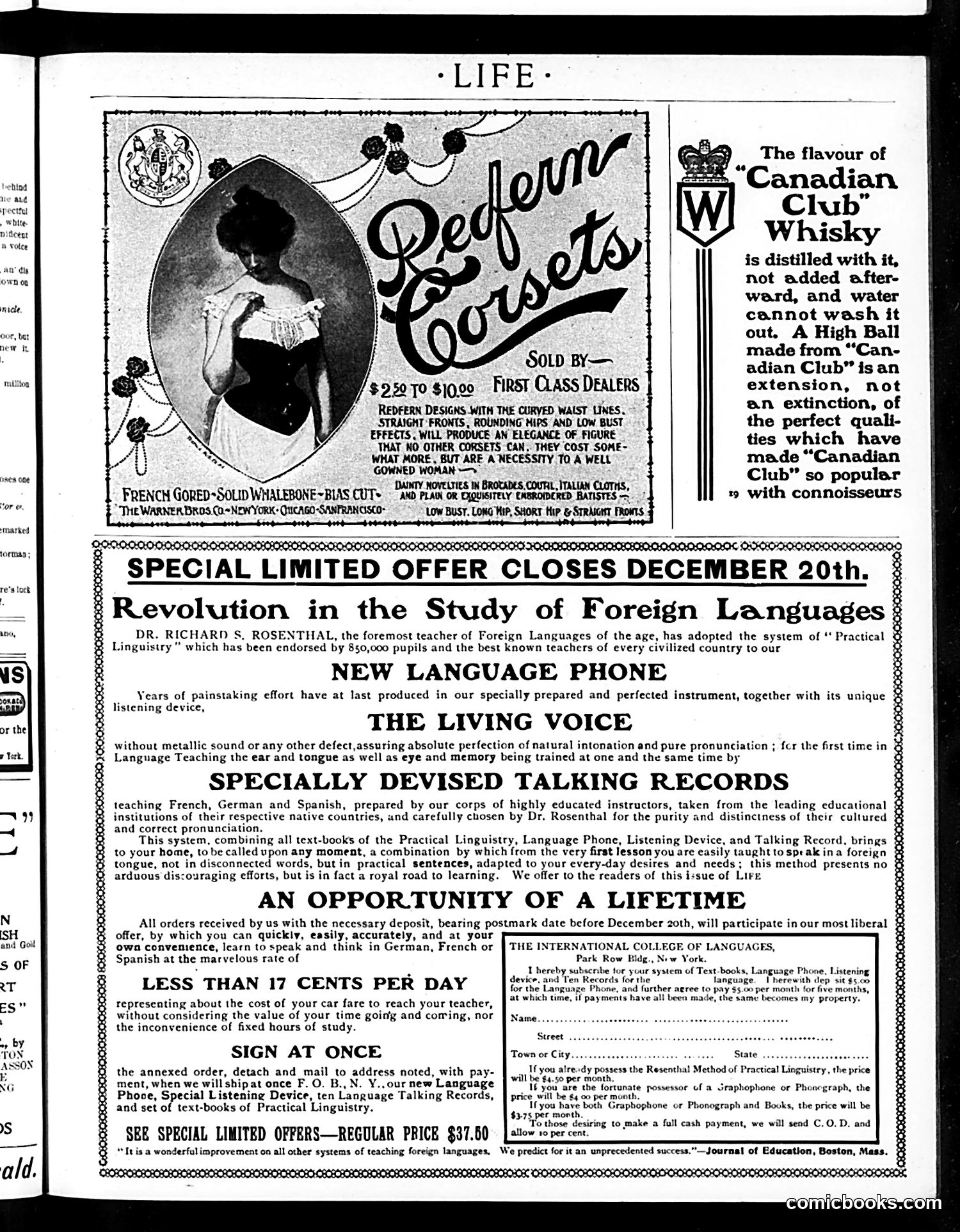
This page is primarily **advertising**, not political satire. It contains two main advertisements: 1. **Top**: A corset ad for "Redfern Corsets" featuring a woman in formal dress, emphasizing curved silhouettes fashionable in the early 1900s. The image reflects period beauty standards prioritizing the "S-bend" corset shape. 2. **Bottom (majority of page)**: An advertisement for the "Language Phone"—an early educational device claiming to teach foreign languages (French, German, Spanish) through recorded talking records and phonograph technology. Dr. Richard S. Rosenthal is presented as an authority figure endorsing the system. The Language Phone ad uses typical advertising hyperbole ("opportunity of a lifetime," endorsement claims) to market what was likely an early self-teaching language system. The "17 cents per day" payment plan suggests it was marketed to middle-class consumers seeking self-improvement. There is also a **Canadian Club Whisky advertisement** on the right side emphasizing the drink's natural qualities and appeal to "connoisseurs." This represents early 20th-century consumer advertising targeting personal improvement and leisure consumption.
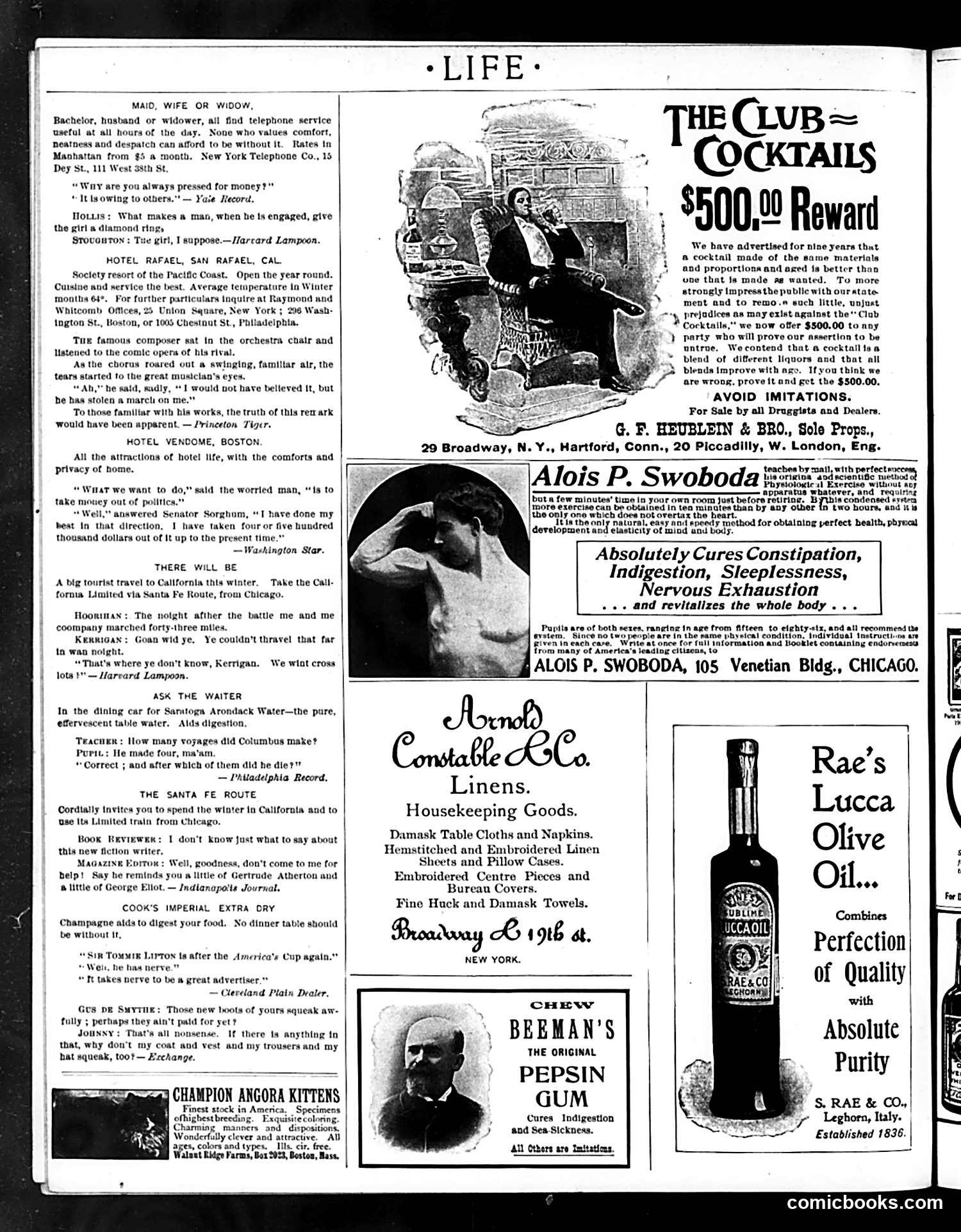
This is primarily an **advertising and humor page** from Life magazine (circa 1916, based on the Arnold Constable Linens ad date). The page contains scattered **short jokes** rather than political cartoons: - A senator joke mocking political corruption (Senator Sorghum claims he's "taken four or five hundred thousand dollars" out of politics) - Composer rivalry humor and Irish immigrant dialect jokes - A "Columbus voyages" schoolroom gag **The main illustrations** are product advertisements—not satirical cartoons. They show: - A woman with a telephone (service ad) - A man with a cocktail shaker (The Club Cocktails reward offer) - A portrait of a man (Alois P. Swoboda health product) - Portrait for Berman's Pepsin Gum **The satire** is mild and domestic: poking fun at marriage, money troubles, and professional jealousy. The senator joke is the closest to political commentary, but it's a standard corruption jab rather than commentary on specific events or figures. This page reflects Life's mixed format: entertainment humor alongside commercial advertising.
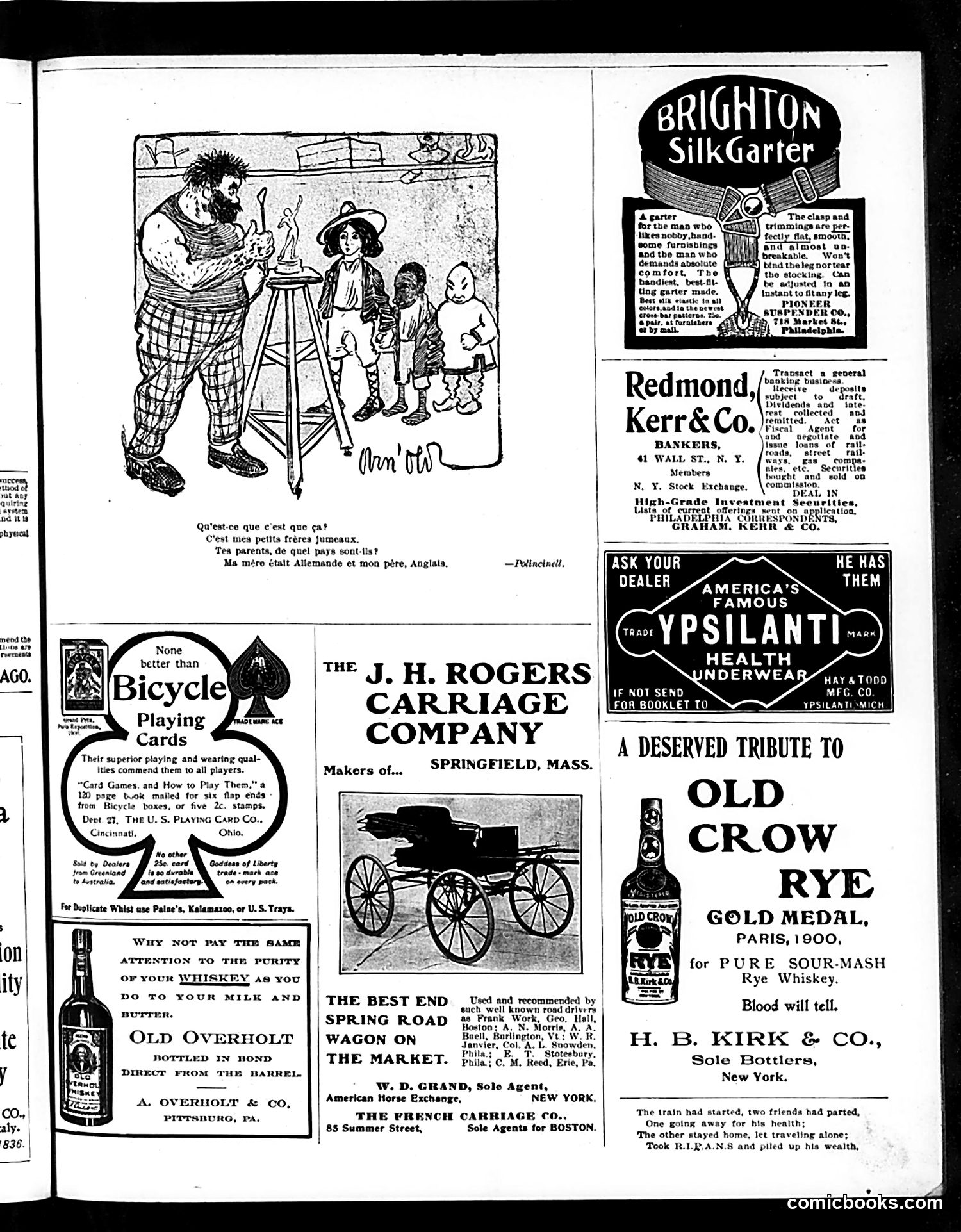
This page is primarily **advertisements** interspersed with a small political cartoon at the top. The main cartoon depicts a large bearded man (likely representing a European immigrant or foreign national) showing three small children to another figure. The French caption translates roughly to: "What is this? These are my little twin brothers. What country are your parents from? My mother was German and my father English." **The satire's point**: This appears to mock the mixed ethnic origins and cosmopolitan nature of American immigrants, or possibly satirizes concerns about foreign-born populations in America. The "twins" with different national parentage humorously illustrates anxieties about European immigration and mongrelization of American stock—a common satirical theme in early 1900s *Life* magazine. The remainder of the page consists of period advertisements for carriages, playing cards, whiskey, banking services, and health underwear—typical commercial content for the era. The cartoon's artist signature appears to be present but is not clearly legible in the image.
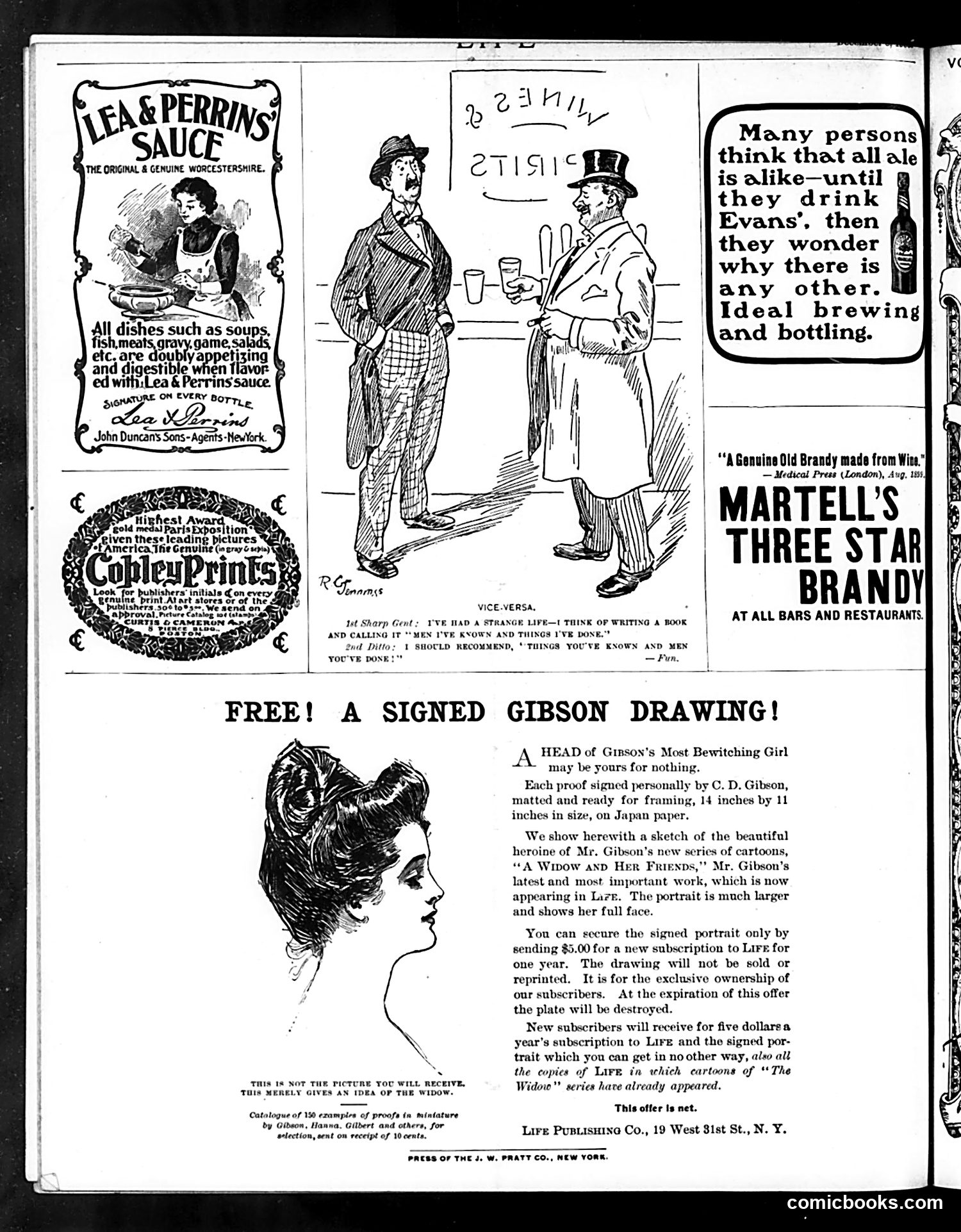
This page is primarily **advertising and promotional content** rather than satirical commentary. The central cartoon—"Vice-Versa"—is a mild joke between two gentlemen: one proposes writing a book called "Men I've Known and Things I've Done," and the other suggests he retitle it "Things You've Known and Men You've Done"—a simple reversal gag poking fun at the first man's presumed lack of accomplishment. The majority of the page consists of **product advertisements** (Lea & Perrin's Sauce, Cobley Prints, Evans ale, Martell's Brandy) typical of early 20th-century magazines. The dominant feature is a **promotional offer** for a signed C.D. Gibson drawing of "A Widow and Her Friends," Gibson's serialized cartoon series appearing in *Life*. The offer incentivizes new subscriptions ($5/year) with an exclusive framed portrait. Gibson was *Life*'s celebrated illustrator; this represents publisher marketing rather than editorial content. The page reflects how magazines of this era blended editorial matter with extensive advertising to fund operations.