
Life, 1900-12-06 · page 7 of 20
Life — December 6, 1900 — page 7: what you’re looking at
What you’re looking at
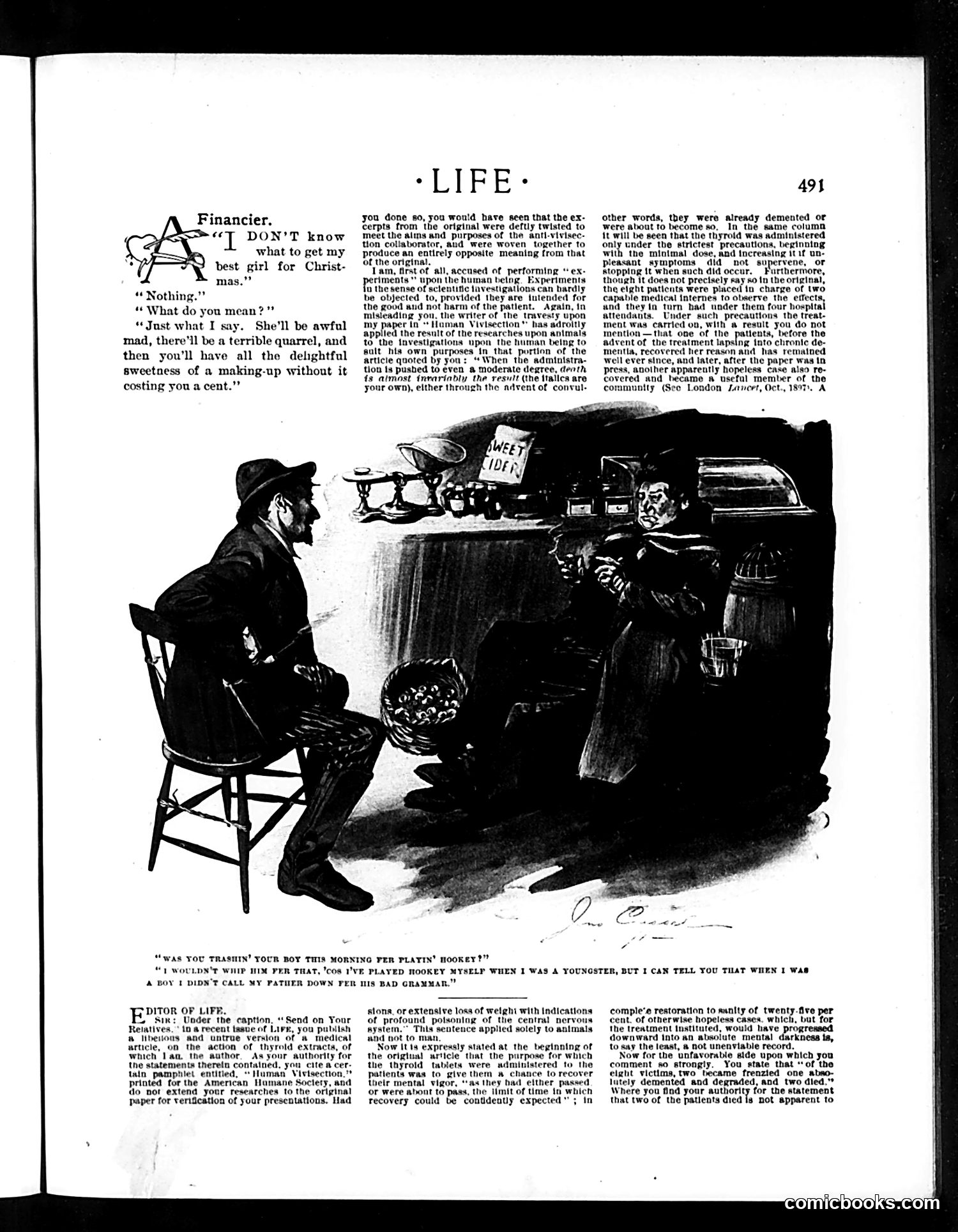
This page from *Life* magazine contains a cartoon satirizing medical ethics and research practices. The illustration shows a man sitting casually while a doctor or researcher performs an examination, with medical equipment visible on a desk behind them. The caption quotes the man saying he wouldn't whip his boy for bad grammar, citing his own childhood hockey playing as an excuse. The accompanying editorial text discusses scientific investigations and medical procedures, criticizing how excerpts from original research are distorted or misrepresented to support predetermined conclusions. The satire targets the manipulation of scientific findings and the use of selective evidence to justify questionable medical or parental practices. It appears to critique both medical researchers who twist their data and parents who excuse poor discipline through flawed reasoning.
📄 Transcribed text from this page (OCR, searchable)
Machine-transcribed from the original scan — historical spelling and the odd misread are preserved.
Financier. <7T DON’T know what to get my best girl for Chri mas.” “Nothing.” “What do you mean?” “Just what I say. She'll be awful mad, there'll be a terrible quarrel, and then you'll have all the dehghtful sweetness of a making-up without it costing you a cent.” -LIFE- you done s0, you would have seen that the ex- cerpts from the original were deftly twisted to meet the alins and purposes of the antl-vivisec- tion collaborator, and were woven together to produce an entirely opposite meaning from that of the original. Lam, first of all, accused of performing “ex riments * upon the human being. Experiments 1 the sense of sclentitic tavestigations can hardly be objected to, provided they are intended for the good and not harm of the patient. Again, in misleading you, the writer of the travesty upon my paper in Hiuman Vivisection” has adroltly appited the result of the researches upon animals fo ‘the investigations upon the human belng to sult hts own purposes in that portion of the article qnoted by you: “When the admintstra- tion ts pushed to even a moderate degree, death fs almost invariably the result (the italics are your own), elther through the advent of convul- “WAS YOU TRASHIN’ YOUR BOY THIS MORNING FER PLAYIN’ HOOKEY?” A BOY I DIDN'T CALL MY PATHER DOWN FER MIS BAD GRAMMAR.” EDITOR OF Lire. 4." Sin: Under the caption, «Send on Your Relatives, * 10 a recent tasue of Live, you pubilah ® libeoas and untrue version of a medical article, on the action of thyrold extracts, of which lam the author. As your authority for the statements therein contained, you cite a cer- tain pamphlet entitled, “Human Vivisection.”* printed forthe American Hamane Soctety, and do not extend your researches to the original Paper for verification of your presentations. Had stona, or extensive loss of weight with indications of profound polsoning of the central nervous system,” This sentence applied sotely to antmals and not to man. Now It ts expressly stated at the beginning of the origi! article that the purpose for which the thyroid tablets were administered to the patients was to give them # chance to recover their mental vigor, ‘as they had elther passed or Were abont to pass, the Imit of time in which recovery could be contidenuy expected"; in 491 other words, they were already demented or were about to become so, In the same columa {t will be seen that the thyroid was administered only under the strictest precautions. beginning with the minimal dose, and tncreasing tif un- pleasant aymptoms did not supervene, or stopplog tt when such did occur. Furthermore, though it does not precisely ray so tn the original, the elght paticnts were placed tn charge of two. capable medical internes to observe the effects, und they in turn bad under them four hospital attendants. Under such precautions the treat ment Was carricd on, with a result you do not mention —that one of the pattents, before the advent of the treatment lapsing {nto chronic de- mentia, recovered her reason and has remained weil ever since, and later, after the paper was tn. press, another apparently hopeless case also re- covered and became a usefal member of the community (See London Lancet, Oct. 1897. A WOULDN'T WHIP HIM YER THAT, 'CO8 I'VE PLAYED MOOKEY MYSELP WHEN 1 WAS A YOUNGSTER, BUT I CAN TELL YOU TUAT WIEN I WAS comple‘e restoration to aunity of twenty-five per Cent. of otherwise hopeless cases. which, but for the treatment instituted, would have progressed downward into an absolute mental darkness a, to say the least, a not unenviable record. Now for the unfavorable side upon which you comment so strongly. You state that “of the elght victims, two became frenzied one abso- lutely demented and degraded, and two died,"* Where you find your authority for the statement that two of the patients died Is not apparent to