
Life, 1900-12-06 · page 6 of 20
Life — December 6, 1900 — page 6: what you’re looking at
What you’re looking at
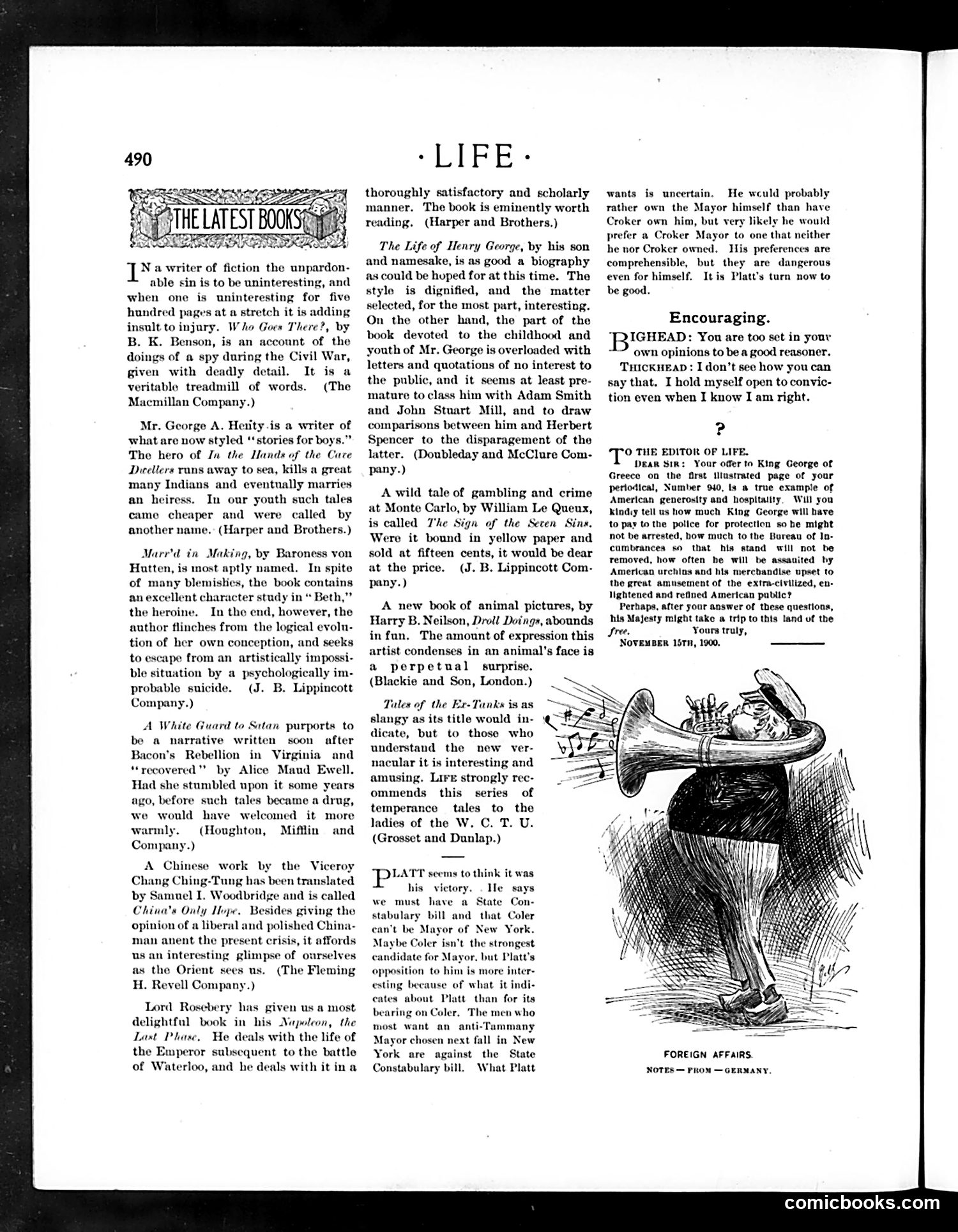
This page is primarily **book reviews** rather than political cartoons. The one illustration shows a figure playing a trumpet with musical notes, accompanying a review section titled "Foreign Affairs: Notes from Germany." The satirical content is textual rather than visual. A letter to the editor mocks a previous article about King George offering to pay for American war damages. The writer sarcastically suggests King George's generosity might "lighten and redden American pride"—implying skepticism about British benevolence. The reviews discuss various books including works on Indians, crime at Monte Carlo, and animal pictures. The "Encouraging" dialogue section offers lighthearted banter between characters named Bighead and Thickhead. The date is November 18th, 1920.
📄 Transcribed text from this page (OCR, searchable)
Machine-transcribed from the original scan — historical spelling and the odd misread are preserved.
Na writer of fiction the unpardon- able sin is to be uninteresting, and when one is uninteresting for five hundred pages at a stretch it is adding insult to injury. Who Goes There?, by B. K. Benson, is an account of the doings of a spy during the Civil War, given with deadly detail. It is a veritable treadmill of words. (The Macmillan Company.) Mr. George A. Hetity.is a writer of what are now styled ‘stories for boys.” The hero of Ja the Hands of the Care Durelters rans away to sea, kills a great many Indians and eventually marries an heiress. In our youth such tales camo cheaper and were called by another name. (Harper and Brothers.) Marr'd in Making, by Baroness von Hatten, is most aptly named. In spite of many blemisties, the book contains an excellent character study in “ Beth,” the heroine. In the end, however, the author flinches from the logical evoln- tion of her own conception, and seeks to escape from an artistically impossi- ble situation by a psychologically im- probable suicide. (J. B. Lippincott Company.) A White Guard to Satan purports to be a narrative written soon after Bacon's Rebellion in Virginia and ‘recovered’ by Alice Maud Ewell. Had she stumbled upon it some years ago, before such tales became a drug, we would have welcomed it more warmly. (Houghton, Mifflin and Company.) A Chinese work by the Viceroy Chang Ching-Tung has been translated by Samuel I. Woodbridge and is called China's Only Hope. Besides giving the opinion of a liberal and polished China- man anent the present crisis, it affords us an interesting glimpse of ourselves as the Orient sees us. (The Fleming H. Revell Company.) Lord Rosebery has given us a most delightful book in his Napoleon, the List Phase, He deals with the life of the Emperor subsequent to the battle of Waterloo, and he deals with it ina » LIFE « thoroughly satisfactory and scholarly manner. The book is eminently worth reading, (Harper and Brothers.) The Life of Henry George, by his son and namesake, is as good a biography as could be hoped for at this time. The style is dignified, and the matter selected, for the most part, interesting. On the other hand, the part of the book devoted to the childhood and youth of Mr. George is overloaded with letters and quotations of no interest to the public, and it seems at least pre- mature to class him with Adam Smith and John Stuart Mill, and to draw comparisons between him and Herbert Spencer to the disparagement of the latter. (Doubleday and McClure Com- pany.) A wild tale of gambling and crime at Monte Carlo, by William Le Queux, is called The Sign of the Seren Sins. Were it bound in yellow paper and sold at fifteen cents, it would be dear at the price. (J. B. Lippincott Com- pany.) A new book of animal pictures, by Harry B. Neilson, Droll Doings, abounds in fun. The amount of expression this artist condenses in an animal's face is a perpetual surprise. (Blackie and Son, London.) Tales of the Ex-Tanks is as slangy as its title would in- dicate, but to those who understand the new ver- nacular it is interesting and amusing. Lire strongly rec- ommends this series of temperance tales to the ladies of the W. C. T. U. (Grosset and Dunlap.) LATT seems to think it was his vietory. . He says we must have a State Con- stabulary bill and that Coler can't be Mayor of New York. Maybe Coler isn’t the strongest candidate for Mayor. but Platt's opposition to him is more inter- esting because of what it indi- cates about Platt than for its bearing on Coler. The men who most want an anti-Tammany Mayor chosen next fall in New York are against the State Constabulary bill, What Platt wants is uncertain. He wculd probably rather own the Mayor himself than have Croker own him, but very likely he would prefer a Croker Mayor to one that neither he nor Croker owned. His preferences are comprehensible, but they are dangerous even for himself. It is Platt’s turn now to be good. Encouraging. ‘BIGHEAD: You are too set in your own opinions to be a good reasoner. THicKHEAD: I don’t see how youcan say that. I hold myself open to convic- tion even when I know I am right. ? ‘© THE EDITOR OF LIFE. Dear SIR: Your offer to King George of Greece on the first illustrated page of your periodical, Number 940, Is a true example of American generosity and hospitality. Will you Kindiy tell us how much King George will have to pay to the police for protection so he might not be arrested, how much to the Bureau of In- cumbrances so that his stand will not be removed, how often he will be assauited by American urchins and his merchandise upset to the great amusement of the extra-civilized, en- lightened and refined American pablic? Perhaps, after your answer of these questions, his Majesty might take a trip to this land of the Sree. Yours truly, NOVEMBER 15TH, 1900, FOREIGN AFFAIRS. NOTES — PROM — GERMANY. comicbooks.com