
Life, 1900-12-06 · page 8 of 20
Life — December 6, 1900 — page 8: what you’re looking at
What you’re looking at
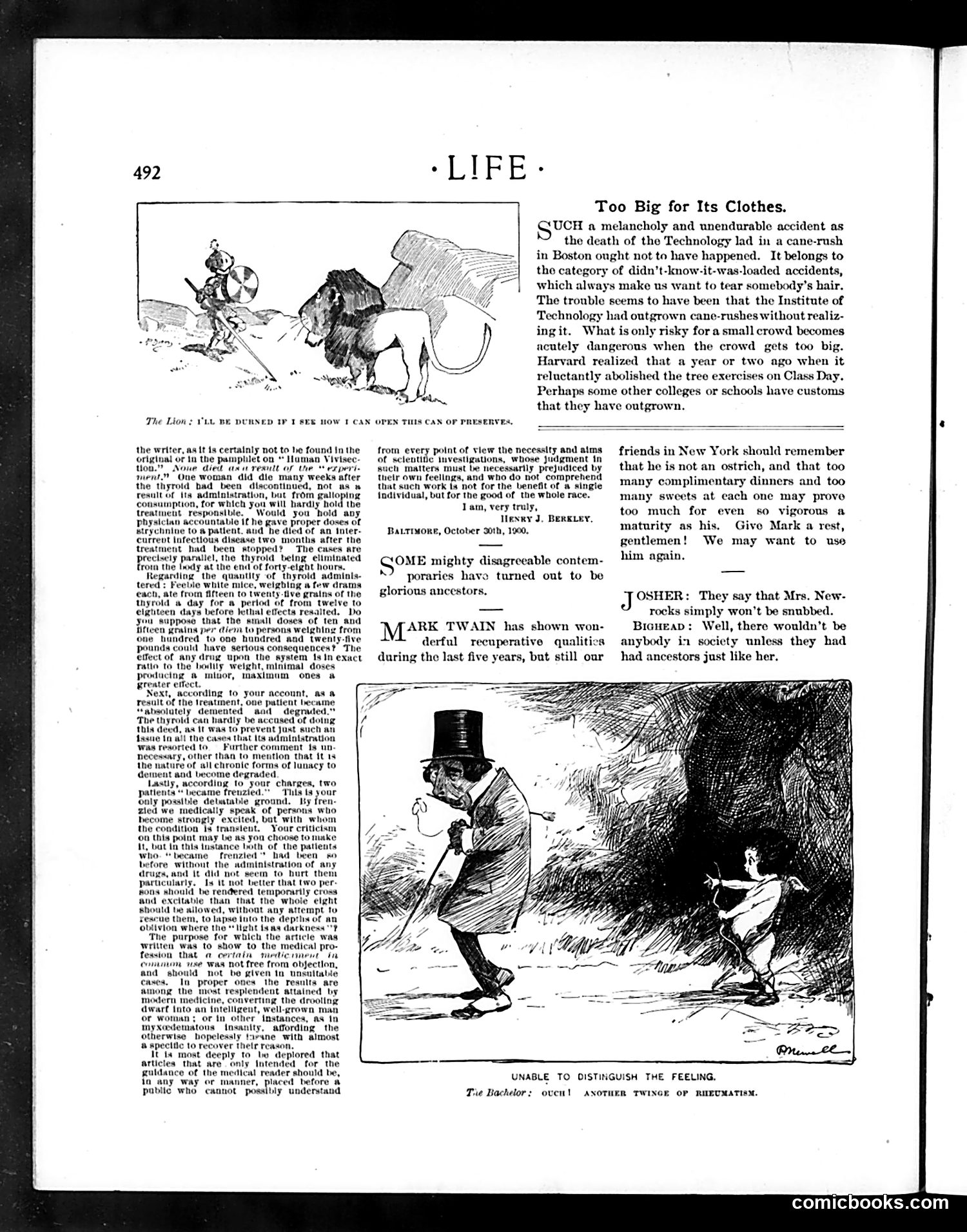
This *Life* magazine page contains two distinct pieces: **Top cartoon**: Shows a lion attempting to open a can of preserves while a soldier watches. The caption reads "I'LL BE BURNED IF I SEE HOW I CAN OPEN THIS CAN OF PRESERVES." This appears to be a humorous commentary on military logistics or problem-solving, using the absurd image of a lion struggling with modern convenience goods. **Bottom cartoon**: Titled "UNABLE TO DISTINGUISH THE FEELING," depicts a man in a top hat apparently experiencing severe rheumatism or gout, with caption suggesting confusion between rheumatism and other ailments. This satirizes the wealthy gentleman's physical ailments and inability to distinguish between different types of pain—a common satirical target in early 20th-century humor magazines. Both reflect *Life*'s tradition of visual satire mocking contemporary social situations.
📄 Transcribed text from this page (OCR, searchable)
Machine-transcribed from the original scan — historical spelling and the odd misread are preserved.
The Lion: Vit. BE DURNED IP I SEE HOW TCA the writer, as it 1s certainly not to be found in the original of tn the pamphlet on * Human Vivisec- tou.” Nowe die asi resntt of Ue exper ment” Que woman did dle many weeks after the thyroid bad been discontinued, not as result of tt administration, but from galloping consumption, for which you will hardly hold tbe treatment responsible." Would you ‘hold apy physician accountable if he gave proper doses of strychnine to a patient, aud he died of an inter- currevt Infectious disease two months after the treatment had been stopped? The cuses are precisely parallel, the thyroid being eltminated from the body at ihe end of forty-eight hours. Regarding the quantity of thyrotd admints- tered: Feeble white mice, weighing a few drama cach, ate from fifteen fo twenty-five grains of the thyrold a day for a period of from twelve to elgtiteen days before lethal eects resaited. Do You suppose that the small doses of ten and iifteen grains per diem to persons welghing from one hundred to one hundred and twenty-five pounds could have serous consequences? The effect of any drug upon the system ts In exact ratio to the bodily welght, minimal doses producing @ mluor, maximum ones a greater effect. Next, according to your account, as a result of the Ireatinent, one patient became ‘absolutely demented aad degraded.” The thyrold can hardly be accased of dottig this deed, as tt was to prevent Just such an Aasuie tn ail the cases that Its admintstration was resorted to. Further comment 1s uo necessary, other than to mention that tis the nature of all chronic forms of lunacy to detent and become degraded Lastly, according to your charges, two patients’ became freuzied."” This ts your only possible debatable ground. Ky zled we medically speak of persons who become strongly excited, bat with wh the condition Is translent. Your critic on this point may be as you choose to make It, but In this tustance both of the patients frenzied * had i Withont the administratio drugs, and It did not seem to burt them particularly. 14 it not better that two per> fons xhould be rendered temporarily cross and excitable than that the whole elght should be allowed, withont any attempt to Feacue them, to Lapse tuto the depths of an Oblivion where the “light ims darkness"? ‘The purpose for which the article was written was to show to the medical pro- fession that @ certain turdicrment. in common use Was not free from objection, and should not be given tn unsuttabie cases, In proper ones the results are among the most resplendent attained by modern medicine, converting the drooling, dwarf Into an intelligent, well-grown man or woman ; or In other’ Instances, as in MyXexdematons Insanlty, affording the Otherwise hopelessly farine with almost & apeclilc to recover thelr reason, It t¢ most de deplored that articles that are ended guldance of the medical reader should in any way or manner, placed before & public who cannot possibly understand Too Big for Its Clothes. Suck a melancholy and unendurable accident as the death of the Technology lad in a cane-rush in Boston ought not to have happened. It belongs to tho category of didn't-know-it-was-loaded accidents, which always make us want to tear somebody's hair. The trouble seems to have been that the Institute of Technology had outgrown cane-rushes without realiz- ingi What is only risky for a small crowd becomes acutely dangerous when the crowd gets too big. Harvard realized that a year or two ago when it reluctantly abolished the tree exercises on Class Day. Perhaps some other colleges or schools have customs that they have outgrown. )PEN THIS CAN OF PRESERVES, from every point of view the necessity and alms of sclentie Investigations, whose Judgment in such matters must be necessarily prejudiced by elr own feelings, and who do not comprenend that such work ts not for the benefit of a singie individual, but for the good of the whole race. 1am, very truly, Henry J. BERKLEY, Baxtiwore, October sth, 1900, OME mighty disagreeable contem- poraries havo turned out to be glorious ancestors, w MARK TWAIN has shown won- derful recuperative qualities during the last five years, but still our friends in New York should remember that he is not an ostrich, and that too many complimentary dinners and too many sweets at cach one may prove too much for even so vigorous a maturity as his, Give Mark a rest, gentlemen! We may want to use him again. OSHER: They say that Mrs. New- rocks simply won't be snubbed. Bicueab: Well, there wouldn’t be anybody in society unless they had had ancestors just like her. UNABLE TO DISTINGUISH THE FEELING, Tie Bachelor: oven! ANOTHER TWINGE OP RIEUMATIOM. comicbooks.com