
Life, 1900-12-06 · page 12 of 20
Life — December 6, 1900 — page 12: what you’re looking at
What you’re looking at
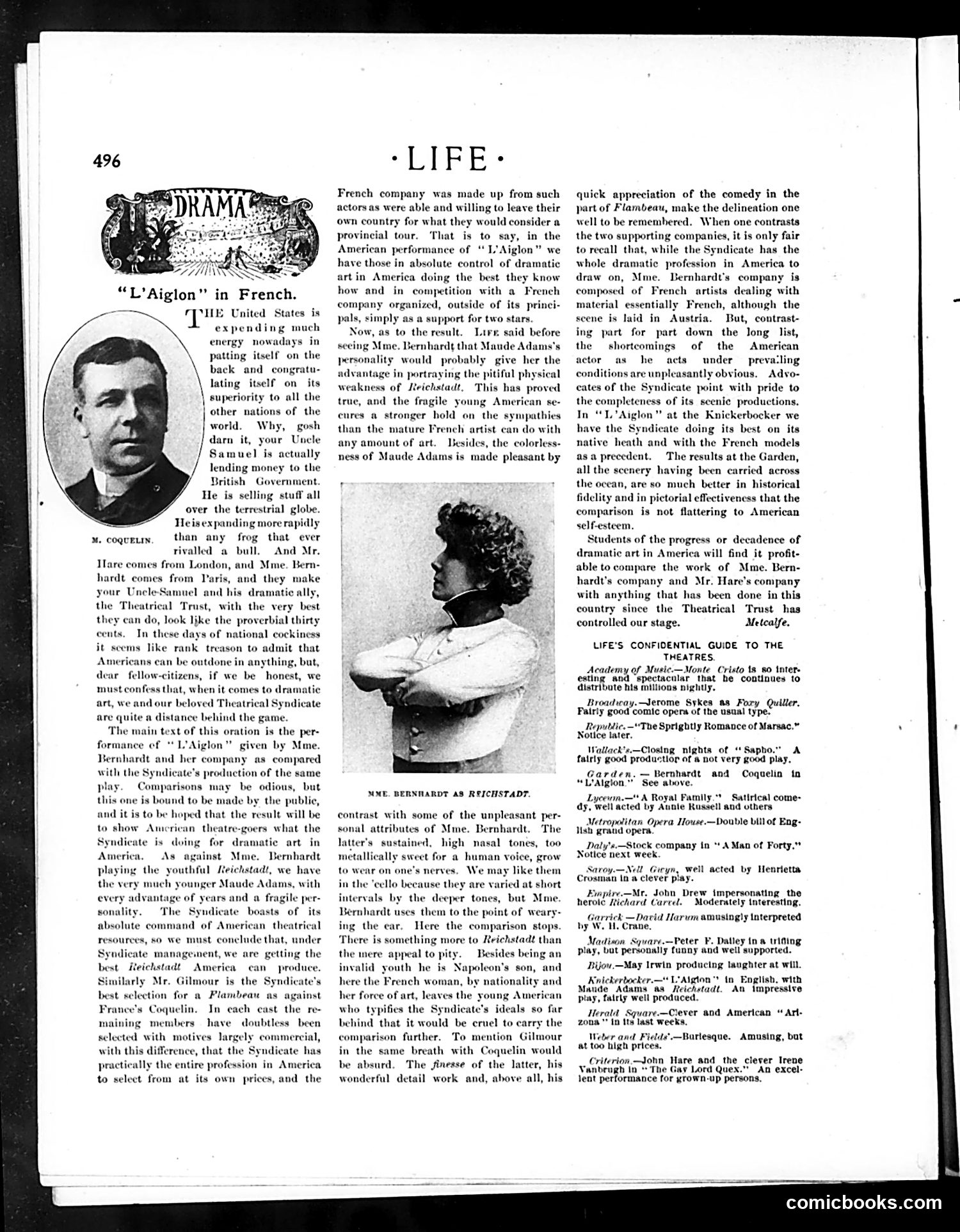
This page discusses a French theatrical production of "L'Aiglon" (The Eagle), comparing American and French dramatic traditions. The article critiques the Theatrical Syndicate's American productions by praising the superior artistry of French performers like Mme. Bernhardt (pictured in the photograph as "Reichstadt"). The text argues that American theater, controlled by commercial interests, lacks the sophistication of European productions. It notes that Bernhardt's company—featuring mature French artists—provides better dramatic work than American actors, despite American audiences' preference for younger performers like Maude Adams. The review essentially defends European theatrical excellence against American commercial theater's dominance, suggesting American dramatic art suffers from prioritizing profit over artistic merit.
📄 Transcribed text from this page (OCR, searchable)
Machine-transcribed from the original scan — historical spelling and the odd misread are preserved.
“L'Aigion” in French. = ve United States is expending much patting itself on the a back and congratu- lating itself on its superiority to all the other nations of the world. Why, gosh darn it, your Uncle Samuel is actually lending money to the British Government. He is selling stuf all over the terrestrial globe. - Heis expanding more rapidly mM. cogveux, than any frog that ever rivalled ‘a bull, And Mr. Hare comes from London, and Mme. Bern- hardt comes from Paris, and they make your UncleSamuel and his dramatic ally, the Theatrical Trust, with the very best they can do, look ljke the proverbial thirty cents, Tn these da it scems like Ameri d 's of national cockiness nk treason to admit that ns can be outdone in anything, but, r fellow-citizens, if we be hon must confess that, when it comes to dramatic art, we and our beloved Theatrical Syndicate are quite a distance behind the game. ‘The main text of this oration is the per- formance cf “ L’Aiglon” given by Mme. Bernhardt and her company as compared with the Syndicate’s production of the same play. Comparisons may be odious, but this one is bound to be made by the public, and it is to be hoped that the result will be to show Anecric: n theatre-goers what the Syndicate is doing for dramatic art in Americ As against Mme. Bernhardt playing the youthful Reickstadt, we have the very much ger Maude Adams, with every advantage of years and a fragile per- sonalit The Syndicate boasts of its absolute command of American theatrical resources, so we must conclude that, under Syndicate management, we are getting the best Heichstadt ilarly Mr. America n produce mour is the Syndicate's best selection for a Plambeaw as against France's Coquelin. In each cast the re- maining members have doubtless been selected with motives Jargely commercial, with this difference, that the Syndicate has practically the entire profession in America to select from at its own prices, and the “LIFE - French company was made up from such actors as were able and willing to leave their own country for what they would consider a provincial tour. That is to in the American performance of “ L’Aiglon” we have those in absolute control of dramatic artin America doing the best they know how and in competition with a French company organized, outside of its prinei- pals, simply as a support for two stars ow, as to the result. Lire said before seeing Mme. Bernhardt that Maude Adams's personality would probably give her the advantage in portraying the pitiful physical weakness of Keichstadt. This has proved true, and the fragile young American se- cures a stronger hold on the sympathies than the mature French artist can do with any amount of art. Lesides, the colorless- ness of Maude Adams is made pleasant by MME. BERNMARDT AS REICHSTADT. contrast with some of the unpleasant per- sonal attributes of Mme. Bernhardt. The latter's sustained, high nasal tones, too metallically sweet for a human voice, grow s nerves, We may like them use they are varied at short intervals by the deeper tones, but Mme. Bernhardt uses them to the point of weary- ing the Here the comparison stops. ‘There is something more to Reichstadt than the mere appeal to pity. Besides being an invalid youth he is Napoleon's son, and here the French woman, by nationality and her force of art, leaves the young American who typifies the Syndicate’s ideals so far behind that it would be cruel to carry the comparison further. To mention Gilmour in the same breath with Coquelin would be absurd. The finesse of the latter, his wonderful detail work and, above all, his to wear o in the ‘cello be quick appreciation of the comedy in the part of Flambeau, make the delineation one well to be remembered. When one contrasts the two supporting companies, it is only fair to recall th: whole dran t, while the Syndicate has the ic profession in America to draw on, Mme. Bernhardt’s company is composed of French artists dealing with material essentially French, although the scene is laid in Austria. But, contrast- ing part for part down the long list, the shortcomings of the American actor as he acts under _ preva‘ling conditions are unpleasantly obvious, Advo- cates of the Syndicate point with pride to the completeness of its scenic productions. In “L'Aiglon” at the Knickerbocker we have the Syndicate doing its best on its native heath and with the French models asa precedent. The results at the Garden, all the scenery having been carried across the ocean, are so much better in historical fidelity and in pictorial effectiveness that the comparison is not flattering to American self-esteem. Students of the progress or decadence of dramatic art in America will find it profit- able to compare the work of Mme. Bern- hardt’s company and Mr. Hare's company with anything that has been done in this country since the Theatrical Trust has controlled our stage. Metcalfe. LIFE'S CONFIDENTIAL GUIDE TO THE THEATRES. Academy of Musie—Monte Cristo 18 80 inter- esting and “spectacular that be continues to distribute his millions nightly. Broaiway.—Jerome Sykes as Fory Quiller. Fairly good comic opera of the usual type. Republic.—"The Sprightly Romance of Marsac.” Notice later. Watlack's.—Closing nights of “Sapbo." A fairly good production of @ not very good play, Garden. — Bernhardt and Coquelin in “Lialgion.” See above. Lycewmn. dy, well —*A Royal Family."* Satirical come- cted by Auntie Russell and others Metropolitan Opera House.—Double vill of Eng lish grand opera. Paly's.—Stock company in “A Man of Forty."* Notice next week. Saroy.—Nel Gicyn, well acted by Henrietta Crosman in a clever play. a herole 7 —Mr. John Drew impersonating the ‘hard Carce. Moderately interesting. Garrick —David Harwm amusingly interpreted hy W. H. Crane, Madison Square.—Peter P. Dalley ina uifing play, but personally funny and well supported. Bijou.—May Irwin producing langhter at will. Knickerbocker.—" L’Algton* tn English, with Maude Adams as Heichetadt. An impressive Play, fairly well produced. Herald Square.—Clever and American “ Art- zona” In {ts last Weeks. Weber and Fietds'-—Burlesque. Amusing, but at too high prices. Criterion —Jobn Hare and the clever Irene Vanbrugh In * The Gay Lord Quex.”" An excel- lent performance for yrown-up persons, comicbooks.com