
Life, 1900-12-06 · page 4 of 20
Life — December 6, 1900 — page 4: what you’re looking at
What you’re looking at
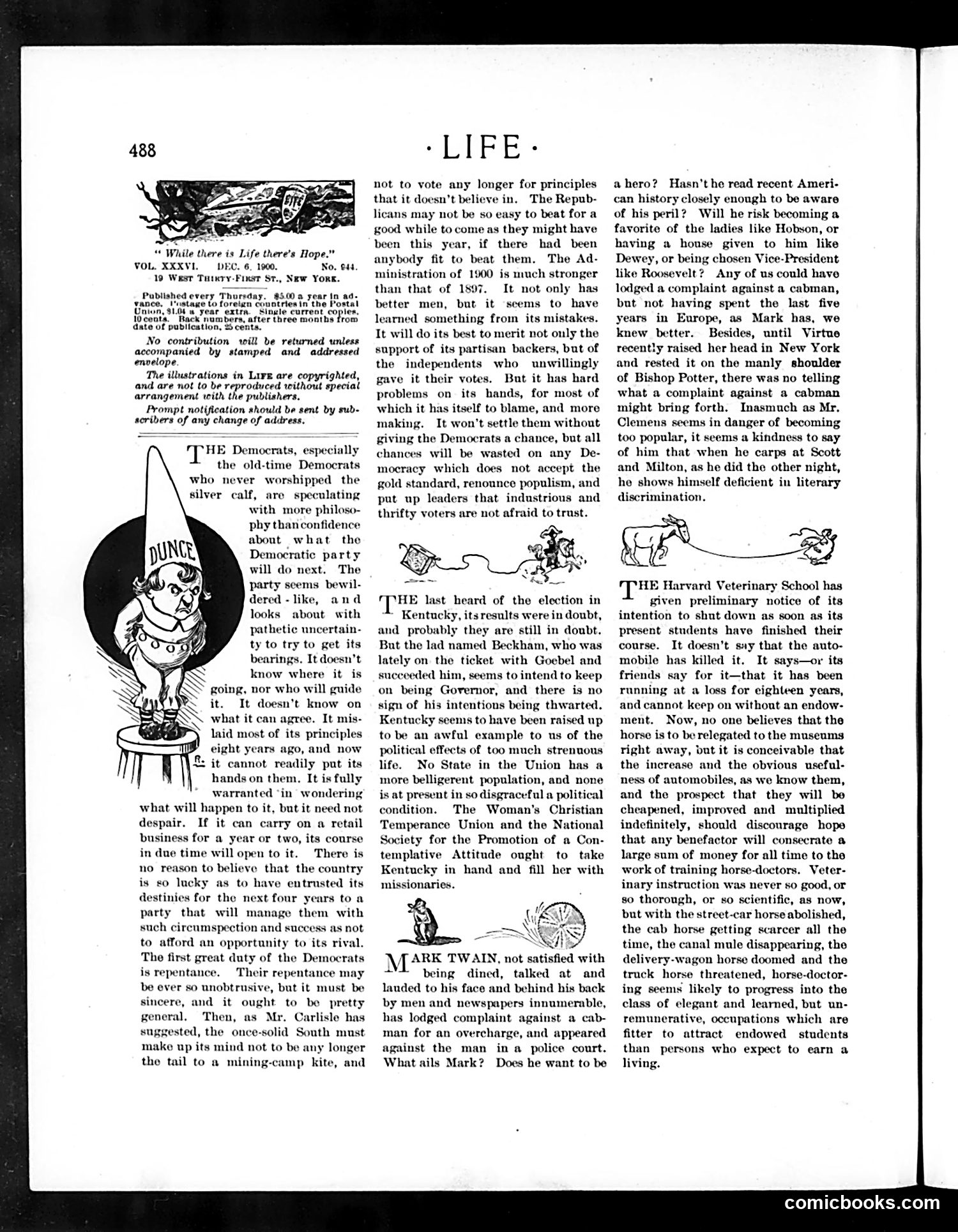
This page contains political commentary on the 1900 U.S. election. The main cartoon depicts a donkey (symbol of the Democratic Party) sitting atop a stool labeled "OUNCE," suggesting the Democrats are precariously balanced on a small foundation. The text discusses Democratic uncertainty about their party's future direction and leadership. It criticizes the party for potentially nominating weak candidates and suggests they've lost public confidence due to past mistakes. References include commentary on Kentucky election results, Mark Twain's complaint against a cabman (a humorous aside), and criticism of Harvard's veterinary school closing—used metaphorically to discuss the decline of useful institutions. The satire mocks Democratic Party instability and poor prospects heading into the 1900 election cycle.
📄 Transcribed text from this page (OCR, searchable)
Machine-transcribed from the original scan — historical spelling and the odd misread are preserved.
“* While there is Life there’s Hope.” VOL. XXXVI. DEC. 6. 1900. No. G44. 19 West Tutxry-Fixst St., New YORK. qLadlished every Thursday. 4500 a sear tn ad. stage to foreign countries in the Postal O14 year extra. | Sinule curreat copies. Back numbers, after three months from date of pubiteations ss conte. No contribution will be returned unless accompanied by stamped and addressed envelope. The illustrations in Lure are copyrighted, and are not to be reproduced without special arrangement with the publishers. Prompt notification should be sent by sub- scribers of any change of address, HE Democrats, especially the old-time Democrats who never worshipped the silver calf, are speculating with more philoso- phy thanconfidence about what the Democratic party will do next. The party seems bewil- dered - like, and looks about with pathetic uncertain- ty to try to get its bearings. It doesn’t know where it is going, nor who will guide it. It doesn’t know on what it can agree. It mis- laid most of its principles eight years ago, and now it cannot readily put its hands on them. It is fully warranted ‘in’ wondering what will happen to it, but it need not If it can carry on a retail business for a year or two, its course in due time will open to it. There is no reason to believe that the country is so lucky as to have entrusted its destinies for the next four years to a party that will manage them with such circumspection and success as not to afford an opportunity to its rival. The first great duty of the Democrats is repentance. Their repentance may be ever so unobtrusive, but it must be sincere, and it ought to be pretty general, Then, as Mr. Carlisle has suggested, the once-solid South must make up its mind not to be any longer the tail to a mining-camp kite, and WIPE not to vote any longer for principles that it doesn’t believe in, The Repub- licans may not be so easy to beat for a good while to come as they might have been this year, if there had been anybody fit to beat them. The Ad- ministration of 1900 is much stronger than that of 1897. It not only has better men, but it scems to have learned something from its mistakes. It will do its best to merit not only the support of its partisan backers, but of the independents who unwillingly gave it their votes. But it has hard problems on its hands, for most of which it has itself to blame, and more making. It won't settle them without giving the Democrats a chance, but all chances will be wasted on any De- mocracy which does not accept the gold standard, renounce populism, and put up leaders that industrious and thrifty voters are not afraid to trust. HE last heard of the election in Kentucky, its results were in doubt, and probably they are still in doubt. But the lad named Beckham, who was lately on the ticket with Goebel and succeeded him, seems to intend to keep on being Governor, and there is no sign of his intentions being thwarted. Kentucky seems to have been raised up to be an awful example to us of the political effects of too much strenuous life. No State in the Union has a more belligerent population, and none is at present in so disgraceful a political condition. The Woman's Christian Temperance Union and the National Society for the Promotion of a Con- templative Attitude ought to take Kentucky in hand and fill her with missionaries. M ARK TWAIN, not satisfied with aa being dined, talked at and lauded to his face and behind his back by men and newspapers innumerable, has lodged complaint against a cab- man for an overcharge, and appeared against the man in a police court. What ails Mark? Does he want to be ahero? Hasn't he read recent Ameri- can history closely enough to be aware of his peril? Will he risk becoming a favorite of the ladies like Hobson, or having a house given to him like Dewey, or being chosen Vice-President like Roc elt? Any of us could have lodged a complaint against a cabman, but not having spent the last five years in Europe, as Mark has, we knew better. Besides, until Virtue recently raised her head in New York and rested it on the manly shoulder of Bishop Potter, there was no telling what a complaint against a cabman might bring forth. Inasmuch as Mr, Clemens seems in danger of becoming too popular, it seems a kindness to say of him that when he carps at Scott and Milton, as he did the other night, he shows himself deficient in literary discrimination. “3 HE Harvard Veterinary School has given preliminary notice of its intention to shut down as soon as its present students have finished their course. It doesn’t say that the auto- mobile has killed it. It says—or its friends say for it—that it has been running at a loss for eighteen years, and cannot keep on without an endow- ment. Now, no one believes that the horse is to be relegated to the museums right away, but it is conceivable that the increase and the obvious useful- ness of automobiles, as we know them, and the prospect that they will be cheapened, improved and multiplied indefinitely, should discourage hope that any benefactor will consecrate a large sum of money for all time to the work of training horse-doctors. Veter- inary instruction was never so good, or so thorough, or so scientific, as now, but with the street-car horse abolished, the cab horse getting scarcer all the time, the canal mule disappearing, the delivery-wagon horse doomed and the truck horse threatened, horse-doctor- ing seems likely to progress into the class of elegant and learned, but un- remunerative, occupations which are fitter to attract endowed students than persons who expect to earn a living. comicbooks.com