
A complete issue · 44 pages · 1900
Life — December 1, 1900
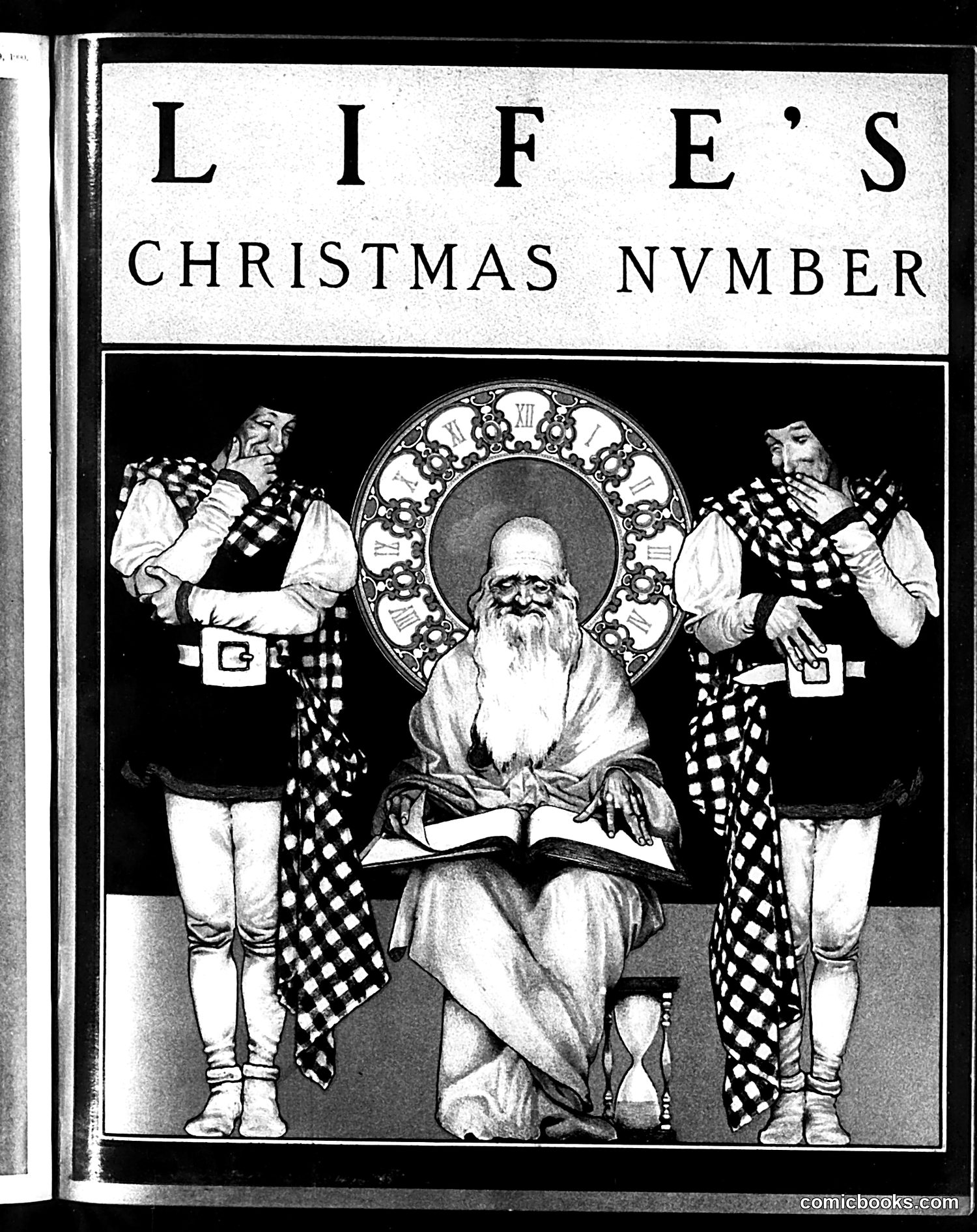
This is the cover of **Life Magazine's Christmas issue**. The central figure appears to be a religious or spiritual authority (indicated by the halo and formal robes), reading from a book while flanked by two jesters or satirical figures in checkered motley costume. The composition suggests commentary on the contrast between sacred religious observance and secular frivolity during Christmas. The jesters' presence alongside the reverent central figure likely satirizes how commercialism, entertainment, and irreverence intrude upon or trivialize the holiday's spiritual significance. The Roman numerals on the halo and the formal artistic style indicate this is an early 20th-century publication. Without additional context, the specific identities of the figures remain unclear, though the visual joke centers on the tension between Christmas piety and worldly amusement.
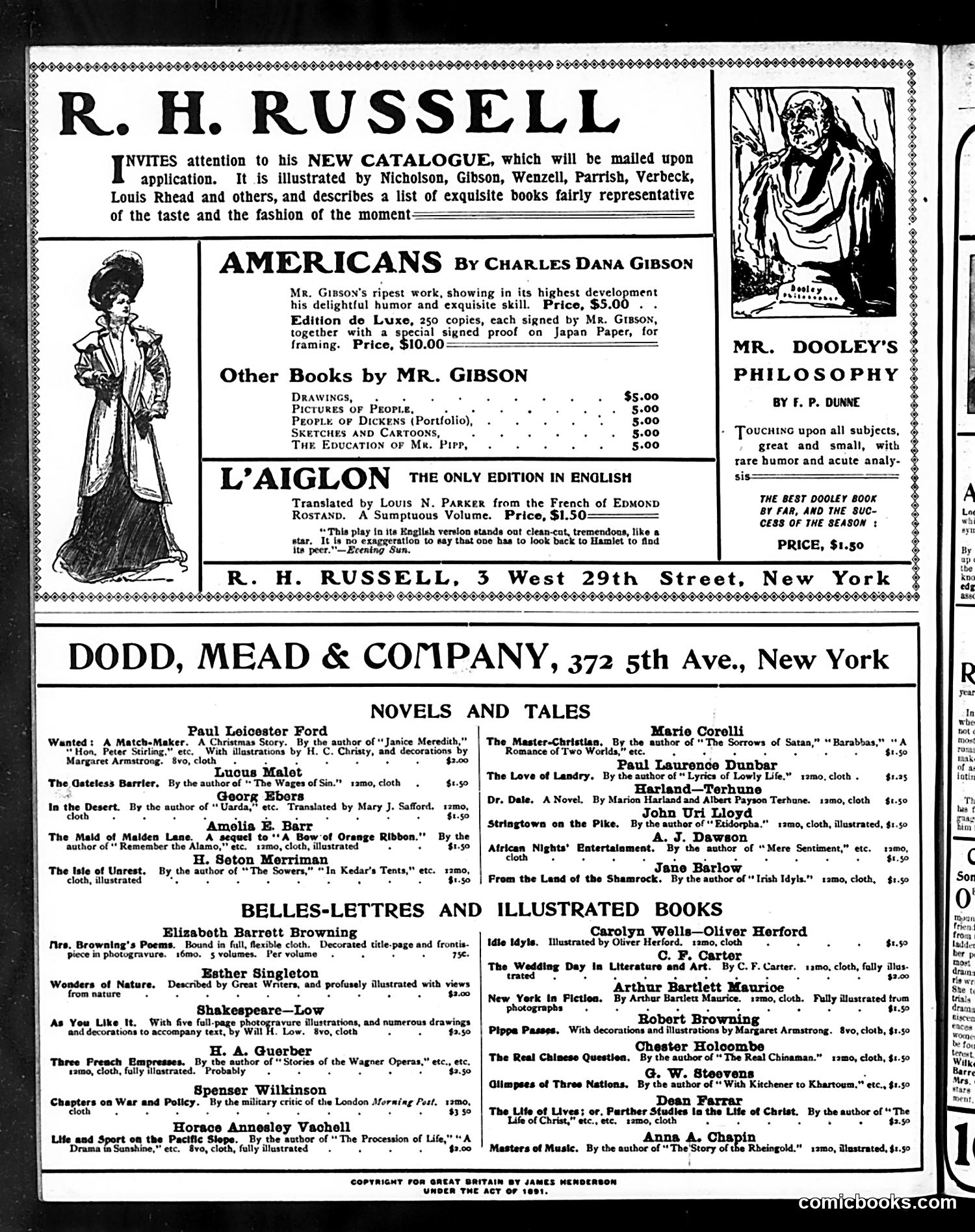
This page is primarily **advertising, not political satire**. It contains book advertisements from publishers R.H. Russell and Dodd, Mead & Company, circa early 1900s. The two illustrated figures are **not political cartoons but decorative advertisements**: one shows a fashionably dressed woman (advertising Russell's books), the other depicts an elderly bearded man (advertising "Mr. Dooley's Philosophy" by F.P. Dunne). The page catalogs contemporary literature—novels, tales, and illustrated books—representing popular taste of the moment. Authors listed include Charles Dana Gibson and Edmond Rostand, indicating this reflects established literary culture rather than satirical commentary. There is **no apparent political satire or social commentary** on this page; it functions purely as a commercial publishing catalog.
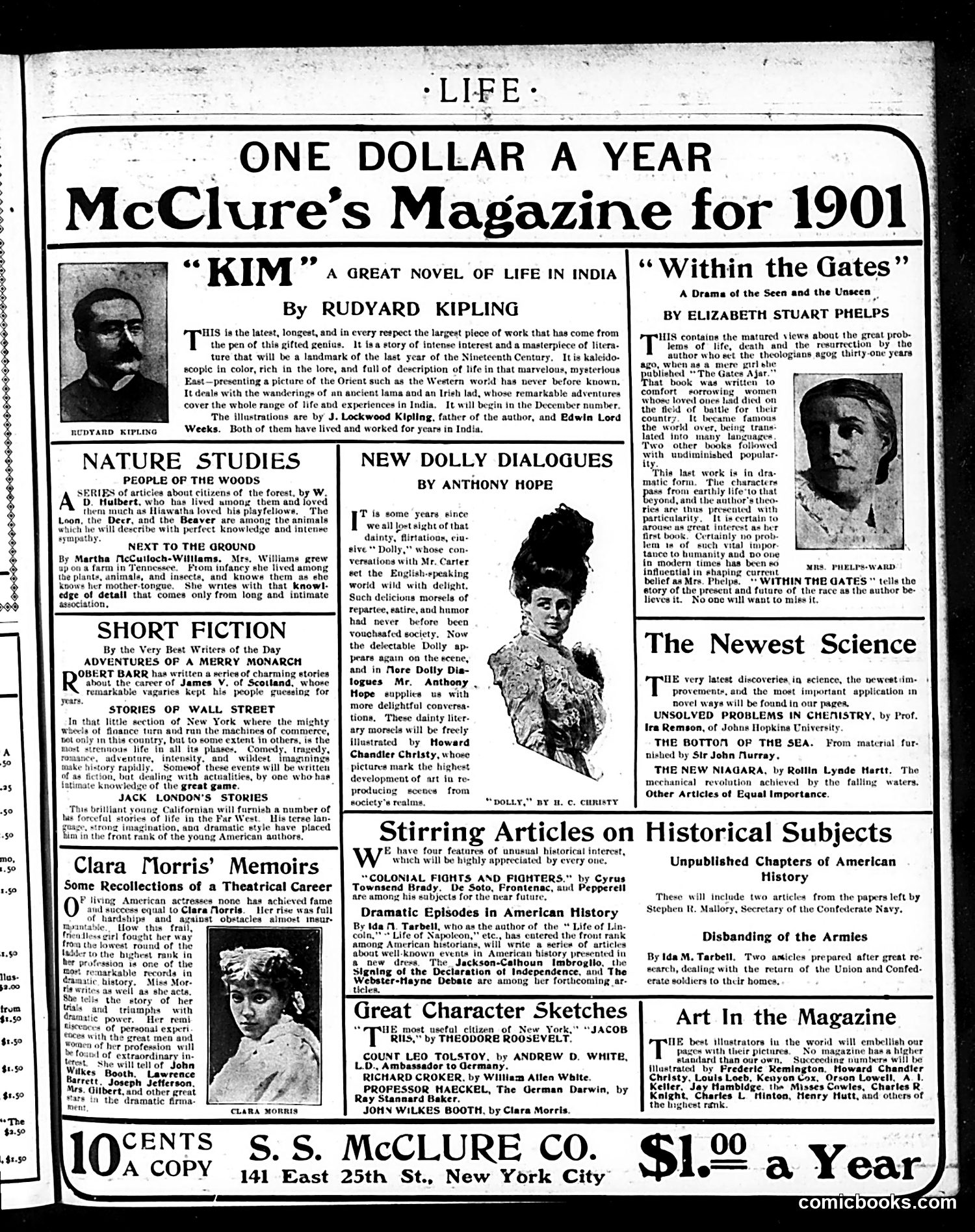
This is primarily a **magazine advertisement and table of contents** rather than political satire or editorial cartoon. The page promotes McClure's Magazine for 1901 at one dollar per year. Featured content includes Rudyard Kipling's novel *Kim* (illustrated with his portrait), a story titled "Within the Gates" by Elizabeth Stuart Phelps, nature studies, fiction by Robert Barr and others, and historical articles. There is one illustration labeled "Dolly" by H.C. Christy—a portrait of a fashionably dressed Gibson Girl-type woman. This appears to be promotional artwork for "New Dolly Dialogues" by Anthony Hope, reflecting early 1900s popular culture rather than political commentary. The page functions as marketing material showcasing the magazine's literary content and illustrators to potential subscribers.
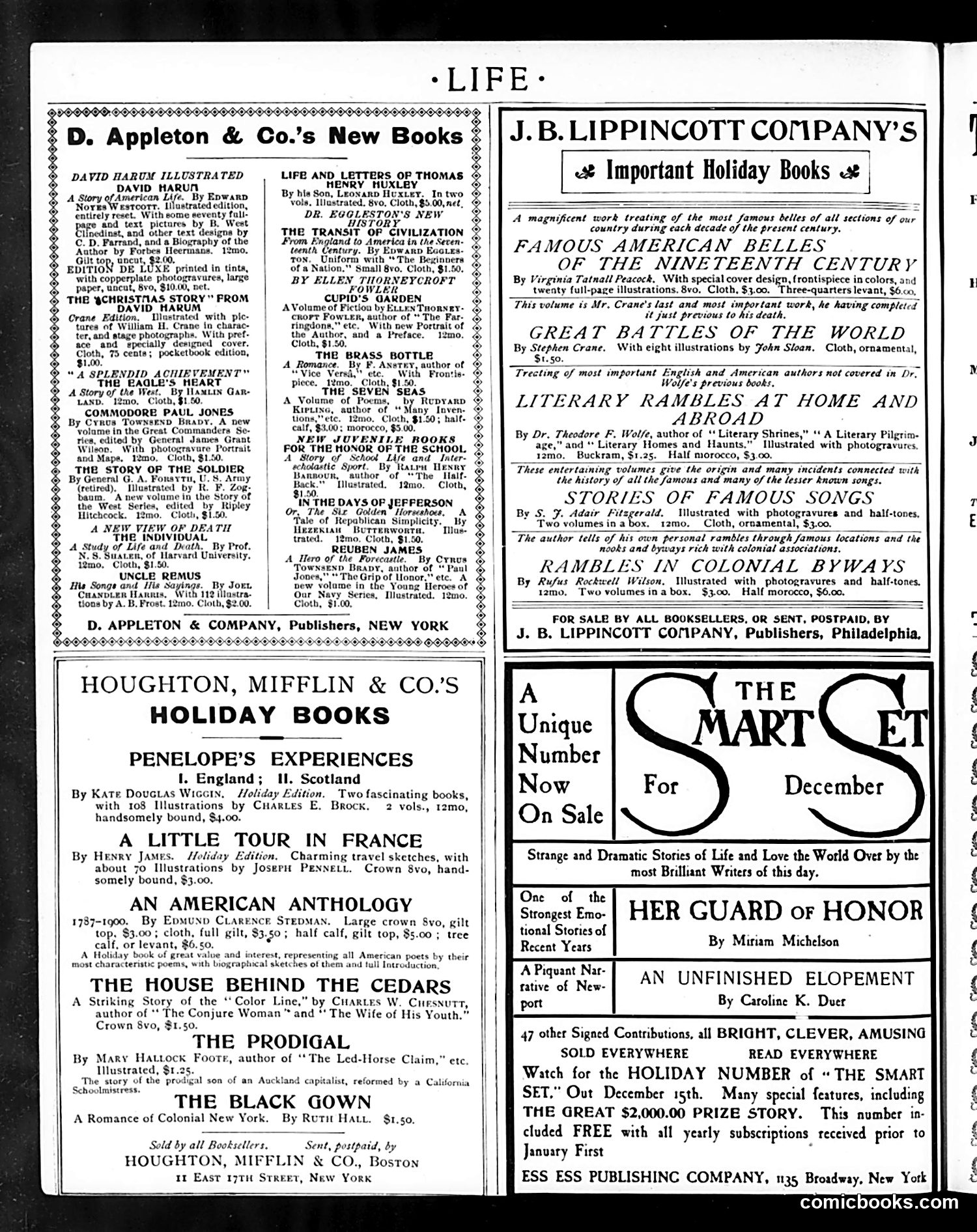
This page is **primarily advertising**, not editorial content or political cartoons. It contains book advertisements from three major publishers of the era: - **D. Appleton & Co.** promoting new books including works on history and literature - **Houghton, Mifflin & Co.** advertising "Holiday Books" for Christmas gift-giving - **J.B. Lippincott Company** featuring famous American belle literature and travel writing - **The Smart Set** magazine promoting its December "Holiday Number" with stories described as "Strange and Dramatic" The ads emphasize gift-appropriate titles—travel narratives, poetry collections, and anthologies—typical of early 20th-century holiday marketing. The decorative typography and layout reflect period advertising aesthetics. There are no political cartoons or satirical content visible on this page.
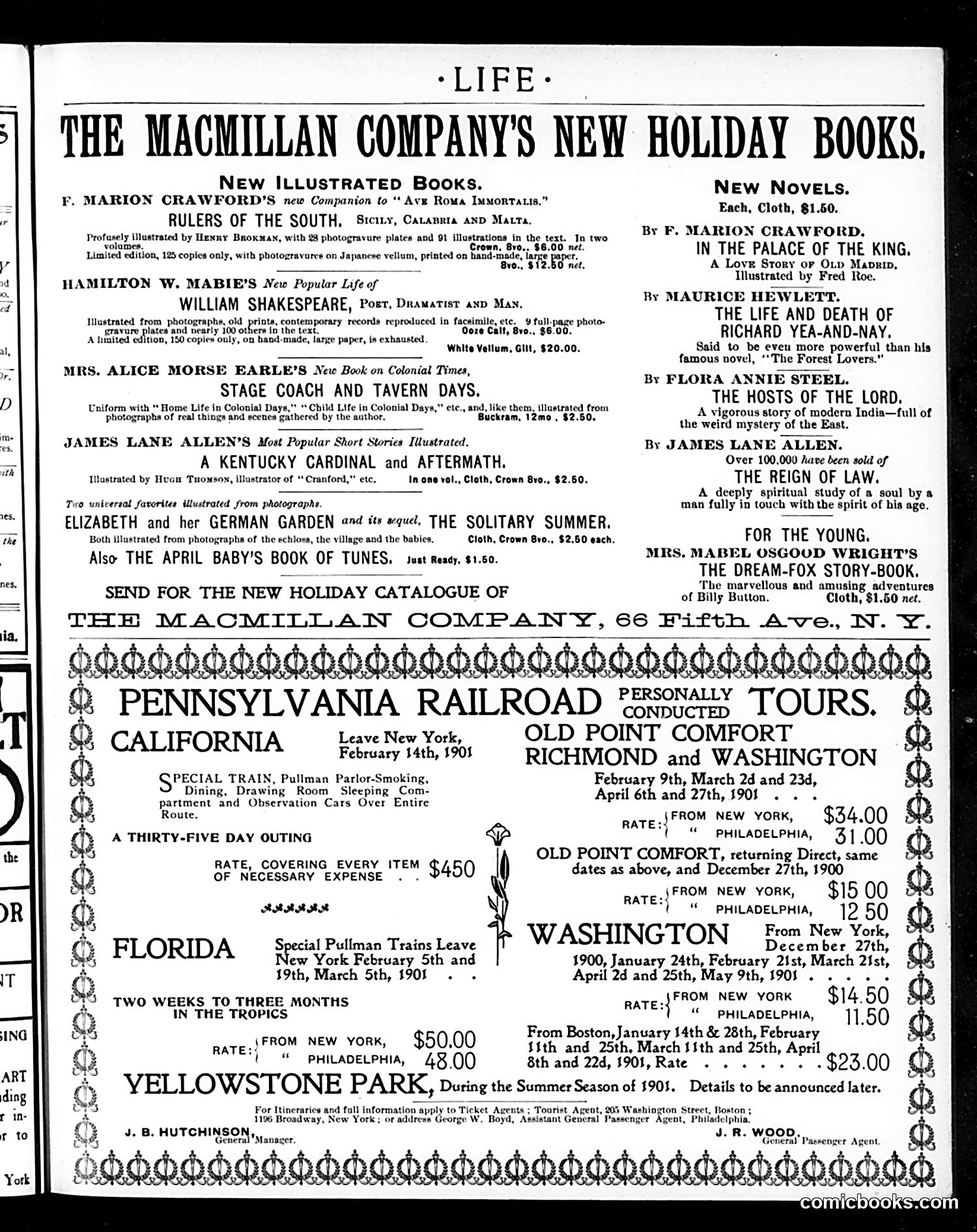
This page is **primarily advertising**, not political satire or comics. It showcases The Macmillan Company's new holiday books (illustrated books and novels, priced $1.50) and the Pennsylvania Railroad's "personally conducted tours" for 1901. The railroad advertisements dominate the lower half, promoting excursions to California, Florida, Yellowstone Park, Old Point Comfort/Richmond/Washington, and other destinations. Prices range from $14.50 to $450 depending on duration and departure city (New York, Philadelphia, Boston). The decorative border features ornamental flourishes typical of 1901 design. There is **no apparent political cartoon or satirical commentary** on this page—it's a straightforward commercial advertisement section from *Life* magazine's pages.
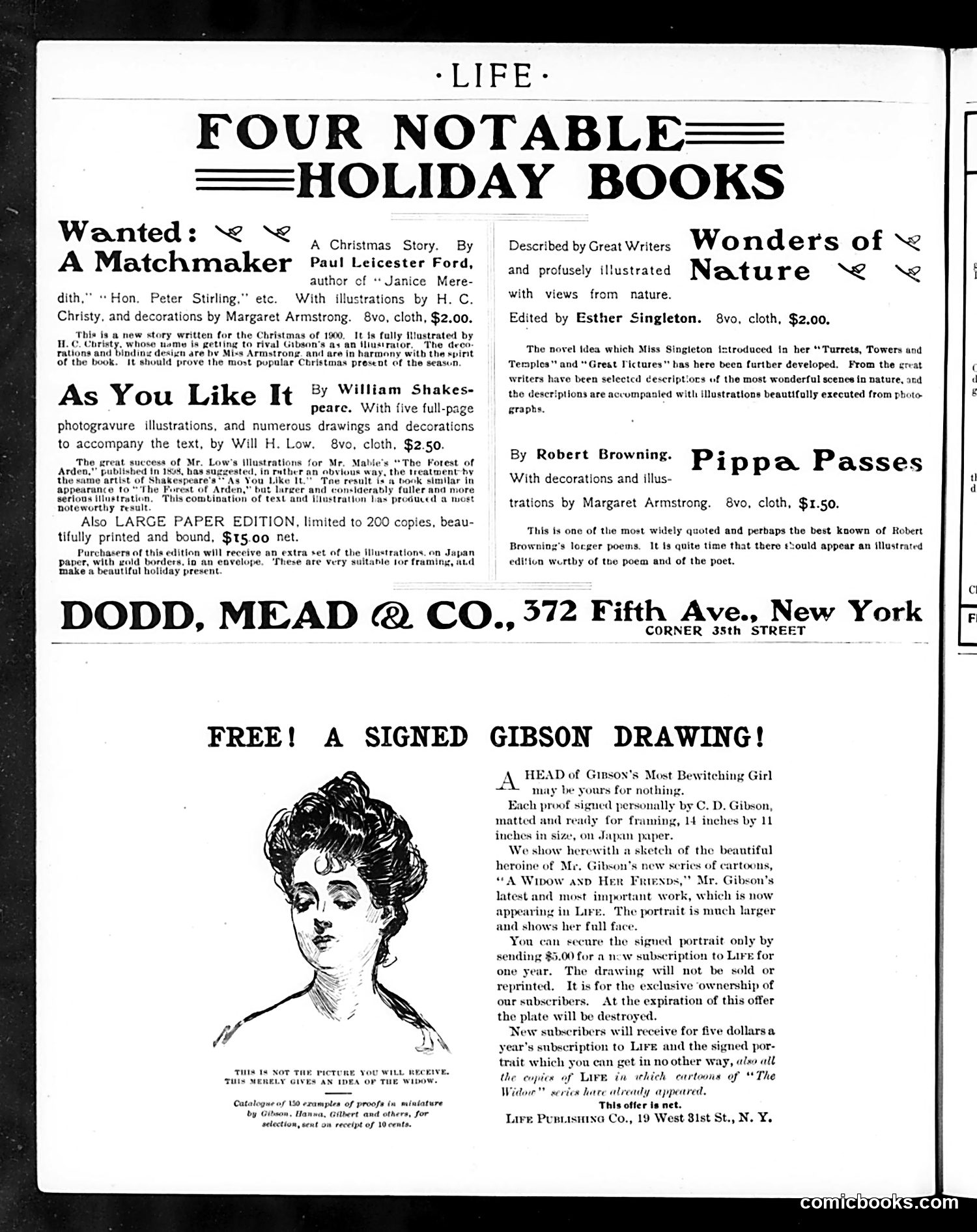
This page is primarily **advertising**, not satirical commentary. It showcases four notable holiday books from publisher Dodd, Mead & Co.: 1. "Wanted: A Matchmaker" by Paul Leicester Ford 2. "As You Like It" illustrated by Will H. Low 3. "Wonders of Nature" edited by Esther Singleton 4. "Pippa Passes" by Robert Browning The bottom half promotes a **Gibson Girl drawing giveaway**—a signed C.D. Gibson portrait available to new Life magazine subscribers. Gibson Girls were iconic illustrations of idealized American femininity popular in the early 1900s. There is no political satire present. This represents Life magazine's dual function as both satirical publication and advertising vehicle for contemporary cultural products.
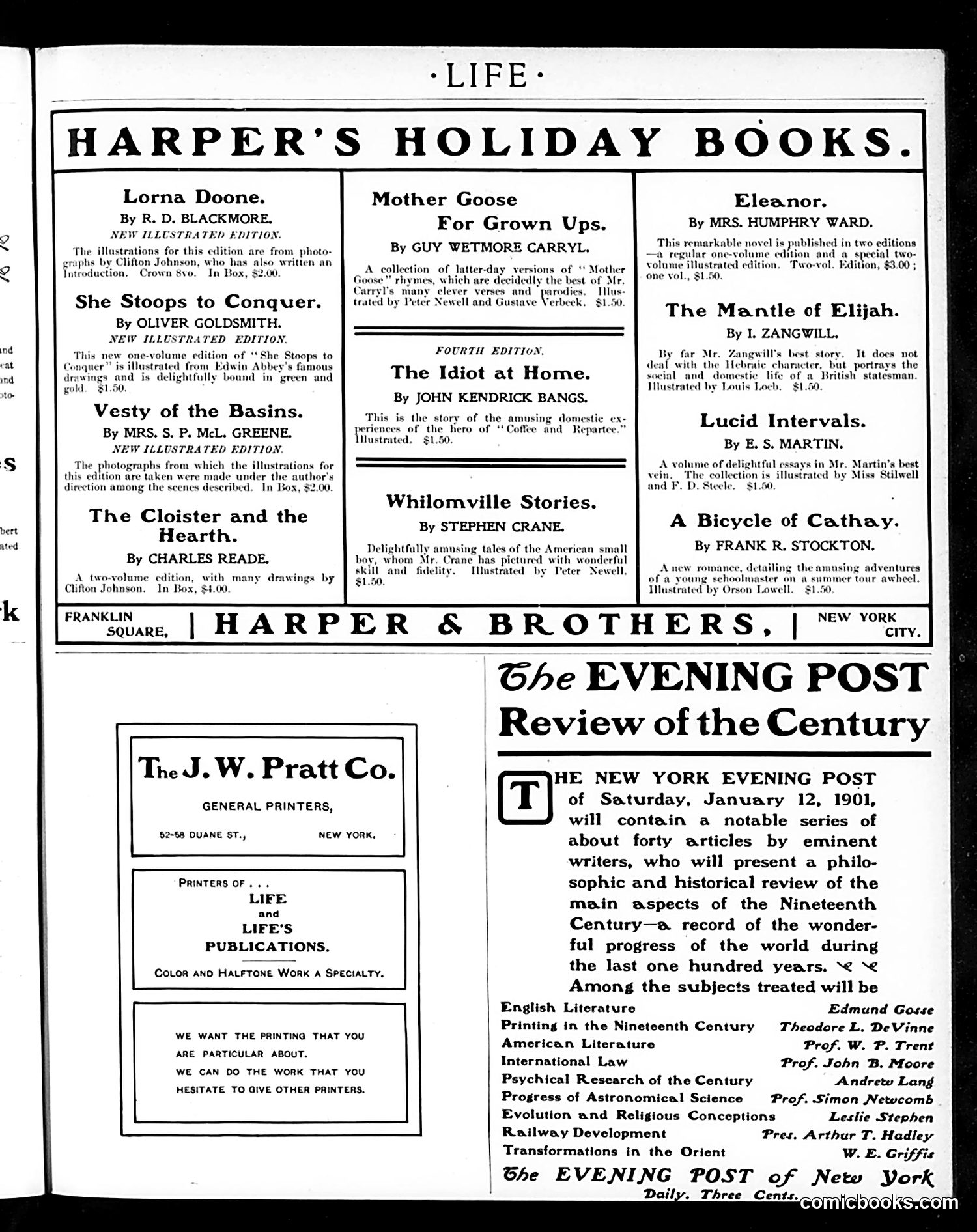
This is primarily an **advertising and announcement page** rather than a satirical cartoon page. The upper section advertises **Harper & Brothers' holiday book releases** (circa 1900), listing titles like *Lorna Doone*, *She Stoops to Conquer*, and *Eleanor*—classic literature repackaged for gift-giving. The lower section announces **The Evening Post's "Review of the Century"** series (January 12, 1901), promoting approximately forty articles by prominent writers reviewing nineteenth-century progress in English literature, American literature, law, astronomy, religion, and railway development. The left sidebar contains **printer's advertisements** for The J.W. Pratt Company, emphasizing their color and halftone printing capabilities for *Life* magazine. There is **no political satire or cartoon content** visible on this page—it functions as a publishing industry promotional piece.
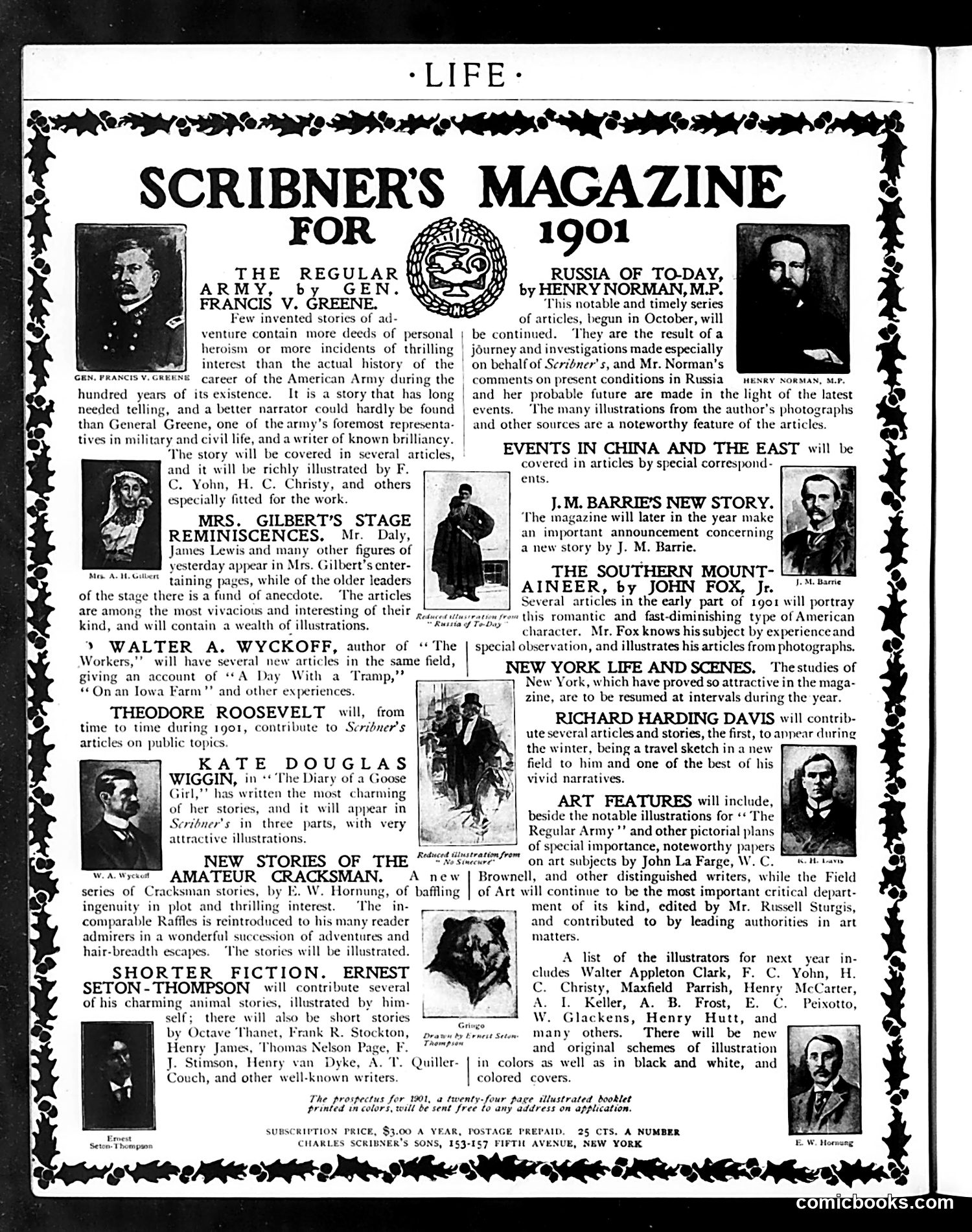
This is primarily a **promotional page** announcing Scribner's Magazine content for 1901, not a satirical cartoon. It features portrait photographs of contributing writers and illustrators positioned around text describing upcoming articles. The page highlights **literary and military content**: General Francis V. Greene's articles on the American Army; Henry Norman's series on Russia; and stories by established authors like Theodore Roosevelt, Kate Douglas Wiggin, and Walter A. Wyckoff. Notable is the **geopolitical focus**—Russia and China features suggest contemporary imperial interests during the Boxer Rebellion era. The page functions as editorial advertising, showcasing the magazine's prestigious contributors to attract subscribers at $1.00 yearly. No satire is evident; this is straightforward magazine promotion.
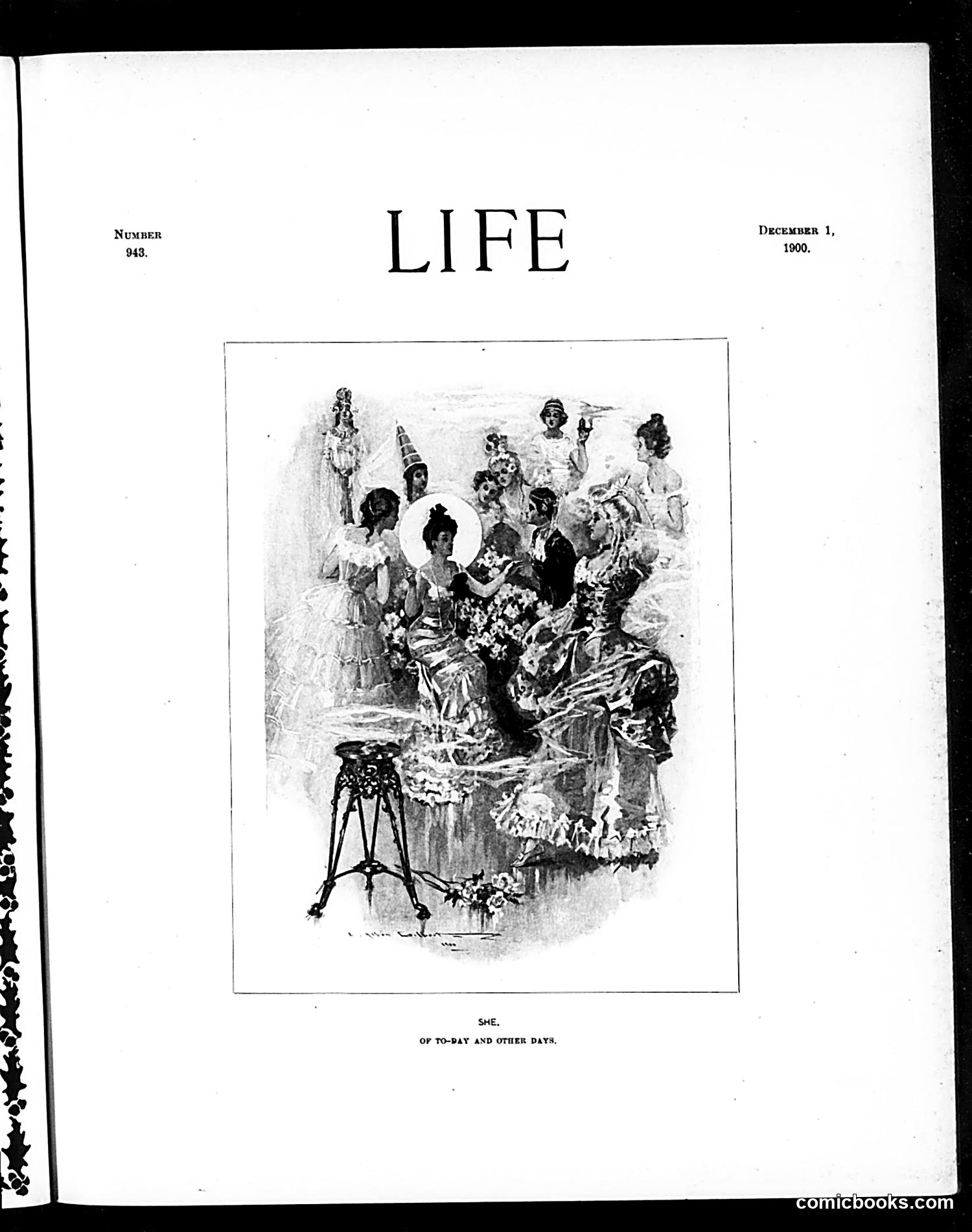
This is a title page for *Life* magazine (Number 943, December 1, 1900) featuring an illustration of elegantly dressed women gathered around what appears to be a fashionable social scene. The central figure wears a large decorative hat typical of the Edwardian era. The caption "She, of To-Day and Other Days" suggests the piece satirizes contemporary women—likely their fashion choices, social pretensions, or evolving roles. The elaborate clothing, hats, and accessories suggest commentary on the excesses or absurdities of upper-class feminine fashion and social gatherings at the turn of the century. Without additional text, the specific satirical target remains unclear, though it appears to critique women's fashion and social conventions of 1900.
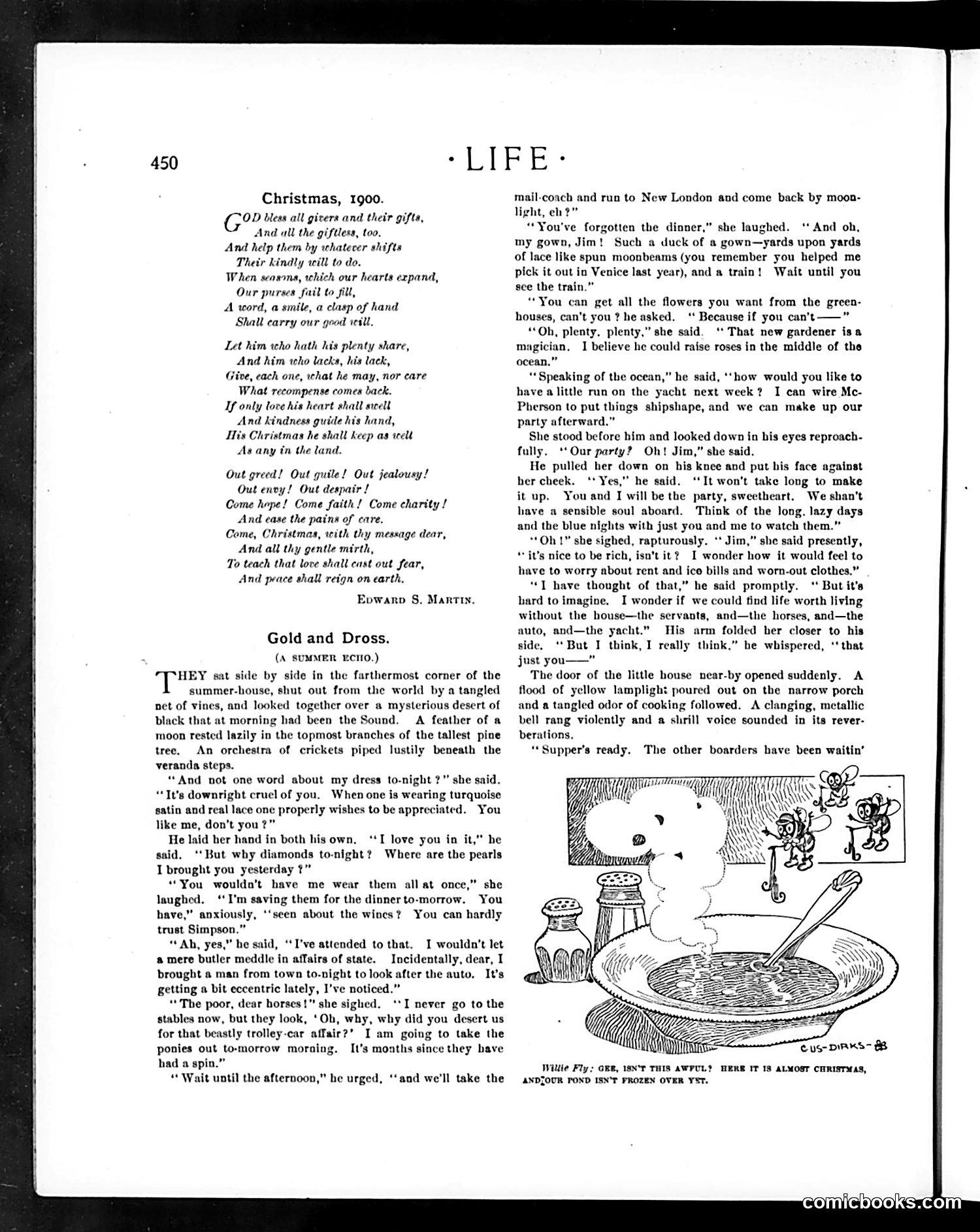
This page contains a Christmas poem by Edward S. Martin and a short story titled "Gold and Dross (A Summer Echo)." The accompanying illustration depicts a humorous domestic scene: a couple discussing evening dress and social obligations. The cartoon shows a man and woman in conversation, with the woman concerned about wearing proper attire to a formal dinner. The man appears dismissive of social conventions. The illustration's humor derives from the tension between maintaining social appearances and genuine domestic comfort—a recurring theme in turn-of-the-century American satire. The accompanying small illustration at bottom shows a fly near a pond or puddle, with a caption referencing Christmas, suggesting visual wordplay or seasonal commentary typical of Life magazine's light satirical approach to contemporary middle-class life and social pretensions.
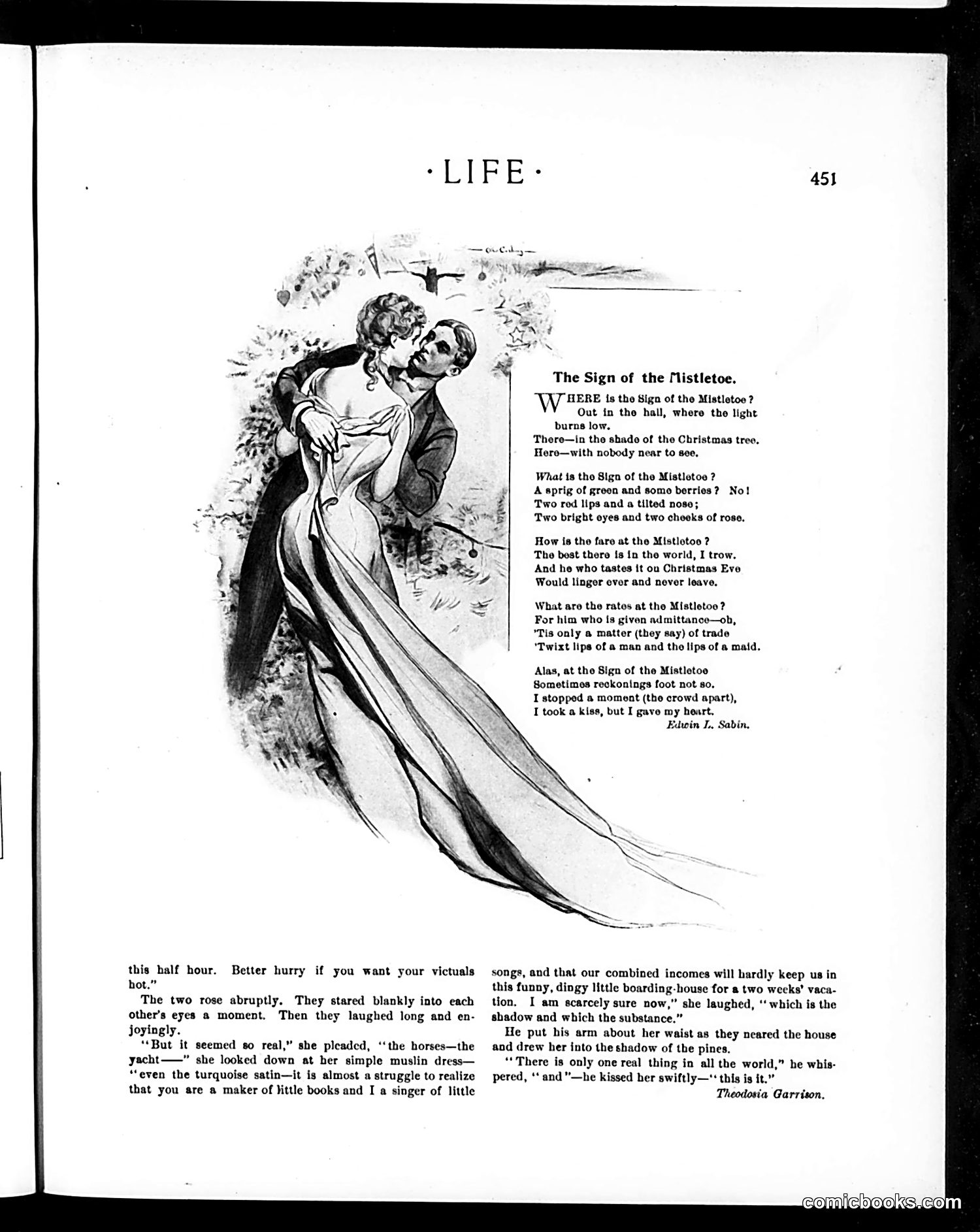
This page features "The Sign of the Mistletoe," a romantic poem by Edwin L. Sabin accompanying an illustration of a couple beneath mistletoe at Christmas. The content is **not political satire** but rather sentimental holiday romance—common to Life magazine's mix of humor and literary content. The illustration shows a man and woman in an intimate moment under mistletoe, a traditional Christmas custom permitting kissing. The poem playfully questions what makes mistletoe special: not the plant itself but the social permission it grants for romantic contact. The final stanza references a moment where the speaker "stopped a moment (the crowd apart), / I took a kiss, but I gave my heart." This represents early-20th-century genteel romance literature rather than political commentary.
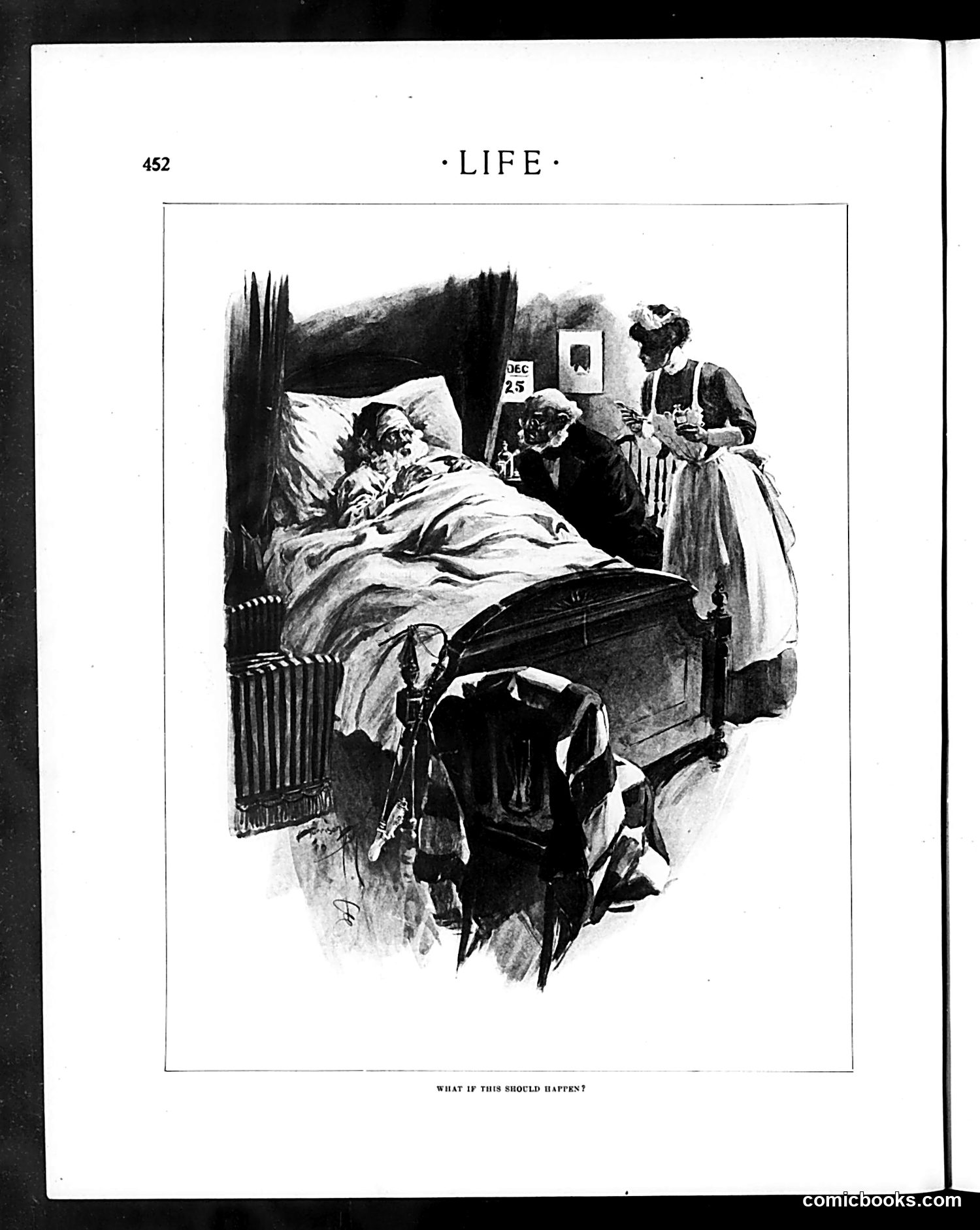
This satirical illustration from *Life* magazine depicts a domestic scene in a bedroom where a woman lies in bed, attended by two female figures (likely nurses or caregivers). A man in a coat stands at the foot of the bed, and a baby carriage is visible in the foreground. The caption "What If This Should Happen?" suggests anxiety about a hypothetical domestic crisis—possibly illness, childbirth complications, or a family emergency. The illustration appears to be social commentary on Victorian-era concerns about women's health, family vulnerability, or the uncertainties of domestic life. Without additional context about the specific issue's date and surrounding content, the exact target of satire remains unclear, though it likely addressed contemporary medical, insurance, or social welfare debates.
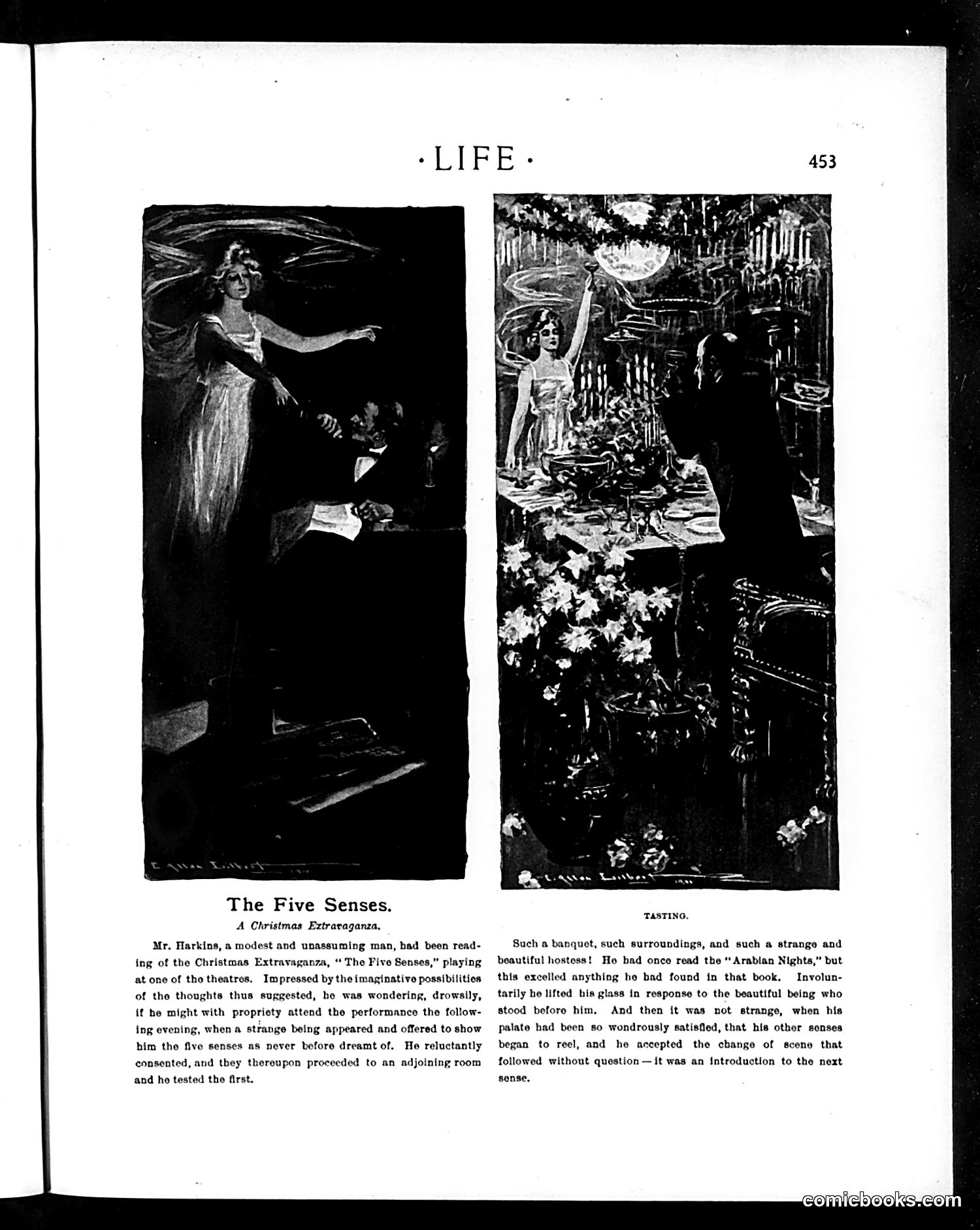
This is an illustrated story (not political satire) about a man named Harkins who attends a theatrical performance titled "The Five Senses." The narrative follows a fantastical premise: a mysterious figure offers to show him the five senses in extraordinary ways beyond the stage production. The page depicts the first sense—"Tasting"—where Harkins attends an elaborate banquet hosted by a beautiful woman in lavish surroundings. The text plays on his enchantment, comparing the experience favorably to the *Arabian Nights*. The implication is suggestively romantic: as his palate is satisfied, "his other senses began to reel," and he willingly moves to experience the next sense. This appears to be holiday-season entertainment fiction typical of Life magazine's lighter content, using the theatrical framework as cover for mildly suggestive humor about sensory pleasure and seduction.
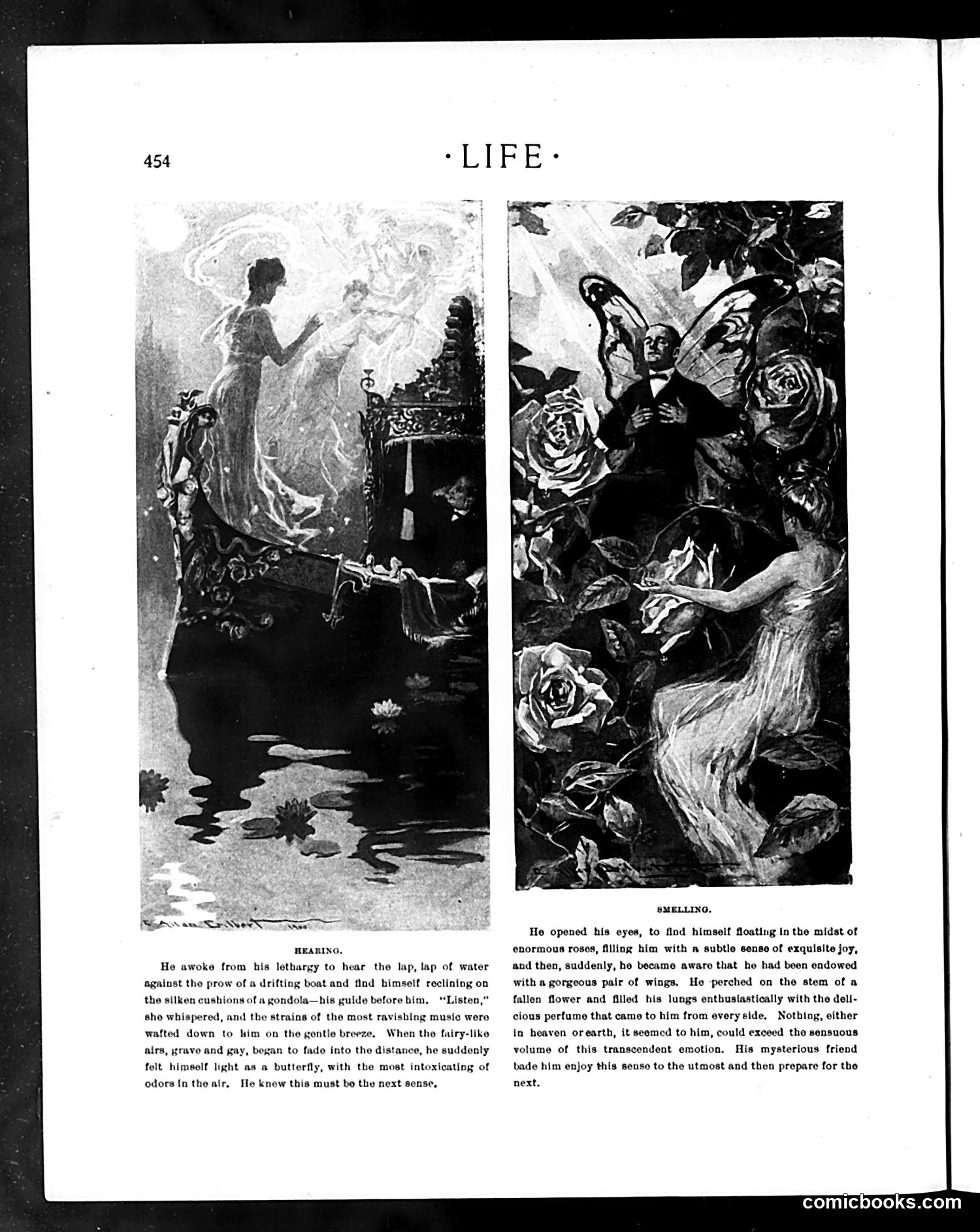
This page illustrates two stages of a fantastical journey through the senses. The left panel, titled "HEARING," shows a man awakening in a gondola, transported by magical music. The right panel, "SMELLING," depicts him surrounded by enormous roses, equipped with wings, inhaling their perfume in ecstatic joy. The narrative appears to be allegorical—a mysterious guide is leading the protagonist through sensory experiences in ascending order of pleasure. The artwork style and romantic imagery (Venice gondola, enchanted garden, fairy-tale elements) suggest this is a whimsical exploration of human sensation and aesthetic experience, likely from the early 20th century. The satire likely mocks either sentimental romanticism or the indulgent pursuit of sensory pleasure. Without seeing subsequent pages showing remaining senses (taste, touch), the ultimate point remains unclear, though the "mysterious friend" may be revealed as a satirical figure.
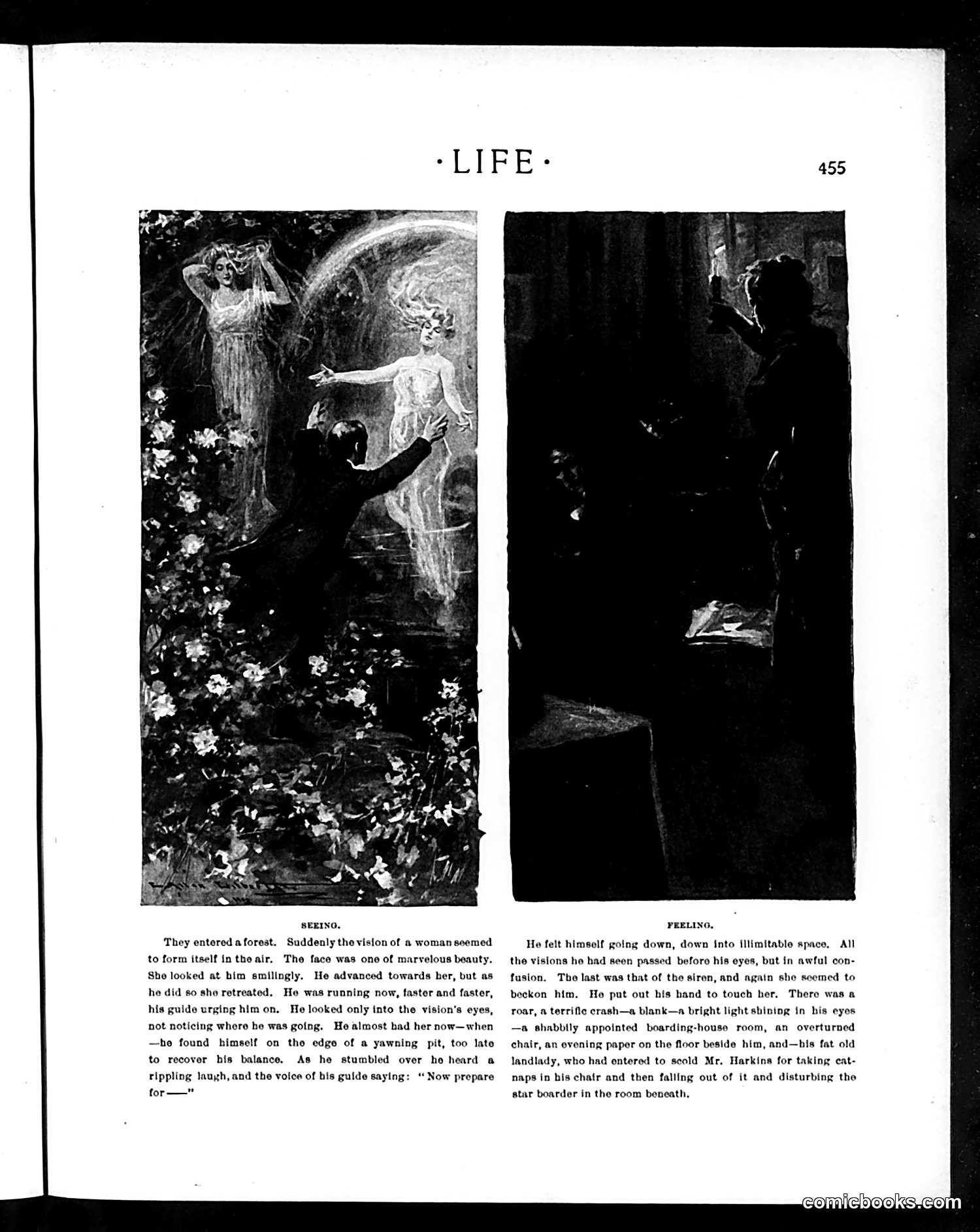
This two-panel illustration depicts a moral allegory about the dangers of distraction and temptation. The left panel ("SEEING") shows a man in a forest pursuing a beautiful woman's vision while his guide urges him forward—he's so entranced that he fails to notice he's running toward a cliff edge. The right panel ("FEELING") reveals the fall's consequences: the man experiences vivid, confused hallucinations of all previous visions before crashing back to reality. The joke's punchline is the deflation: the dramatic supernatural descent turns out to be a man named Harkins simply falling out of his chair during a nap in his shabby boardinghouse room, startling his landlady and disturbing the downstairs tenant. The satire mocks both romantic idealism (the pursuit of illusory beauty) and the grandiose inner lives people construct—here reduced to a mundane domestic embarrassment. It's early-20th-century *Life* magazine humor: satirizing human pretension through contrasting romantic fantasy with unglamorous reality.
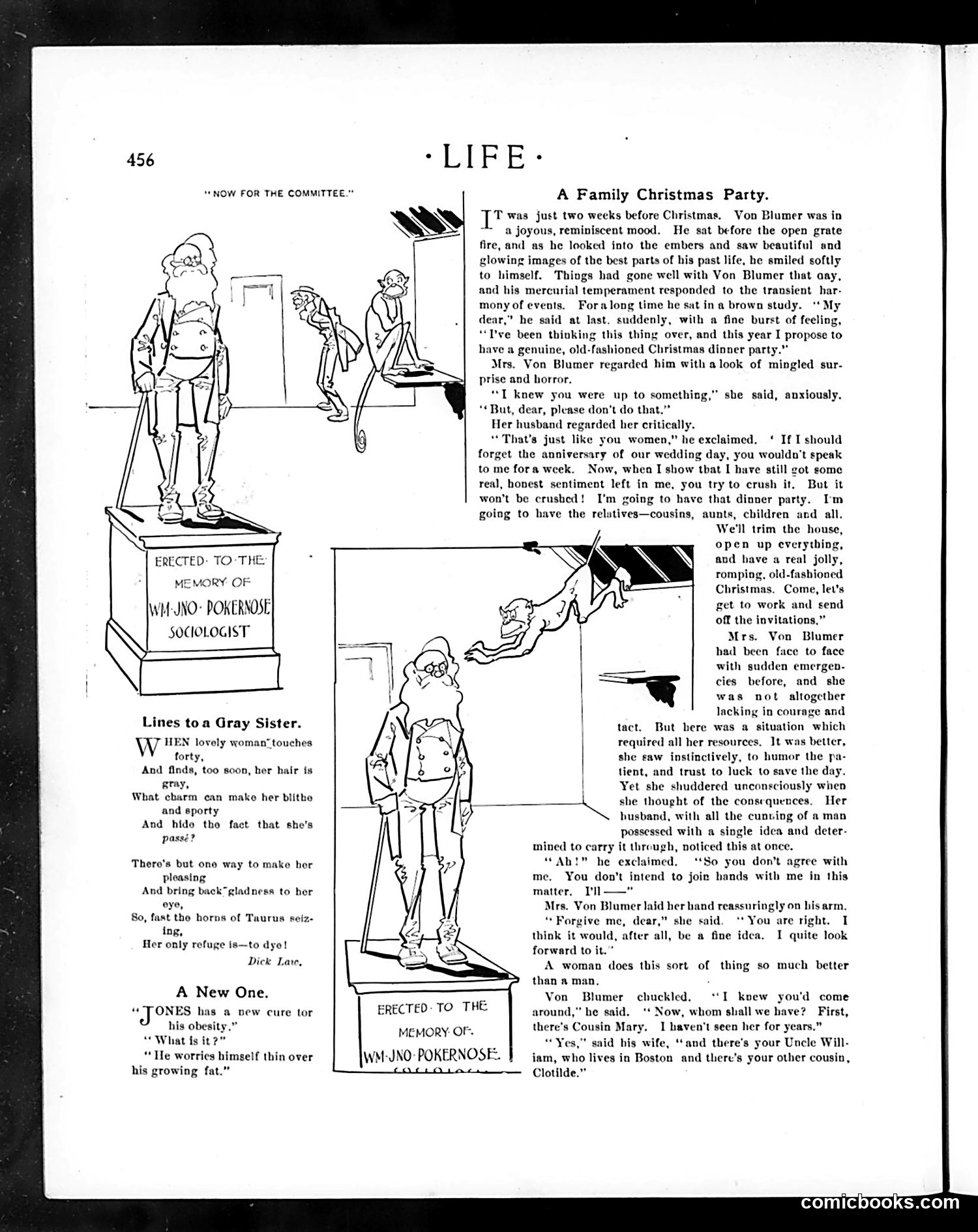
This Life magazine page (page 456) contains three distinct items: **Left side:** Two small satirical poems and a cartoon depicting a statue "Erected to the Memory of Wm. Jno. Pokernose, Sociologist" with figures examining it. The reference to "Pokernose" appears to be a generic mockery of a pompous or ridiculous person—likely a type-character rather than a specific identifiable figure. The cartoons mock vanity and self-importance. **Right side:** A serialized short story titled "A Family Christmas Party" about Von Blumer, who insists on hosting a traditional Christmas dinner despite his wife's reluctant concerns. The narrative illustrates spousal dynamics: the husband's sentimental impulse versus the wife's practical anxiety about managing relatives. The story emphasizes that women handle such social situations "so much better than a man." **Context for modern readers:** This reflects early 20th-century gender assumptions—depicting wives as socially competent managers of family obligations, while husbands are portrayed as emotionally impulsive but socially inept. The humor relies on recognizable domestic tensions around holiday entertaining.
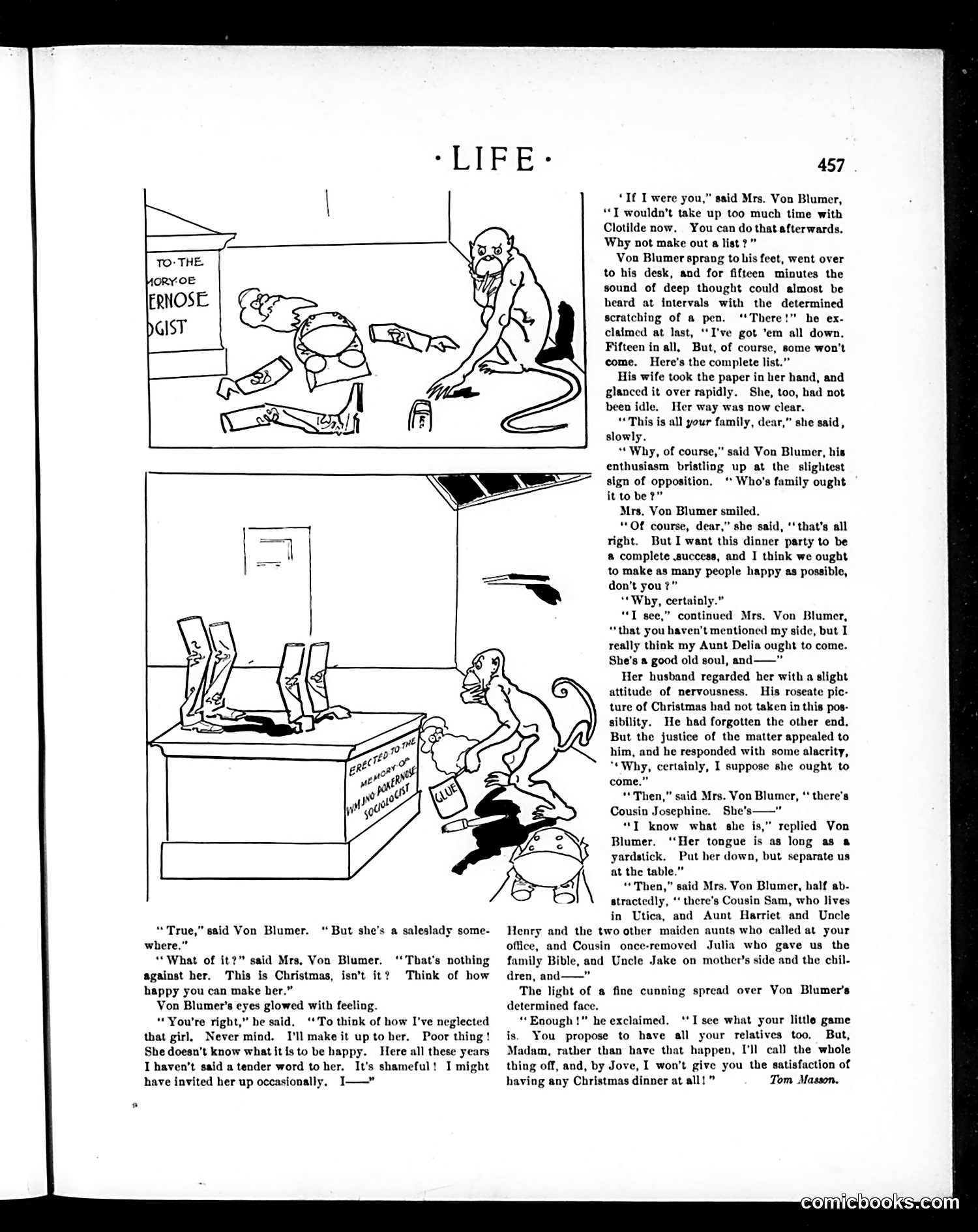
This is a domestic comedy about Christmas dinner planning. Von Blumer intends to invite 15 of *his* relatives, but his wife cleverly manipulates him into expanding the guest list by suggesting he invite her neglected saleslady relative, then gradually revealing she wants her own family present too—Aunt Delia, Cousin Josephine (mocked for talking too much), Cousin Sam from Utica, multiple aunts, and various other relations. The satire targets marital power dynamics: the wife's strategic cunning versus the husband's initial obliviousness. When Von Blumer realizes he's been outmaneuvered into hosting her entire extended family, he threatens to cancel Christmas dinner entirely rather than submit. The cartoons show the domestic chaos of planning and the couple's negotiation. The humor relies on recognizable family tension—relatives one must invite out of obligation rather than genuine desire—and the wife's superior manipulation skills.
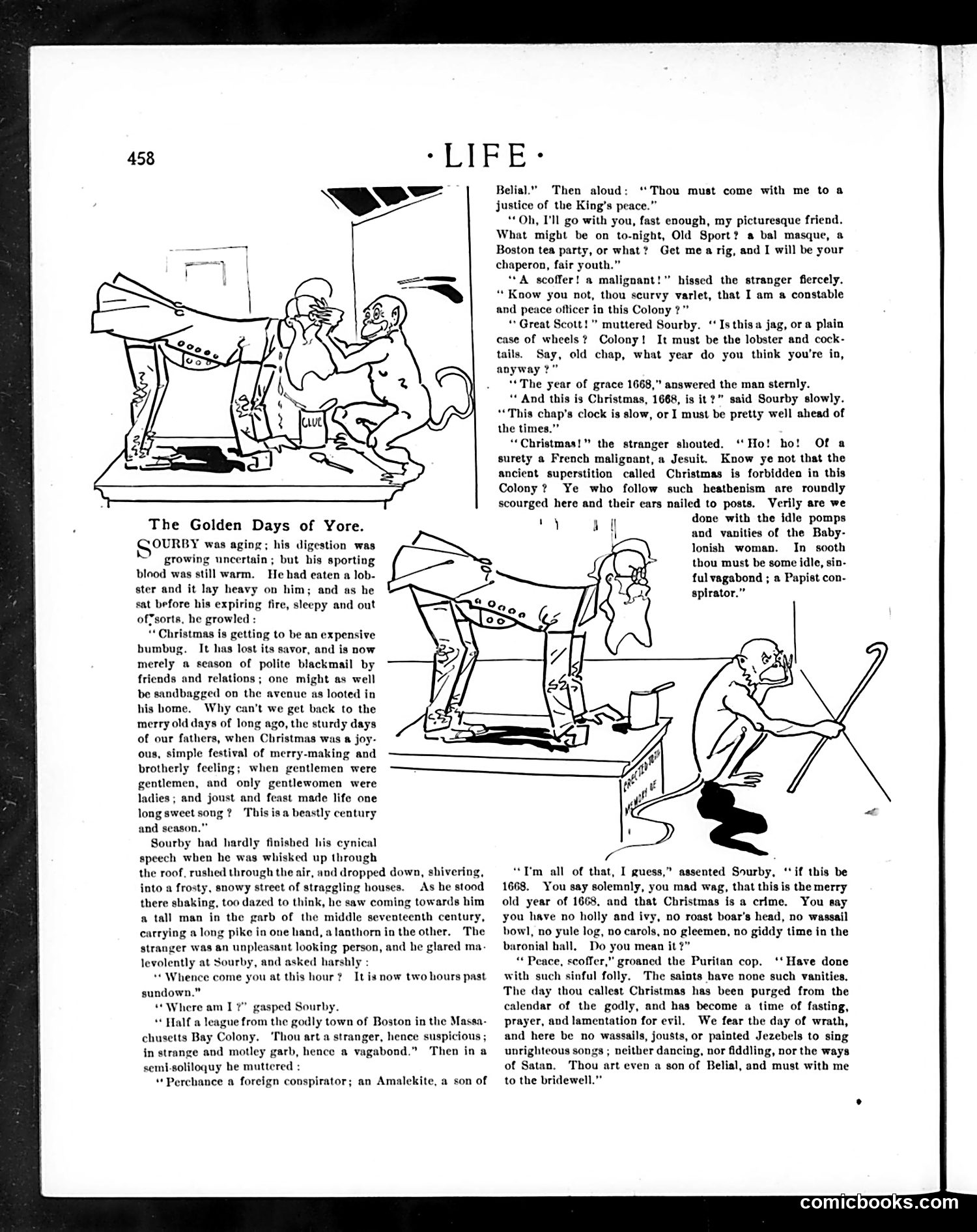
This is a satirical story illustrated with cartoons about a man named Sourby who complains that modern Christmas (the 1880s-90s) has become commercialized and lost its charm. He wishes for the "merry old days" of his ancestors. He's magically transported to 1668 Massachusetts Bay Colony, where he encounters a Puritan constable who informs him that Christmas is **forbidden** and considered sinful. The joke targets Sourby's nostalgia: the "good old days" he romanticizes were actually far grimmer—Puritans actively suppressed Christmas celebrations as "heathen" practices, viewing them as sinful vanities. The satire mocks both Sourby's naive romanticism about the past and the era's broader tendency to idealize earlier American history. It also jabs at Puritan severity. The constable's hostility and threat of violence (ear-nailing to posts) emphasizes the harsh reality behind the myth.
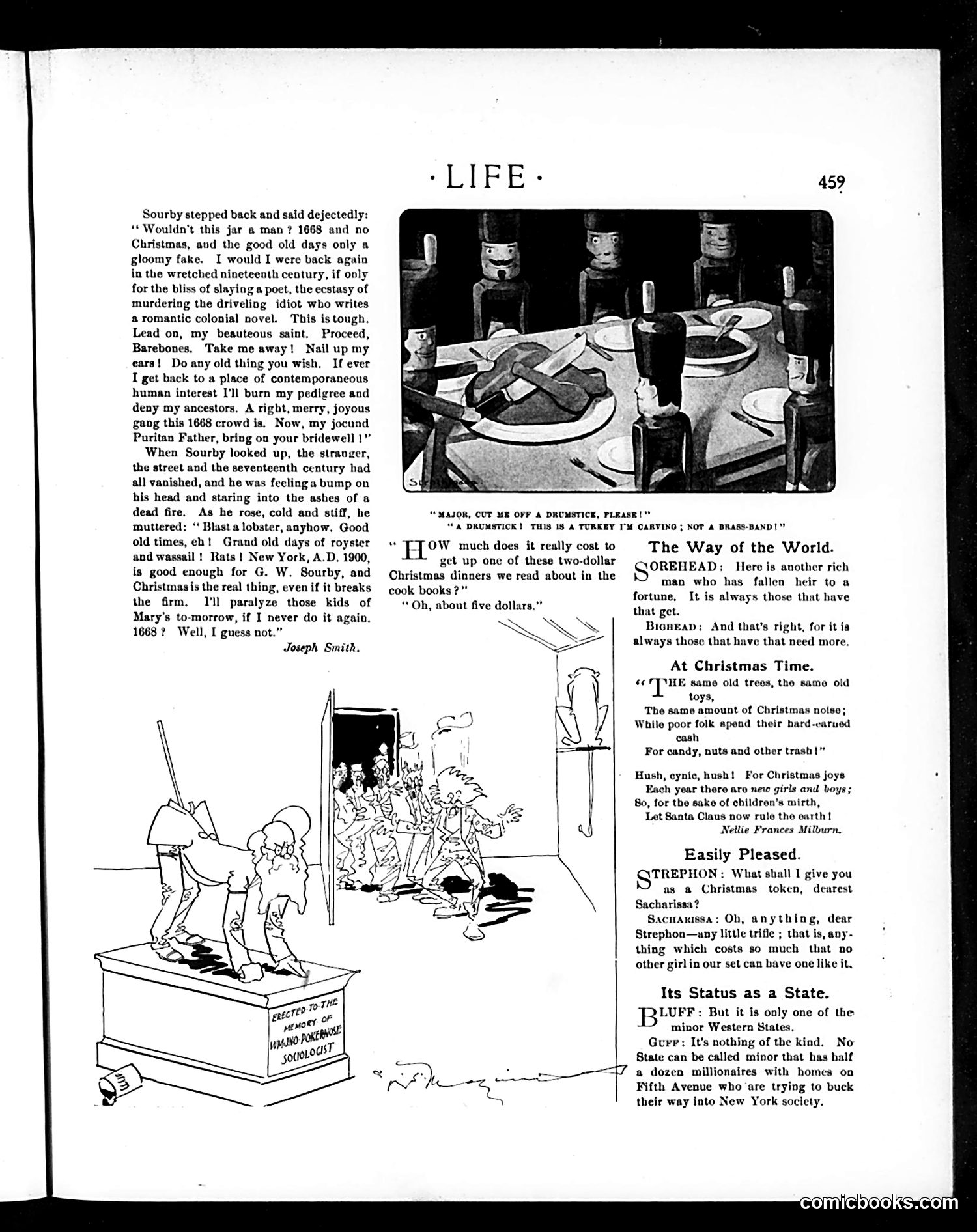
This page contains multiple satirical pieces mocking turn-of-the-century American society, particularly around Christmas and wealth. The main narrative excerpt follows "Sourby," who dreams of escaping 1900 New York for the "romantic" colonial past (1668), only to awaken disillusioned—suggesting the present era, however flawed, beats nostalgic fantasies. The cartoons mock: 1. **Class and consumption**: A dialogue reveals expensive "two-dollar Christmas dinners" actually cost five dollars, satirizing middle-class pretension and hidden costs. 2. **Wealth inequality**: Wealthy heirs receiving fortunes while the poor struggle—a sardonic comment on unequal distribution. 3. **Social climbing**: A Western state is deemed "not minor" because its millionaires possess Fifth Avenue homes and social ambitions, mocking how wealth alone defines status rather than geographic importance. The humor targets Gilded Age materialism, class anxiety, and the gap between public perception and economic reality in 1900s America.
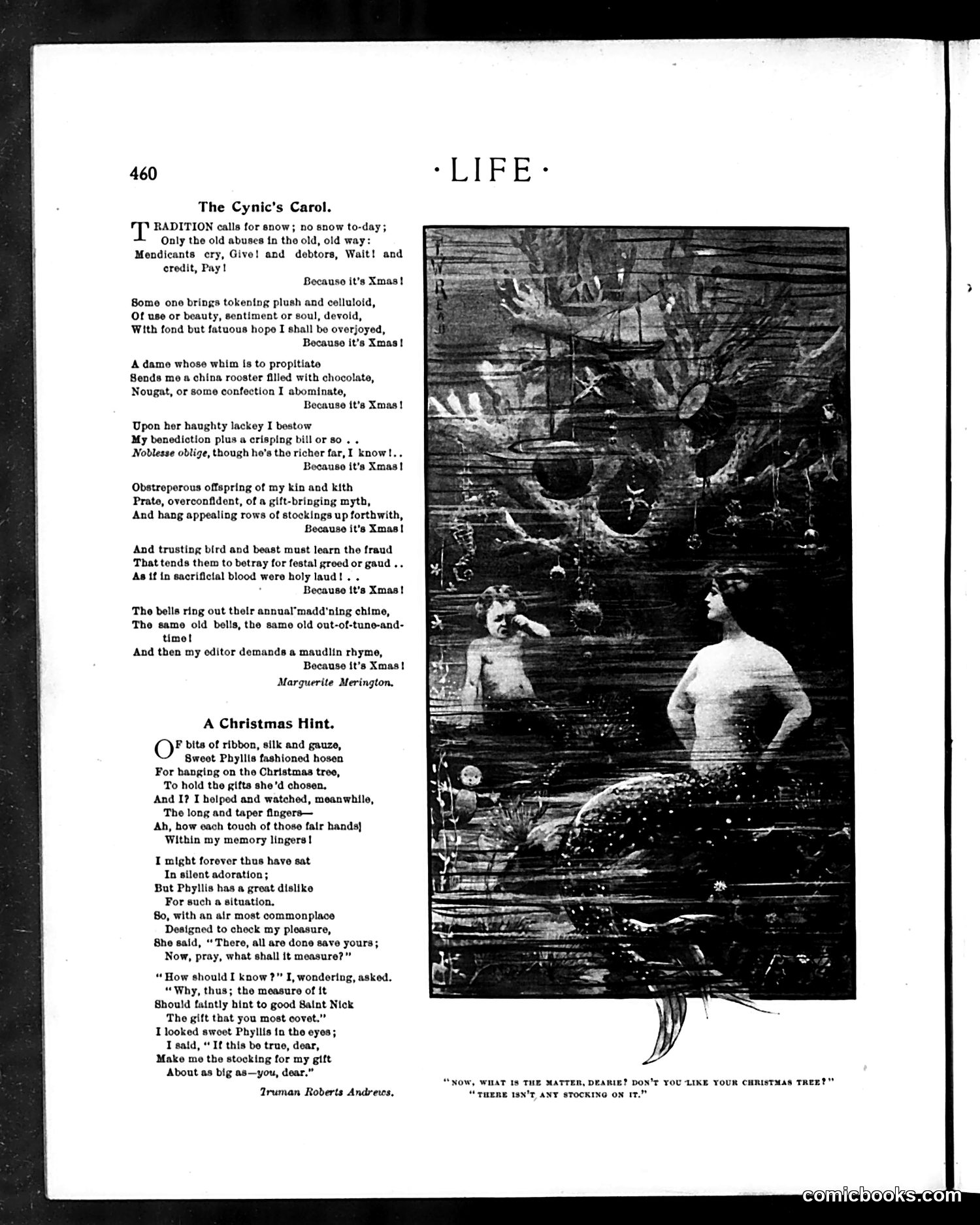
**"The Cynic's Carol"** by Marguerite Merington is a satirical poem mocking Christmas commercialism and social obligation. The speaker bitterly catalogs the season's hypocrisies: receiving useless gifts (a chocolate-filled ceramic rooster), tipping servants despite their greater wealth ("noblesse oblige"), indulging spoiled children, and the general fraud perpetrated on both animals and people in Christmas's name. The repeated refrain "Because it's Xmas!" emphasizes how the holiday excuses and enables behavior normally criticized. **"A Christmas Hint"** by Truman Roberts Andrews is a sentimental romance about a young man helping his beloved Phyllis sew Christmas stockings. When she asks what size stocking he wants, he romantically suggests one "about as big as—you, dear," implying she is his desired gift. The cartoon below illustrates the second piece, showing a disappointed child noting the tree lacks a stocking—suggesting the sentimental story's implicit happy ending or romantic proposal.
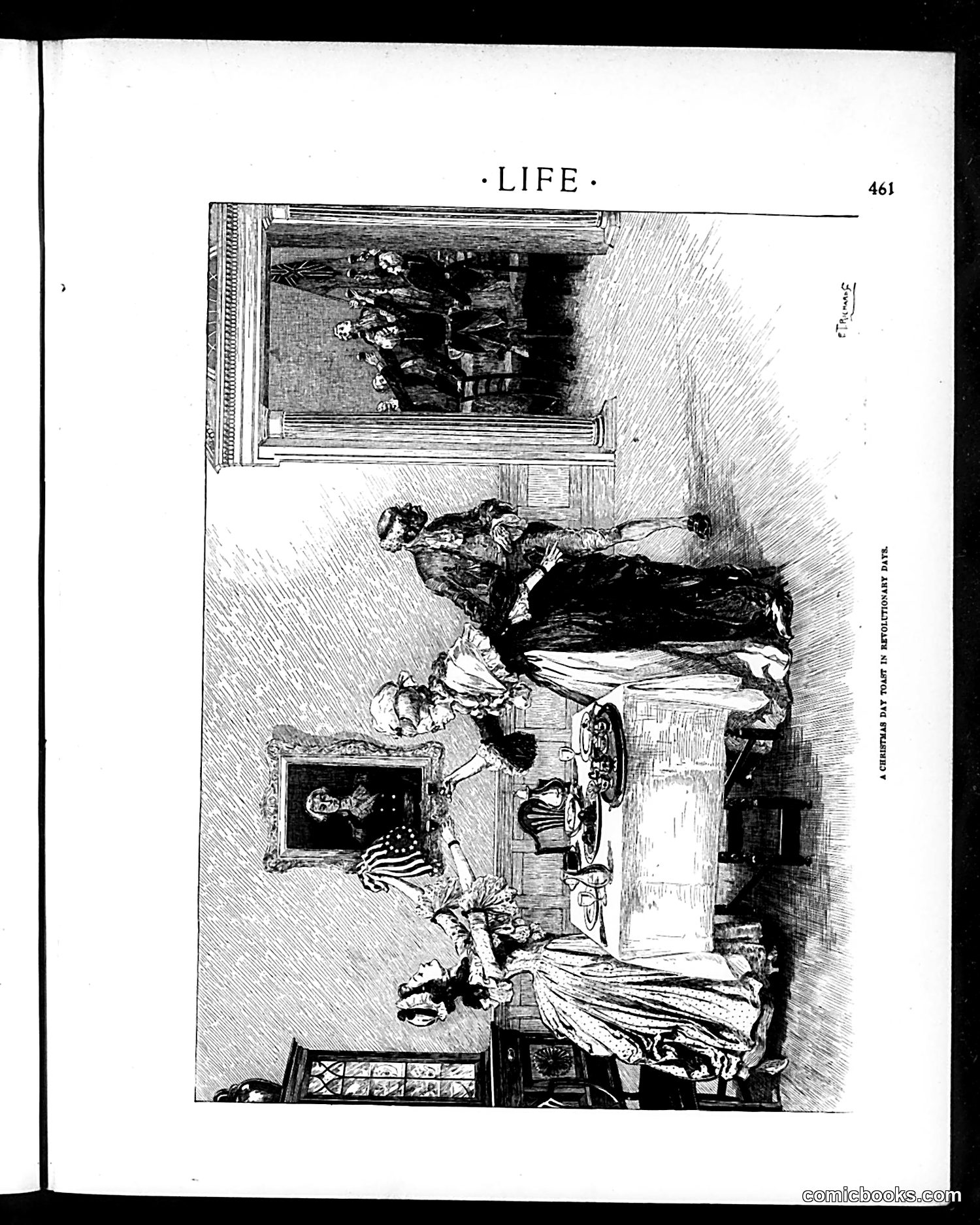
This page appears to be rotated 90 degrees, making it difficult to read the OCR text clearly. The illustration shows what seems to be a Victorian-era interior scene with multiple figures in period dress. There's a framed portrait on the wall and various people in formal attire positioned throughout the room. However, without being able to reliably read the caption or title text (the OCR is heavily corrupted), I cannot confidently identify the specific political or social references this cartoon is meant to satirize. The artistic style and clothing suggest late 19th century subject matter, but determining the actual joke, which figures are caricatured, or what event is being referenced would require legible text. To provide an accurate explanation as instructed, I would need either a clearer image or corrected OCR text.
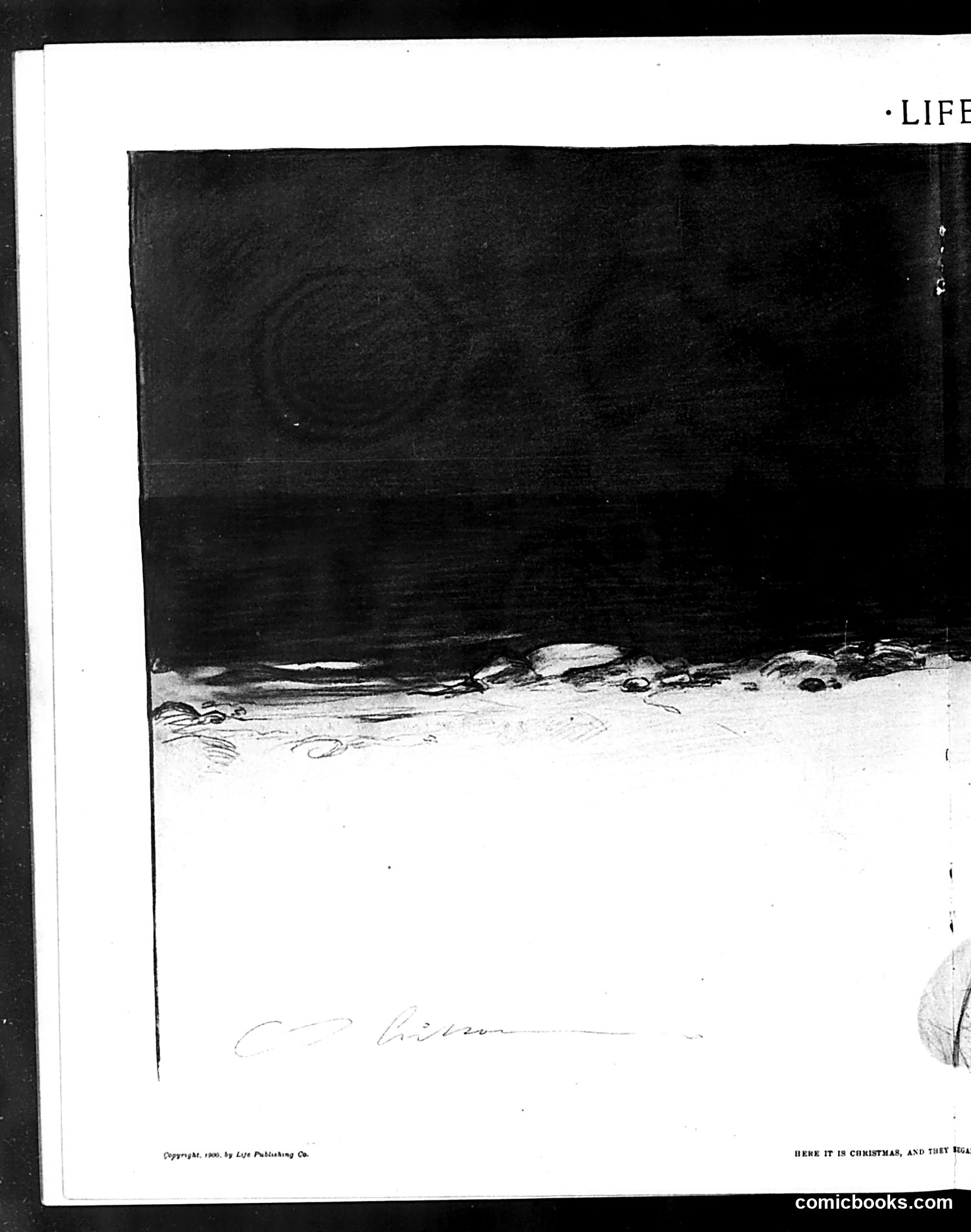
This appears to be a page from Life magazine (copyright 1900). The image shows what seems to be a winter beach or sandy scene with dark water or sky above and light sand below, with some scattered objects or debris along the shoreline. The caption reads "HERE IT IS CHRISTMAS, AND THEY HOG—" but is cut off, suggesting satirical commentary about Christmas behavior or material greed during the holiday season. The truncated text implies criticism of people hoarding or selfishly consuming during Christmas. However, without seeing the complete caption or accompanying illustration/cartoon clearly, I cannot definitively identify the specific figures, social commentary, or full satirical point being made. The page quality and image composition make it difficult to discern precise details of any depicted characters or their identities.
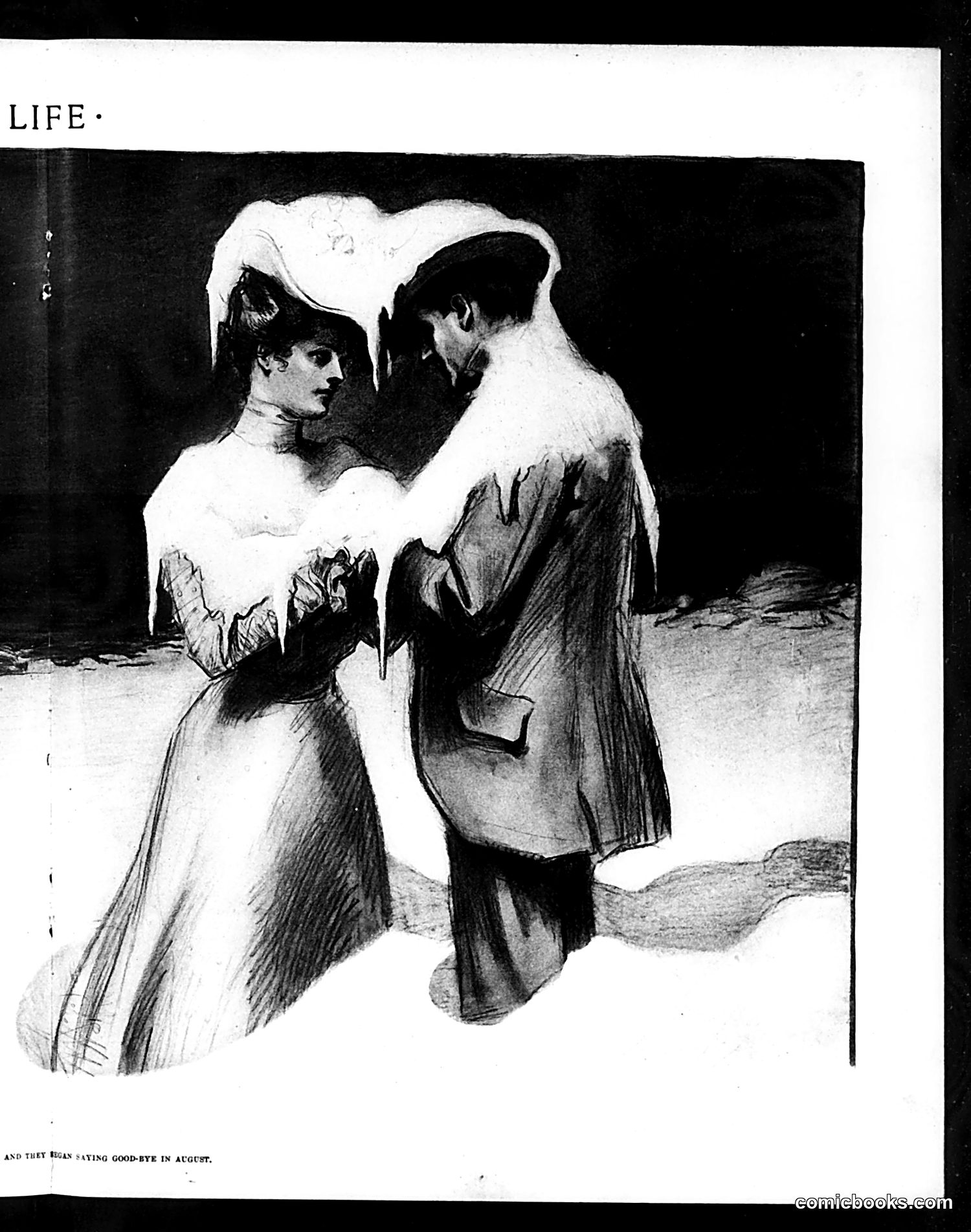
This appears to be a romantic illustration from *Life* magazine showing a couple in an intimate moment. The caption reads "AND THEY HAN SAYING GOOD-BYE IN AUGUST" (OCR likely garbled; probably "AND THEY HAVE SAYING GOOD-BYE IN AUGUST" or similar). The sketch depicts a woman in an elaborate white dress with a large feathered hat saying farewell to a man in formal attire. The sentimentality suggests this illustrates a seasonal romantic theme—likely commenting on summer romances or the bittersweet farewells of the season. Without additional context or visible byline, the exact satirical point remains unclear, though it may reference common literary or social tropes about transient romantic relationships during vacation season. The magazine's satirical tone suggests gentle mockery of romantic conventions rather than serious commentary.
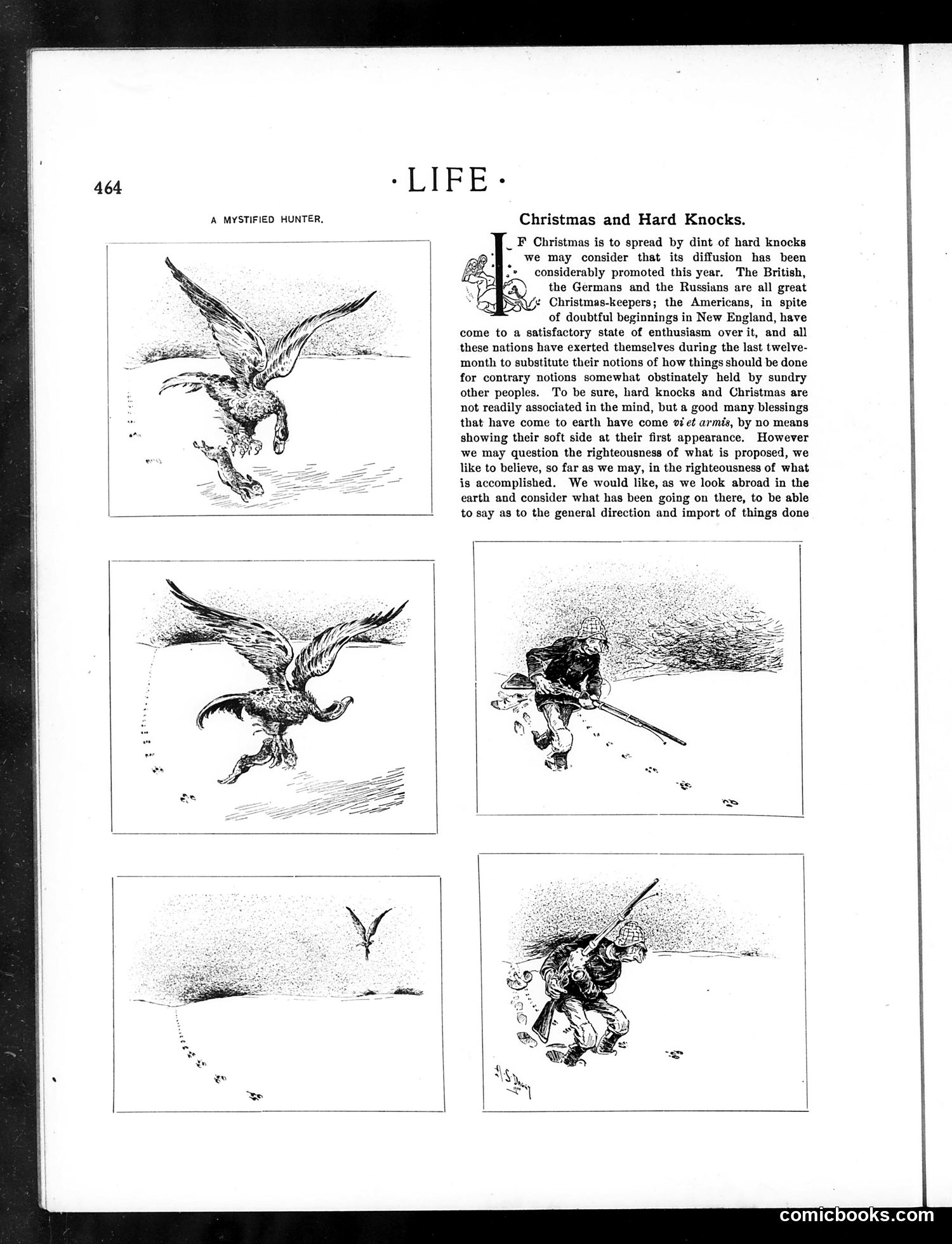
This page from *Life* magazine uses hunting imagery as satire about World War I. The comic panels show a bewildered hunter pursuing game (depicted as a bird), repeatedly missing or being confounded by his target—a visual metaphor for military futility. The accompanying essay darkly jokes that Britain, Germany, and Russia are "spreading Christmas" through warfare ("hard knocks" and "et armis"—by force of arms). The satire suggests these nations are imposing their will on others under the guise of civilization, conflating holiday generosity with violent imperial or military expansion. The "mystified hunter" represents military commanders unable to achieve their objectives despite considerable effort—a commentary on the seeming incompetence and futility of the ongoing war. The piece expresses *Life*'s cynical view that nations justify warfare as righteous while actually pursuing self-interested expansion.
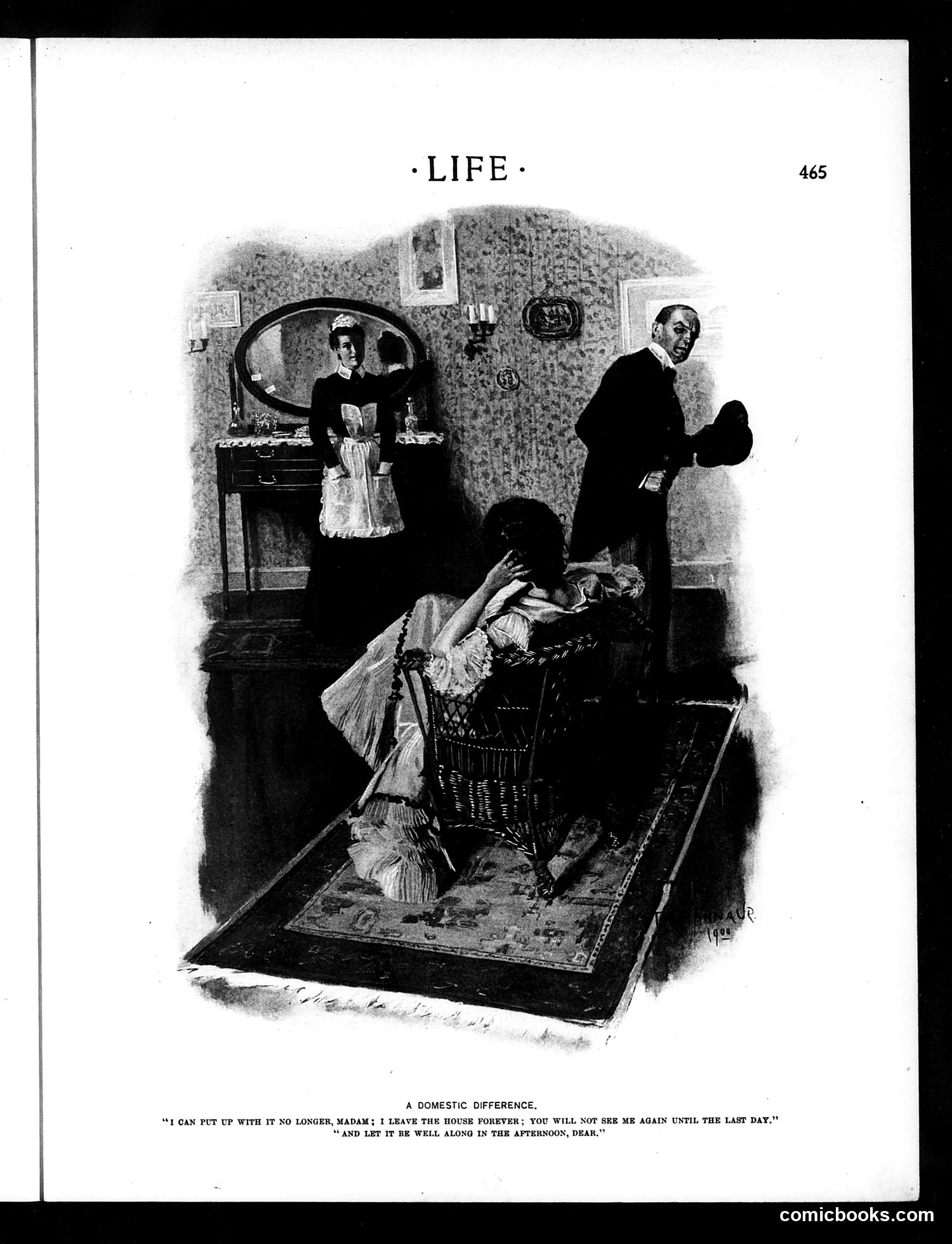
This is a satirical cartoon about marital discord. A man, dressed formally and angry, declares he's leaving his wife forever and won't return until "the last day" (likely meaning Judgment Day or doomsday—a dramatic exit threat). His wife, seated and reading, responds dismissively: "And let it be well along in the afternoon, dear"—suggesting she's so unbothered by his departure that she only asks he stay away until afternoon, implying his threat carries no weight. The joke mocks both spouses: the husband's grandiose, empty ultimatum and the wife's casual indifference, suggesting their marital conflict is routine and his dramatic gesture means nothing. It's typical early-20th-century Life magazine humor about domestic disputes, portraying marriage as a battleground where neither party takes the other's complaints seriously.
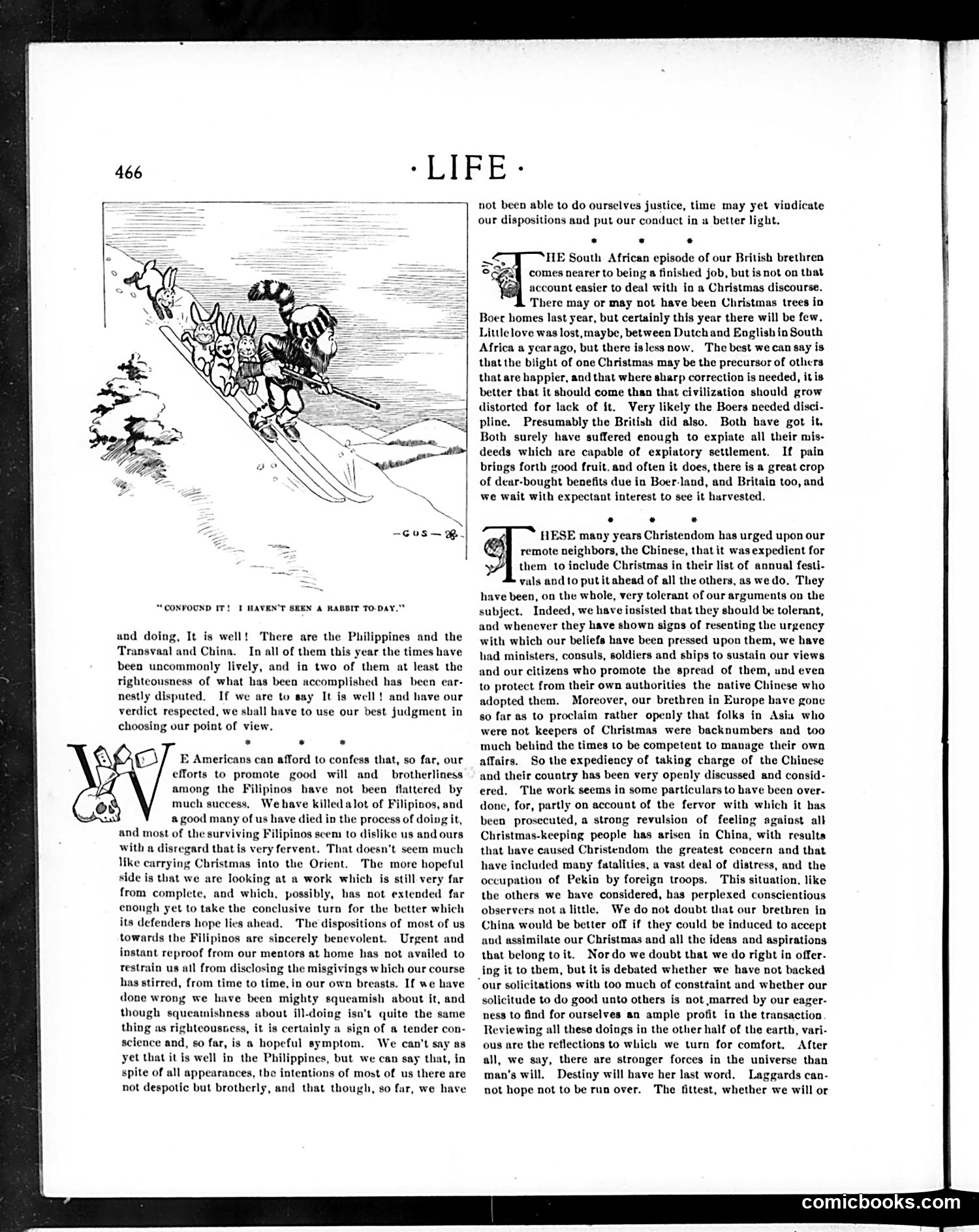
This page discusses American military interventions framed as "Christmas" moral missions. The small cartoon shows a frustrated hunter saying "Confound it! I haven't seen a rabbit to-day"—likely satirizing imperialist expectations of easy victories. The text critically examines three conflicts: 1. **The Philippines**: America killed many Filipinos while claiming benevolent intentions, yet Filipinos resent American occupation. The author notes this contradicts "carrying Christmas into the Orient." 2. **The Boer War**: British aggression against Dutch settlers in South Africa, justified as necessary "discipline." 3. **China**: Western powers, particularly America, have forcibly promoted Christianity and Western values, using "ministers, consuls, soldiers and ships" to enforce compliance. The satire's point: Western powers hypocritically invoke Christian charity while conducting brutal colonial wars. The "Christmas" framing exposes the gap between stated moral intentions and violent imperial actions.
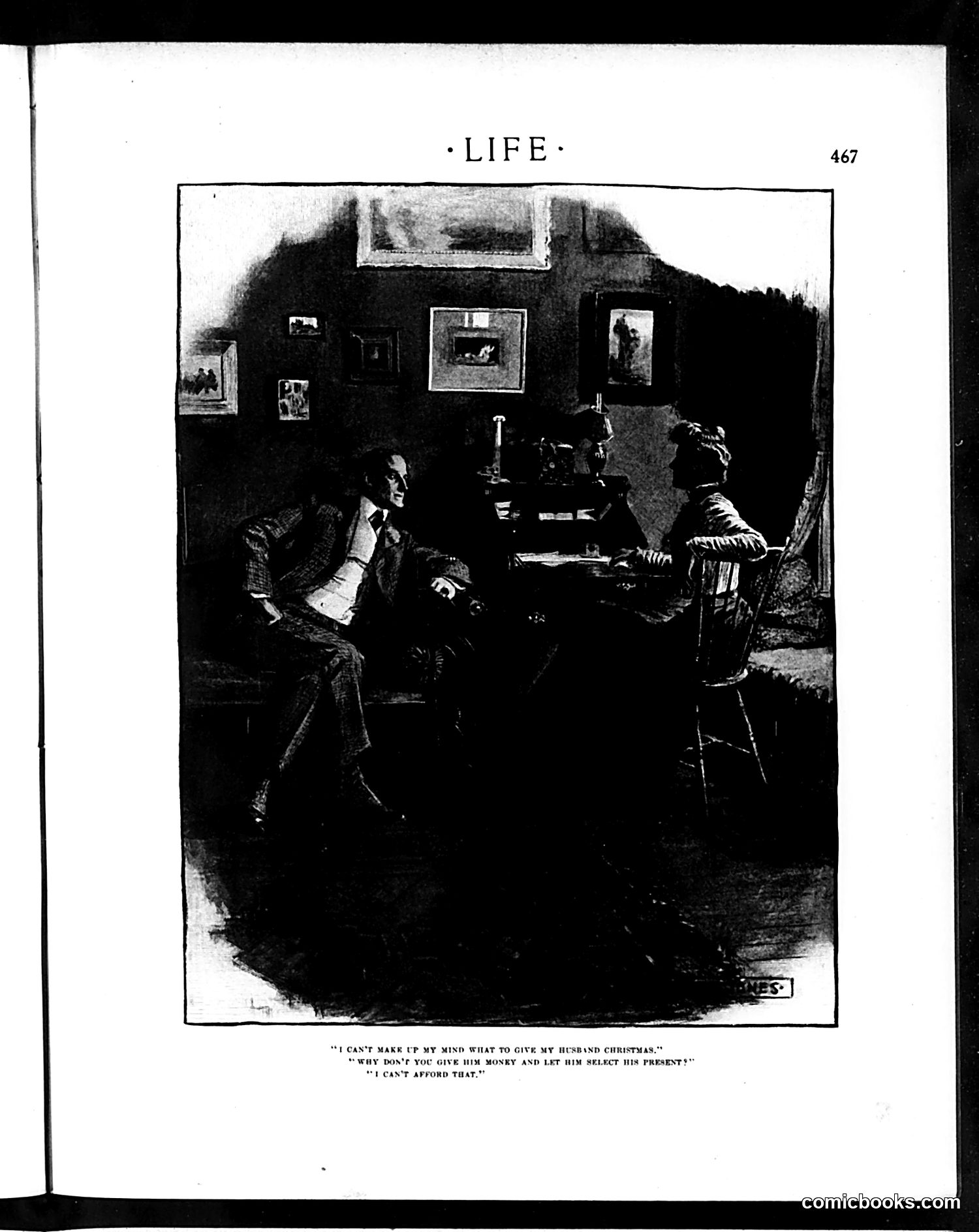
This is a domestic comedy cartoon depicting a conversation between two women about Christmas gift-giving. One woman expresses indecision about what to give her husband, while her companion suggests simply giving him money so he can choose his own present. The first woman rejects this solution, saying "I can't afford that." The satire targets wives' financial dependence on husbands during this era. The joke implies that even a small sum of money—enough for a modest gift—is beyond a married woman's means, suggesting she has no independent income or control over household finances. This reflects early-to-mid 20th century marital economics where women typically lacked financial autonomy, making even gifting their own husband difficult without his permission or resources.
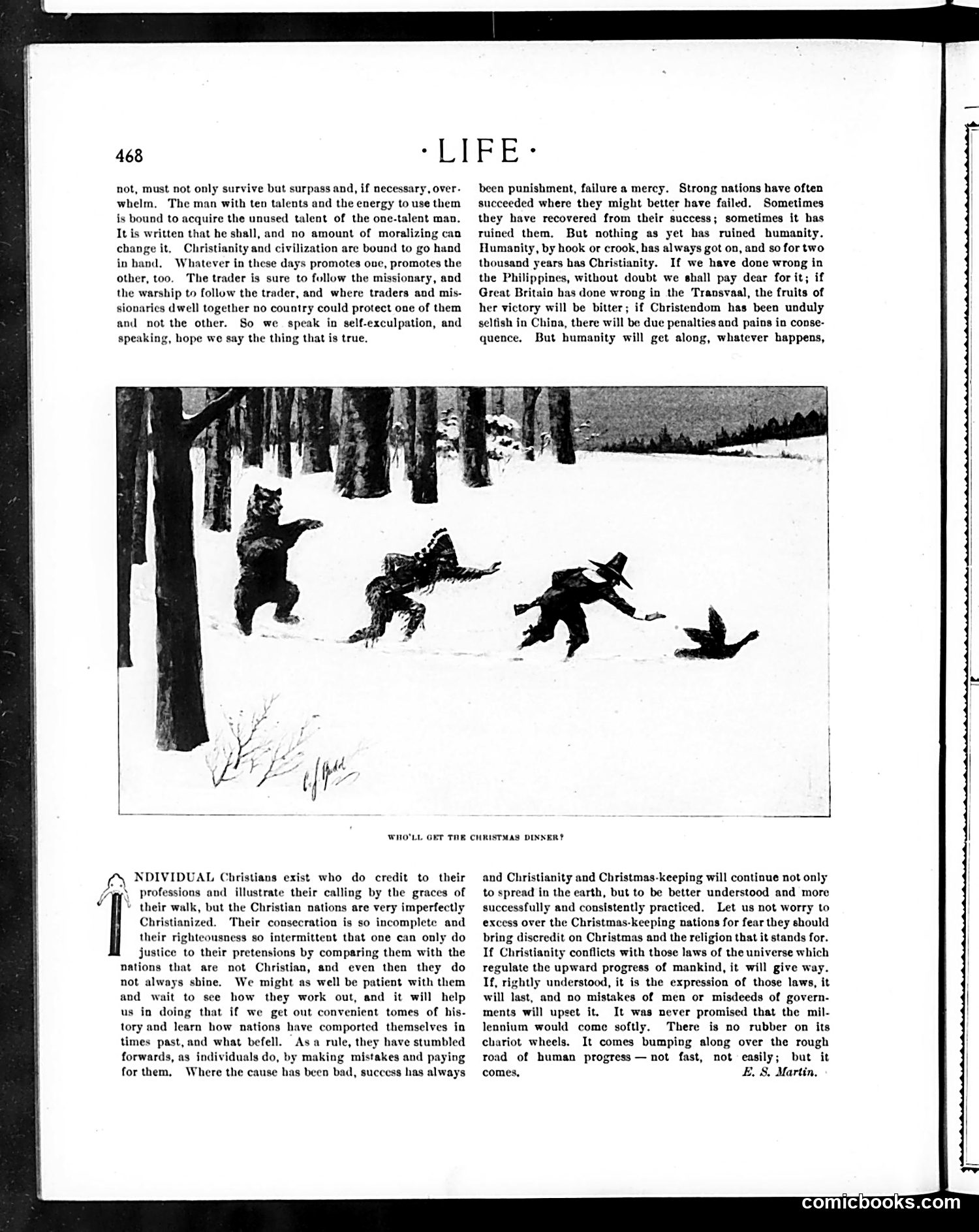
The cartoon "Who'll Get the Christmas Dinner?" depicts animals (appears to be bears or similar creatures) in a snowy forest scene, seemingly engaged in a struggle or chase. The image serves as visual metaphor for the accompanying essay. The text—a commentary on Christian nations' global conduct—argues that while individual Christians may be virtuous, Christian nations (specifically referencing the Philippines and the Transvaal/South Africa) act imperfectly and sometimes immorally. The cartoon satirizes this hypocrisy: just as animals fight over Christmas dinner in nature's harsh struggle, so too do supposedly "Christian" nations compete ruthlessly for imperial dominance and resources, belying their religious principles. The essay defends this behavior as inevitable human progress, but the cartoon's darkly ironic image undercuts this rationalization—suggesting Christian civilization is merely predatory appetite dressed in moral language.
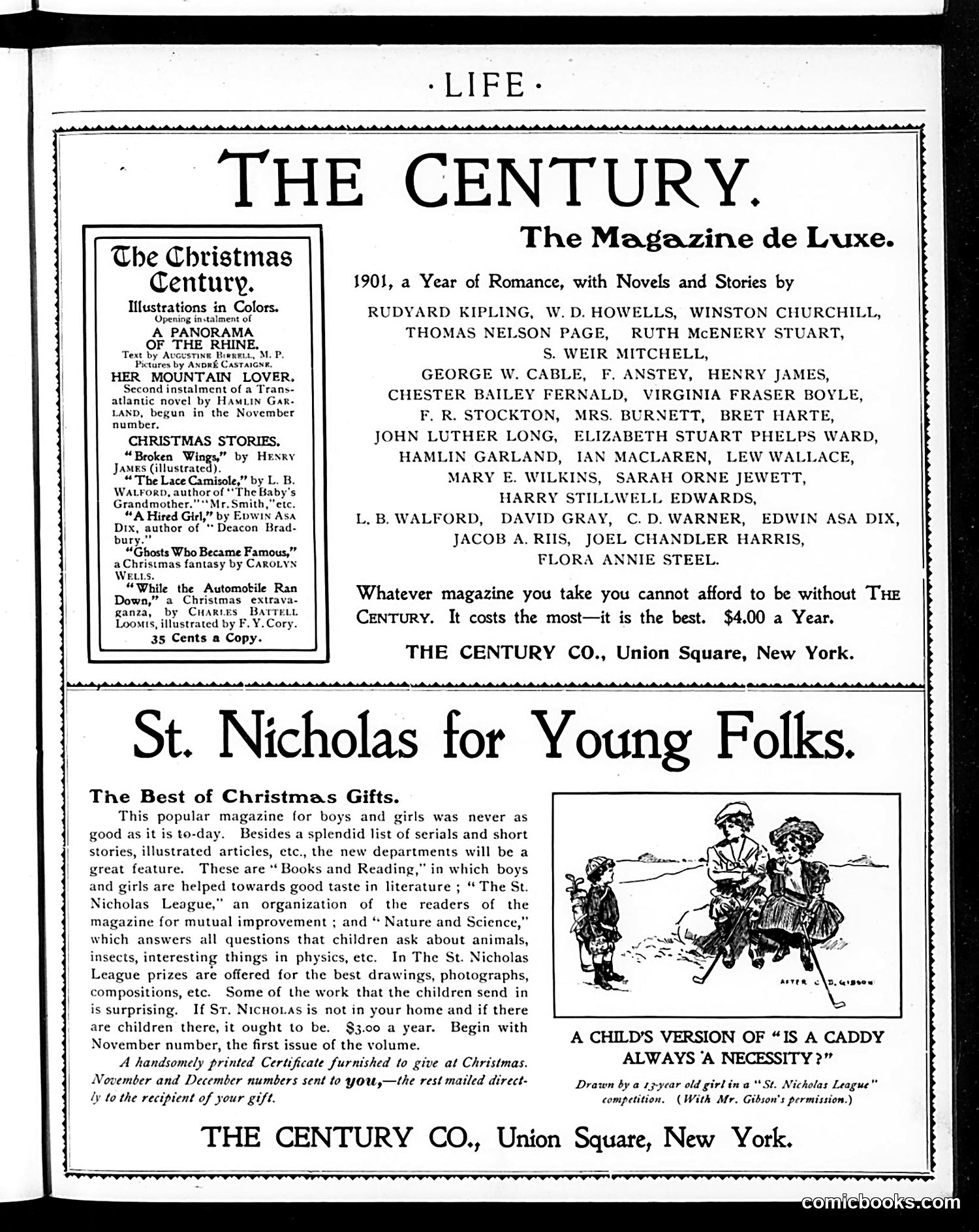
This is primarily a **magazine advertisement page**, not satirical content. It promotes two publications by The Century Co. for 1901: **The Century Magazine** ("Magazine de Luxe") advertises itself as essential reading, costing $4/year and featuring major literary names: Kipling, Howells, Henry James, Bret Harte, and others. The competitive claim—"It costs the most—it is the best"—uses price as a marker of quality and prestige. **St. Nicholas Magazine** targets children, promoting educational features like "Books and Reading" department and the "St. Nicholas League" (a reader competition). The small cartoon shown is a child's golf-themed drawing from this competition. The only potentially humorous element is the modest drawing credited to a 12-year-old, presented as worthy competition work—perhaps gently poking fun at children's earnest attempts at art, though this appears straightforward rather than satirical.
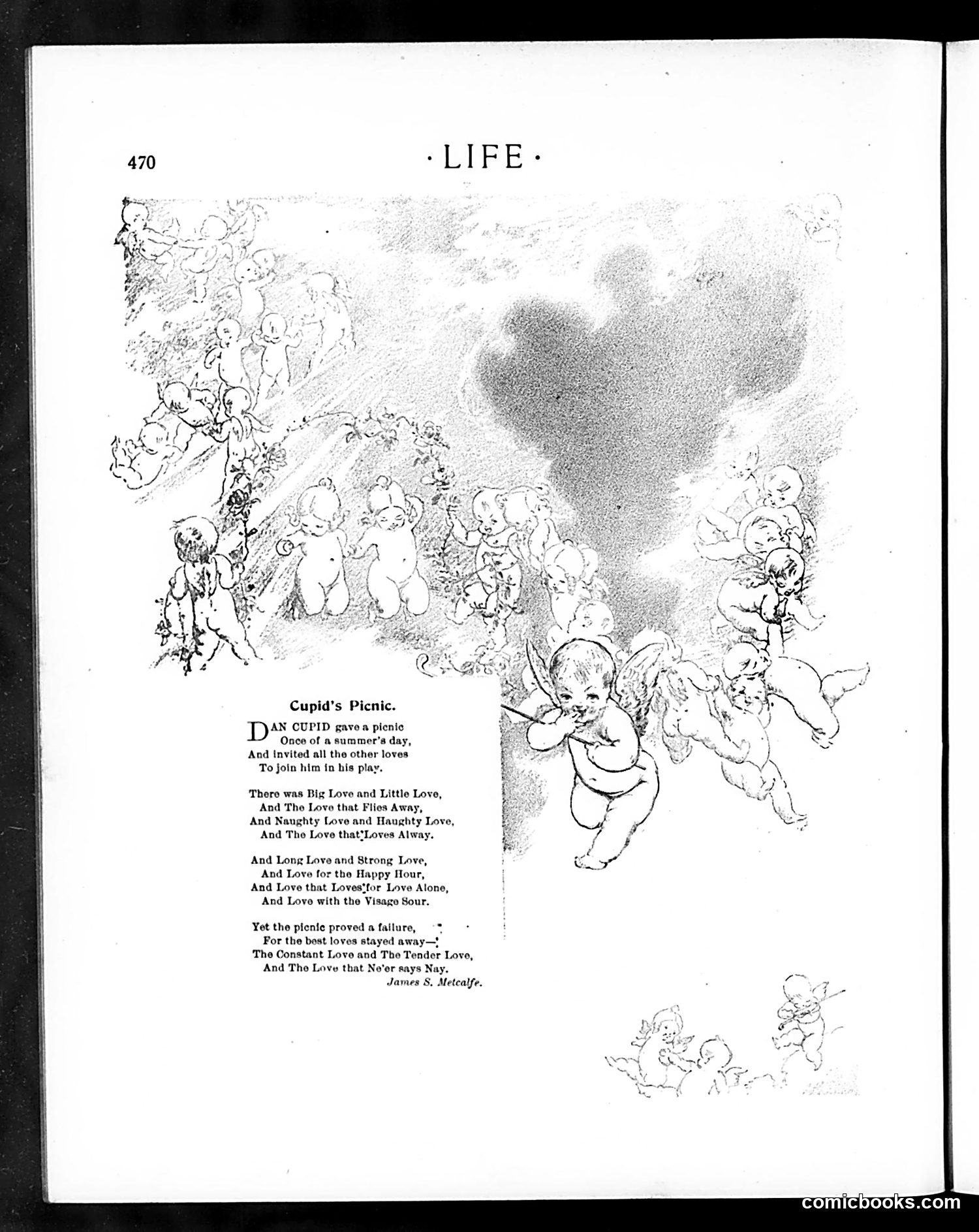
This is a whimsical poem by James S. Metcalfe illustrated with cherubs/cupids, not political satire. The page presents a romantic allegory about different types of love attending a summer picnic. The poem personifies various loves as guests—"Big Love," "Little Love," "Naughty Love," "Strong Love," etc.—creating a humorous taxonomy of romantic emotions. The central joke is ironic: despite Cupid organizing this gathering of many loves, the *best* loves fail to show up. Specifically absent are "The Constant Love," "The Tender Love," and "The Love that Never says Nay"—the most desirable romantic qualities. The illustrations show playful cherubs in classical style scattered throughout. This represents typical Life magazine content: light, sentimental verse mixing gentle satire about human nature (here, romance and relationships) with decorative artwork. It's essentially a sophisticated Valentine's Day-style piece for a general audience.
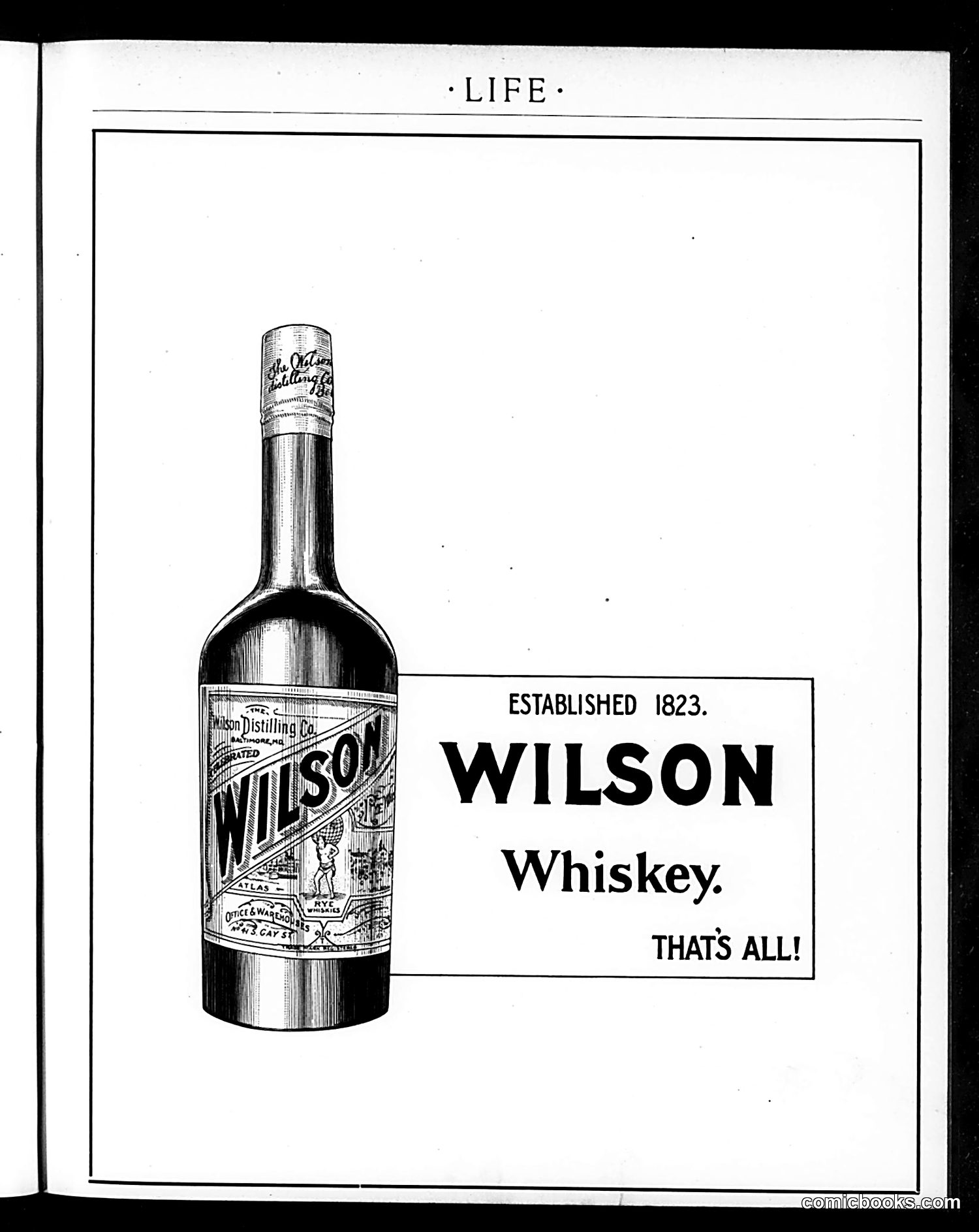
This is a straightforward advertisement for Wilson Whiskey, not political satire. The page features a detailed illustration of a Wilson Whiskey bottle with an ornate label, accompanied by text emphasizing the brand's establishment date (1823) and a tagline: "THAT'S ALL!" The ad's appeal is based on simplicity and longevity—suggesting the product's quality speaks for itself without elaborate claims. The "That's All!" suggests confidence in the brand's reputation and established history. This represents typical early-to-mid 20th century advertising strategy, where heritage and straightforward presentation were used to market spirits to consumers.
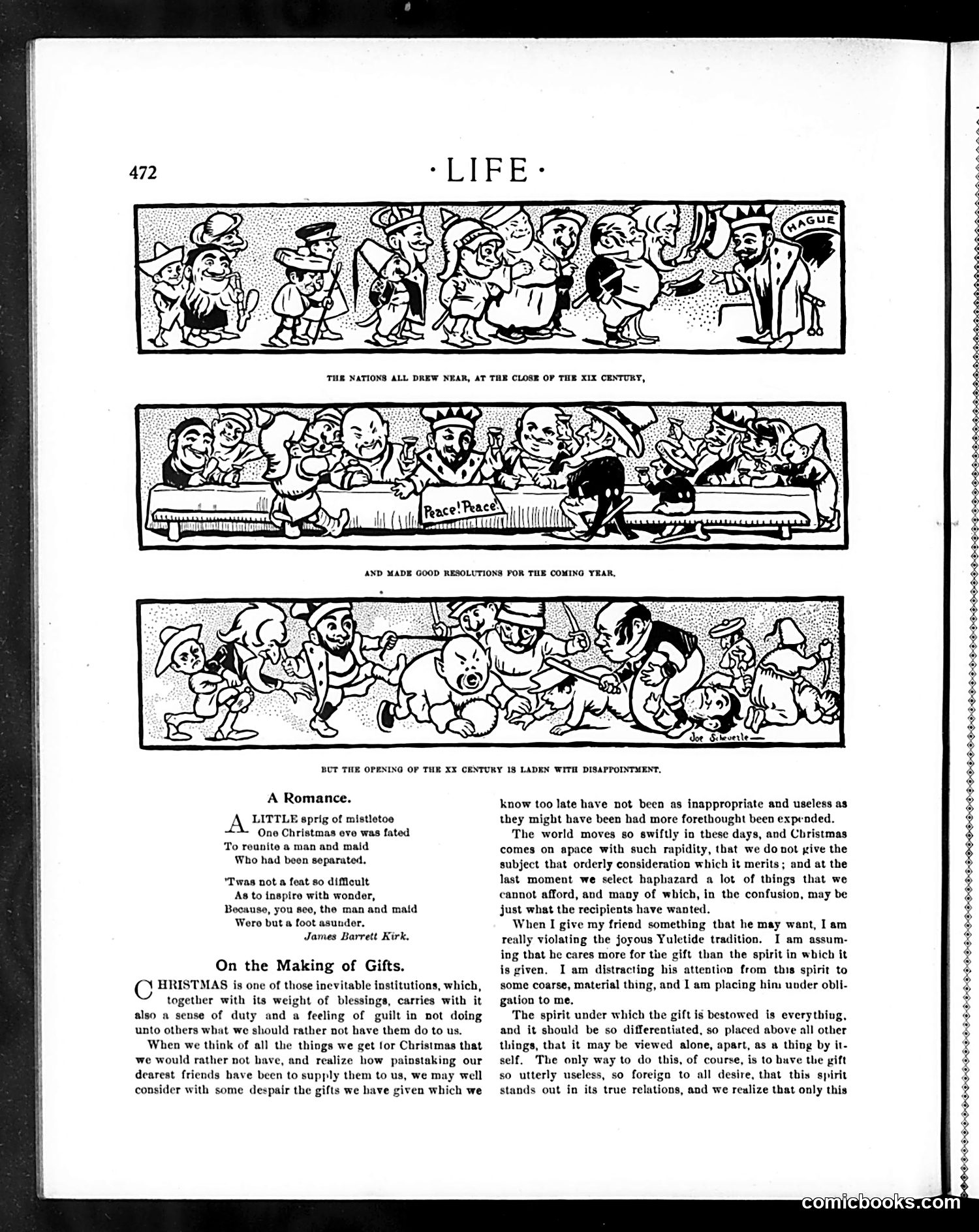
This page from *Life* magazine contains three decorative cartoon strips at the top satirizing New Year's celebrations around the turn of the 20th century. The caption indicates these show "the nations all drew near, at the close of the XIX century" making resolutions, followed by disappointment as "the opening of the XX century is laden with disappointment." The cartoons depict various national figures (likely represented as caricatures) celebrating, toasting, and then deflating—a commentary on unfulfilled optimism about the new century's arrival. Below are two prose pieces: "A Romance," a humorous short poem about mistletoe reuniting separated lovers who were standing close together, and "On the Making of Gifts," an essay satirizing the anxious Christmas gift-giving tradition. The essay ironically argues that truly thoughtful gift-giving requires selecting items so utterly *useless* that the recipient cannot mistake material value for spiritual sentiment—poking fun at Victorian gift-giving pretensions and social anxiety.
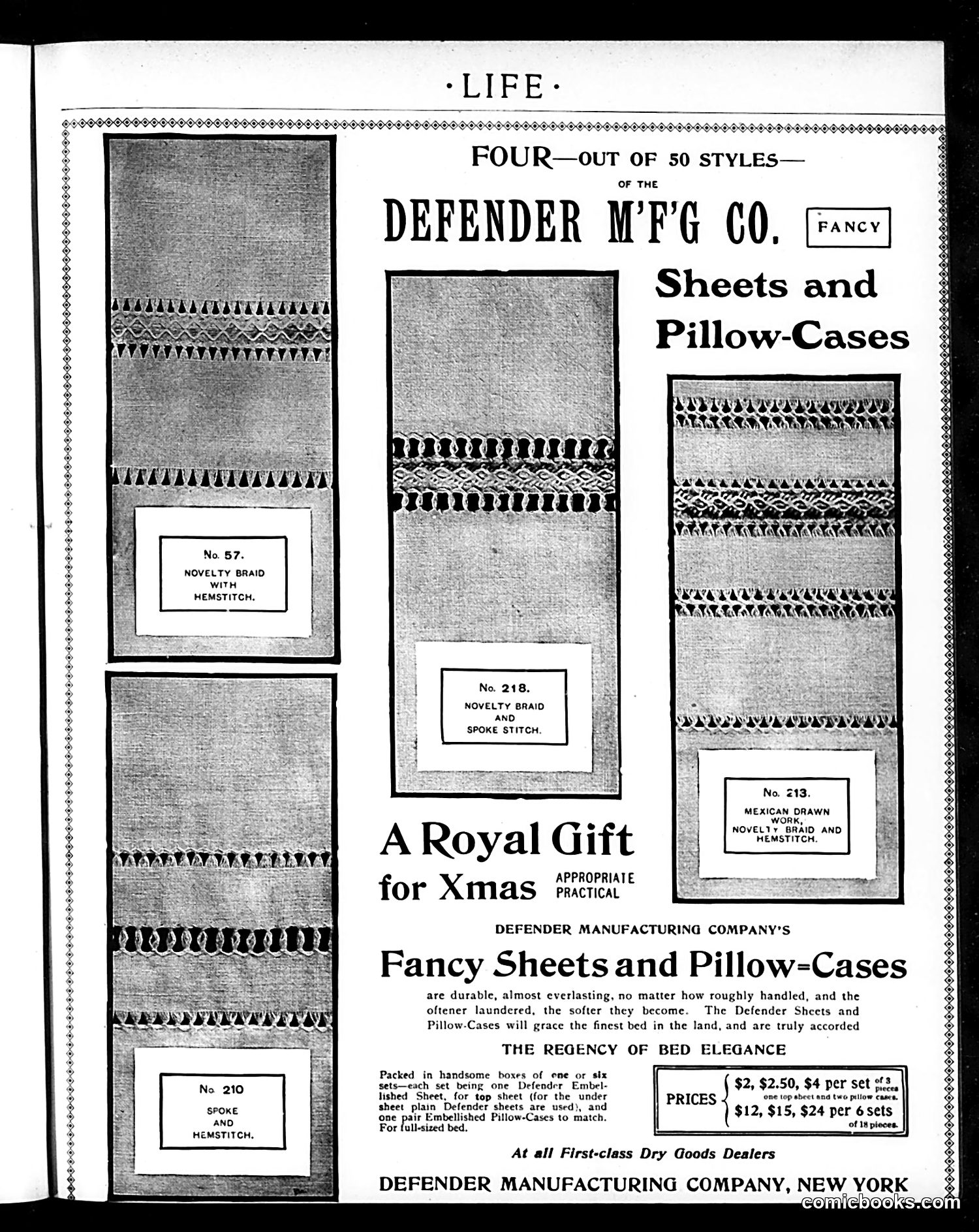
This page is **not a cartoon or satirical content**—it's a straightforward advertisement. The page displays a full-page ad for the Defender Manufacturing Company promoting their "Fancy Sheets and Pillow-Cases." Four product styles are shown (Nos. 57, 218, 213, and 210), each featuring decorative braiding, hemstitching, or drawn-work embellishments. The ad emphasizes durability and elegance, marketing the products as appropriate Christmas gifts. Pricing ranges from $2 to $24 per set depending on quantity and style. Products were sold at first-class dry goods dealers. This appears in *Life* magazine as a paid advertisement—a common revenue source for publications of this era. There is no political commentary, satire, or joke present; it's purely commercial product promotion.
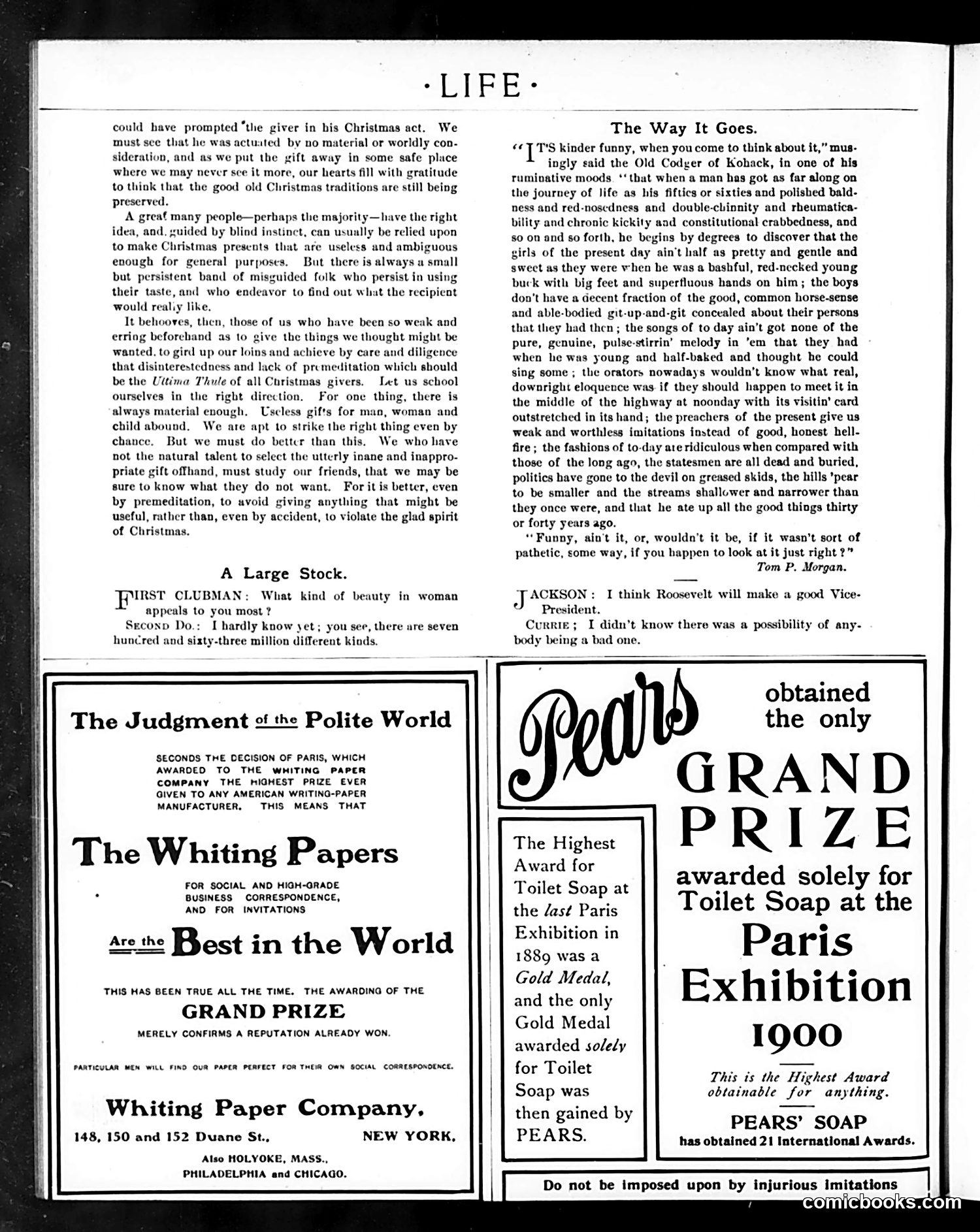
This page contains **satirical essays and advertisements** rather than visual cartoons. The main satirical content includes: 1. **"The Way It Goes"** — A humorous monologue by "the Old Codger of Kohack" lampooning aging nostalgia. He complains that modern youth, music, oratory, and preaching are inferior to his day, while he himself has become bald, red-nosed, and perpetually grumpy. The satire mocks how elderly men universally romanticize their youth and dismiss the present generation—a timeless complaint. 2. **"A Large Stock"** — A brief joke about female beauty standards, where a clubman says there are "seven hundred and sixty-three million different kinds," satirizing either male superficiality or the impossibility of defining female beauty. The page is **heavily dominated by advertisements** for Whiting Paper and Pears' Soap, which claim prestigious international awards. These ads appear designed to parody exaggerated commercial claims typical of the era.
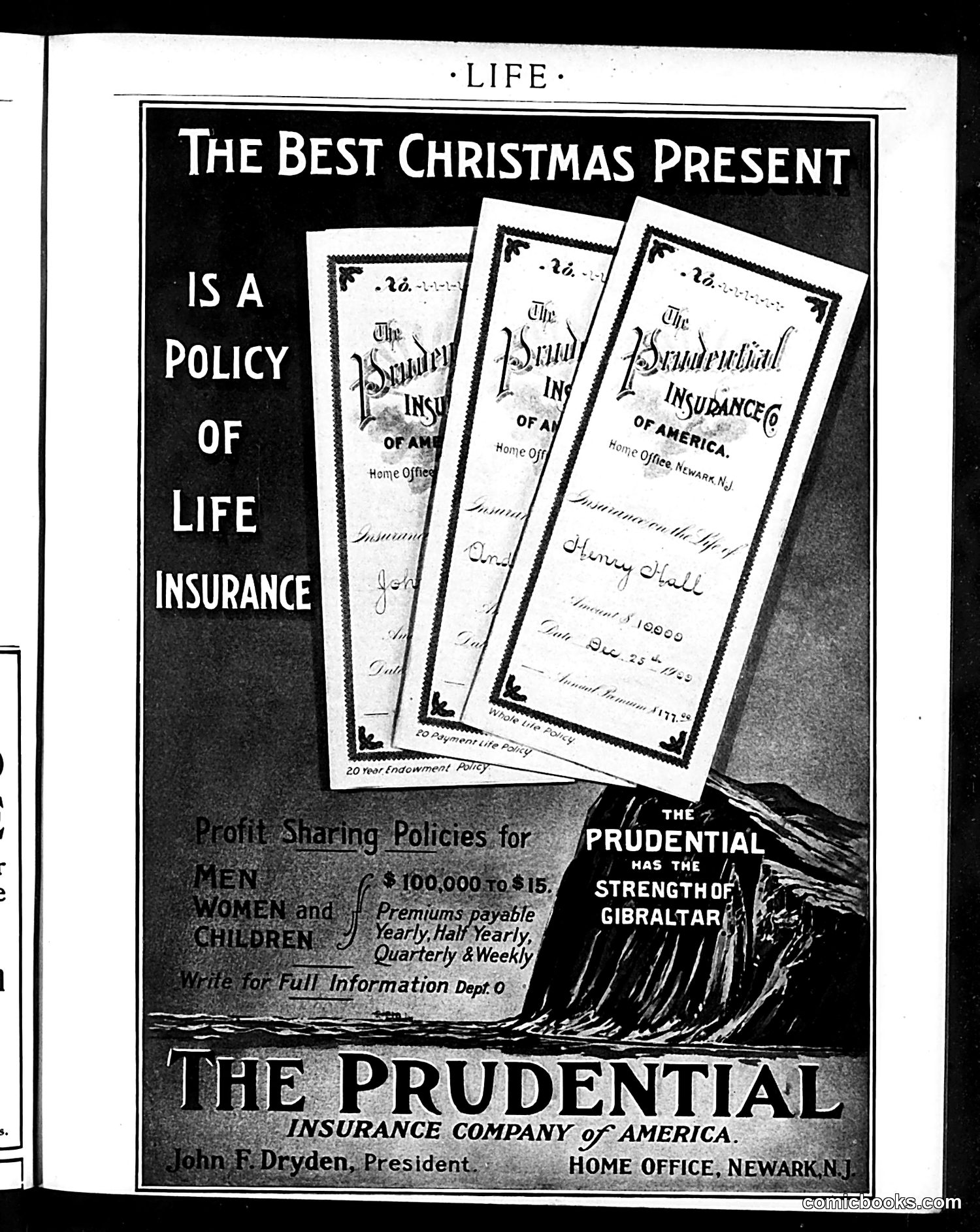
This is primarily a **life insurance advertisement** for The Prudential Insurance Company, not a satirical cartoon. The ad presents life insurance policies as an ideal Christmas gift, showing three sample policy documents from "The Prudential Insurance Company of America" (Home Office: Newark, N.J.). The marketing pitch targets three demographics: **men, women, and children**, offering flexible premium payment options (yearly, half-yearly, quarterly, and weekly). The only visual element beyond the policies is **Gibraltar Rock** at bottom right, which serves as Prudential's corporate symbol—representing strength and stability (note the tagline: "The Prudential has the strength of Gibraltar"). There is no political satire or caricature here. This is straightforward early 20th-century commercial messaging using Life magazine's advertising pages to promote life insurance as a practical, family-oriented holiday gift.
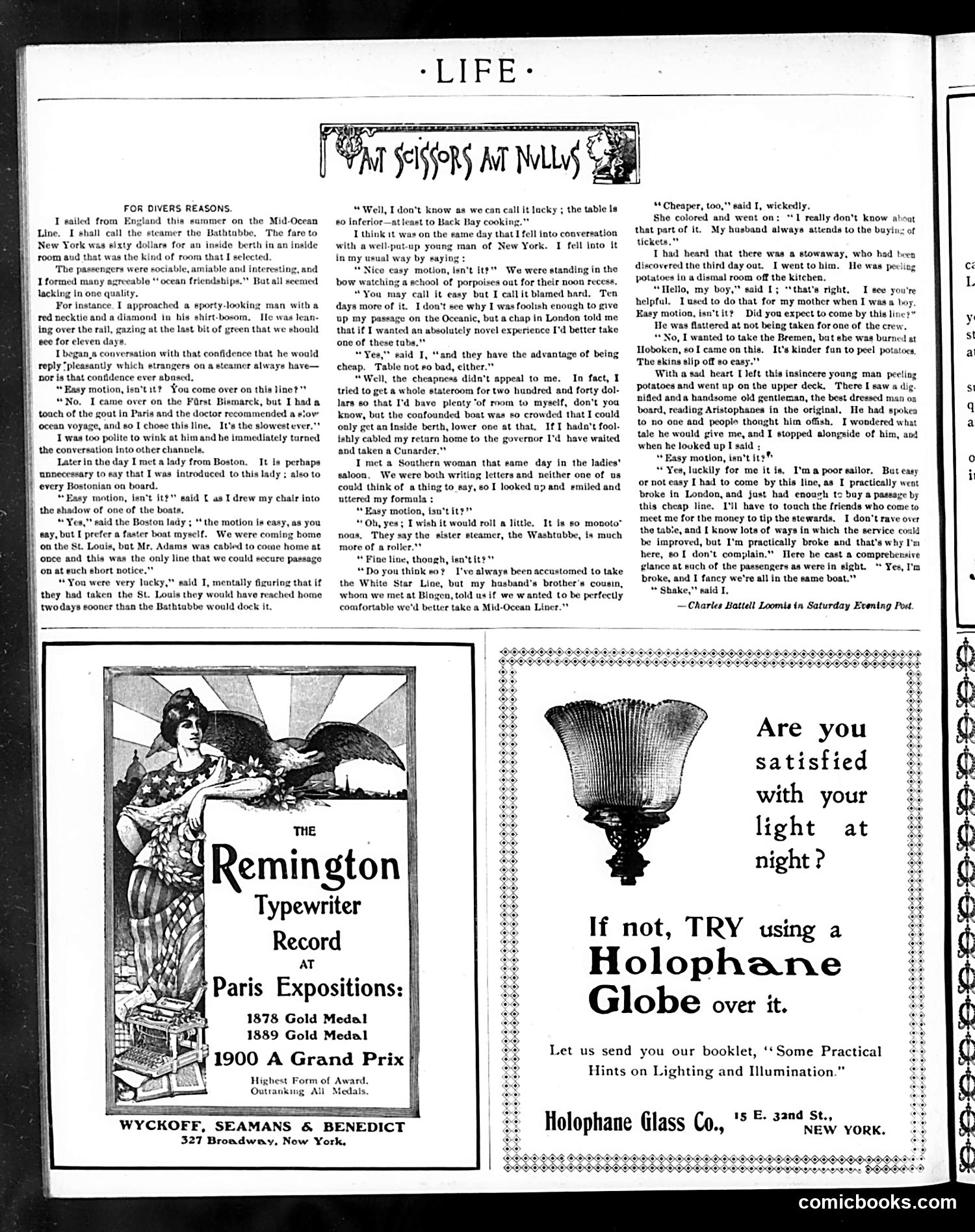
This humorous narrative satirizes the predictable tedium of ocean liner travel among American passengers. The author mocks the homogeneous wealthy travelers aboard the fictional "Bathtabbe" steamer, who all recite the identical opening line about "easy motion" to strangers, as if reading from a social script. The piece ridicules several stereotypes: the wealthy Bostonian obsessed with social status and "Back Bay cooking," the young New Yorker boasting about exotic travel, and the Southern woman defensive about her husband's relatives' recommendations. Each passenger repeats the same banal observations and social formulas despite vastly different circumstances. The satire critiques not dramatic events but the *monotonous conformity* of upper-class leisure travel—where even complaints become predictable social performances. The author's detached, polite observations emphasize how superficial and scripted these shipboard interactions are, making conversation itself feel as slow and tedious as the vessel's journey.
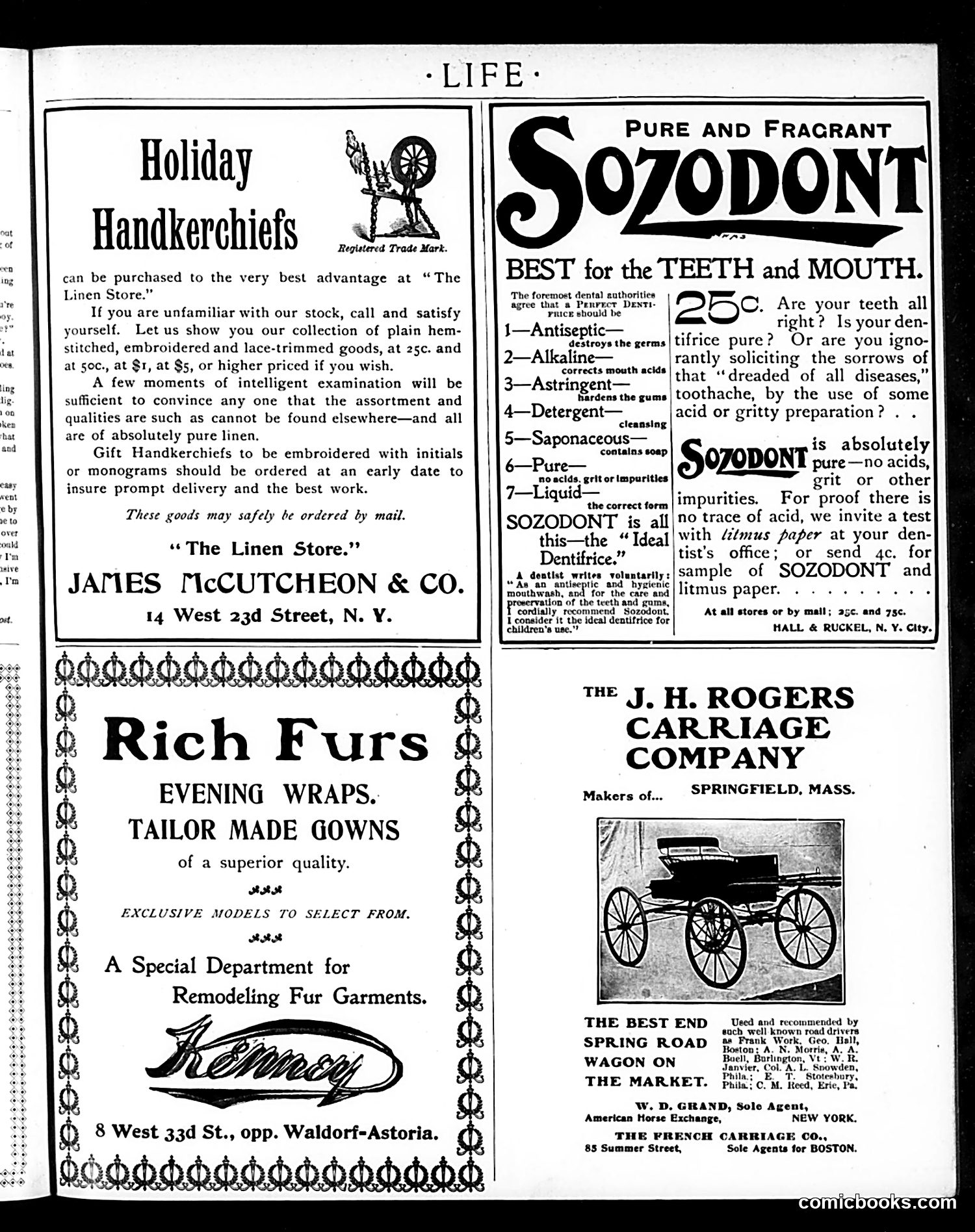
This page contains **no cartoons or satire**—it is purely a collection of period advertisements from Life magazine. The ads promote luxury goods typical of early 20th-century American consumer culture: handkerchiefs from James McCutcheon & Co. (a high-end linen retailer on West 23rd Street), Sozodont toothpaste (marketed as the "ideal dentifrice" with seven purifying properties), fur garments and evening wear, and J.H. Rogers carriages from Springfield, Massachusetts. The Sozodont ad is notable for claiming scientific authority—listing seven desirable dental properties and including a testimonial from an unnamed dentist. This reflects early advertising's attempt to lend credibility through pseudo-scientific language, a common marketing tactic of the era before strict FDA regulations. The page illustrates consumer aspirations of wealthy New Yorkers rather than political commentary or humor.
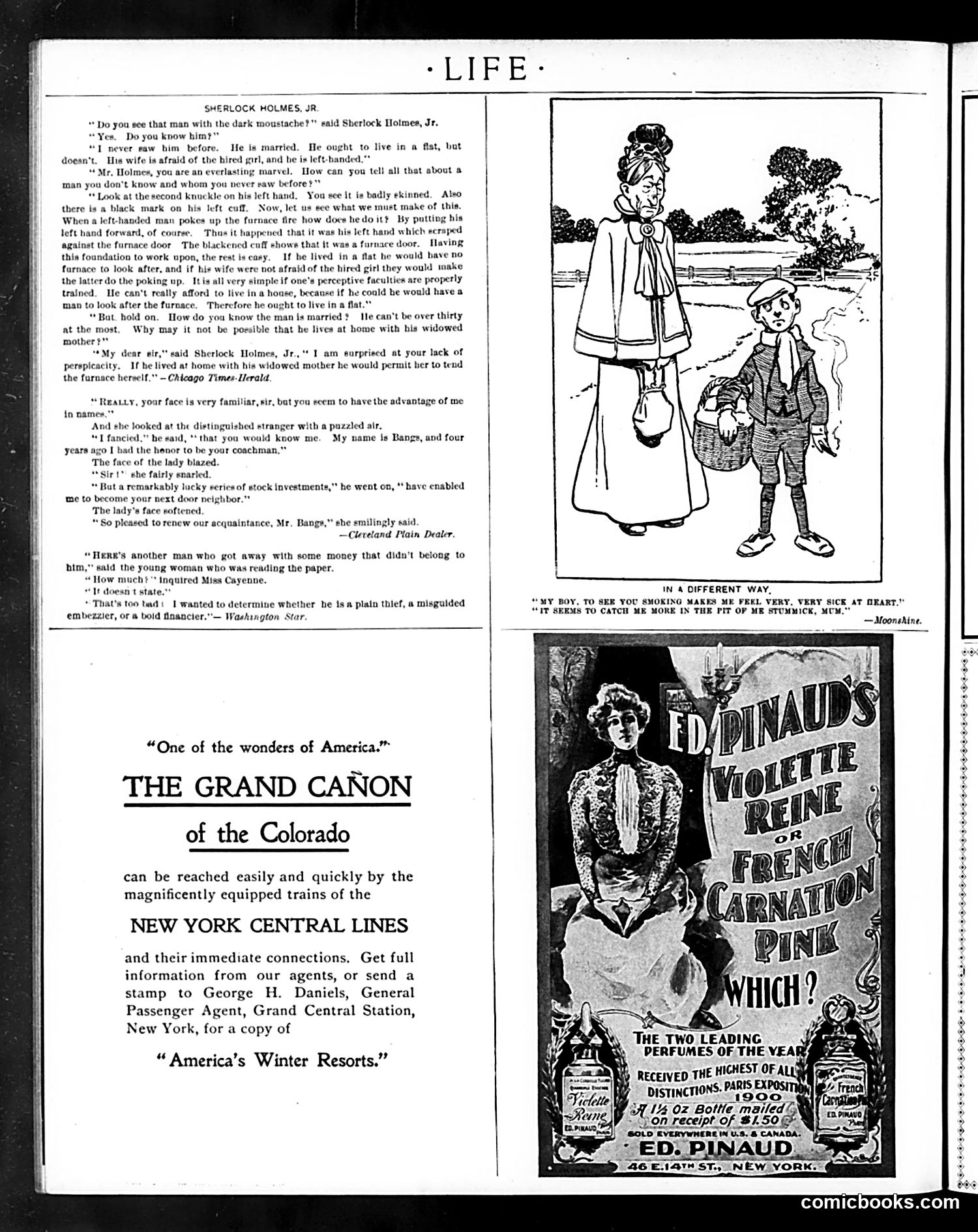
This page contains three brief comic anecdotes satirizing different social observations: **Main cartoon (top)**: A parody of Sherlock Holmes' deductive method. A character makes absurdly elaborate conclusions about a stranger (married, lives in a house, left-handed) from minimal evidence (a scraped knuckle, a black cuff mark). The humor lies in overthinking—the deductions are presented as logical but are comically overconfident. When challenged about knowing the man is married (not living with his widowed mother), Holmes offers circular reasoning. The satire mocks both detective fiction's exaggerated deductions and human tendency to construct elaborate narratives from scraps of evidence. **Secondary anecdotes**: One depicts class mobility—a former coachman becomes wealthy through stock investments and is suddenly welcomed by his former employer. Another shows how incomplete newspaper reports prevent proper moral judgment of financial crimes. The page is primarily **satirical commentary on logic, class, and journalism** rather than political content. The advertisements below are period typical.
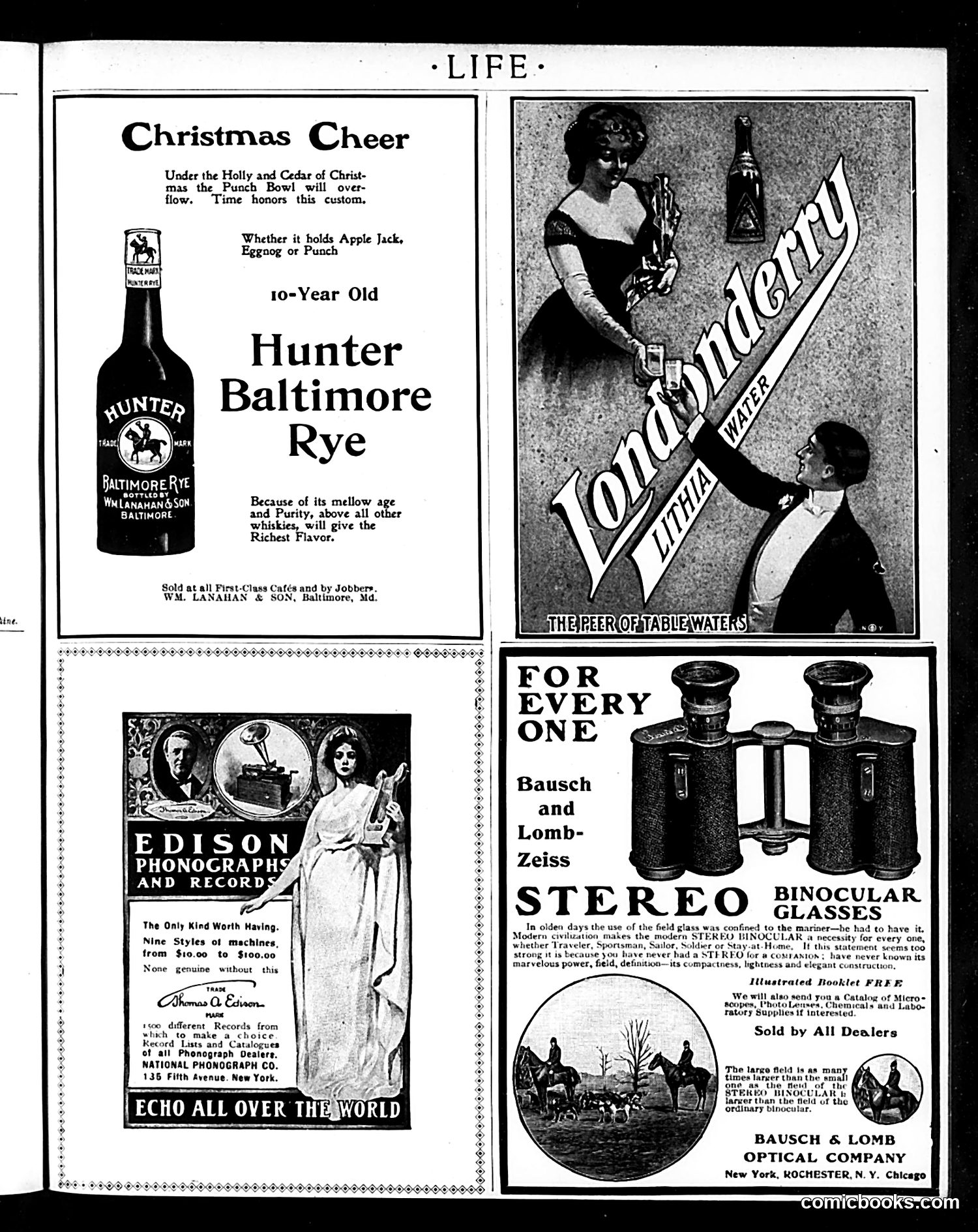
This page is primarily **advertising**, not satire or political commentary. It contains four commercial advertisements from circa early 1900s: 1. **Hunter Baltimore Rye** whiskey—marketed as a 100-year-old spirit for Christmas drinking, emphasizing age and purity. 2. **Edison Phonographs and Records**—promoting nine machine styles ($10-$100) as the "only kind worth having," with catalogues available. 3. **Omnigraphy** water advertisement (right panel)—unclear from the visible text, but appears to be promoting a branded water product. 4. **Bausch & Lomb Stereo Binocular Glasses**—optical equipment advertised as superior to ordinary binoculars, with free illustrated booklets offered. The only potential social reference is the Christmas/holiday drinking theme in the whiskey ad, which was common advertising during this era before Prohibition. Otherwise, this is straightforward commercial promotion typical of *Life* magazine's revenue model.
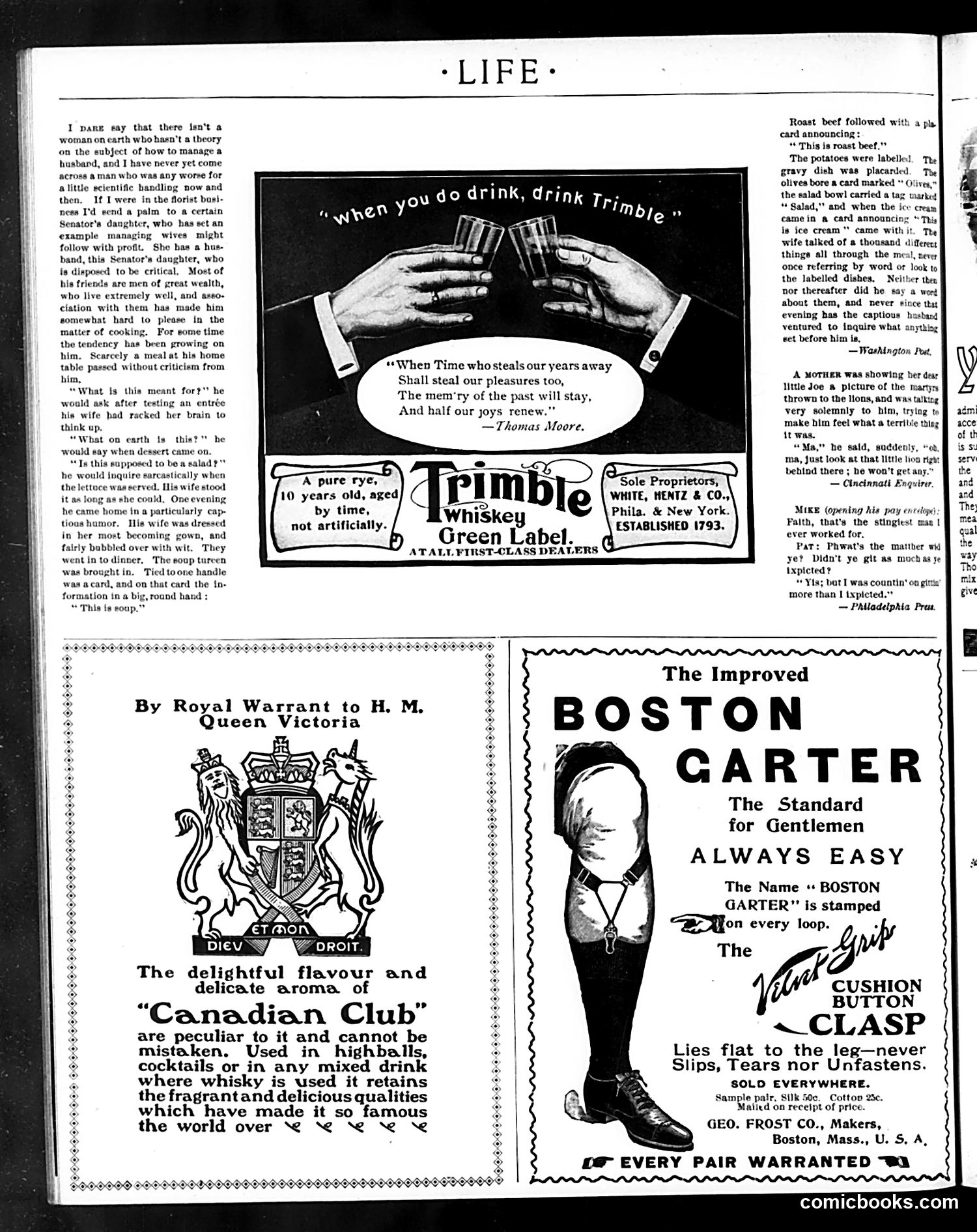
This page contains three separate satirical pieces: **Main Cartoon (top):** A humorous domestic story about a Senator's daughter who manages her critical husband by labeling every dish served at dinner ("This is soup," "This is roast beef," etc.). The satire mocks the husband's constant complaints about his wife's cooking and suggests that public embarrassment—having to read labels like a child—cured him of his fault. It's social commentary on marital dynamics and nagging spouses. **"Little Joe" Cartoon (right):** A brief joke where a mother explains the religious martyrdom of Christians thrown to lions, but young Joe pragmatically points out that one lion won't get any food—missing the moral lesson entirely. It satirizes children's literal-minded innocence versus adult spiritual instruction. **"Mike and Pat" Cartoon (bottom right):** An Irish-accented joke about a worker complaining his boss paid exactly what was expected rather than more. It mocks working-class hopes for unexpected generosity. The remainder consists of period advertisements for Trimble Whiskey, Canadian Club whiskey, Boston Garter suspenders, and related products.
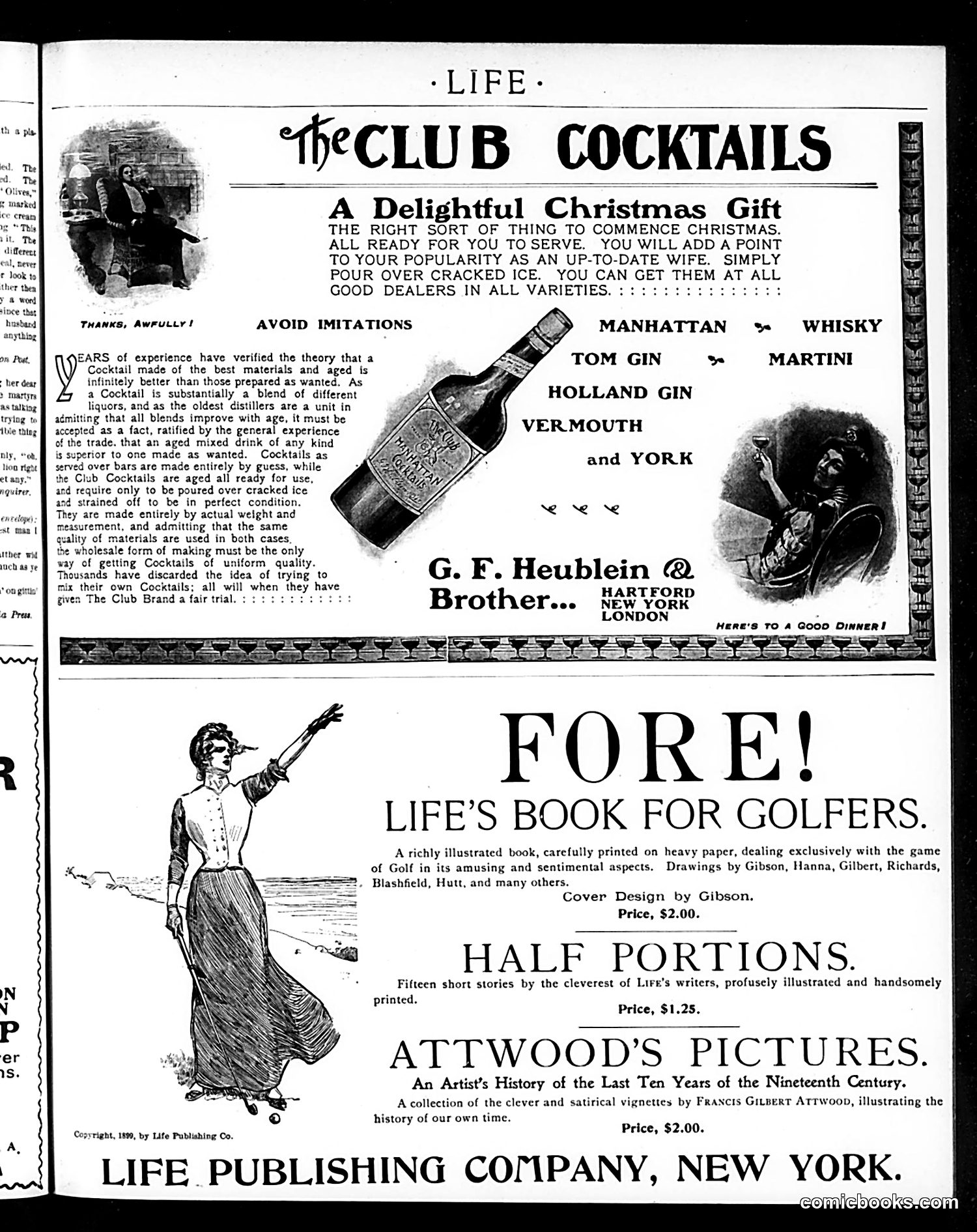
This page is primarily **advertising**, not political satire. The top half promotes Club Cocktails as a Christmas gift, targeting "up-to-date" wives who want to appear modern and fashionable by serving pre-made cocktails at home. The ad emphasizes that aged, manufactured cocktails are superior to homemade versions—a pitch to lazy or inexperienced hostesses. The bottom half advertises Life Publishing Company products: a golf book with illustrations by prominent artists (Gibson, etc.), a short-story collection called "Half Portions," and "Attwood's Pictures," a satirical visual history of the 1890s by cartoonist Francis Gilbert Attwood. The small illustrations—a grateful drinker, a woman golfer—are decorative rather than satirical. This is a commercial page using gentle humor and attractive imagery to sell cocktail mixes and books to affluent readers during the holiday season.
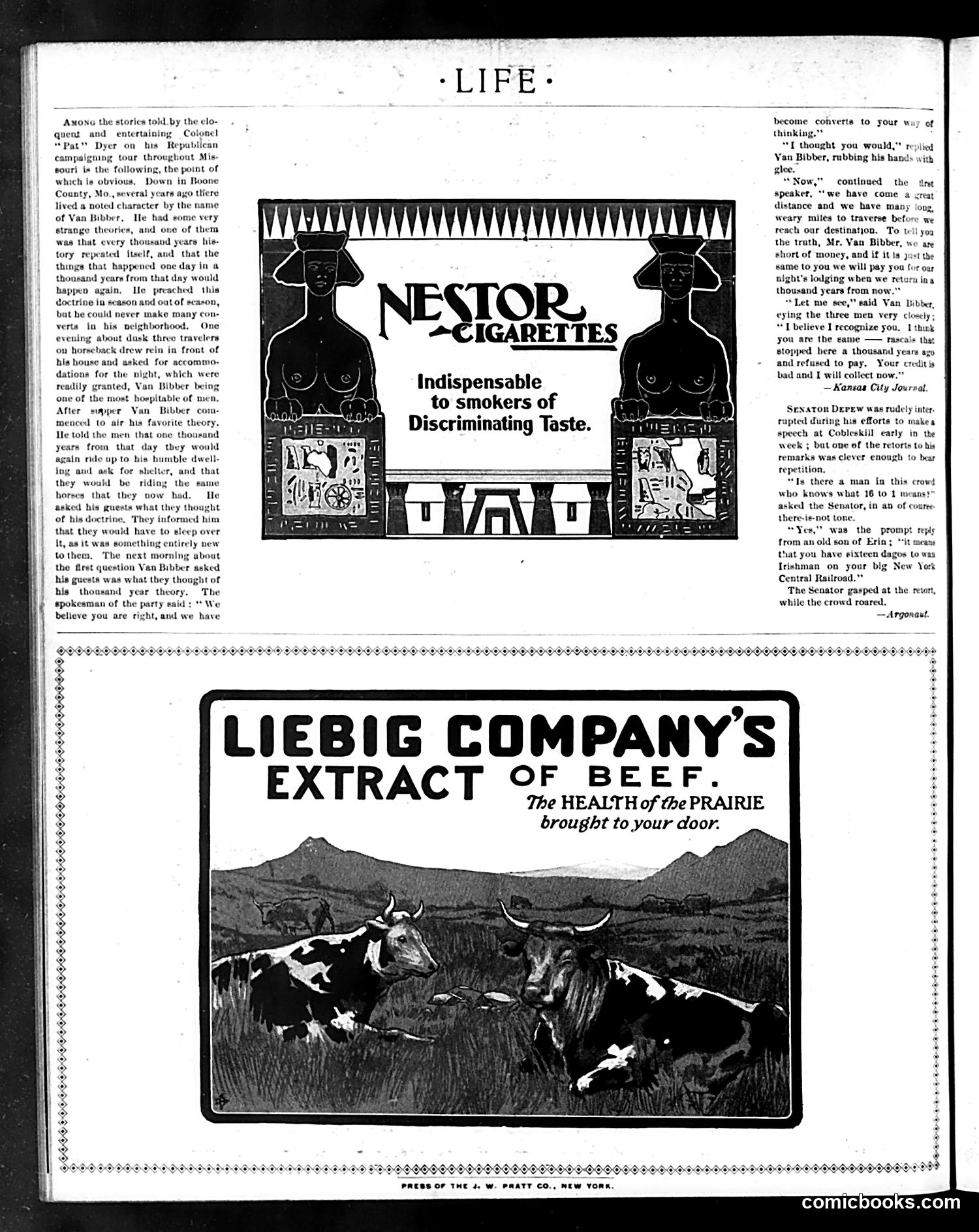
This page contains a humorous story—not a cartoon—used as Republican campaign material by Colonel "Pat" Dyer during Missouri campaigning. The joke satirizes **naive credulity and comeuppance**. Van Bibber, a local character who obsessively preaches that history repeats exactly every thousand years, encounters three travelers seeking shelter. When they claim to be the *same three men* from a thousand years prior—who previously refused to pay—Van Bibber's own logic traps him. He's forced to collect payment for that ancient debt rather than grant them new lodging. The satire likely targets **Democratic opponents or skeptics** of Republican doctrine, portraying them as dishonest opportunists who exploit believers' own arguments against them. The secondary anecdote about Senator Drew ridicules a politician's rhetorical question about "16 to 1" (a currency ratio), where an Irish heckler's crude retort about "dagos" (derogatory term for Italians) gets applause—illustrating era-typical ethnic prejudices and anti-politician sentiment.
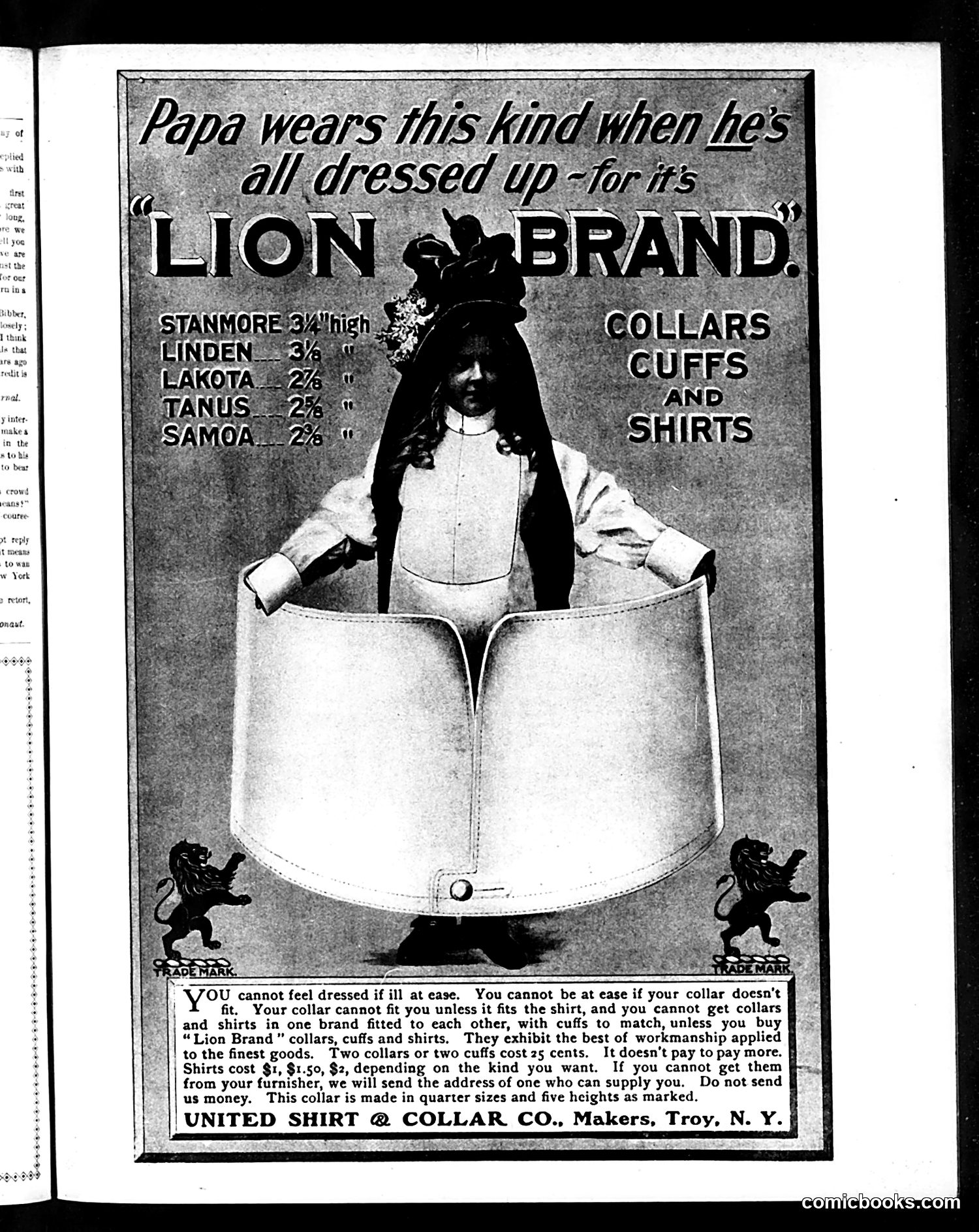
This is primarily a **product advertisement** for Lion Brand collars, cuffs, and shirts by United Shirt & Collar Co. (Troy, N.Y.), not a political cartoon. The visual shows a man in formal attire emerging from an oversized collar—a playful demonstration of the product's size range and fit quality. The accompanying copy emphasizes that proper collar fit is essential to looking dressed and feeling confident. The advertisement lists specific collar styles (Stanmore, Linden, Dakota, Tanus, Samoa) in various heights and sizes, highlighting the brand's precision manufacturing. The sales pitch argues that buying coordinated collars, cuffs, and shirts from one brand ensures they match properly. This reflects early 20th-century menswear standards where detachable collars were common, and fit was genuinely complicated. The humor is gentle and product-focused rather than satirical—the exaggerated collar serves as visual proof of the brand's range and quality workmanship.
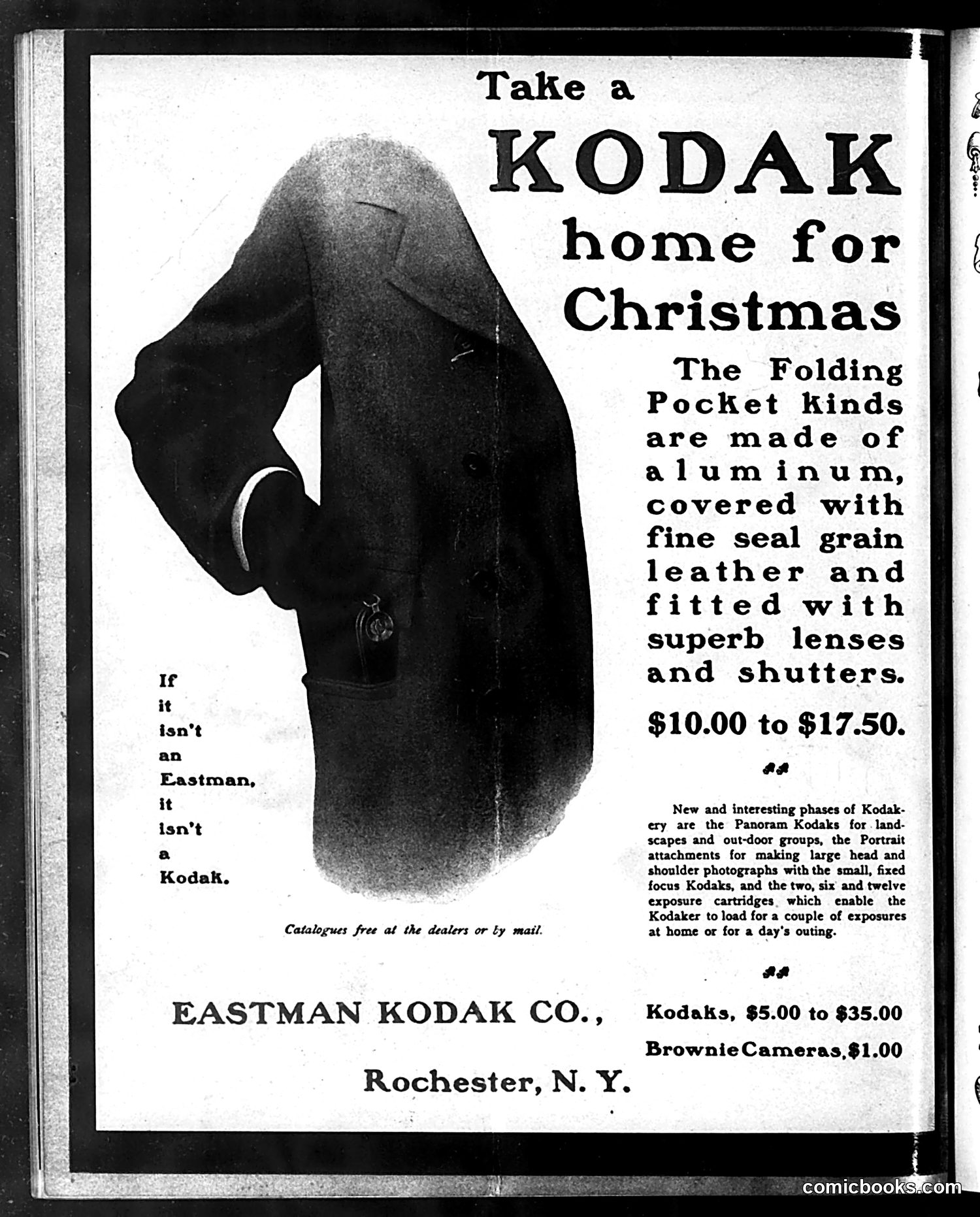
This is primarily an **advertisement**, not a cartoon or satirical content. It's a Kodak camera advertisement from Life magazine (early 1900s, based on style and pricing). The page features a photograph of a woman in dark clothing holding a folding pocket Kodak camera to her face. The accompanying slogan—"If it isn't an Eastman, it isn't a Kodak"—is a marketing claim asserting Eastman Kodak's brand dominance. The ad promotes Kodak's Folding Pocket models ($10-$17.50) as Christmas gifts, emphasizing their aluminum construction, leather covering, and quality lenses. It also mentions their Panoram Kodaks, Portrait attachments, and affordable Brownie Cameras ($1.00). **No political satire is present.** This is straightforward consumer advertising targeting holiday shoppers, reflecting the era when photography was becoming accessible to middle-class consumers.