
Life, 1900-12-01 · page 28 of 44
Life — December 1, 1900 — page 28: what you’re looking at
What you’re looking at
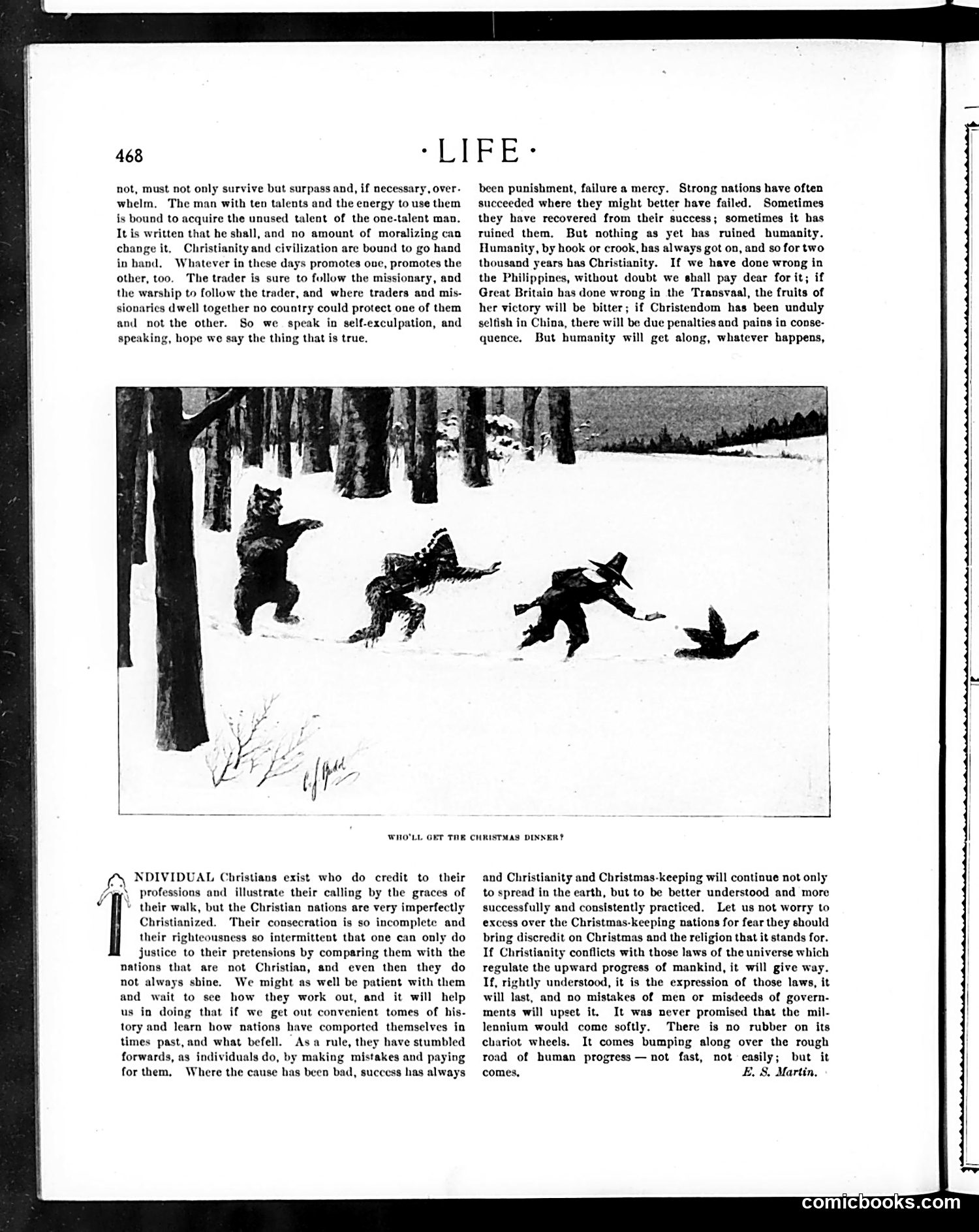
The cartoon "Who'll Get the Christmas Dinner?" depicts animals (appears to be bears or similar creatures) in a snowy forest scene, seemingly engaged in a struggle or chase. The image serves as visual metaphor for the accompanying essay. The text—a commentary on Christian nations' global conduct—argues that while individual Christians may be virtuous, Christian nations (specifically referencing the Philippines and the Transvaal/South Africa) act imperfectly and sometimes immorally. The cartoon satirizes this hypocrisy: just as animals fight over Christmas dinner in nature's harsh struggle, so too do supposedly "Christian" nations compete ruthlessly for imperial dominance and resources, belying their religious principles. The essay defends this behavior as inevitable human progress, but the cartoon's darkly ironic image undercuts this rationalization—suggesting Christian civilization is merely predatory appetite dressed in moral language.
📄 Transcribed text from this page (OCR, searchable)
Machine-transcribed from the original scan — historical spelling and the odd misread are preserved.
468 not, must not only survive but surpass and, if necessary, over- whelm. The man with ten talents and the energy to use them is bound to acquire the unused talent of the one-talent man. It is written that he shall, and no amount of moralizing can change it, Christianity and civilization are bound to go hand in hand. Whatever in these days promotes oue, promotes the other, too. The trader is sure to fullow the missionary, and the warship to follow the trader, and where traders and mis- sionarics dwell together no country could protect one of them and not the other. So we speak in self-exculpation, and speaking, hope we say the thing that is true. *LIPE > been punishment, failure a mercy, Strong nations have often succeeded where they might better have failed. Sometimes they have recovered from their success; sometimes it has ruined them. But nothing as yet has ruined humanity. Humanity, by hook or crook, has always got on, and so for two thousand years has Christianity. If we have done wrong in the Philippines, without doubt we shall pay dear for it; if Great Britain has done wrong in the Transvaal, the fruits of her victory will be bitter; if Christendom has been unduly seltish in China, there will be due penalties and pains in conse- quence, But humanity will get along, whatever happens, WHO'LL GET THE CHRISTMAS DINNER? NDIVIDUAL Christians exist who do credit to their professions and illustrate their calling by the graces of * their walk, but the Christian nations are very imperfectly Christianized. Their consecration is so incomplete and their righteousness so intermittent that one can only do justice to their pretensions by comparing them with the nations that are not Christian, and even then they do not always shine. We might as well be patient with them and wait to see how they work out, and it will help us in doing that if we get out convenient tomes of his- tory and learn bow nations have comported themselves in times past, and what befell. Asa rule, they have stumbled forwards, as individuals do, by making mistakes and paying for them, Where the cause has been bad, success has always and Christianity and Christmas-keeping will continue not only to spread in the earth, but to be better understood and more successfully and consistently practiced. Let us not worry to excess over the Christmas-keeping nations for fear they should bring discredit on Christmas and the religion that it stands for. If Christianity conflicts with those laws of the universe which regulate the upward progress of mankind, it will give way. If, rightly understood, it is the expression of those laws, it will last, and no mistakes of men or misdeeds of govern- ments will upset it, It was never promised that the mil- lennium would come softly. There is no rubber on its chariot wheels. It comes bumping along over the rough road of human progress — not fast, not easily; but it comes, E. 8. Martin, comicbooks.com