
Life, 1900-12-01 · page 19 of 44
Life — December 1, 1900 — page 19: what you’re looking at
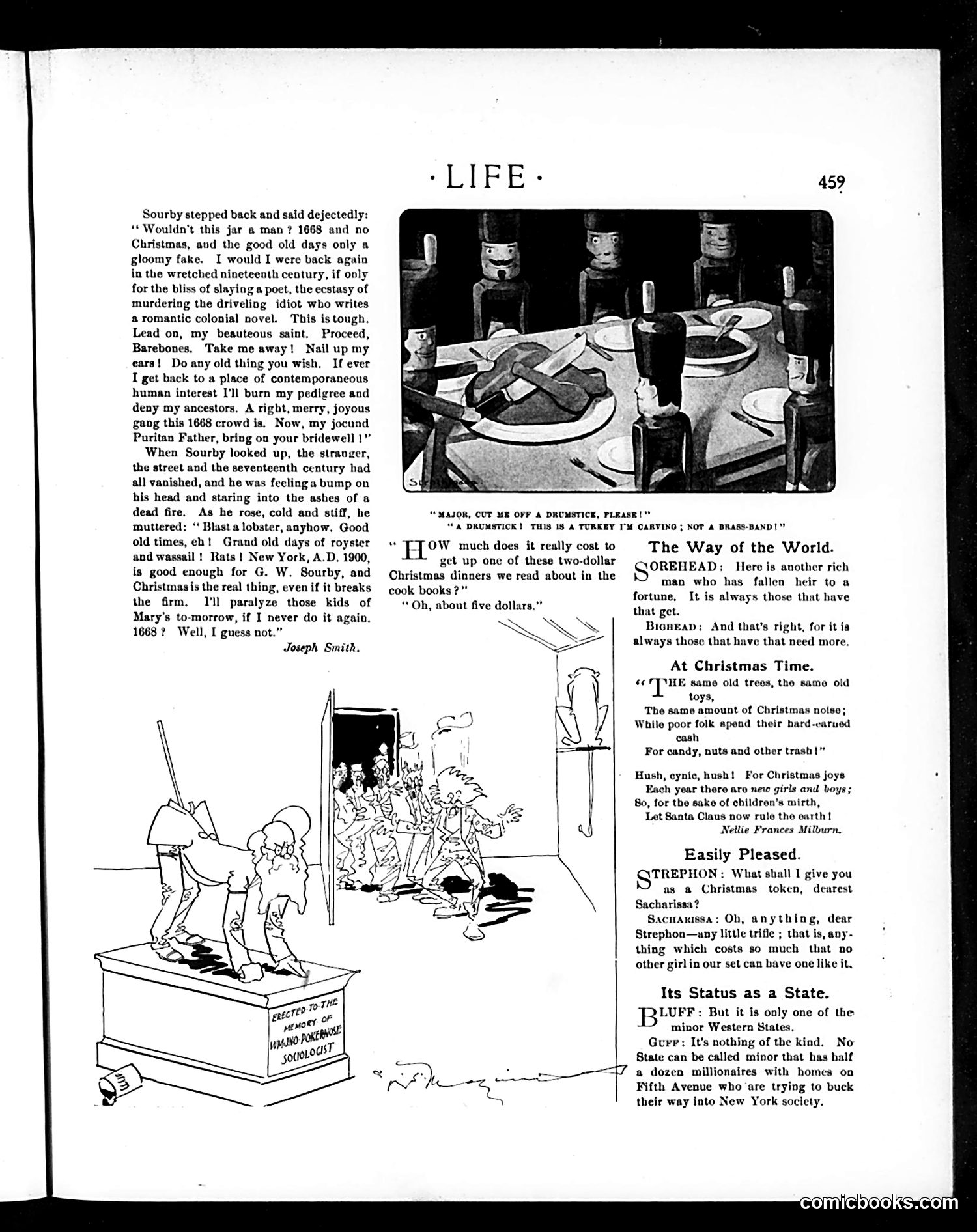
What you’re looking at
This page contains multiple satirical pieces mocking turn-of-the-century American society, particularly around Christmas and wealth. The main narrative excerpt follows "Sourby," who dreams of escaping 1900 New York for the "romantic" colonial past (1668), only to awaken disillusioned—suggesting the present era, however flawed, beats nostalgic fantasies. The cartoons mock: 1. **Class and consumption**: A dialogue reveals expensive "two-dollar Christmas dinners" actually cost five dollars, satirizing middle-class pretension and hidden costs. 2. **Wealth inequality**: Wealthy heirs receiving fortunes while the poor struggle—a sardonic comment on unequal distribution. 3. **Social climbing**: A Western state is deemed "not minor" because its millionaires possess Fifth Avenue homes and social ambitions, mocking how wealth alone defines status rather than geographic importance. The humor targets Gilded Age materialism, class anxiety, and the gap between public perception and economic reality in 1900s America.
📄 Transcribed text from this page (OCR, searchable)
Machine-transcribed from the original scan — historical spelling and the odd misread are preserved.
Sourby stepped back and said dejectedly: ““Wouldn’t this jar a man? 1668 and no Christmas, and the good old days only a gloomy fake. I would I were back again in the wretched nineteenth century, if only for the bliss of slaying a poet, the ecstasy of murdering the driveling idiot who writes a romantic colonial novel. This is tough. Lead on, my besuteous saint. Proceed, Barebones. Take me away! Nail up my ears! Do any old thing you wish. If ever I get back to a place of contemporaneous human interest I'll burn my pedigree and deny my ancestors. A right, merry, joyous gang this 1668 crowd is. Now, my jocuad Puritan Father, bring on your bridewell !” When Sourby looked up, the stranger, the street and the seventeenth century had all vanished, and he was feelinga bump on his head and staring into the ashes of a dead fire. As he rose, cold and stiff, he muttered: ‘‘ Blast a lobster, anyhow. Good old times, eh! Grand old days of royster and wassail ! Rats! New York, A.D. 1900, is good enough for G. W. Sourby, and Christmasis the real thing, even if it breaks the firm. I'll paralyze those kids of Mary's to-morrow, if I never do it again. 1668? Well, I guess not.” Joseph Smith. AJOR, CUT ME OFF A DRUMSTICK, PLEASE!" “(a DRUMSTICK! THIS 18 4 TURKEY I'M CARVING ; XOT A BRASS-BAND!" at FH’ much does it really cost to get up one of these two-dollar Christmas dinners we read about in the cook books?” “Oh, about five dollars.” The Way of the World. SOREHEAD: Here is another rich man who has fallen heir to a fortune, It is always those that have that get. Bicneap: And that’s right, for it is always those that have that need more. At Christmas Time. ¢¢ TXHE samo old treos, tho samo old toys, Tbe same amount of Christmas noise; While poor folk spend their hard-carued cash For candy, nuts and other trash!” Hush, cynic, hush! For Christmas joys Each year there aro new girls and boys; 8o, for the sake of childron’s mirth, Let Santa Claus now rule the oarth | Nellie Frances Milburn, Easily Pleased. TREPHON: What shall I give you as a Christmas Sacharissa? Sacnanissa: Oh, anything, dear Strephon—uny little trifle ; that is, any- thing which costs so much that no otber girl in our set can bave one like it, token, dearest Its Status as a State. BiLvEF: But it is only one of the minor Western States. Gurr: It’s nothing of the kind. No State can be called minor that has half a dozen millionaires with homes on Fifth Avenue who ‘are trying to buck their way into New York society.