
A complete issue · 20 pages · 1900
Life — November 1, 1900
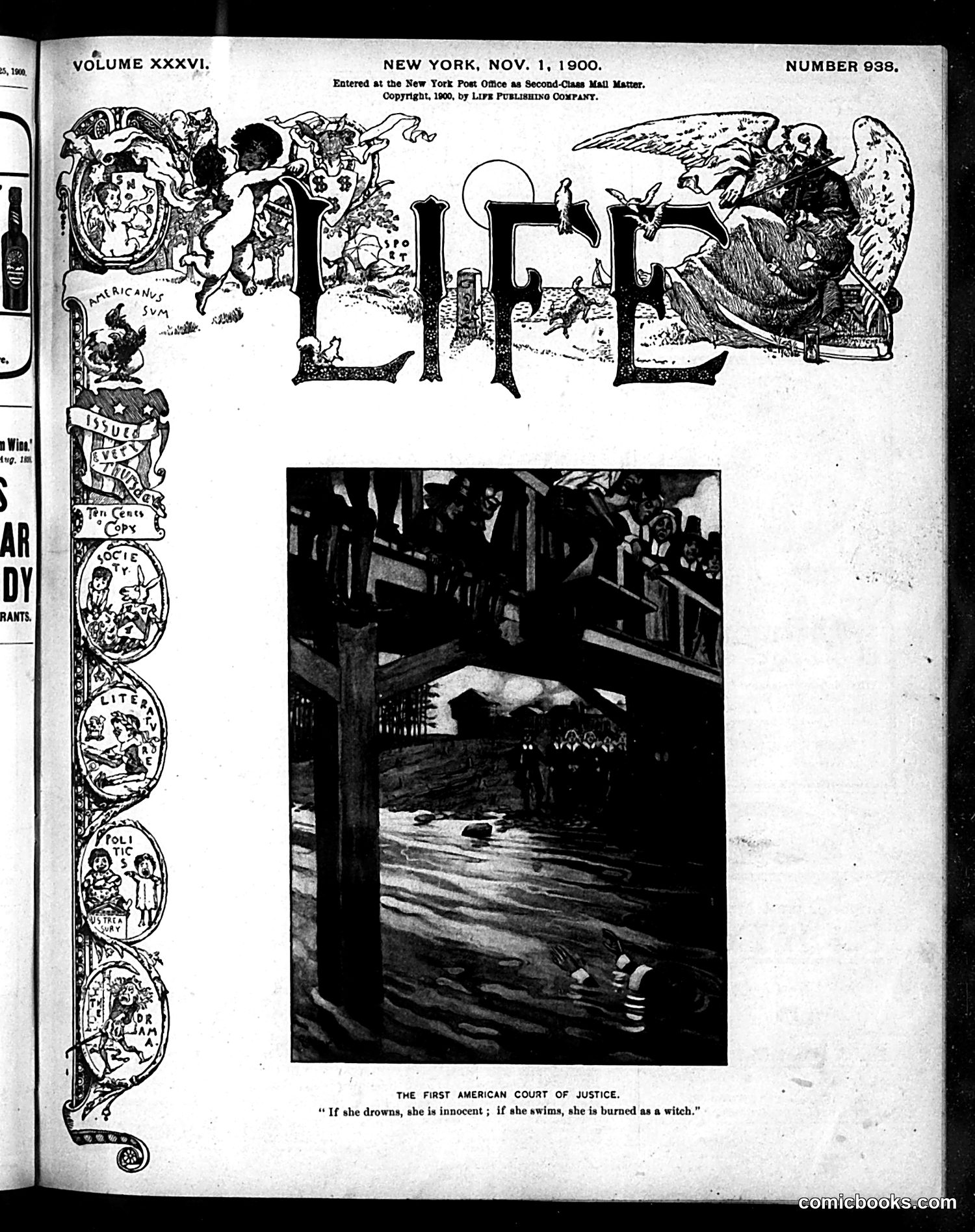
This page satirizes early American witch trial hysteria through "The First American Court of Justice." The caption—"If she drowns, she is innocent; if she swims, she is burned as a witch"—highlights the impossible logic of colonial witch trial tests: accused women faced certain death either way (drowning or burning). The photograph below shows what appears to be a water dunking or swimming test, the historical method used to "prove" witchcraft. By presenting this as America's "first court of justice," the satirist critiques how early American legal proceedings were fundamentally irrational and cruel, particularly toward women. This commentary likely responded to contemporary concerns about due process and justice system fairness in the year 1900.
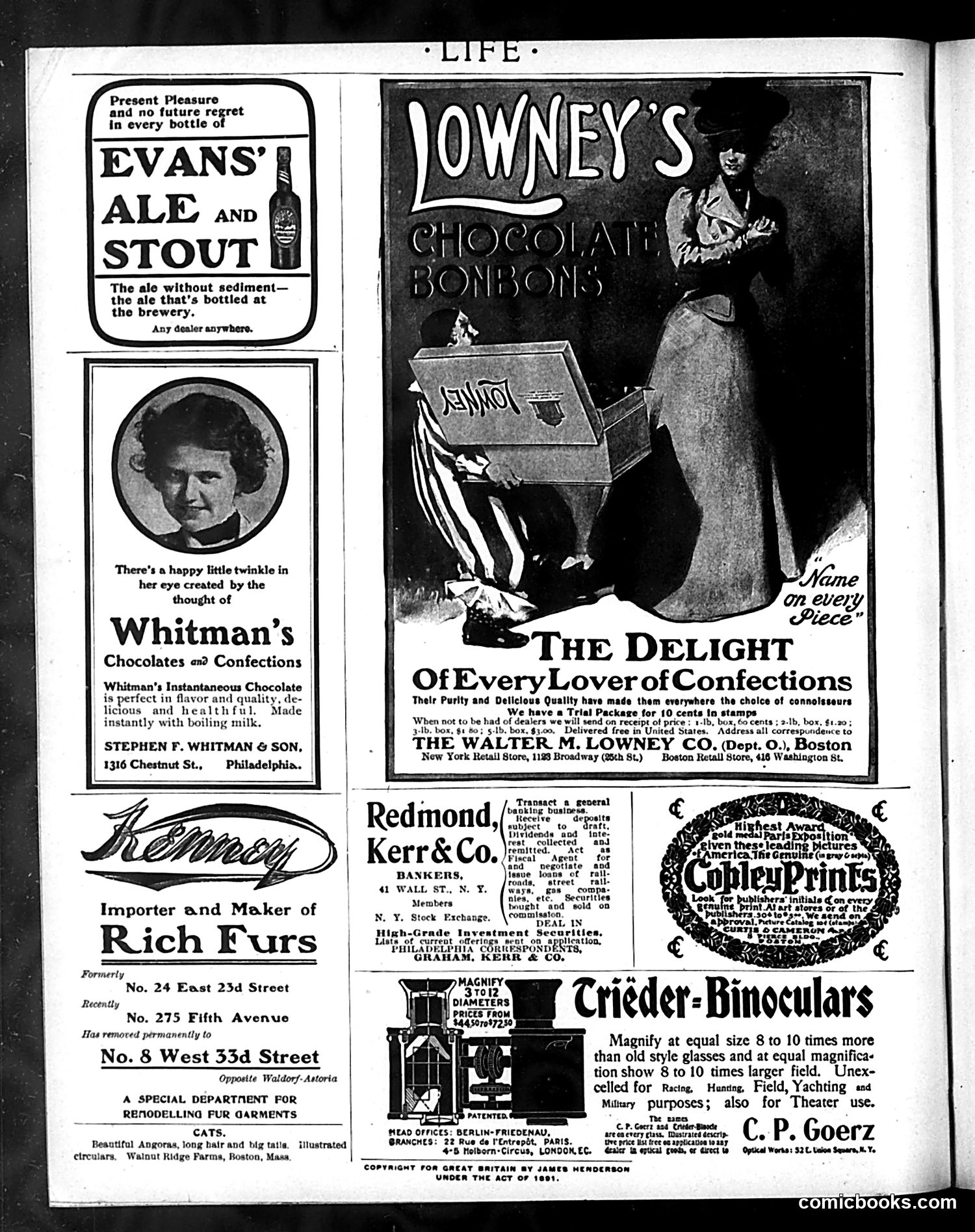
This page is primarily **advertising**, not satirical content. It contains five distinct product advertisements from the early 20th century: 1. **Evans' Ale and Stout** - beverage ad 2. **Whitman's Chocolates** - confectionery, featuring a smiling woman's portrait 3. **Lowney's Chocolate Bonbons** - the largest ad, showing a woman presenting a gift box 4. **Hennessy Furs** - luxury fur importer with multiple Manhattan locations 5. **Miscellaneous ads** for banking services, prints, and binoculars There is **no political satire or cartoon commentary** visible. The "Life" magazine page showcases luxury consumer goods marketed to affluent readers, with particular emphasis on chocolates, alcohol, and furs—typical high-end products advertised in this era's publications.
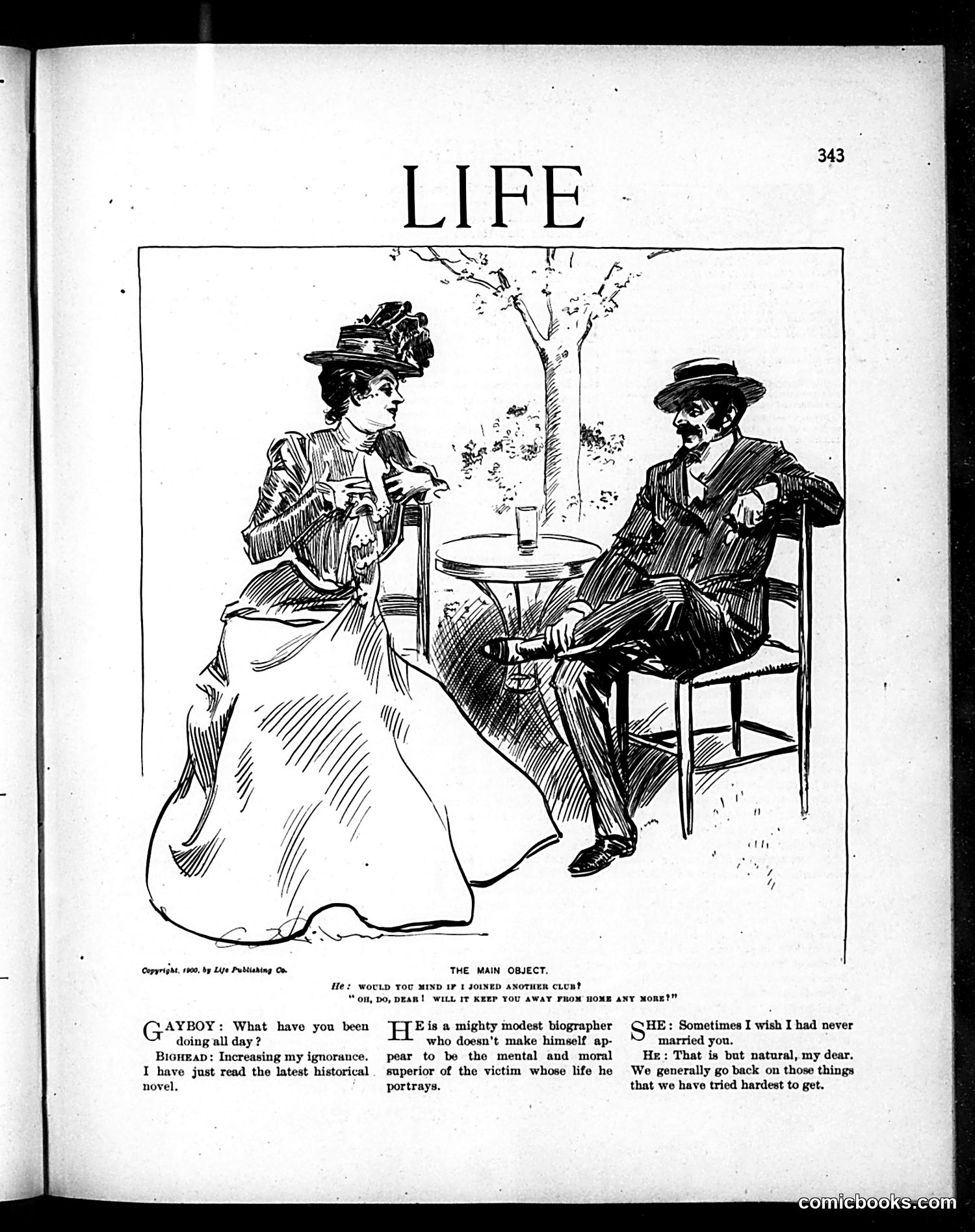
This early 1900s cartoon satirizes marriage dynamics through a domestic scene. A well-dressed couple sits in a garden; the woman asks her husband if he'd join another club, worried it will keep him away from home. His response—"Oh, do, dear! Will it keep you away from home any more?"—reveals marital tension. The surrounding dialogue mocks a self-important "biographer" who inflates his own importance, and contrasts with a woman's regret about marriage. The satire targets both marriage's disillusionment and male pomposity. The cartoon's title, "The Main Object," suggests the ironic point: husbands and wives actively seek separation from each other, contrary to traditional domestic ideals of the era.
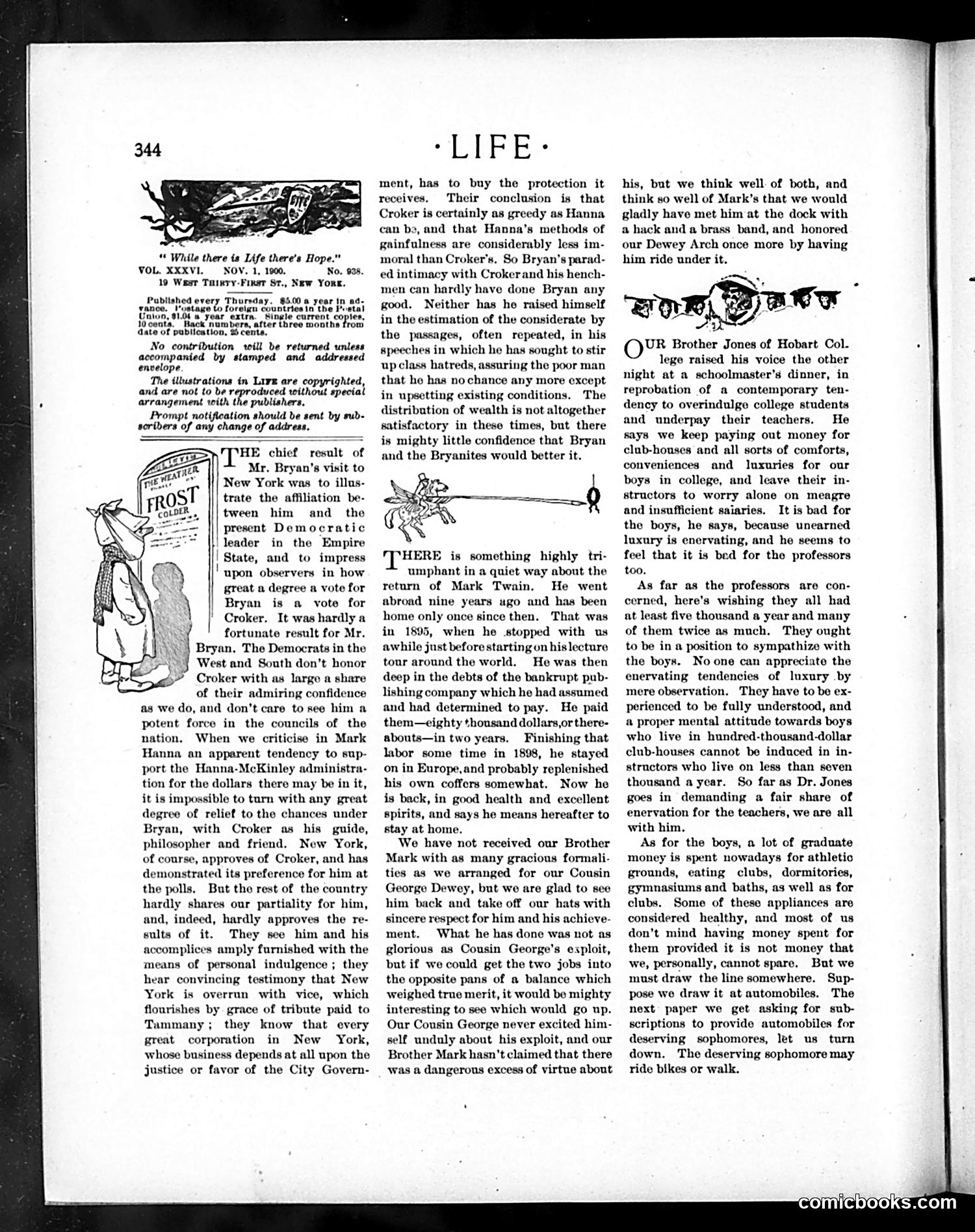
The page contains two distinct sections: **Left column:** A political cartoon showing a figure labeled "THE FRAU" (appearing to reference a German woman, likely Kaiser Wilhelm II's wife during WWI era based on the styling). The cartoon depicts this figure in a satirical manner related to American political divisions. **Main text:** Articles discussing Mark Twain's return from abroad and Brother Jones of Hobart College criticizing how wealthy alumni fund luxuries (club-houses, dormitories, athletics) for students rather than paying professors adequate salaries. Jones argues this creates moral hazard among students and demoralizes underpaid faculty earning under $7,000 annually. The satire critiques both wealth disparity in American institutions and how privilege corrupts educational priorities—a Progressive Era concern about inequality and proper resource allocation.
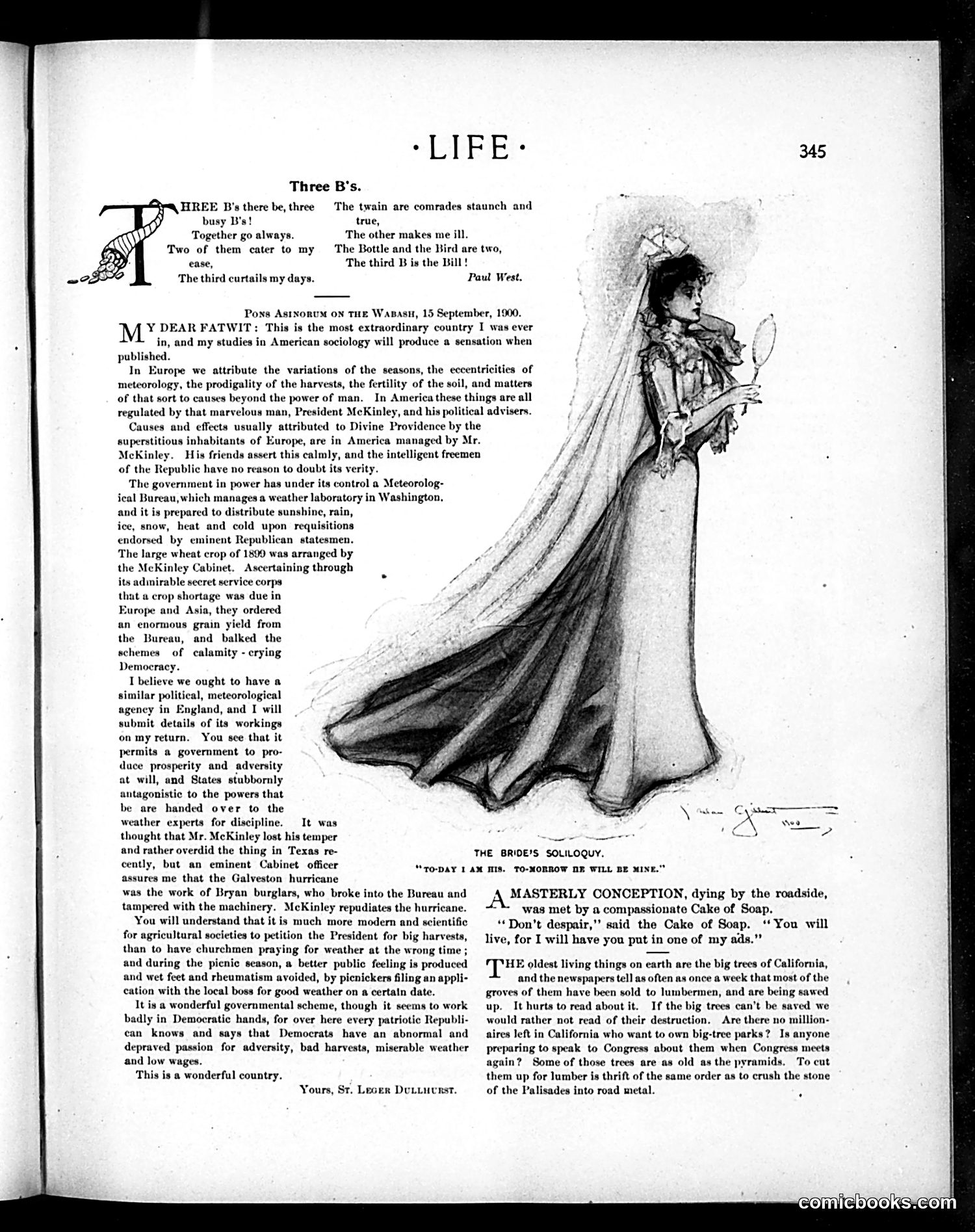
**"Three B's" Poem**: A brief satirical verse by Paul West mocking three entities—likely political figures or institutions of the 1900 era—where "the third B is the bill!" **Main Illustration**: "The Bride's Soliloquy" depicts a woman in elaborate wedding dress with the caption "To-day I am his; to-morrow he will be mine." This appears to satirize marriage dynamics, possibly commenting on women's legal or economic power within matrimony—a social commentary on gender relations. **"Poss Asshorum" Letter**: A lengthy satirical piece mocking President McKinley's administration (referenced explicitly), particularly ridiculing the idea that Republicans control weather/prosperity through a "Meteorological Bureau." The satire attacks claims that McKinley's policies artificially produce agricultural abundance, equating government control of nature with the "schemes of calamity-crying Democracy." The page satirizes Republican political claims and gender relations circa 1900.
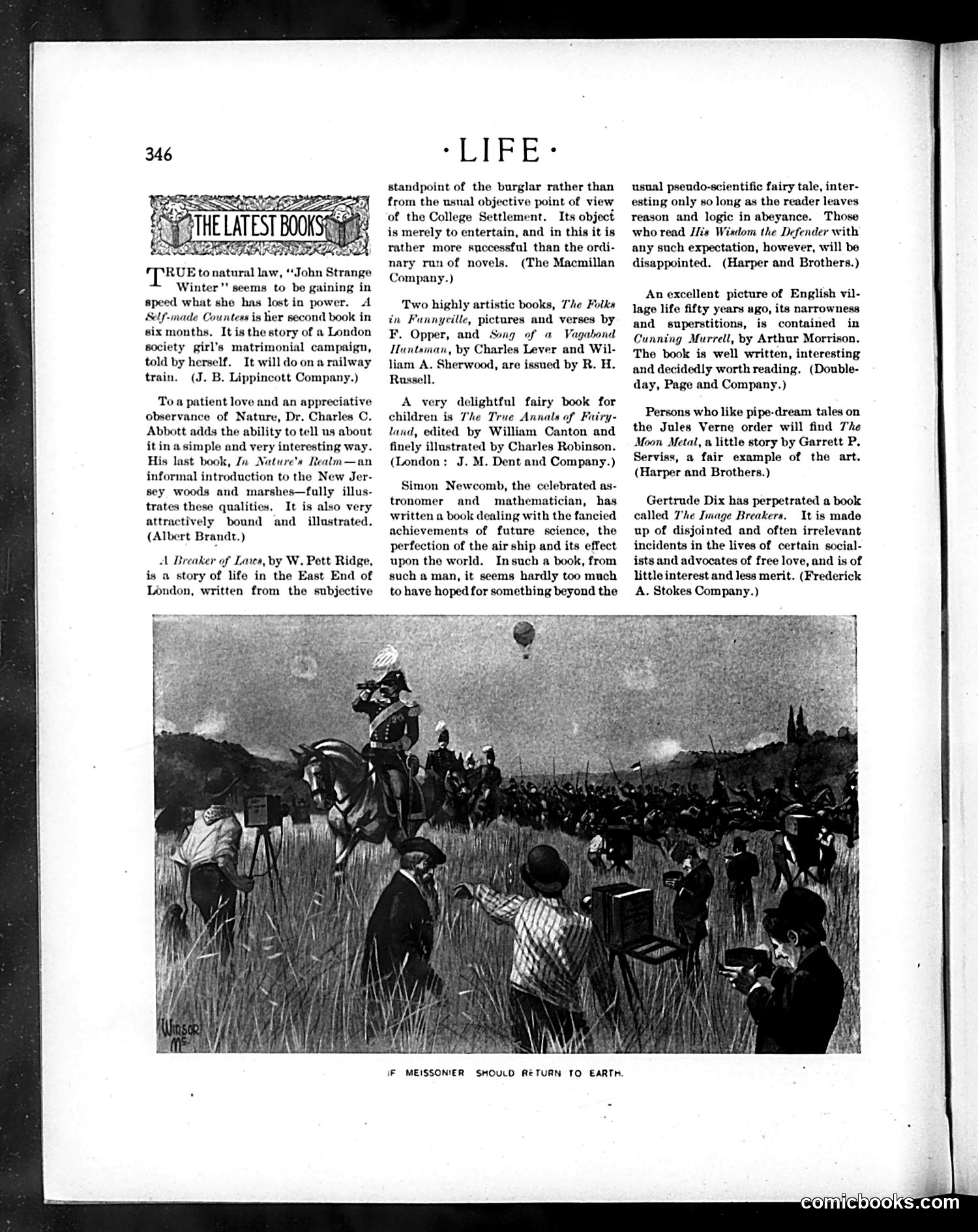
The main illustration depicts "If Meissoner Should Return to Earth"—a reference to Jean-Louis-Ernest Meissonier, a 19th-century French military painter famous for detailed historical battle scenes. The cartoon imagines Meissonier witnessing a modern (early 20th-century) military balloon ascension or aerial demonstration, surrounded by crowds and observers. The satire likely comments on how warfare and military technology have transformed beyond what the historical painter could have imagined—from his detailed depictions of cavalry and ground combat to modern aerial warfare with balloons and aircraft. The joke plays on the contrast between Meissonier's romantic, carefully-rendered historical military art and contemporary mechanized warfare's radical innovations.
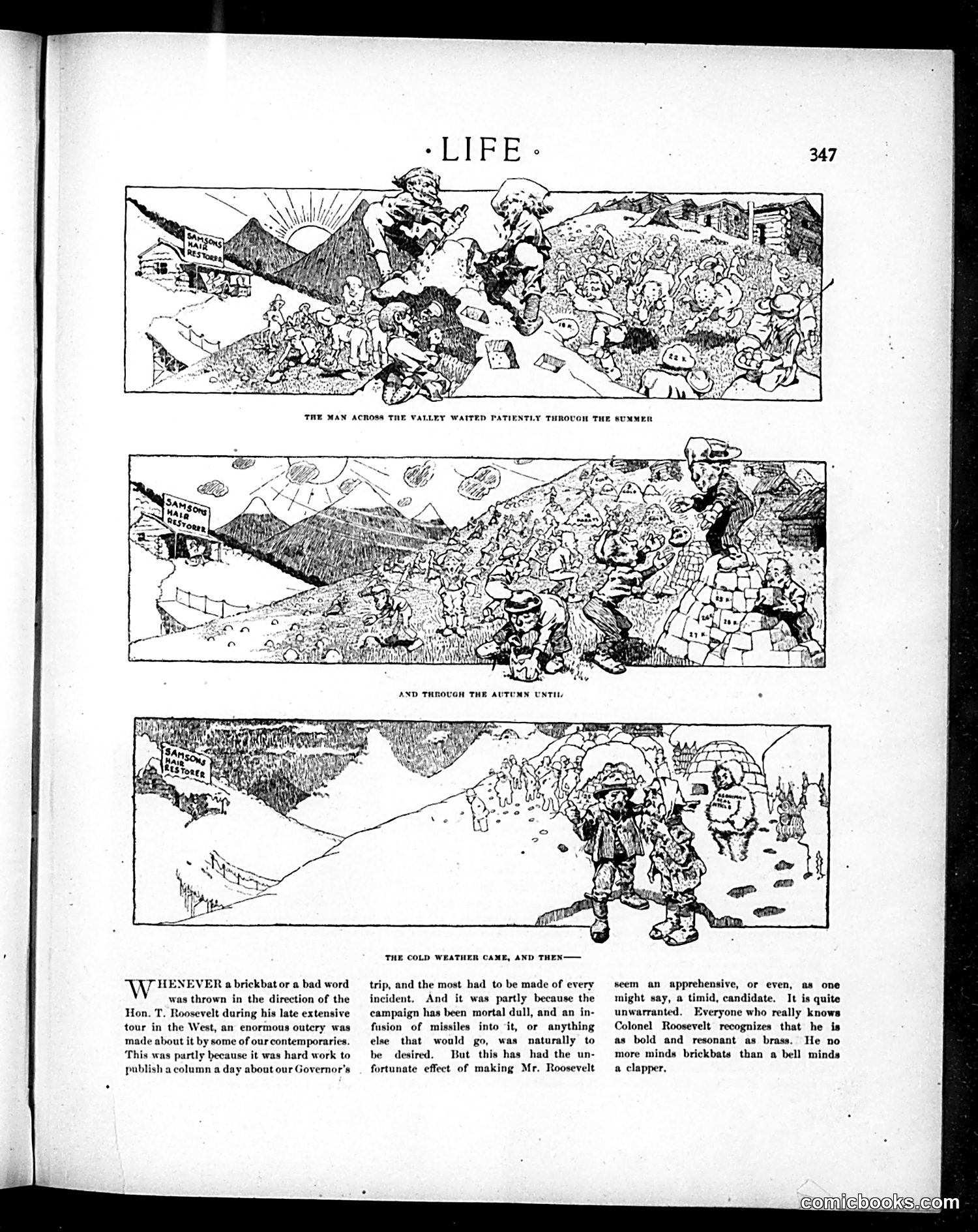
This page contains a three-panel comic strip depicting "The Man Across the Valley" waiting patiently through seasons—summer, autumn, and cold weather. The accompanying text criticizes Theodore Roosevelt's extensive Western tour, describing it as an "enormous outcry" that was "hard work to publish." The satire targets Roosevelt's active campaigning and public visibility, suggesting his constant presence and activity made him difficult to avoid or ignore in the press. The text notes that while such campaigns are typically "mortal dull," Roosevelt's generated significant controversy and media attention—characterizing him as bold and resonant rather than merely a conventional political figure. The comic illustrates the tedious waiting game of politics across changing seasons.
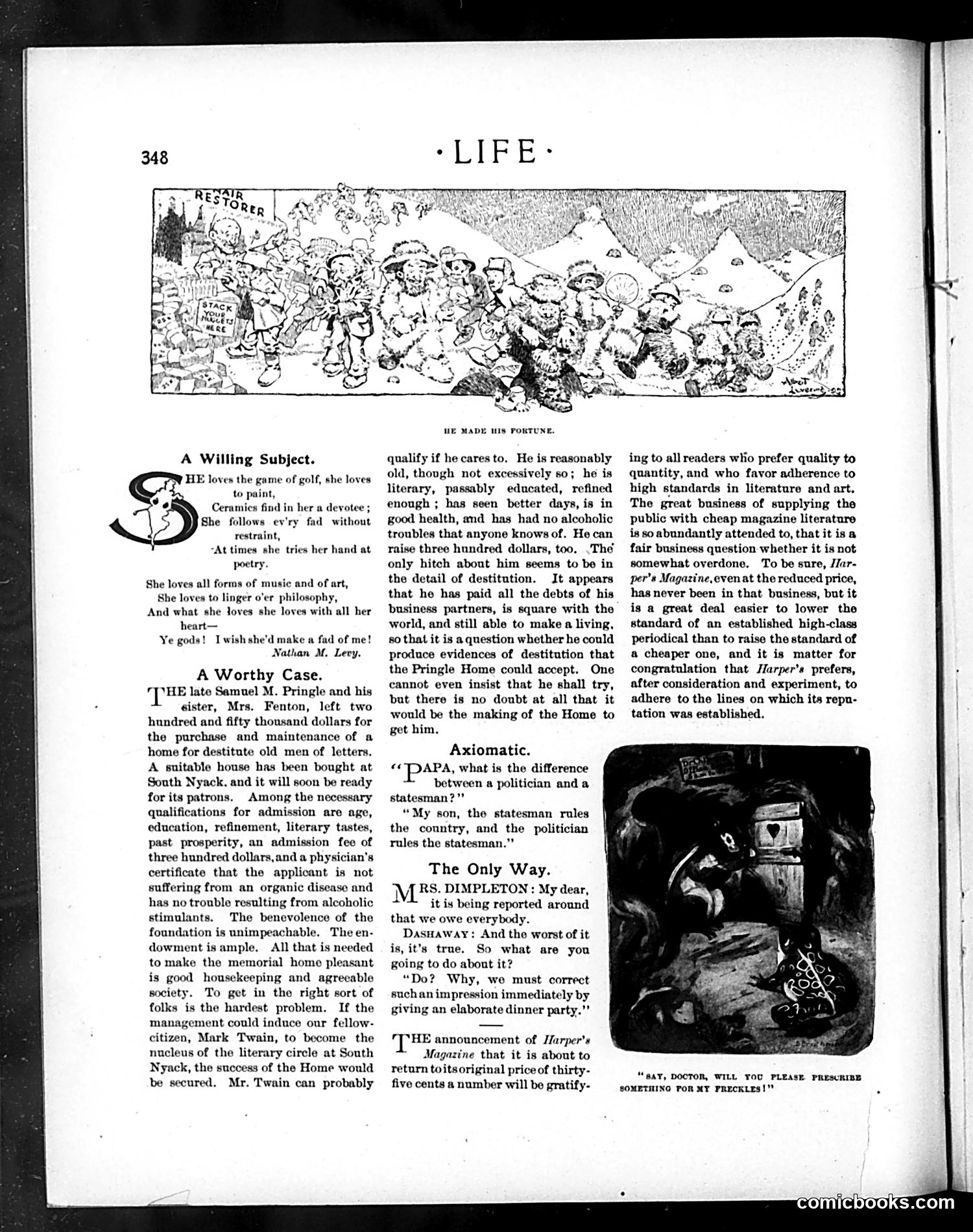
The page contains three short satirical pieces rather than a single unified cartoon: 1. **"A Willing Subject"** mocks a woman devoted to golf and art while neglecting domestic duties—a common early-20th-century critique of women pursuing interests beyond homemaking. 2. **"A Worthy Case"** describes charitable efforts to establish a memorial home, likely referencing a real philanthropic initiative from the period. 3. **"Axiomatic"** presents a brief father-son joke about the difference between politicians and statesmen—typical period humor about political hypocrisy. 4. **"The Only Way"** satirizes solving social problems through elaborate dinner parties rather than substantive action. A photograph captioned "Say, Doctor, will you please prescribe something for my freckles?" appears to show beauty-related vanity humor typical of the era. The overall tone targets gender roles, politics, and social pretension.
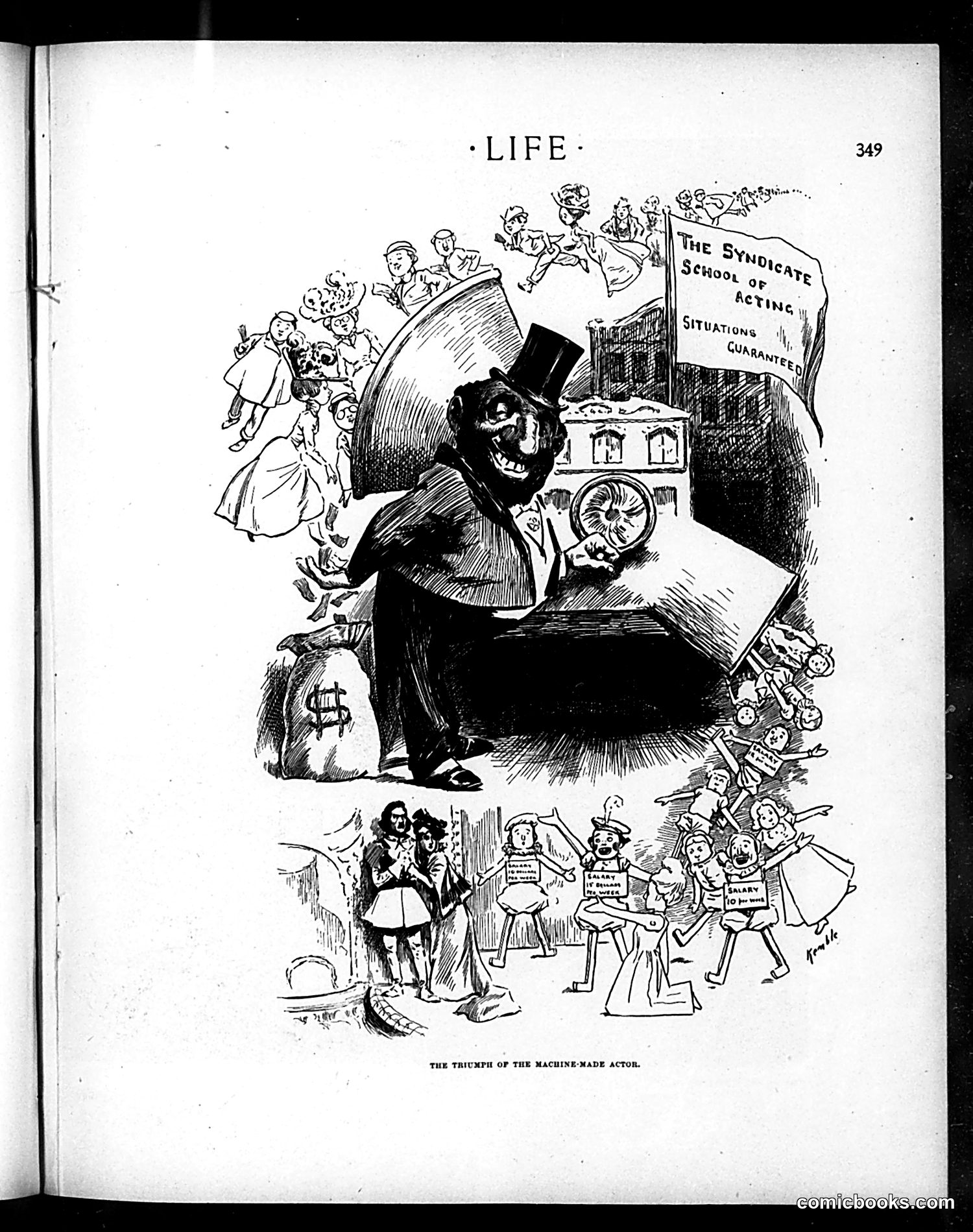
This satirical cartoon critiques the commercialization of theater and acting during the early 20th century. A large, grotesque figure in a top hat—representing a theatrical impresario or producer—operates a mechanical apparatus labeled "The Syndicate School of Acting—Situations Guaranteed." The machine manufactures interchangeable actors (shown as small figures pouring out), suggesting that professional acting has become industrialized and formulaic rather than an art requiring genuine talent. A money bag sits at the producer's feet, emphasizing profit motive. The satire targets "The Syndicate," likely referring to theatrical syndicates that controlled booking and distribution, reducing actors to commodities and standardized performances. The cartoon mocks how commercial systems prioritize reproducible entertainment over artistic authenticity.
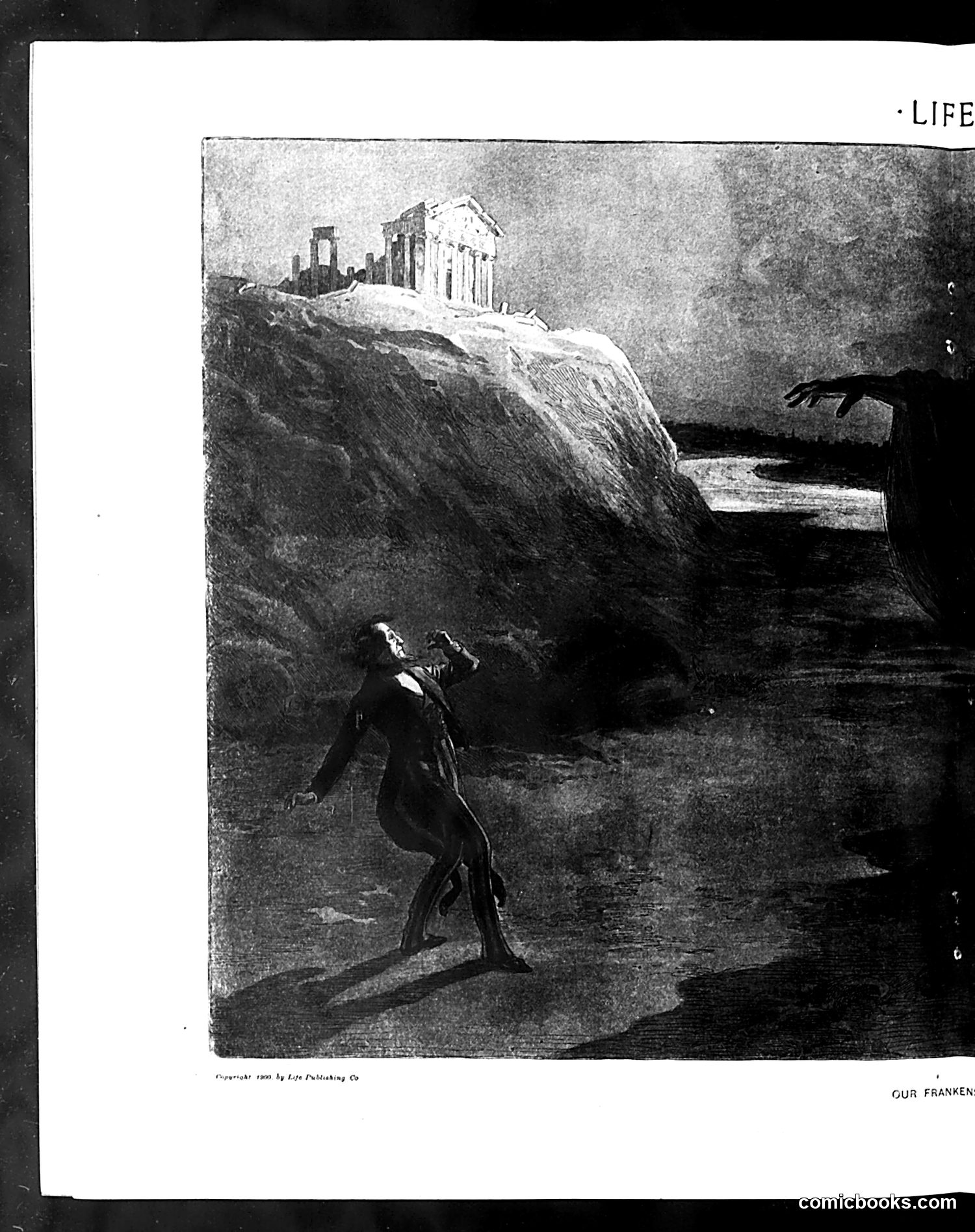
This appears to be a satirical illustration titled "Our Franken[stein]" from Life magazine. The image shows a figure in dark clothing on lower ground, gesturing upward toward a classical building perched dramatically on a cliff. The composition suggests the figure has created or is responsible for something larger and uncontrollable above them. Without the complete title or publication date visible, the specific reference remains unclear. However, the "Frankenstein" metaphor typically satirized creators who unleashed dangerous forces beyond their control. The classical architecture may represent an institution or government body. This likely critiques American political or industrial leadership for creating destructive consequences they cannot manage—a common satirical theme in early 20th-century American humor.
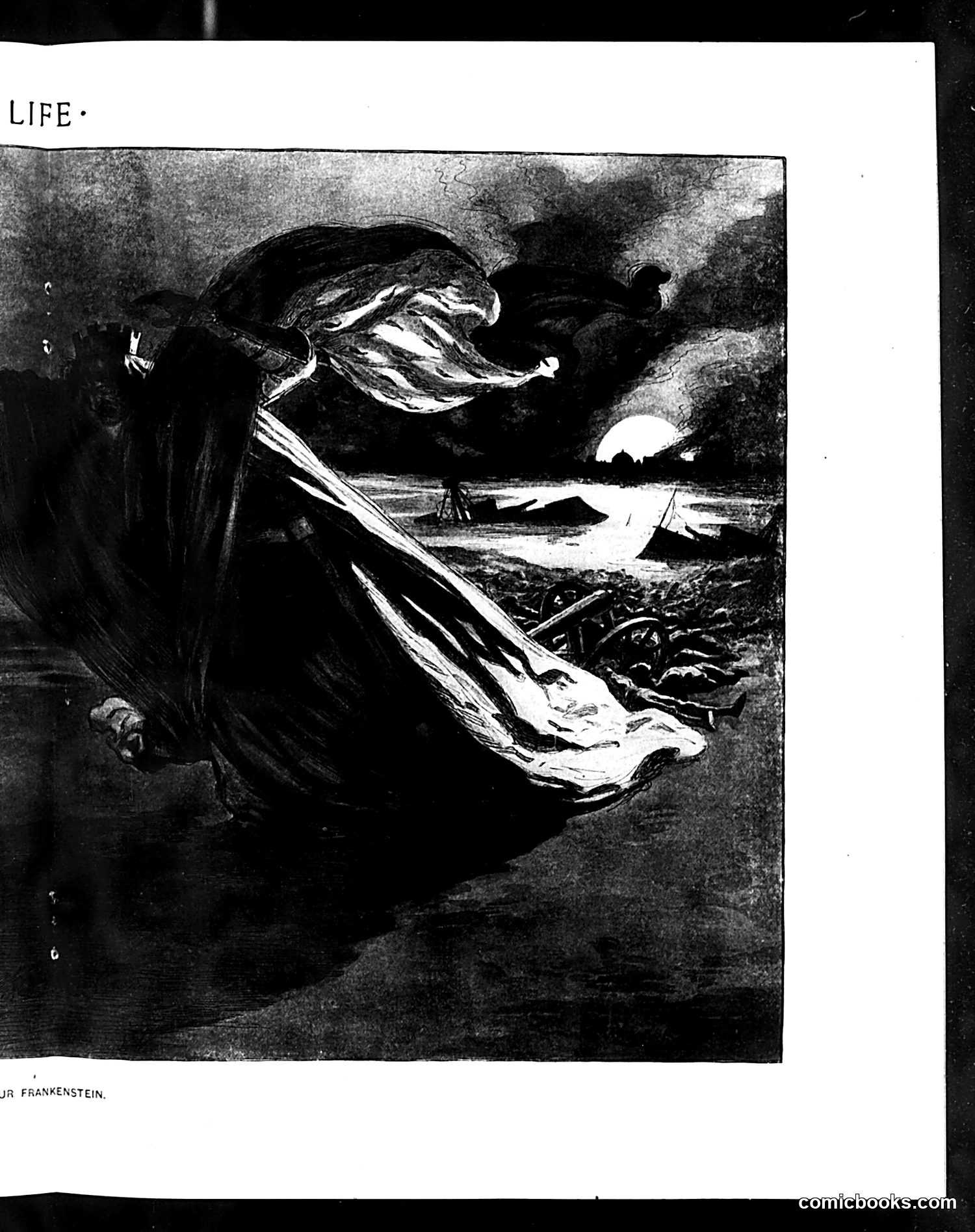
This page from *Life* magazine shows an illustration titled "Life" with a credit to "Dr Frankenstein" at the bottom. The dramatic black-and-white image depicts a robed figure gesturing toward a moonlit landscape with water and boats. The satire appears to reference Mary Shelley's *Frankenstein*, using the mad scientist as a metaphor. The "Dr Frankenstein" credit suggests the illustration comments on someone creating or manipulating something monstrous or unnatural—likely a contemporary political or social figure portrayed as a reckless creator. The moonlit, gothic aesthetic emphasizes the dark, uncontrolled nature of whatever is being "created." Without additional context about the magazine's publication date, the specific target remains unclear, though the imagery suggests criticism of dangerous innovation or manipulation.
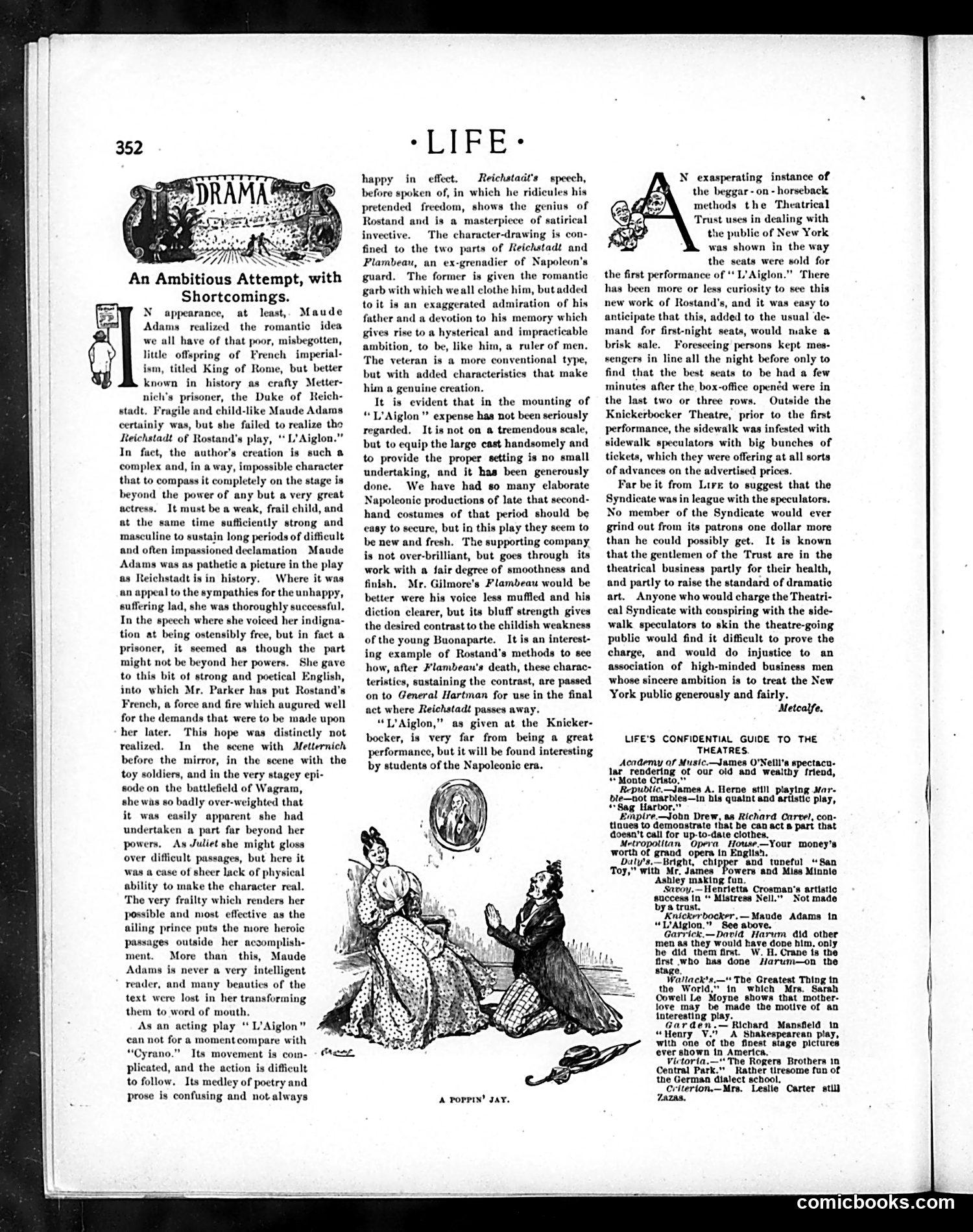
This page reviews "An Ambitious Attempt, with Shortcomings"—a theatrical production featuring an actress named Maude Adams. The main illustration, captioned "A Poppin' Jay," depicts a scene from the play "L'Aiglon," showing figures in period costume (appears to be Napoleonic era based on the context). The review critiques Adams's performance as ambitious but flawed. While praising her romantic interpretation and emotional appeal, the critic notes she lacked the physical stamina for demanding roles. The text suggests her weakness undermined an otherwise noble artistic effort. The page includes a "Life's Confidential Guide to the Theatres" listing current Broadway productions and their stars. This review-and-listings format was typical for Life magazine during this theatrical era.
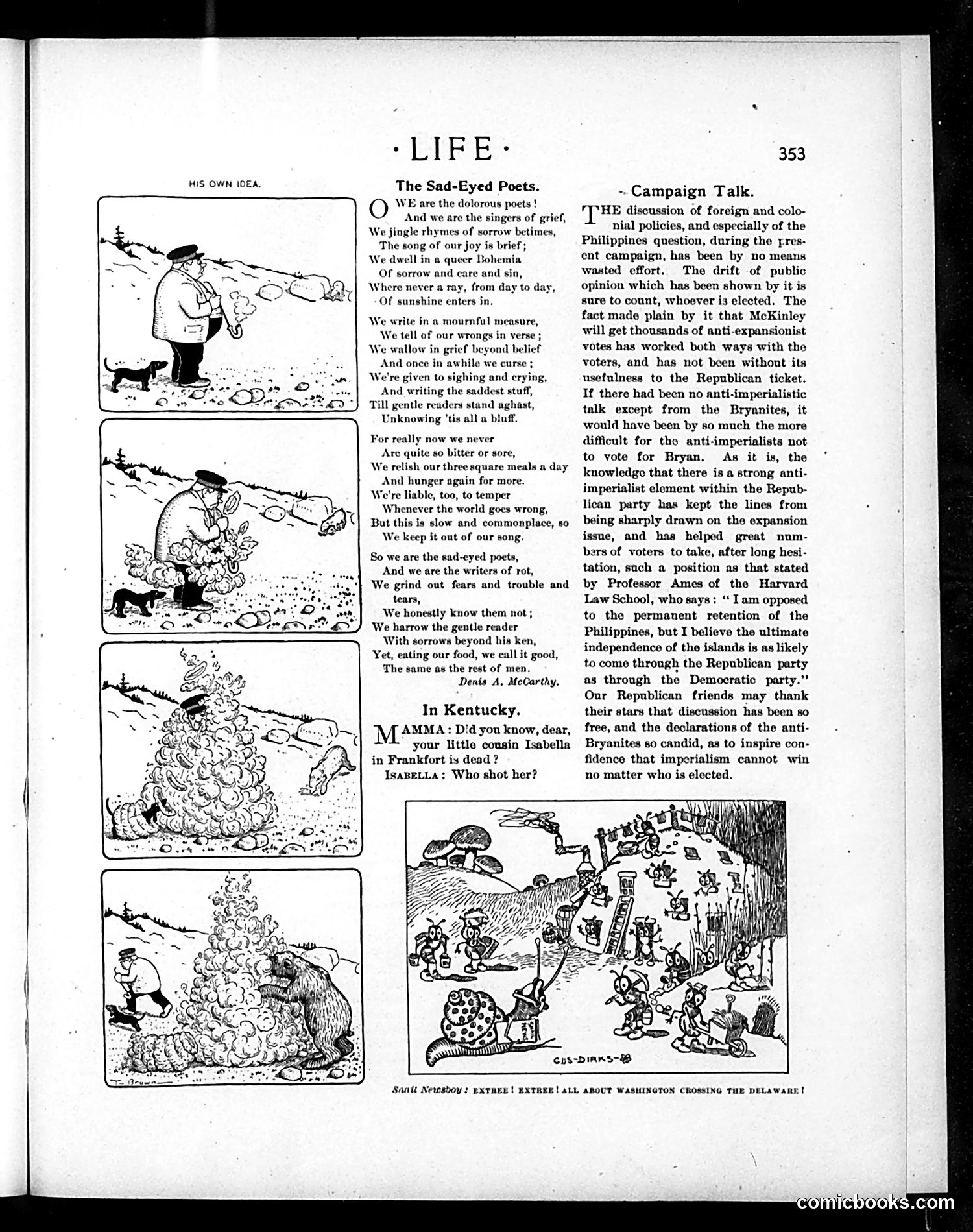
**"His Own Idea" (left comic strip):** A man repeatedly tries to start a fire, progressively enlarging it through four panels while his dog watches. The joke plays on self-deception—the caption suggests the man thinks this is his own clever idea, when he's simply escalating an obvious outcome. **"The Sad-Eyed Poets" (center poem):** A satirical mockery of self-pitying bohemian poets who claim deep suffering but actually live comfortably. The poem exposes them as frauds—"unknowing 'tis all a bluff"—who theatrically perform angst while eating regular meals. **"Campaign Talk" (right column):** Political commentary on the 1900 presidential campaign. It discusses how anti-imperialist sentiment (opposition to American colonial expansion, especially in the Philippines) has paradoxically helped President McKinley's re-election by appealing to Republican voters skeptical of imperialism. The text argues this open debate has strengthened rather than weakened Republican chances. **"In Kentucky" (bottom):** A darkly humorous dialogue about a shooting death, with the street newsboy's cry about "Washington Crossing the Delaware" providing absurdist contrast.
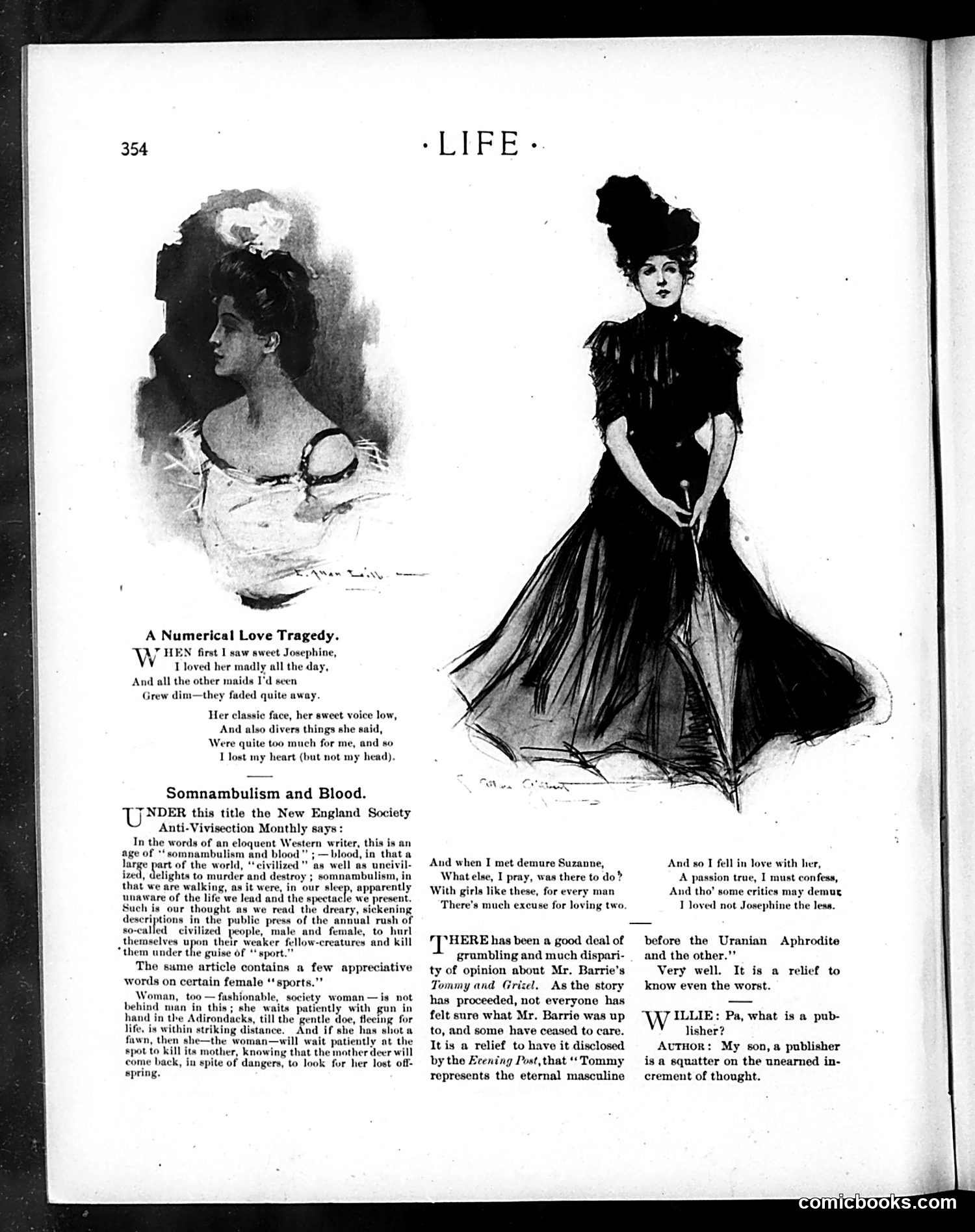
This page contains two satirical pieces. The left illustration and poem "A Numerical Love Tragedy" mock the narrator's serial romantic entanglements—he loves Josephine madly, then meets Suzanne and falls for her too, claiming both loves are equally genuine. The humor lies in exposing the speaker's emotional inconsistency and shallow rationalization. The larger section, "Somnambulism and Blood," critiques what the New England Anti-Vivisection Society calls modern society's unconscious cruelty. It attacks both men and fashionable women who participate in hunting for sport, particularly depicting wealthy women waiting in the Adirondacks to kill does and their fawns. The satire condemns this casual violence as evidence of civilization's moral sleepwalking. A brief exchange at bottom defines a "publisher" as one who profits from others' intellectual labor without compensation—a jab at publishing industry exploitation.
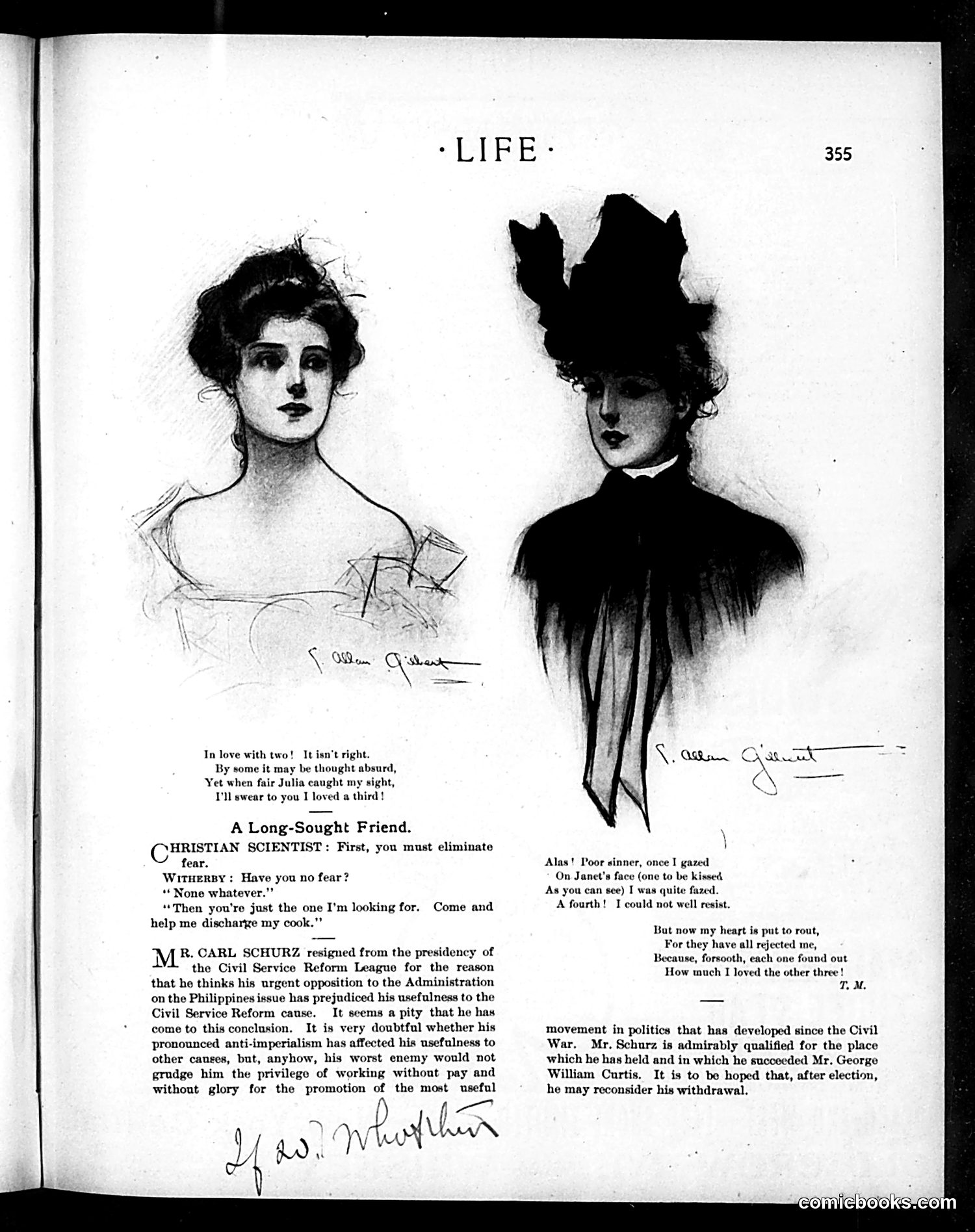
This page contains two distinct items from early 20th-century Life magazine: **Top illustrations:** Two portrait sketches (signed by Gibson, likely Charles Dana Gibson) accompanying a poem about romantic entanglement—a man claims to love three (or four) different women simultaneously. This appears to be light satirical commentary on romantic duplicity, a common theme in Life's humor. **Lower section:** A brief political dialogue mocking Christian Science practitioners as emotionally detached—the joke being that someone with "no fear" would make a suitable accomplice in firing a servant. **Main article:** Discussion of Carl Schurz's resignation from the Civil Service Reform League presidency, opposing U.S. imperialism in the Philippines. The author argues Schurz's anti-imperialist stance hasn't actually harmed his other reform work and hopes he'll reconsider after the next election. This reflects contemporary debate over American expansionism in the Philippines following the Spanish-American War. The page blends lighthearted social satire with serious political commentary typical of Life's editorial approach.
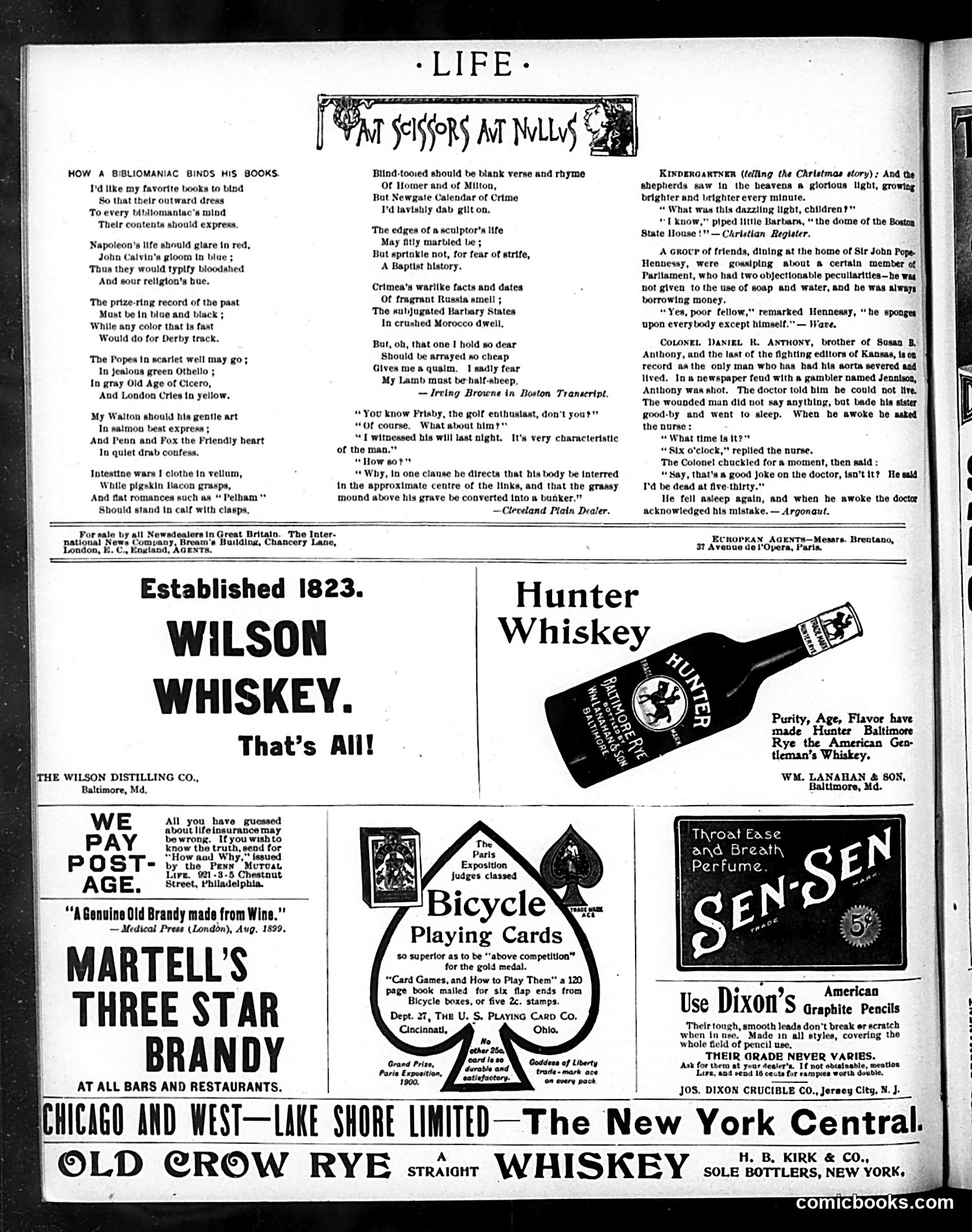
This page contains primarily **humorous literary content and advertisements** rather than political cartoons. The main satirical pieces are short jokes and poems: 1. **"How a Bibliomaniac Binds His Books"** — A humorous poem about matching book binding colors to their content (red for Napoleon's bloodshed, blue for Calvin's gloom, etc.). It's gentle satire on obsessive book collectors. 2. **Three anecdotal jokes** about: a golf enthusiast's will directing his body be buried in a golf course bunker; a kindergarten teacher's students mistaking a light for Boston's State House dome; and a witty politician named Hennessy joking that a slovenly colleague "sponges upon everybody except himself." 3. **Colonel Daniel R. Anthony** — A biographical anecdote about the Kansas newspaper editor and abolitionist (brother of Susan B. Anthony) who survived a severed aorta and outlived his doctor's five-thirty death prediction. The page is **primarily advertisements** for Wilson Whiskey, Hunter Whiskey, Martell Brandy, Bicycle Playing Cards, and other products—typical of Life magazine's revenue model.
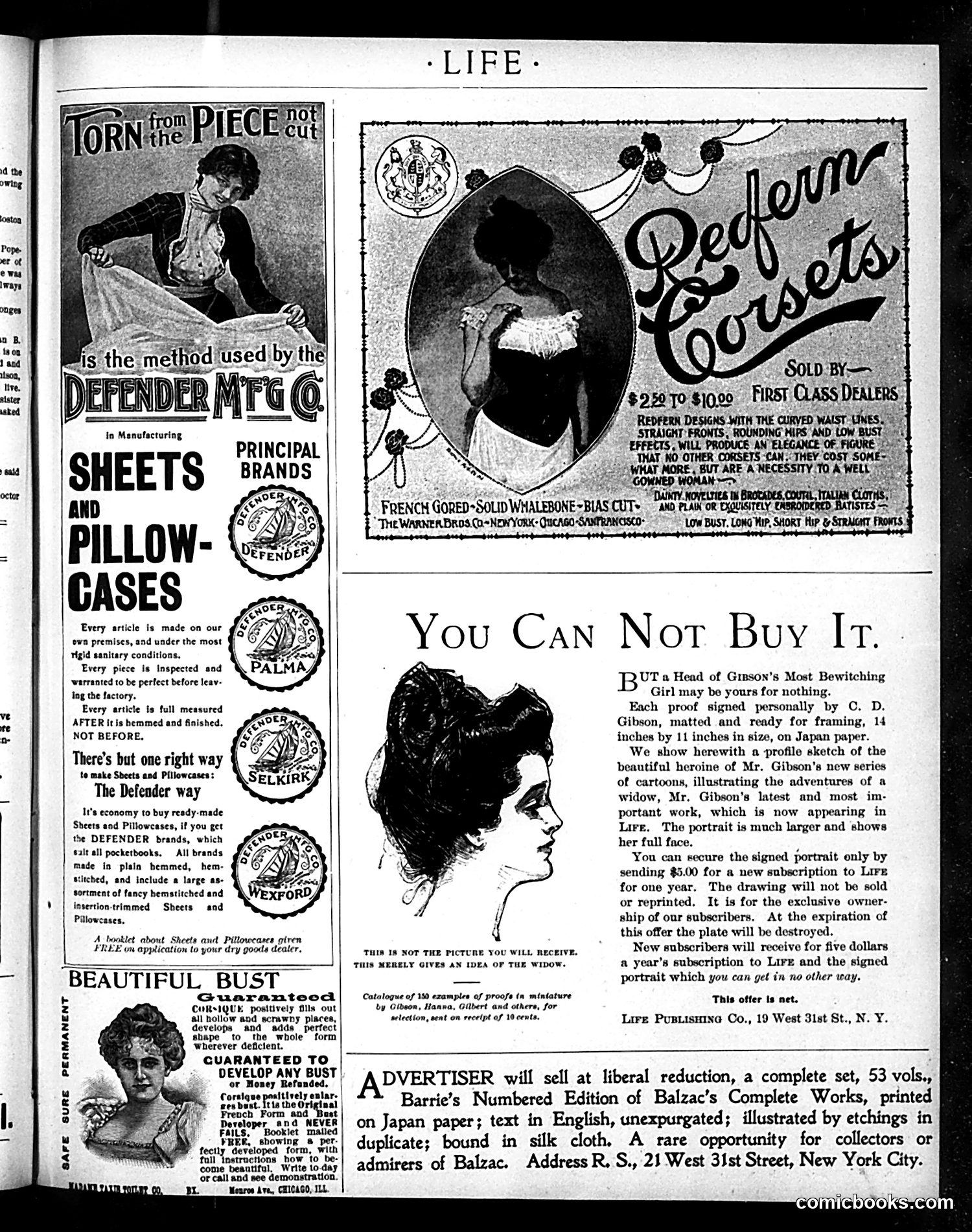
This page is primarily **advertising**, with no political cartoons. The content reflects early 20th-century commercial and cultural interests: **Major advertisements:** - **Defender Manufacturing**: Promotes sheets and pillowcases with claims of sanitary production and quality control - **Corsique corset**: Guarantees to develop or enlarge the bust, targeting women's body anxieties - **Gibson Girl portrait**: Life magazine offers a signed C.D. Gibson illustration (the famous "Gibson Girl" ideal) as an incentive for $5 yearly subscriptions **Social context for modern readers:** The ads reveal period preoccupations: domestic standardization through factory production, female body modification through corsetry, and celebrity artist merchandising. Gibson's illustrations were immensely popular cultural touchstones. The "You Can Not Buy It" tagline uses scarcity marketing—the portrait exists exclusively for subscribers, with the printing plate destroyed afterward. No satire or political commentary is evident; this is straightforward commercial promotion typical of *Life*'s revenue model.
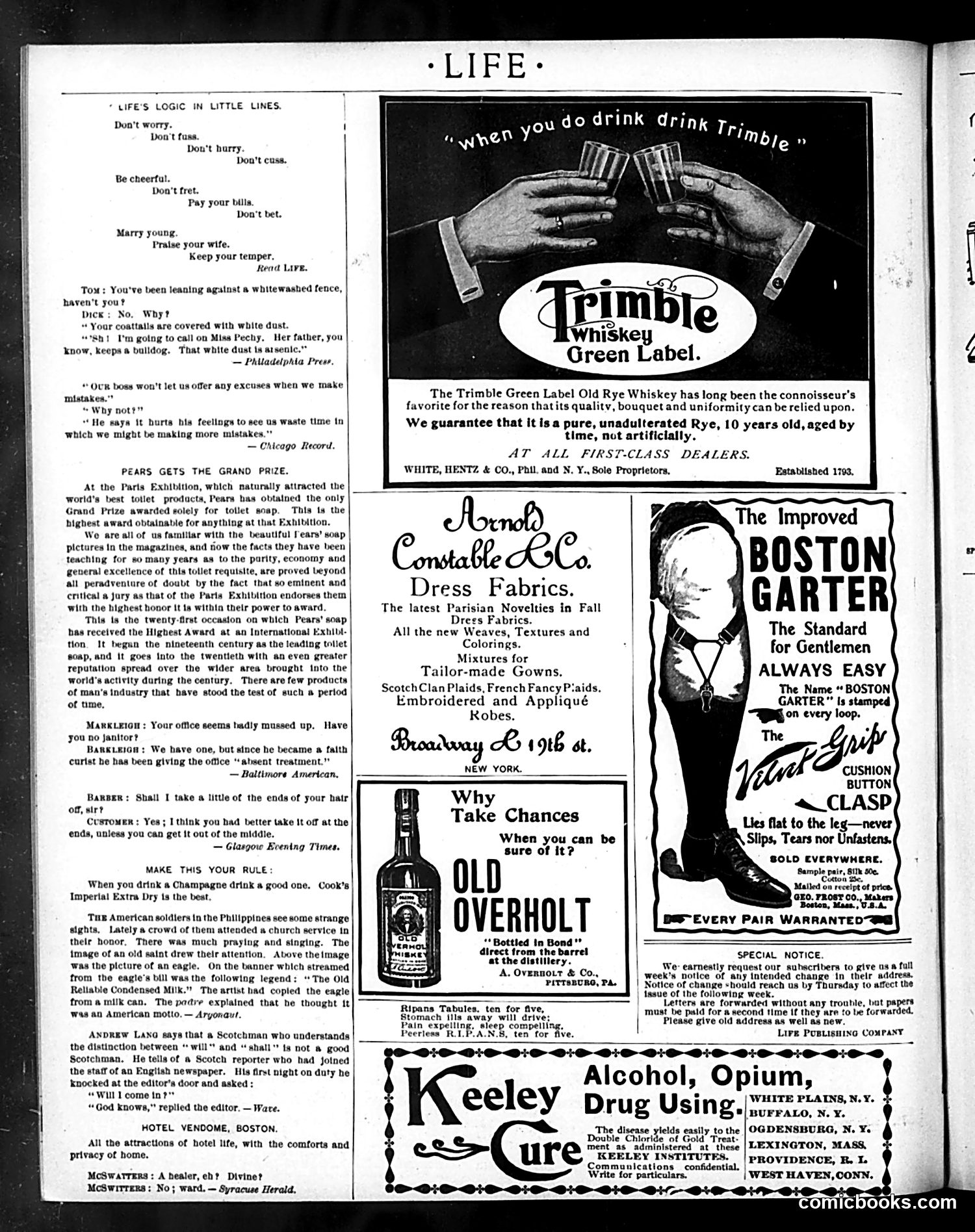
This page from *Life* magazine is primarily **advertising**, not political satire. The content consists of: **Left side:** Humorous anecdotes and aphorisms—brief jokes about workplace absurdity, customer service mishaps, and Scottish dialect—typical of the era's light humor. **Right side:** Full-page advertisements for commercial products: Trimble Whiskey, Constable dress fabrics, Boston Garter, Old Overholt whiskey, and the Keeley Institute (treating alcohol and drug addiction). **What's notable to modern readers:** The juxtaposition is darkly ironic—the page simultaneously advertises alcohol prominently while also advertising addiction treatment. This reflects early 1900s America's conflicted attitudes toward drinking: whiskey was marketed as refined and desirable, yet addiction was recognized as a serious medical problem requiring institutional cure. The ads reveal period anxieties about respectability, masculinity (garters, whiskey), and social status, but there's no coherent political cartoon or unified satirical message here—it's simply a magazine page mixing light humor with period commercial interests.
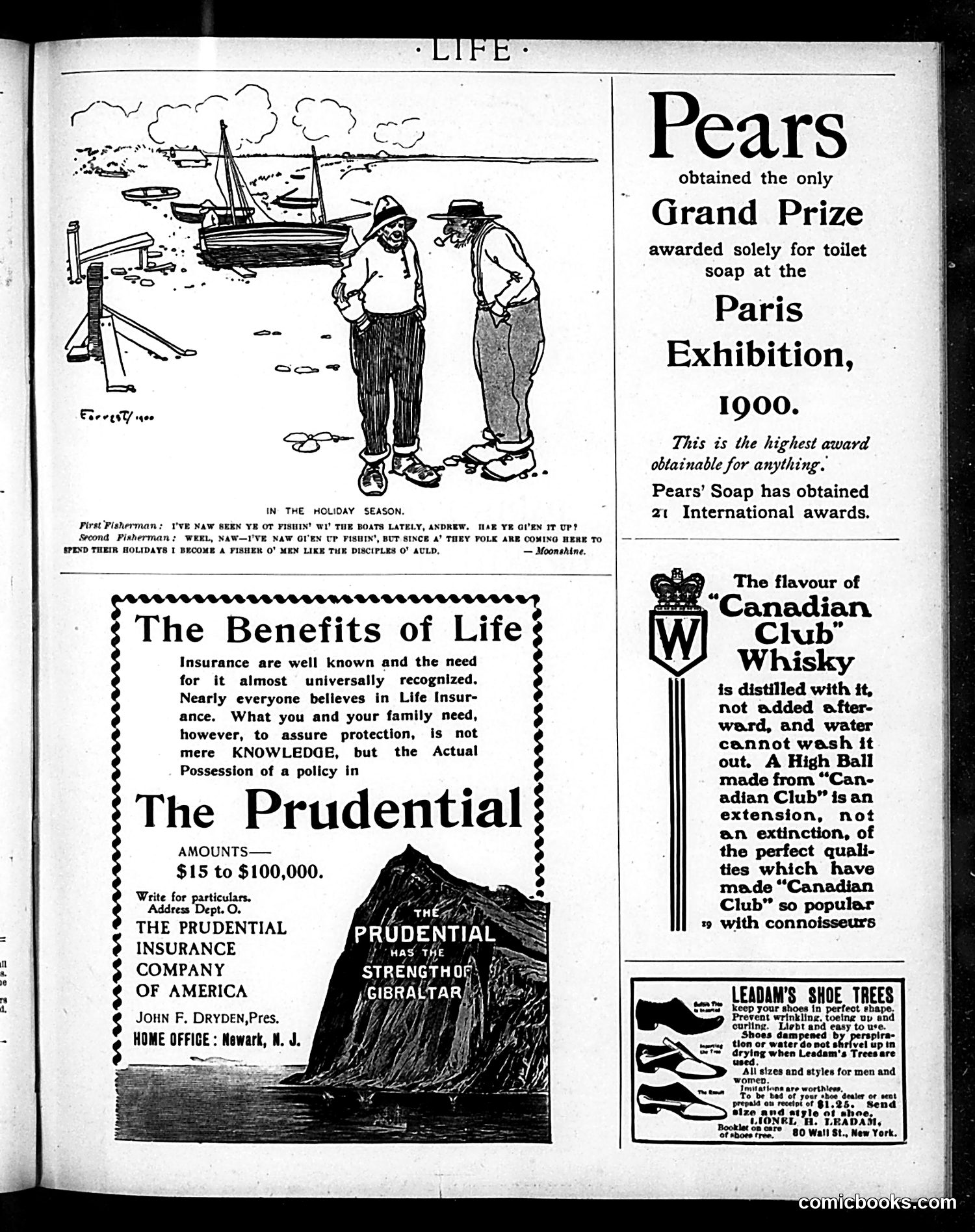
This *Life* magazine page contains a satirical cartoon and period advertisements (circa 1900). **The Cartoon:** Two Scottish fishermen discuss holiday season tourism. The first asks if the second has given up fishing; the second replies that while he hasn't stopped fishing for fish, he now fishes for "men" (tourists spending holidays) instead—a biblical reference to disciples becoming "fishers of men." The joke satirizes how local communities exploited seasonal visitors for profit, treating tourism as a commercial opportunity rather than a leisure activity. **The Advertisements:** The page heavily promotes luxury goods—Pears' Soap (emphasizing its Paris Exhibition award), Prudential Insurance (offering financial security), "Canadian Club" whisky (marketed to "connoisseurs"), and Leadam's shoe trees. These ads reflect early 1900s consumer culture aimed at affluent readers, positioning products as markers of sophistication and respectability.
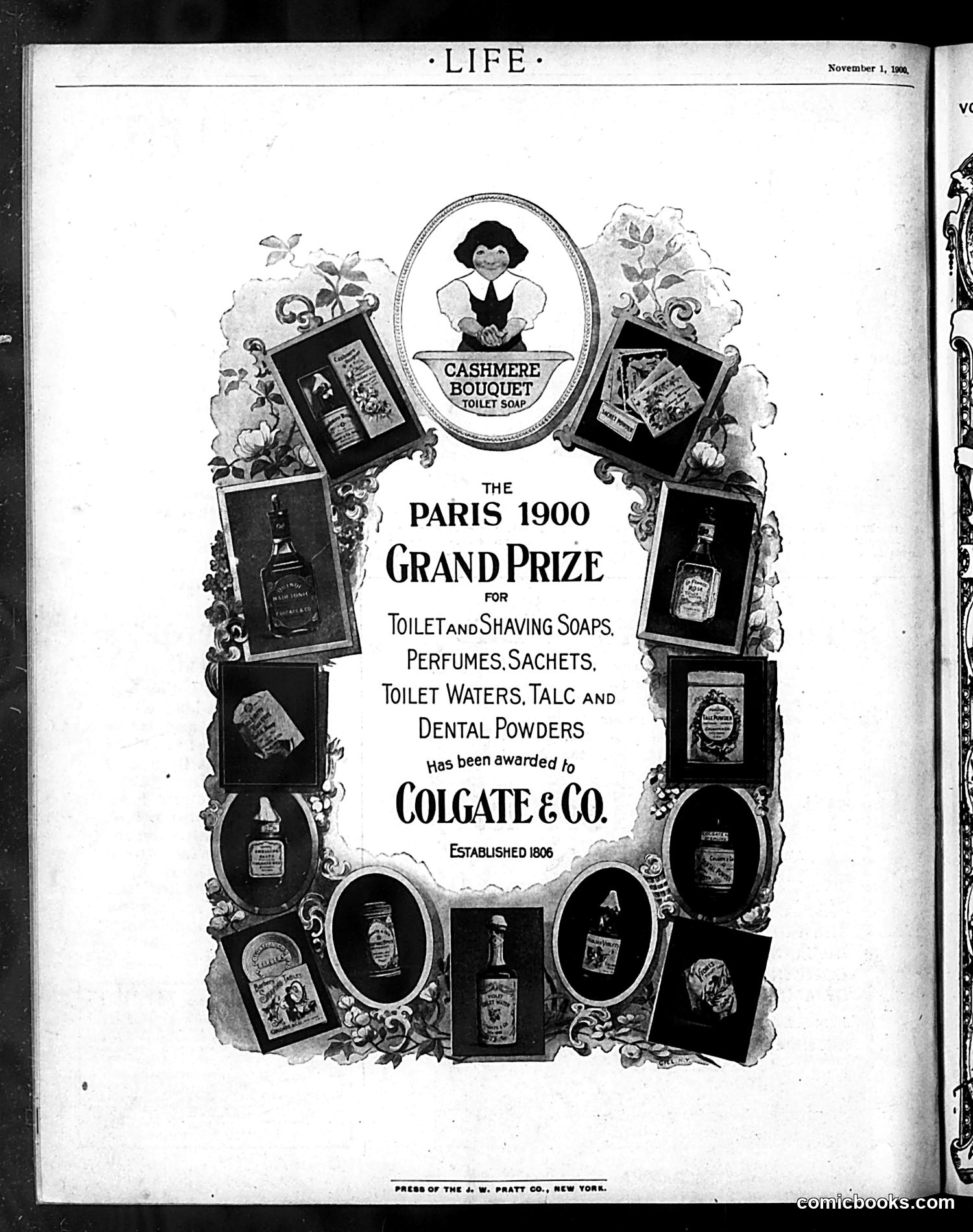
This is a full-page advertisement for Colgate & Co., not a political cartoon. The ornate decorative frame displays various toiletry products (soaps, perfumes, powders, dental products) arranged around a central medallion featuring a woman labeled "Cashmere Bouquet Toilet Soap." The advertisement announces that Colgate & Co. won the Paris 1900 Grand Prize for toilet and shaving soaps, perfumes, sachets, toilet waters, talc, and dental powders. The company's establishment date of 1806 is prominently featured. The elaborate Victorian-era design with floral flourishes and product bottles arranged symmetrically was typical early 1900s advertising meant to convey luxury, prestige, and quality through the Paris award claim—a significant mark of distinction for consumer products of that era.