
Life, 1900-11-01 · page 4 of 20
Life — November 1, 1900 — page 4: what you’re looking at
What you’re looking at
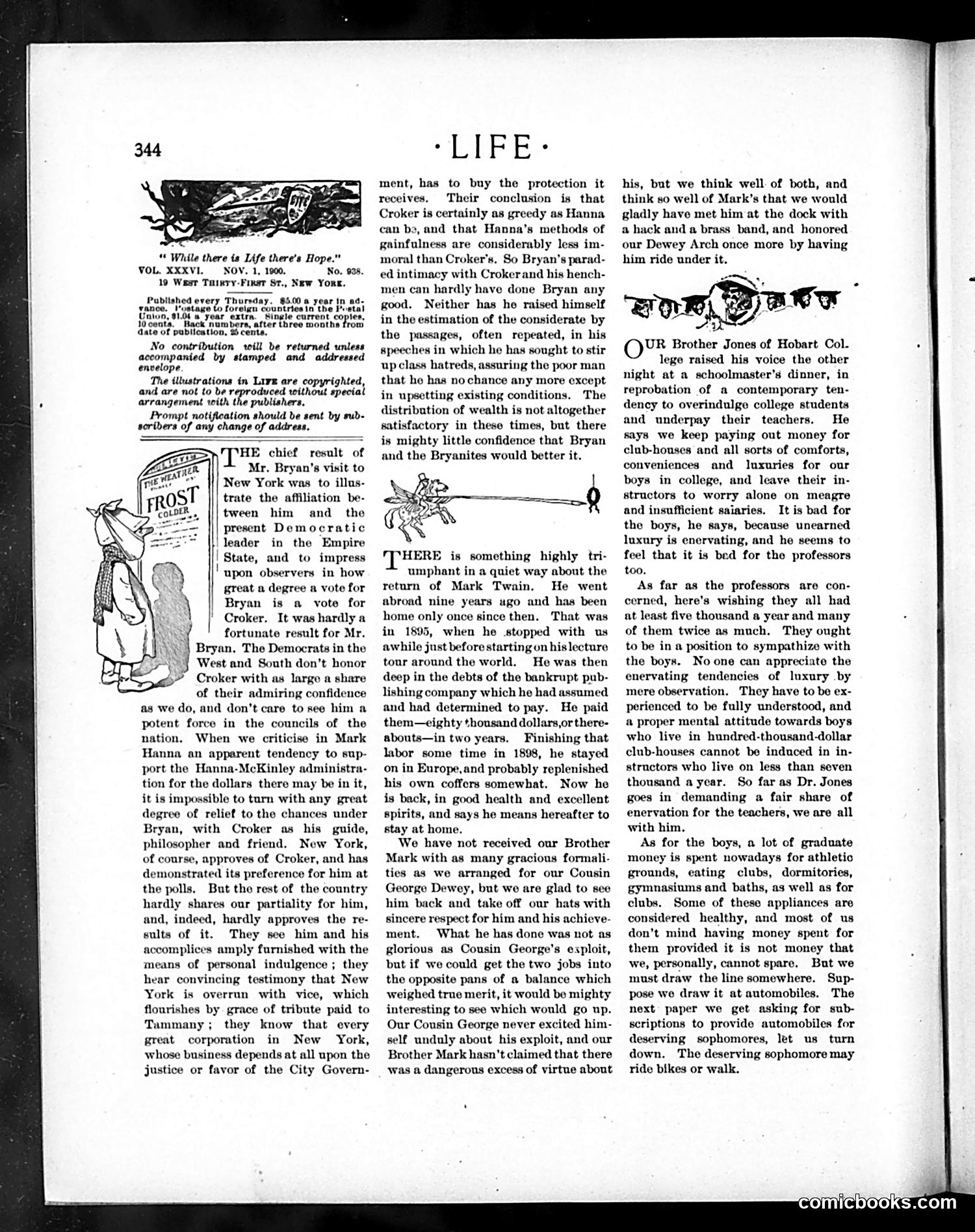
The page contains two distinct sections: **Left column:** A political cartoon showing a figure labeled "THE FRAU" (appearing to reference a German woman, likely Kaiser Wilhelm II's wife during WWI era based on the styling). The cartoon depicts this figure in a satirical manner related to American political divisions. **Main text:** Articles discussing Mark Twain's return from abroad and Brother Jones of Hobart College criticizing how wealthy alumni fund luxuries (club-houses, dormitories, athletics) for students rather than paying professors adequate salaries. Jones argues this creates moral hazard among students and demoralizes underpaid faculty earning under $7,000 annually. The satire critiques both wealth disparity in American institutions and how privilege corrupts educational priorities—a Progressive Era concern about inequality and proper resource allocation.
📄 Transcribed text from this page (OCR, searchable)
Machine-transcribed from the original scan — historical spelling and the odd misread are preserved.
“ While there is Life there's Hope.” VOL. XXXVI NOV. 1, 1900, No. 938. 19 Wear Taixry-Finst St., New Yors. Published ever; $5.00 a year in ad- vance. stage to foreign countries in the Postal 1.04 a year extra. Single current copies. Wcents. Back numbers, after three months from date of publication, % cents, No contribution will be returned unless accompanied by stamped and addressed envelope The illustrations in Live are copyrighted, and are not to be reproduced without special arrangement with the publishers, Prompt notification should be sent by sub- soribers of any change of address, HE chief result of Mr. Bryan’s visit to New York was to illus- trate the affiliation be- tween him and the present Democratic leader in the Empire | State, and to impress upon observers in how great a degree a vote for Bryan is a vote for Croker. It was hardly a fortunate result for Mr. Bryan, The Democrats in the West and South don’t honor of their admiring confidence as we do, and don’t care to see him a potent force in the councils of the nation. When we criticise in Mark Hanna an apparent tendency to sup- port the Hanna-McKinley administra- tion for the dollars there may be in it, it is impossible to turn with any great degree of relief to the chances under Bryan, with Croker as his guide, philosopher and friend. New York, of course, approves of Croker, and has demonstrated its preference for him at the polls, But tho rest of the country hardly shares our partiality for him, and, indeed, hardly approves the re- sults of it. They see him and his accomplices amply furnished with the means of personal indulgence ; they hear convincing testimony that New York is overrun with vice, which flourishes by grace of tribute paid to Tammany; they know that every great corporation in New York, whose business depends at all upon the justice or favor of the City Govern- LIFES ment, has to buy the protection it receives. Their conclusion is that Croker is certainly as greedy as Hanna can bs, and that Hanna’s methods of gainfulness are considerably less im- moral than Croker's. So Bryan's parad- ed intimacy with Croker and his hench- men can hardly have done Bryan any good. Neither has he raised himself in the estimation of the considerate by the passages, often repeated, in his speeches in which he has sought to stir up class hatreds, assuring the poor man that he has no chance any more except in upsetting existing conditions. The distribution of wealth is not altogether satisfactory in these times, but there is mighty little confidence that Bryan and the Bryanites would better it. ‘THERE is something highly tri- umphant in a quiet way about the return of Mark Twain, He went abroad nine years ugo and has been home only once since then. That was in 1895, when he stopped with us awhile just before starting on his lecture tour around the world, He was then deep in the debts of the bankrupt pub- lishing company which he had assumed and had determined to pay. He paid them—eighty thousand dollars,orthere- abouts—in two years. Finishing that labor some time in 1898, he stayed on in Europe,and probably replenished his own coffers somewhat. Now he is back, in good health and excellent spirits, and says he means hereafter to stay at home, We have not received our Brother Mark with as many gracious formali- ties as we arranged for our Cousin George Dewey, but we are glad to see him back and take off our hats with sincere respect for him and his achieve- ment. What he has done was not as glorious as Cousin George’s exploit, but if we could get the two jobs into the opposite pans of a balance which weighed true merit, it would be mighty interesting to see which would go up. Our Cousin George never excited him- self unduly about his exploit, and our Brother Mark hasn't claimed that there was a dangerous excess of virtue about his, but we think well of both, and think so well of Mark’s that we would gladly have met him at the dock with a hack and a brass band, and honored our Dewey Arch once more by having him ride under it. UR Brother Jones of Hobart Col. lege raised his voice the other night at a schoolmaster’s dinner, in reprobation of a contemporary ten- dency to overindulge college students and underpay their teachers. He says we keep paying out money for club-honses and all sorts of comforts, conveniences and luxuries for our boys in college, and leave their in- structors to worry alone on meagre and insufficient saiaries. It is bad for the boys, he says, because unearned luxury is enervating, and he seems to feel that it is bed for the professors too. As far as the professors are con- cerned, here's wishing they all had at least five thousand a year and many of them twice as much. They ought to be in a position to sympathize with the boys. Noone can appreciate the enervating tendencies of luxury by mere observation. They have to be ex- perienced to be fully understood, and a proper mental attitude towards boys who live in hundred-thousand-dollar club-houses cannot be induced in in- structors who live on less than seven thousand a year. So far as Dr. Jones goes in demanding a fair share of enervation for the teachers, we are all with him, As for the boys, a lot of graduate money is spent nowadays for athletic grounds, eating clubs, dormitories, gymnasiums and baths, as well as for clubs. Some of these appliances are considered healthy, and most of us don’t mind having money spent for them provided it is not money that we, personally, cannot spare. But we must draw the line somewhere. Sup- pose we draw it at automobiles. The next paper we get asking for sub- scriptions to provide automobiles for deserving sophomores, let us turn down. The deserving sophomore may ride bikes or walk.