
Life, 1900-11-01 · page 12 of 20
Life — November 1, 1900 — page 12: what you’re looking at
What you’re looking at
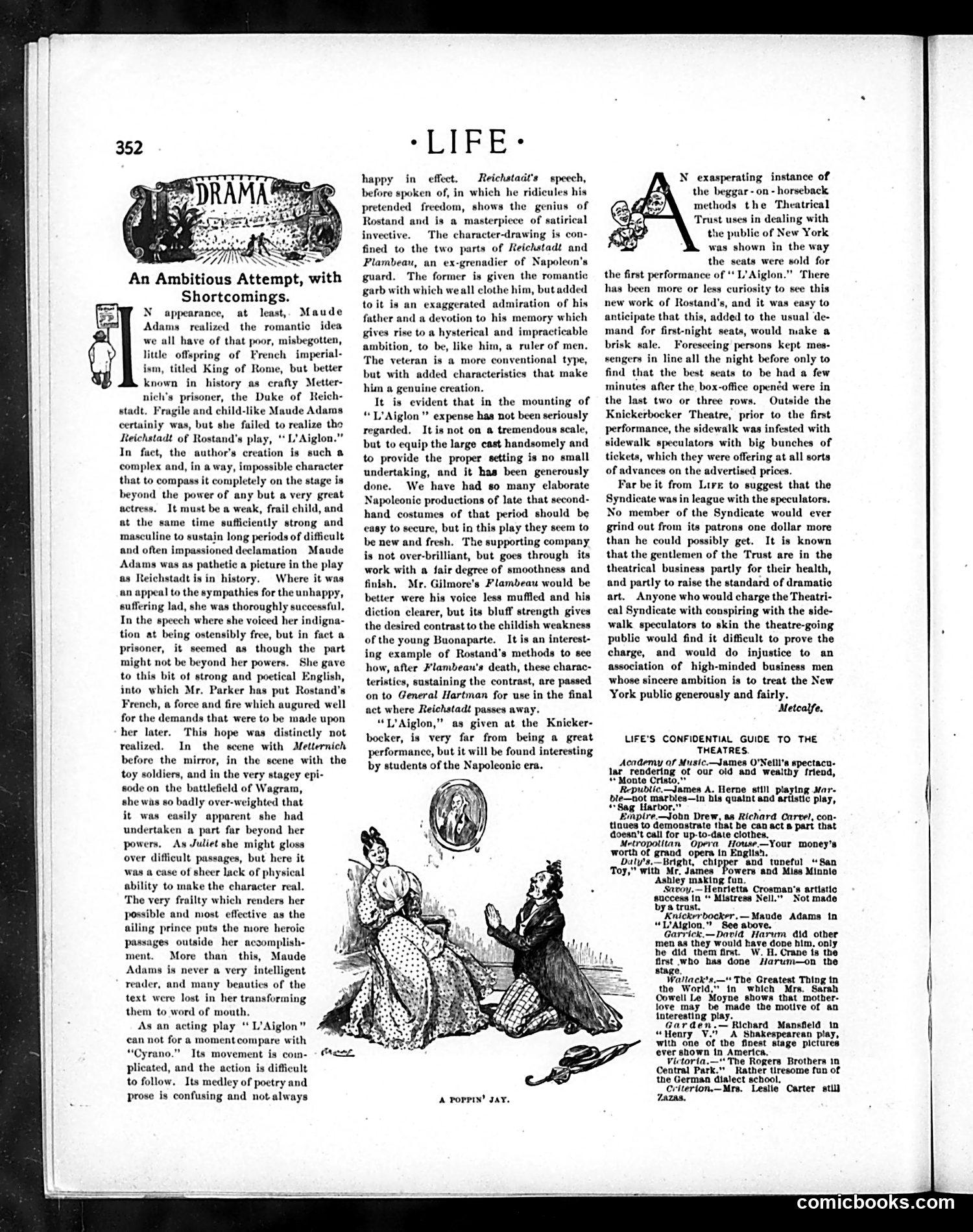
This page reviews "An Ambitious Attempt, with Shortcomings"—a theatrical production featuring an actress named Maude Adams. The main illustration, captioned "A Poppin' Jay," depicts a scene from the play "L'Aiglon," showing figures in period costume (appears to be Napoleonic era based on the context). The review critiques Adams's performance as ambitious but flawed. While praising her romantic interpretation and emotional appeal, the critic notes she lacked the physical stamina for demanding roles. The text suggests her weakness undermined an otherwise noble artistic effort. The page includes a "Life's Confidential Guide to the Theatres" listing current Broadway productions and their stars. This review-and-listings format was typical for Life magazine during this theatrical era.
📄 Transcribed text from this page (OCR, searchable)
Machine-transcribed from the original scan — historical spelling and the odd misread are preserved.
An Ambitious Attempt, wit Shortcomings. N appearance, at least,, Maude Adams realized the romantic idea we all have of that poor, misbegotten, little offspring of French imperial- ism, titled King of Rome, but better known in history as crafty Metter- nich’s prisoner, the Duke of Reich- stadt. Fragile and child-like Maude Adams certainly was, but she failed to realize the Reichstadt of Rostand’s play, ** L'Aiglon.” In fuct, the author's creation is such a complex and, in a way, impossible character that to compass it completely on the stage is beyond the power of any but a very great actress. It must be a weak, frail child, and at the same time sufficiently strong and masculine to sustain long periods of difficult and often impassioned declamation Maude Adams was as pathetic a picture in the play as Reichstadt isin history. Where it was an appeal to the sympathies for the unhappy, suffering lad, she was thoroughly successful. In the speech where she voiced her indigna- tion at being ostensibly free, but in fact a prisoner, it seemed as though the part might not be beyond her powers. She gave to this bit of strong and poetical English, into which Mr. Parker has put Rostand’s French, a force and fire which augured well for the demands that were to be made upon her later. This hope was distinctly not realized. In the scene with AMfetternich before the mirror, in the scene with the toy soldiers, and in the very stagey epi- sode on the battlefield of Wagram, she was so badly over-weighted that it was easily apparent she had undertaken a part far beyond her powers. As Juliet she might gloss over difficult passages, but here it was a case of sheer lack of physical ability to make the character real. ‘The very frailty which renders her possible and most effective as the ailing prince puts the more heroic passages outside her acsomplish- ment. More than this, Maude Adams is never a very intelligent reader, and many beauties of the text were lost in her transforming them to word of mouth. As an acting play “ L’Aiglon” can not for a momentcompare with “Cyrano.” Its movement is coim- plicated, and the action is difficult to follow. Its medley of poetry and prose is confusing and not always LIFE happy in effect, Reichstadt's before spoken of, in which he ri pretended freedom, shows the ger Rostand and is a masterpiece of satirical invective. The character-drawing is con- fined to the two parts of Reichstadt and Plambeau, an ex-grenadier of Napoleon's guard. The former is given the romanti garb with which we all clothe him, butadded toit is an exaggerated admiration of his father and a devotion to his memory which gives rise to a hysterical and impracticable ambition, to be, like him, a ruler of men, The veteran is a more conventional type, but with added characteristics that make him a genuine creation. It is evident that in the mounting of “L’Aiglon ” expense has not been seriously regarded. It is not on a tremendous scale, but to equip the large cast handsomely and to provide the proper setting is no small undertaking, and it has been generously done. We have had so many elaborate Napoleonic productions of late that second- hand costumes of that period should be easy to secure, but in this play they seem to be new and fresh. The supporting company is not over-brilliant, but goes through its work with a fair degree of smoothness and finish, Mr. Gilmore's Flambeau would be better were his voice less muffled and his diction clearer, but its bluff strength gives the desired contrast to the childish weakness of the young Buonaparte. It is an interest- ing example of Rostand’s methods to see how, after Flambean's death, these charac- teristics, sustaining the contrast, are passed on to General Hartman for use in the final act where Reichstadt passes away. “L'Aiglon,” as given at the Knicker- speech, bocker, is very far from being a great performance, but it will be found interesting by students of the Napoleonic era. A POPPIN’ JAY. N exasperating instance of the beggar-on - horseback methods the Theatrical ‘Trust uses in dealing with the public of New York was shown in the way the seats were sold for the first performance of “L’Aiglon.” There has been more or less curiosity to see this new work of Rostand’s, and it was easy to anticipate that this, added to the usual de- mand for first-night seats, would make a brisk sale. Foresceing persons kept mes- sengers in line all the night before only to find that the best seats to be had a few minutes after the box-office openéd were in the last two or three rows. Outside the Knickerbocker Theatre, prior to the first performance, the sidewalk was infested with sidewalk speculators with big bunches of tickets, which they were offering at all sorts of advances on the advertised prices. Far be it from Lire to suggest that the Syndicate was in league with the speculators, No member of the Syndicate would ever grind out from its patrons one dollar more than he could possibly get. It is known that the gentlemen of the Trust are in the theatrical business partly for their health, and partly to raise the standard of dramatic art, Anyone who would charge the Theatri- cal Syndicate with conspiring with the side- walk speculators to skin the theatre-going public would find it difficult to prove the charge, and would do injustice to an association of high-minded business men whose sincere ambition is to treat the New York public generously and fairly. Metcalfe. LIFE'S CONFIDENTIAL GUIDE TO THE THEATRES. Academy of Music-—James O'Nelll’s spectacu- lar rendering of our old and wealthy friend, “ Monte Cristo.” Republic,—James A. Herne still playing sar- te oot marblee-—in Bis qusint and pad play, Pmpire—Jobn Drew, as Richard Carvel, con tloues to demonstrate that be can act a part that doesn’t call for up-to-date clothes, Metropotitan Opera House —Your money's worth of grand opera in Daty's.— Bright, chipper and tuneful “San Toy," with Mr, James Powers and Miss Minnie Ashley making fun. ry. Henrietta Crosman's arttatio success ia * Mistress Nel” Not mad bya trust. Knickrrbocker,— Maude Adams tn “LiAlgion.” See above. Garrick.—David Harum aid other men as they would bave done bim. only he did them first. W. H. Crane fs the first who has done Harum—on the Wallack's,—" The areateet eTing 1a tn the World,” in which Cowell Le Moyne shows tit moter. love may be made the motive of an interesting play. Garden.— Richard Mansfeld tn “Henry V." A Shakespearean play, with one of the finest stage pictures ever shown in America, Victoria,—"* The Rogers Brothers 1n Central Park." Rather tiresome fun of the German dialect school. Criterion.—Mra. Leslie Carter still Zazas. comicbooks.com