
Life, 1900-11-01 · page 6 of 20
Life — November 1, 1900 — page 6: what you’re looking at
What you’re looking at
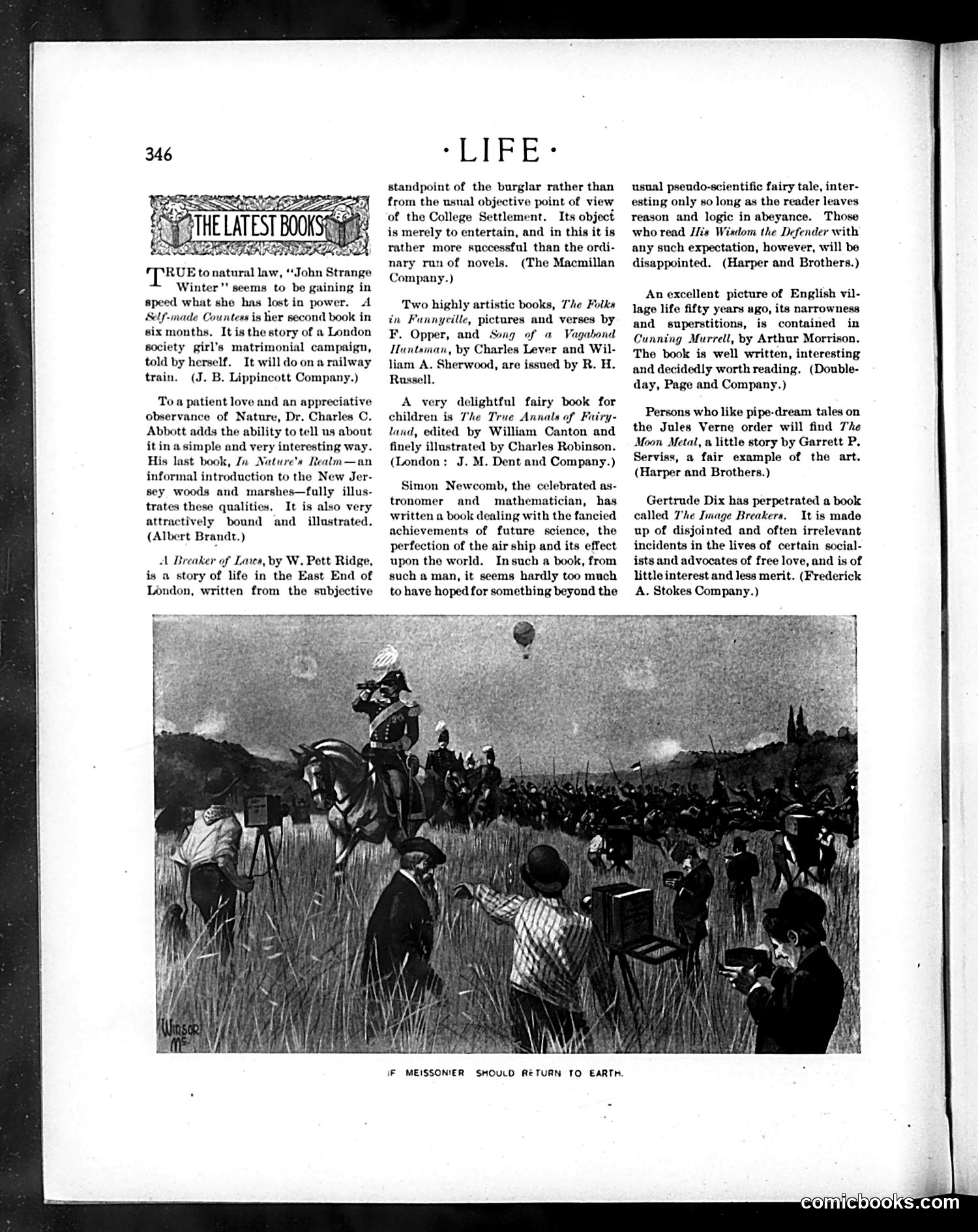
The main illustration depicts "If Meissoner Should Return to Earth"—a reference to Jean-Louis-Ernest Meissonier, a 19th-century French military painter famous for detailed historical battle scenes. The cartoon imagines Meissonier witnessing a modern (early 20th-century) military balloon ascension or aerial demonstration, surrounded by crowds and observers. The satire likely comments on how warfare and military technology have transformed beyond what the historical painter could have imagined—from his detailed depictions of cavalry and ground combat to modern aerial warfare with balloons and aircraft. The joke plays on the contrast between Meissonier's romantic, carefully-rendered historical military art and contemporary mechanized warfare's radical innovations.
📄 Transcribed text from this page (OCR, searchable)
Machine-transcribed from the original scan — historical spelling and the odd misread are preserved.
P HELATT§ or RUE to natural law, ‘John Strange Winter "’ seems to be gaining in speed what she has lost in power. A Self-made Countess is her second book in six months. It is the story of a London society girl’s matrimonial campaign, told by herself. It will do on a railway train. (J. B. Lippincott Company.) Toa patient love and an appreciative observance of Nature, Dr. Charles C. Abbott adds the ability to tell us about it in a simple and very interesting way. His last book, Jn Nature's Realm—an informal introduction to the New Jer- sey woods and marshes—fally illus- trates these qualities. It is also very attractively bound and_ illustrated. (Albert Brandt.) «l Breaker of Laws, by W. Pett Ridge, is a story of life in the East End of London, written from the subjective LIFE standpoint of the burglar rather than from the usual objective point of view of the College Settlement. Its object is merely to entertain, and in this it is rather more successful than the ordi- nary run of novels. (The Macmillan Company.) Two highly artistic books, The Folks in Funnycville, pictures and verses by F. Opper, and Song of a Vagabond Huntsman, by Charles Lever and Wil- liam A. Sherwood, are issued by R. H. Russell. A very delightful fairy book for children is The True Annals of Fairy- land, edited by William Canton and finely illustrated by Charles Robinson. (London: J. M. Dent and Company.) Simon Newcomb, the celebrated as- tronomer and mathematician, has written a book dealing with the fancied achievements of future science, the perfection of the air ship and its effect upon the world. Insuch a book, from such a man, it seems hardly too much to have hoped for something beyond the =. vik IF MEISSONIER SHOULD RETURN TO EARTH. usual pseudo-scientific fairy tale, inter- esting only so long as the reader leaves reason and logic in abeyance. Those who read [is Wisdom the Defender with any such expectation, however, will be disappointed. (Harper and Brothers.) An excellent picture of English vil- lage life fifty years ago, its narrowness and superstitions, is contained in Cunning Murrell, by Arthur Morrison. The book is well written, interesting and decidedly worth reading. (Double- day, Page and Company.) Persons who like pipe-dream tales on the Jules Verne order will find The Moon Metal, a little story by Garrett P, Serviss, a fair example of the art. (Harper and Brothers.) Gertrude Dix has perpetrated a book called 7'he Image Breakers. It is made up of disjointed and often irrelevant incidents in the lives of certain social- ists and advocates of free love, and is of little interest and less merit. (Frederick A. Stokes Company.)