
A complete issue · 20 pages · 1900
Life — October 25, 1900
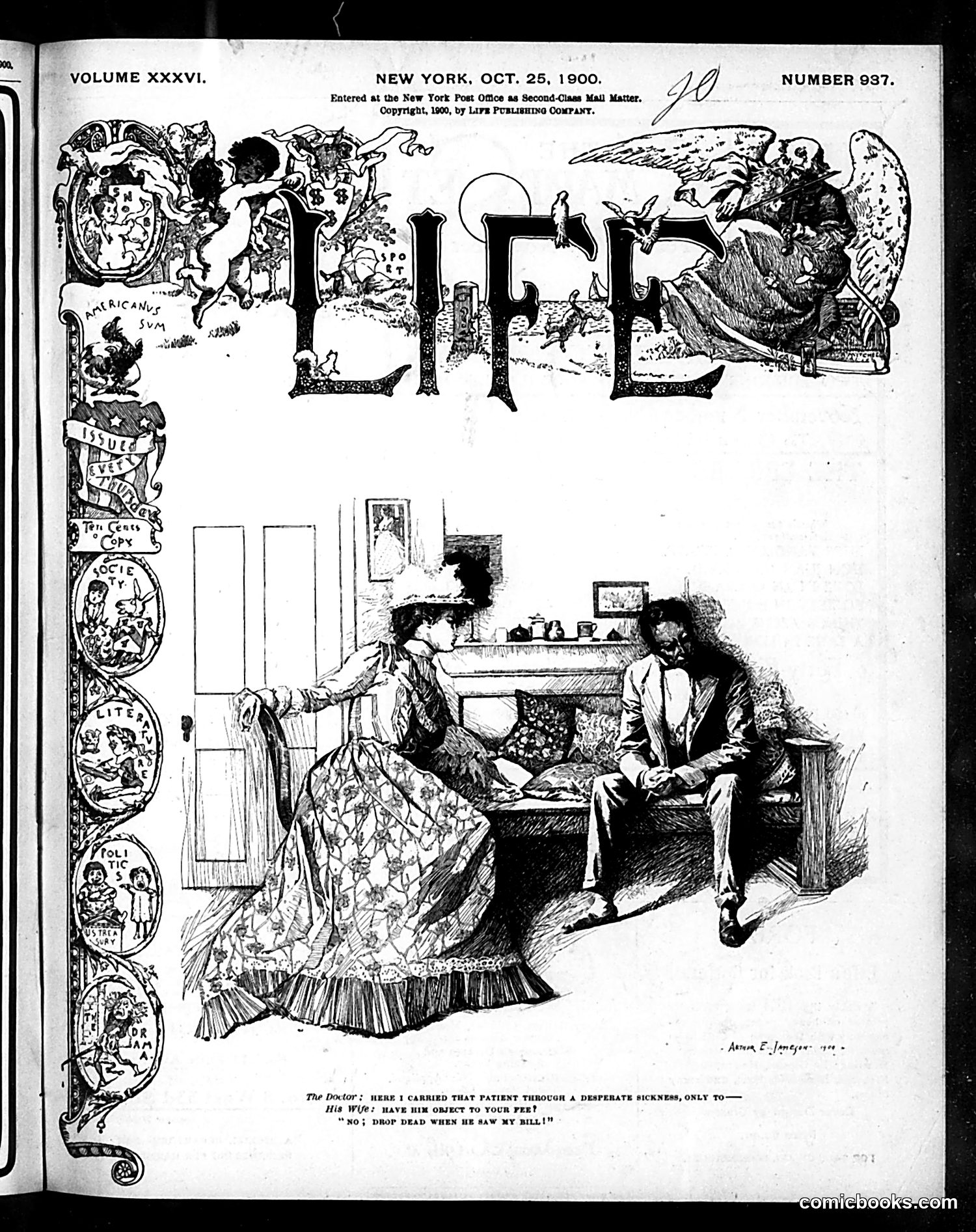
This page features a satirical illustration about a doctor's visit. The caption reads: "THE DOCTOR: HERE I CARRIED THAT PATIENT THROUGH A DESPERATE SICKNESS, ONLY TO—/ HIS WIFE: HAVE HIS OBJECT TO YOUR FEE? / 'NO; DROP DEAD WHEN HE SAW MY BILL!'" The joke satirizes the high cost of medical services at the turn of the 20th century. The doctor, having successfully treated a critically ill patient, expects gratitude and payment. Instead, the patient dies—not from illness, but from shock at receiving the physician's bill. This reflects contemporary anxiety about medical expenses and satirizes the medical profession's focus on fees over patient welfare. The ornate decorative borders and masthead are typical of Life's design during this era.
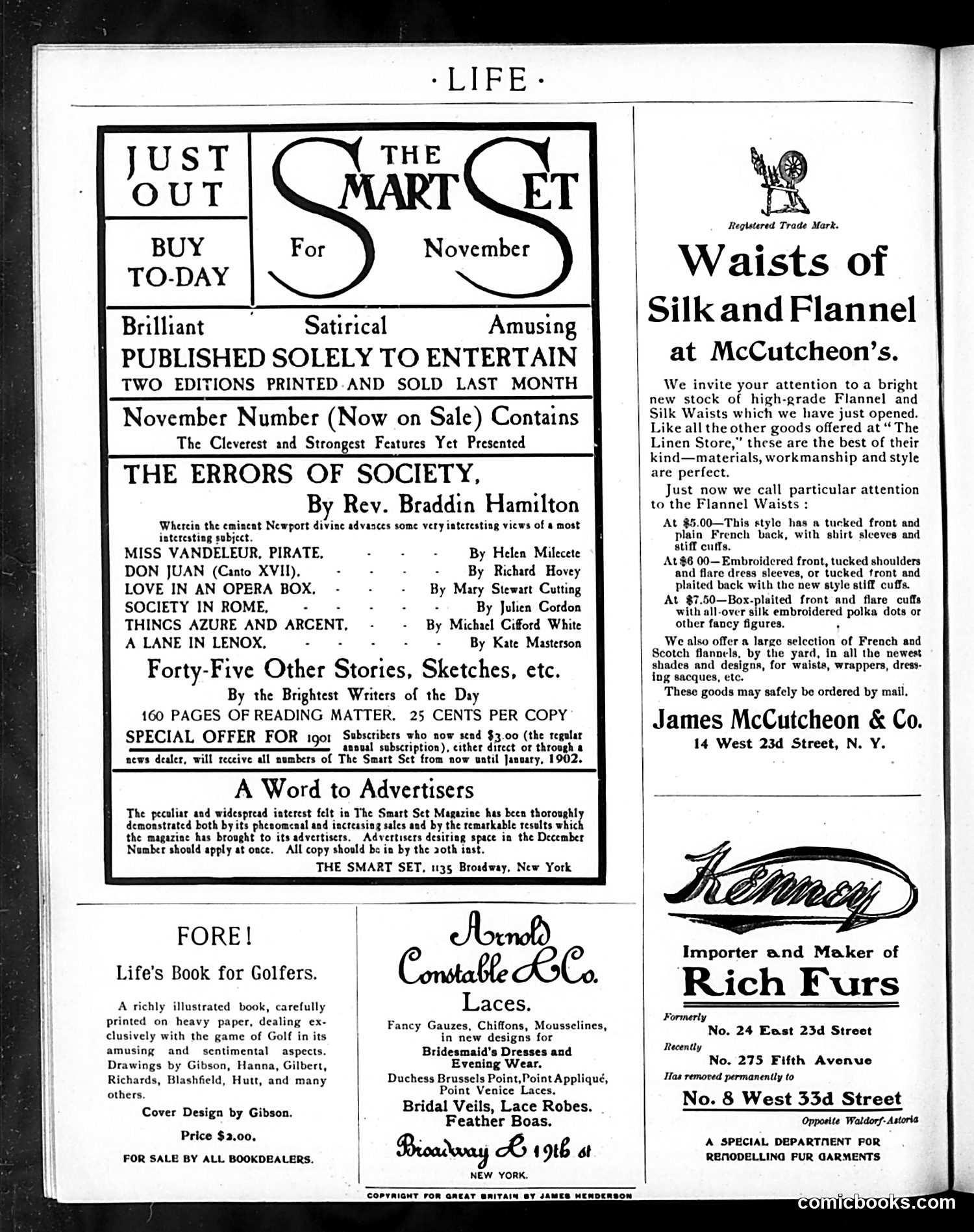
This page is **primarily advertising** rather than editorial content or political cartoons. The main advertisements include: - **The Smart Set Magazine** (center): promoting its November issue featuring satirical stories by noted writers like Helen Milcete and Richard Hovey - **McCutcheon's** (right): advertising silk and flannel waists for women - **Arnold Constable & Co.** (bottom center): selling fancy laces and bridal wear - **Hennessy** (right): advertising imported furs with relocated addresses - **Life's Book for Golfers** (bottom left): a richly illustrated golf book The page contains **no political cartoons or caricatures**. It represents typical early 1900s magazine advertising targeting middle to upper-class consumers, with emphasis on women's clothing, luxury goods, and entertainment products. The satirical content referenced is purely literary within *Smart Set*, not visual.
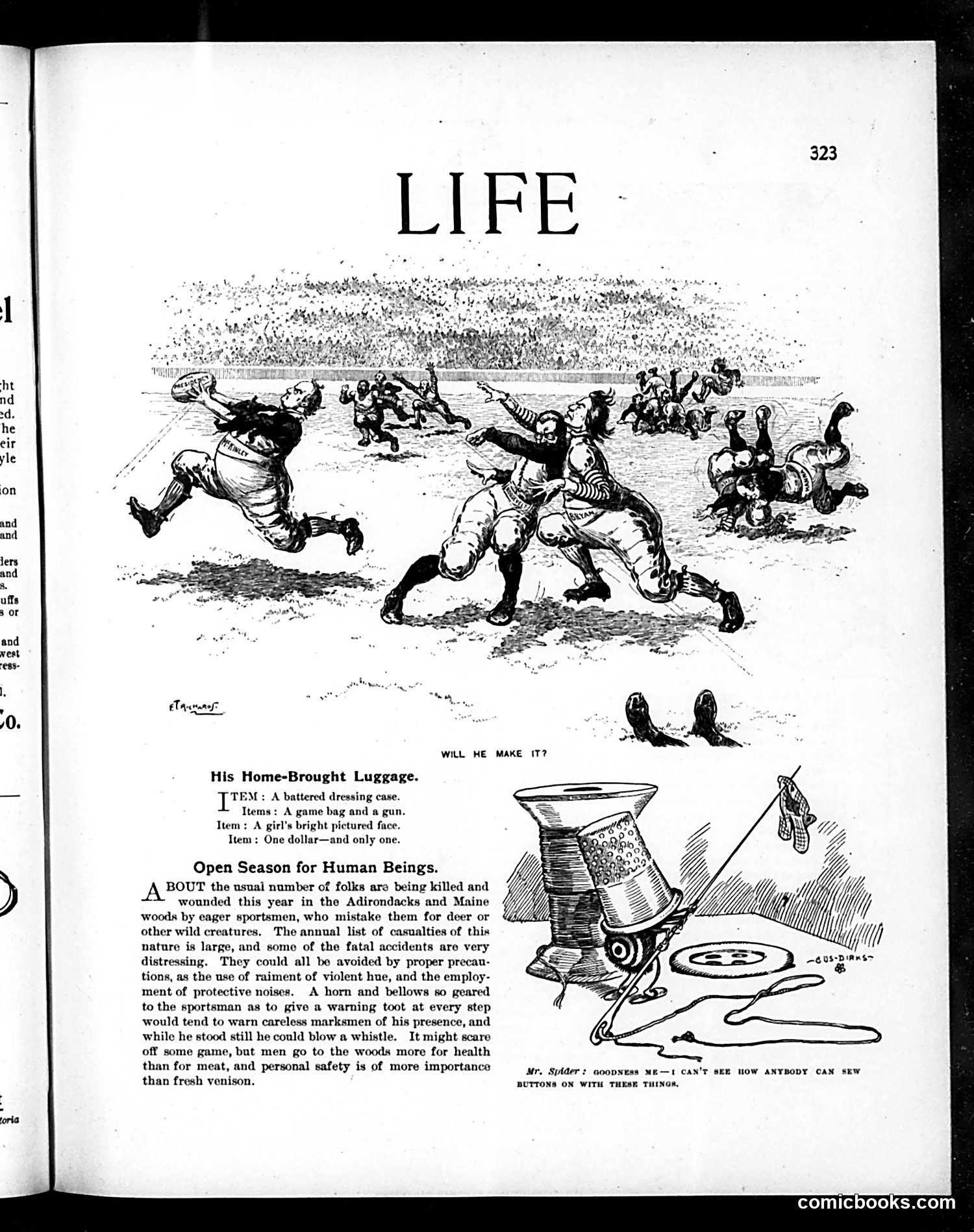
**Top Cartoon - "Will He Make It?"** This depicts a football game where players are being tackled and carried away on stretchers. The caption questions whether someone will succeed despite obstacles. This appears to be social commentary on a contemporary challenge, though the specific reference is unclear without additional context. **Bottom Section - "His Home-Brought Luggage"** A humorous list of items a hunter brings home from the Adirondacks and Maine: a battered case, game bag, gun, and "girl's bright colored hood" worth one dollar. This satirizes hunters returning with minimal or worthless spoils. **"Open Season for Human Beings"** The text warns of accidental shootings in woods when hunters mistake people for deer, advocating protective measures like noise-making to prevent casualties. This addresses real hunting safety concerns of the era.
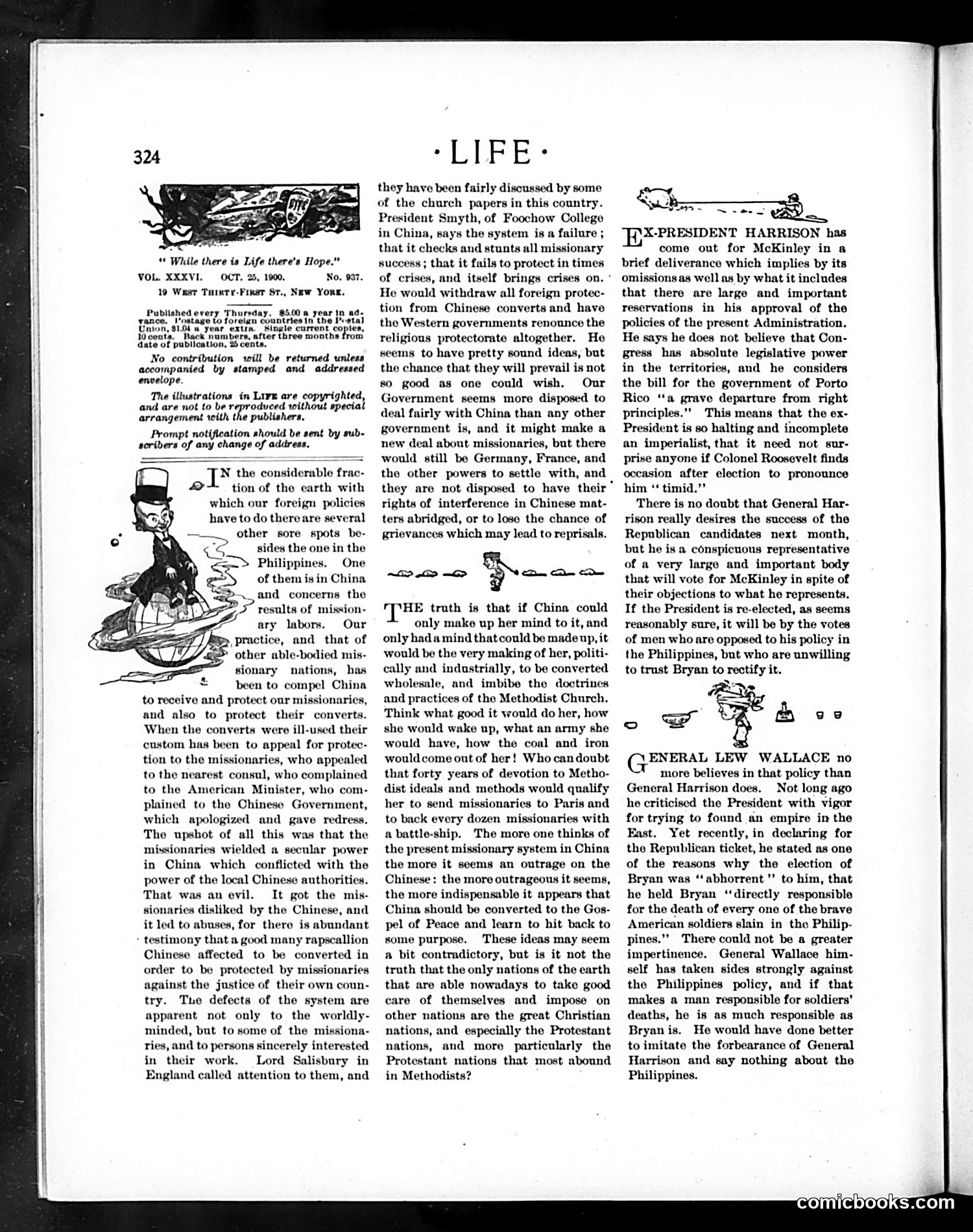
The central cartoon depicts a caricatured figure riding a globe, appearing to represent American foreign policy expansion. The figure's exaggerated facial features and posture suggest satirical commentary on aggressive interventionism. The accompanying text discusses China policy under President Harrison, focusing on missionary protection and colonial ambitions. It critiques General Lew Wallace's statements and debates whether the U.S. should maintain military presence in the Philippines. The satire targets American imperial expansion at the turn of the 20th century—specifically the tension between protecting Christian missionaries and pursuing territorial interests. The cartoon mocks what the magazine views as contradictory or hypocritical justifications for military intervention in Asia.
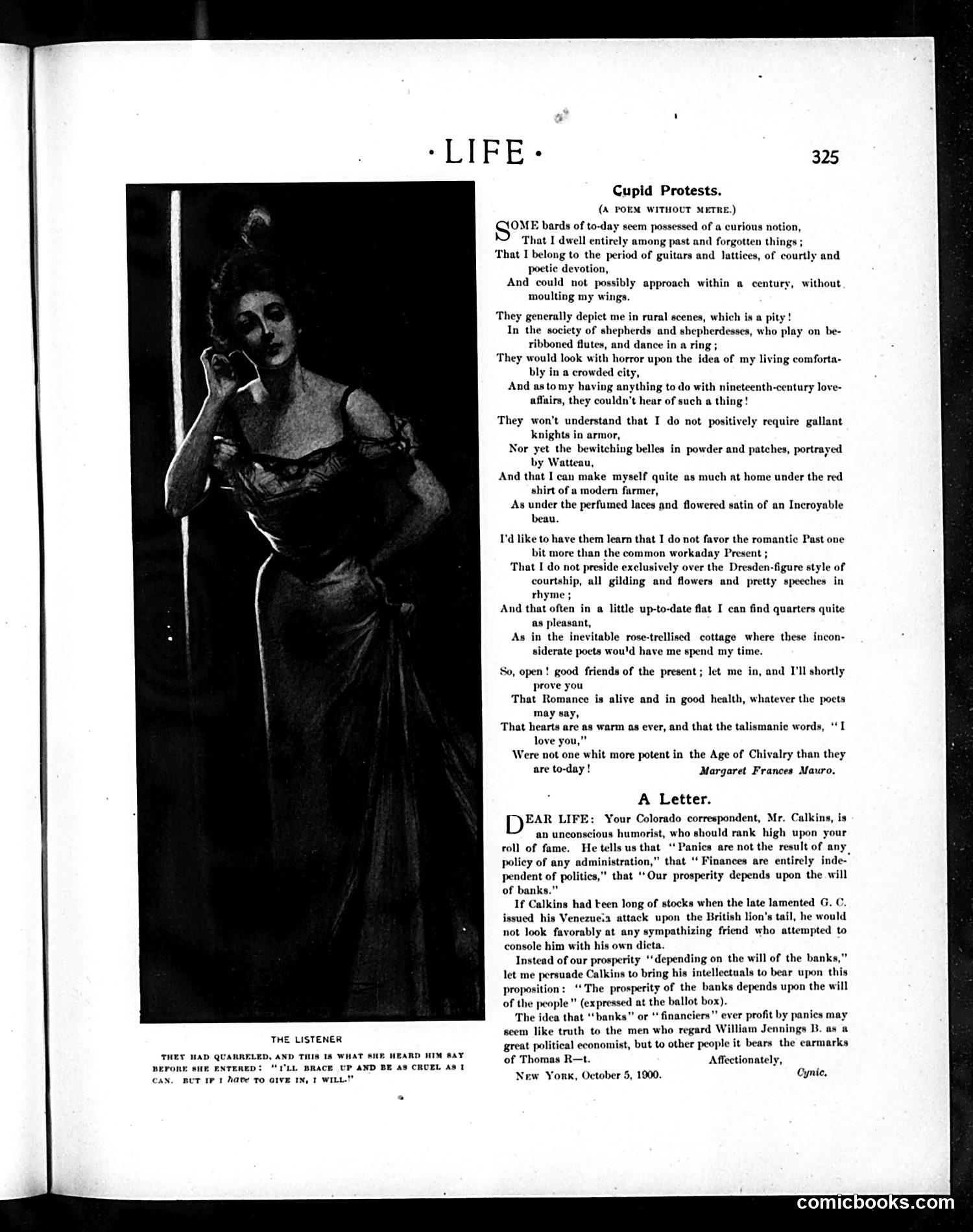
The illustration shows a woman in classical dress listening at a door or wall, likely representing the mythological figure of Echo or a similar archetype of female eavesdropping. The caption reads: "They had quarreled, and this is what she heard him say before she entered: 'I'll brace up and be as cruel as I can. But if I have to give in, I will.'" The satire mocks romantic domestic conflict—specifically male bluster and insincerity. The man postures about being "cruel" but simultaneously admits he'll capitulate, undermining his own toughness. The woman's concealed listening represents feminine insight into male pretense, suggesting women see through men's performative hardness in relationships. This reflects early-20th-century gender dynamics and marital comedy conventions.
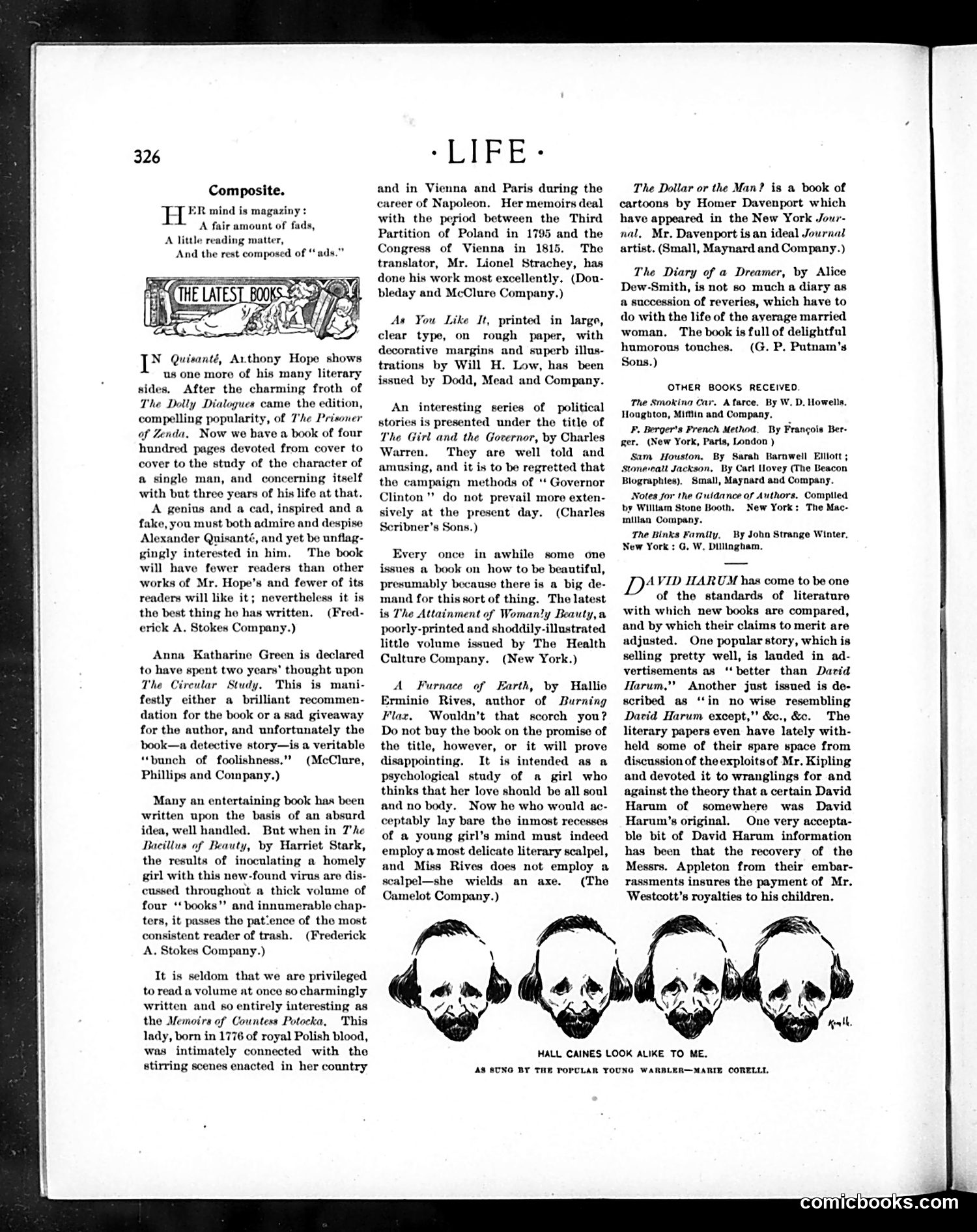
This cartoon depicts four identical bald heads with facial hair, captioned as "as sung by the popular young warblers—Marie Corelli." The joke appears to reference **Hall Caine**, a prominent British novelist of the era, though the specific context is unclear from this page alone. The four identical faces suggest either: mockery of Caine's appearance being repeated/copied, or possibly a comment on derivative or repetitive work. The attribution to "Marie Corelli" (a popular contemporary female writer) suggests this may be satirizing either a song about Hall Caine or comparing the two writers' work as similarly forgettable or interchangeable. Without additional historical context about contemporary literary feuds or cultural references, the precise satirical target remains uncertain, though it clearly mocks either Caine himself or critical reception of his work.
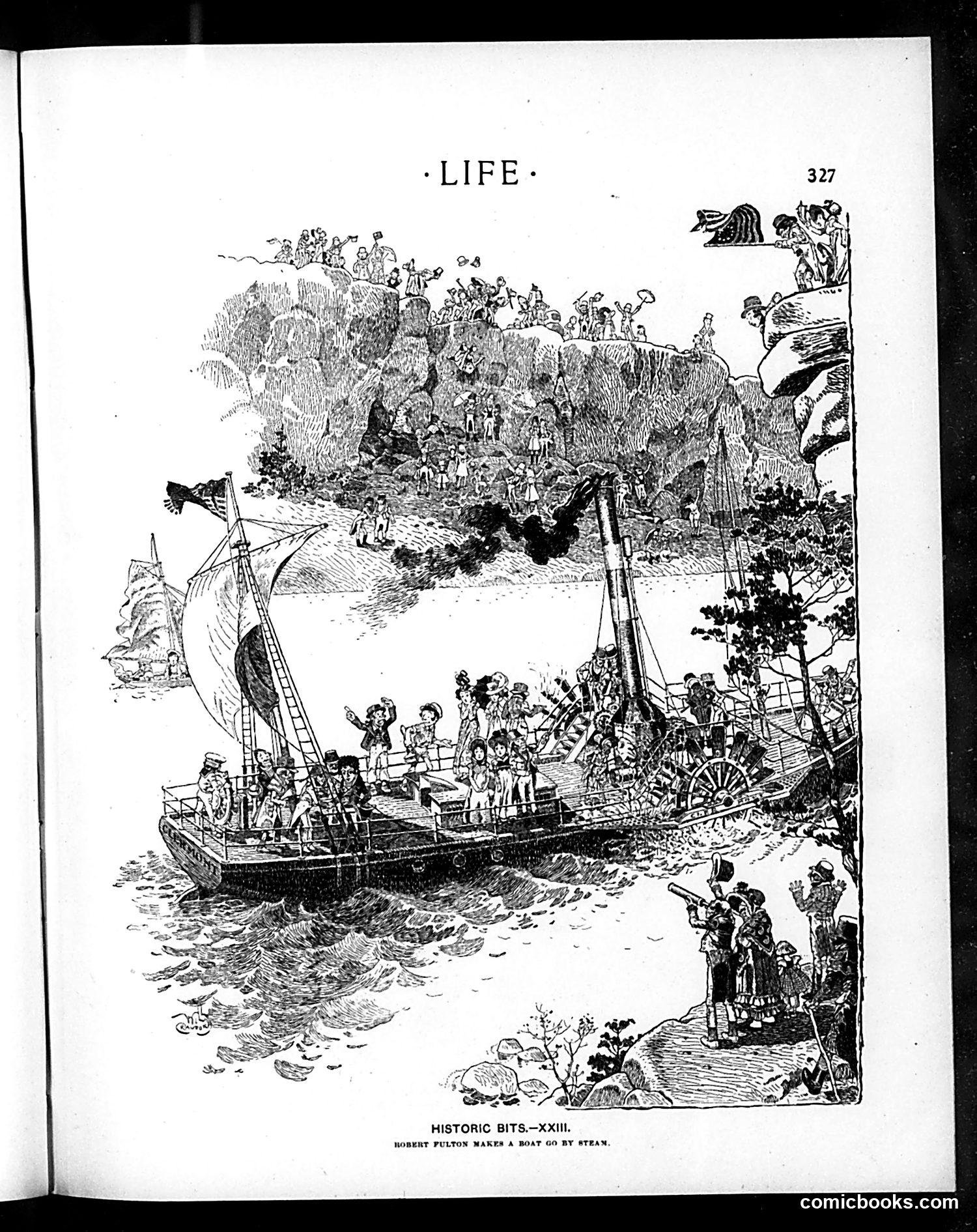
This is a satirical illustration depicting Robert Fulton's steamboat invention. The engraving shows a crowded vessel with smoke billowing from its stack, surrounded by onlookers on shore observing this technological marvel with apparent amazement or skepticism. The "Historic Bits" series appears to be Life magazine's humorous take on famous historical moments. The satire likely mocks either the initial public reaction to steam power as strange/dangerous technology, or Fulton's own ambitions and the skepticism he faced. The gathering of crowds and gesturing figures suggests both fascination and doubt about whether this mechanical innovation would actually work—a common satirical theme when depicting early industrial breakthroughs.
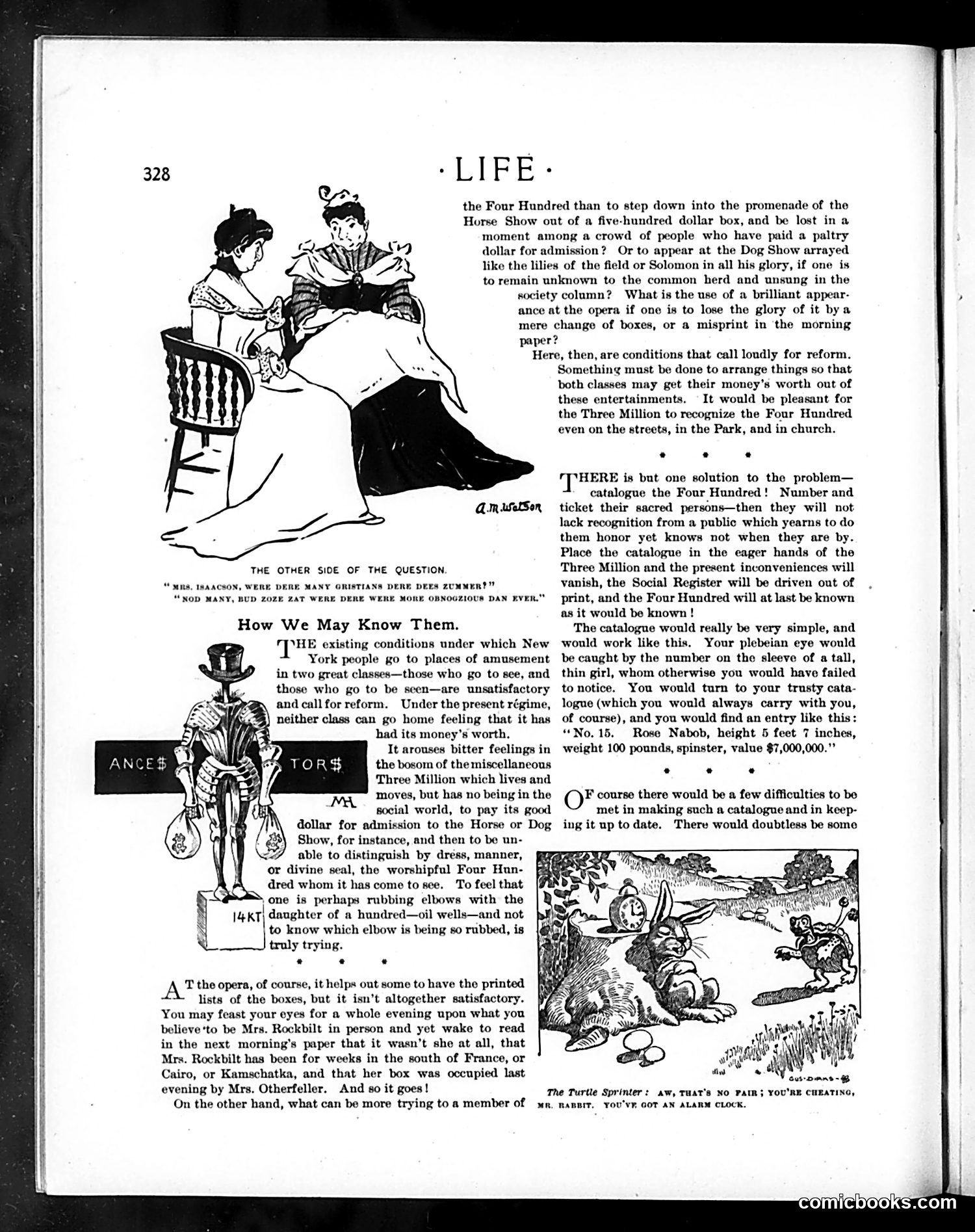
This page satirizes New York's class divisions regarding public entertainment access. The main article, "How We May Know Them," critiques how wealthy New Yorkers attend the same venues—Horse Shows, Dog Shows, opera—but occupy separate social spheres from working-class attendees, remaining mutually unrecognizable despite shared spaces. The solution proposed is a social register or "catalogue" numbering system for the Four Hundred (New York's elite social circle), allowing the wealthy to identify and avoid contact with common people at public events. The cartoon "The Other Side of the Question" depicts women discussing this exclusion, with a caption suggesting Christian hypocrisy about such segregation. The satirical point: wealthy society's anxiety about mingling with lower classes, despite pretensions to public-spirited entertainment attendance.
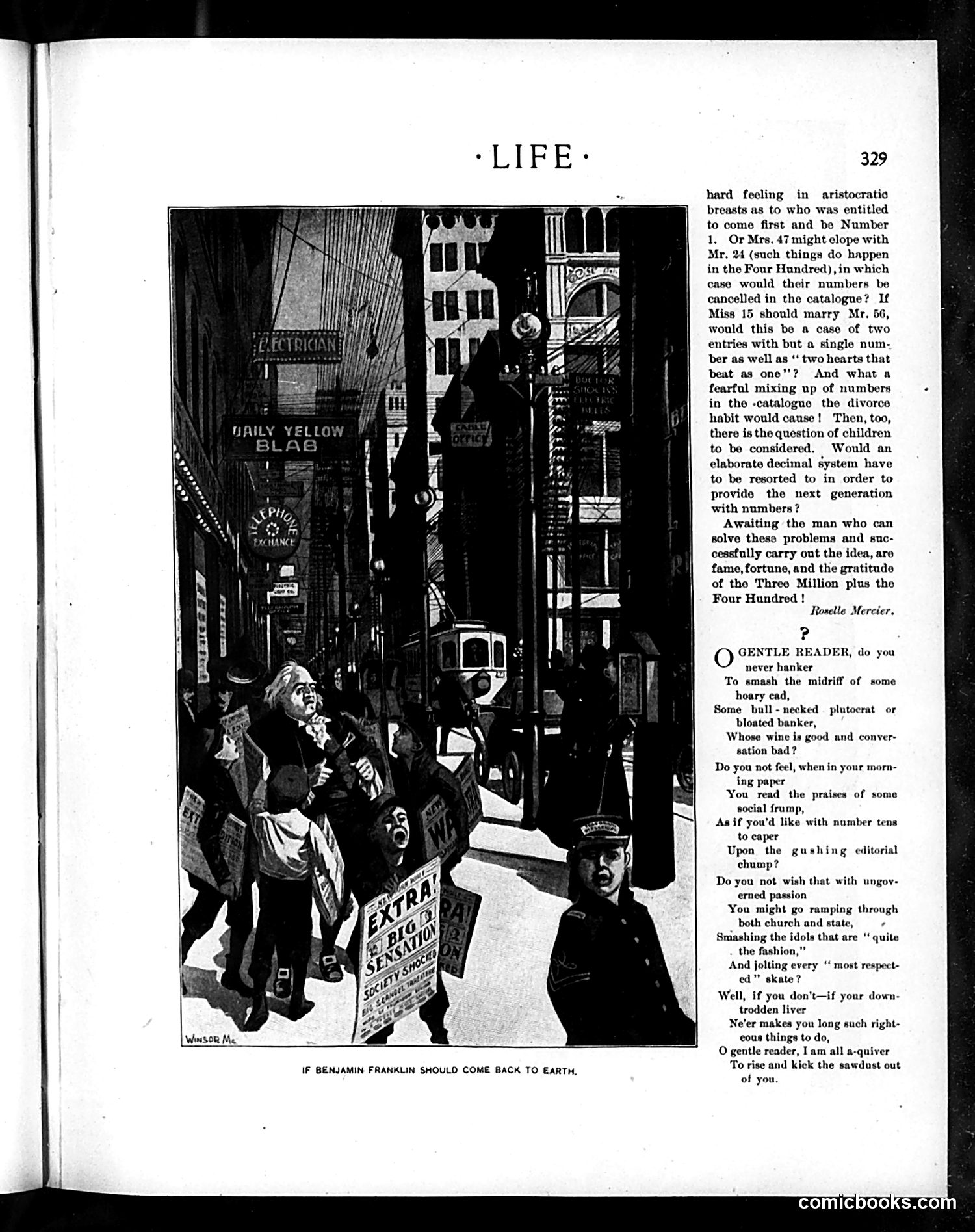
The illustration depicts a crowded urban street scene titled "If Benjamin Franklin Should Come Back to Earth." The satirical point appears to be contrasting Franklin's 18th-century values with modern (early 20th-century) city life: towering buildings, electrical signs ("Daily Yellow Slab"), trolleys, and dense commercial activity overwhelm the scene. The accompanying text on the right is a poem mocking contemporary social attitudes—specifically banker excess, editorial sanctimoniousness, and moral hypocrisy. It sarcastically asks whether the reader "bankers / To smash the midriff of some hoary cad" and criticizes newspapers praising social virtue while ignoring corruption. The overall satire contrasts Franklin's principles of industriousness and virtue with modern urban corruption and materialism.
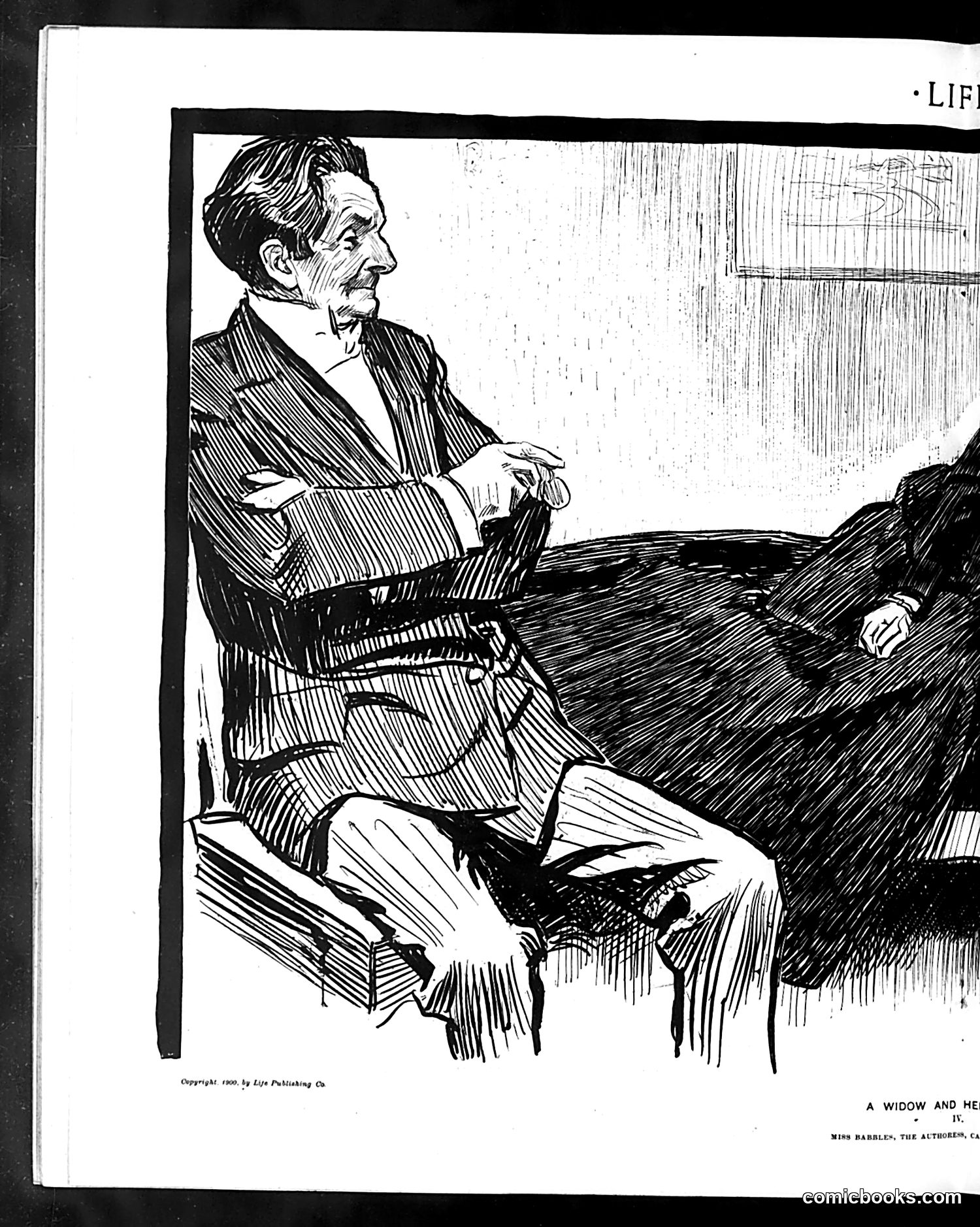
This Life magazine page contains a satirical ink drawing depicting two figures in what appears to be a domestic or office scene. The standing man on the left, wearing a pinstriped suit, is shown in profile looking somewhat stern or disapproving. A second figure appears on the right side of the composition. The partial caption visible reads "A WIDOW AND HE..." with reference to "MISS HARRIET" and "THE AUTHOR, CA[lifornia]," suggesting this illustrates a literary or social scenario, likely from a serialized story or satirical commentary on relationships. The artistic style employs heavy cross-hatching typical of early 20th-century editorial illustration. Without the complete caption and context, the specific satirical target remains unclear, though the composition suggests commentary on social or romantic dynamics.
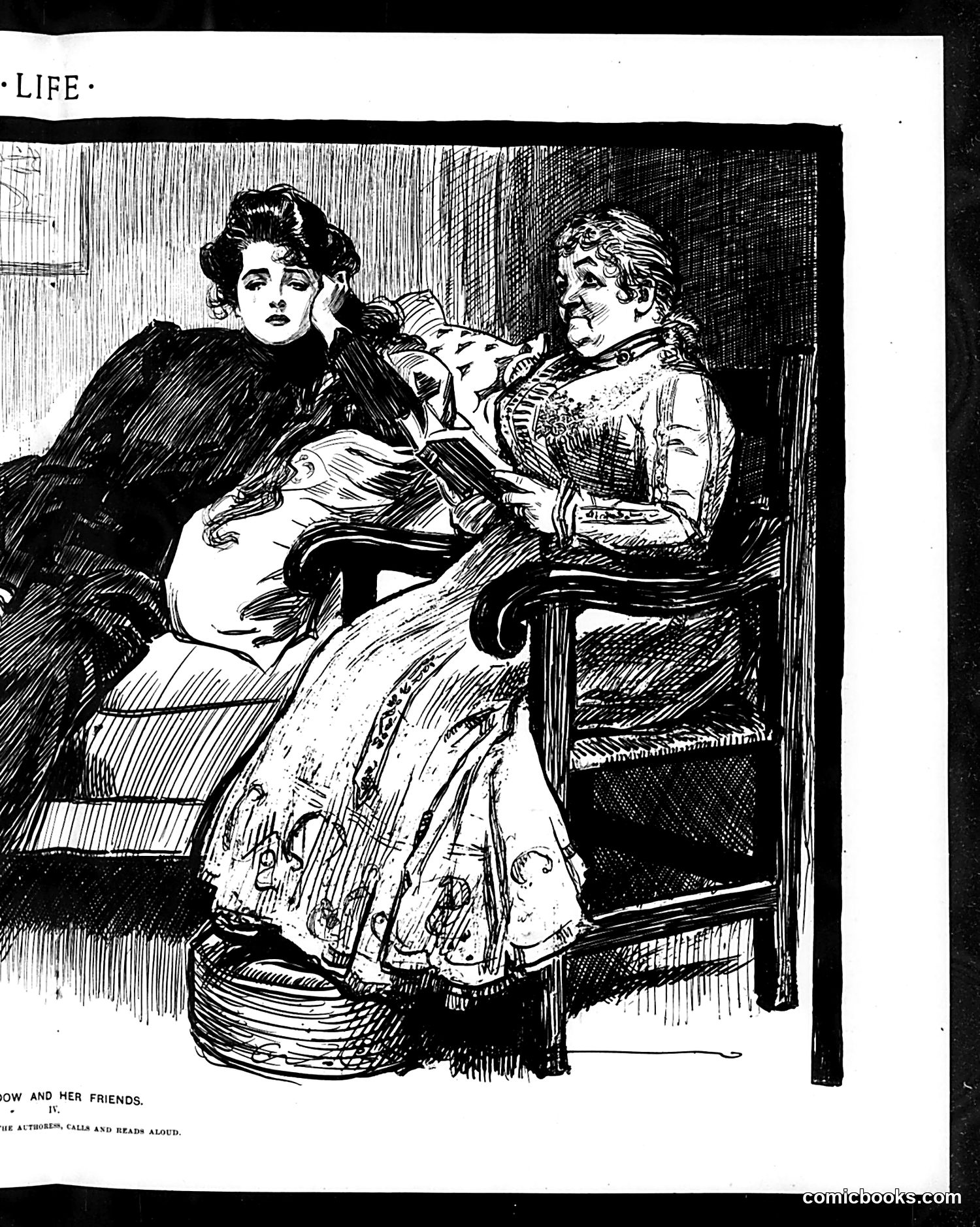
This appears to be a page from Life magazine showing an illustration titled "HOW AND HER FRIENDS" (text partially visible at bottom). The black-and-white ink drawing depicts three figures in what appears to be an early 20th-century interior setting: a woman in an elaborate dress holding a baby, seated with two other people. The partially legible OCR text mentions "THE ACTRESSES, CALLA AND READS ALOUD," suggesting this may satirize theatrical or entertainment figures of the era, though the specific identities are unclear from the visible text alone. The style is consistent with Life's satirical cartoons from the 1900s-1920s, but without clearer caption text, the precise social or political commentary remains uncertain.
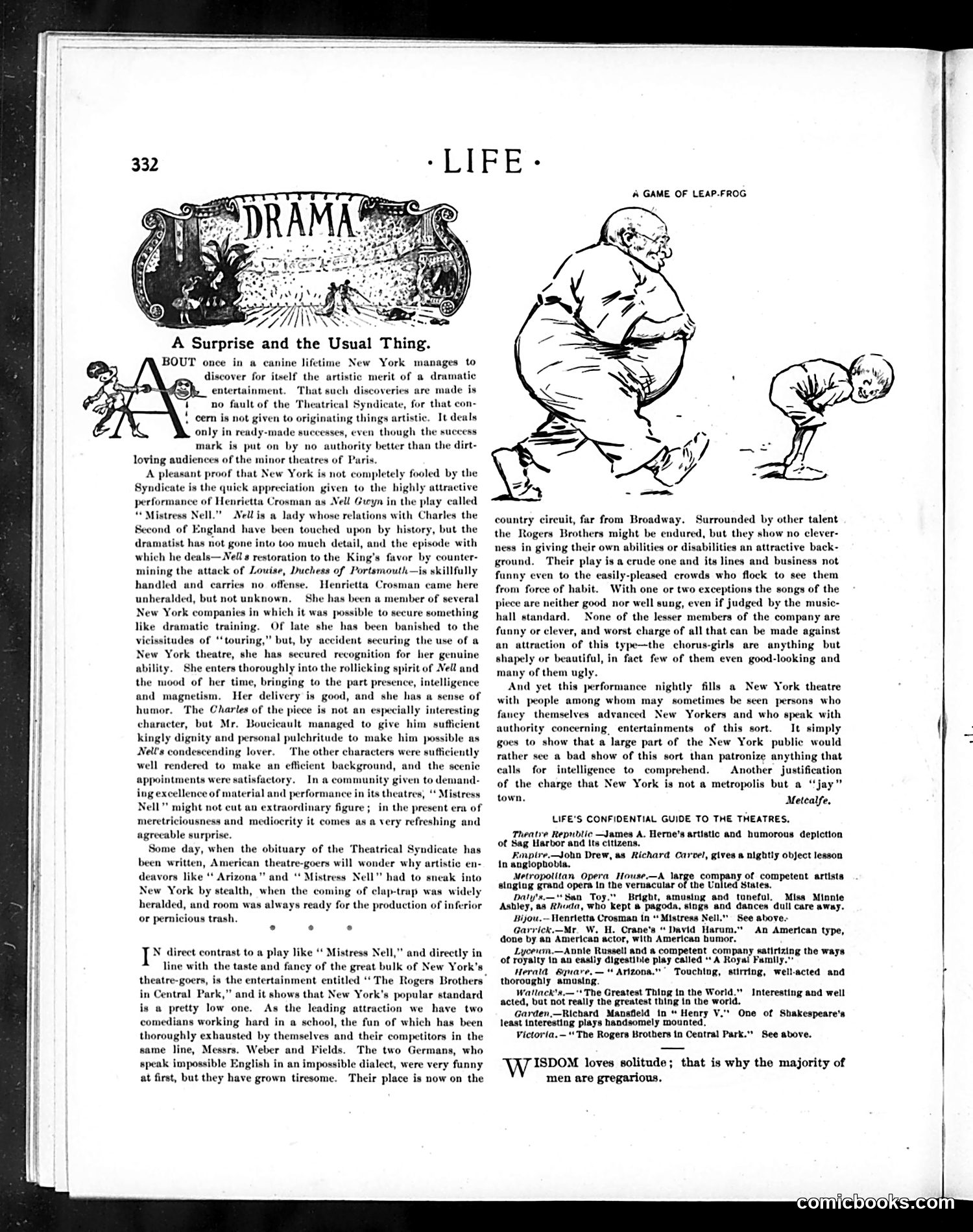
This cartoon satirizes the Rogers Brothers, popular vaudeville performers of the era. The illustration shows a rotund man leaping over a smaller figure in a "leap-frog" game—a visual pun on their theatrical dominance. The accompanying article criticizes their Central Park productions as mediocre entertainment that succeeds through popularity rather than quality. The text notes their comedic abilities are limited, describing their performances as "crude" with "lines and business not funny." The "leap-frog" image suggests they're jumping over worthier theatrical competition to maintain their position. This represents Life magazine's typical role: satirizing popular entertainment and public figures while asserting standards of artistic quality over mass appeal.
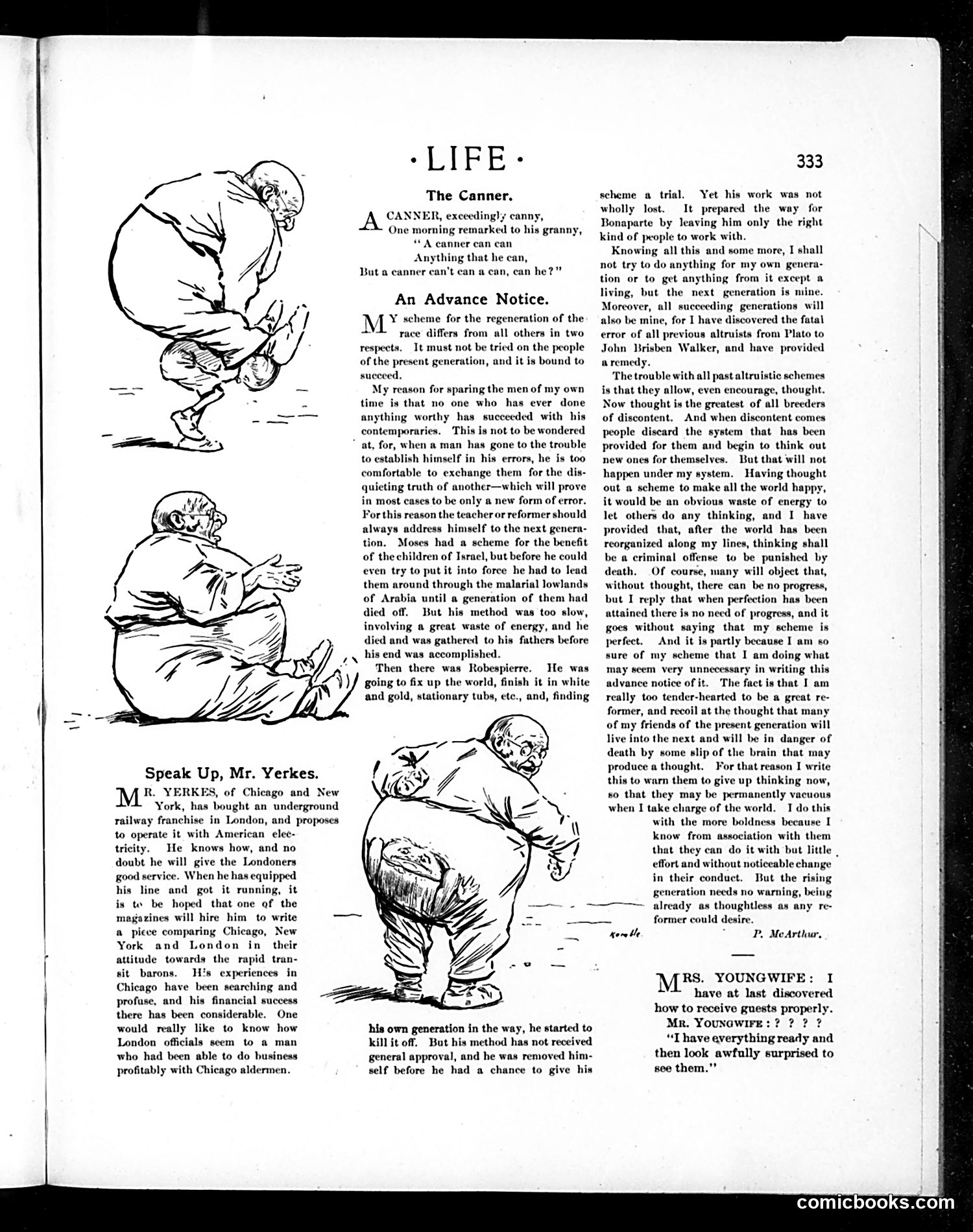
This 1906 Life magazine page contains three satirical pieces: **"Speak Up, Mr. Yerkes"** mocks Charles Yerkes, a real Chicago transit magnate who bought a London Underground franchise. The joke: Life sarcastically invites him to write comparing how he succeeded with Chicago aldermen versus London officials—implying Chicago politicians were notoriously corrupt and easier to bribe than their British counterparts. **"The Canner"** is a simple tongue-twister joke playing on homophones (can/cannot). **"An Advance Notice"** is the page's main satire. An unnamed reformer proposes perfecting humanity by implementing his scheme only on the *next* generation while suppressing all thought and free will. The author satirizes utopian reformers and their fatal flaw: they expect people to abandon their existing beliefs. Historical examples (Moses, Robespierre) supposedly support this absurd logic. The satire targets naive progressivism and authoritarian thinking masquerading as benevolence.
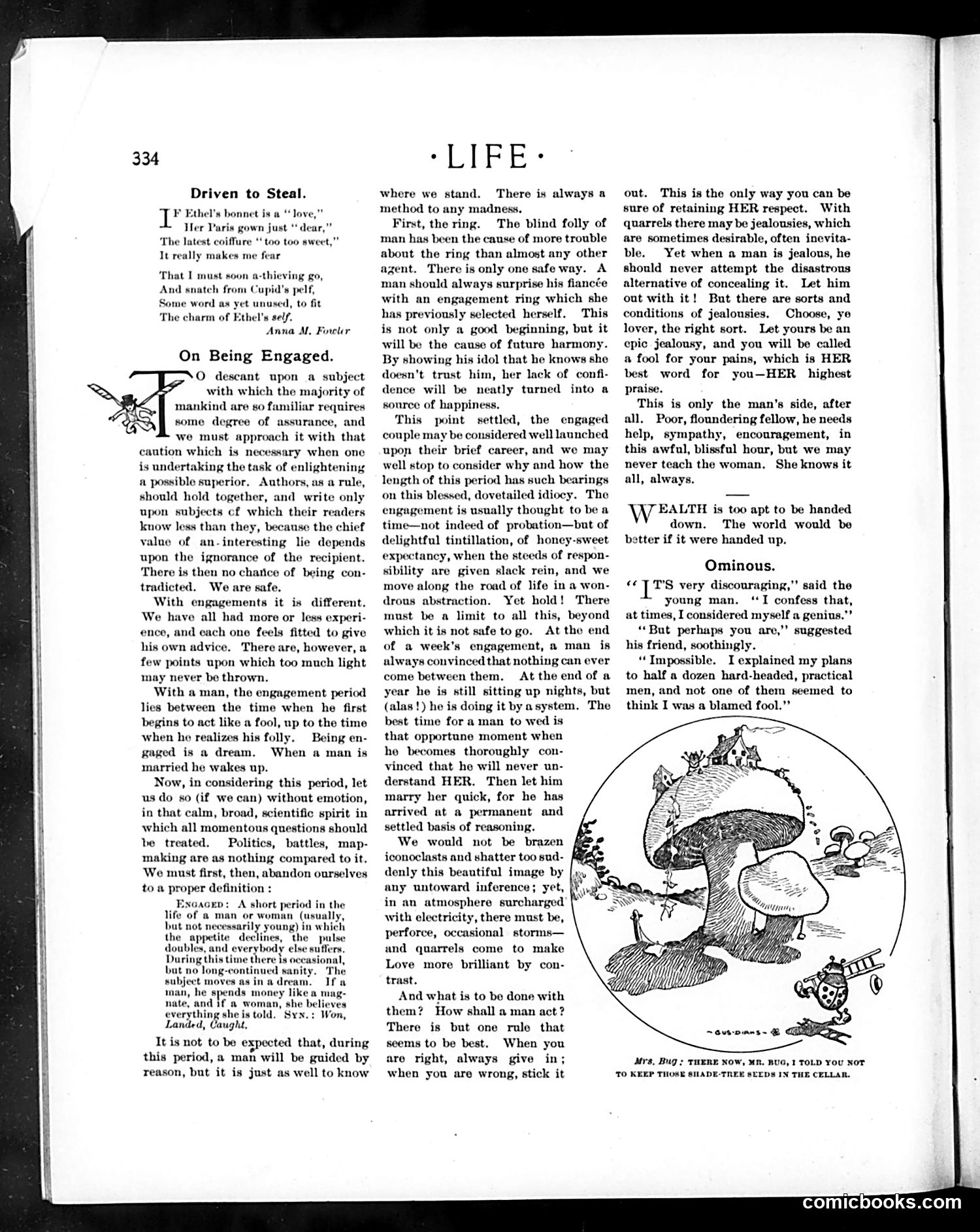
This page contains two satirical pieces about courtship and engagement, typical of Life's humorous social commentary. **"Driven to Steal"** is a short poem mocking how an engaged man feels compelled to find increasingly elaborate compliments for his fiancée—her bonnet, gown, and hairstyle are already described with superlatives ("love," "dear"), leaving him desperate to "steal" new words from Cupid's treasury just to adequately praise her. **"On Being Engaged"** is a longer satirical essay defining engagement as "a short period in the life of a man or woman (usually...young) in which the appetite declines, the pulse doubles, and everybody else suffers." The piece humorously advises that a man should propose when he realizes he'll *never* understand his fiancée—presenting this surrender as "a permanent and settled basis of reasoning." The accompanying cartoon shows a couple in a romantic garden setting, with the caption about hiding seeds in the cellar, reinforcing themes of domestic life and hidden practical concerns beneath romantic sentiment. Both pieces mock courtship conventions through exaggeration and ironic reversal.
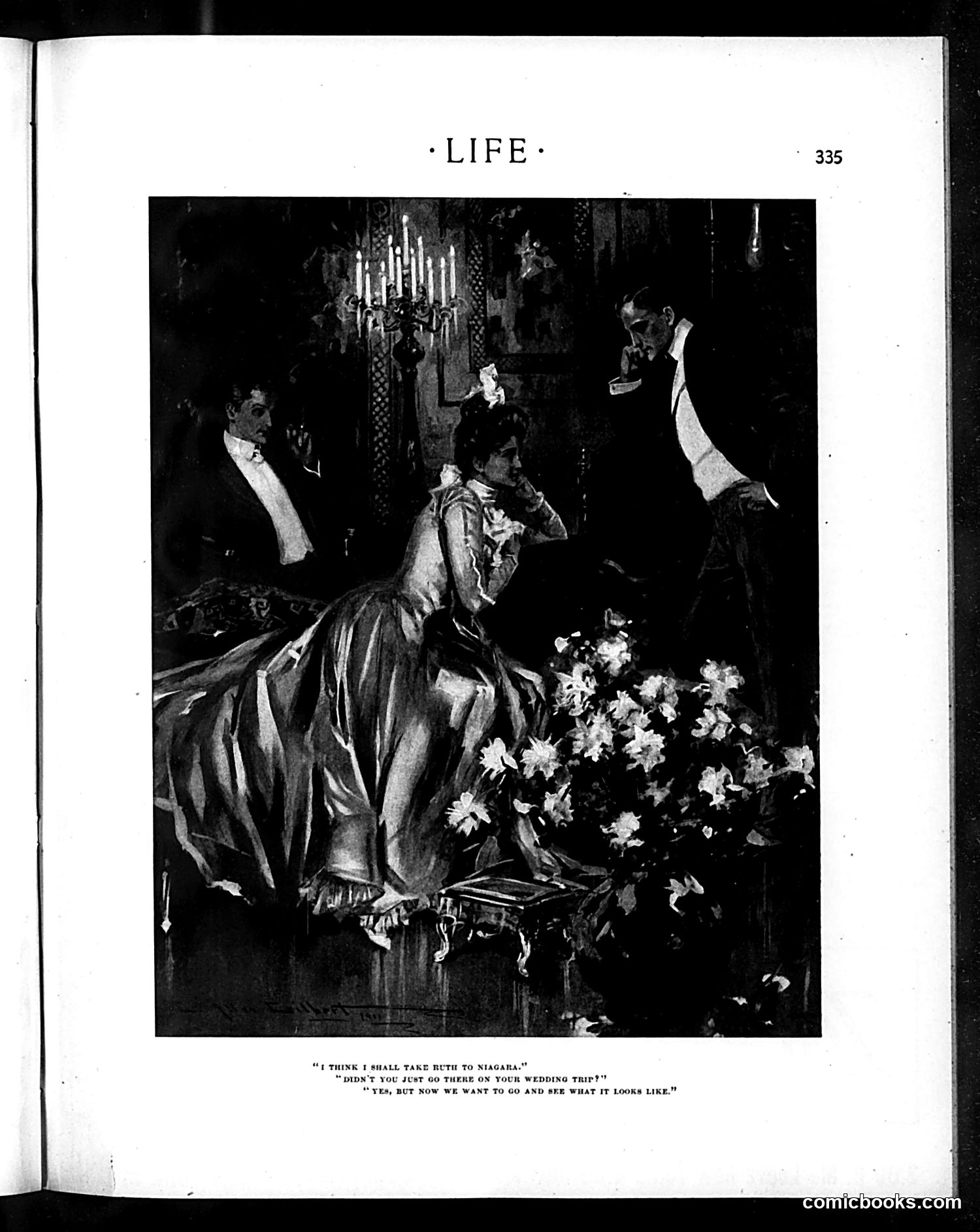
This appears to be a satirical illustration from *Life* magazine depicting an elegant social scene at what looks like a formal dinner or reception. The dialogue references a honeymoon trip to Niagara Falls, a traditional destination for newlyweds in early 20th-century America. The satire seems to mock upper-class attitudes toward tourism and marital customs. The woman's suggestion to visit Niagara Falls is presented as unoriginal ("didn't you just go there on your wedding trip?"), and the man's response—that they want to "see what it looks like"—humorously suggests wealthy people are motivated by fashionable trends rather than genuine interest in natural attractions. The elaborate formal dress, candlelit setting with flowers, and multiple attendants emphasize the artificiality and performative nature of high society conventions being lampooned.
This page contains **literary satire and advertisements** rather than political cartoons. The main content mocks **contemporary American authors** for writing sentimental, tedious fiction. A poem to "Mrs. T. Sandys" celebrates her "recovery" from forgetfulness—satirizing how readers wish they could forget books by James Barrie and James M. (likely James MacArthur), whose work the magazine dismisses as vacuous. The "Dooley on the Stage" piece—written by **Finley Peter Dunne** (credited as "E.P. Dunne")—uses his Irish-dialect character to ridicule the trend of adapting books into plays. The satire extends to adapting unlikely sources: the Constitution as farce, Webster's Dictionary as drama, even the Bible—comically noting that playwrights had to keep Adam and Eve throughout, converting them into a British nobleman and French countess to fit theatrical conventions. A brief anecdote about pianist **Paderewski** performing for Samuel Shortridge concludes the page—a story about absent-mindedness during music. The remaining content is **period advertising** (whiskey, steel pens, gramophones).
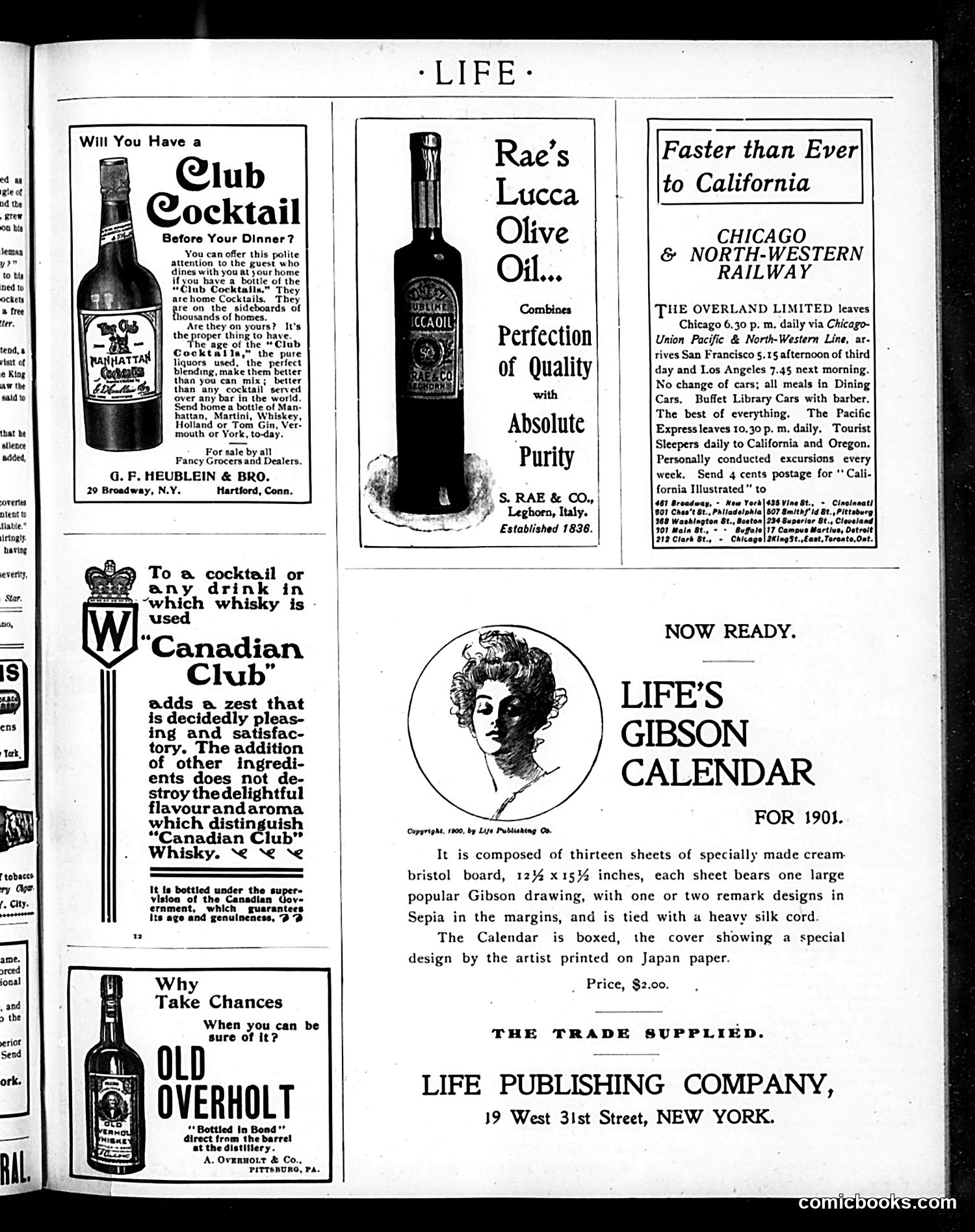
This is primarily a **advertising page** rather than satirical content. It showcases various luxury products marketed to affluent American consumers of the era: **Alcoholic beverages dominate:** Club Cocktails, Canadian Club whisky, and Old Overholt bourbon are prominently advertised—reflecting the pre-Prohibition cocktail culture of the wealthy. These ads emphasize home entertaining and gentility ("polite attention to guests"). **Other luxury goods** include Rae's Italian olive oil (emphasizing European sophistication and "purity") and railroad service to California, promoting fast transcontinental travel as a status symbol. **The Gibson Calendar advertisement** announces a 1901 calendar featuring Gibson Girl drawings—the idealized female beauty standard of the era created by illustrator Charles Dana Gibson. At $2.00, this represented a premium product. The page reflects **Gilded Age consumer culture**: imported goods, leisure travel, home entertainment, and aesthetic refinement were markers of social status. There is no satire here—Life's editors are simply selling luxury to their affluent readership.
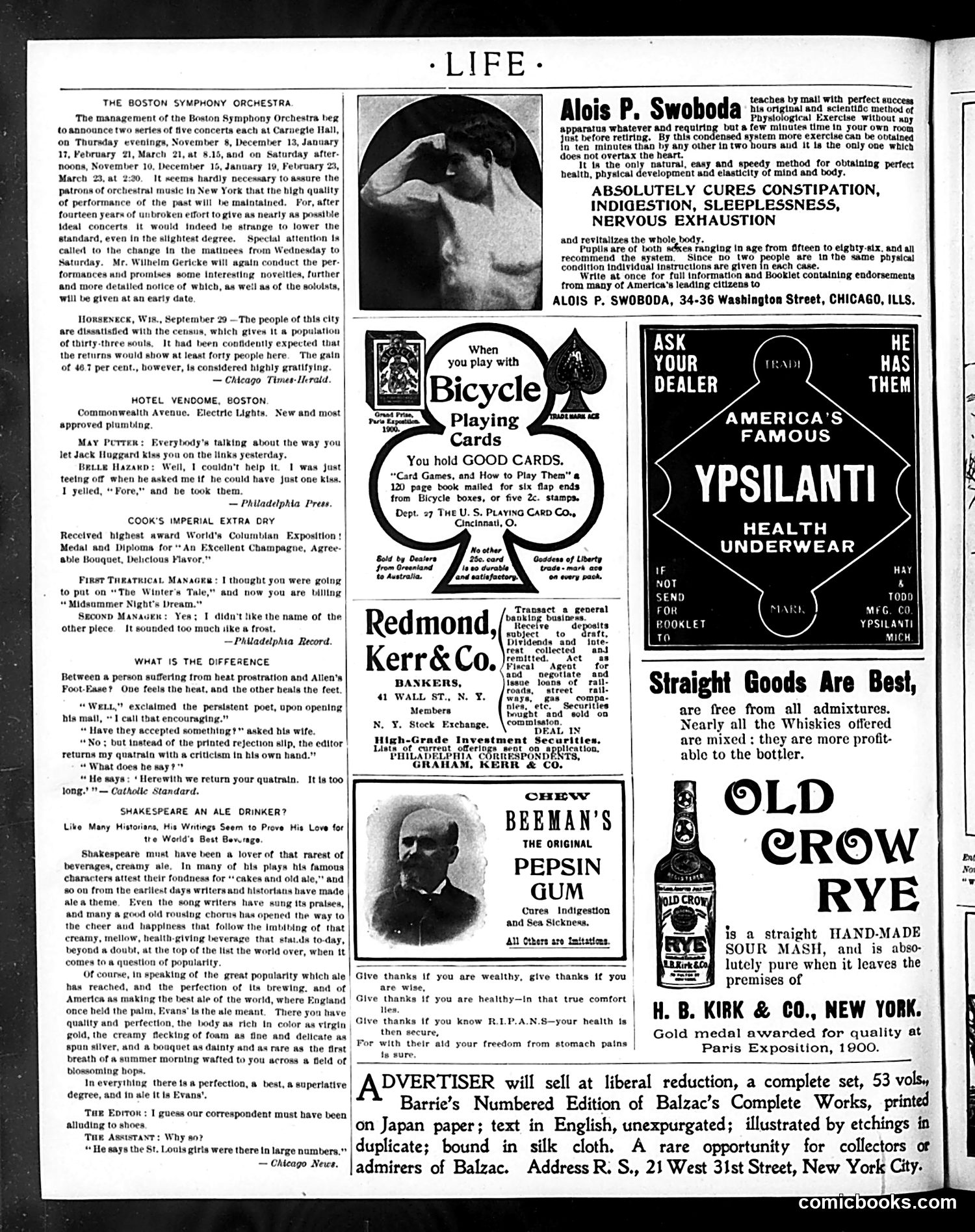
This page consists primarily of **advertisements and miscellaneous notices** rather than political cartoons. The content includes: **Main Items:** - Boston Symphony Orchestra concert announcements - Bicycle Playing Cards advertisement (featuring a humorous circular design explaining card quality) - Health/patent medicine ads (Alois P. Swoboda's "physiological exercise," Beeman's Pepsin Gum) - Liquor advertisements (Old Crow Rye, Evans' Ale) - Banking and investment notices - Book sales notice **Notable Social Content:** A brief humor item mocks a Wisconsin census reporting only 33 residents, calling a 467% population gain "gratifying"—likely satirizing census inaccuracies or small-town exaggeration. The page includes period-appropriate advertising promoting patent medicines and tonics as health solutions—common early 1900s marketing tactics now recognized as dubious. No significant political cartoons or satire appear on this page; it's primarily a commercial and announcements page typical of Life magazine's mixed editorial-advertising format.
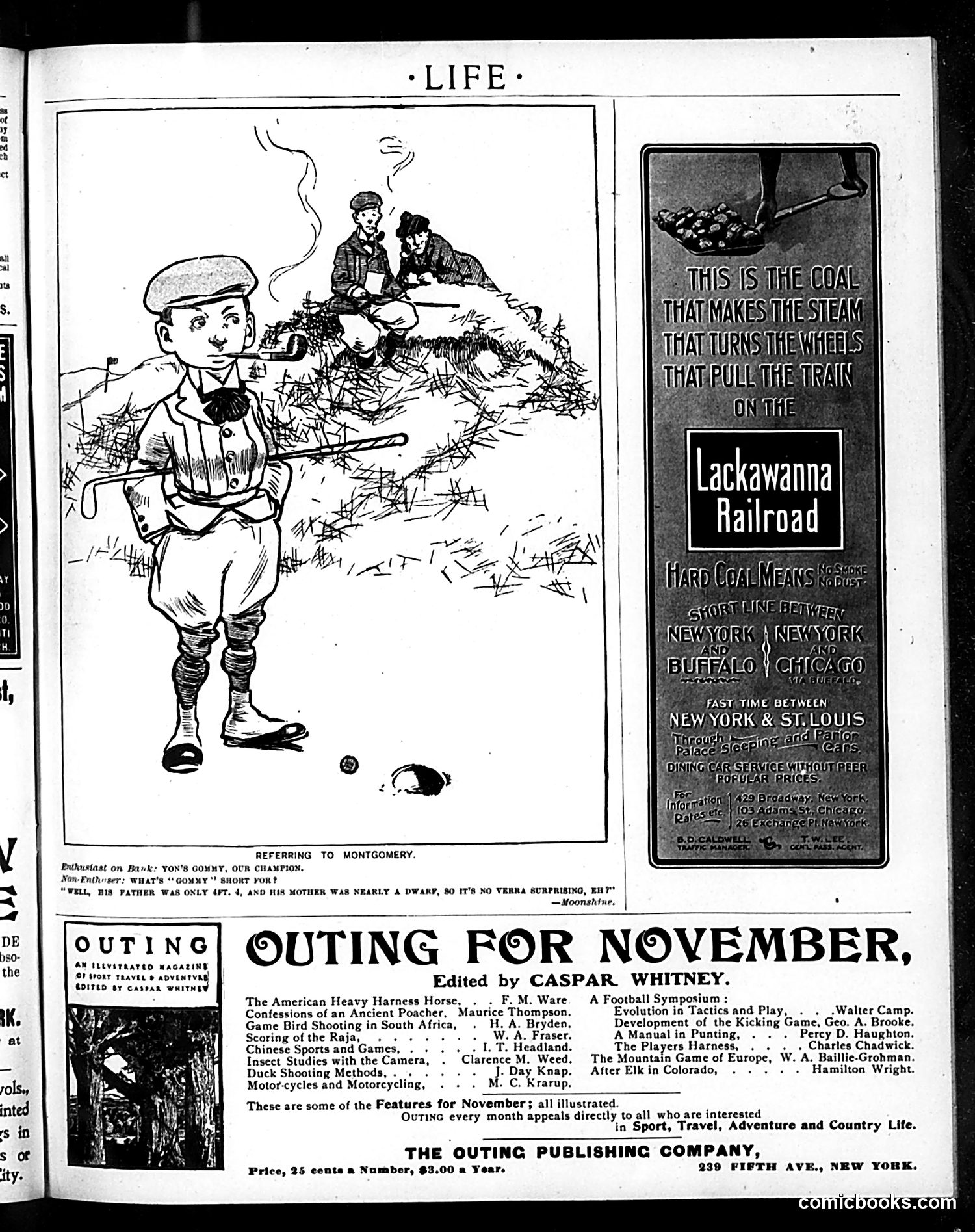
This page contains two main elements: **Left cartoon:** A caricatured figure labeled "Referring to Montgomery" depicts what appears to be a person of unusually short stature (a "gommy" or dwarf). The joke, sourced from *Moonshine*, mocks someone's small height by attributing it to genetics—his father was only 5'4" and his mother "nearly a dwarf." This reflects early 20th-century attitudes that treated dwarfism as a subject for ridicule rather than respectful discussion. The humor relies on eugenic-era assumptions about heredity. **Right side:** A Lackawanna Railroad advertisement promoting coal and passenger service between New York and Chicago. **Bottom:** A table of contents for *Outing* magazine's November issue, featuring articles on sports, hunting, motorcycles, and outdoor pursuits—typical recreational content for this era's leisure-focused readership. The page primarily showcases period advertising and entertainment rather than political satire, reflecting *Life*'s evolution into a general-interest magazine.
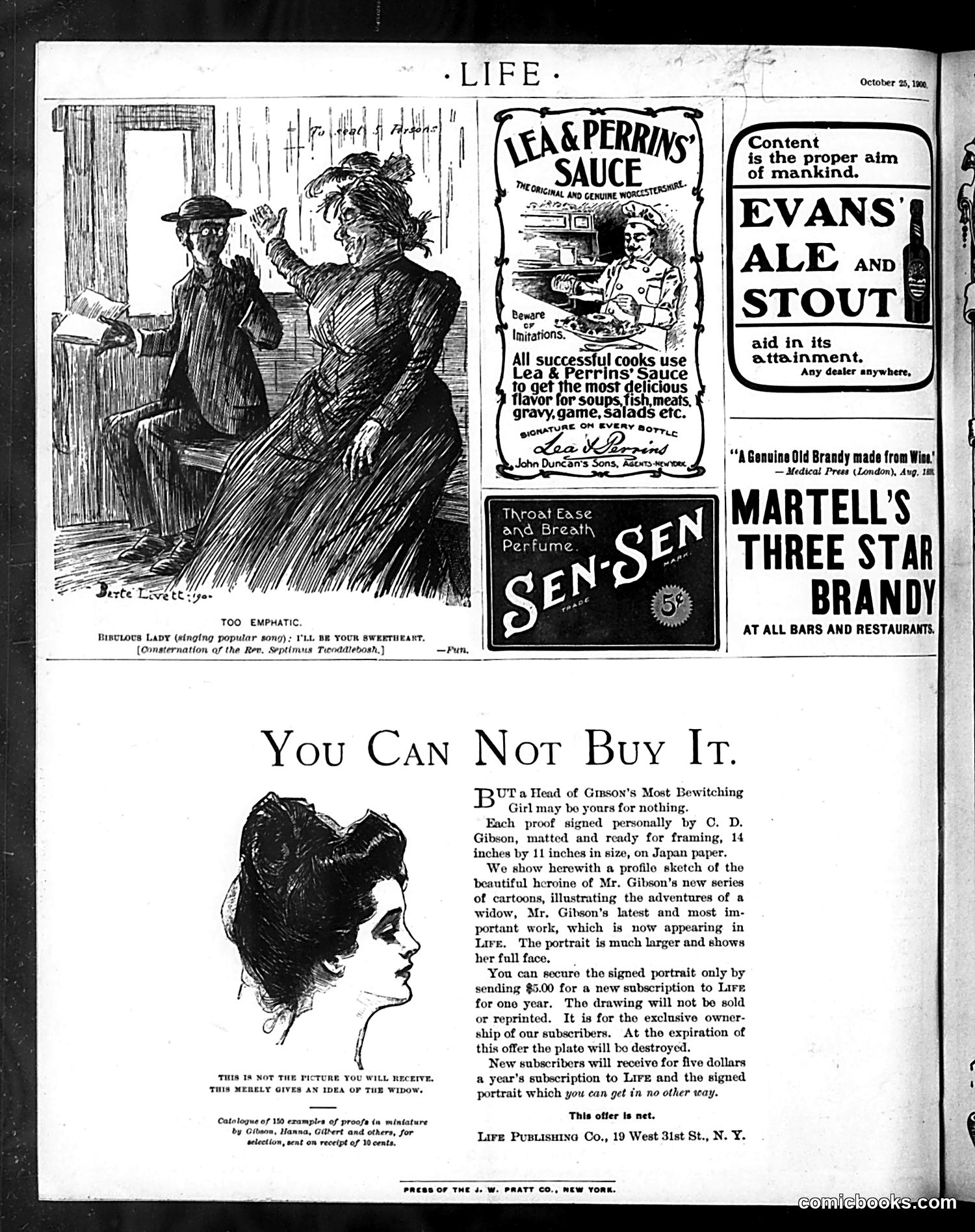
**Main Cartoon ("Too Emphatic"):** A clergyman (Rev. Septimus Twoddledosh) appears shocked as a woman sings a popular song to a man in a doorway. The joke plays on the contrast between Victorian propriety and modern entertainment—a "respectable" lady singing a secular love song ("I'll be your sweetheart") publicly represents loose morality to the shocked clergyman. The humor mocks Victorian prudishness. **Lower Section:** An advertisement for C.D. Gibson's cartoon series about "a widow" (likely his famous "Gibson Girl" illustrations). The pitch emphasizes exclusivity—subscribers receive a signed, matted portrait unavailable elsewhere; the plate will be destroyed after the offer ends. **Remainder:** Period advertisements for Lea & Perrins Sauce, Evans' Ale and Stout, Sen-Sen breath perfume, and Martell's Brandy—typical early 1900s consumer goods marketing.