
Life, 1900-10-25 · page 6 of 20
Life — October 25, 1900 — page 6: what you’re looking at
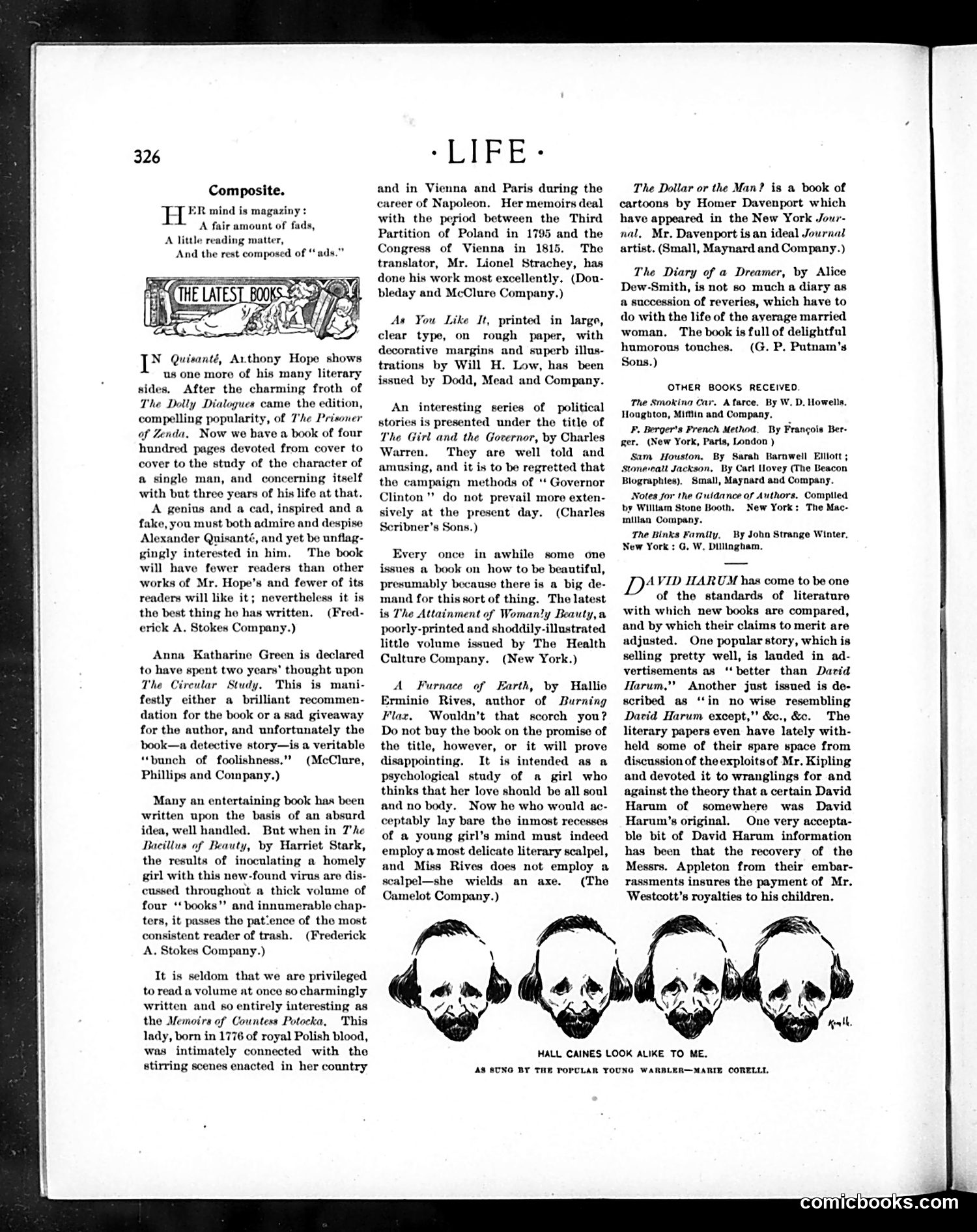
What you’re looking at
This cartoon depicts four identical bald heads with facial hair, captioned as "as sung by the popular young warblers—Marie Corelli." The joke appears to reference **Hall Caine**, a prominent British novelist of the era, though the specific context is unclear from this page alone. The four identical faces suggest either: mockery of Caine's appearance being repeated/copied, or possibly a comment on derivative or repetitive work. The attribution to "Marie Corelli" (a popular contemporary female writer) suggests this may be satirizing either a song about Hall Caine or comparing the two writers' work as similarly forgettable or interchangeable. Without additional historical context about contemporary literary feuds or cultural references, the precise satirical target remains uncertain, though it clearly mocks either Caine himself or critical reception of his work.
📄 Transcribed text from this page (OCR, searchable)
Machine-transcribed from the original scan — historical spelling and the odd misread are preserved.
Composite. EL ER ning is magaziny A fair amount of fads, A little reading matter, And the rest composed of “ads.” LX Quisanté, Avthony Hope shows us one more of his many literary sides, After the charming froth of The Dolly Dialogues came the edition, compelling popularity, of The Prisoner of Zenda, Now we bave a book of four hundred pages devoted from cover to cover to the study of the character of a single man, and concerning itself with but three years of his life at that. A genius and a cad, inspired and a fake, you must both admire and despise Alexander Quisanté, and yet be unflag- gingly interested in him. The book will have fewer readers than other works of Mr. Hope’s and fewer of its readers will like it; nevertheless it is the best thing he has written. (Fred- erick A. Stokes Company.) Anna Katharine Green is declared to have spent two years’ thought upon The Cireular Study, This is mani- festly either a brilliant recommen- dation for the book or a sad giveaway for the author, and unfortunately the book—a detective story—is a veritable “bunch of foolishness,” (McClure, Phillips and Company.) Many an entertaining book has been written upon the basis of an absurd idea, well handled. But when in The Bacillus of Beauty, by Harriet Stark, the results of inoculating a homely girl with this new-found virus are dis- cussed throughout a thick volume of four ‘*books”’ and innumerable chap- ters, it passes the pat‘ence of the most consistent reader of trash. (Frederick A. Stokes Company.) It is seldom that we are privileged to read a volume at once so charmingly written and so entirely interesting as the Memoirs of Countess Potocka, This lady, born in 1776 of royal Polish blood, was intimately connected with tho stirring scenes enacted in her country ‘LPRE « and in Vienna and Paris during the career of Napoleon, Her memoirs deal with the pegiod between the Third Partition of Poland in 1795 and the Congress of Vienna in 1815. The translator, Mr. Lionel Strachey, has done his work most excellently, (Dou- bleday and McClure Company.) As You Like It, printed in largo, clear type, on rough paper, with decorative margins and superb illus- trations by Will H. Low, has been issued by Dodd, Mead and Company. An interesting series of political stories is presented under the title of The Girt and the Governor, by Charles Warren. They are well told and amusing, and it is to be regretted that the campaign methods of ‘* Governor Clinton” do not prevail more exten- sively at the present day. (Charles Scribner’s Sons.) Every once in awhile some ono issues a book on how to be beautiful, presumably because there is a big de- mand for this sort of thing. The latest is The Attainment of Womanty Beauty, a poorly-printed and shoddily-illustrated little volume issued by The Health Culture Company. (New York.) A Furnace of Earth, by Hallie Erminie Rives, author of Burning Flax, Wouldn't that scorch you? Do not buy the book on the promise of the title, however, or it will prove disappointing. It is intended as a psychological study of a girl who thinks that her love should be all soul and no body. Now he who would ac- ceptably lay bare the inmost recesses of a young girl’s mind must indeed employ a most delicate literary scalpel, and Miss Rives does not employ a scalpel—she wields an axe. (The Camelot Company.) The Dollar or the Man? is a book of cartoons by Homer Davenport which have appeared in the New York Jour- nal, Mr. Davenport is an ideal Journal artist. (Small, Maynard and Company.) The Diary of a Dreamer, by Alice Dew-Smith, is not so much a diary as a succession of reveries, which have to do with the life of the average married woman. The book is full of delightful humorons touches. (G. P. Putnam's Sons.) OTHER BOOKS RECEIVED. The Smoking Car, Atarce. By W. D. Howells. Houghton, Mimiin and Company, F. Berger's French Method. By Frangois Ber- ger. (New York, Paris, London ) Sam Houston. By Sarah Barnwell Elilott; Stoneratt Jackson, By Cart Hovey (The Beacon Biographies), Small, Maynard and Company. Notes for the Guidance of Authors. Compiled by Willtam Stone Booth. New York: The Mac- millan Company. The Binks Family, By John Strange Winter, New York : G, W. Dillingham. D4 VID IARUM has come to be one of the standards of literature with which new books are compared, and by which their claims to merit are adjusted. One popular story, which is selling pretty well, is lauded in ad- vertisements as ‘better than Darid Harum,”” Another just issued is de- scribed as ‘in no wise resembling David Harum except,” &., &. The literary papers even have lately with- held some of their spare space from discussion of the exploitsof Mr. Kipling and devoted it to wranglings for and against the theory that a certain David Harum of somewhere was David Harum’s original. Ono very accepta- ble bit of David Harum information has been that the recovery of the Messrs. Appleton from their embar- rassments insures the payment of Mr. Westcott’s royalties to his children. HALL CAINES LOOK ALIKE TO ME. AS SUNG BY THE POPCLAR YOUNG WARBLER—MARIE CORELLI. Comicbooks.com