
Life, 1900-10-25 · page 5 of 20
Life — October 25, 1900 — page 5: what you’re looking at
What you’re looking at
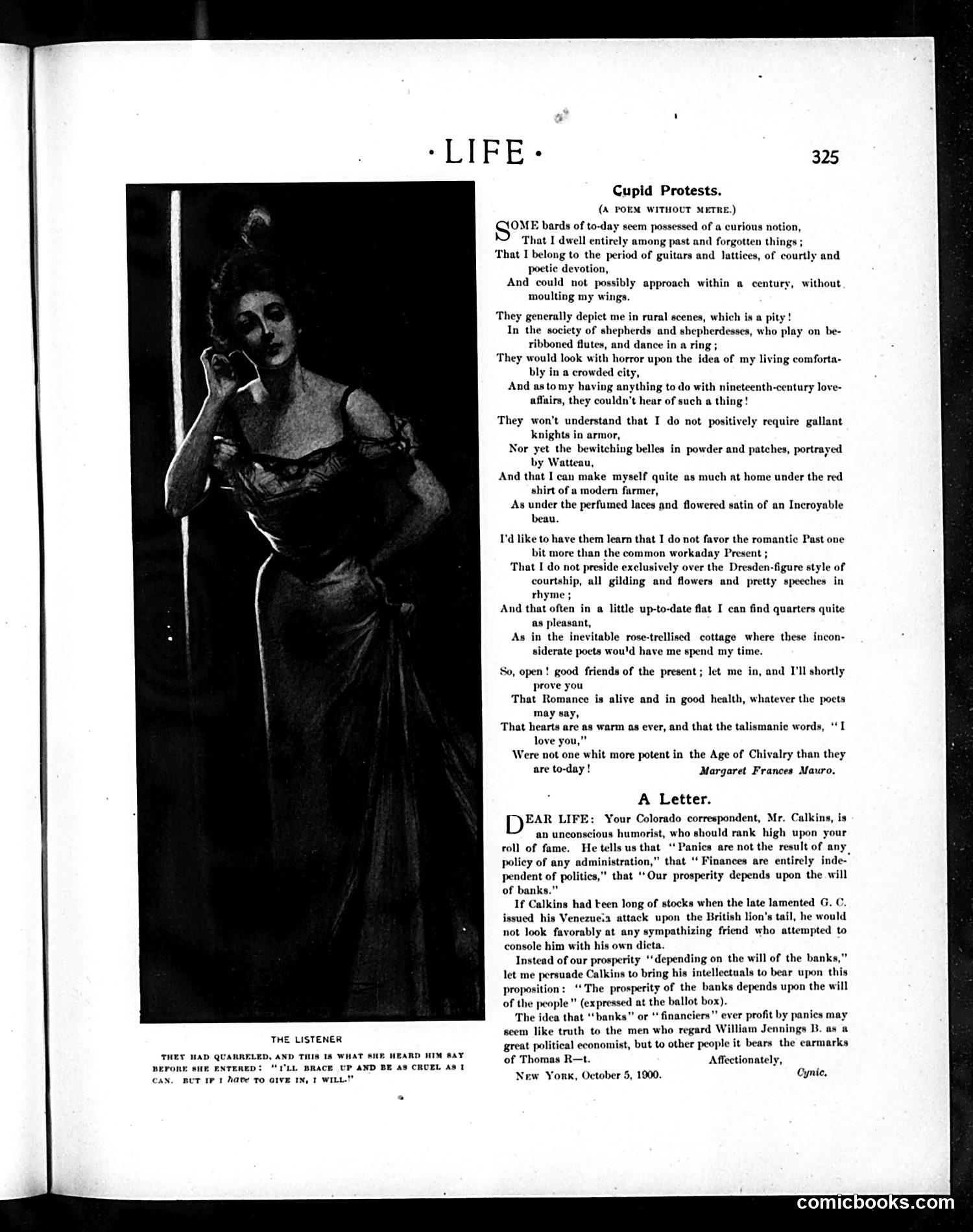
The illustration shows a woman in classical dress listening at a door or wall, likely representing the mythological figure of Echo or a similar archetype of female eavesdropping. The caption reads: "They had quarreled, and this is what she heard him say before she entered: 'I'll brace up and be as cruel as I can. But if I have to give in, I will.'" The satire mocks romantic domestic conflict—specifically male bluster and insincerity. The man postures about being "cruel" but simultaneously admits he'll capitulate, undermining his own toughness. The woman's concealed listening represents feminine insight into male pretense, suggesting women see through men's performative hardness in relationships. This reflects early-20th-century gender dynamics and marital comedy conventions.
📄 Transcribed text from this page (OCR, searchable)
Machine-transcribed from the original scan — historical spelling and the odd misread are preserved.
Cupid Protests. (A POEM WITHOUT METRE.) OME bards of to-day seem possessed of a curious notion, That I dwell entirely among past and forgotten things ; ‘That I belong to the period of guitars and lattices, of courtly and poetic devotion, And could not possibly approach within a century, without moulting my wings. They generally depict me in rural scenes, which is a pity! In the society of shepherds and shepherdesses, who play on be- ribboned flutes, and dance in a ring ; They would look with horror upon the idea of my living comforta- bly in a crowded city, And astomy having anything to do with nineteenth-century love- affairs, they couldn’t hear of such a thing! They won't understand that I do not positively require gallant knights in armor, Nor yet the bewitching belles in powder and patches, portrayed by Watteau, And that I can make myself quite as much at home under the red shirt of a modern farmer, ‘As under the perfumed laces and flowered satin of an Incroyable beau. I'd like to have them learn that I do not favor the romantic Past one bit more than the common workaday Present ; That I do not preside exclusively over the Dresden-figure style of courtship, all gilding and flowers and pretty speeches in rhyme ; And that often in a little up-to-date flat I can find quarters quite as pleasant, As in the inevitable rose-trellised cottage where these incon- siderate poets wou'd have me spend my time. So, open! good friends of the present ; let me in, and I'll shortly prove you ‘That Romance is alive and in good health, whatever the poets may say, That hearts are as warm as ever, and that the talismanie words, ‘‘1 love you,” Were not one whit more potent in the Age of Chivalry than they are to-day! Margaret Frances Mauro, A Letter. EAR LIFE: Your Colorado correspondent, Mr. Calkins, is an unconscious humorist, who should rank high upon your roll of fame. He tells us that ‘Panics are not the result of any policy of any administration,” that “ Finances are entirely inde- pendent of politics,” that ‘Our prosperity depends upon the will of banks.” If Calkins had teen long of stocks when the late lamented G. C. issued his Venezueia attack upon the British lion's tail, he would not look favorably at any sympathizing friend who attempted to console him with his own dicta. Instead of our prosperity ‘depending on the will of the banks,” let me persuade Calkins to bring his intellectuals to bear upon this proposition: ‘<The prosperity of the banks depends upon the will of the people” (expressed at the ballot box). ‘The idea that “banks” or “financiers” ever profit by panics may seem like truth to the men who regard William Jennings B. as a great political economist, but to other people it bears the earmarks THEY MAD QUARRE Tals ta wher swe weanD wrx ea of Thomas R—t. ‘Attecilooaialy: BEFORE #1” ENTERED? “I'LL BRACE U y . a CAN. BUT IF 1 Rate TO GIVE IN, 1 WILL." New York, October 5, 1900. Cynic. THE LISTENER comicbooks.com