
Life, 1900-10-25 · page 8 of 20
Life — October 25, 1900 — page 8: what you’re looking at
What you’re looking at
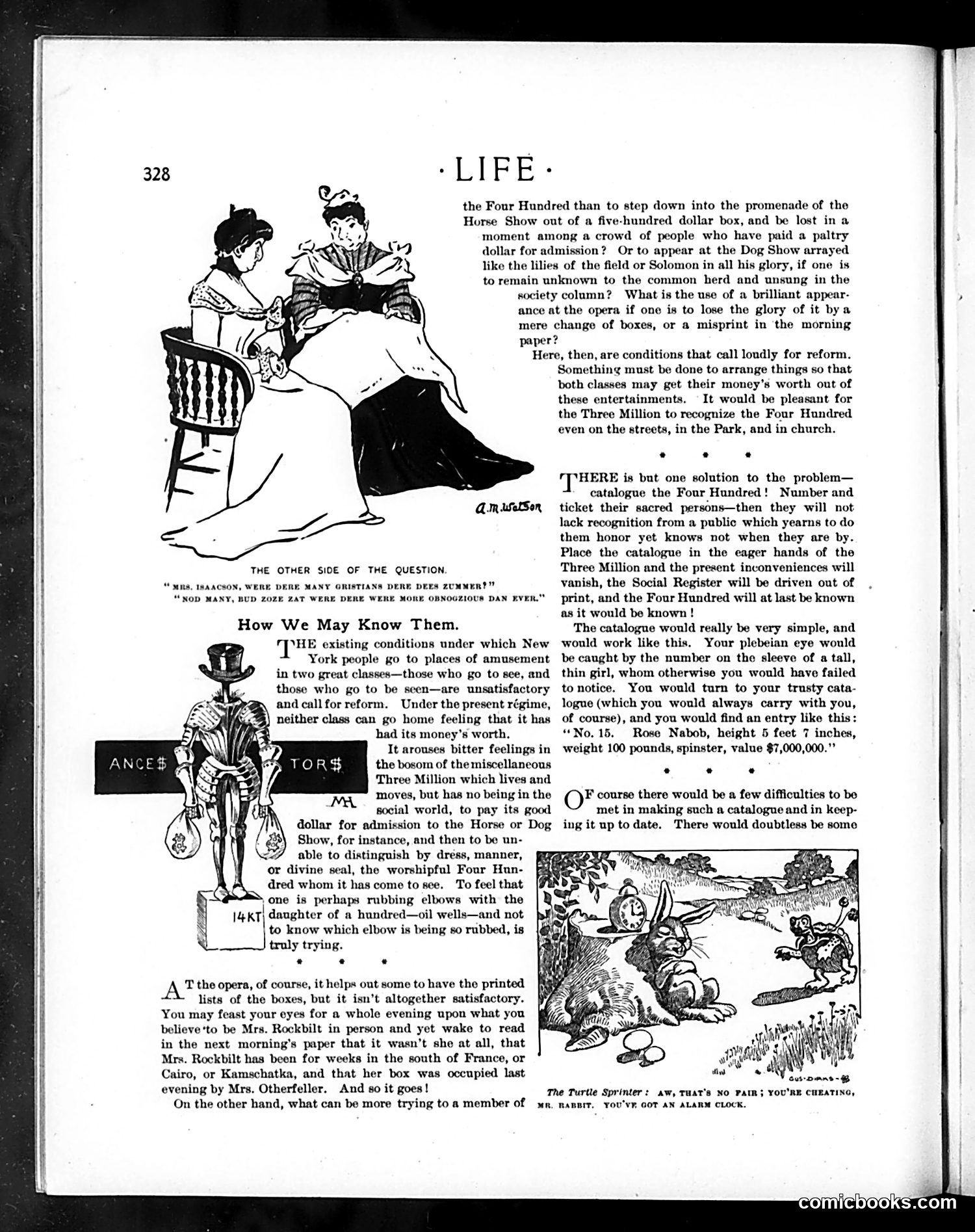
This page satirizes New York's class divisions regarding public entertainment access. The main article, "How We May Know Them," critiques how wealthy New Yorkers attend the same venues—Horse Shows, Dog Shows, opera—but occupy separate social spheres from working-class attendees, remaining mutually unrecognizable despite shared spaces. The solution proposed is a social register or "catalogue" numbering system for the Four Hundred (New York's elite social circle), allowing the wealthy to identify and avoid contact with common people at public events. The cartoon "The Other Side of the Question" depicts women discussing this exclusion, with a caption suggesting Christian hypocrisy about such segregation. The satirical point: wealthy society's anxiety about mingling with lower classes, despite pretensions to public-spirited entertainment attendance.
📄 Transcribed text from this page (OCR, searchable)
Machine-transcribed from the original scan — historical spelling and the odd misread are preserved.
-LIFE- the Four Hundred than to step down into the promenade of the Horse Show out of a five-hundred dollar box, and be lost in a moment among a crowd of people who have paid a paltry dollar for admission? Or to appear at the Dog Show arrayed like the lilies of the field or Solomon in all his glory, if one is to remain unknown to the common herd and unsung in the society column? What is the use of a brilliant appear. ance at the opera if one is to lose the glory of it bya mere change of boxes, or a misprint in the morning paper? Here, then, are conditions that call loudly for reform. THE OTHER SIDE OF THE QUESTION. “MRS, ISAACSON, WERE DERE MANY GRISTIANS DERE DEES zUMMER?” “NOD MANY, BUD Z0ZE ZAT WERE DERE WERE MORE OBNOGZIOUS DAN EVER.” How We May Know Them. THE existing conditions under which New York people go to places of amusement in two great classes—those who go to see, and those who go to be seen—are unsatisfactory and callfor reform. Under the present régime, neither class can go home feeling that it has ‘: had its money's worth, It arouses bitter feelings in the bosom of the miscellaneous Three Million which lives and moves, but has no being in the social world, to pay its good dollar for admission to the Horse or Dog Show, for instance, and then to be un- able to distinguish by dress, manner, or divine seal, the worshipful Four Hun- dred whom it has come to see. To feel that one is perhaps rubbing elbows with the 14KT| daughter of a hundred—oil wells—and not \ to know which elbow is being so rubbed, is YJ traly trying. A? the opera, of course, it helps out some to have the printed lists of the boxes, but it isn’t altogether satisfactory. You may feast your eyes for a whole evening upon what you believe ‘to be Mrs. Rockbilt in person and yet wake to read in the next morning's paper that it wasn’t she at all, that Mrs. Rockbilt has been for weeks in the south of France, or Cairo, or Kamschatka, and that her box was occupied last evening by Mrs, Otherfeller. And so it goes! On the other hand, what can be more trying to a member of Something must be done to arrange things so that both classes may get their money’s worth out of these entertainments. It would be pleasant for the Three Million to recognize the Four Hundred even on the streets, in the Park, and in church. THERE is but one solution to the problen— catalogue the Four Hundred! Number and ticket their sacred persons—then they will not lack recognition from a public which yearns to do them honor yet knows not when they are by. Place the catalogue in the eager hands of the Three Million and the present inconveniences will vanish, the Social Register will be driven out of print, and the Four Hundred will at last be known as it would be known ! The catalogue would really be very simple, and would work like this, Your plebeian eye would be caught by the number on the sleeve of a tall, thin girl, whom otherwise you would have failed to notice. You would turn to your trusty cata- logue (which you would always carry with you, of course), and you would find an entry like this: “No. 15. Rose Nabob, height 5 feet 7 inches, weight 100 pounds, spinster, value $7,000,000.”” . . . OF course there would be a few difficulties to be met in making such a catalogue and in keep- ing it up to date. There would doubtless be some The Turtle Sprinter: aw, THAT'S NO PAIR; YOU'RE CURATING, MR. RABBIT, YOU'VE, GOT AN ALARM CLOCK.