
A complete issue · 20 pages · 1900
Life — September 6, 1900
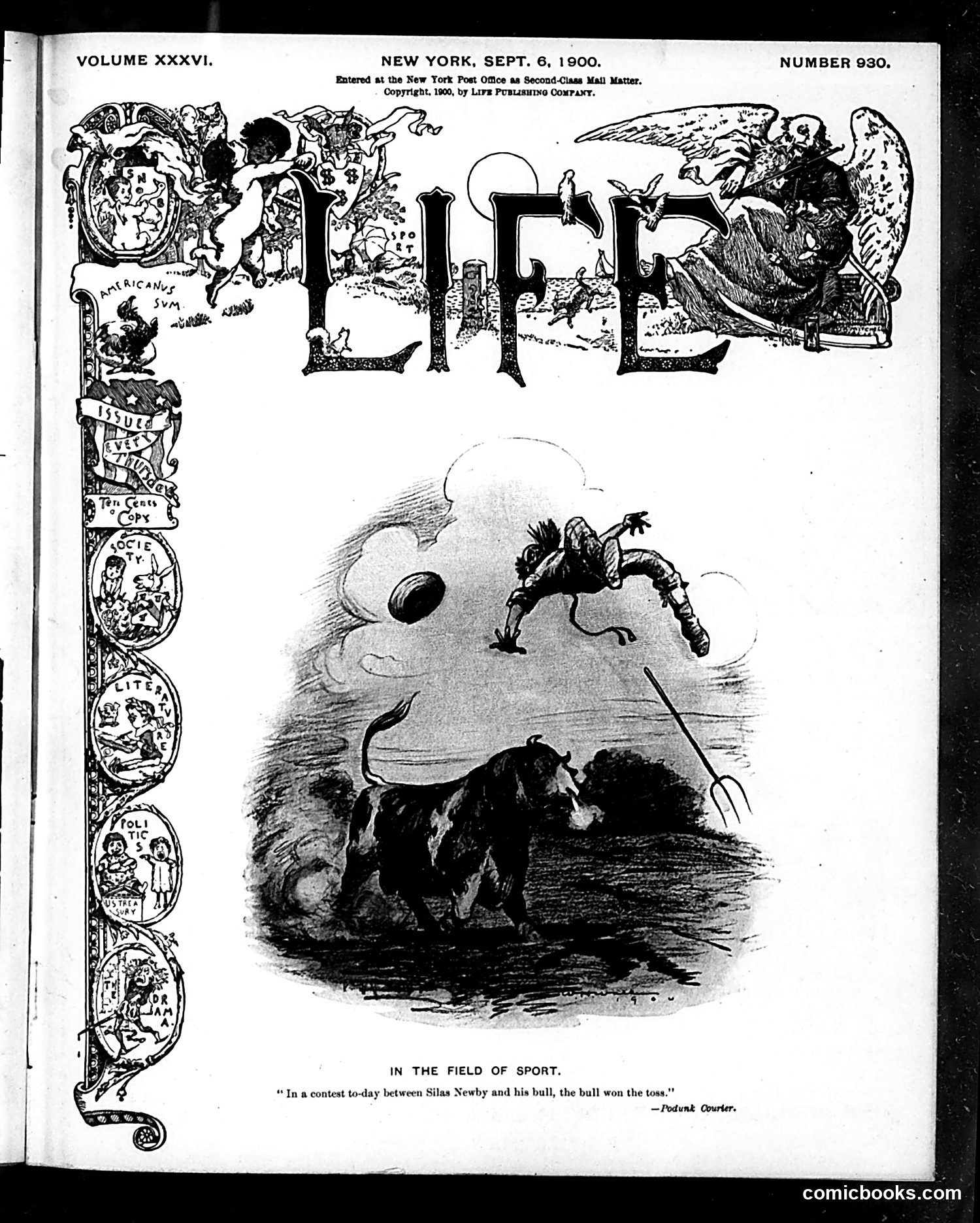
This page from Life magazine (Sept. 6, 1900) contains a humorous illustration about a contest between "Silas Newby and his ball." The cartoon shows a dog straining against a rope while a small devil-like figure rides atop a ball above, with the caption crediting "Padlock Corder." The joke appears to be a visual pun: the dog is literally competing against a ball (and winning the "toss"), playing on the phrase "the ball won the toss"—a sports expression. The devil figure likely represents fate or chance in competitive sport. The ornate left border contains decorative vignettes typical of Life's design aesthetic. Without additional historical context about Silas Newby, the specific sporting reference remains unclear, though the humor relies on wordplay rather than political commentary.
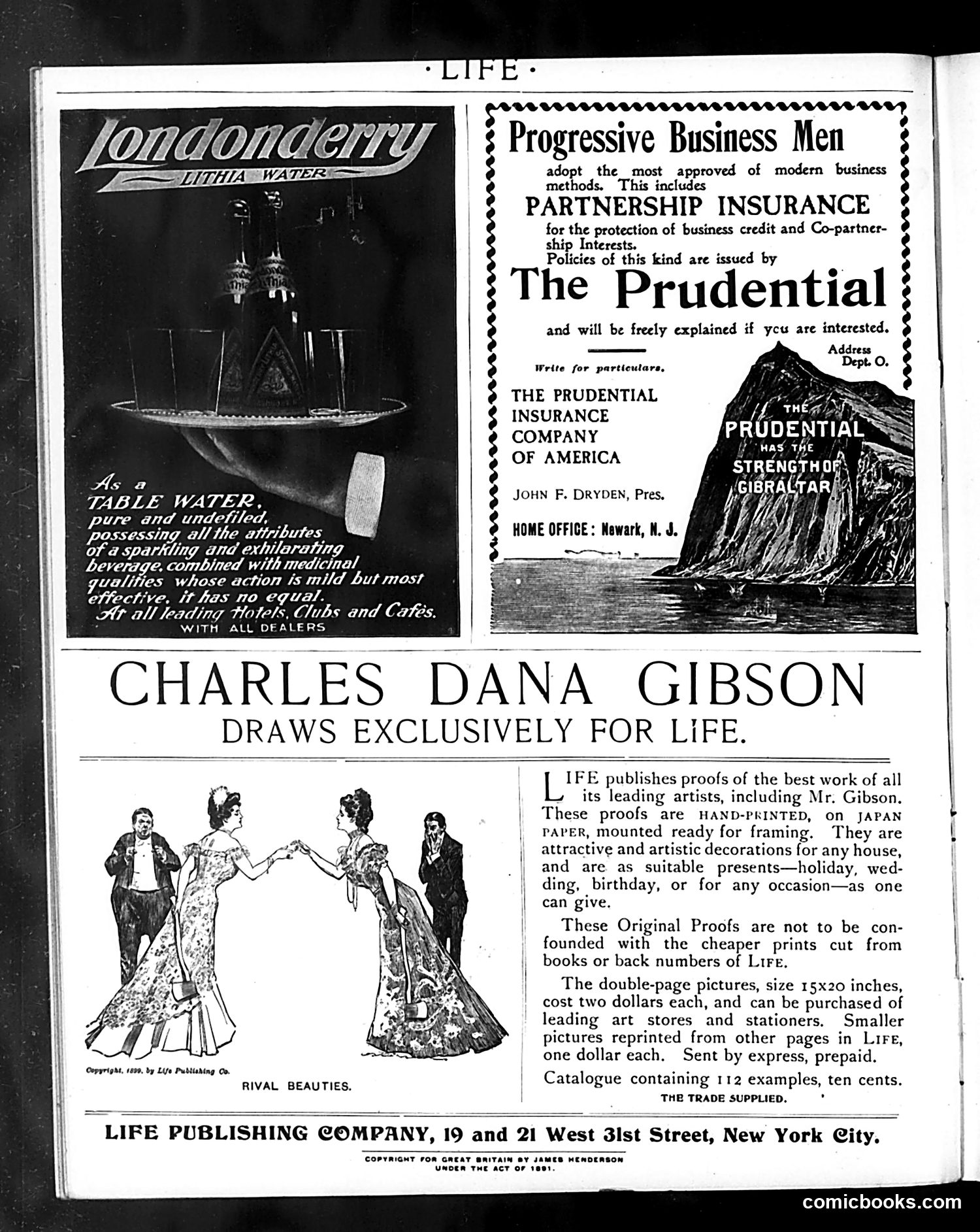
This page is primarily **advertising rather than satirical content**. The top left advertises **Londonderry Lithia Water**, a mineral water marketed as a pure beverage with medicinal properties, available at hotels and cafés. The top right promotes **Prudential Insurance Company**, emphasizing partnership insurance for business protection. Their logo features Gibraltar, symbolizing strength and stability. The main feature advertises **Charles Dana Gibson's artwork** available exclusively through *Life* magazine. Gibson was a renowned illustrator famous for the "Gibson Girl" aesthetic. The image titled "Rival Beauties" depicts four fashionably dressed figures in early 1900s attire—the satire here concerns social competition and idealized femininity rather than political commentary. The advertisement notes these artworks are hand-printed on Japanese paper and sold as framed prints for home decoration.
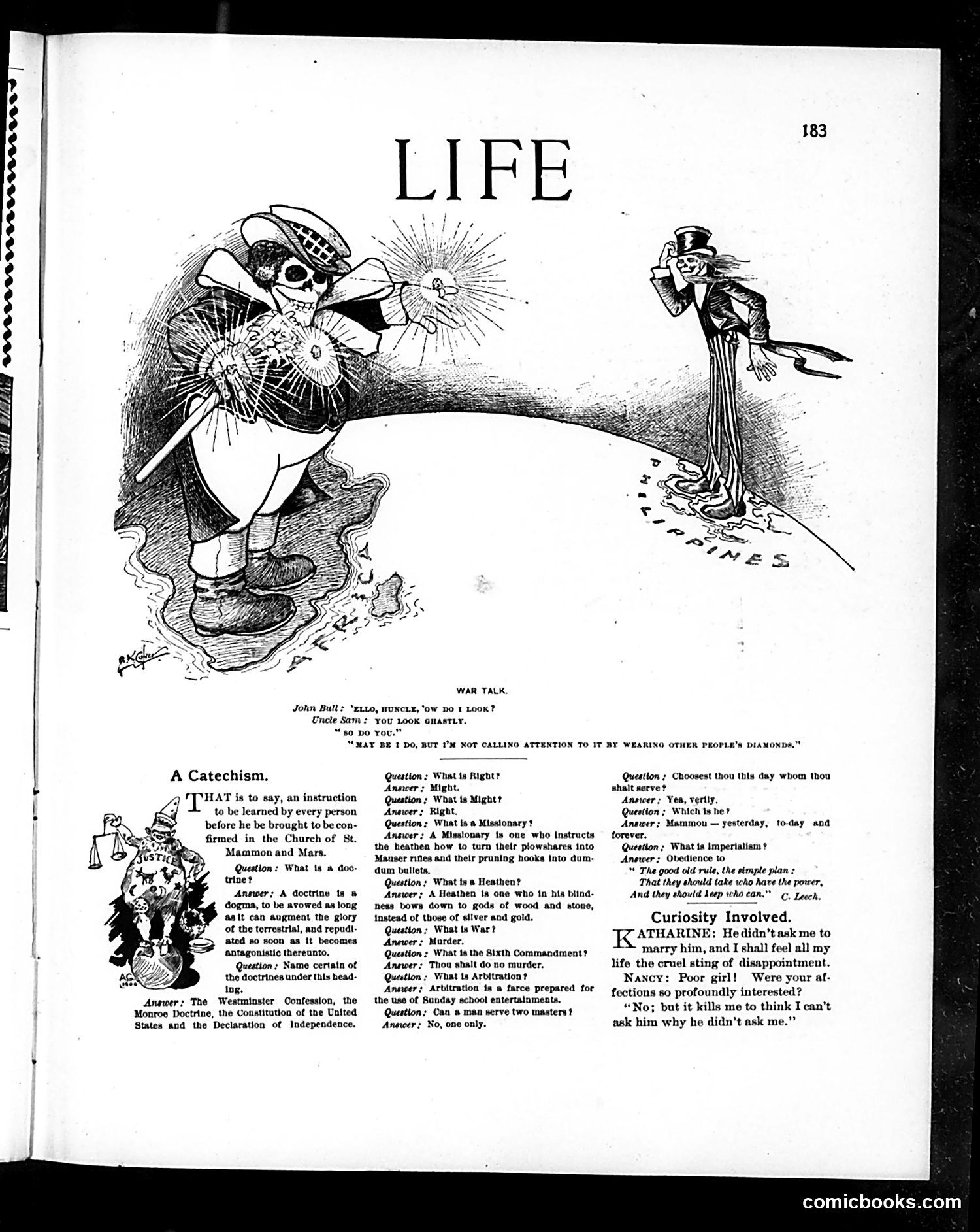
**Top Cartoon ("War Talk"):** This satirizes Uncle Sam's appearance during wartime. John Bull (British personification) comments that Uncle Sam looks "ghastly," and Uncle Sam admits his poor appearance but deflects by claiming it's due to "wearing other people's diamonds"—suggesting America profited from selling weapons or supplies to warring nations rather than direct involvement. **"A Catechism" Section:** This is religious satire using question-and-answer format mimicking catechism lessons. It mocks American institutions by redefining civic concepts: "Heathen" = those without proper national pride; "War" = murder; "Missionary" = one instructing heathens to adopt "pruning books into dominum tablets"—satirizing forced cultural assimilation and missionary work. The content criticizes American hypocrisy regarding neutrality, profiteering, and cultural imperialism.
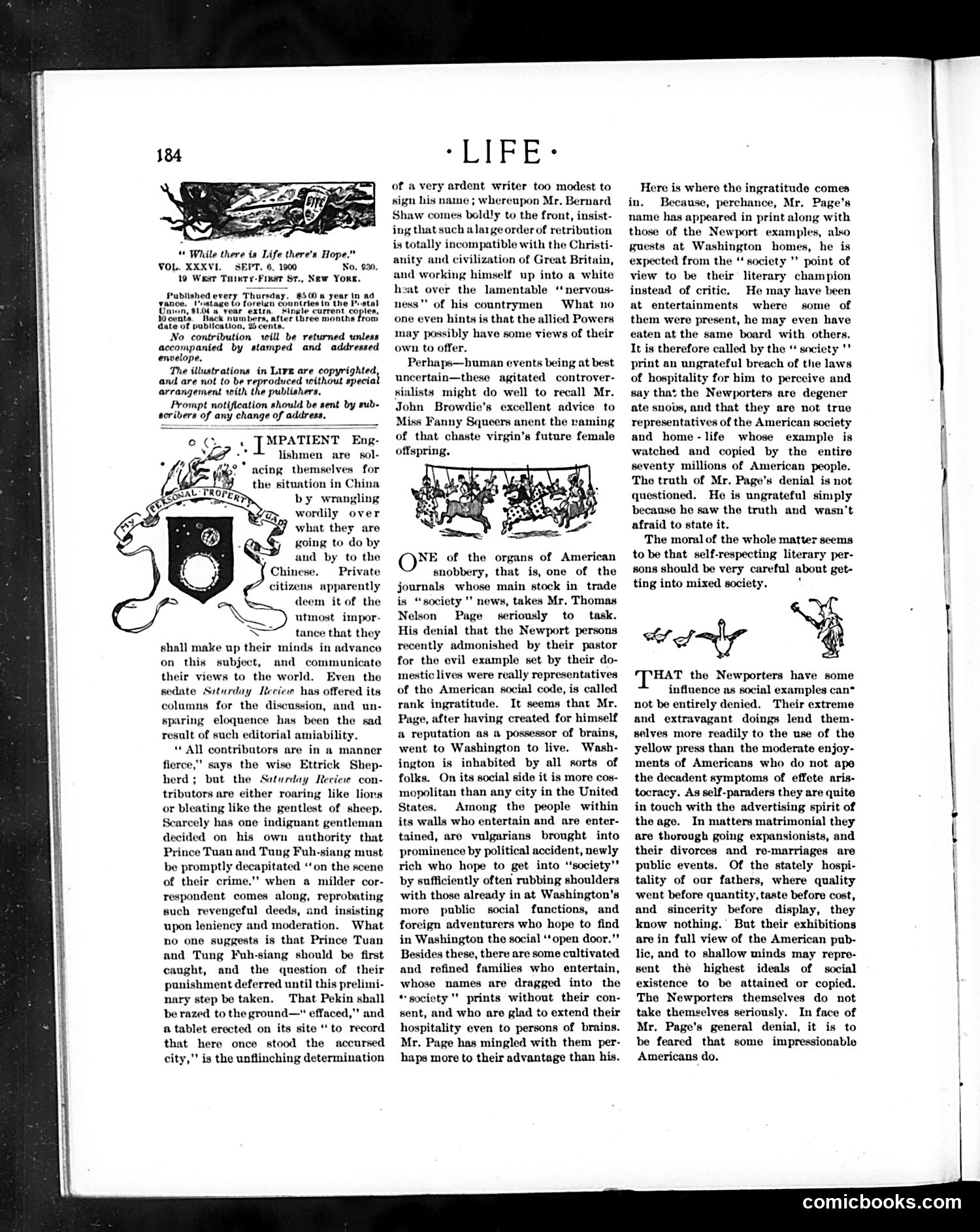
This page contains satirical commentary on American social pretensions, particularly targeting Newport society and journalists covering it. The text attacks Thomas Nelson Page's denial that Newport personalities exemplify American social codes, arguing that Page—despite claiming modesty—has actually promoted himself through association with elite circles. The cartoon (left side) depicts an impatient Englishman observing China, using the figure to satirize foreign perspectives on American society. The main article critiques Newport's wealthy residents for their hollow "society" status and mocks their self-importance. The satire suggests that Newport's elite, including those Page socializes with, represent shallow social climbing rather than genuine cultural contribution. The piece ironically notes these figures take themselves seriously despite lacking substantive achievement beyond wealth and social position.
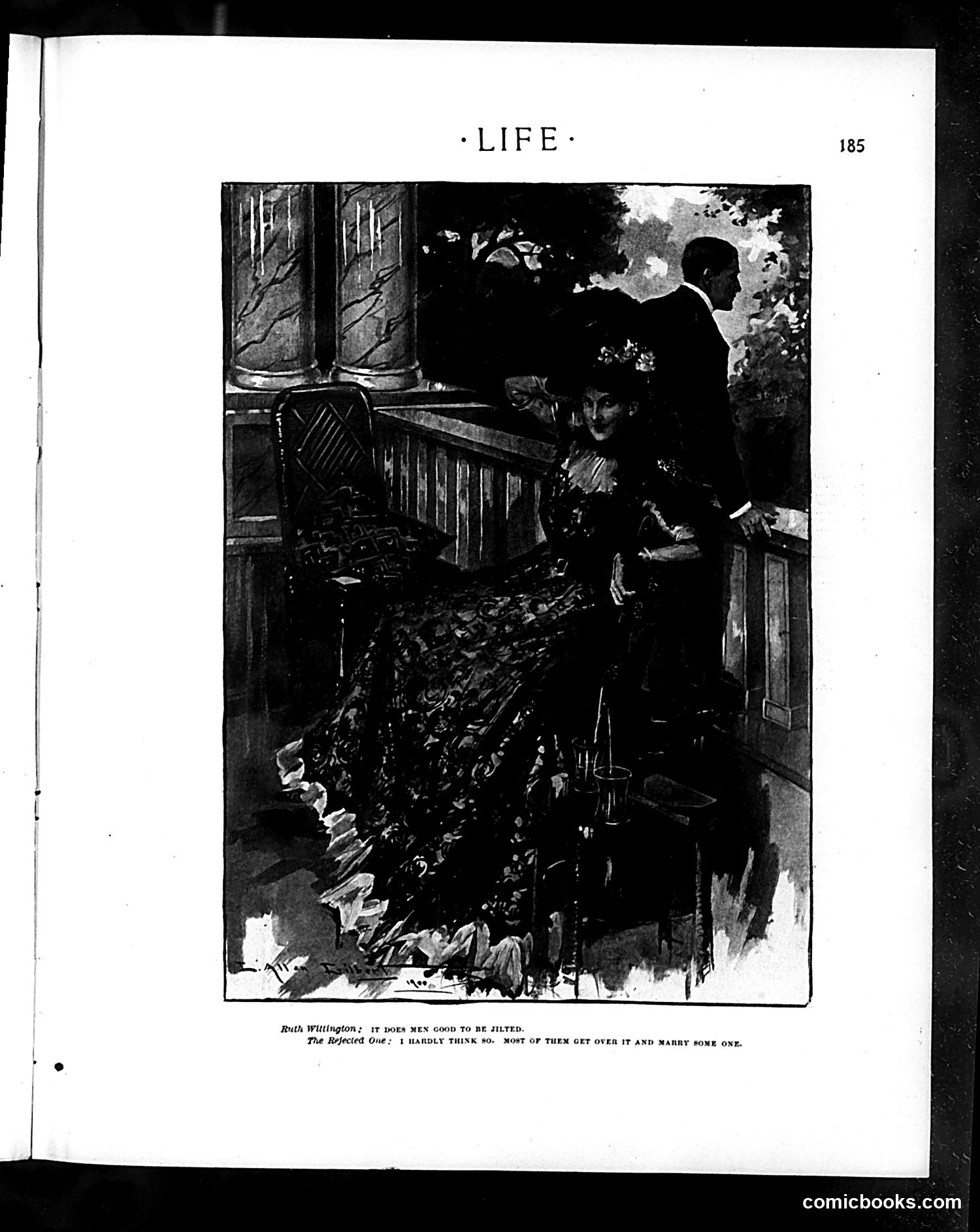
This page features a single illustration by Ruth Willington titled "It Does Men Good to Be Jilted." The scene depicts a romantic rejection: a well-dressed woman in an elaborate dark gown turns away from a suited man in what appears to be an indoor setting, while other figures observe in the background. The caption dialogue reads: "The Rejected One: I Hardly Think So. Most of Them Get Over It and Marry Some One." This is satirical commentary on romantic rejection and courtship customs of the era. The joke appears to mock the common Victorian/Edwardian notion that romantic rejection is devastating, with the rejected suitor's protestations being countered by the suggestion that rejected men typically recover and marry someone else—hardly the tragedy they claim it to be.
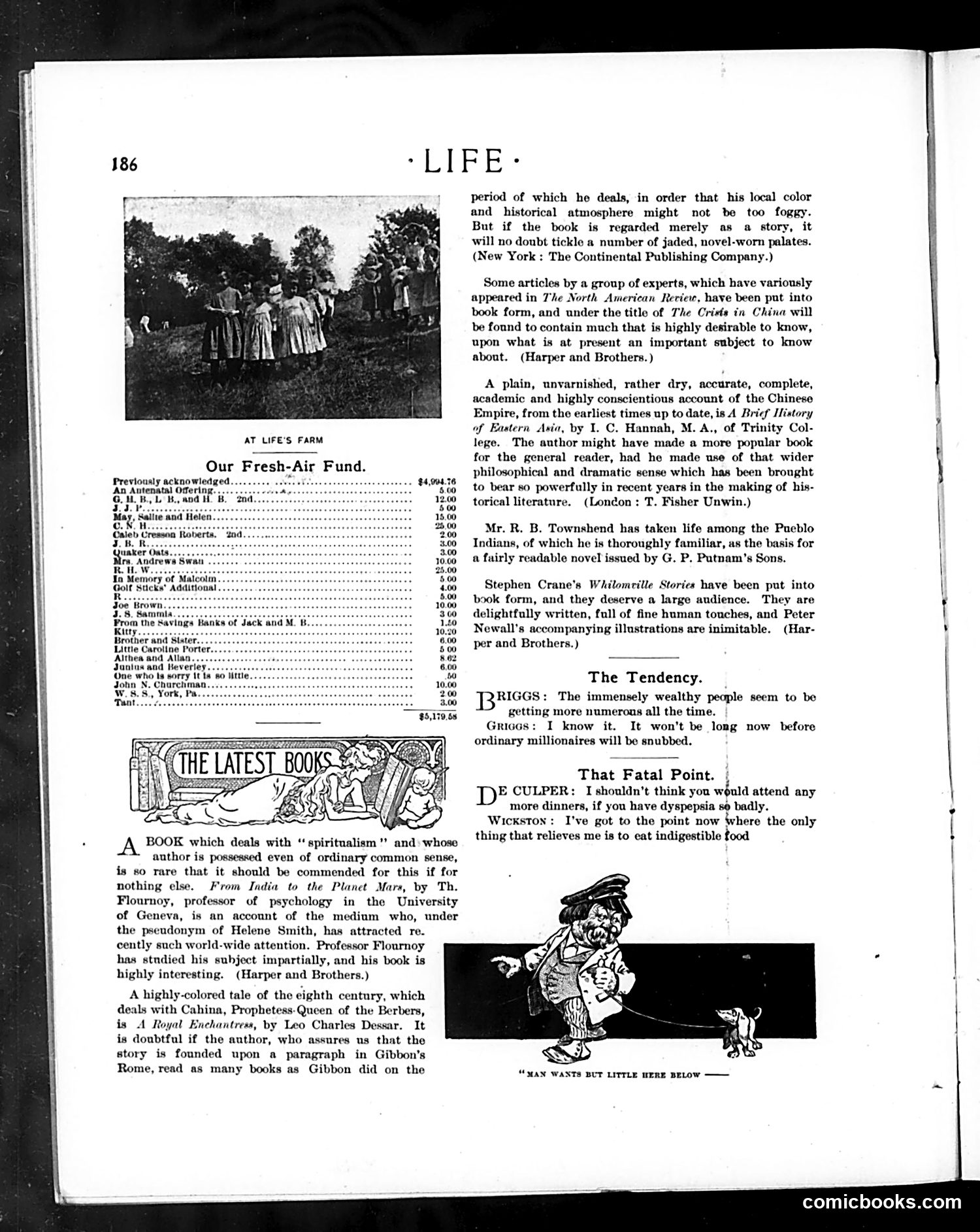
The page contains two distinct comic dialogues rather than traditional political cartoons. **"The Tendency"** features Briggs and Giggles discussing wealth inequality—Briggs notes that "ordinary millionaires" are becoming commonplace, implying social concern about economic stratification during what appears to be a prosperous era. **"That Fatal Point"** depicts De Culper and Wickston discussing dining and digestive health. Wickston jokes that he's reached the point where only indigestible food provides relief, a satirical jab at wealthy men's excessive consumption and resulting dyspepsia—a common complaint among affluent Americans of the era. The accompanying illustration shows a portly gentleman, emphasizing the stereotype of wealthy overindulgence. The humor relies on period anxieties about wealth's physical toll.
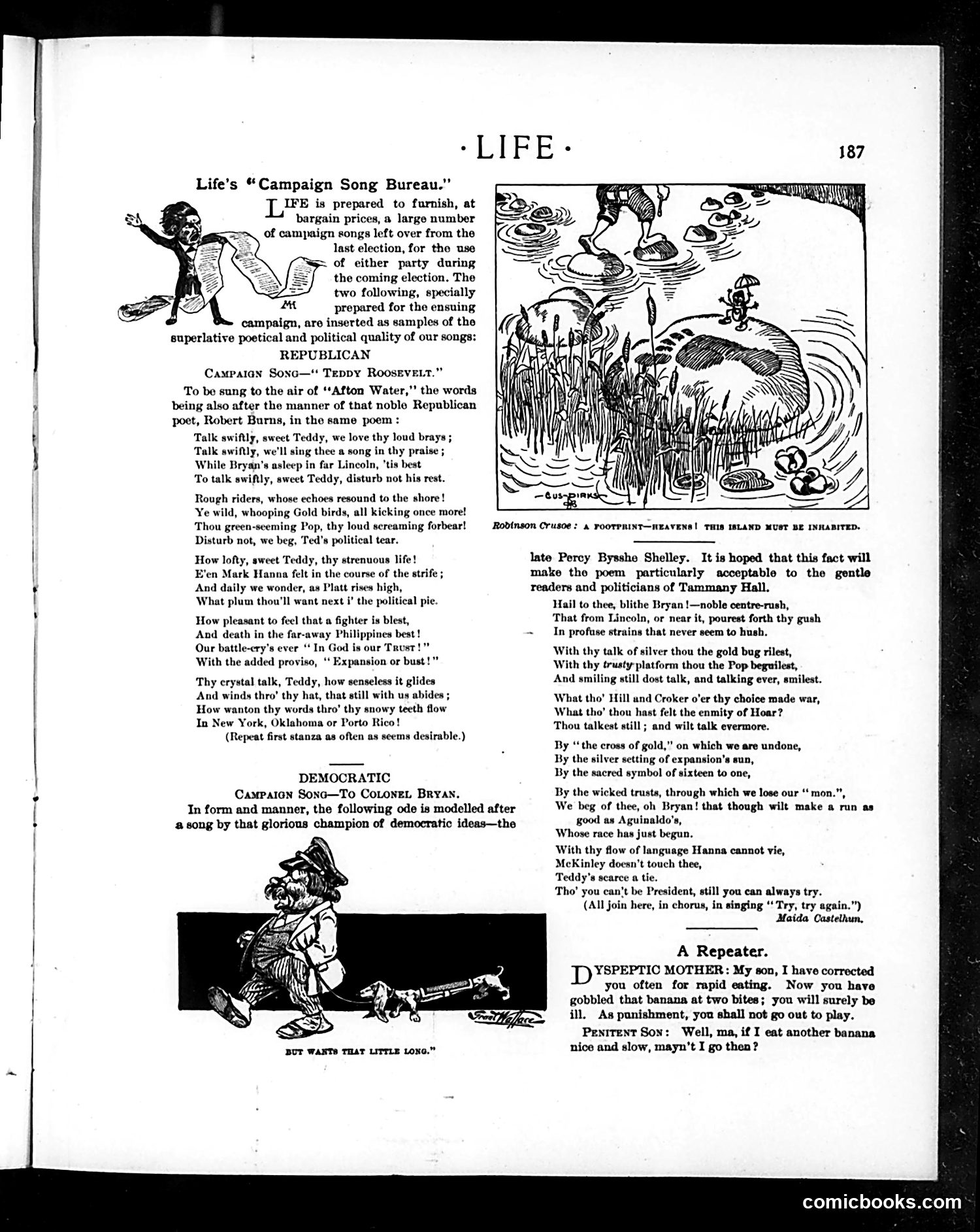
This page showcases campaign songs for the 1908 U.S. presidential election. The Republican song honors **Theodore Roosevelt** ("Teddy Roosevelt"), set to the tune "Afton Water." The text praises Roosevelt as a fighter and warrior, emphasizing his vigor and expansionist policies. The Democratic song targets **Colonel Bryan**, likely William Jennings Bryan, the three-time presidential candidate. The crude caricature labeled "BUT WANTS THAT LITTLE LORD" depicts him unfavorably. The page also includes a woodcut cartoon showing someone surrounded by dishes, titled "A Footprint—Heaven! This Island Must Be Inhabited," which appears to reference colonial/imperial themes common to 1908 political debate. The satirical "Repeater" section mocks parental discipline, using a lighter comedic tone to fill space.
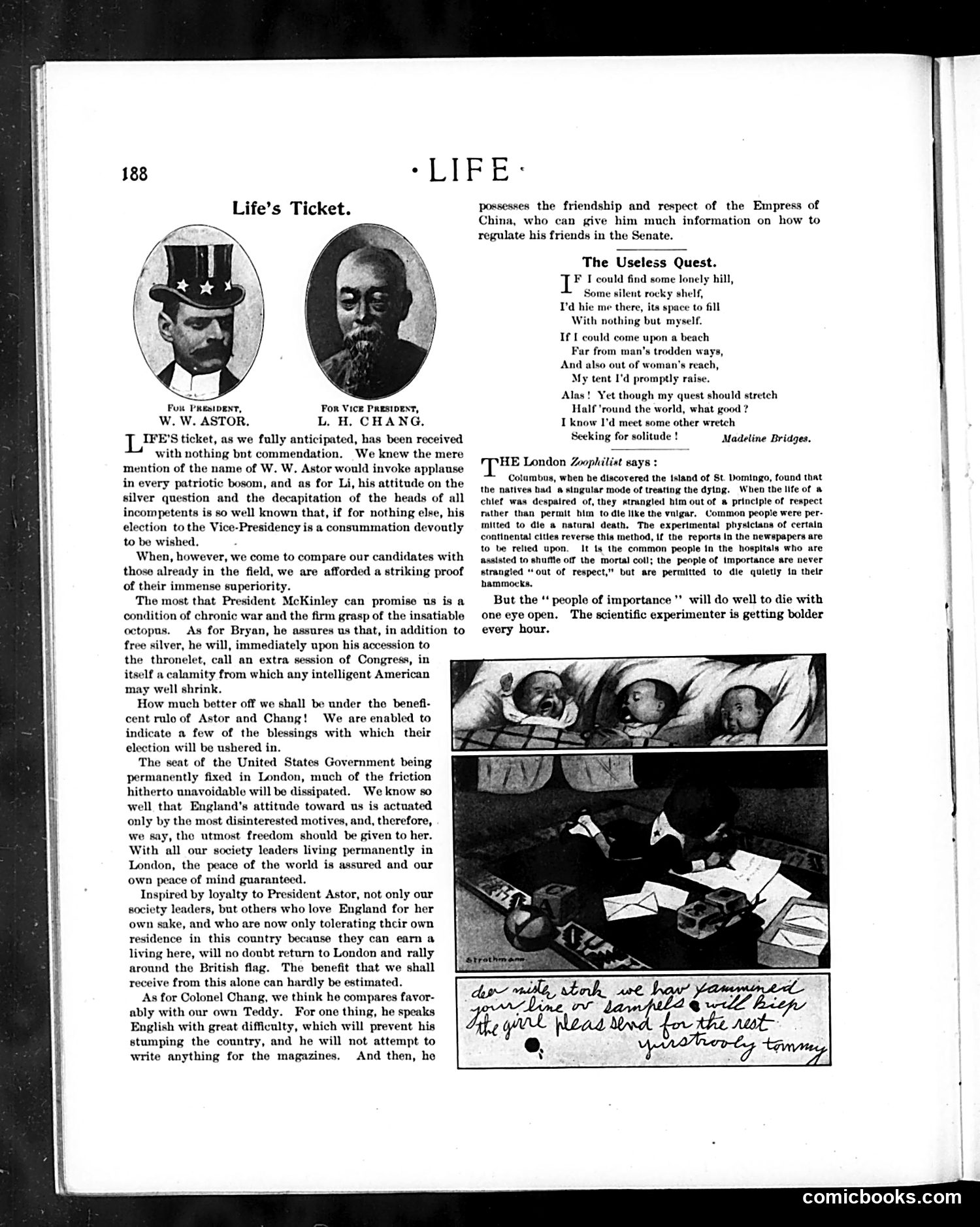
This page satirizes the 1904 U.S. presidential election, presenting "Life's Ticket" with caricatures of W.W. Astor for President and L.H. Chang for Vice President. The satire mocks the actual candidates by suggesting wealthy figures instead—Astor representing American industrial wealth and Chang (likely referencing Chinese interests) representing foreign influence. The text criticizes both major parties' candidates as inferior to these alternatives, sarcastically praising Astor's wealth and Chang's diplomatic connections. The accompanying poem "The Useless Quest" laments the difficulty of finding worthy political candidates. The lower section includes "The London Zoophilist" commentary on questionable scientific practices and a photograph with handwritten caption—likely documenting some contemporary controversy or social issue, though the specific subject is unclear from the image quality.
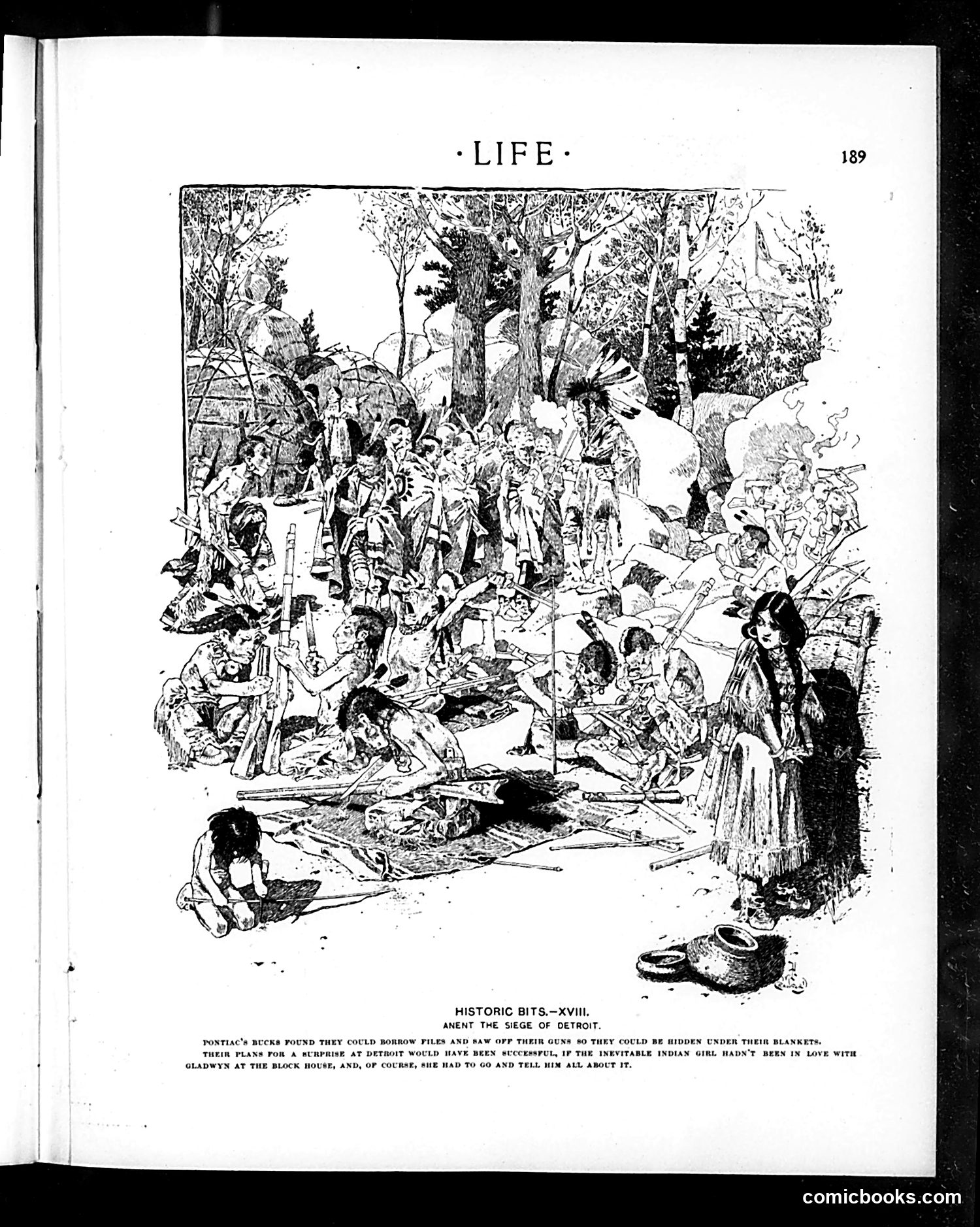
This satirical illustration depicts a scene from the American frontier during what appears to be the War of 1812. The caption references Pontiac's forces borrowing files and gun parts hidden under blankets to stage a surprise attack at Detroit. The narrative joke involves an "inevitable Indian girl" who hadn't fallen in love with Gladwyn at the block house—implying she had to inform him about the plot. The satire mocks both frontier military incompetence and the tired romantic trope of indigenous women betraying their people for European men. The densely packed scene with numerous figures, weapons, and period costume suggests Life magazine's characteristic visual complexity and irreverent humor about historical events.
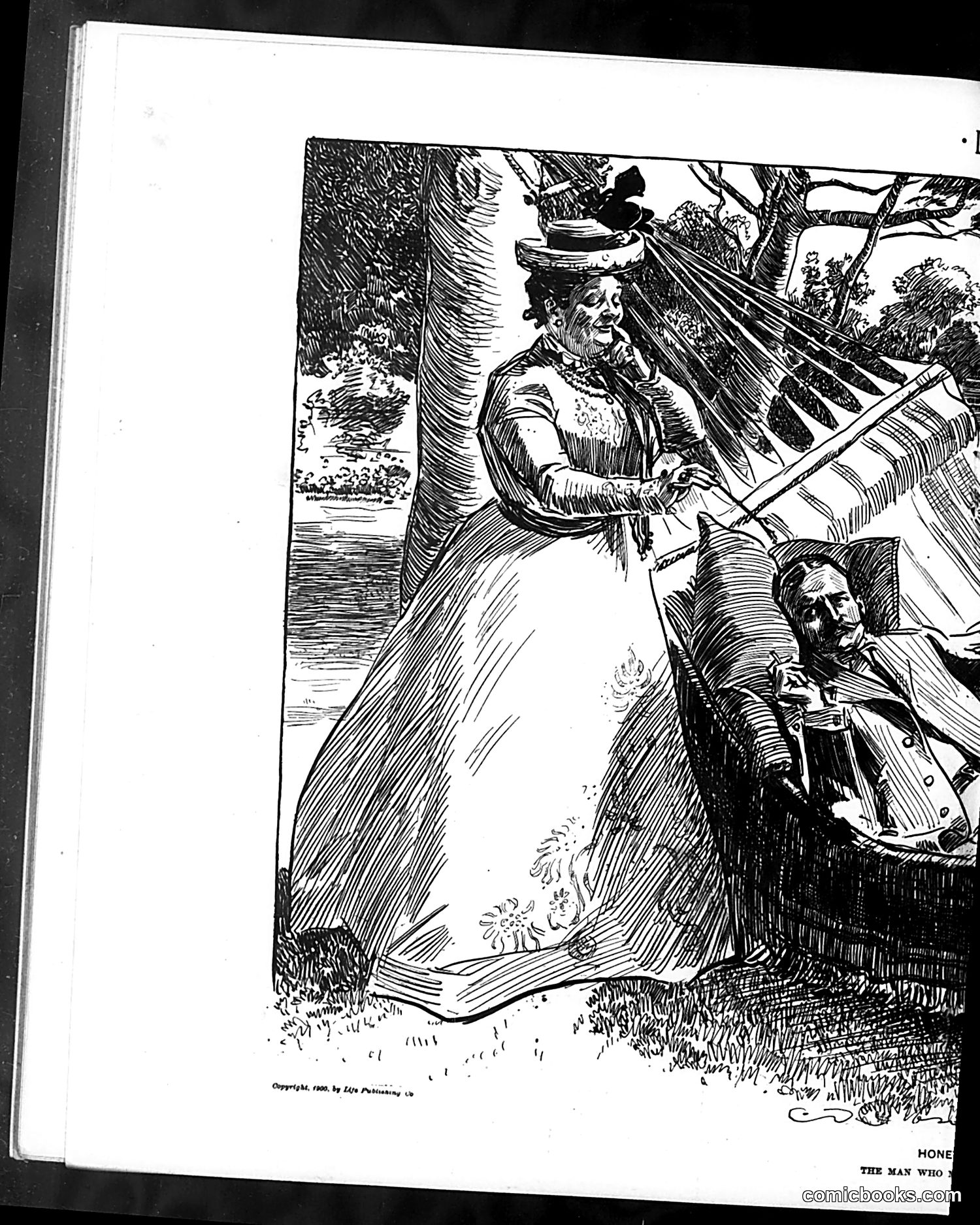
This is a pen-and-ink illustration titled "The Man Who" (text visible at bottom right). The drawing shows a woman in elaborate Edwardian dress and hat standing in what appears to be a boat or seaside setting, gesturing toward a man seated nearby. The style and composition suggest social satire typical of *Life* magazine's early 20th-century content. Without the complete title or caption text, I cannot definitively identify which specific "man" is being referenced or what social commentary the cartoon intends. The elaborate female costume and theatrical pose suggest satire of either courtship dynamics, social pretension, or a specific contemporary figure or scandal. The copyright credit reads "by [artist name], U.S." but is not fully legible. The full context and satirical point remain unclear without additional text.
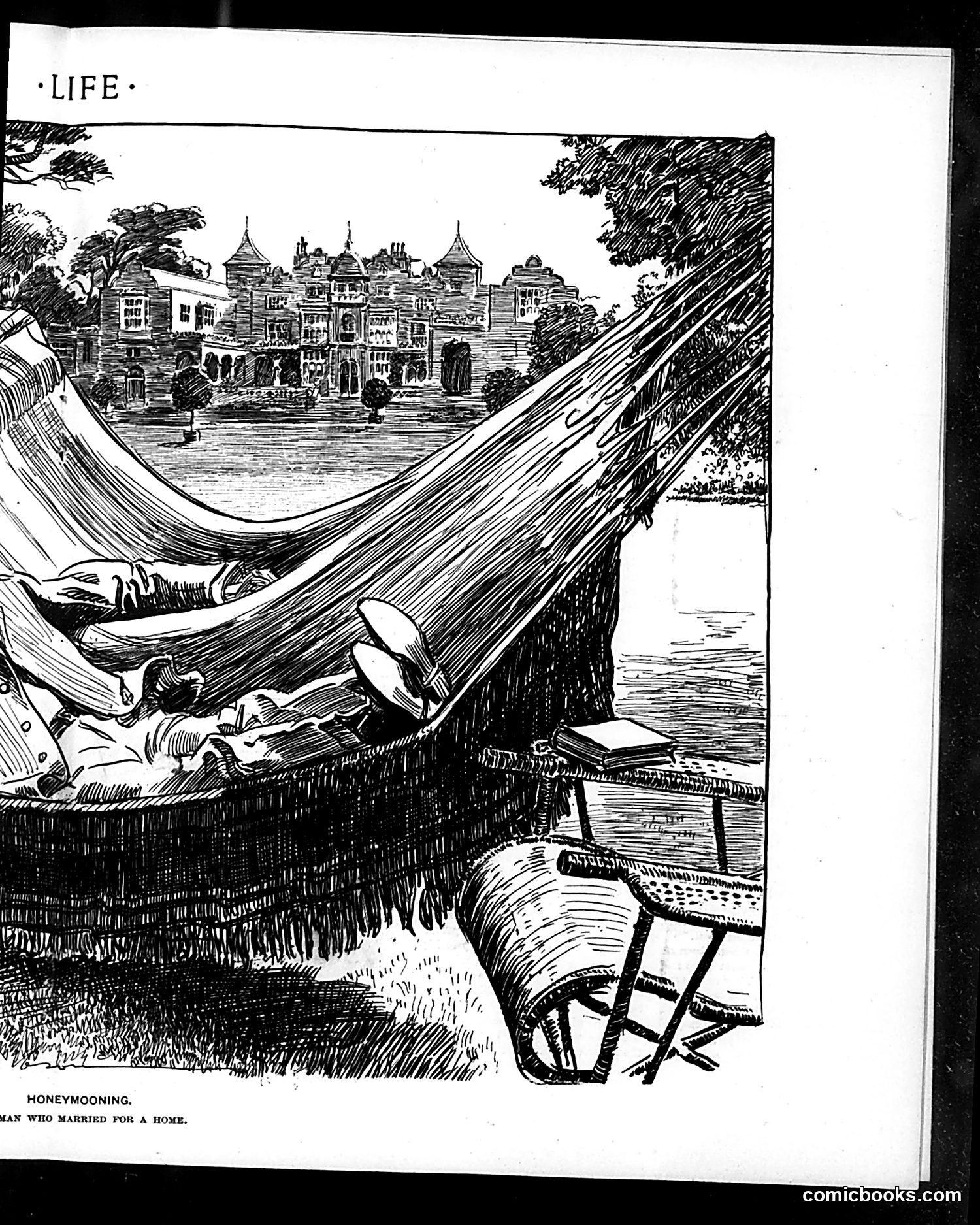
This satirical illustration depicts a newlywed couple in a hammock overlooking a grand castle-like mansion across the water. The caption's subtitle reveals the joke's target: a man who married primarily to gain wealth and property rather than for love. The image contrasts the couple's leisurely romantic setting with the implicit critique that his motivation was materialistic. The elaborate estate in the background serves as both the prize he sought and visual evidence of his mercenary marriage. This was likely commentary on wealthy marriages of convenience common among upper classes, where men married women (or their fortunes) to acquire estates and status. The satire suggests such marriages lack genuine affection.
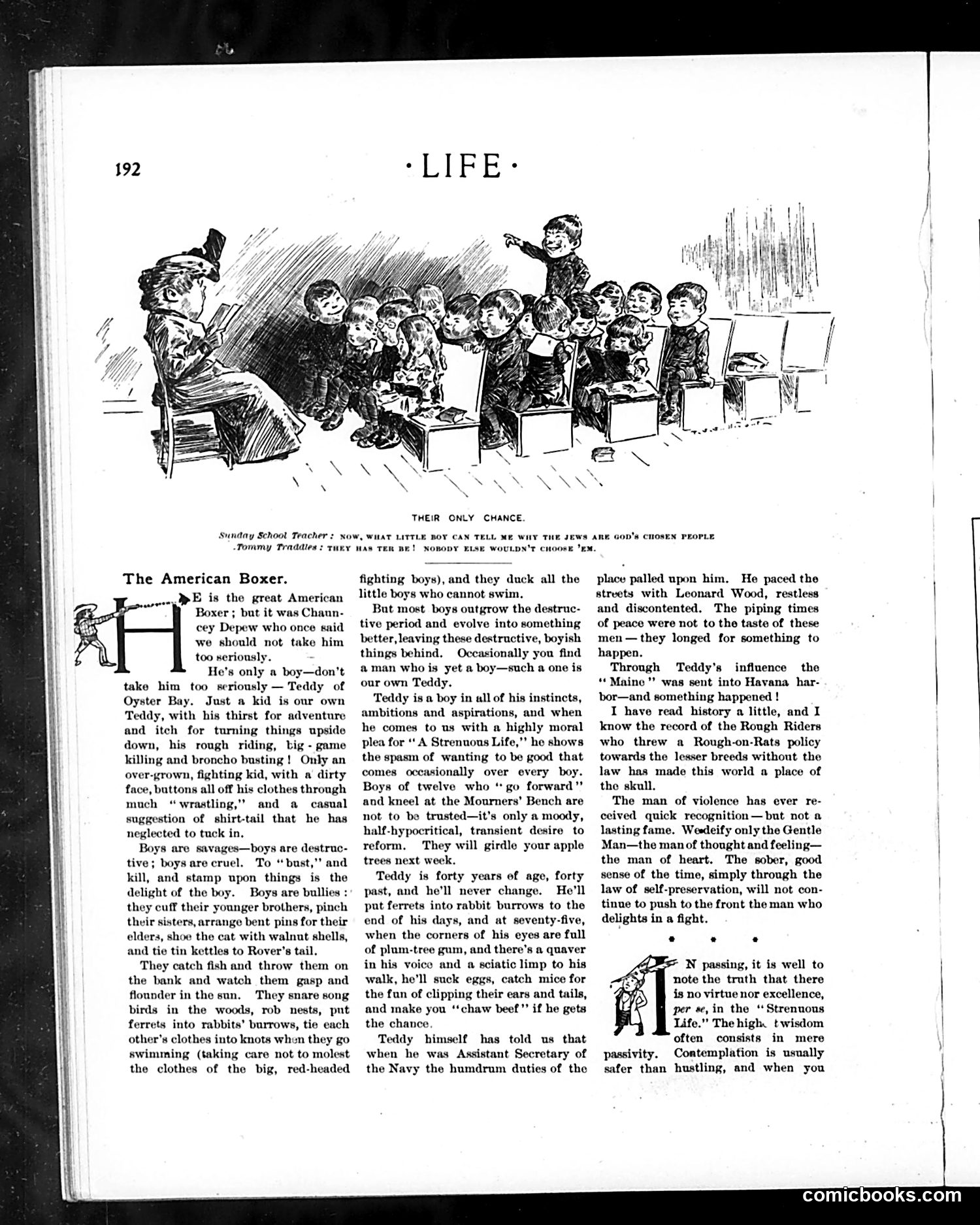
The top cartoon titled "Their Only Chance" depicts a Sunday School teacher instructing young boys about Jewish people being God's chosen people. The caption notes that one boy questions why Jews were chosen when "nobody else wouldn't choose 'em"—expressing antisemitic sentiment. Below, "The American Boxer" article discusses "Toddy," apparently a rambunctious boy-type character. The text satirizes aggressive, destructive boyish behavior—fighting, theft, and general mischief—as supposedly inherent American traits. The article contrasts this with ideals of virtue and restraint, suggesting that unchecked aggression, while celebrated in some circles, produces morally inferior men. Both pieces reflect early 20th-century anxieties about social hierarchy, character formation, and cultural values.
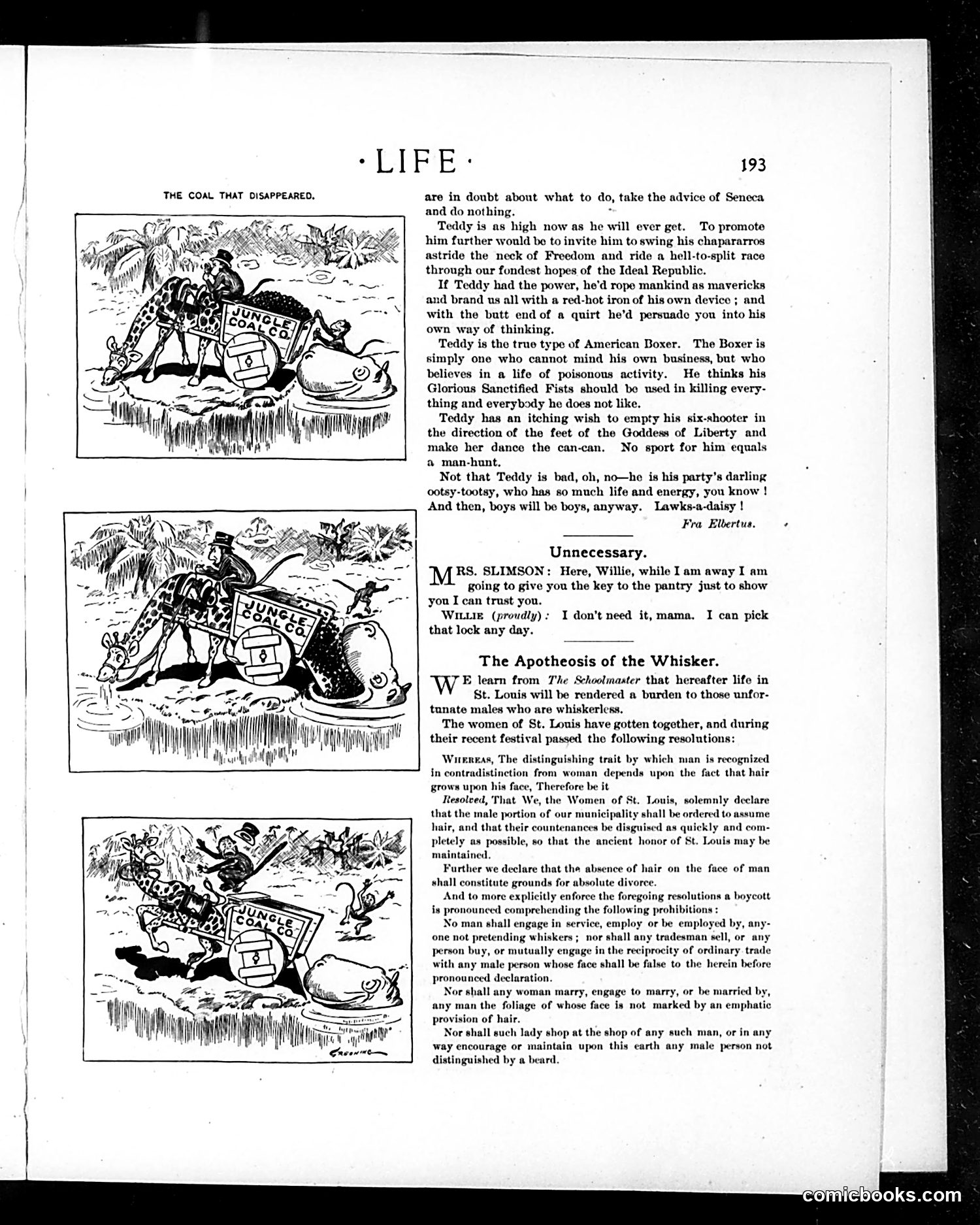
**"The Coal That Disappeared"** (three cartoon panels): This satirical sequence depicts Theodore Roosevelt as a figure labeled "Jungle" (referencing his African safari), shown tumbling or falling. The accompanying text viciously attacks Roosevelt, calling him a dangerous "Boxer" who meddles in others' affairs, wants to kill indiscriminately, and threatens American freedom. The "coal that disappeared" appears to reference a scandal or lost political power—the cartoons show Roosevelt's decline from prominence. **"The Apotheosis of the Whisker"**: A humorous piece from St. Louis where women passed mock resolutions requiring all men to grow beards/whiskers, threatening boycotts and divorce against clean-shaven men. This satirizes both women's activism and absurd municipal ordinances. **"Unnecessary"**: A brief joke about a boy who boasts he can pick the pantry lock, undermining his mother's trust. The page reflects early 20th-century American political satire attacking Roosevelt's interventionist foreign policy and activism.
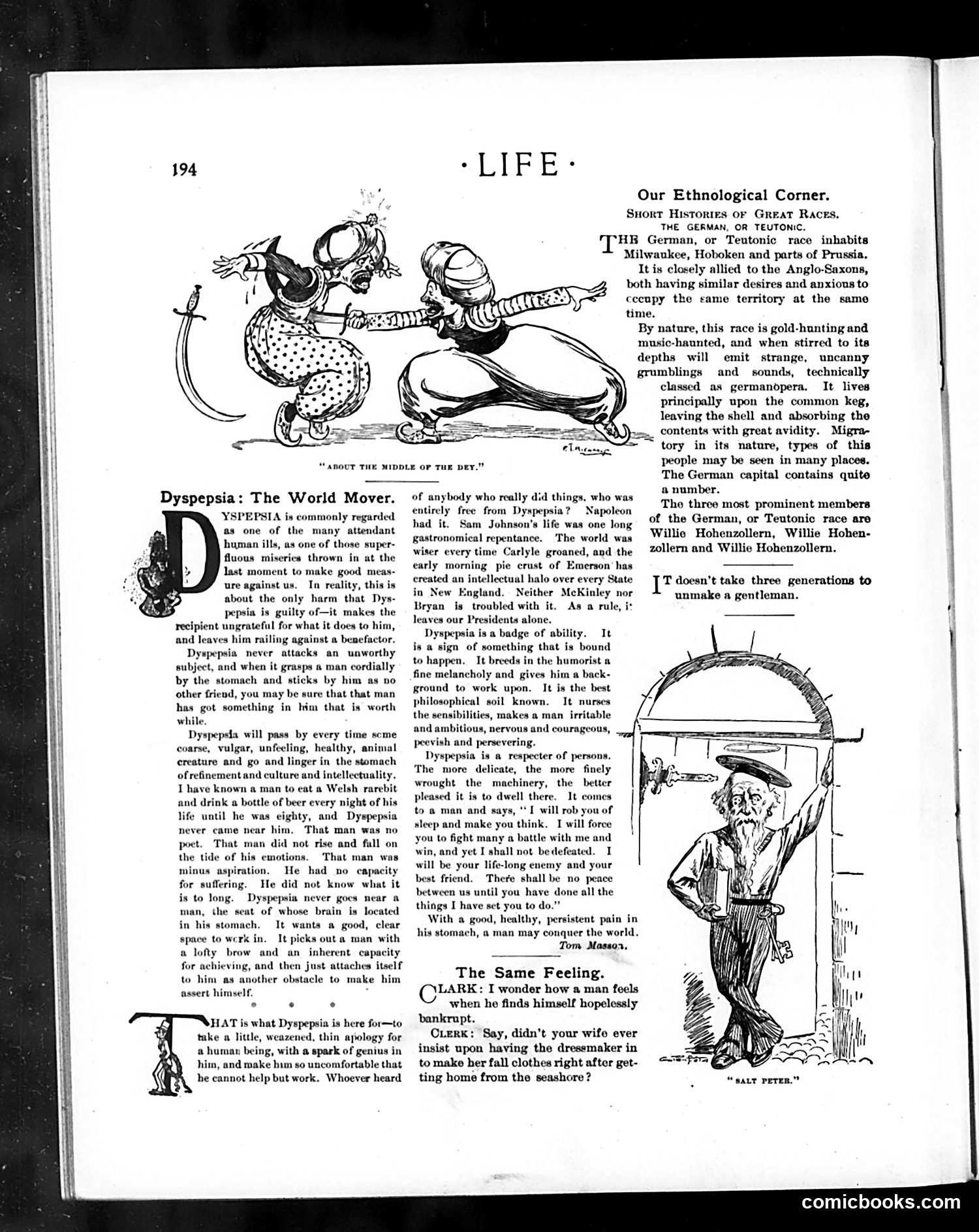
This page contains three distinct satirical pieces: **"Dyspepsia: The World Mover"** — A lengthy essay-article arguing that indigestion/dyspepsia is actually a mark of genius and ambition. The satire claims dyspepsia only afflicts intellectually superior people (naming Napoleon, Carlyle, Emerson) and drives achievement. The piece humorously inverts a common complaint into a badge of honor, suggesting that suffering from digestive troubles indicates one possesses "something worth while." The illustrations show figures in discomfort. **"Our Ethnological Corner"** — A brief, crude ethnic stereotype piece about Germans/Teutonics living in Milwaukee and Hoboken, describing them as gold-hunting and music-loving. This appears to be standard period ethnic humor, though the text cuts off. **"The Same Feeling"** — A short joke where a clerk compares a man's bankruptcy to his wife insisting on new dressmaker-made fall clothes immediately after returning from vacation—implying wives' spending habits create financial ruin equal to actual bankruptcy. All three pieces use exaggeration and inversion for satirical effect typical of early-1900s American humor magazines.
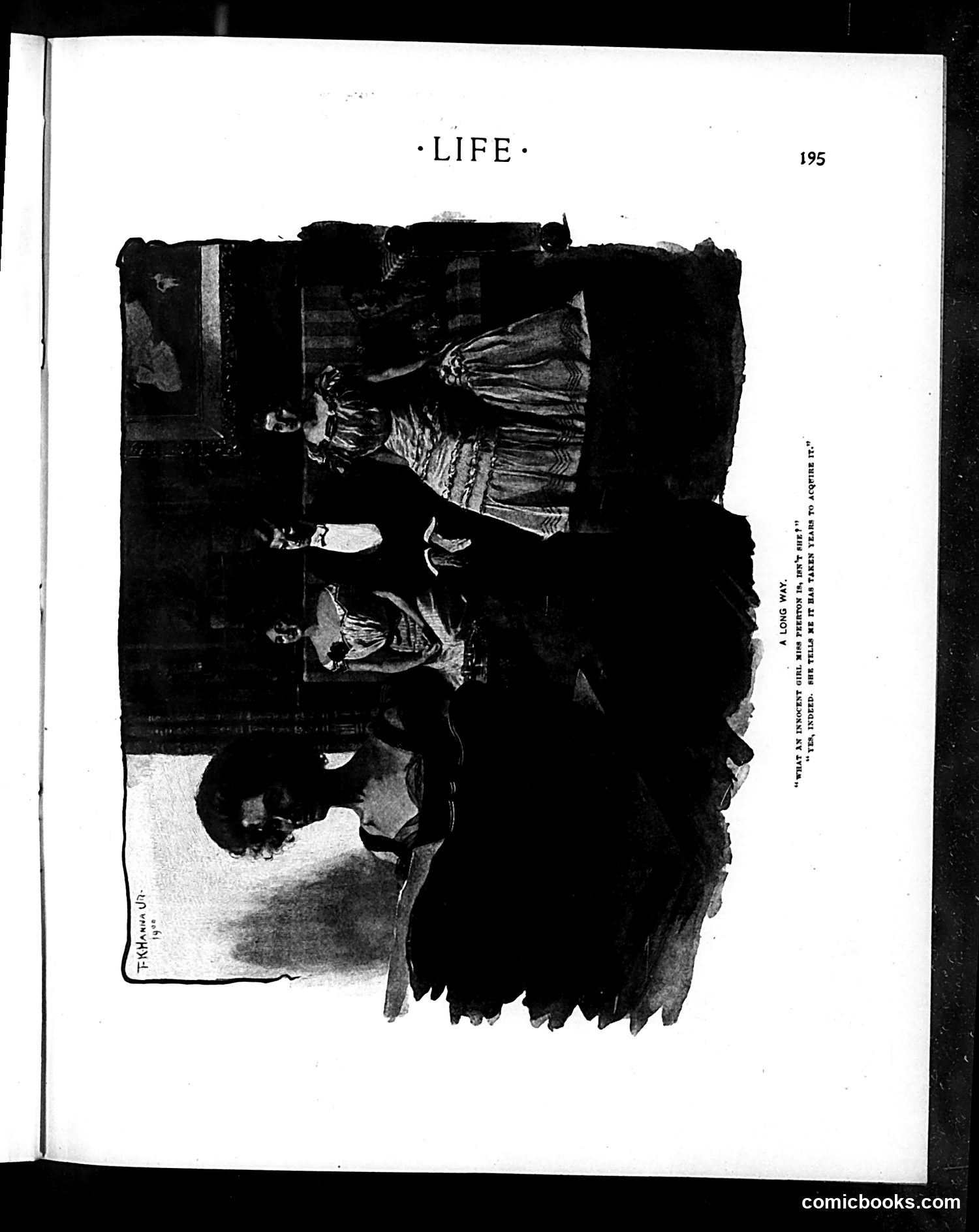
I can see this is page 195 from Life magazine, but the OCR text is largely garbled and illegible, making it impossible to read the actual caption or article. The image itself appears to be a dark, dramatic illustration or photograph showing figures in what looks like an interior scene, but the image quality and contrast make it difficult to discern clear details about specific characters or their identities. Without legible text explaining the context, I cannot reliably identify what political or social commentary this cartoon/illustration was meant to convey, who the figures represent, or what events it references. To accurately explain this page's meaning to a modern reader would require either clearer source text or additional context about the publication date and surrounding material.
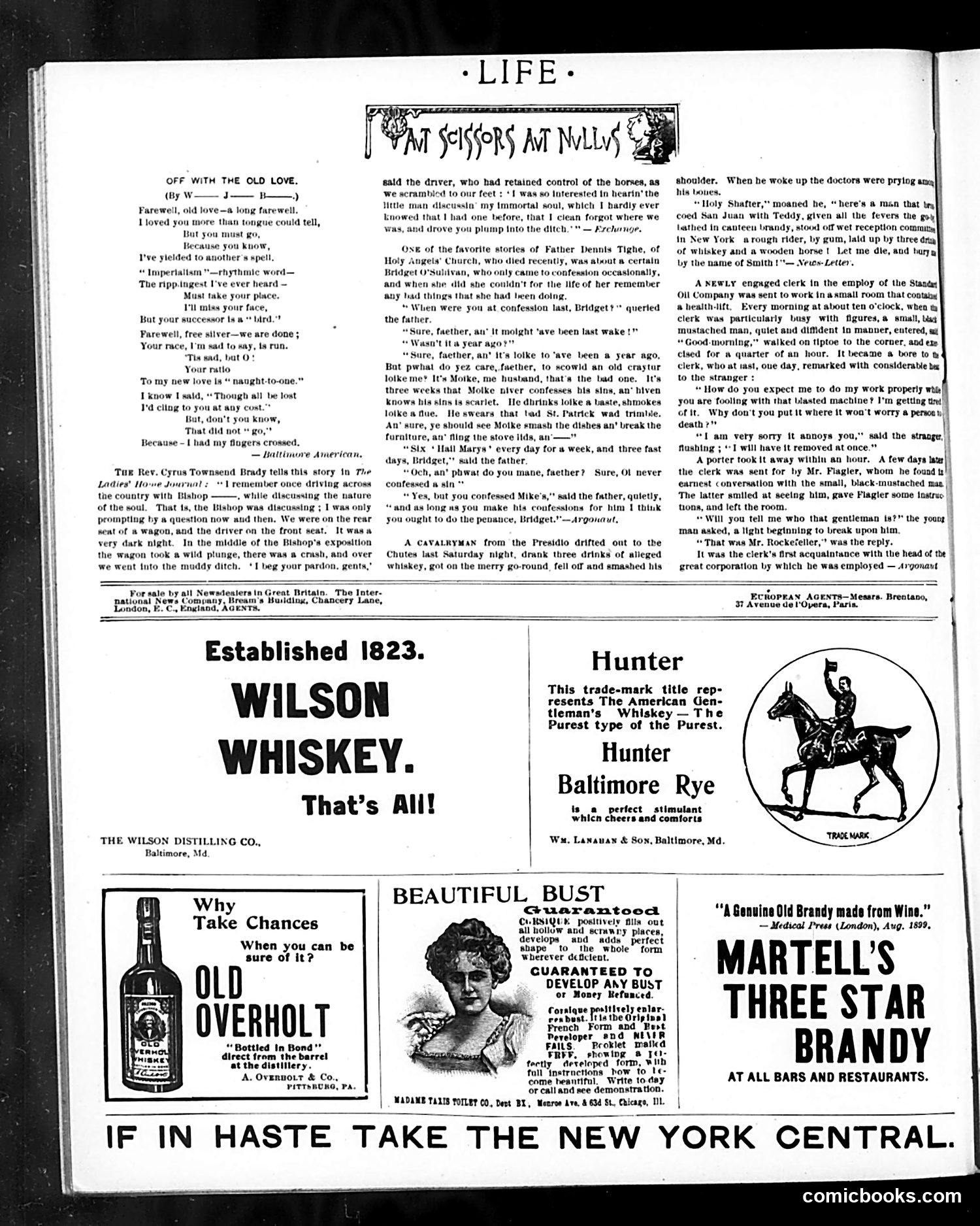
This page is primarily **advertising and humorous anecdotes**, not political cartoons. The main content includes: **"Off With the Old Love"** — A poem (appears by W. J—n—) using romantic language as extended metaphor for abandoning "free silver" currency policy in favor of the gold standard. References like "Your ratio / To my new love is 'naught-to-one'" satirize late-1890s monetary debate. **Three humorous stories** featuring priests, drivers, and military personnel—typical Life magazine humor of the era, relying on dialect comedy and situational irony rather than political commentary. **Advertisements** dominate the lower half: Wilson Whiskey (established 1823), Hunter Baltimore Rye, Old Overholt whiskey, bust-development products, and Martell's Three Star Brandy. The page reflects turn-of-century American attitudes: casual use of Irish dialect for comedy, alcohol advertising prominence, and monetary policy as popular satirical subject matter.
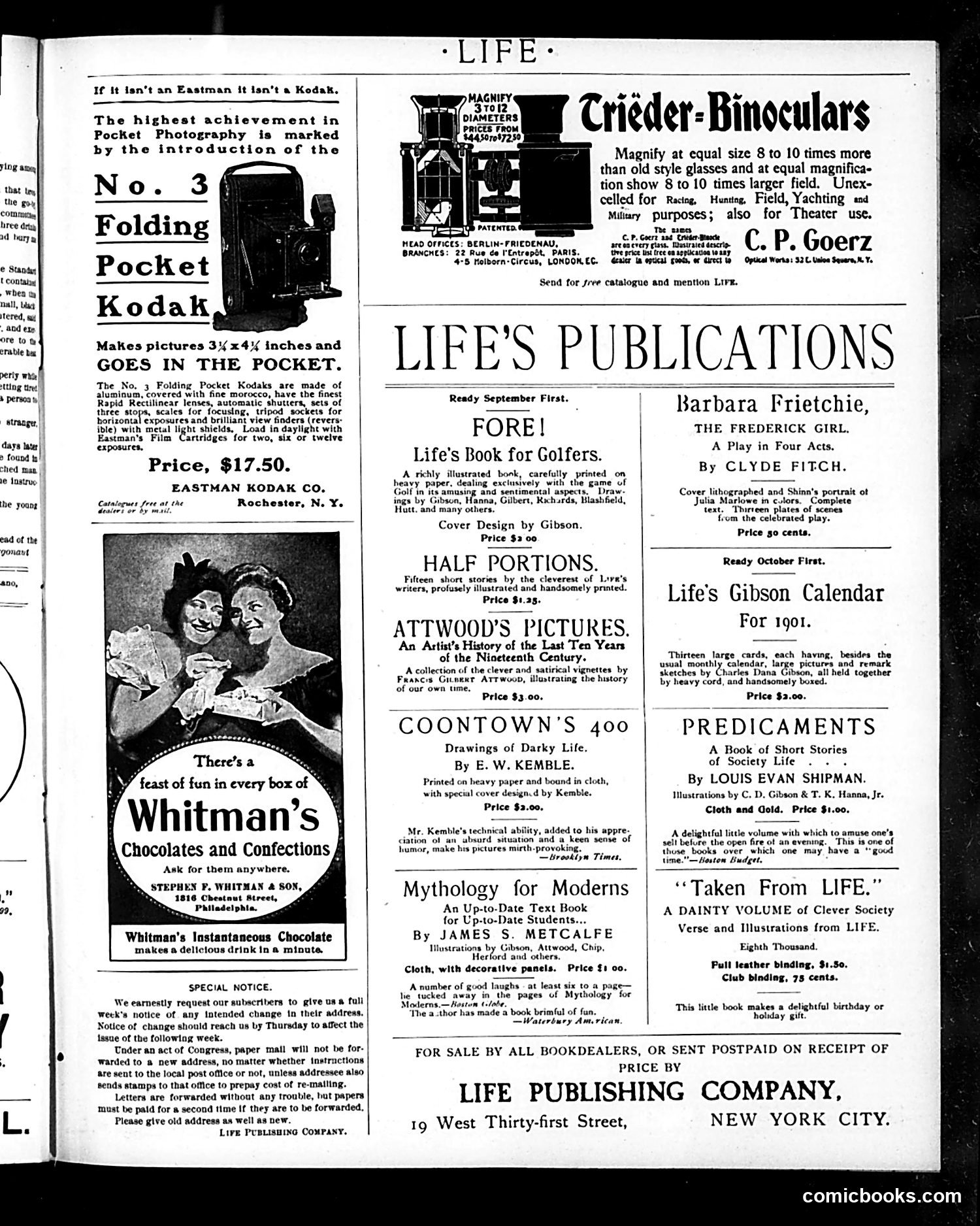
This is primarily an **advertising and publications page** from Life magazine, not a political cartoon page. The content consists of product advertisements and promotional announcements for Life's own published books. **Key advertisements include:** - Eastman Kodak's folding pocket camera ($17.50) - Crieder binoculars for hunting and theater use - Whitman's chocolates and confections **Life Publishing Company promotions feature:** - "Fore!" — Life's Book for Golfers (illustrated) - "Coontown's 400: Drawings of Darky Life" by E.W. Kemble (a period-appropriate but now offensive title reflecting contemporary minstrelsy traditions) - Books by Gibson, Attwood, and others The page reflects early 1900s consumer culture and Life's role as both satirical magazine and publisher of illustrated gift books. The "Coontown's 400" title, while jarring to modern readers, was standard commercial humor of the era, though it perpetuated racial stereotypes common in that period's entertainment.
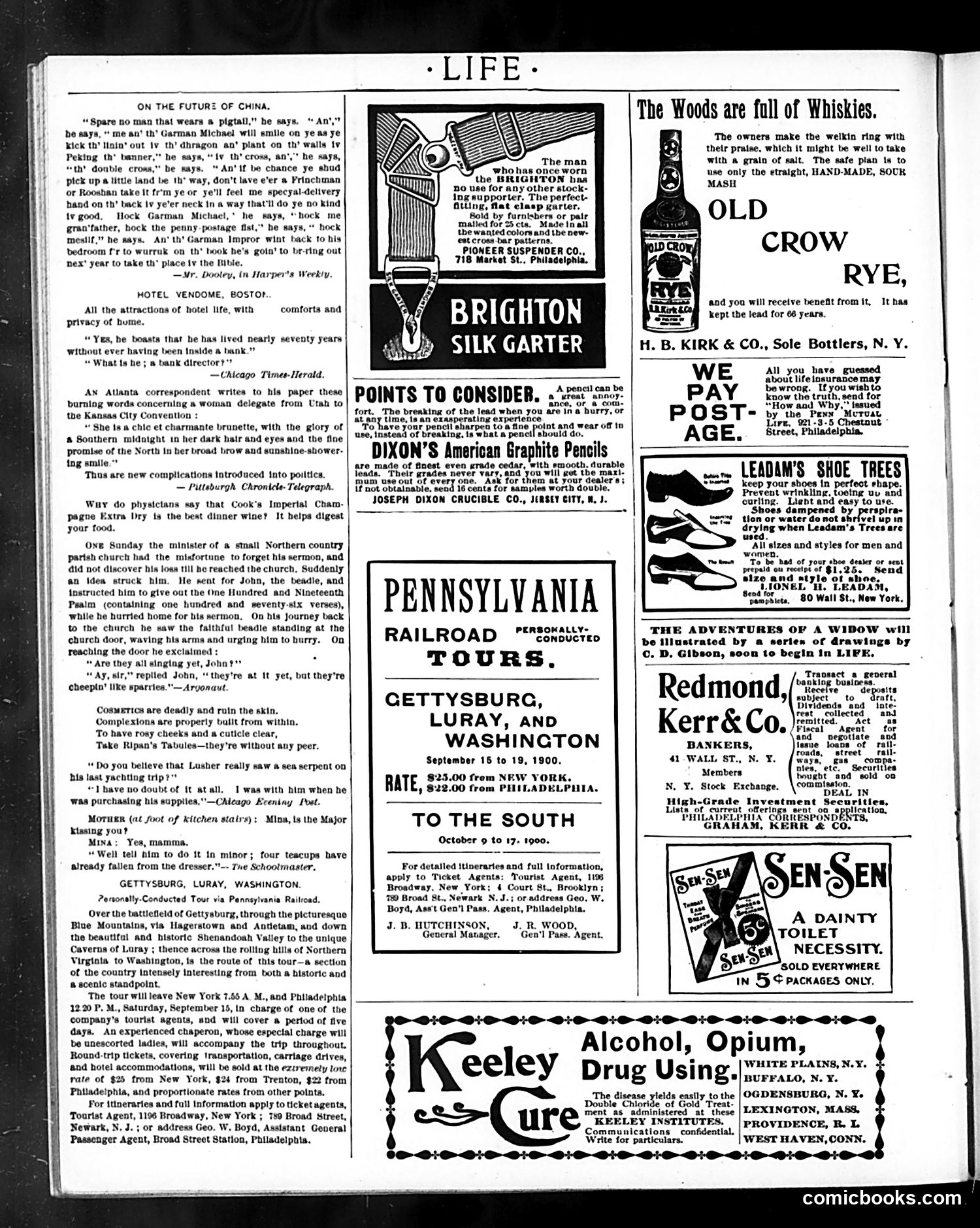
This page is primarily **advertisements and humorous social commentary**, not political cartoons. The main content includes: **"On the Future of China"** — A satirical piece (attributed to "Mr. Dooley," a popular Irish-American character) mocking imperialist rhetoric about China. The speaker uses exaggerated dialect to parody Western powers (Germany, Russia, France) dividing China and threatening each other over territorial gains, presenting the whole colonial enterprise as absurd bravado. **Humor snippets** throughout mock: - A banker who's never entered a bank (implying bankers are fraudulent) - A woman delegate's appearance being discussed as political news - A confused minister and beadle **Advertisements** dominate the right half: Dixon pencils, Pennsylvania Railroad tours, Old Crow whiskey, shoe trees, and notably a **"Keeley Cure"** for alcohol and drug addiction—reflecting period concerns about substance abuse. The page reflects **1900 attitudes**: imperialist cynicism, gender curiosity, and acceptance of dubious medical/chemical products as normal commerce.
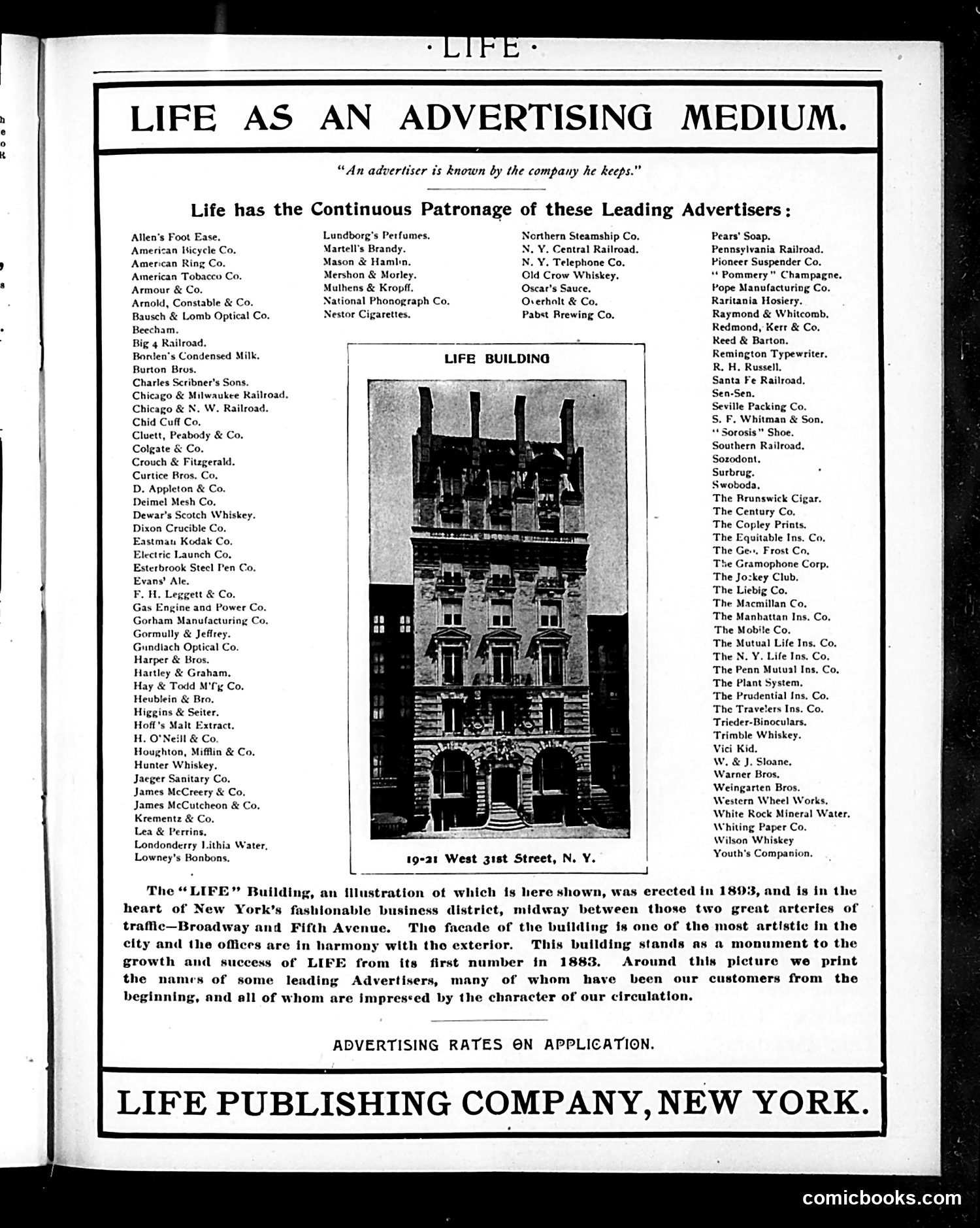
This is not a cartoon or satirical content—it's a **self-promotional advertising page** from *Life* magazine itself. The page showcases the *Life* Building (erected 1893) located on West 31st Street in Manhattan, positioned prominently between Broadway and Fifth Avenue. The accompanying text emphasizes the building as "a monument to the growth and success of LIFE from its first number in 1883." The real content is the **extensive advertiser list** surrounding the building image. This serves two purposes: (1) to demonstrate *Life*'s commercial success and prestige by listing major national brands (railroads, whiskey, soap, insurance companies, typewriters), and (2) to validate the magazine's reach and influence to potential advertisers. The opening motto—"An advertiser is known by the company he keeps"—implies that prestigious brands advertising in *Life* reflect well on the magazine's credibility and circulation quality. This is *Life* essentially saying: major corporations trust us, so should you.
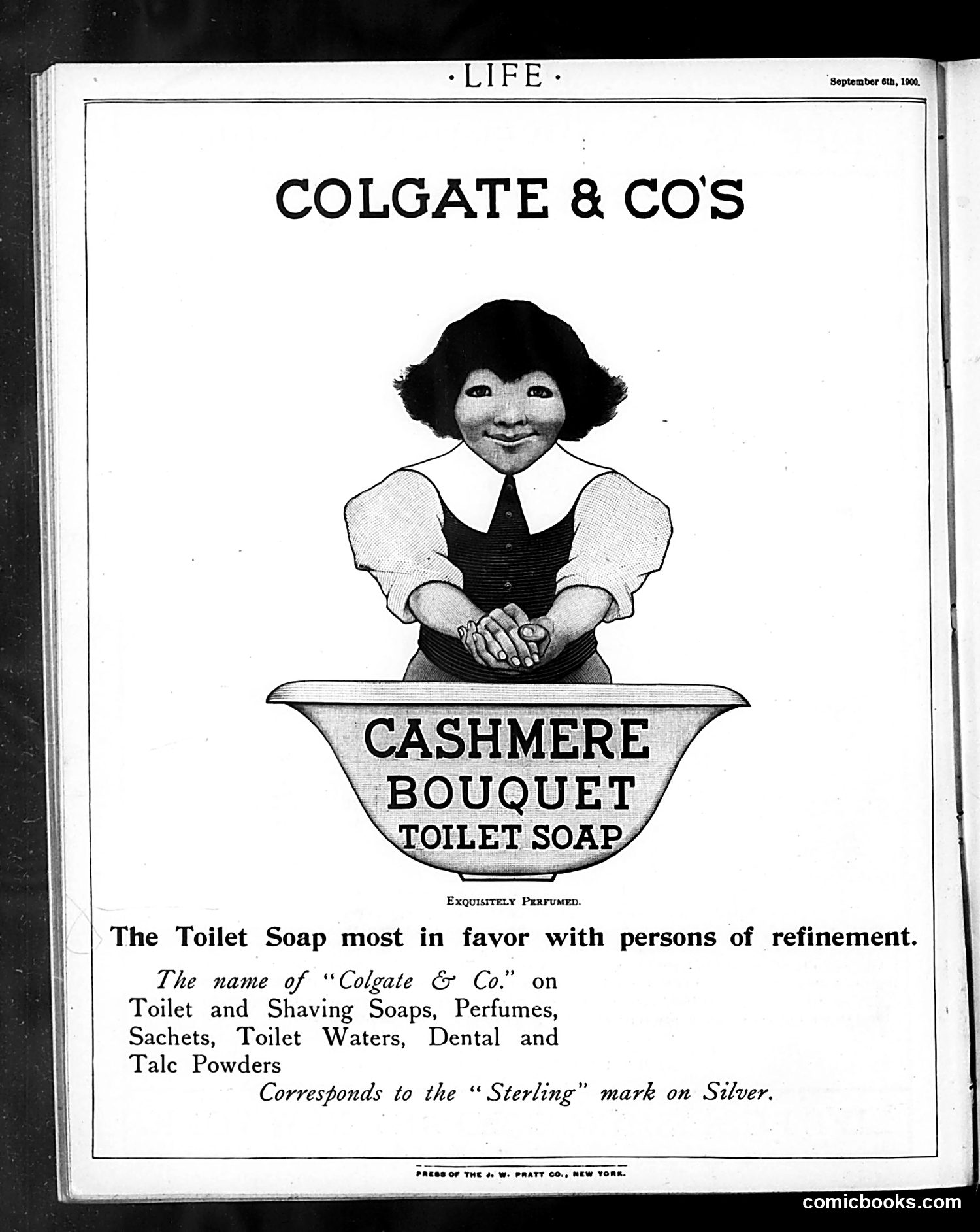
This is a **full-page advertisement** for Colgate & Co.'s Cashmere Bouquet Toilet Soap from *Life* magazine (September 6, 1906). The illustration features a stylized female figure with an exaggerated, cartoonish face emerging from or positioned above a decorative soap dish. The image is not satirical commentary but rather **product advertising** using the visual style common to early 1900s marketing. The ad's appeal targets "persons of refinement" and employs luxury language ("Exquisitely Perfumed," "Sterling" mark comparison) to position the soap as a status symbol. The cheerful, somewhat caricatured face serves as a brand mascot meant to make the product memorable and approachable. This represents typical early advertising in *Life*, which—while primarily a humor magazine—carried substantial paid advertisements that often blended commercial messaging with the period's visual aesthetic.