
Life, 1900-09-06 · page 6 of 20
Life — September 6, 1900 — page 6: what you’re looking at
What you’re looking at
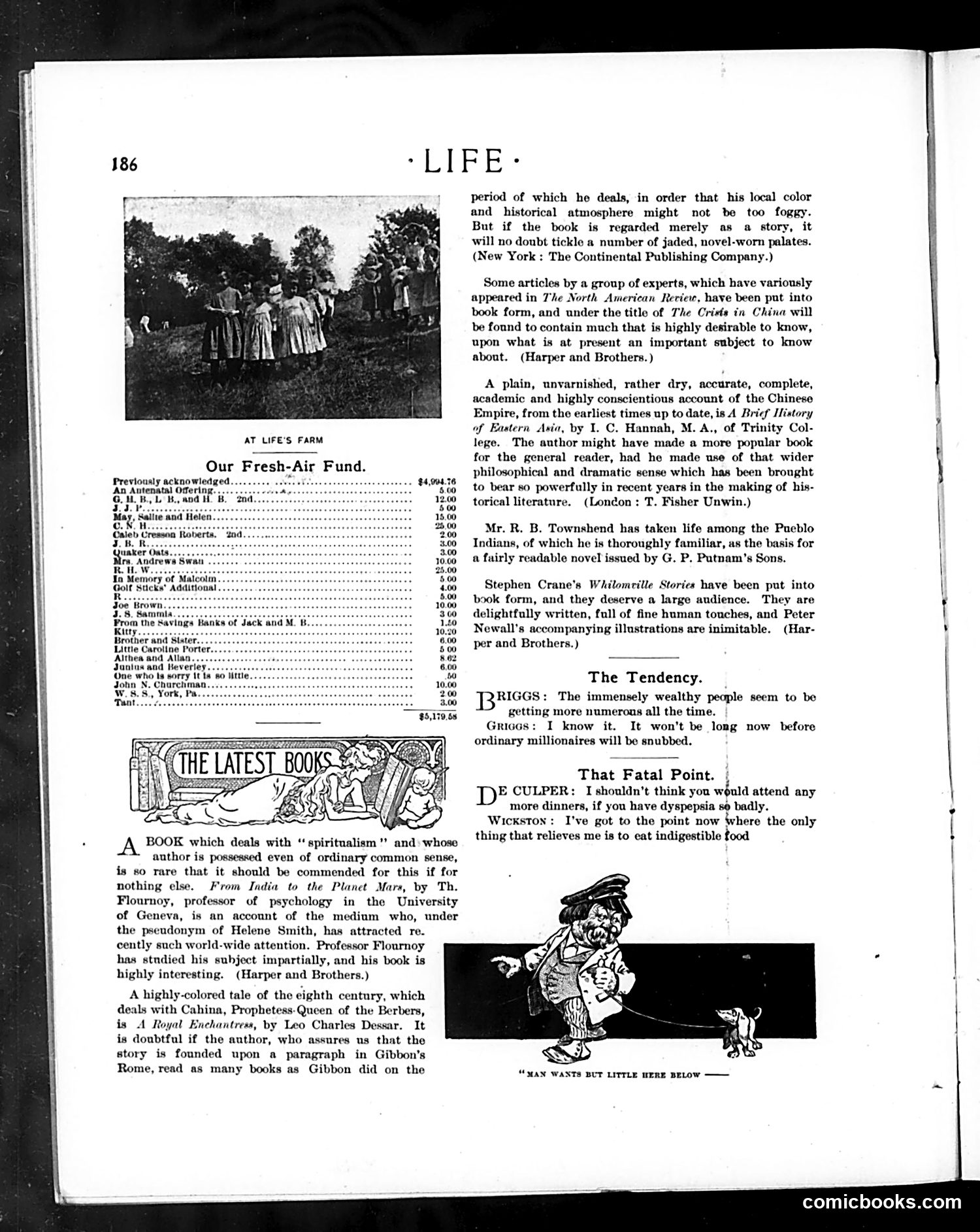
The page contains two distinct comic dialogues rather than traditional political cartoons. **"The Tendency"** features Briggs and Giggles discussing wealth inequality—Briggs notes that "ordinary millionaires" are becoming commonplace, implying social concern about economic stratification during what appears to be a prosperous era. **"That Fatal Point"** depicts De Culper and Wickston discussing dining and digestive health. Wickston jokes that he's reached the point where only indigestible food provides relief, a satirical jab at wealthy men's excessive consumption and resulting dyspepsia—a common complaint among affluent Americans of the era. The accompanying illustration shows a portly gentleman, emphasizing the stereotype of wealthy overindulgence. The humor relies on period anxieties about wealth's physical toll.
📄 Transcribed text from this page (OCR, searchable)
Machine-transcribed from the original scan — historical spelling and the odd misread are preserved.
AT LIFES FARM Our Fresh-Air Fund. Previously acknowledged. AD Antenatal Odering By 3.8. Sammia From the Savings Banks of Jack and M. i. BOOK which deals with ‘spiritualism ’’ and: whose author is possessed even of ordinary common sense, is so rare that it should be commended for this if for nothing else. From India to the Planet Mara, by Th. Flournoy, professor of psychology in the University of Geneva, is an account of the medium who, under the pseudonym of Helene Smith, has attracted re. cently such world-wide attention. Professor Flournoy has studied his subject impartially, and his book is highly interesting. (Harper and Brothers.) A highly-colored tale of the eighth century, which deals with Cahina, Prophetess-Queen of the Berbers, is A Royal Enchantress, by Leo Charles Dessar. It is doubtful if the author, who assures us that the story is founded upon a paragraph in Gibbon’s Rome, read as many books as Gibbon did on the » LIFE» period of which he deals, in order that his local color and historical atmosphere might not be too foggy. But if the book is regarded merely as a story, it will no doubt ticklo a number of jaded, novel-worn palates. (New York : The Continental Publishing Company.) Some articles by a group of experts, which have variously appeared in The North American Reriew, have been put into book form, and under the title of The Crists in China will be found to contain much that is highly desirable to know, upon what is at present an important subject to know about. (Harper and Brothers.) A plain, unvarnished, rather dry, accurate, complete, academic and highly conscientious account of the Chinese Empire, from the earliest times up to date, is A Brief Ilistory of Eastern Asia, by I. C. Hannah, M. A., of Trinity Col- lege. The author might have made a more popular book for the general reader, had he made use of that wider philosophical and dramatic sense which has been brought to bear so powerfully in recent years in the making of his- torical literature. (London: T. Fisher Unwin.) Mr. R. B. Townshend has taken life among the Pueblo Indians, of which he is thoroughly familiar, as the basis for a fairly readable novel issued by G. P. Putnam's Sons. Stephen Crane's Whilomrille Stories have been put into book form, and they deserve a large audience. They are delightfully written, full of fine human touches, and Peter Newall's accompanying illustrations are inimitable. (Har- per and Brothers.) The Tendency. RIGGS: The immensely wealthy people seem to be getting more numeroas all the time. Griccs: I know it. It won't be lomg now before ordinary millionaires will be snubbed. That Fatal Point. | E CULPER: I shouldn’t think you would attend any more dinners, if you have dyspepsia so badly. Wickston : I've got to the point now Where the only thing that relieves me is to cat indigestible food “MAN WANTS BUT LITTLE HERE BELOW —— comicbooks.com