
Life, 1900-09-06 · page 12 of 20
Life — September 6, 1900 — page 12: what you’re looking at
What you’re looking at
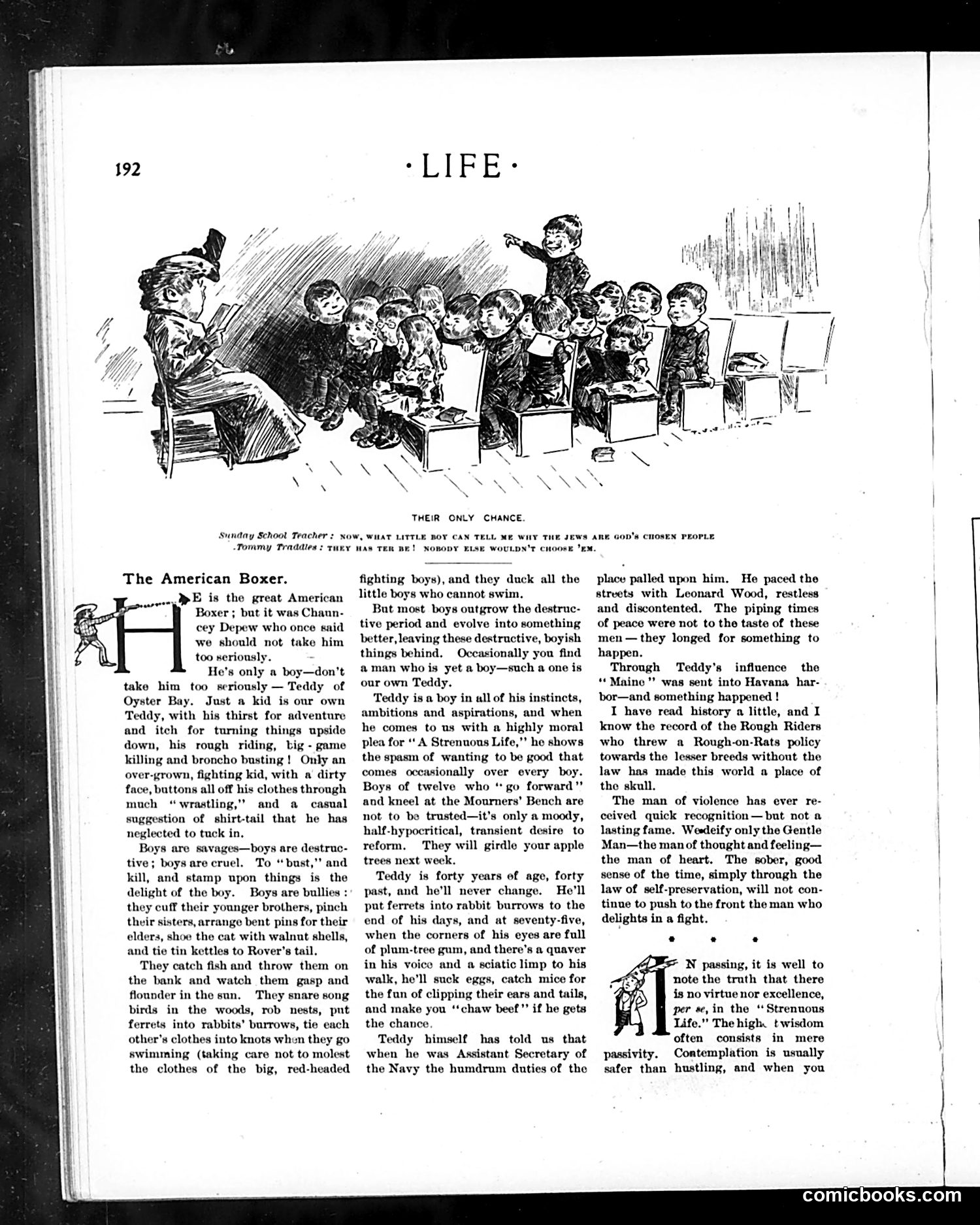
The top cartoon titled "Their Only Chance" depicts a Sunday School teacher instructing young boys about Jewish people being God's chosen people. The caption notes that one boy questions why Jews were chosen when "nobody else wouldn't choose 'em"—expressing antisemitic sentiment. Below, "The American Boxer" article discusses "Toddy," apparently a rambunctious boy-type character. The text satirizes aggressive, destructive boyish behavior—fighting, theft, and general mischief—as supposedly inherent American traits. The article contrasts this with ideals of virtue and restraint, suggesting that unchecked aggression, while celebrated in some circles, produces morally inferior men. Both pieces reflect early 20th-century anxieties about social hierarchy, character formation, and cultural values.
📄 Transcribed text from this page (OCR, searchable)
Machine-transcribed from the original scan — historical spelling and the odd misread are preserved.
Sunday School Teacher : Now, WHAT LITTLE BOY CAN TELL ME Wi -Tommy Traddies : TuRY WAS TER BE! NOBODY ELSE WOULDN The American Boxer. JpE is the great American Boxer ; but it was Chaun- cey Depew who once said we should not take him too seriously. He's only a boy—don't take him too seriously — Teddy of Oyster Bay. Just a kid is our own Teddy, with his thirst for adventure and itch for turning things upside down, his rough riding, big - game killing and broncho busting! Only an over-grown, fighting kid, with a dirty face, buttons all off his clothes through much “wrastling,"”” and a casual suggestion of shirt-tail that he has neglected to tuck in, Boys are savages—boys are destruc- tive; boys are cruel. To “bust,” and kill, and stamp upon things is the delight of the boy. Boys are bullies : they cuff their younger brothers, pinch their sisters, arrange bent pins for their elders, shoe the cat with walnut shells, and tie tin kettles to Rover's tail, They catch fish and throw them on the bank and watch them gasp and flounder in the sun. They snare song birds in the woods, rob nests, put ferrets into rabbits’ burrows, tie each other's clothes into knots when they go swimming (taking care not to molest the clothes of the big, red-headed THEIR ONLY CHANCE. fighting boys), and they duck all the little boys who cannot swim. But most boys outgrow the destruc- tive period and evolve into something better, leaving these destructive, boyish things behind. Occasionally you find aman who is yet a boy—such a one is our own Teddy. Teddy is a boy in all of his instincts, ambitions and aspirations, and when he comes to us with a highly moral plea for “A Strenuons Life,”’ he shows the spasm of wanting to be good that comes occasionally over every boy. Boys of twelve who “go forward’ and kneel at the Mourners’ Bench are not to be trusted—it’s only a moody, half-hypocritical, transient desire to reform. They will girdle your apple trees next week. Teddy is forty years of age, forty past, and he'll never change. He'll put ferrets into rabbit burrows to the end of his days, and at seventy-five, when the corners of his eyes are full of plum-tree gum, and there's a quaver in his voice and a sciatic limp to his walk, he'll suck eggs, catch mice for the fun of clipping their ears and tails, and make you ‘‘chaw beef"’ if he gets the chance. Teddy himself has told us that when he was Assistant Secretary of the Navy the humdrum duties of the Jews ARE Dowe EM. op's CHOSEN PEOPLE place palled upon him, He paced the streets with Leonard Wood, restless and discontented. The piping times of peace were not to the taste of these men—they longed for something to happen. Through Teddy’s influence the “Maine "’ was sent into Havana har- bor—and something happened ! I have read history a little, and I know the record of the Rough Riders who threw a Rough-on-Rats policy towards the lesser breeds without the law has made this world a place of the skull, The man of violence has ever re- ceived quick recognition— but not a lasting fame. Weedeify only the Gentle Man—the manof thought and feeling— the man of heart. The sober, good sense of the time, simply through the law of self-preservation, will not con- tinue to push to the front the man who delights in a fight. note the truth that there is no virtue nor excellence, B per ae, in the “Strenuons Life.” The high. t wisdom often consists in mere passivity. Contemplation is usually safer than hustling, and when you comicbooks.com