
A complete issue · 20 pages · 1900
Life — August 9, 1900
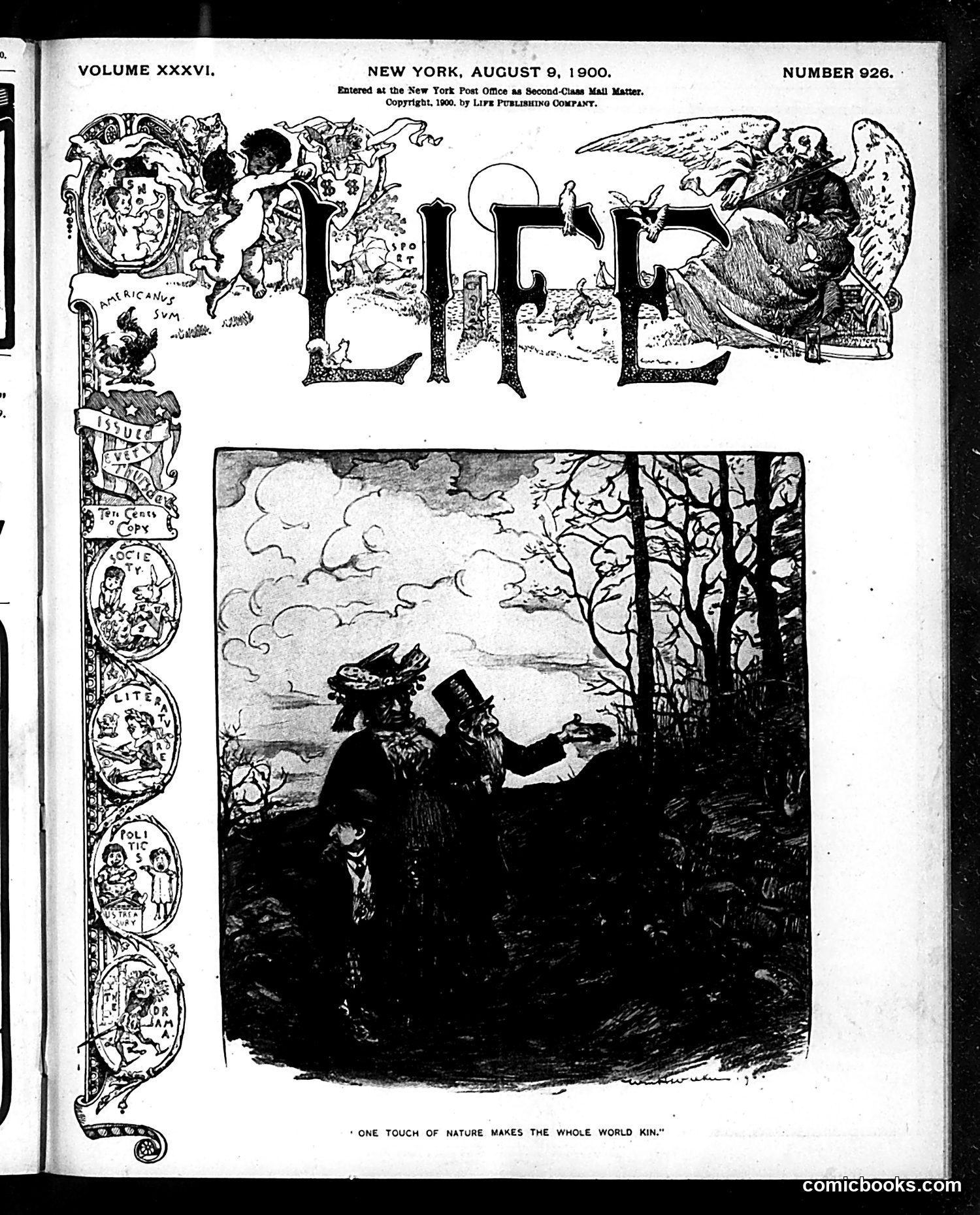
This is the cover of *Life*, a satirical weekly. The main illustration shows two well-dressed gentlemen in a forest at night, with one gesturing expansively. The caption reads: "ONE TOUCH OF NATURE MAKES THE WHOLE WORLD KIN." This appears to be political satire, likely referencing contemporary events from 1900, though the specific figures aren't clearly identifiable from the image alone. The ornate left border contains decorative medallions with various scenes or symbols, typical of *Life*'s artistic design. The quote is a Shakespeare reference (modified from *As You Like It*), suggesting ironic commentary on human nature or international relations. Without additional context about 1900 politics, the cartoon's exact satirical target remains unclear, though the formal dress and wilderness setting suggest commentary on civilized society or diplomacy.
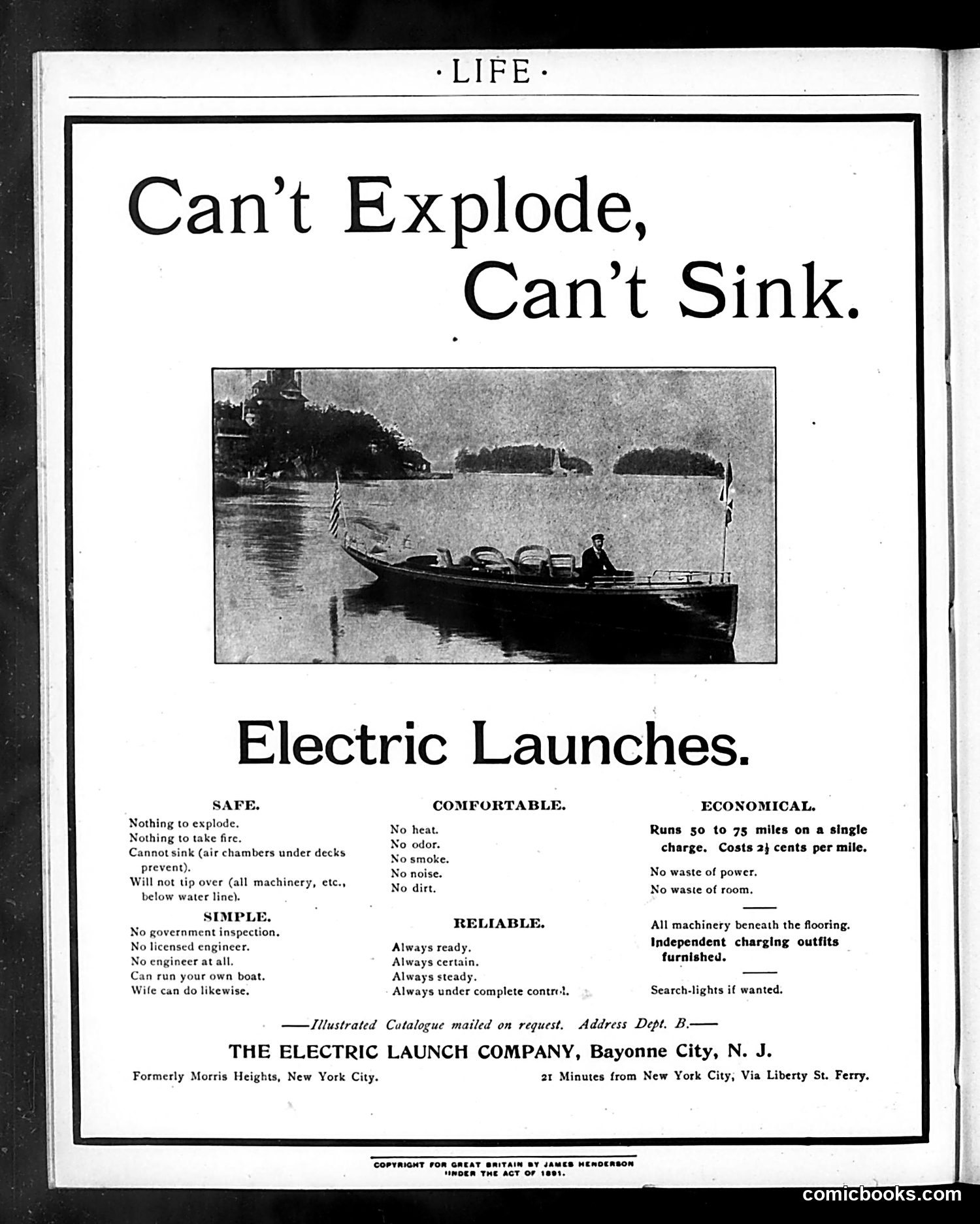
This page is **primarily an advertisement**, not a political cartoon. The Electric Launch Company of Bayonne, New Jersey is marketing electric-powered boats to early 20th-century consumers. The advertisement emphasizes safety ("Can't Explode, Can't Sink") as a selling point, contrasting electric launches with the gasoline and steam-powered boats then common. The messaging targets wealthy leisure boaters concerned about reliability and operational simplicity—notably, it mentions "Wife can do likewise," suggesting boats so safe and easy that even women could operate them without formal training, a notable claim for the era. The "SAFE," "COMFORTABLE," and "ECONOMICAL" categories highlight advantages over contemporary alternatives: no fire risk, no noxious fumes, lower running costs. This reflects the early automotive/marine era when electric power competed seriously with combustion engines.
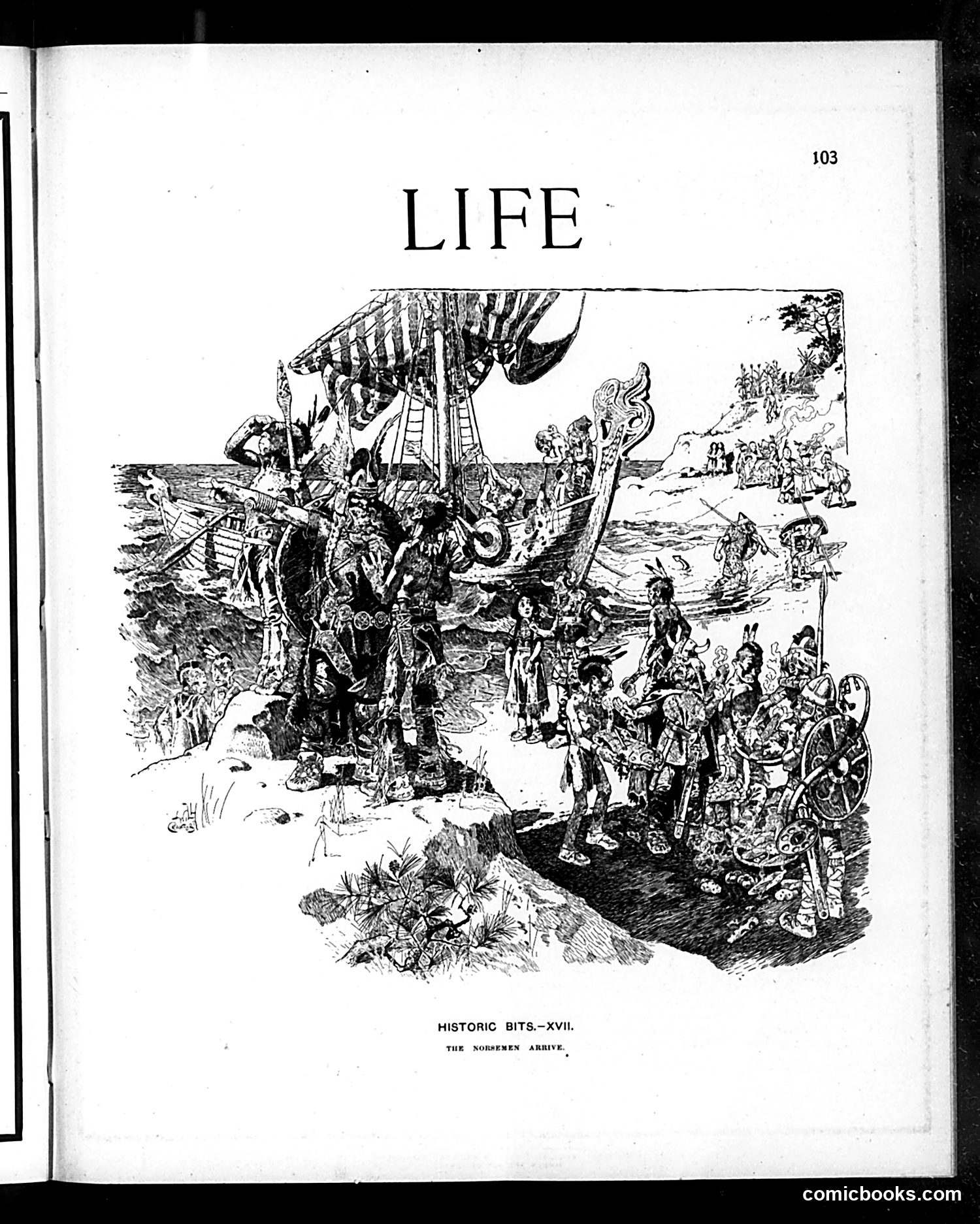
This satirical illustration depicts the arrival of Viking/Norse explorers, likely referencing historical Norse settlement in North America or Europe. The detailed engraving shows a Viking ship with characteristic sail and dragon-headed prow, with armed Norse warriors in period dress meeting with indigenous peoples on shore. The satire's specific point remains somewhat unclear without additional context, but Life magazine typically used historical scenarios to comment on contemporary issues—possibly immigration, colonization, or cultural conflict. The juxtaposition of the "civilized" Norse arrival against indigenous populations may reflect late-19th or early-20th century attitudes about exploration and conquest, though the cartoonist's intended commentary (celebratory, critical, or ironic) is not definitively apparent from the image alone.
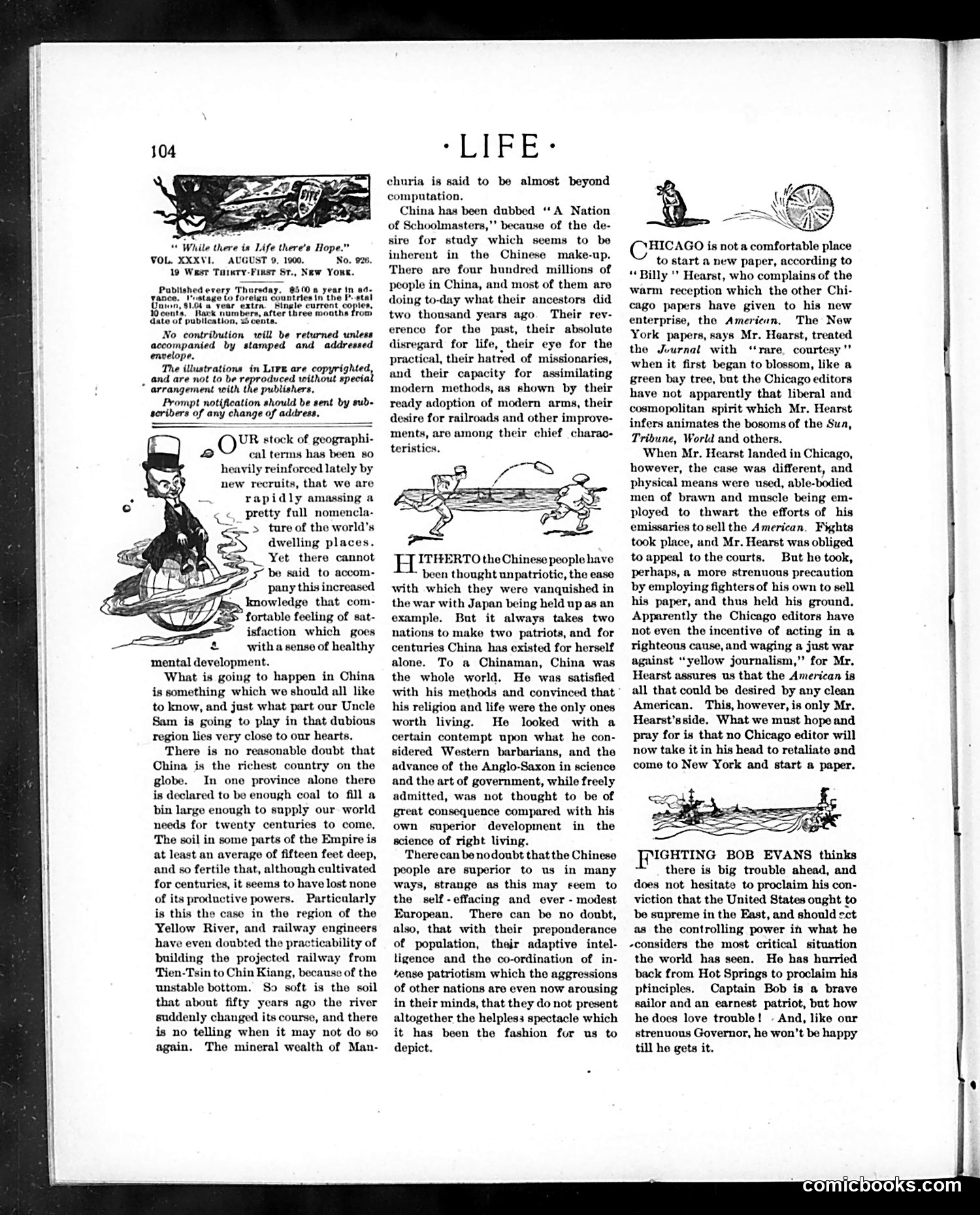
The page contains three distinct editorial pieces rather than traditional political cartoons. The left illustration depicts a caricatured figure with exaggerated features (likely representing a foreign diplomat or politician) balanced precariously on a globe, symbolizing instability in international affairs—a common visual metaphor of the era. The main text discusses China's modernization and Western influence, expressing skepticism about Chinese patriotism and superiority. The piece appears critical of both Chinese self-regard and American presumptions about spreading "Americanism." A separate section addresses "Fighting Bob Evans," seemingly referencing a naval figure's views on international conflict and America's role as a controlling power in world affairs. The satire targets both American imperial confidence and Chinese resistance to Western dominance during the early 20th-century period of great-power competition.
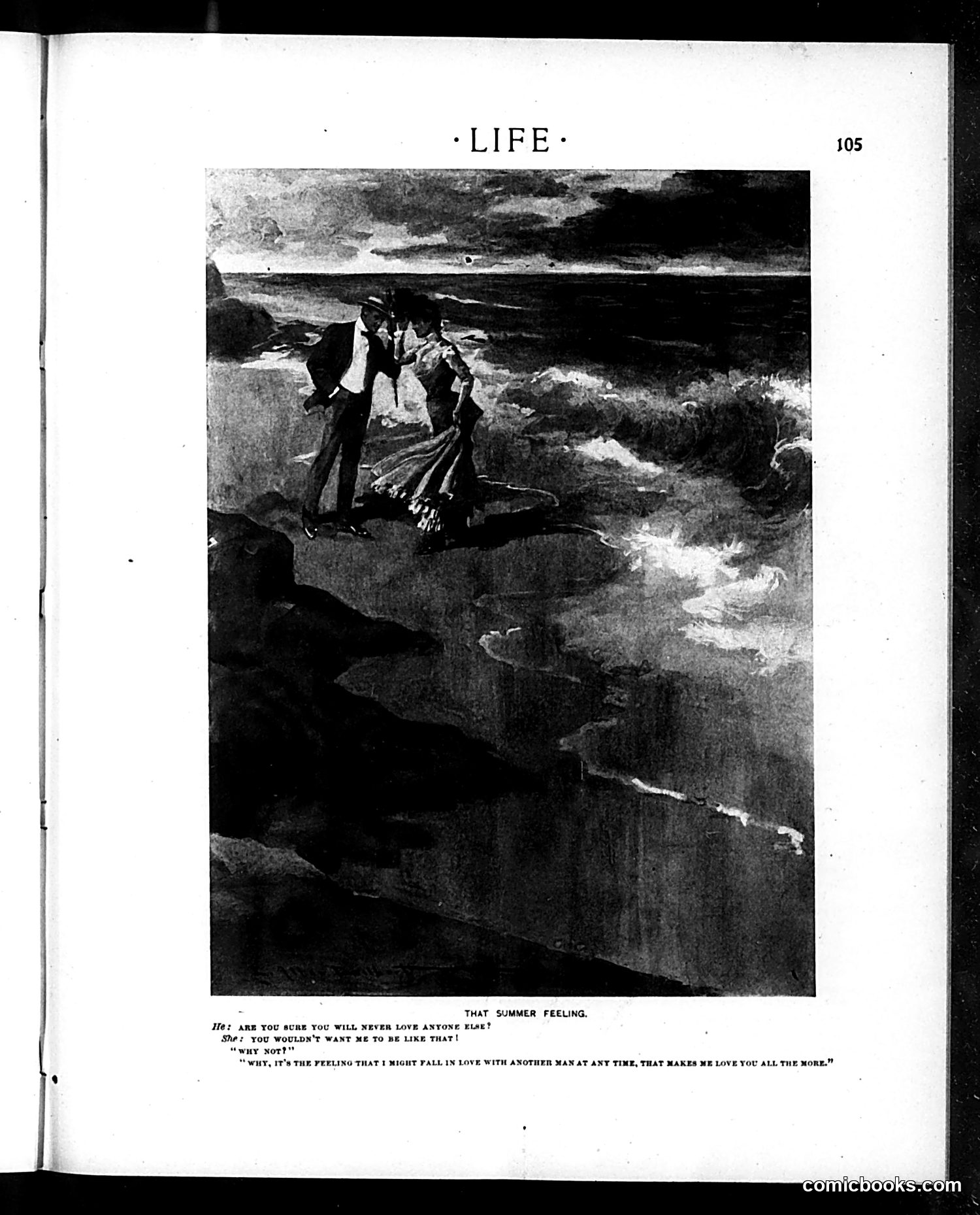
This page from *Life* magazine (page 105) depicts a romantic scene at the seaside titled "That Summer Feeling." Two figures stand together on rocks overlooking waves, with dialogue below: The man expresses worry about future infidelity ("ARE YOU SURE YOU WILL NEVER LOVE ANYONE ELSE?"). The woman responds dismissively ("YOU WOULDN'T WANT ME TO BE LIKE THAT!"). The final quote—"WHY NOT?" followed by "WHY, IT'S THE FEELING THAT I MIGHT FALL IN LOVE WITH ANOTHER MAN AT ANY TIME, THAT MAKES ME LOVE YOU ALL THE MORE"—satirizes modern romantic attitudes of the era (likely early 20th century). The joke critiques changing social values regarding fidelity and female independence, presenting a woman's potential unfaithfulness as paradoxically strengthening her current romantic bond. It mocks both modernist attitudes and masculine insecurity.
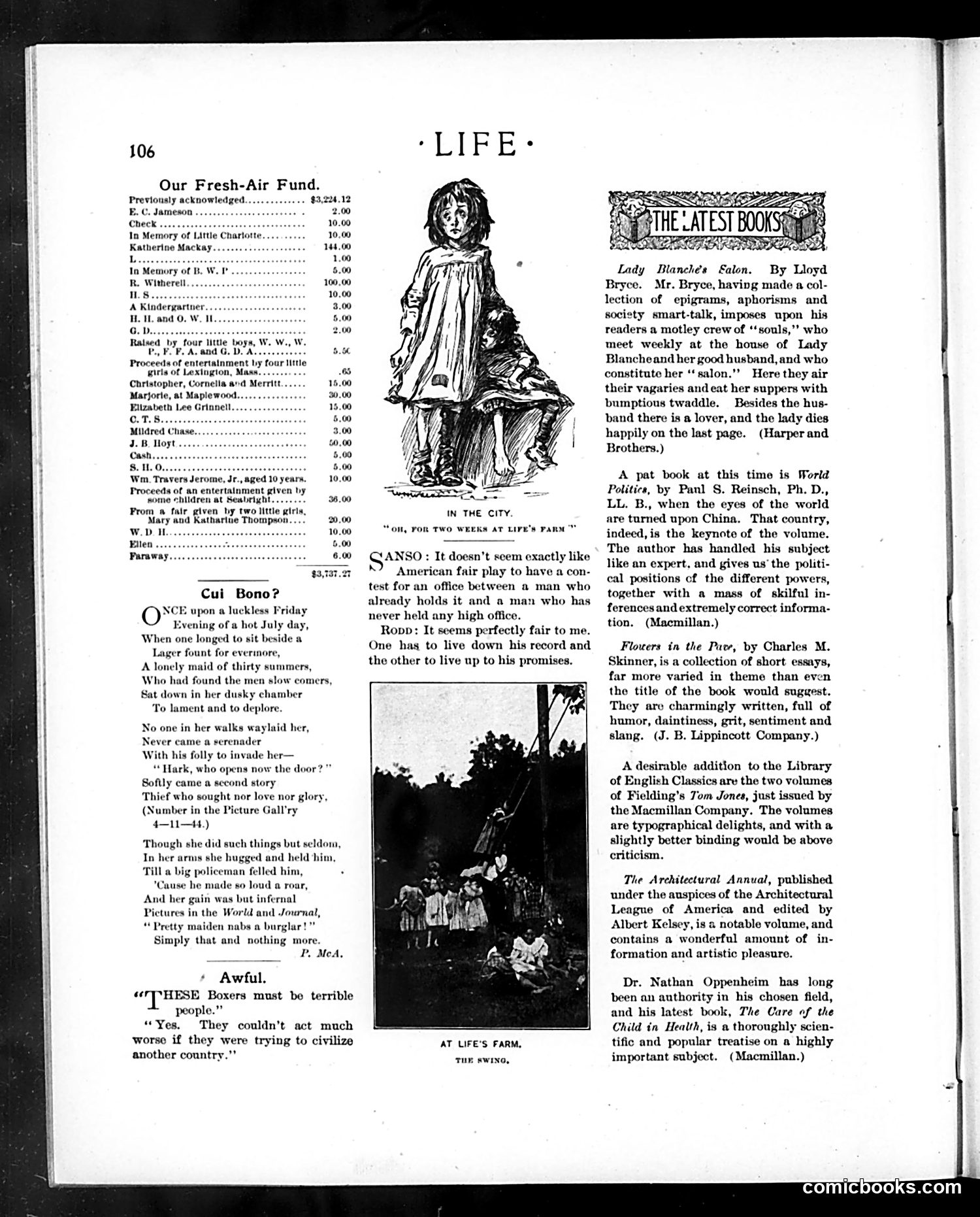
This page contains two distinct sections: **Left side:** A poem titled "Cui Bono?" (Latin: "Who benefits?") satirizing political corruption. The verse mocks bureaucratic hypocrisy—specifically someone climbing the social ladder while ignoring past misdeeds ("One has to live down his record"). The poem references a policeman and suggests cynical disregard for justice ("Simply that and nothing more"). **Right side:** Book reviews discussing recent publications, including works on China and architecture. **Center image:** "In the City" and "At Life's Farm" appear to be illustrations, likely contrasting urban versus rural life—a common satirical theme in this era examining American society. The page's overall tone critiques political opportunism and social hypocrisy typical of *Life* magazine's satirical approach to Gilded Age/Progressive Era American institutions.
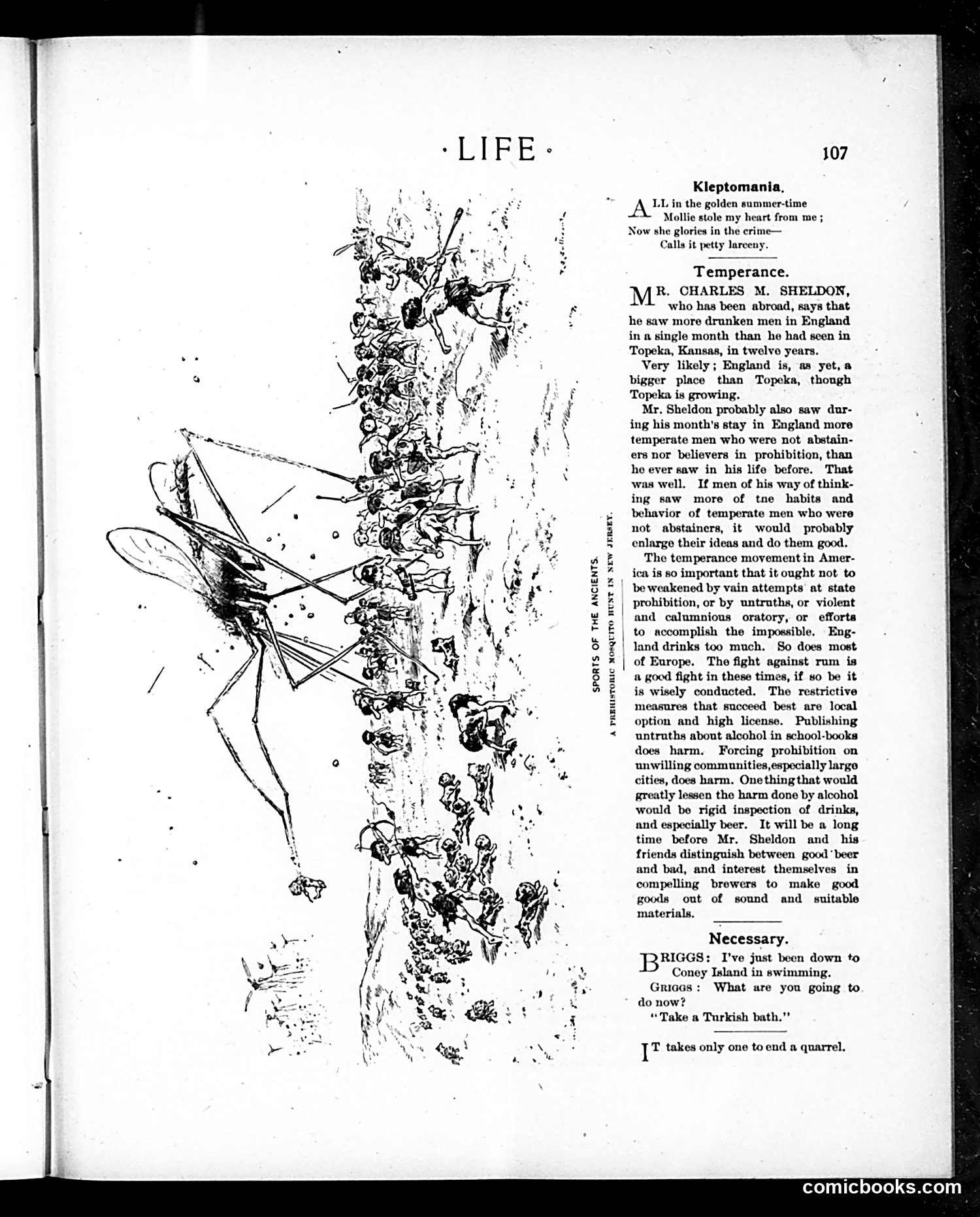
This page contains three separate items: a humorous poem titled "Kleptomania" about a woman named Mollie who steals hearts; an essay on "Temperance" by Charles M. Sheldon discussing drunkenness in England versus Kansas; and a brief joke labeled "Necessary" about someone visiting Coney Island. The large illustration on the left appears to be a detailed scientific or naturalistic drawing—possibly of insects or aquatic creatures—rather than a political cartoon. The image's relationship to the text is unclear. The "Temperance" essay advocates for local prohibition enforcement and responsible brewing practices rather than blanket legal prohibition, reflecting early-20th-century temperance movement debates in America.
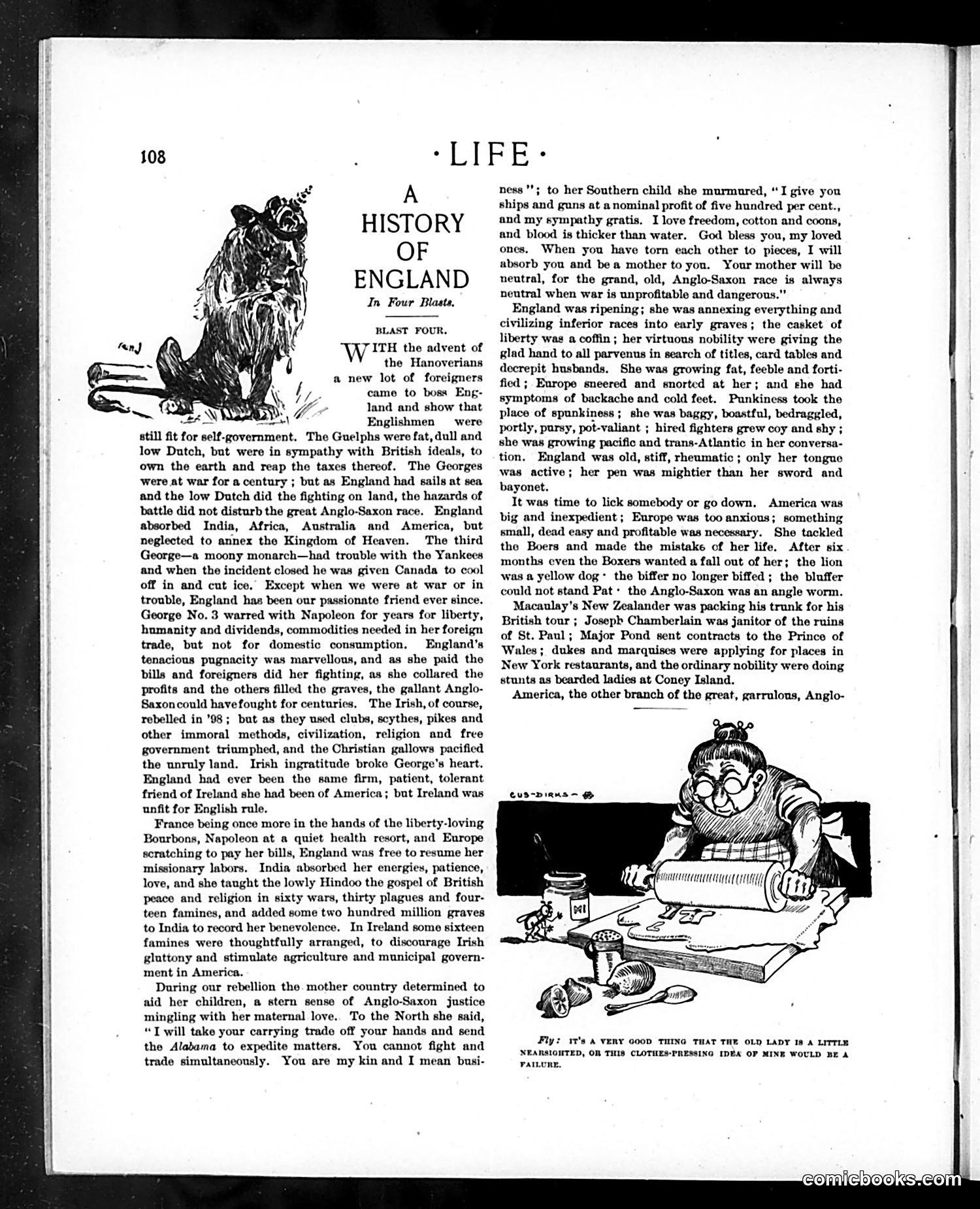
This page satirizes British imperial decline through allegorical female personification. The text describes England as aging, weakening, and losing her former vigor—"stiff, rheumatic," with "tongue...active" but "pen mightier than her sword and bayonet." The accompanying cartoon depicts an elderly woman hunched over, struggling with a clothes-pressing device, captioned: "It's a very good thing that the old lady is a little nearsighted, or this clothes-pressing idea of mind would be a failure." The satire suggests Britain, personified as an aging figure, is failing to maintain her global position. The cartoon implies she's literally flattening herself through effort, unable to see her own decline. This reflects post-WWI anxieties about British imperial power waning relative to emerging competitors like America.
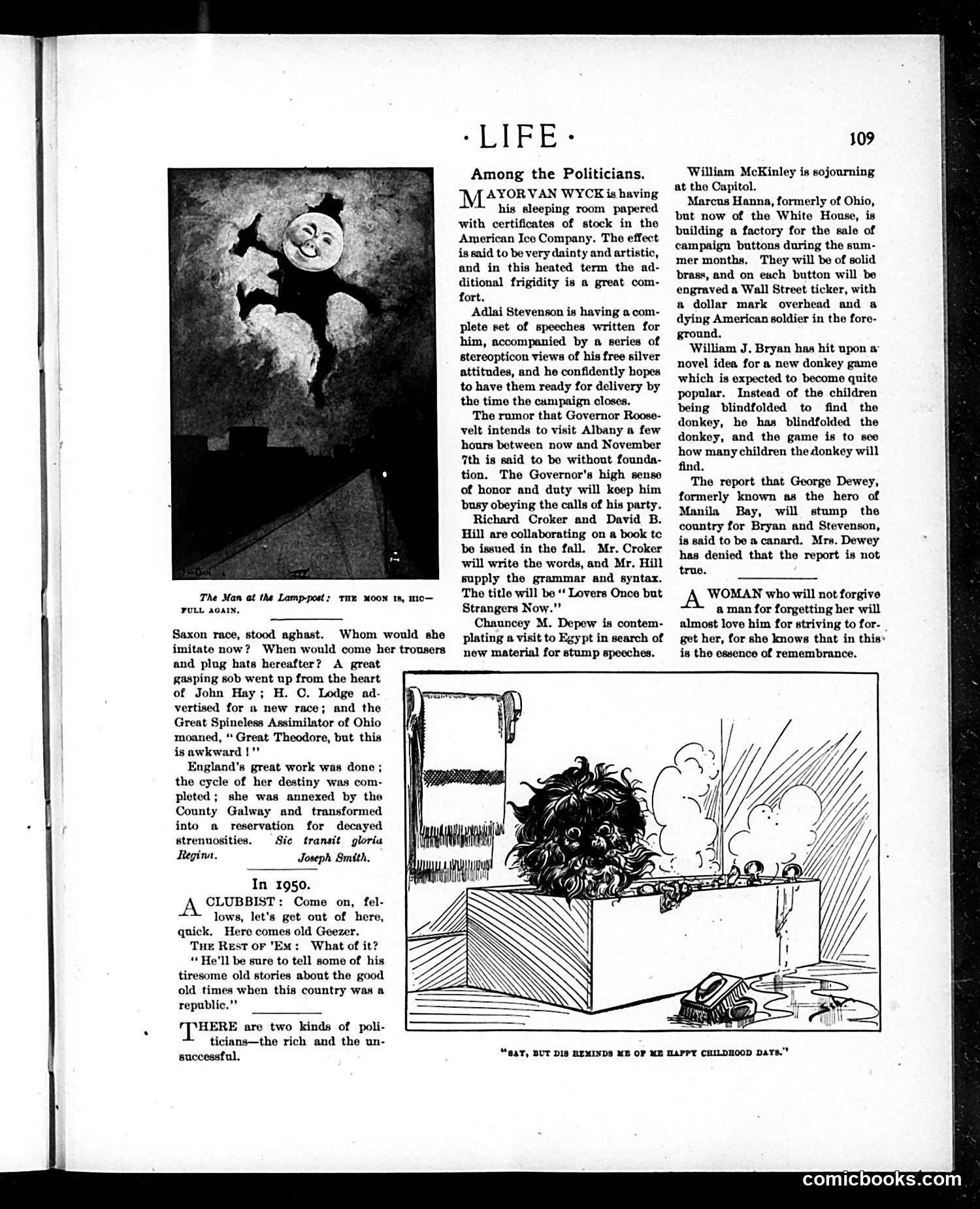
The page contains political gossip and social commentary rather than formal cartoons. Key items include: **"Among the Politicians"** section discusses various political figures' activities—Mayor Van Wyck's decorating choices, Adlai Stevenson preparing speeches, and rumors about Governor Roosevelt visiting Albany. The main **cartoon** depicts a shaggy dog on a shelf looking out a window at rain, captioned "Say, but dis reminds me of me happy childhood days." This is humor about the dog's nostalgia, contrasting its current comfortable domestic life with supposed rougher origins. The page also discusses a planned book collaboration between Richard Croker and David B. Hill, and mentions various political rumors and social activities. The overall tone is gossipy and satirical about turn-of-the-century political and social figures.
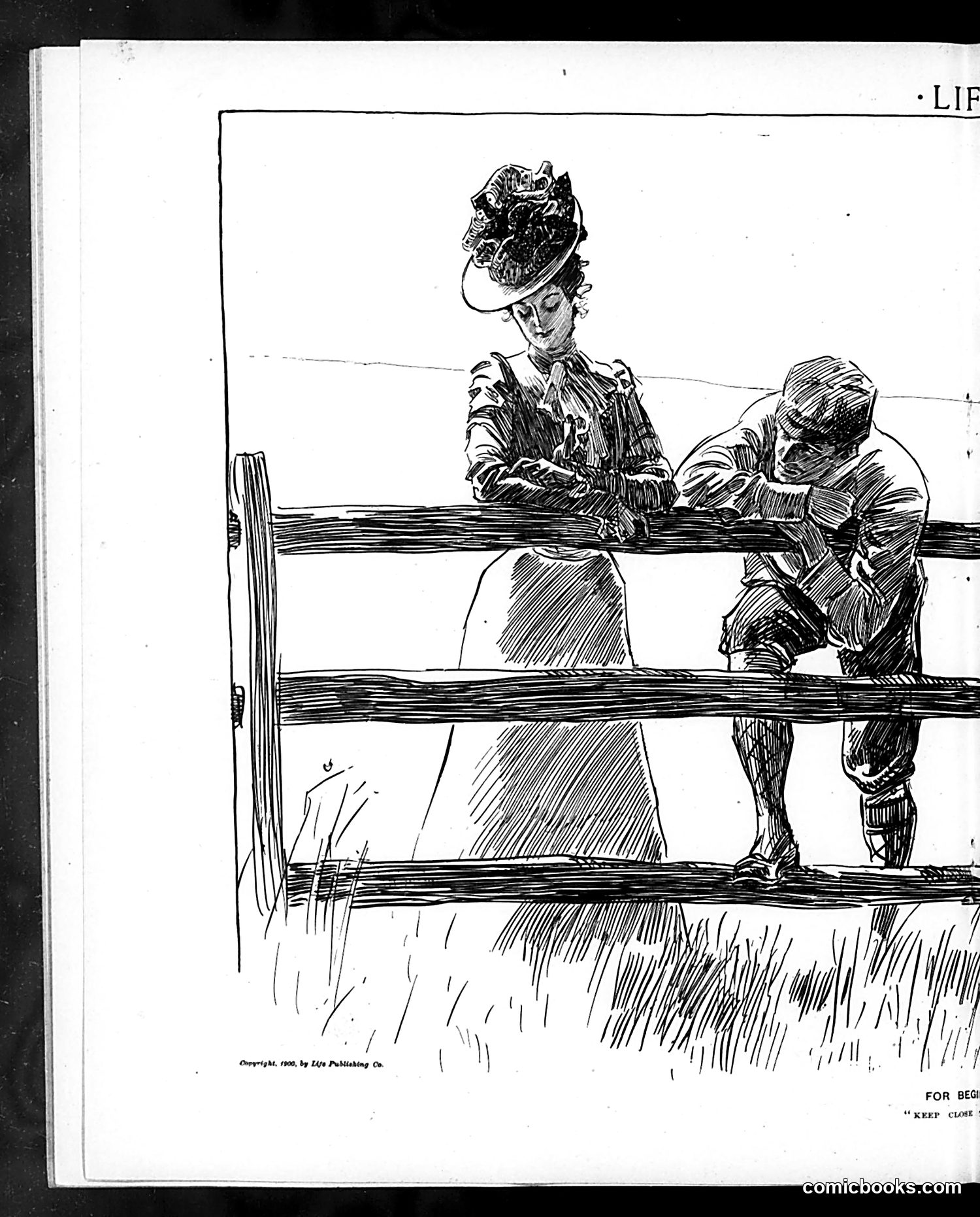
This pen-and-ink illustration depicts two figures at a fence rail in rural settings. The woman on the left wears an elaborate hat and fitted clothing typical of early 20th-century fashion, while a man on the right leans casually against the fence. The style and composition suggest this is likely satirical commentary on class differences or courtship dynamics of the era. The partial text visible ("FOR BEG..." and "KEEP CLOSE") appears cut off, making the specific satirical point unclear. Without complete caption text or publication date confirmation, I cannot definitively identify the figures or the particular social commentary intended. The image likely mocks either romantic pretension, class-crossing relationships, or rural-urban social contrasts typical of Life magazine's satirical work from this period.
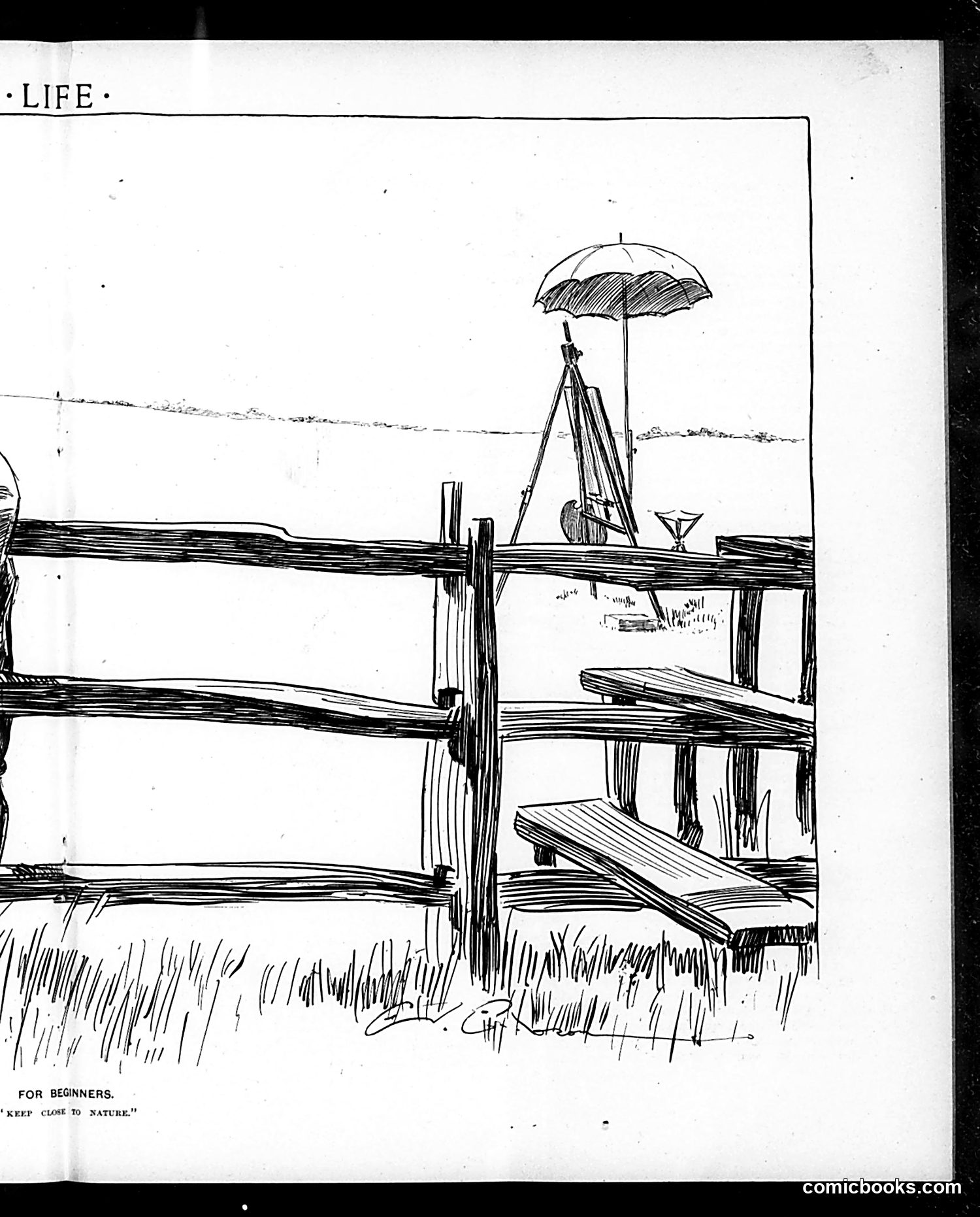
This cartoon depicts a leisure scene at a rustic fence with an umbrella-shaded figure relaxing beside a cocktail. The caption "For Beginners: 'Keep Close to Nature'" uses irony—the figure has brought artificial comforts (umbrella, formal drink) into a deliberately pastoral setting, undermining the stated principle. The satire targets a trendy lifestyle philosophy popular in early-to-mid 20th century America: returning to nature for health and authenticity. The cartoon mocks how wealthy urbanites attempted this while maintaining their conveniences and luxuries, never genuinely roughing it. It's gentle social commentary on the gap between romantic ideals about nature and the reality of how privileged people actually experience the outdoors.
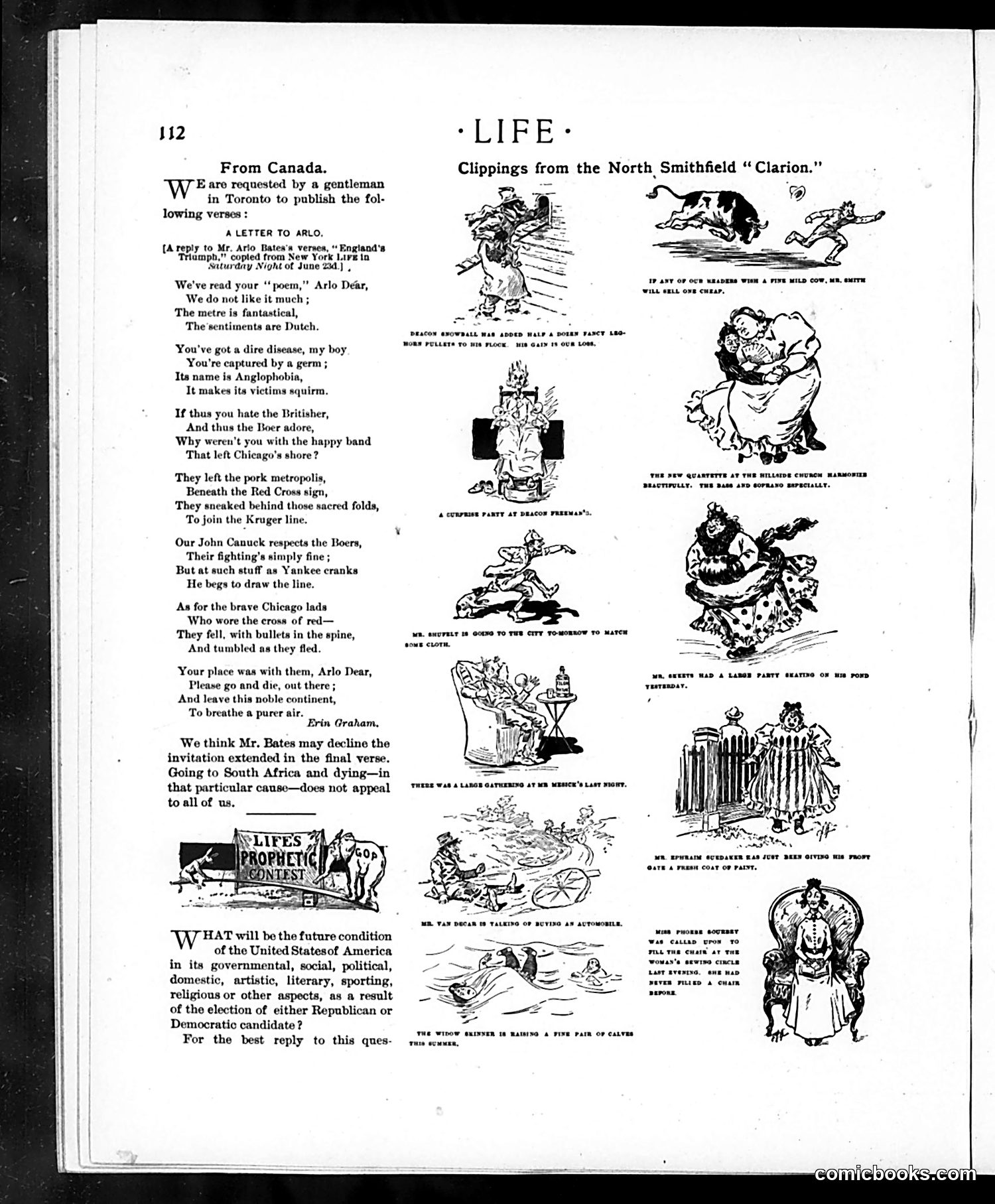
This page contains a critical poem titled "A Letter to Arlo" attacking poet Arlo Bates's verse "England's Triumph." The writer mocks Bates's work as overly sentimental and criticizes his pro-British stance, suggesting he should have sided with America instead. References to "John Chuuck" (likely John Bull, representing Britain) and "Chicago lads" with "cross of red" (possibly Irish-American Civil War soldiers) indicate tensions over American identity and loyalty during the period. The right side features "Clippings from the North Smithfield 'Clarion'"—humorous cartoon vignettes depicting absurd local scenarios (church mishaps, party disasters, automobile incidents), typical of early-1900s satirical magazine humor mocking small-town life and emerging technologies. At bottom, a political question asks readers to predict America's future under either Republican or Democratic leadership.
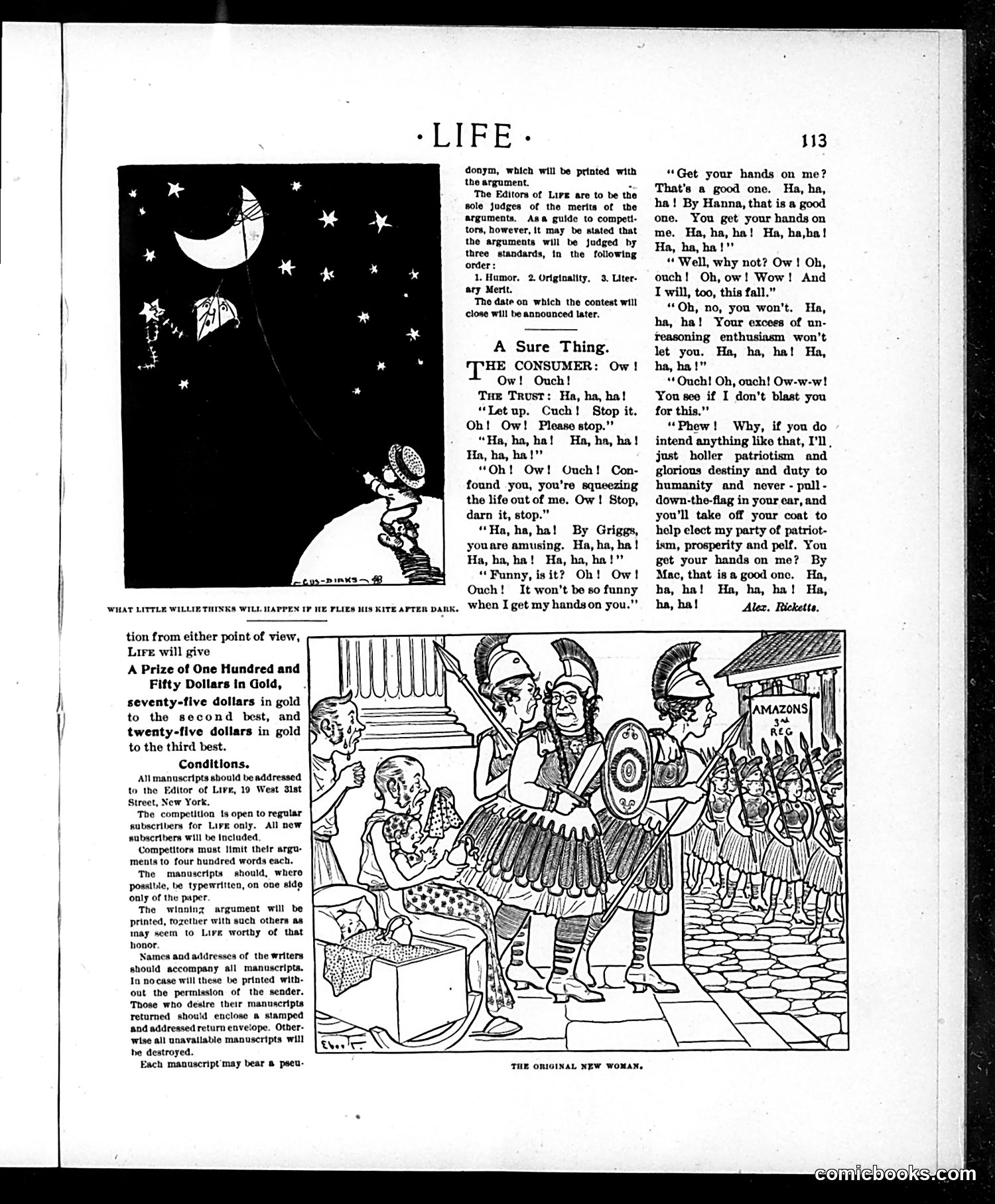
This cartoon satirizes **monopolistic trusts** (large corporations controlling markets) and their exploitation of consumers during the Gilded Age. The "Trust" figure laughs while squeezing the "Consumer," who pleads for mercy—depicting how trusts extracted excessive profits through price-fixing and market control. The twist reveals the Trust's cynical confidence: even if consumers rebel, they'll be manipulated by appeals to "patriotism," "glorious destiny," and "duty to humanity"—nationalist rhetoric that distracts the public from economic exploitation. The Trust predicts citizens will support his political party (likely Republican) based on jingoism rather than economic self-interest. The cartoon critiques both corporate greed and how politicians weaponize patriotic language to maintain the status quo. The page also announces a *Life* contest inviting arguments against trusts, showing the magazine's role in progressive anti-monopoly discourse of the era.
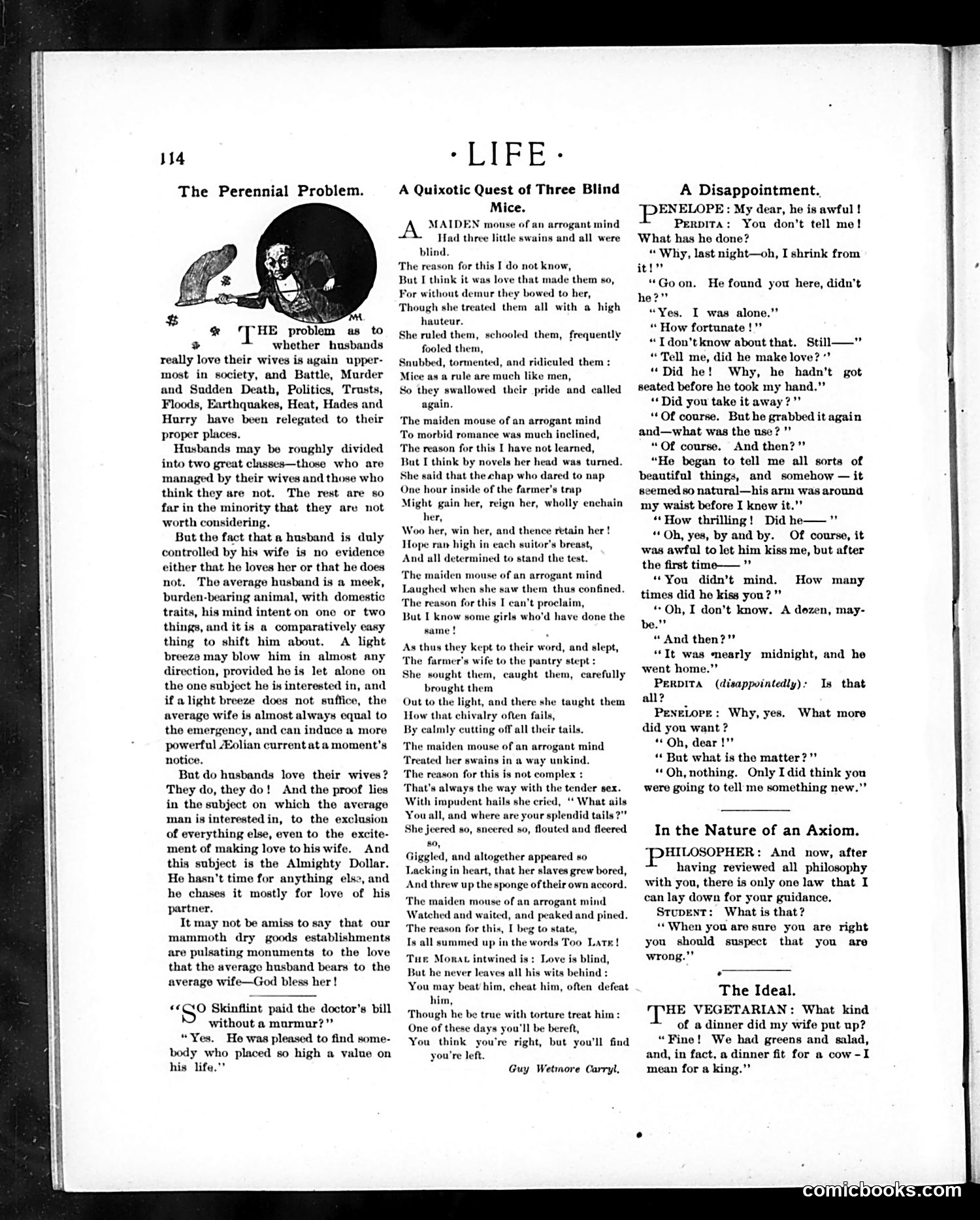
This page contains three satirical pieces about relationships and male behavior: **"The Perennial Problem"** (left column): A prose essay dismissing the question of whether husbands truly love their wives. The author argues husbands are easily controlled but ultimately devoted to earning money for their families—framing financial provision as proof of love. A small illustration shows a meek man dominated by his large wife, embodying the "controlled husband" stereotype. A brief joke about "Skinflint" reinforces that even stingy men value their wives enough to pay for medical care. **"A Quixotic Quest of Three Blind Mice"** (center): A lengthy narrative poem mocking both romantic idealism and female manipulation. Three blind suitors compete for an arrogant mouse-maiden who demands they endure danger. When they succeed, she ridicules them for losing their tails in the attempt. The poem satirizes male gullibility in romance and female cruelty—"always the way with the tender sex." **"In the Nature of an Axiom"** and **"The Ideal"** (right): Brief humorous dialogues about marriage expectations and disappointment. Overall, the page reflects early 20th-century satirical attitudes toward marriage as a battle of wills where men are either dominated by wives or obsessed with money.
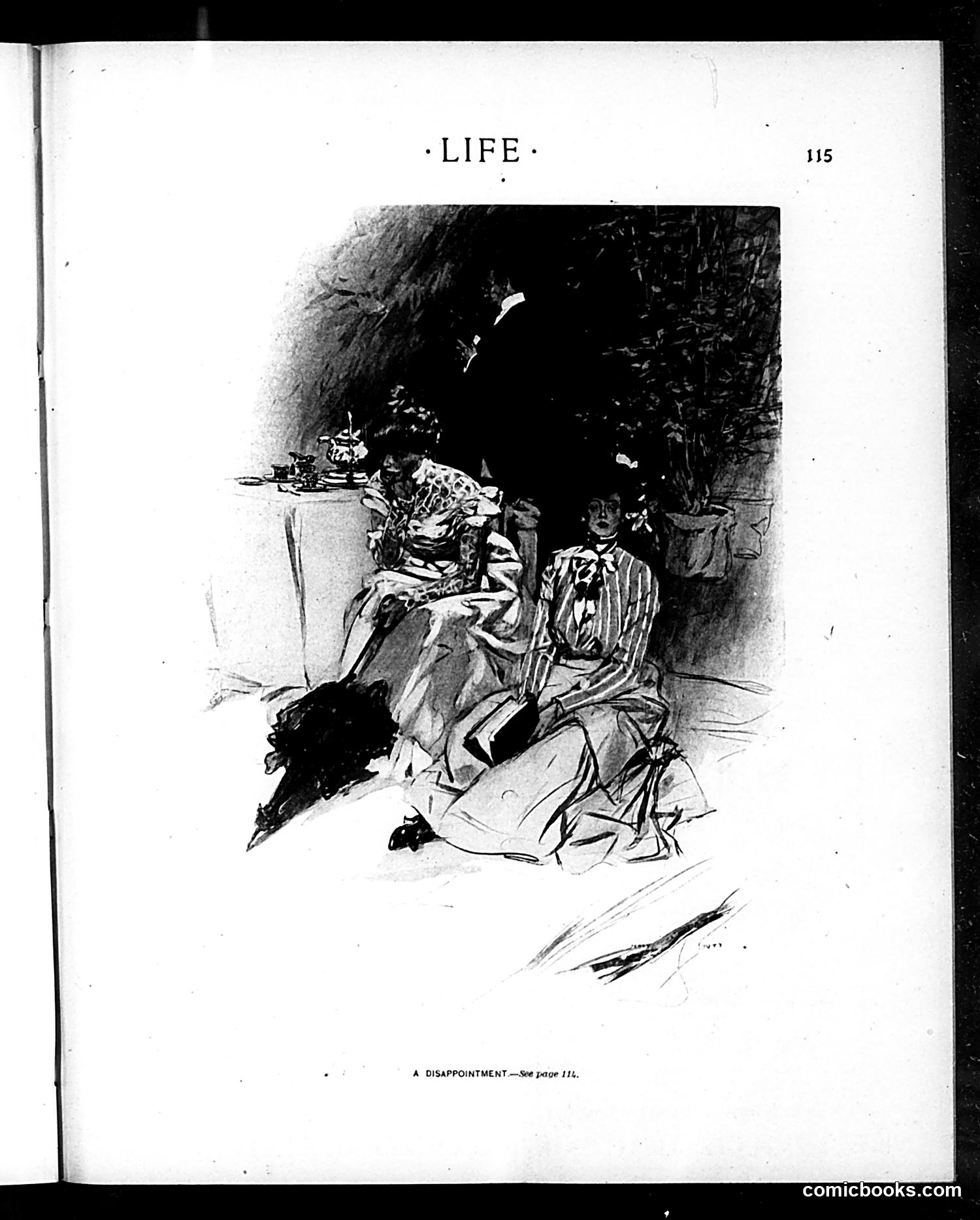
This sketch illustrates a domestic scene titled "A Disappointment" (with reference to page 114). The cartoon depicts two figures in what appears to be a modest interior—a woman in elaborate dress and a man in striped clothing, both seated. A black dog is prominently featured in the foreground. The satire likely concerns unfulfilled expectations in a romantic or domestic relationship, a common theme in Life magazine's social commentary. The woman's ornate clothing contrasts with the humble setting, suggesting aspirations versus reality. The dog's prominent placement may symbolize loyalty or domestic life's mundane realities. Without the referenced page 114, the full context remains unclear, but this appears to be satirizing middle-class domestic disappointments or romantic mismatches common to early 20th-century American humor.
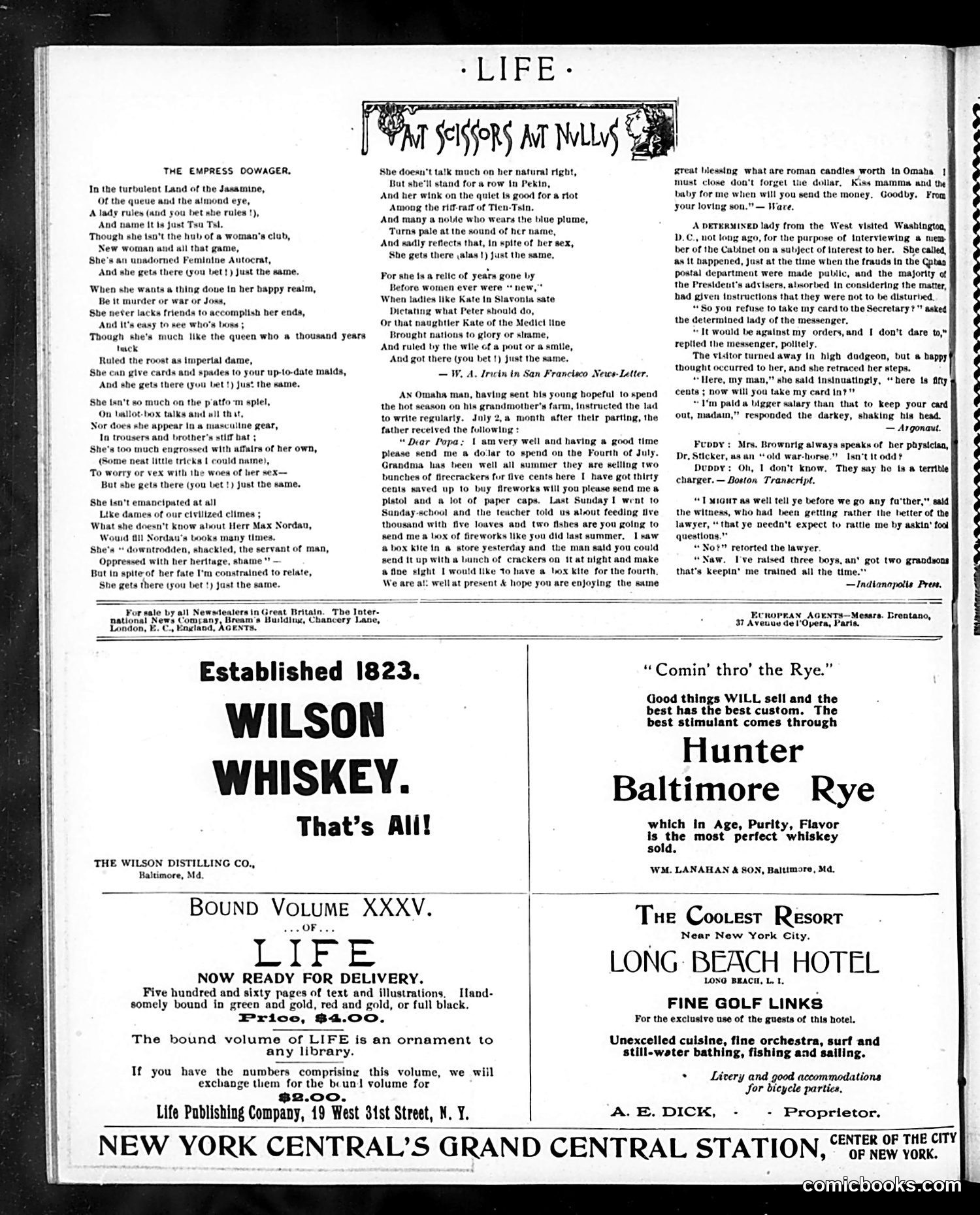
This page contains a humorous poem about the **Empress Dowager of China** (Tsu Hsi, ruling during the late Qing Dynasty). The satire contrasts Western ideals of female emancipation with her actual power. The joke: While the Empress Dowager appears to be an "oppressed" traditional woman—she doesn't speak publicly, doesn't wear Western clothes, and lacks "modern" rights—she actually wields absolute authority. She accomplishes her goals through traditional feminine means (charm, cunning) rather than modern activism. The poem references "Max Nordau" (a real social critic) and compares her favorably to historical female rulers like Catherine the Great ("that naughty Kate of the Medici line"), suggesting that real female power predates modern women's movements. The satire targets both conservative views (that traditional women lack agency) and perhaps progressive claims that only modern emancipation grants women influence. The Empress Dowager simply *gets things done*, regardless of ideology.
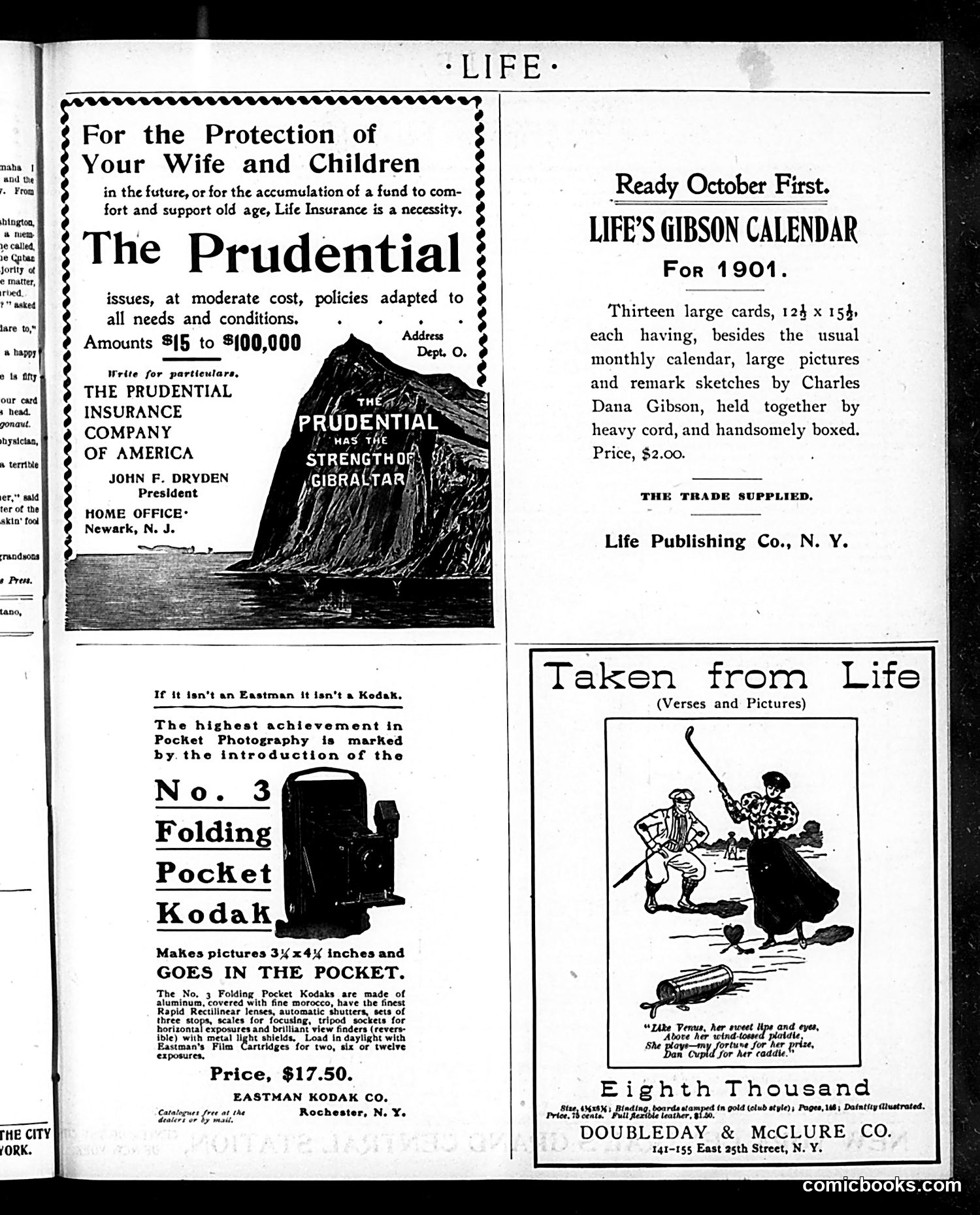
This page is **primarily advertisements** with one small cartoon illustration. The main content includes ads for: - **The Prudential Insurance Company** (life insurance for family protection) - **Life's Gibson Calendar for 1901** (featuring illustrations by Charles Dana Gibson, the famous cartoonist) - **Kodak No. 3 Folding Pocket Camera** ($17.50) - **"Eighth Thousand"** book by Doubleday & McClure Co. The only illustration is a small cartoon labeled **"Taken from Life"** showing two figures (a woman in dark dress and a man) with a caddie, accompanying a verse about "Venus" and winning "her prize." This appears to be a romantic or humorous sketch typical of Gibson's work—likely satirizing courtship or social interactions of the era. The page reflects early 1900s consumer culture and demonstrates Life magazine's dual role as satirical publication and advertising vehicle.
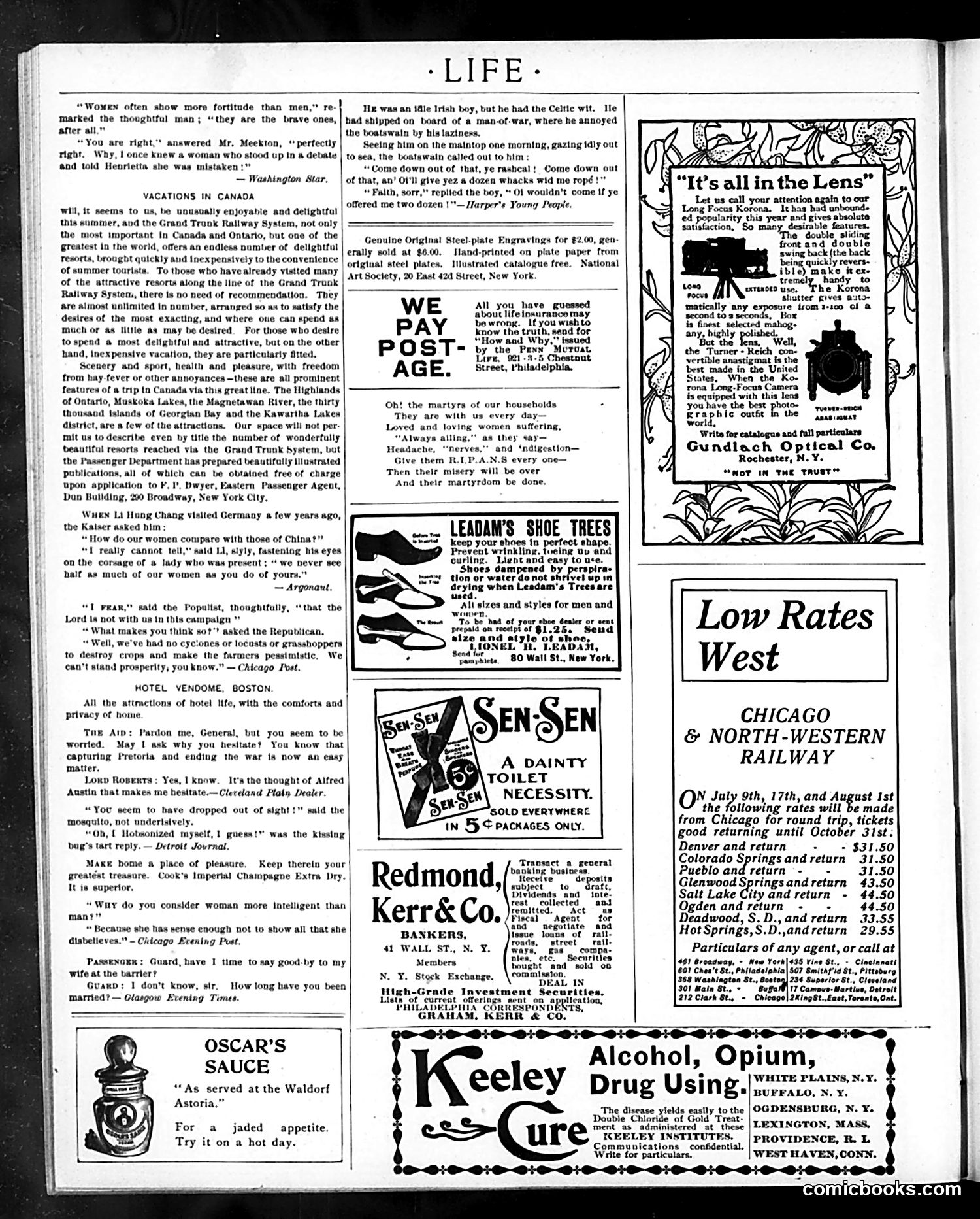
This is primarily a **humor and advertising page** from Life magazine's satirical section. The page contains several brief jokes and one notable cartoon reference: **Key Content:** The jokes mock gender relations and contemporary politics. One quip about a woman telling "Henrietta she was mistaken" satirizes male anxiety about women's assertiveness. Another references **Lord Roberts** hesitating to capture Pretoria during the **Boer War**, attributing his reluctance to poet **Alfred Austin**—a topical jab at Austin's unpopular war poetry. A "Hobsonized" joke references **Admiral Dewey's popular subordinate Hobson**, apparently meaning to self-aggrandize foolishly. **Advertisements** dominate the lower half, hawking shoe trees, railway excursions, alcohol-addiction "cures," and sauce—typical early-1900s commercial appeals. The page reflects turn-of-the-century concerns: gender role anxieties, imperial military campaigns, and dubious medical treatments. Modern readers miss the immediate topicality of these references without historical context.
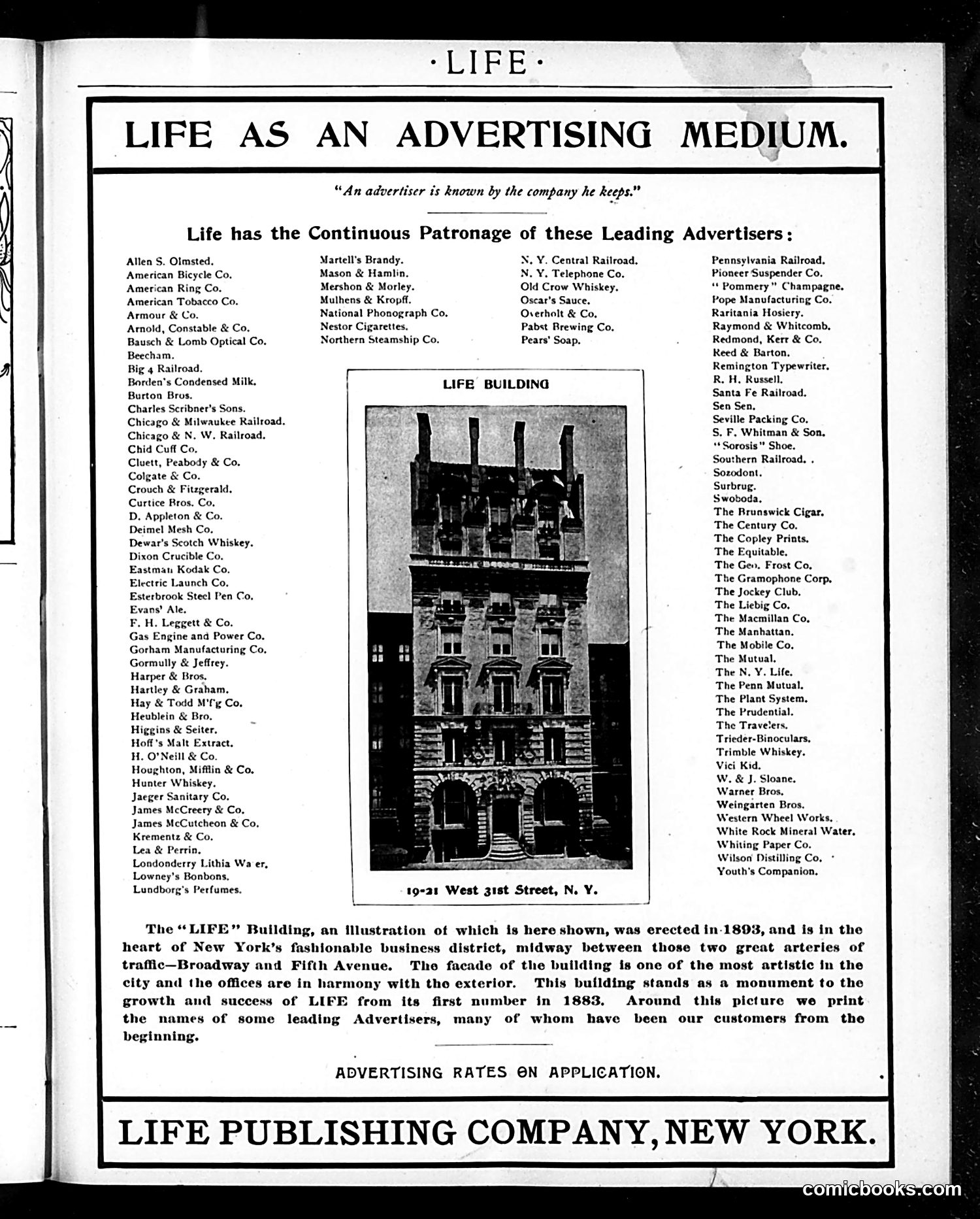
This is a **promotional advertisement**, not a political cartoon. It showcases Life Publishing Company's credibility as an advertising platform by displaying their newly erected office building (1893) at 19-21 West 31st Street in Manhattan. The page's central claim—"An advertiser is known by the company he keeps"—lists over 100 major American corporations (railroads, whiskey brands, typewriters, soaps, etc.) as evidence of Life's prestige and reach. By association with such prominent advertisers, Life establishes itself as a respectable, financially successful publication worthy of further advertising investment. The architectural photograph symbolizes the magazine's growth since its 1883 founding. This is essentially corporate self-promotion demonstrating market dominance through institutional grandeur and commercial endorsements.
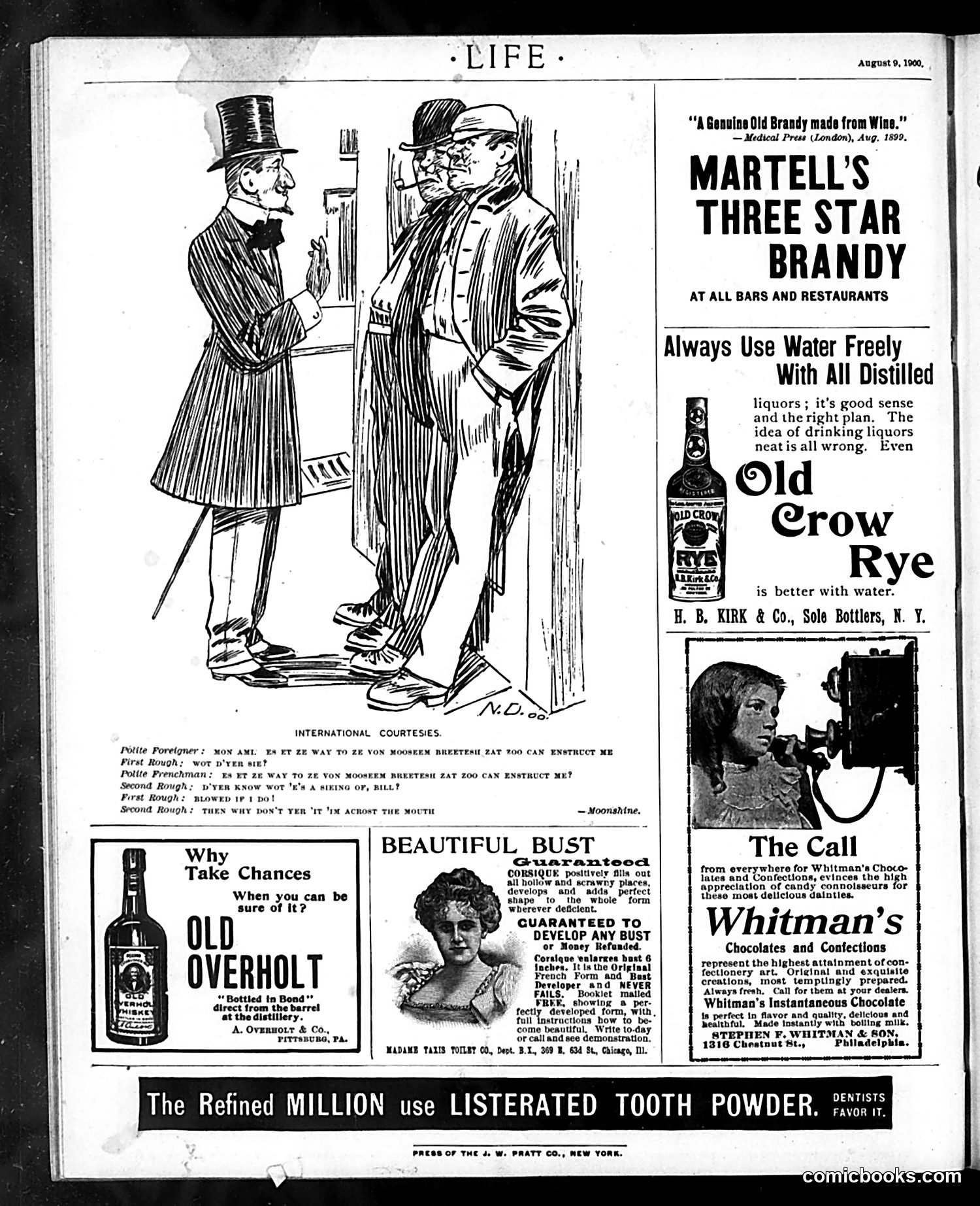
The main cartoon depicts "International Courtesies" — a dialogue between a formally dressed man in a top hat (labeled "Petit Foreigner," likely French based on the context) and a working-class American. The humor targets cultural misunderstandings between European and American men regarding alcohol consumption and etiquette. The caption dialogue, written in broken English/French accent, suggests the European visitor attempting to bond over drinking, asking questions the American finds absurd or offensive. The joke satirizes both European pretensions about refined drinking customs and American working-class defensiveness. The page is predominantly **advertising** for liquors (Martell's Brandy, Old Overholt whiskey, Old Crow Rye), beauty products (bust developers), chocolates, and tooth powder — typical consumer goods pitched to early-1900s readers. These ads reflect period anxieties about class status and personal appearance.