
Life, 1900-08-09 · page 6 of 20
Life — August 9, 1900 — page 6: what you’re looking at
What you’re looking at
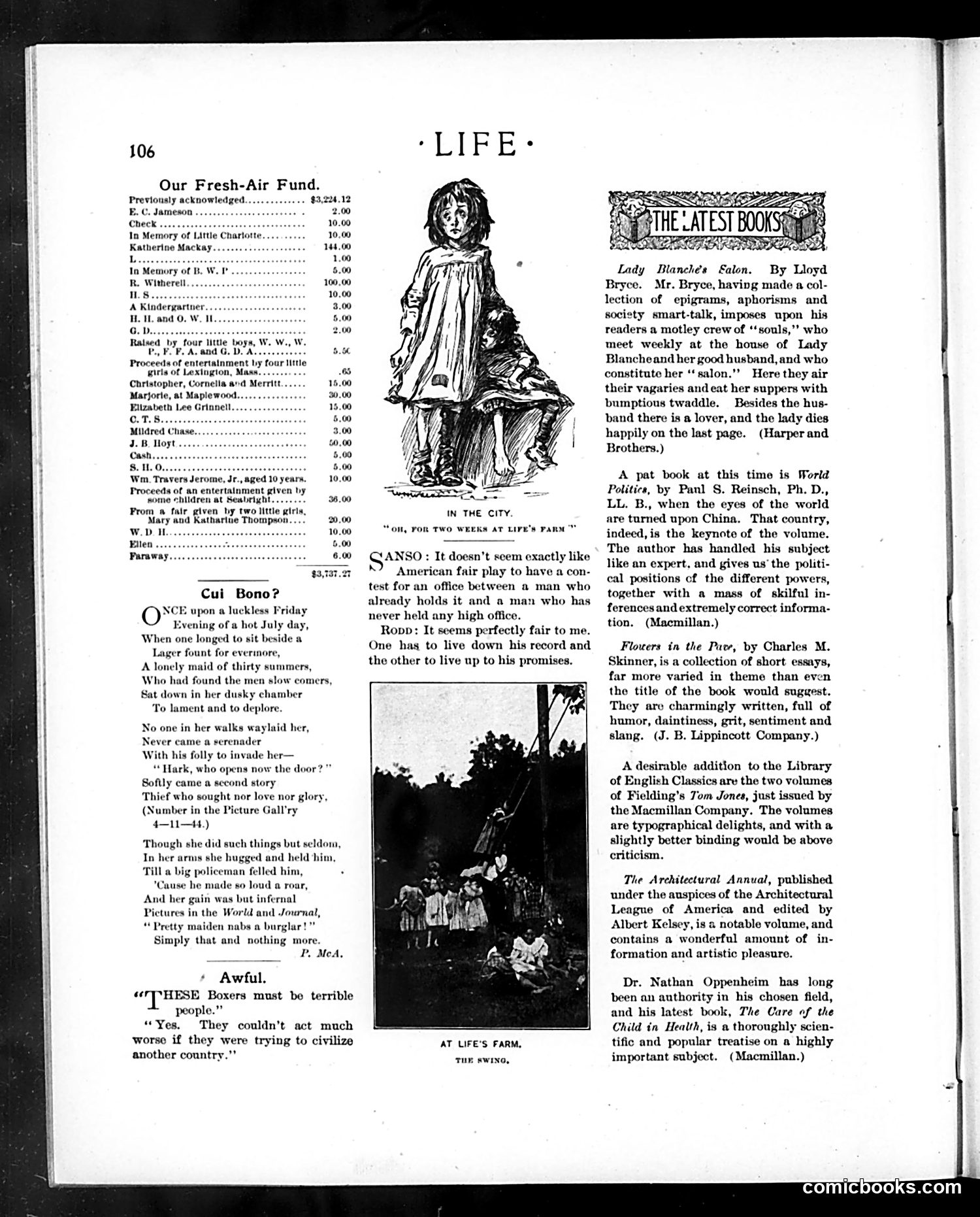
This page contains two distinct sections: **Left side:** A poem titled "Cui Bono?" (Latin: "Who benefits?") satirizing political corruption. The verse mocks bureaucratic hypocrisy—specifically someone climbing the social ladder while ignoring past misdeeds ("One has to live down his record"). The poem references a policeman and suggests cynical disregard for justice ("Simply that and nothing more"). **Right side:** Book reviews discussing recent publications, including works on China and architecture. **Center image:** "In the City" and "At Life's Farm" appear to be illustrations, likely contrasting urban versus rural life—a common satirical theme in this era examining American society. The page's overall tone critiques political opportunism and social hypocrisy typical of *Life* magazine's satirical approach to Gilded Age/Progressive Era American institutions.
📄 Transcribed text from this page (OCR, searchable)
Machine-transcribed from the original scan — historical spelling and the odd misread are preserved.
106 Our Fresh-Air Previously acknowledged E. C, Jameson . Check Fund. WFLPA, Procendeot cniertlatseat by four little girls of Lexington, Mass. . Christopher, Cornelia and Merritt Marjorie, at Maplewood. Elizabeth Lee Grinnelt ©.T. Mildres J.B Host Cash. 8.1. 3 Wm. Travers Jerome, Jr., aged 10 years, Proceeds of an entertalnment given by some children at Seabriy’ From a fair given by two little ars Mary and Kathariue Thompso: W.D IL Eien Faraway Cui Bono? upon a luckless Friday ening of a hot July day, o% E When one longed to sit beside a Lager fount for everinore, A lonely maid of thirty summers, Who had found the m Sat down in her dusky chamber lament and to deplore. one in her walks waylaid her, r came a serenader ith his folly to invade her— 5.00 10,00 6.00 20.00 10,00 6.00 6.00 n slow comers, “ Hark, who opens now the door?” Softly came a second story Thief who sought nor love nor glory, (Number in the Picture Gall'ry 4-11-44.) Though she did such things but seldom, In her armis she hugged and held him, Till a big policeman felled him, "Cause he made so loud a roar, And her gain was but infernal Pictures in the World and Journal, -retty maiden nabs a burglar!” Simply that and nothing more. P. McA * Awful. HESE Boxers must be terrible people. “Yes. They couldn't act m uch worse if they were trying to civilize another country.’ IN THE CITY. “On, POR TWO WEEKS AT LIFE’s PAR ANSO : It doesn’t seem exactly like American fair play to have a con- test for an office between a man who already holds it and a man who has never held any high office. Ropp: It seems perfectly fair to me. One has to live down his record and the other to live up to his promises. w AT LIFE'S FARM, TUN SWING, Blanchés Salon. By Lloyd Bryce. Mr. Bryce, having made a col- lection of epigrams, aphorisms and society smart-talk, imposes upon his readers a motley crew of ‘‘souls,’’ who meet weekly at the house of Lady Blancheand her good husband, and who constitute her ‘‘salon."’ Here they air their vagaries and eat her suppers with bumptious twaddle. Besides the hus- band there is a lover, and the lady dies happily on the last page. (Harper and Brothers.) A pat book at this time is World Politica, by Panl S. Reinsch, Ph. D, LL. B., when the eyes of the world are turned upon China. That country, indeed, is the keynote of the volume. The author has handled his subject like an expert, and gives us’ the politi- cal positions of the different powers, together with a mass of skilful in- ferences and extremely correct informa- tion. (Macmillan.) Flowers in the Pace, by Charles M. Skinner, is a collection of short essays, far more varied in theme than even the title of the book would suggest. They are charmingly written, fall of humor, daintiness, grit, sentiment and slang. (J. B. Lippincott Company.) A desirable addition to the Library of English Classics are the two volumes of Fielding’s Tom Jones, just issued by the Macmillan Company. The volumes are typographical delights, and with a slightly better binding would be above criticism. The Architectural Annual, published under the auspices of the Architectural League of America and edited by Albert Kelsey, is a notable volume, and contains a wonderful amount of in- formation and artistic pleasure. Dr. Nathan Oppenheim has long been an authority in his chosen field, and his latest book, The Care of the Child in Health, is a thoroughly scien- tific and popular treatise on a highly important subject. (Macmillan.)