
Life, 1900-08-09 · page 8 of 20
Life — August 9, 1900 — page 8: what you’re looking at
What you’re looking at
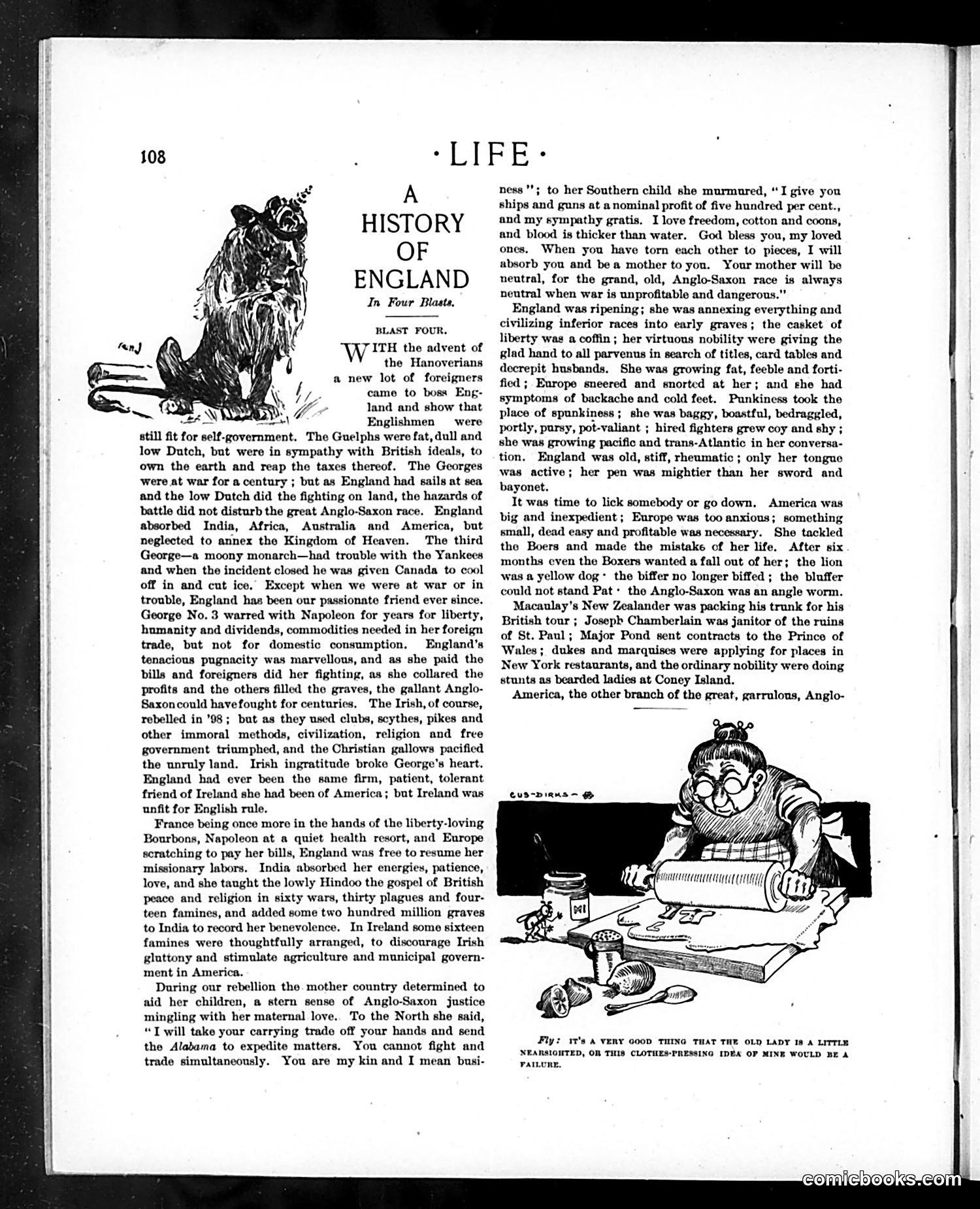
This page satirizes British imperial decline through allegorical female personification. The text describes England as aging, weakening, and losing her former vigor—"stiff, rheumatic," with "tongue...active" but "pen mightier than her sword and bayonet." The accompanying cartoon depicts an elderly woman hunched over, struggling with a clothes-pressing device, captioned: "It's a very good thing that the old lady is a little nearsighted, or this clothes-pressing idea of mind would be a failure." The satire suggests Britain, personified as an aging figure, is failing to maintain her global position. The cartoon implies she's literally flattening herself through effort, unable to see her own decline. This reflects post-WWI anxieties about British imperial power waning relative to emerging competitors like America.
📄 Transcribed text from this page (OCR, searchable)
Machine-transcribed from the original scan — historical spelling and the odd misread are preserved.
‘LIFE * A HISTORY OF ENGLAND In Four Blasts, BLAST FOUR. 7 ITH the advent of the Hanoverians a new lot of foreigners came to boss Eng- land and show that Englishmen were mment. The Guelphs were fat, dull and low Dutch, but were in sympathy with British ideals, to own the earth and reap the taxes thereof. The Georges were at war for a century ; but as England had sails at sea and the low Dutch did the fighting on land, the hazards of battle did not disturb the great Anglo-Saxon race. England absorbed India, Africa, Australia and America, but neglected to annex the Kingdom of Heaven. The third George—a moony monarch—had trouble with the Yankees and when the incident closed he was given Canada to cool off in and cut ice. Except when we were at war or in trouble, England has been our passionate friend ever since. George No. 3 warred with Napoleon for years for liberty, humanity and dividends, commodities needed in her foreign trade, but not for domestic consumption, England's tenacious pugnacity was marvellous, and as she paid the bills and foreigners did her fighting, as she collared the profits and the others filled the graves, the gallant Anglo- Saxoncould havefought for centuries. The Irish, of course, rebelled in '98; but as they used clubs, scythes, pikes and other immoral methods, civilization, religion and free government triumphed, and the Christian gallows pacified the unruly land. Irish ingratitude broke George's heart. England had ever been the same firm, patient, tolerant friend of Ireland she had been of America; but Ireland was unfit for English rule. France being once more in the hands of the liberty-loving Bourbons, Napoleon at a quiet health resort, and Europe scratching to pay her bills, England was free to resume her missionary labors. India absorbed her energies, patience, love, and she taught the lowly Hindoo the gospel of British peace and religion in sixty wars, thirty plagues and four- teen famines, and added some two hundred million graves to India to record her benevolence. In Ireland some sixteen famines were thoughtfully arranged, to discourage Irish glattony and stimulate agriculture and municipal govern- ment in America. During our rebellion the. mother country determined to aid her children, a stern sense of Anglo-Saxon justice mingling with her maternal love. To the North she said, “T will take your carrying trade off your hands and send the Alabama to expedite matters. You cannot fight and trade simultaneously. You are my kin and I mean busi- ness’; to her Southern child she murmured, “I give you ships and guns at anominal profit of five hundred per cent., and my sympathy gratis. I love freedom, cotton and coons, and blood is thicker than water. God bless you, my loved ones. When you have torn each other to pieces, I will absorb you and bea mother to you. Your mother will be neutral, for the grand, old, Anglo-Saxon race is always neutral when war is unprofitable and dangerous.”” England was ripening; she was annexing everything and civilizing inferior races into early graves; the casket of liberty was a coffin; her virtuous nobility were giving the glad hand to all parvenus in search of titles, card tables and decrepit husbands, She was growing fat, feeble and forti- fied ; Europe sneered and snorted at her; and she had symptoms of backache and cold feet. Punkiness took the place of spunkiness ; she was baggy, boastful, bedraggled, portly, pursy, pot-valiant ; hired fighters grew coy and shy ; she was growing pacific and trans-Atlantic in her conversa- tion. England was old, stiff, rheumatic ; only her tongue was active; her pen was mightier than her sword and bayonet. It was time to lick somebody or go down. America was big and inexpedient ; Europe was too anxious; something small, dead easy and profitable was necessary. She tackled the Boers and made the mistake of her life. After six months even the Boxers wanted a fall out of her; the lion was a yellow dog’ the biffer no longer biffed; the bluffer could not stand Pat: the Anglo-Saxon was an angle worm. Macaulay's New Zealander was packing his trunk for his British tour ; Joseph Chamberlain was janitor of the ruins of St. Paul; Major Pond sent contracts to the Prince of Wales; dukes and marquises were applying for places in New York restaurants, and the ordinary nobility were doing stunts as bearded ladies at Coney Island. America, the other branch of the great, garrulons, Anglo- Cus-DiRns~ @ Fly: t's A VERY GOOD THING THAT THE OLD LADY 18 A LITTLE NEARSIONTED, OR THIS CLOTHES-PRESSING IDEA OP MINE WOULD BE 4 FAILURE.