
A complete issue · 20 pages · 1900
Life — March 22, 1900
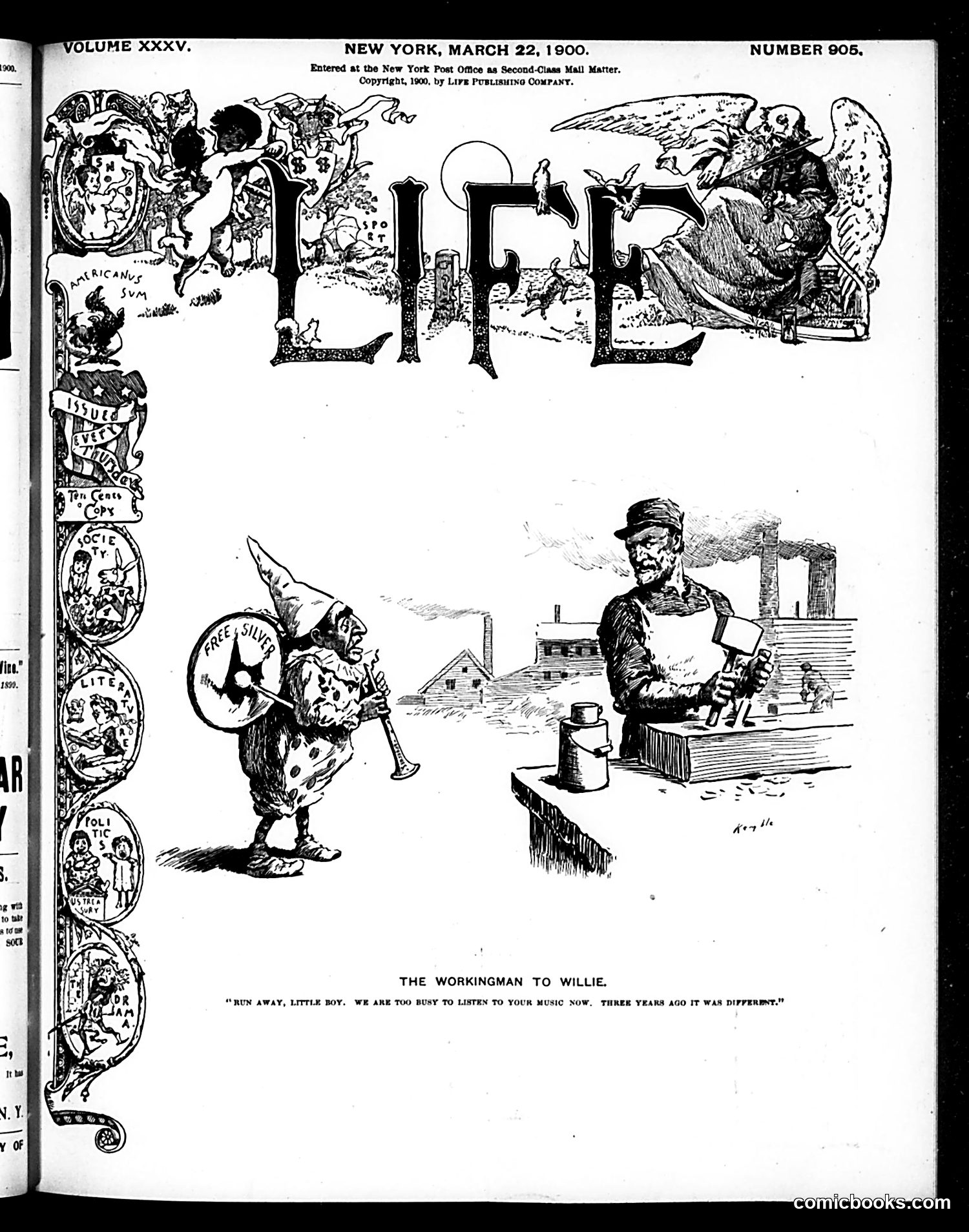
This 1900 *Life* magazine cartoon contrasts two figures: on the left, a gnome-like character labeled "Free Silver" (a major political issue of the 1890s-1900 era), and on the right, a working-class man with an axe. The caption reads: "Run away, little boy. We are too busy listening to your music now. Three years ago it was different." The satire targets the decline of "Free Silver" as a political movement. Around 1896-1897, Free Silver—the idea of unlimited coinage of silver—had energized workingmen and populist politics. By 1900, it had lost momentum as an issue. The cartoon mocks how workers have moved on from this once-compelling cause, dismissing it as childish noise ("music") compared to their current concerns. The workingman's axe suggests he's focused on labor itself rather than monetary policy.
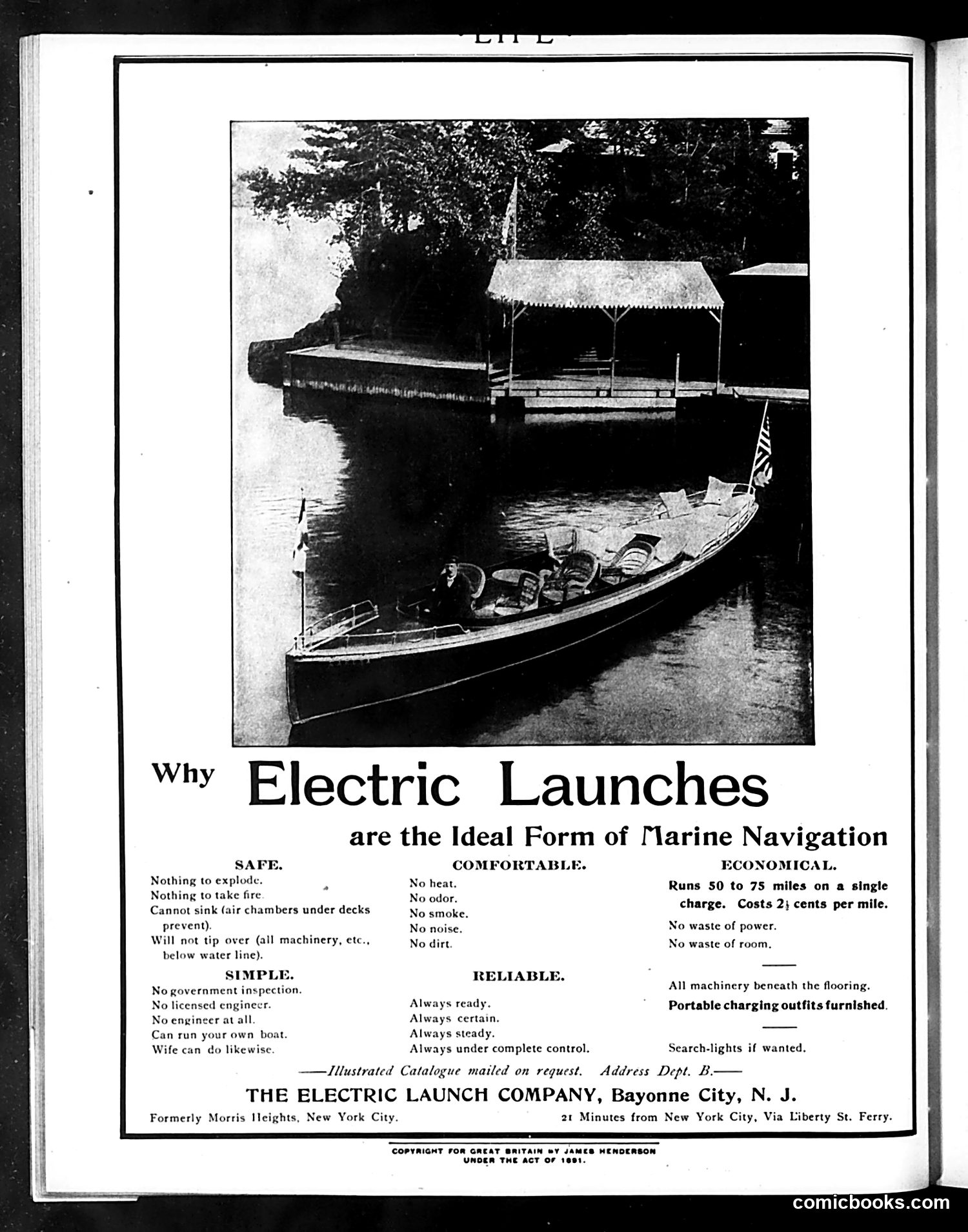
This is **not a political cartoon or satire**—it's a straightforward advertisement for electric launches (small motorboats) by The Electric Launch Company of Bayonne, New Jersey. The ad promotes electric boats as superior to gasoline-powered vessels for recreational boating. Key selling points include safety (no explosions or fire risk), comfort (no heat, smell, or noise), simplicity (no government inspection or licensed engineer required), reliability, and economy (2.5 cents per mile). The photograph shows a small electric launch moored near a boathouse on what appears to be the Hudson River. The ad emphasizes that even a wife could operate the vessel—reflecting early-20th-century assumptions about technology and gender. This represents the pre-gasoline era when electric vehicles were considered cutting-edge alternatives.
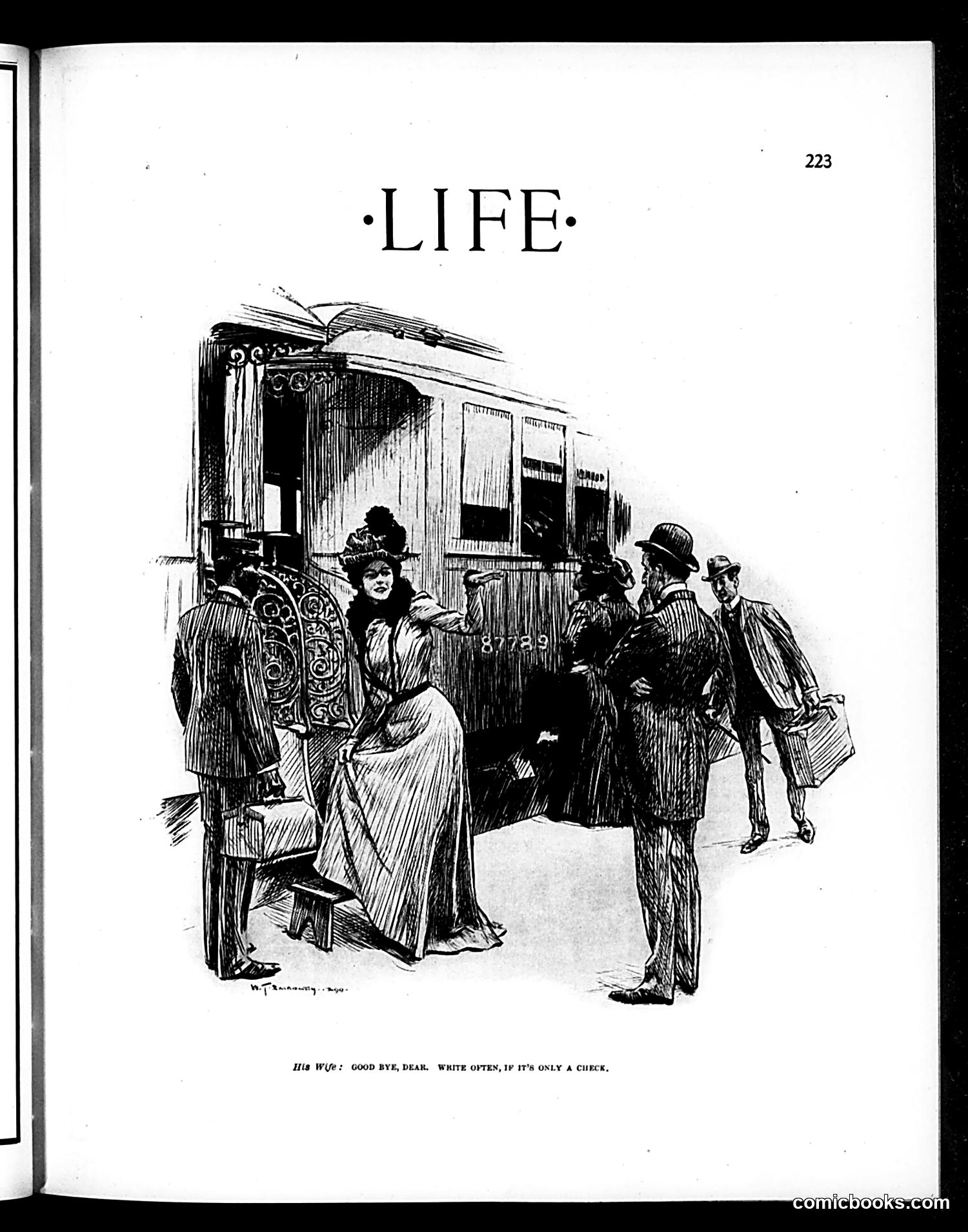
This illustration depicts a scene at a train station, where a well-dressed woman seated in the doorway of a railway car says goodbye to a man. The caption reads: "HIS WIFE: GOOD BYE, DEAR. WRITE OFTEN, IF IT'S ONLY A CHECK." The satire targets marital dynamics and women's financial dependence. The joke suggests that the departing husband's most meaningful communication will be monetary checks rather than affectionate letters. This reflects early 20th-century social commentary on marriages perceived as transactional, where wives awaited financial support during husbands' travels. The illustration's formal dress and train setting indicate upper-class subjects, suggesting satire aimed at wealthy society's relationship conventions.
The page contains three satirical editorial pieces without accompanying cartoons visible in this image. The main topics discussed are: 1. **General Corbin and military reform**: Criticism of Corbin's ambitions to become Major-General despite lacking battlefield distinction, arguing soldiers—not politicians—should lead the army. 2. **Secretary Root and the Porto Rican tariff**: Commentary on Root's legal work drafting tariff legislation, suggesting politicians use lawyers to accomplish unpopular measures while avoiding direct responsibility. 3. **Lieutenant-Governor Woodruff's vice-presidential aspirations**: A satirical piece mocking Woodruff's fashion sense (wrist watches, ruffled cuffs) and suggesting his qualifications for higher office are questionable. The satire focuses on military and political ambition, using personal ridicule and institutional critique typical of early-1900s Life magazine commentary.
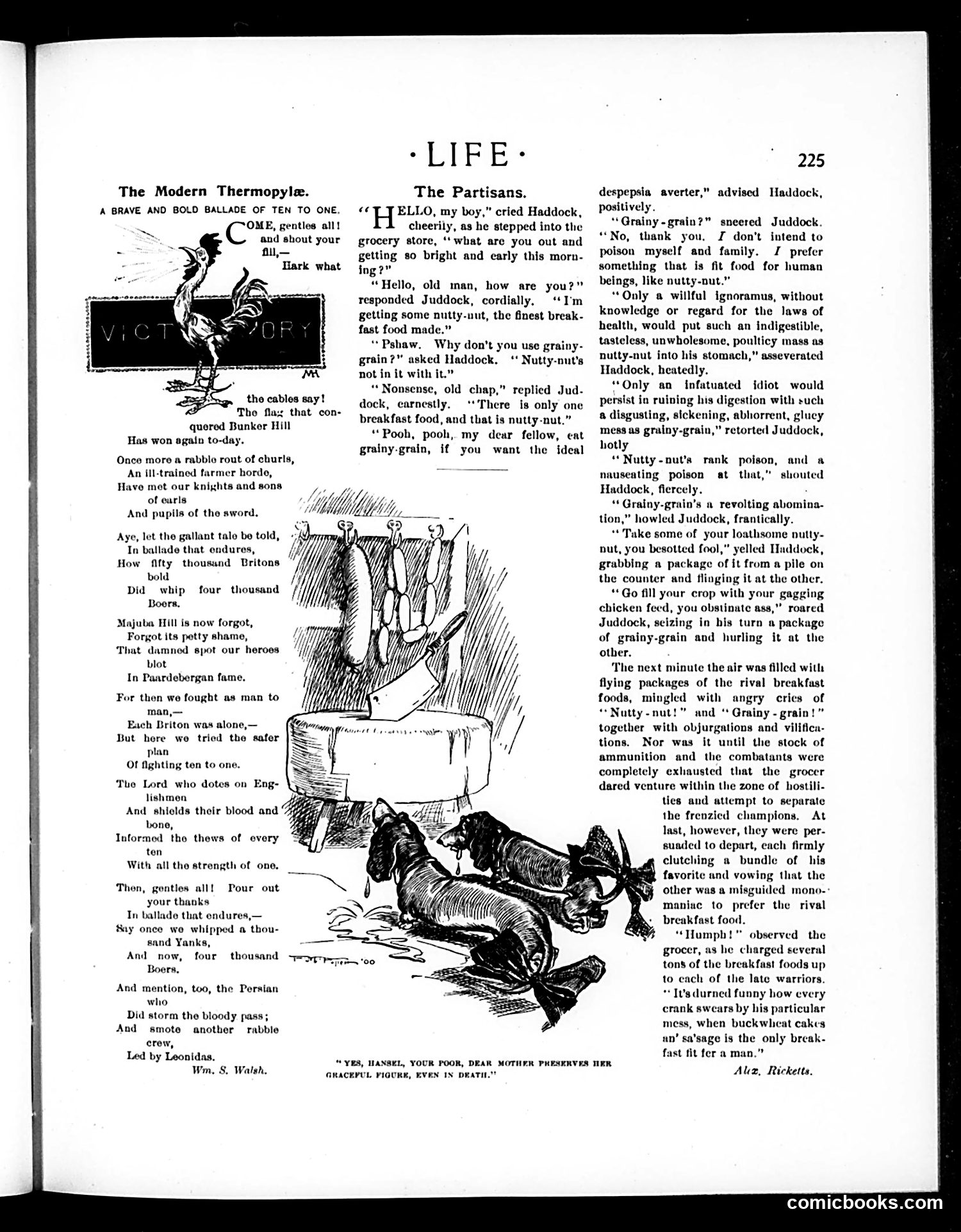
This satirical piece mocks a fierce dispute between two grocery merchants, Haddock and Juddock, over rival breakfast cereals: "nutty-nut" versus "grainy-grain." The humor lies in escalating the trivial commercial competition into mock-heroic warfare, complete with poetic battle descriptions and classical references (invoking "Majuba Hill" and Persian conflicts). Two men are shown fighting violently over cereal boxes. The satire targets American commercial rivalries and aggressive advertising tactics of the era, where competing food manufacturers made exaggerated health claims. By treating a breakfast cereal dispute with grandiose military language, the piece ridicules both the merchants' competitive fervor and consumers' gullibility toward marketing claims about these essentially identical products.
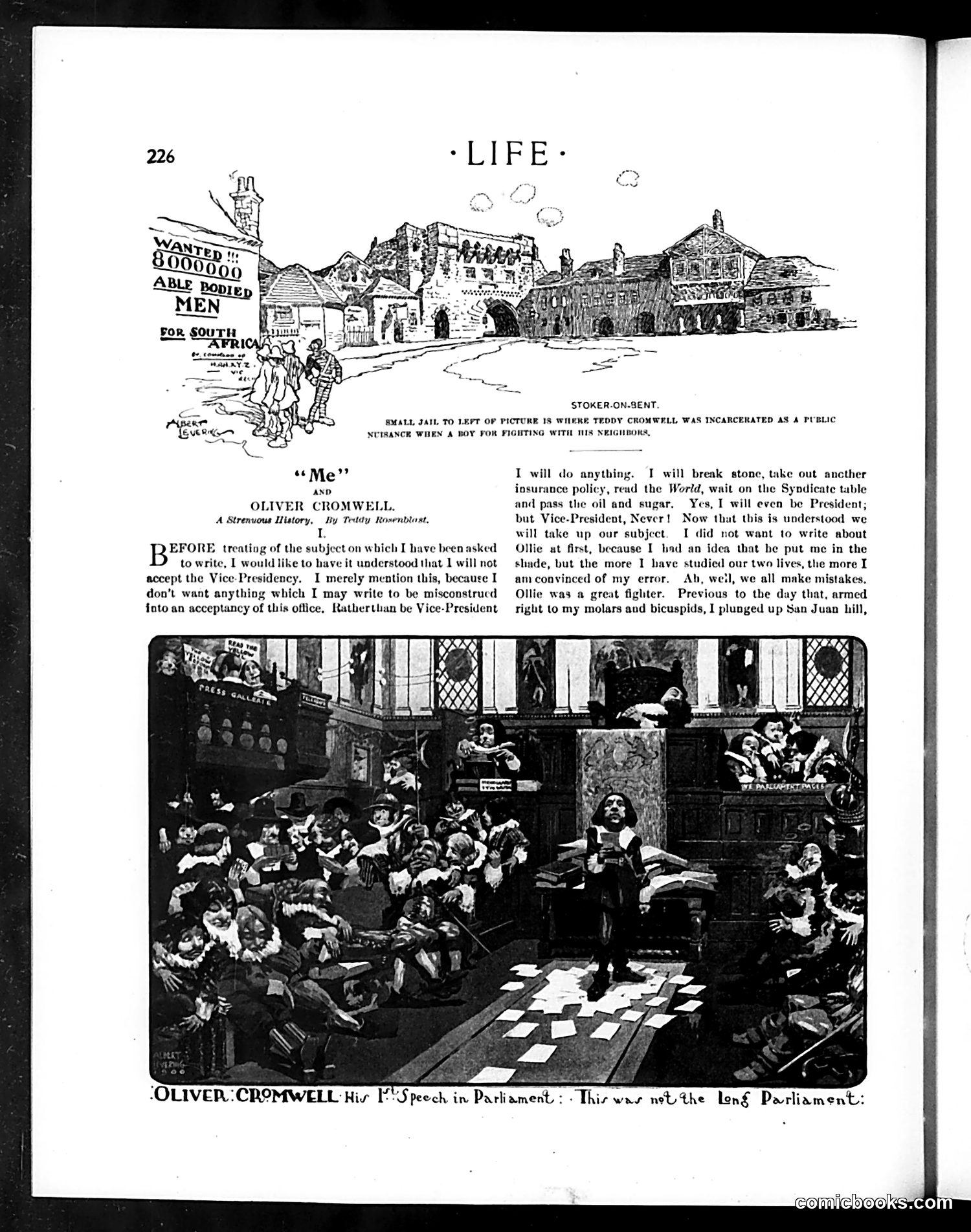
This page satirizes **Oliver Cromwell**, the 17th-century English military and political leader. The top illustration shows Stoker-on-Bent, where Cromwell was allegedly jailed as a boy for fighting a neighbor. The main article presents Cromwell's first-person voice, where he claims he'll do "anything"—break laws, read seditious material, even become Vice-President—to achieve his goals. He defends his youthful fighting and justifies his actions as necessary. The large illustration below depicts Cromwell addressing Parliament, labeled "This was not the long Parliament," showing him as a forceful, commanding figure dominating the chamber. The satire likely critiques Cromwell's authoritarianism and moral flexibility, using historical commentary to comment on contemporary political ambition and power-seeking behavior.
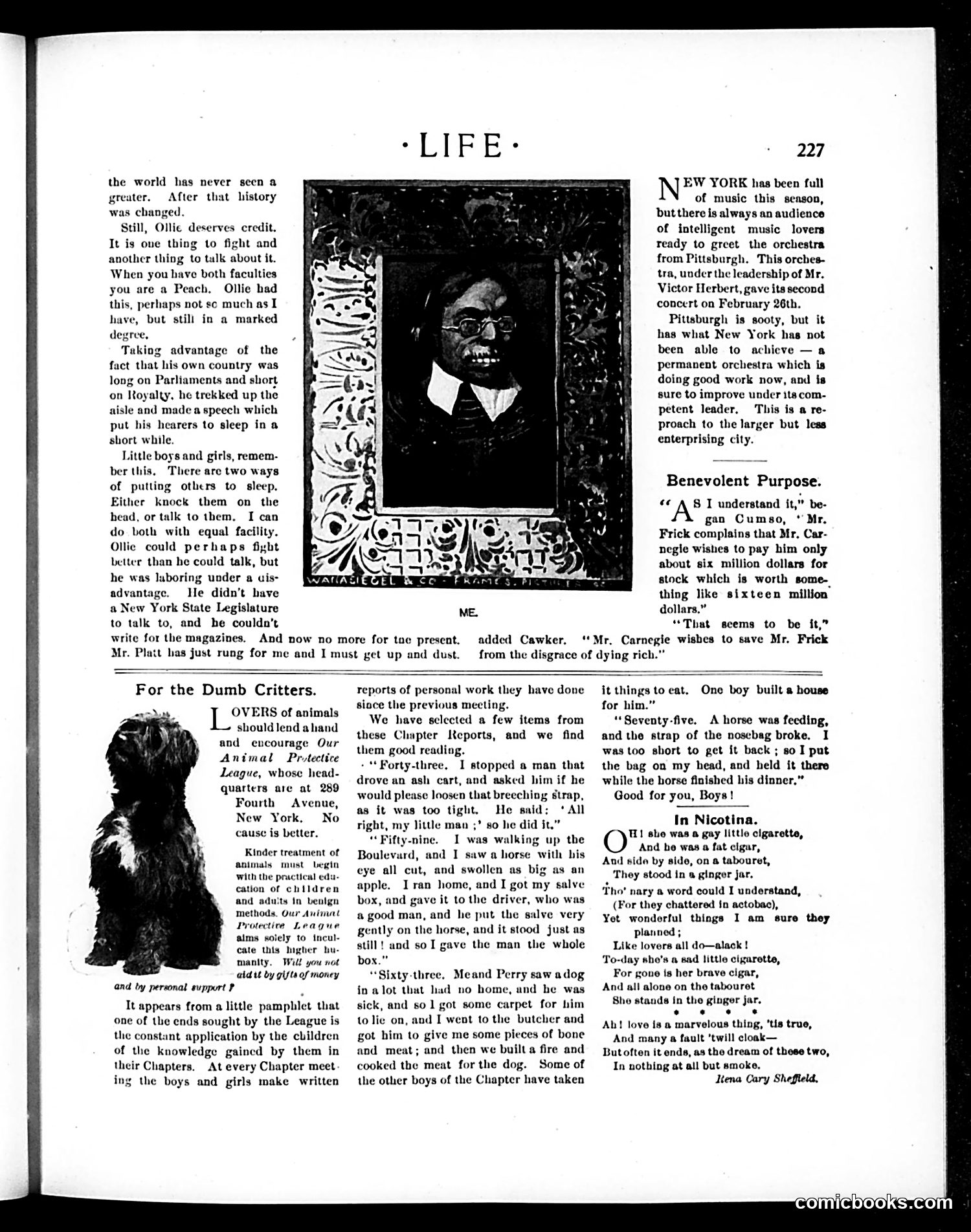
This page contains several distinct articles and illustrations rather than a single cartoon. The central portrait appears to be of a notable figure, though the OCR and image quality prevent certain identification. The main content includes: 1. **"For the Dumb Critters"** - An article about the Animal Protective League (headquarters at 289 Fourth Avenue, New York), advocating humane treatment of animals. It includes anecdotes about children helping injured horses and dogs, suggesting animal welfare awareness. 2. **"In Nicotina"** - A humorous poem about smoking, with satirical tone regarding cigarette use. 3. **Articles on music and cultural topics** addressing New York versus Pittsburgh orchestras. The page reflects early 20th-century progressive concerns about animal welfare and urban cultural institutions, presented through *Life*'s characteristic mix of satire, social commentary, and illustration.
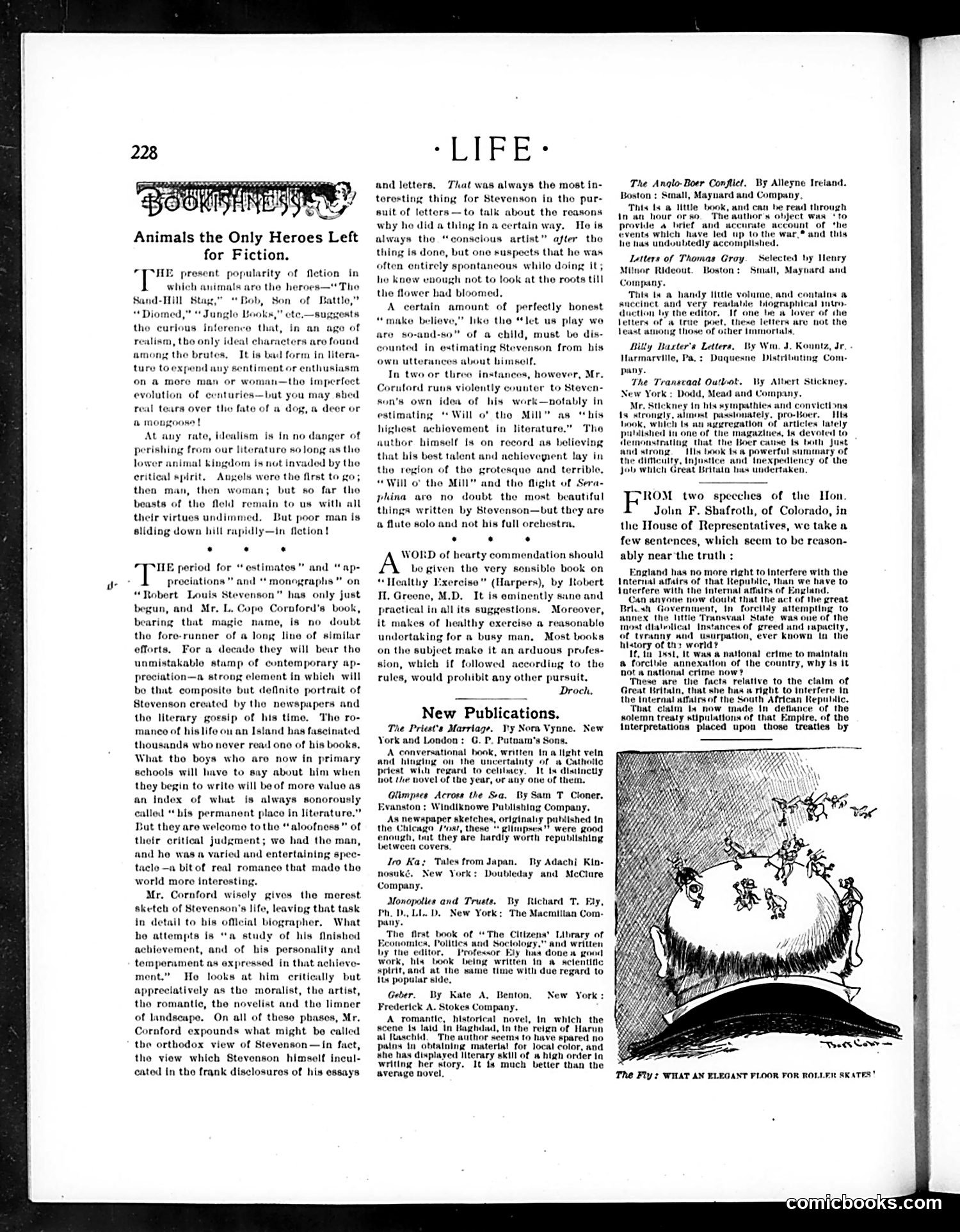
This page is primarily **book reviews and literary discussion**, not political satire. The main article, "Animals the Only Heroes Left for Fiction," critiques Robert Louis Stevenson's work and literary trends. It argues that modern literature relies too heavily on animal characters rather than human heroes. The single cartoon at bottom right, captioned "The Fly: What an Elegant Floor for Roller Skates," shows a fly observing what appears to be a smooth surface—likely satirizing the fly's perspective on human spaces. This is a **gentle visual joke** about scale and perception rather than political commentary. The page primarily serves as a **book review section** rather than satirical commentary on current events.
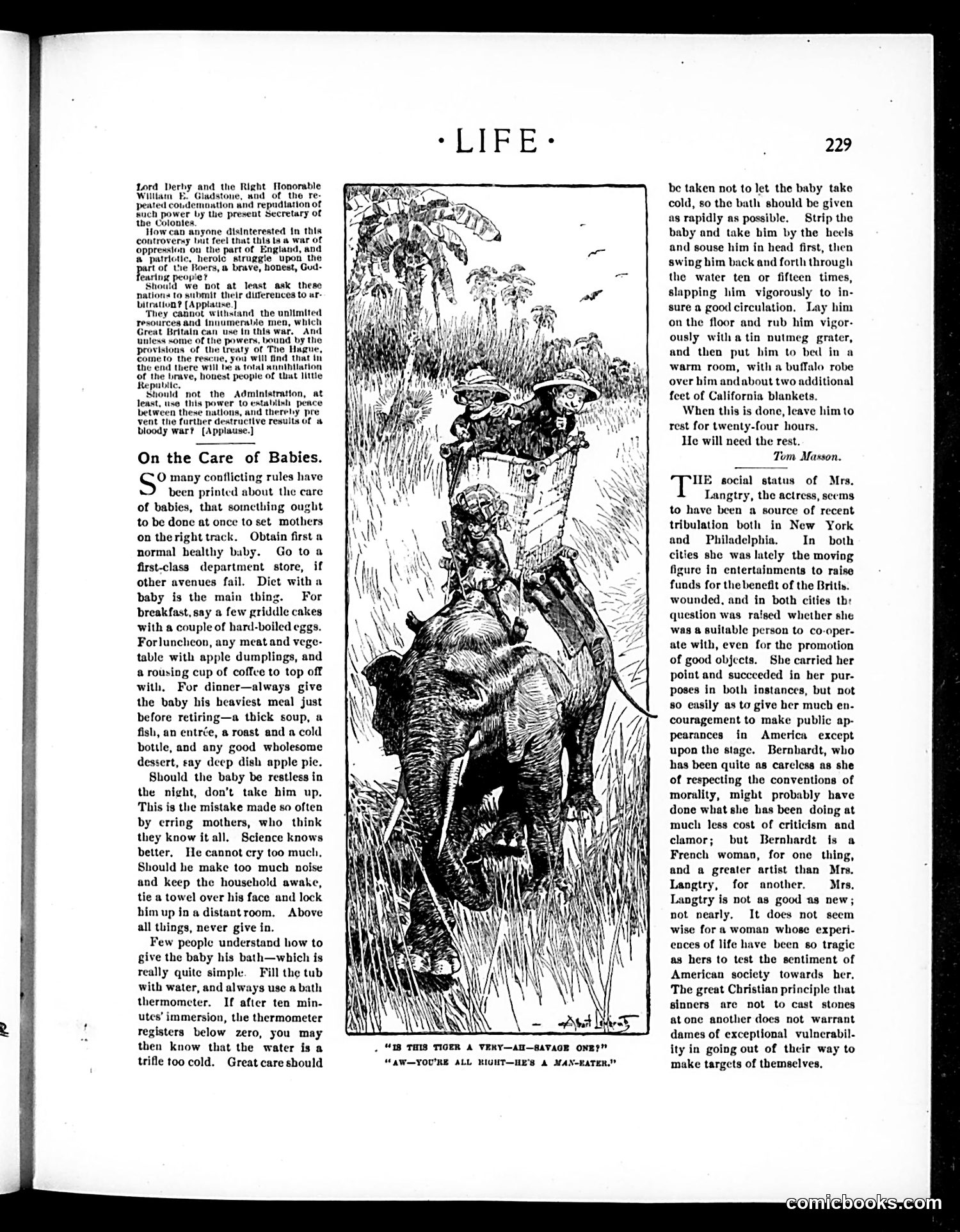
The central illustration depicts a tiger attacking a man in tall grass, with the caption "IS THIS TIGER A VERY—AH—SAVAGE ONE?" and the response "AW—YOU'RE ALL RIGHT—HE'S A MAN-EATER." This appears to be a visual joke playing on the double meaning of "man-eater"—both a tiger that hunts humans and (colloquially) a predatory woman. The cartoon likely satirizes anxieties about aggressive, independent women of the era. The page also contains an article "On the Care of Babies" offering practical infant care advice, and text discussing Mrs. Langtry, a famous actress whose social status and fundraising efforts for wounded British soldiers sparked controversy about whether she was an appropriate public figure.
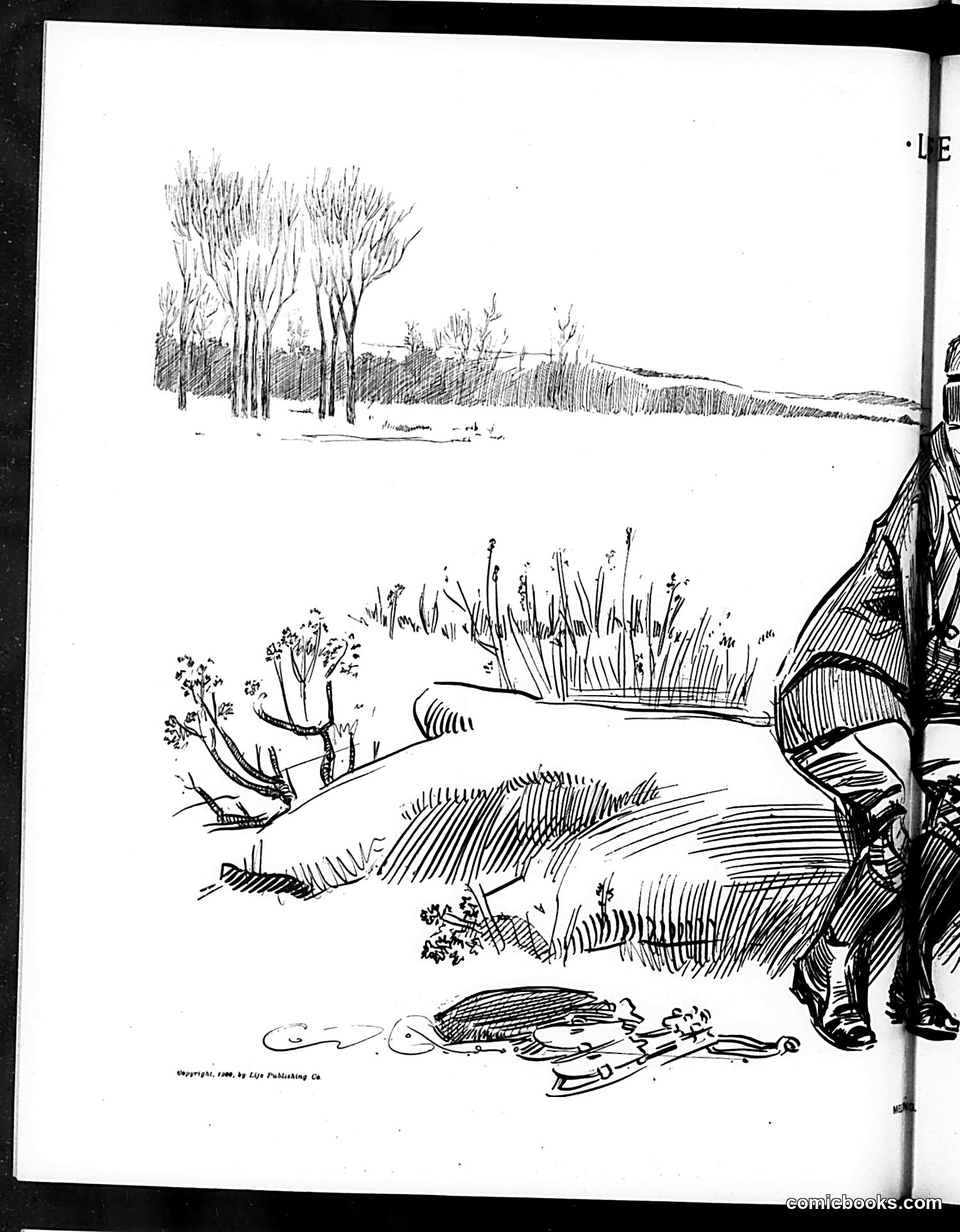
I can see this is a pen-and-ink illustration showing a fishing scene with a person standing on the right holding a fishing rod, with a caught fish displayed at the bottom of the page. The landscape includes trees, water, vegetation, and rolling hills in the background. However, without clearer OCR text or visible captions identifying specific political figures or satirical references, I cannot reliably determine what this cartoon is meant to satirize. The image appears to be from Life magazine's public-domain era, but the satirical point—whether it comments on a politician, social trend, or current event—is not evident from the visual elements alone. To accurately explain the satire to a modern reader, I would need legible text identifying the figures or context.
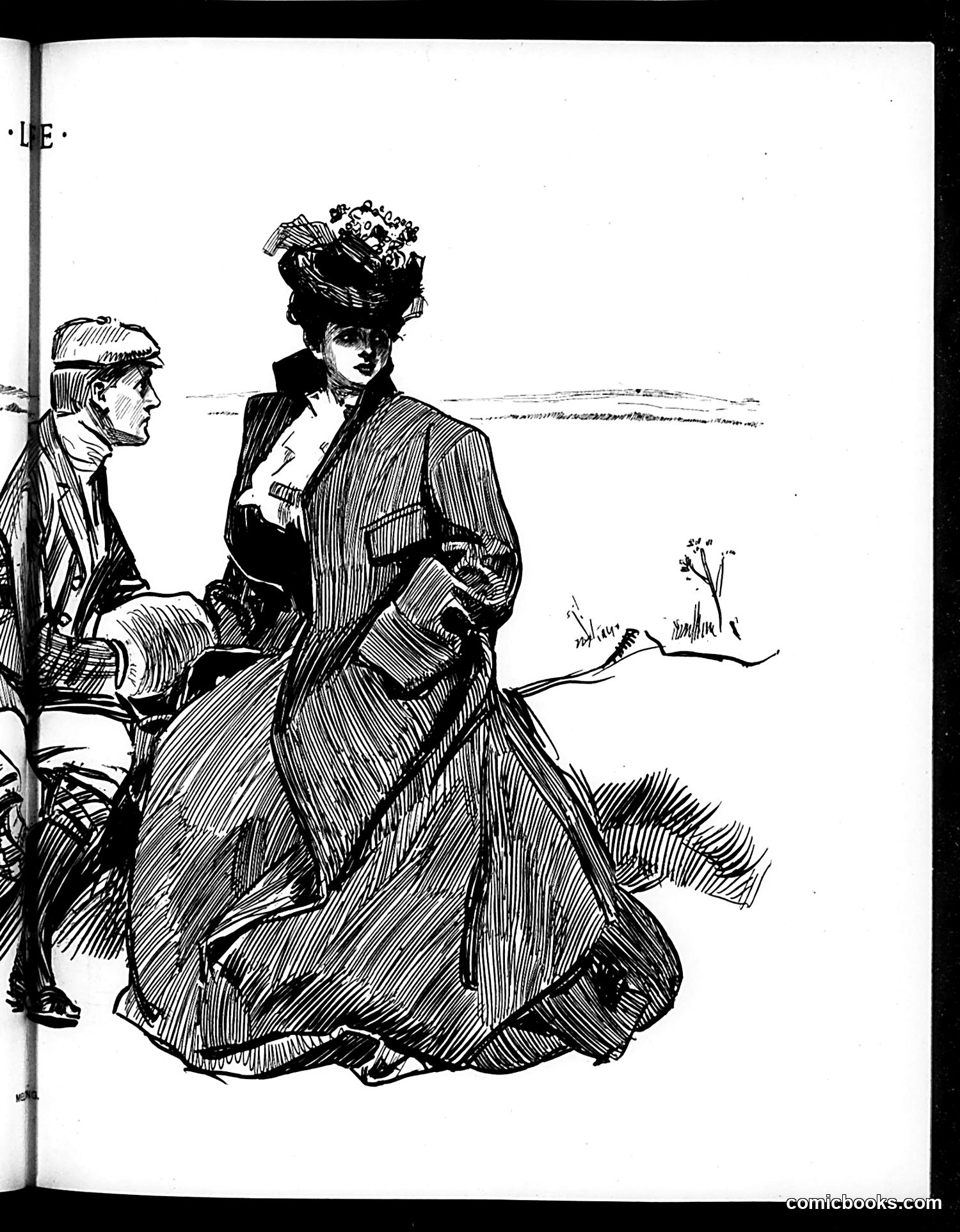
I can see this is a pen-and-ink illustration from *Life* magazine showing two figures in late 19th or early 20th-century dress in an outdoor setting. The woman wears an elaborate outfit with a full skirt and ornate hat topped with decorative elements; the man sits beside her in simpler attire. However, without visible text or captions identifying the specific figures or satirical point, I cannot definitively explain what political or social commentary this cartoon makes. The style and composition suggest social satire—possibly about gender roles, class differences, or fashion—but the OCR text provided contains only "LIFE" and appears incomplete. To accurately explain the satire's meaning, I would need legible captions or article text accompanying this illustration.
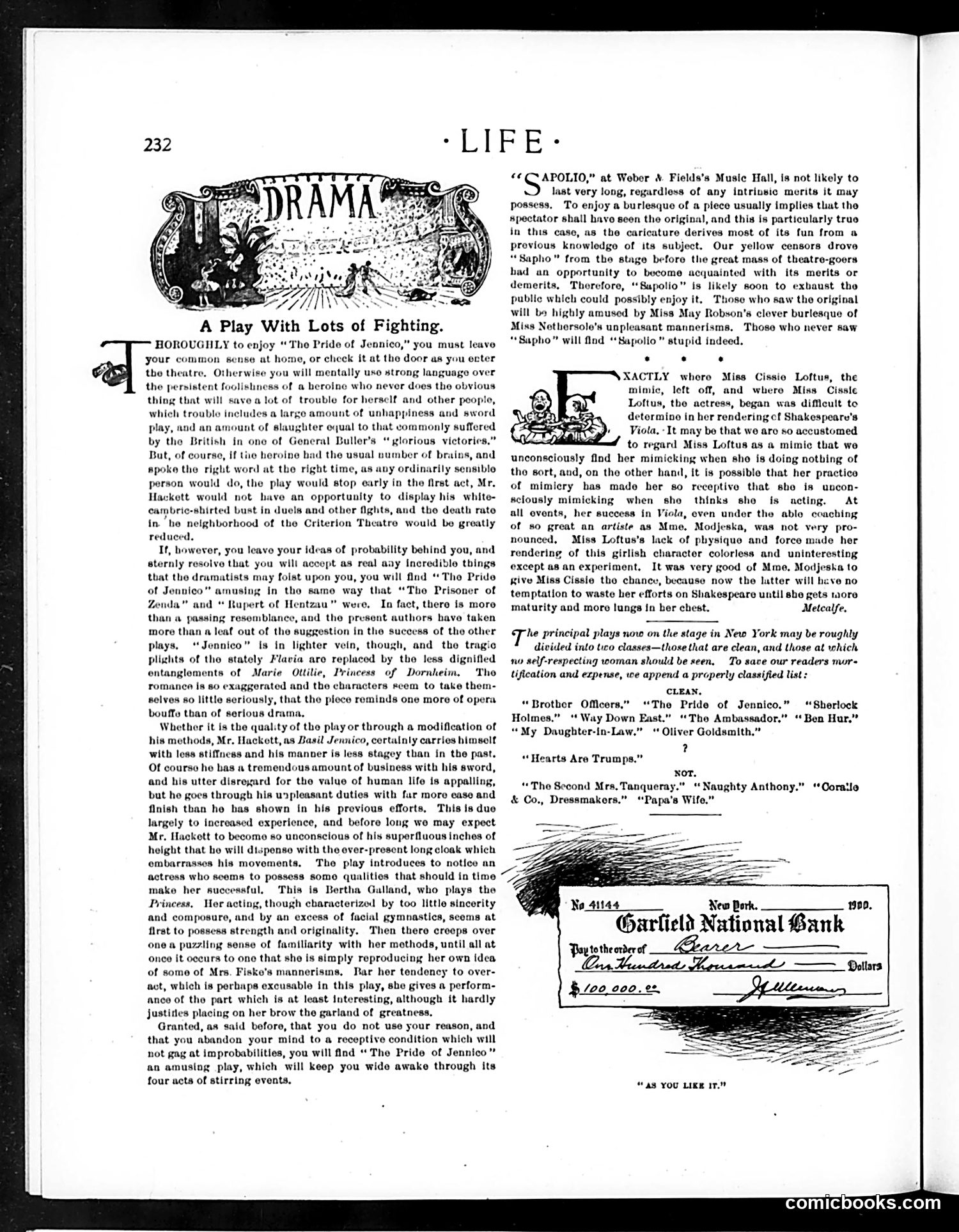
This page contains theatrical criticism rather than political satire. The main article, "A Play with Lots of Fighting," reviews "The Pride of Jennico," critiquing its plot mechanics and violence. The text discusses several theatrical productions and performers, including Miss May Robson's "burlesque" and Miss Ciscie Loftus's mimicry work in "Viola." The critic argues these plays rely too heavily on fighting and action rather than substantive drama. A bank check from Garfield National Bank appears as an advertisement at the bottom. The "DRAMA" header and ornate theatrical illustration indicate this is entertainment criticism for a general audience interested in New York theater, not political commentary.
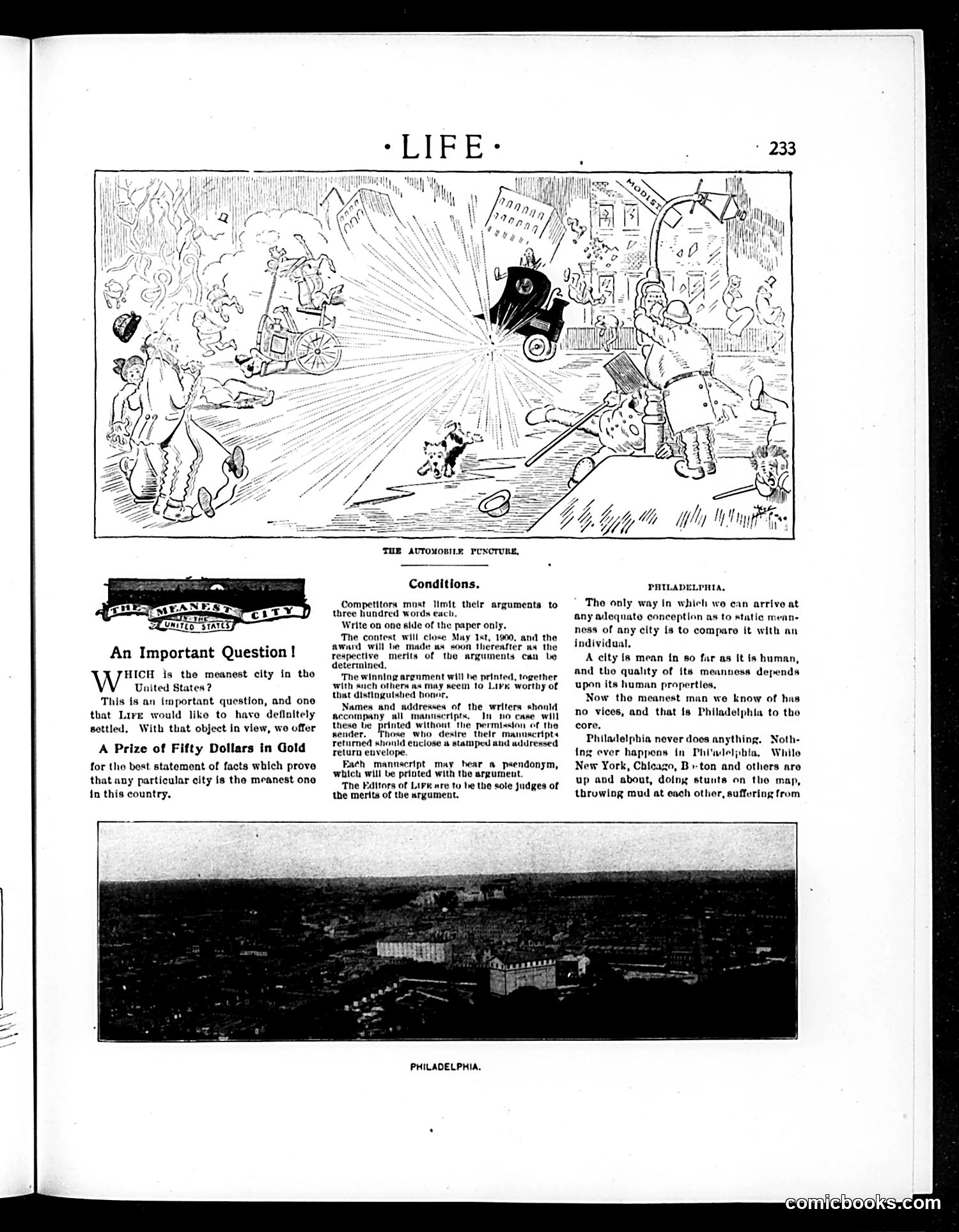
This page announces a satirical competition asking readers to identify "the meanest city in the United States," offering a $50 gold prize for the best 300-word argument. **The cartoon** at top ("The Automobile Puncture") depicts the chaos of early motorcar culture—vehicles colliding, pedestrians scattering, general mayhem—reflecting contemporary anxiety about this new technology. **The satire's target**: Philadelphia. The text argues that a city's "meanness" correlates with human activity. Philadelphia's "meanness," it claims, stems not from vice but from *inactivity*—it "never does anything." While New York, Chicago, and Boston create spectacles (including mutual conflict), Philadelphia remains passive and dull, making it uniquely "mean" through mediocrity rather than malice. This reflects turn-of-the-century urban rivalry and Philadelphia's reputation as a staid, conservative city lacking the dynamism of newer commercial hubs. The joke targets Philadelphia's perceived sluggishness rather than moral failings.
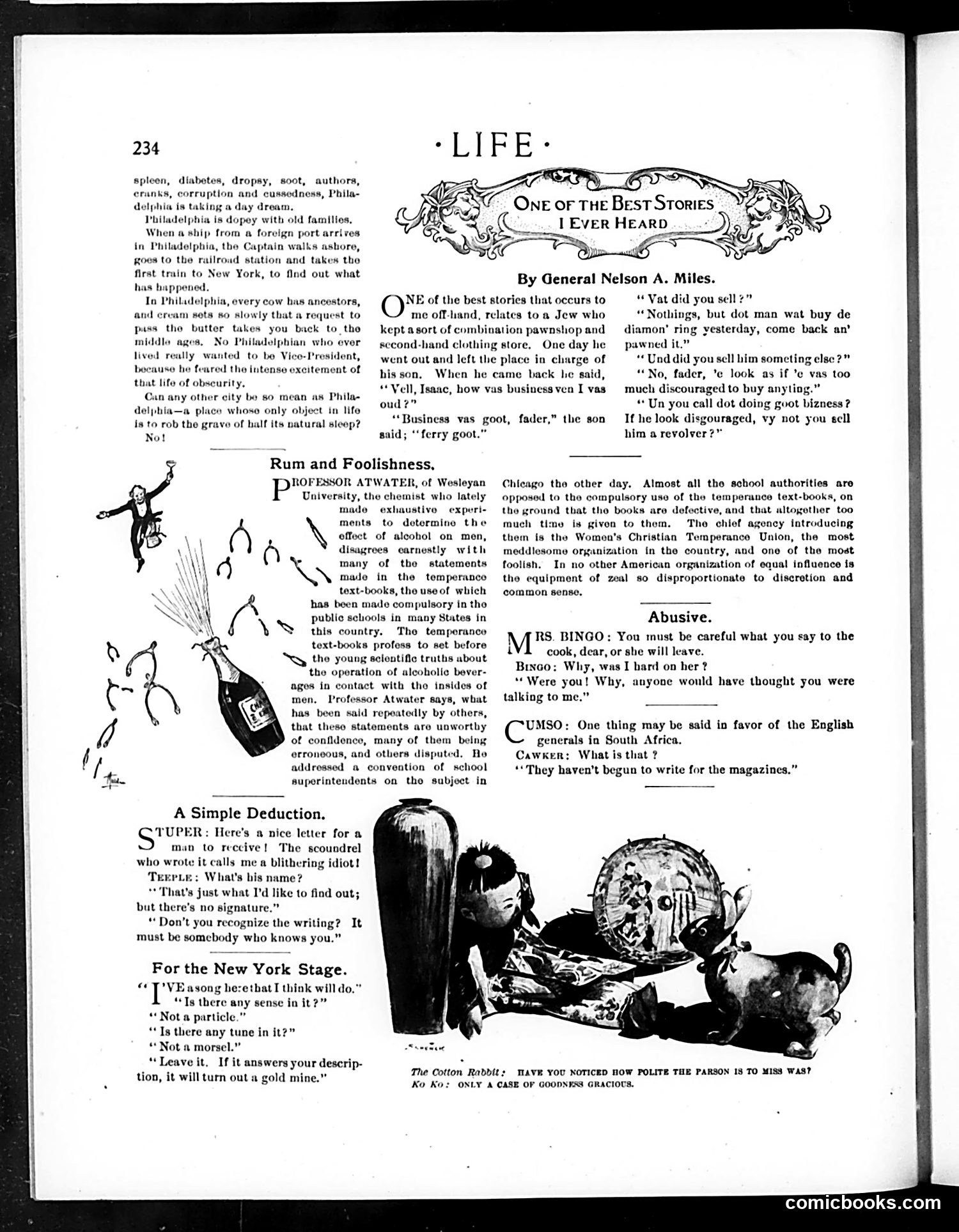
This page from *Life* magazine contains several satirical pieces: **"One of the Best Stories Ever Heard"** by General Nelson A. Miles presents a Jewish pawnbroker stereotype joke. The humor relies on dialect humor (phonetic spelling of Yiddish-accented English) and a punchline suggesting the son should have sold the discouraged customer a revolver—dark satire about despair and suicide. **"Rum and Foolishness"** critiques temperance advocacy in schools. It attacks the Women's Christian Temperance Union (WCTU) as "meddlesome" and their mandatory temperance textbooks as scientifically inaccurate, citing Professor Atwater's research. This reflects ongoing debates about alcohol education and women's activist organizations. The remaining brief comedic exchanges mock writing quality, marital dynamics, and British military generals. **Historical context**: This reflects early 1900s attitudes toward Jewish immigrants, ongoing temperance movement conflicts, and skepticism toward women's reform organizations—common *Life* magazine targets of this era.
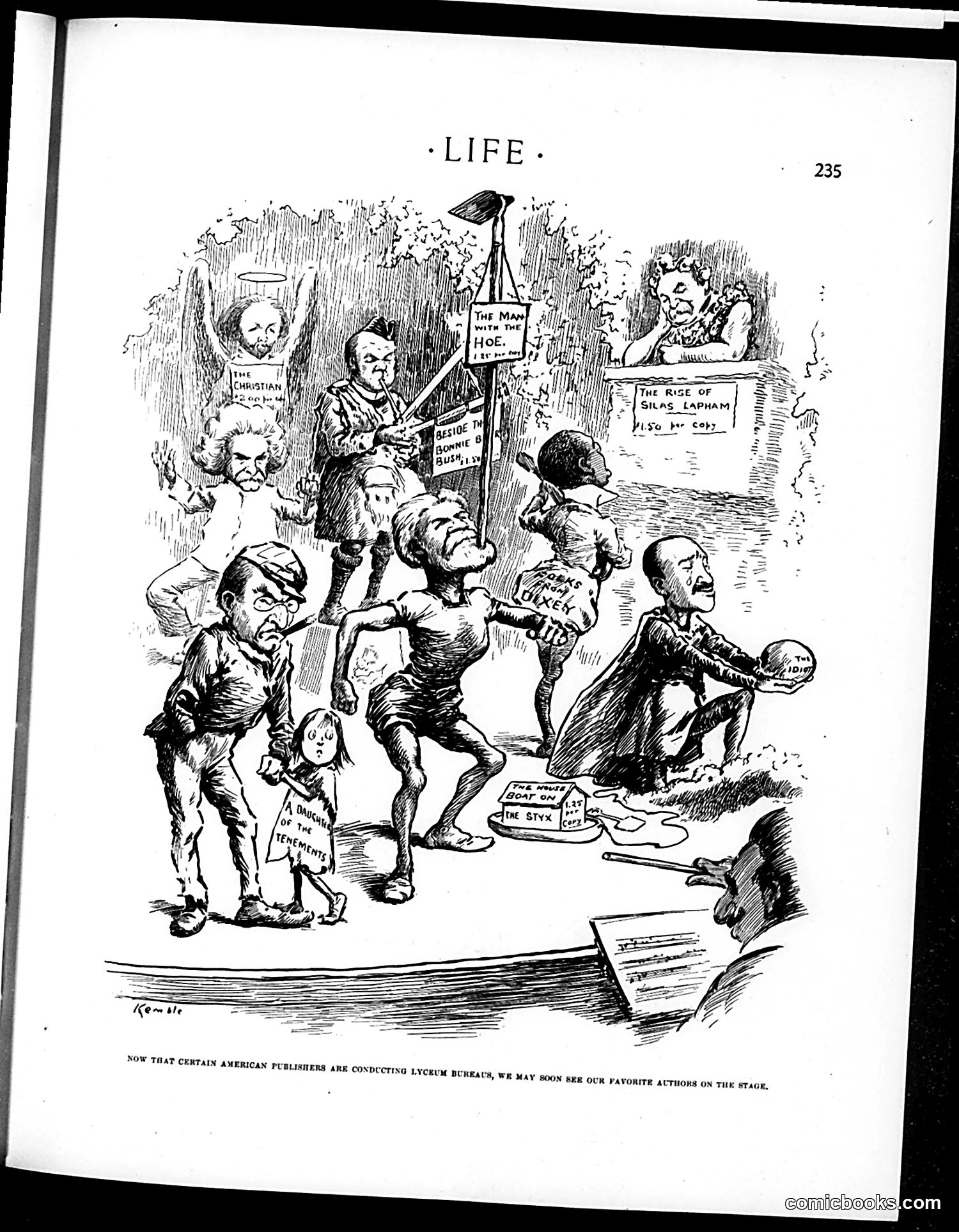
This is a satirical cartoon titled "LIFE" (page 235) criticizing American book publishers. The caption states: "NOW THAT CERTAIN AMERICAN PUBLISHERS ARE CONDUCTING LYCEUM BUREAUS, WE MAY SOON SEE OUR FAVORITE AUTHORS ON THE STAGE." The cartoon depicts caricatured figures (likely prominent authors of the era) being paraded like circus performers or puppets by publishers. Visible signs reference literary works including "The Rise of Silas Lapham" and "The Man with the Hoe." The satire mocks publishers' recent practice of establishing lyceum bureaus—lecture agencies that booked authors for public performances. The cartoon suggests this commercialization treats serious literary figures as mere entertainment commodities, reducing distinguished authors to carnival attractions controlled by profit-seeking publishers rather than allowing them to maintain intellectual dignity.
This page contains **two satirical short stories** from early 1900s Life magazine, plus advertisements. **"A Happy Little Girl"** (left): A whimsical poem mocking cramped urban apartment living. The joke is that a girl living in a tiny flat has no room for anything—not even her hat, mouth, or pessimism. It's social satire on how poverty and poor housing conditions constrain even basic human expression. **"The Gun Store" (right)**: A man enters a sporting goods store and impresses the clerk by using technical jargon about shotguns ("choke bores," "damascus," etc.), appearing to be an experienced hunter. After buying the gun and returning furious—unable to hit anything despite days of hunting—the clerk reveals the punchline: the man bought **blank ammunition**. The satire targets pretentious posturing and the gap between claimed expertise and actual competence. Both stories use humorous situations to mock contemporary social types.
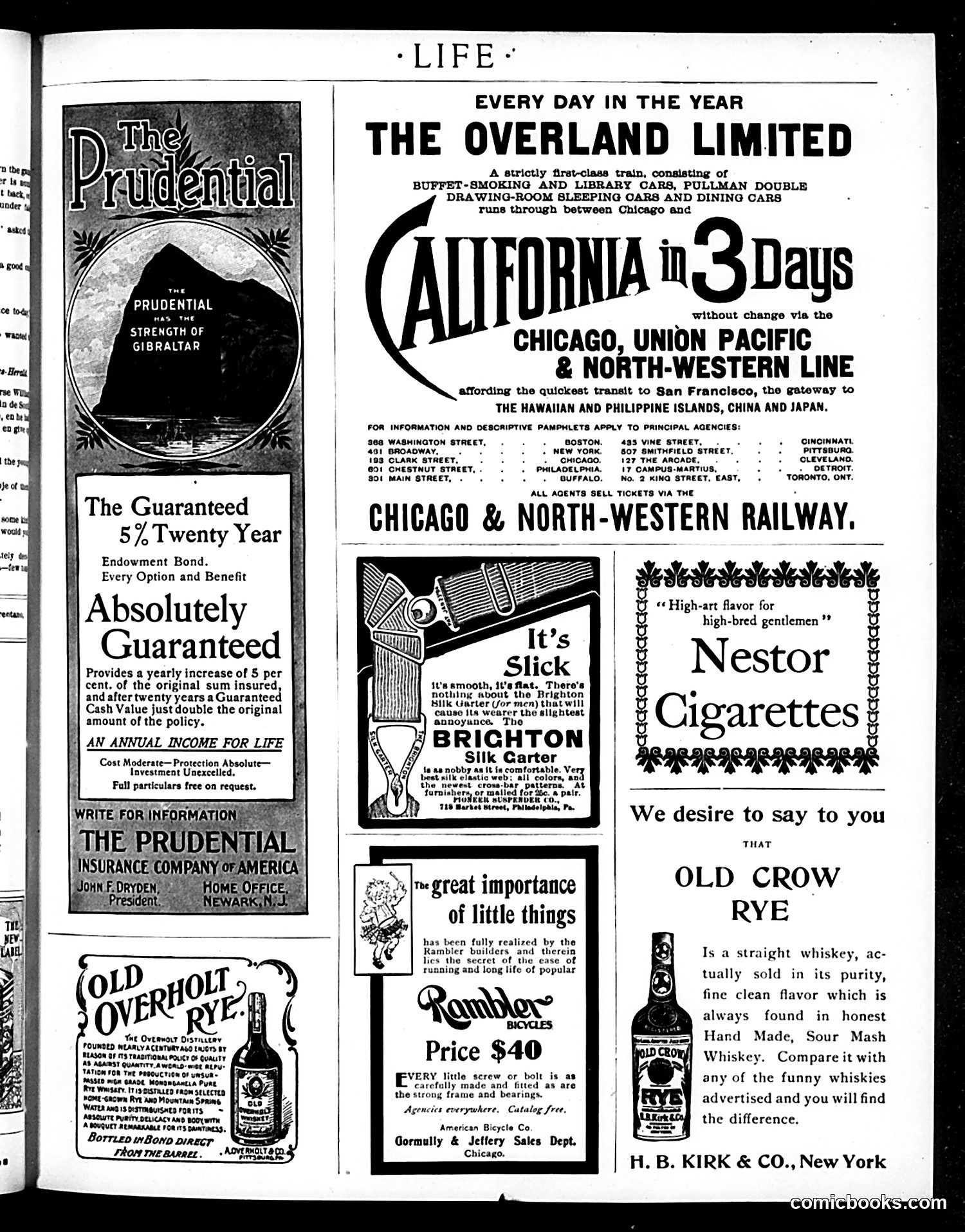
This is predominantly an **advertising page** from an early 20th-century Life magazine, containing no political cartoons or satire requiring historical unpacking. The page features period product advertisements typical of the era: - **Transportation**: The Overland Limited train (Chicago to California in 3 days via Union Pacific) - **Financial services**: Prudential Insurance's 5% endowment bonds - **Consumer goods**: Brighton silk garters, Rambler bicycles ($40), Nestor cigarettes, and whiskey brands **Notable for modern readers**: The casual marketing of cigarettes and whiskey alongside insurance and transportation reflects an era before tobacco/alcohol advertising restrictions. The language—"high-art flavor for high-bred gentlemen"—reflects class-conscious marketing conventions of the period. **The only visual element** is a simple silhouette of Gibraltar accompanying the Prudential ad, using the rock's symbolic strength to promote financial security—straightforward metaphorical advertising with no satirical intent.
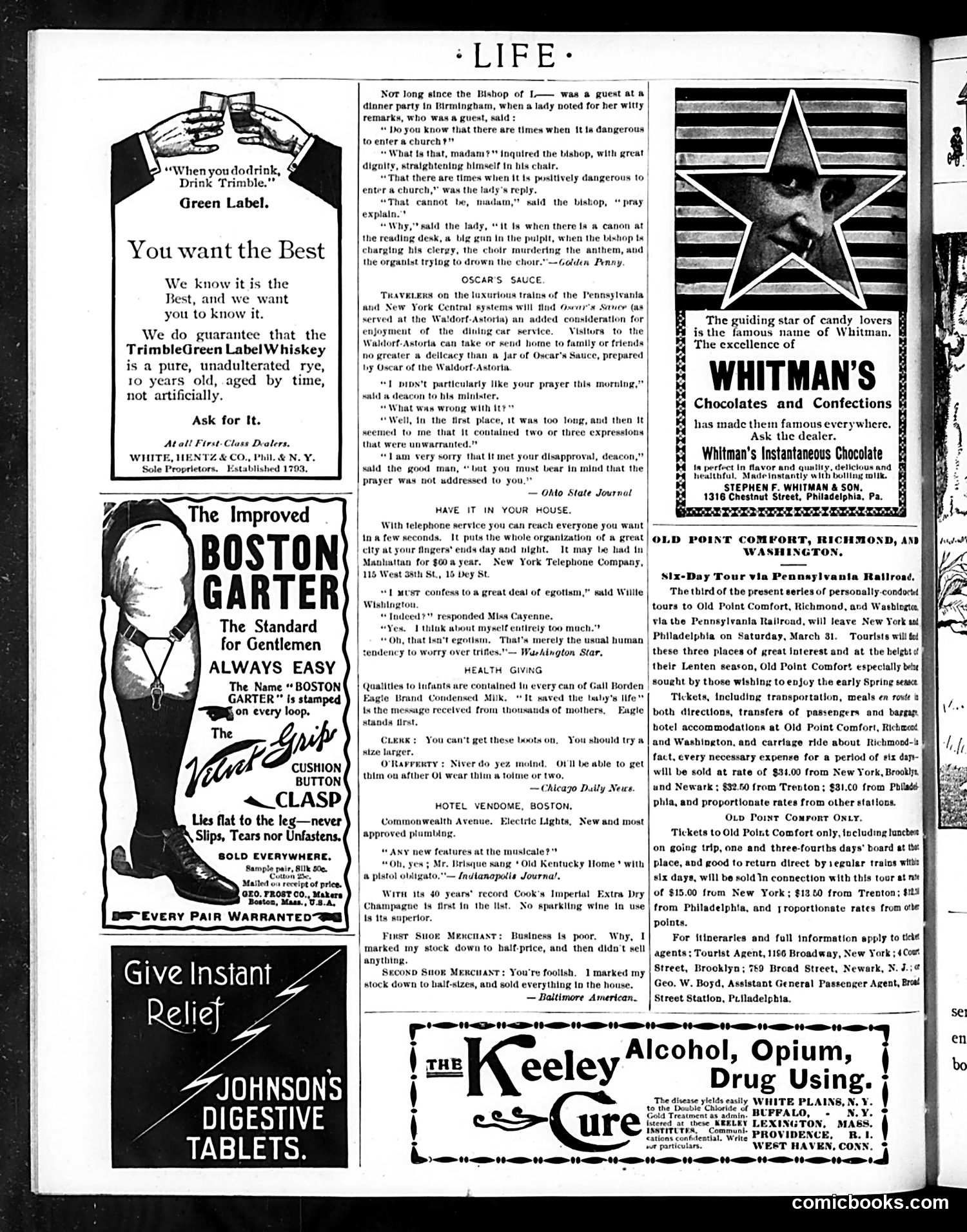
This page is primarily **advertising** interspersed with brief humor pieces, typical of early 20th-century magazines. The main satirical content includes: 1. **"When you do drink, Drink Trimble"** - Advertisement for whiskey emphasizing purity and age. 2. **The Bishop joke** - A witty exchange where a lady at a dinner party tells a bishop that entering church is "dangerous" when there's "a canon at the reading desk, a big gun in the pulpit" while "the bishop is charging his clergy." This is a pun-based joke playing on military/clerical terminology ("charging," "canon/gun"). 3. **The Deacon's prayer complaint** - A minister jokes that the deacon's criticism doesn't matter since the prayer "was not addressed to you." 4. **Minor quips** about egotism, boot-fitting, and musicales populate the page. The advertisements—for garters, digestive tablets, telephone service, condensed milk, and hotels—dominate the layout. The humor relies on wordplay and social observations rather than political satire.
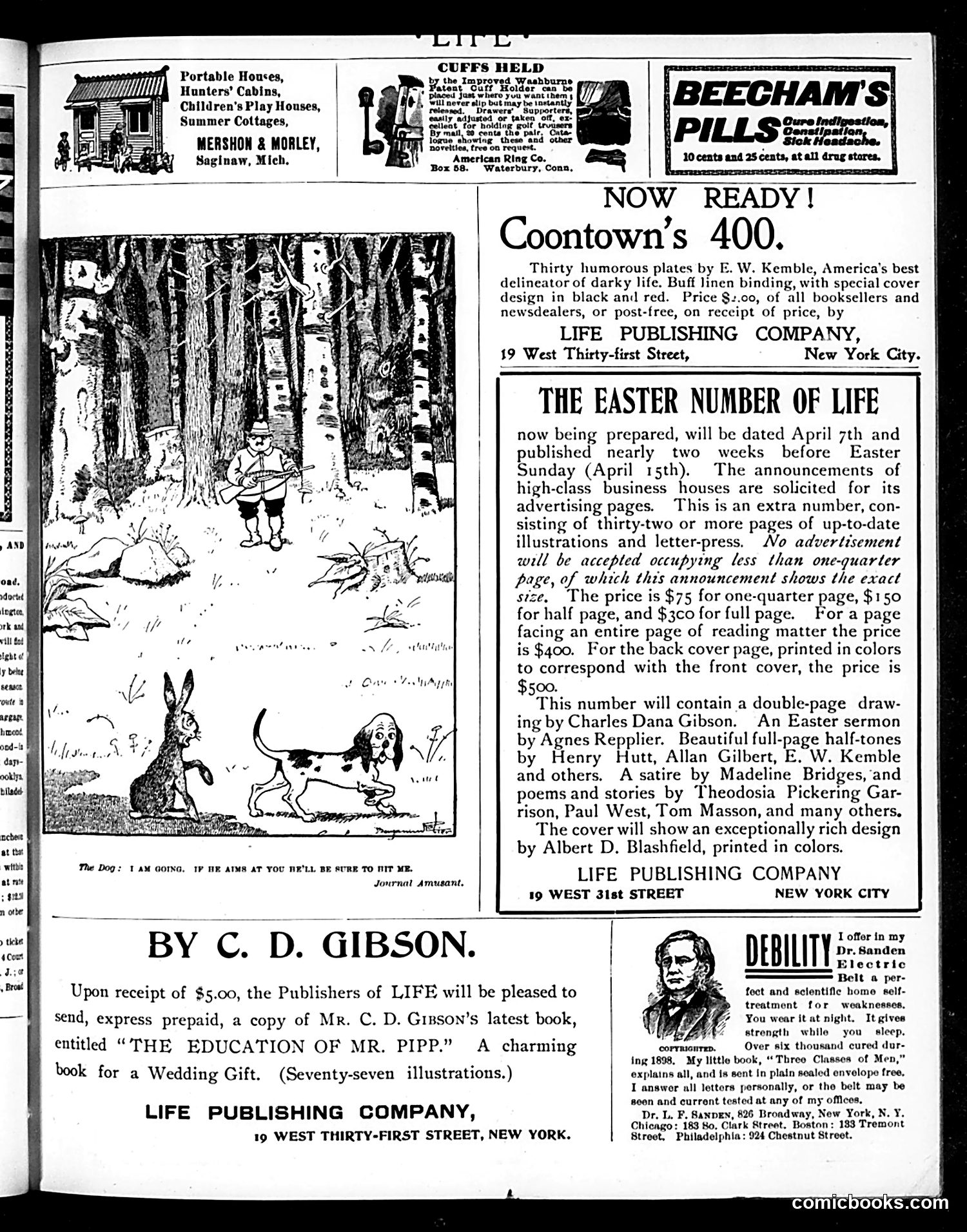
This page is primarily **advertising and promotional content** rather than editorial satire. The main cartoon by C.D. Gibson shows a boy and rabbit in a forest with the caption "I am going, if he aims at you he'll be sure to hit me"—a humorous domestic scene about protecting a pet. The page heavily promotes Life Publishing Company's forthcoming releases, including "Coontown's 400," a book of humorous illustrations by E.W. Kemble described using the period term "darky life"—reflecting the racist caricature humor common to early 1900s American magazines. The Easter Number advertisement solicits high-end advertising from businesses, listing premium rates ($75-$500 per page). Other ads include a "Debility Electric Belt" claiming to cure male weakness through nighttime wear—a common quack remedy of the era. The page lacks sustained political commentary; it's a snapshot of turn-of-century American magazine commerce and popular entertainments, including the casual racism considered acceptable at the time.
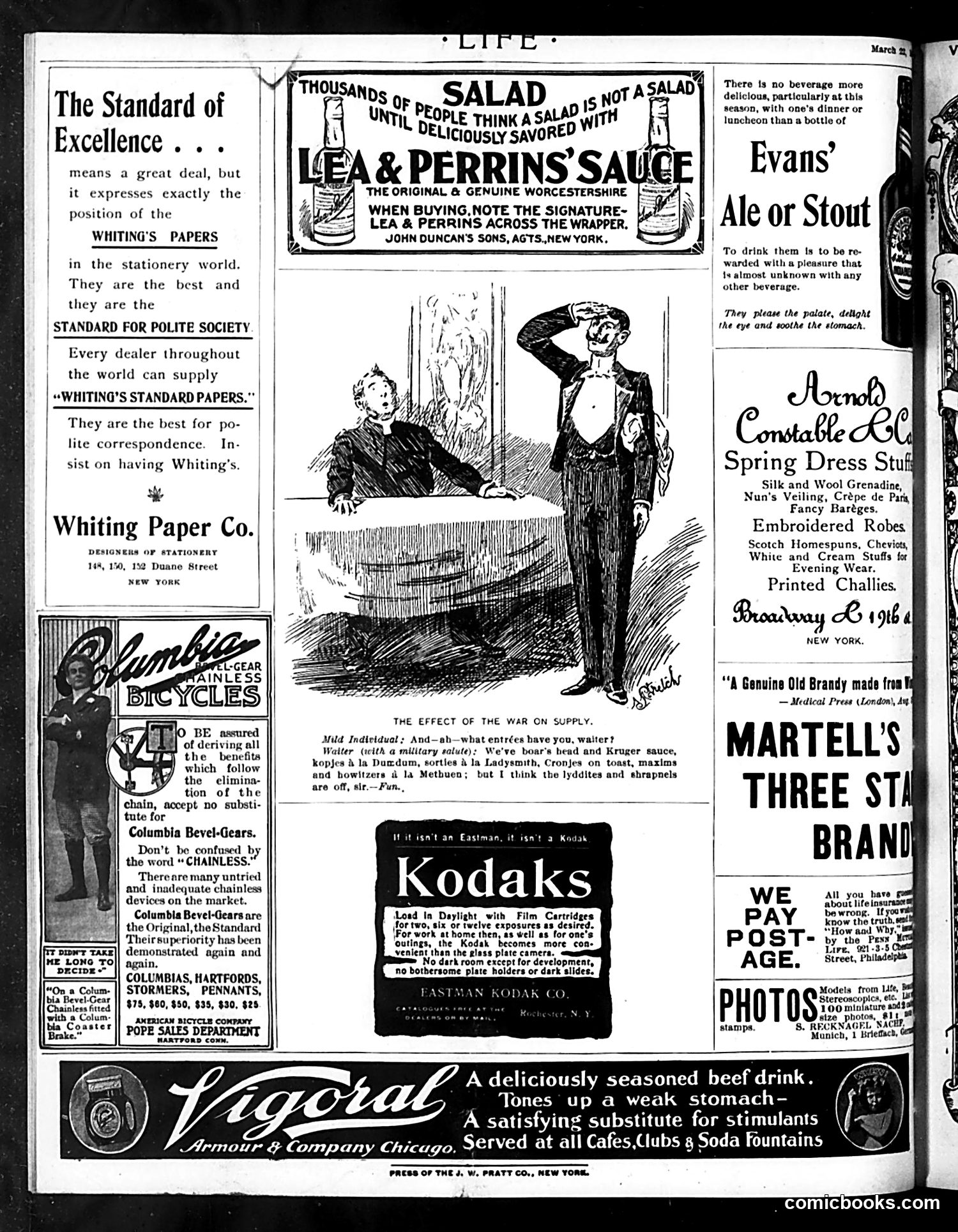
The central cartoon, titled "The Effect of the War on Supply," satirizes wartime food shortages during what appears to be the Boer War (references to "Kruger sauce," "Ladysmith," "Cronje," and "Lyddites" confirm this early 1900s context). A waiter, saluting militarily, responds to a diner's request for entrées by listing dishes named after war-related terms and weaponry: "boar's head and Kruger sauce, kopjes à la Dumdom, sorties à la Ladysmith, Cronjes on toast, maxims and howitzers à la Methuen." The punchline—that lyddites and shrapnels are "off"—jokes that even war-themed dishes have become unavailable due to supply disruptions. The satire mocks how wartime scarcity had become so normalized that restaurants disguised limited menus by creatively renaming ordinary items with military terminology, suggesting both the absurdity of wartime privation and public acceptance of diminished provisions.