
Life, 1900-03-22 · page 4 of 20
Life — March 22, 1900 — page 4: what you’re looking at
What you’re looking at
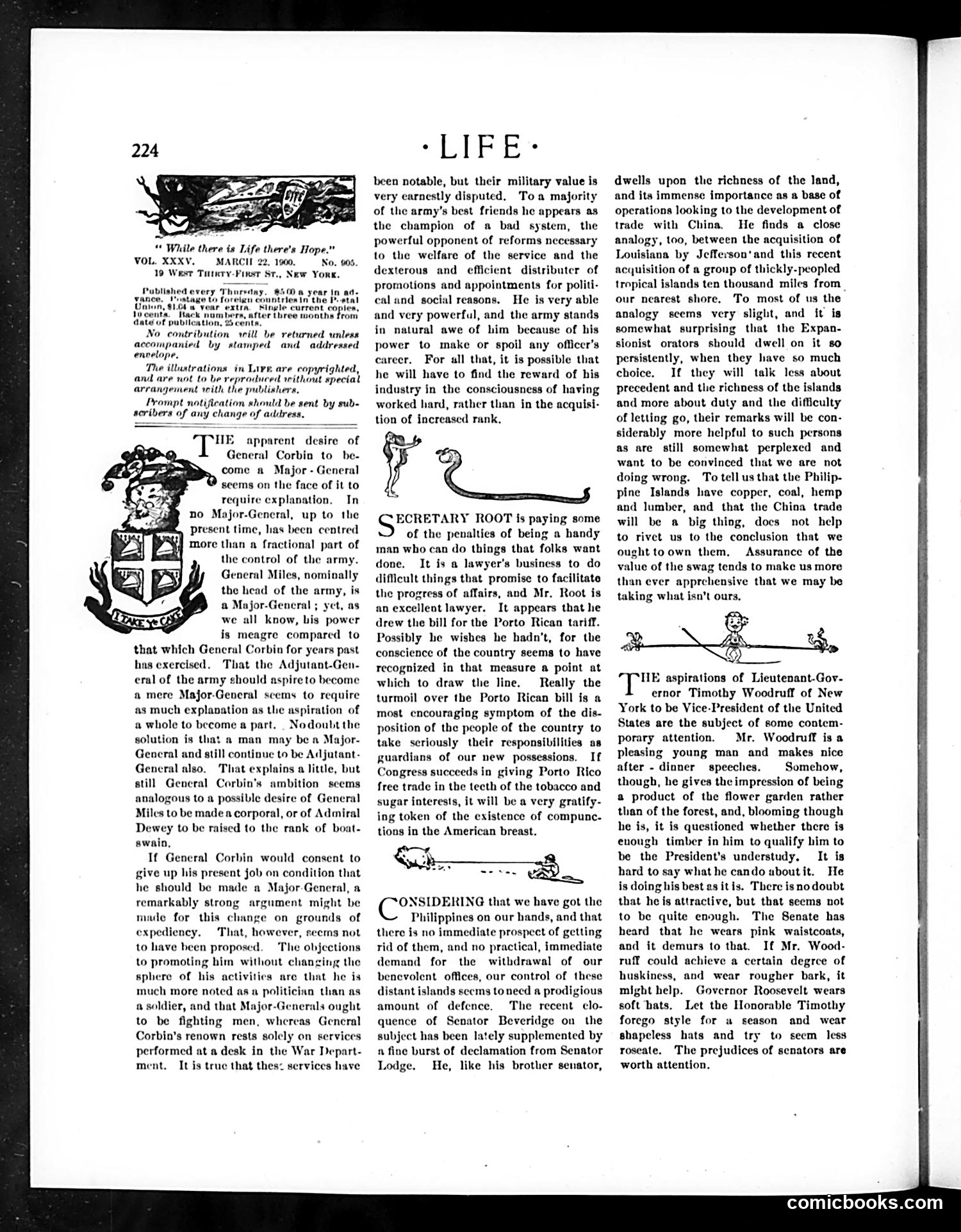
The page contains three satirical editorial pieces without accompanying cartoons visible in this image. The main topics discussed are: 1. **General Corbin and military reform**: Criticism of Corbin's ambitions to become Major-General despite lacking battlefield distinction, arguing soldiers—not politicians—should lead the army. 2. **Secretary Root and the Porto Rican tariff**: Commentary on Root's legal work drafting tariff legislation, suggesting politicians use lawyers to accomplish unpopular measures while avoiding direct responsibility. 3. **Lieutenant-Governor Woodruff's vice-presidential aspirations**: A satirical piece mocking Woodruff's fashion sense (wrist watches, ruffled cuffs) and suggesting his qualifications for higher office are questionable. The satire focuses on military and political ambition, using personal ridicule and institutional critique typical of early-1900s Life magazine commentary.
📄 Transcribed text from this page (OCR, searchable)
Machine-transcribed from the original scan — historical spelling and the odd misread are preserved.
“ While there is Life there's Hope.” VOL. XXXV. MARCI A. . after Hac pubileatios 3 No contribution will be returned unless accompanied by stamped and addressed envelope. The illustrations in Live. are copyrighted, and are not to be reproduced without speciat arrangement with the publishers, Prompt notification should be sent by sub- scribers of any change of address, HE apparent desire of General Corbin to be- come a Major-General Y seems on the face of it to require explanation. In no Major-General, up to the present time, has been centred more than a fractional part of the control of the army. General Miles, nominally the head of the army, is a Major-General ; yet, as we all know, bis power is meagre compared to that which General Corbin for years past has exercised. That the Adjutant-Gen- eral of the army should aspire to become a mere Major-General scems to require as much explanation as the aspiration of a whole to become a part. _ Nodoubtthe solution is that a man may be a Major- Gencral and still continue to be Adjutant- General also, That explains a little, but still General Corbin'’s ambition seems analogous to a possible desire of General Miles to be madea corporal, or of Admiral Dewey to be raised to the rank of boat- swain, If General Corbin would consent to give up his present job on condition that he should be made a Major-General, a remarkably strong argument might be made for this change on grounds of expediency. ‘That, however, seems not to have been proposed. ‘The objections to promoting him without changing the sphere of his activities are that he is much more noted as a politician than as a soldier, and that Major-Generals ought to be fighting men, whereas General Corbin’s renown rests solely on services performed at a desk in the War Depart- ment, It is true that thes: services have * LPB been notable, but their military value is very earnestly disputed. Toa majority of the army’s best friends he appears as the champion of a bad system, the powerful opponent of reforms necessary to the welfare of the service and the dexterous and efficient distributer of promotions and appointments for politi- cal and social reasons. He is very able and very powerful, and the army stands in natural awe of him because of his power to make or spoil any officcr’s career. For all that, it is possible that he will have to find the reward of his industry in the consciousness of having worked hard, rather than in the acquisi- tion of increased rank, Lo) ECRETARY ROOT is paying some of the penalties of being a handy man who can do things that folks want done. It is a lawyer's business to do difficult things that promise to facilitate the progress of affairs, and Mr. Root is an excellent lawyer. It appears that he drew the bill for the Porto Rican tariff. Possibly he wishes he hadn't, for the conscience of the country seems to have recognized in that measure a point at which to draw the line. Really the turmoil over the Porto Rican bill is a most encouraging symptom of the dis- position of the people of the country to take seriously their responsibilities a8 guardians of our new possessions, If Congress succeeds in giving Porto Rico free trade in the tecth of the tobacco and sugar interests, it will be a very gratify- ing token of the existence of compunc- tions in the American breast. os. 2. ONSIDERING that we have got the Philippines on our hands, and that there is no immediate prospect of getting rid of them, and no practical, immediate demand for the withdrawal of our benevolent offices, our control of these distant islands secms tonecd a prodigious amount of defence. The recent clo- quence of Senator Beveridge on the subject has been lately supplemented by a fine burst of declamation from Senator Lodge. He, like his brother senator, dwells upon the richness of the land, and its immense importance as a base of operations looking to the development of trade with China. He finds a close analogy, too, between the acquisition of Louisiana by Jefferson'and this recent acquisition of a group of thickly-peopled tropical islands ten thousand miles from our nearest shore. To most of us the analogy scems very slight, and it is somewhat surprising that the Expan- sionist orators should dwell on it so persistently, when they have so much choice. If they will talk less about precedent and the richness of the islands and more about duty and the difficulty of letting go, their remarks will be con- siderably more helpful to such persons as are still somewhat perplexed and want to be convinced that we are not doing wrong. To tellus that the Philip- pine Islands have copper, coal, hemp and lumber, and that the China trade will be a big thing, docs not help to rivet us to the conclusion that we ought toown them, Assurance of the value of the swag tends to make us more than ever apprehensive that we may be taking what isn’t ours, IIE aspirations of Lieutenant-Gov- ernor Timothy Woodruff of New York to be Vice-President of the United States are the subject of some contem- porary attention. Mr. Woodruff is a pleasing young man and makes nice after - dinner speeches. Somehow, though, he gives the impression of being a product of the flower garden rather than of the forest, and, blooming though he is, it is questioned whether there is euough timber in him to qualify him to be the President’s understudy, It is hard to say what he cando aboutit. He is doing his best as itis. There isnodoubt that he is attractive, but that secms not to be quite enough. The Senate has heard that he wears pink waistcoats, and it demurs to that. If Mr. Wood- ruff could achieve a certain degrce of huskiness, and wear rougher bark, it might help. Governor Roosevelt wears soft hats. Let the Honorable Timothy forego style for a season and wear shapeless hats and try to seem less roseate, The prejudices of senators are worth attention, comicbooks.com