
A complete issue · 20 pages · 1900
Life — March 15, 1900
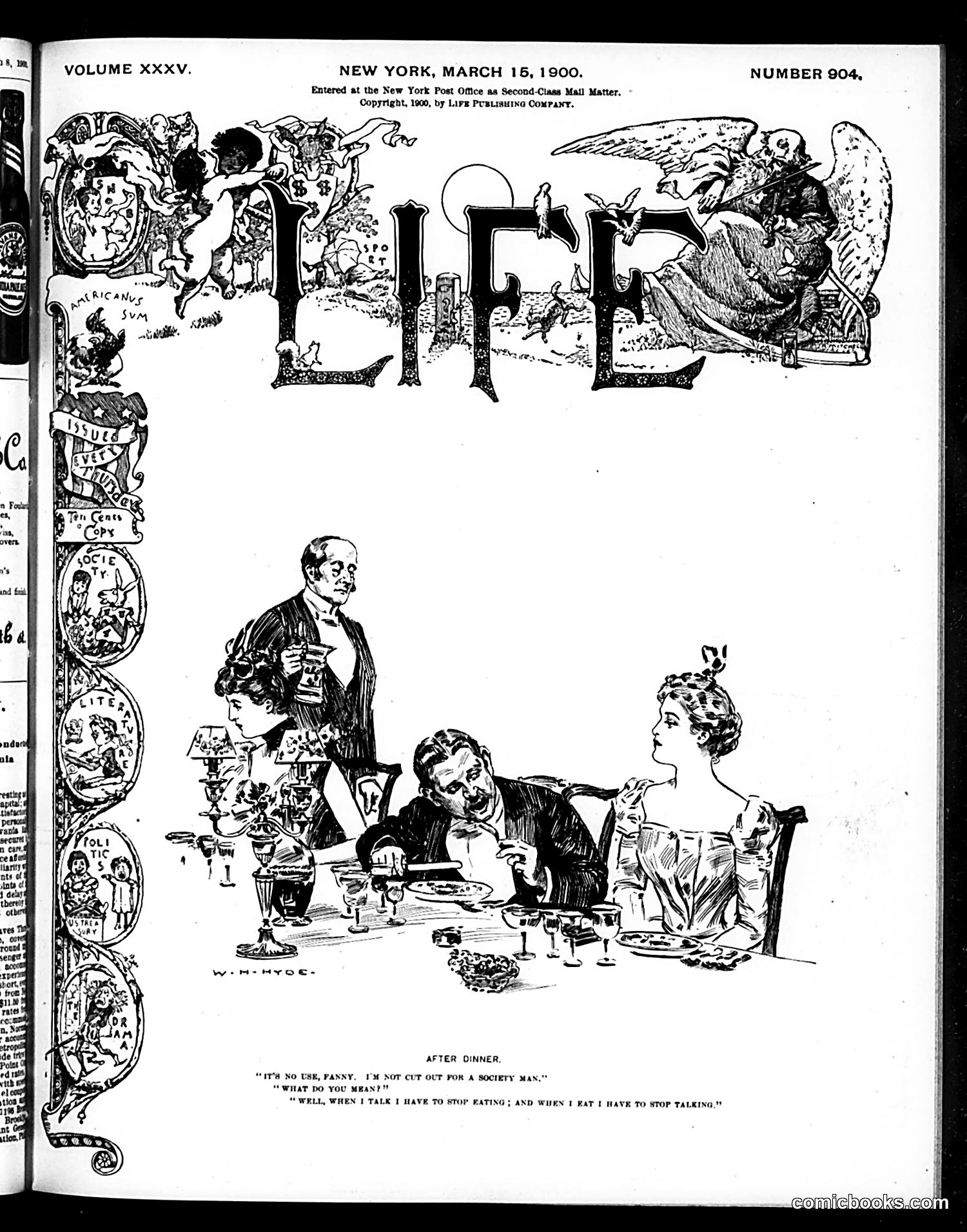
The main cartoon titled "After Dinner" depicts a social scene where a man stands while three others sit at a dinner table. The dialogue reveals the joke's point: a woman complains her companion isn't "cut out for a society man," and he responds that he must stop eating when he stops talking, and stop talking when he eats. This is satirical commentary on Victorian social etiquette—specifically the tension between eating and maintaining polite dinner conversation. The humor mocks both the rigid rules of upper-class dining and the absurdity of a man who cannot simultaneously eat and participate in social discourse, suggesting incompetence at the basic performance of genteel society.
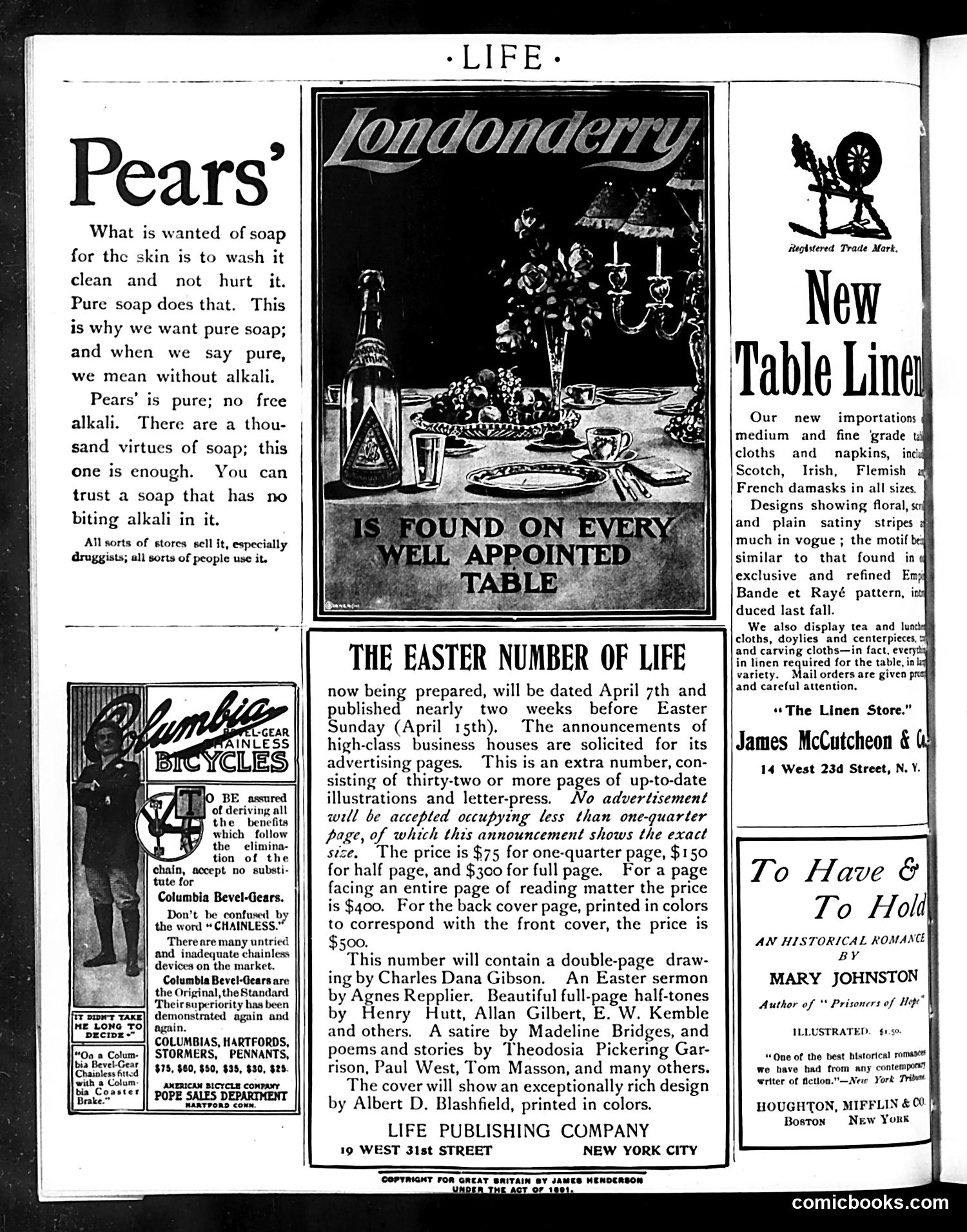
This page is primarily **advertising and announcements** rather than satirical content. The main elements are: 1. **Pears' Soap ad** (left): Promotes pure soap without alkali for skin care—a straightforward product advertisement. 2. **Londonderry ad** (center): Shows an elegant dinner table scene advertising that this brand appears "on every well appointed table"—a luxury goods appeal. 3. **Columbia Bicycles ad** (lower left): Features a figure promoting "chainless" bicycles, highlighting the elimination of the chain mechanism as an innovation. 4. **Life Magazine Easter issue announcement** (center): The main text announces the upcoming Easter special issue with details about pricing and contributors. 5. **Table Linen and book advertisements** (right): Additional product and book promotions. No political satire or social commentary is evident. This appears to be a standard early-20th-century magazine page mixing editorial content with paid advertisements.
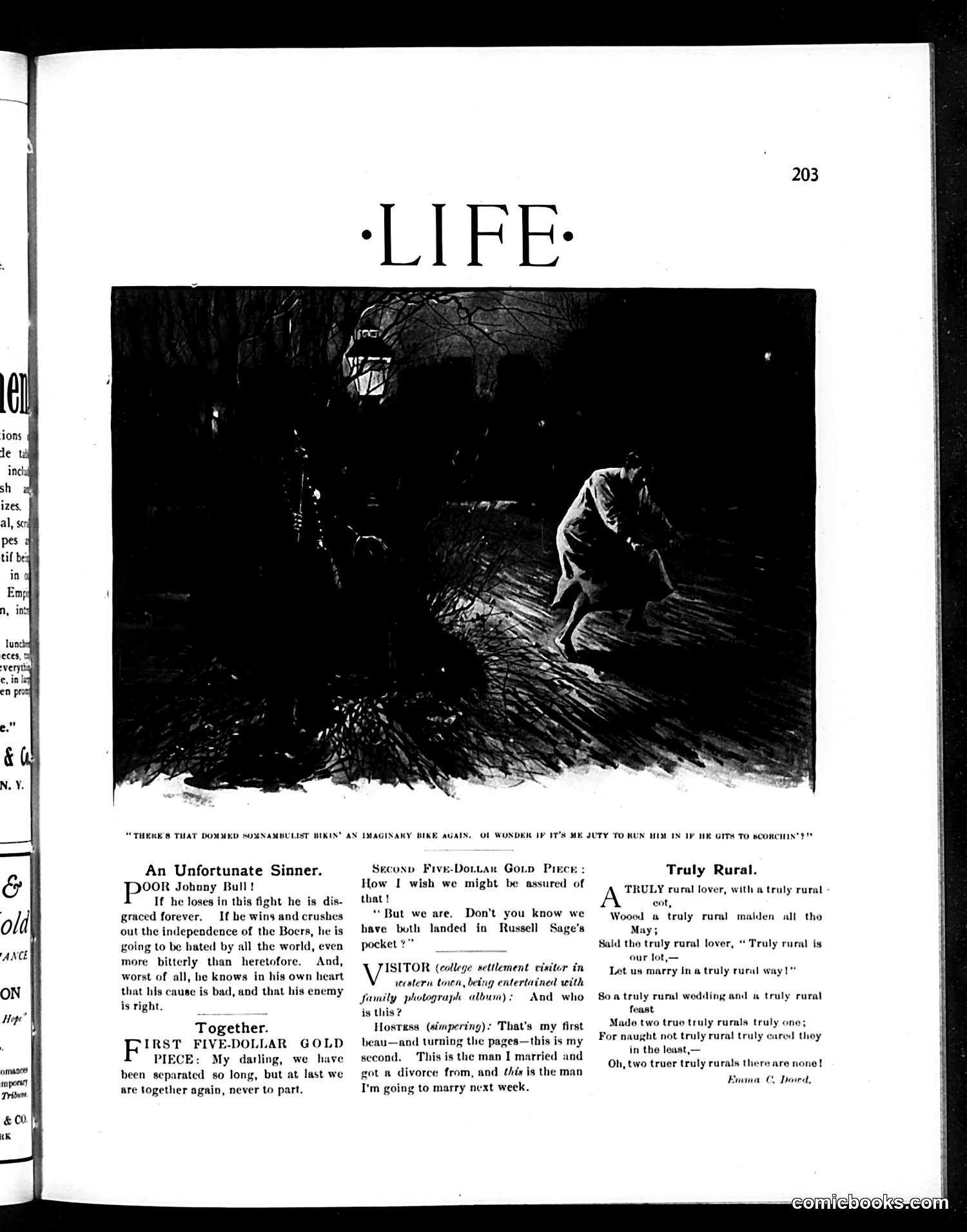
This page contains three brief humorous pieces rather than a political cartoon. **"An Unfortunate Sinner"** mocks a man named Johnny Bull (representing Britain) who, after losing independence to the Boers, faces further humiliation—his enemy now controls his finances. **"Together"** presents newlyweds separated by a five-dollar gold piece, now reunited and vowing never to part again—a joke about marital reconciliation through shared wealth. **"Truly Rural"** is a comedic poem about rural romance, playing on the repetition of "truly rural" to create absurdist humor about countryside courtship and marriage. The page appears designed for light entertainment rather than serious political commentary, using wordplay and domestic situations for humor.
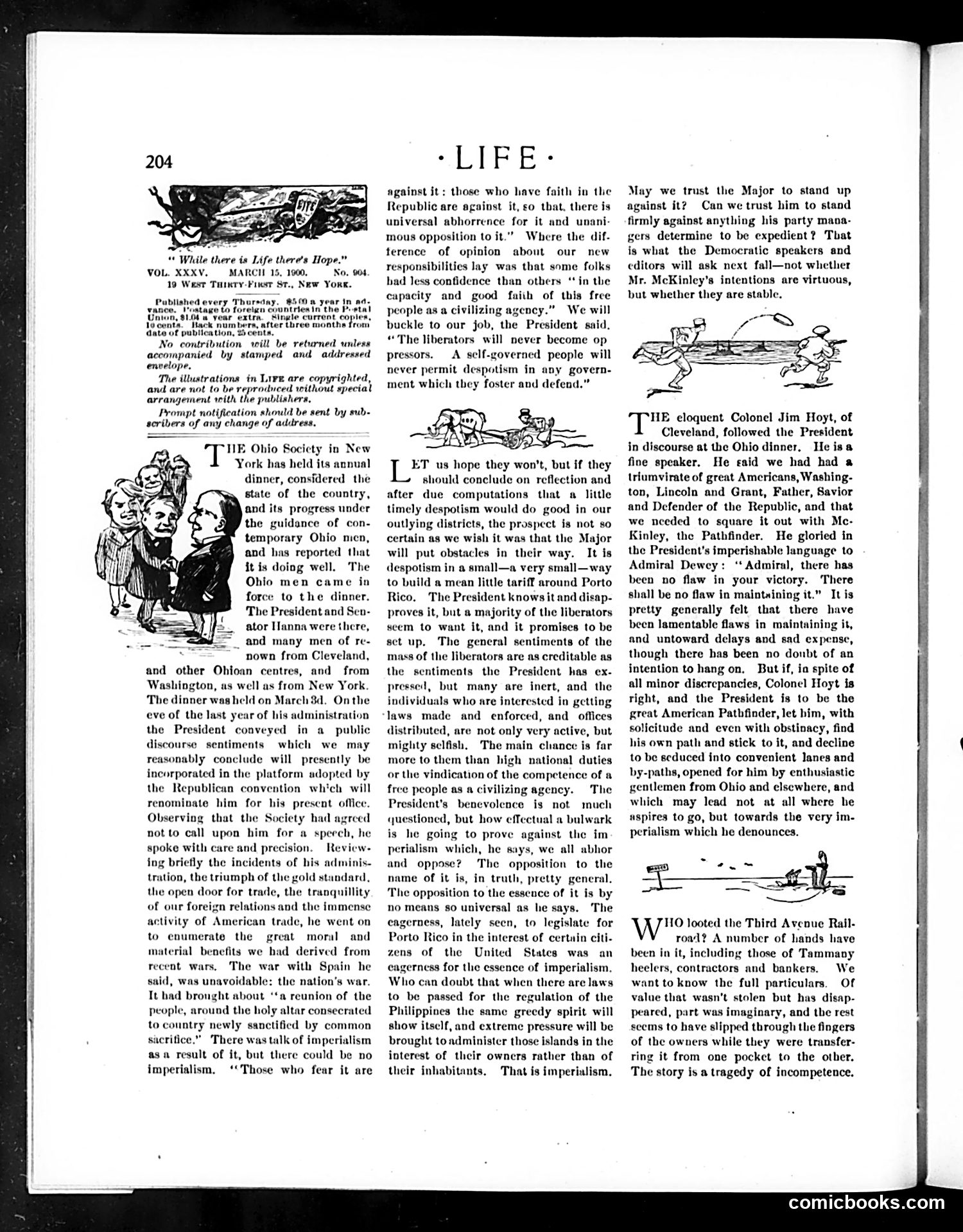
This page discusses President McKinley's administration and domestic policy debates circa 1900. The left cartoon depicts an Ohio Society dinner where political figures gathered; the text references Senator Hanna and other Ohio politicians. The main political argument concerns **imperialism vs. anti-imperialism**—specifically U.S. expansion in the Philippines. The text defends McKinley's position against critics who call the expansion "imperialistic." The author argues the administration's policies benefit trade and American interests, not mere territorial conquest. The bottom cartoon about Third Avenue Railway relates to a separate story involving business dealings and embezzlement—"a tragedy of incompetence" where bank deposits disappeared between transactions. The satire criticizes both imperialism's opponents as obstructionist and internal corruption in American business.
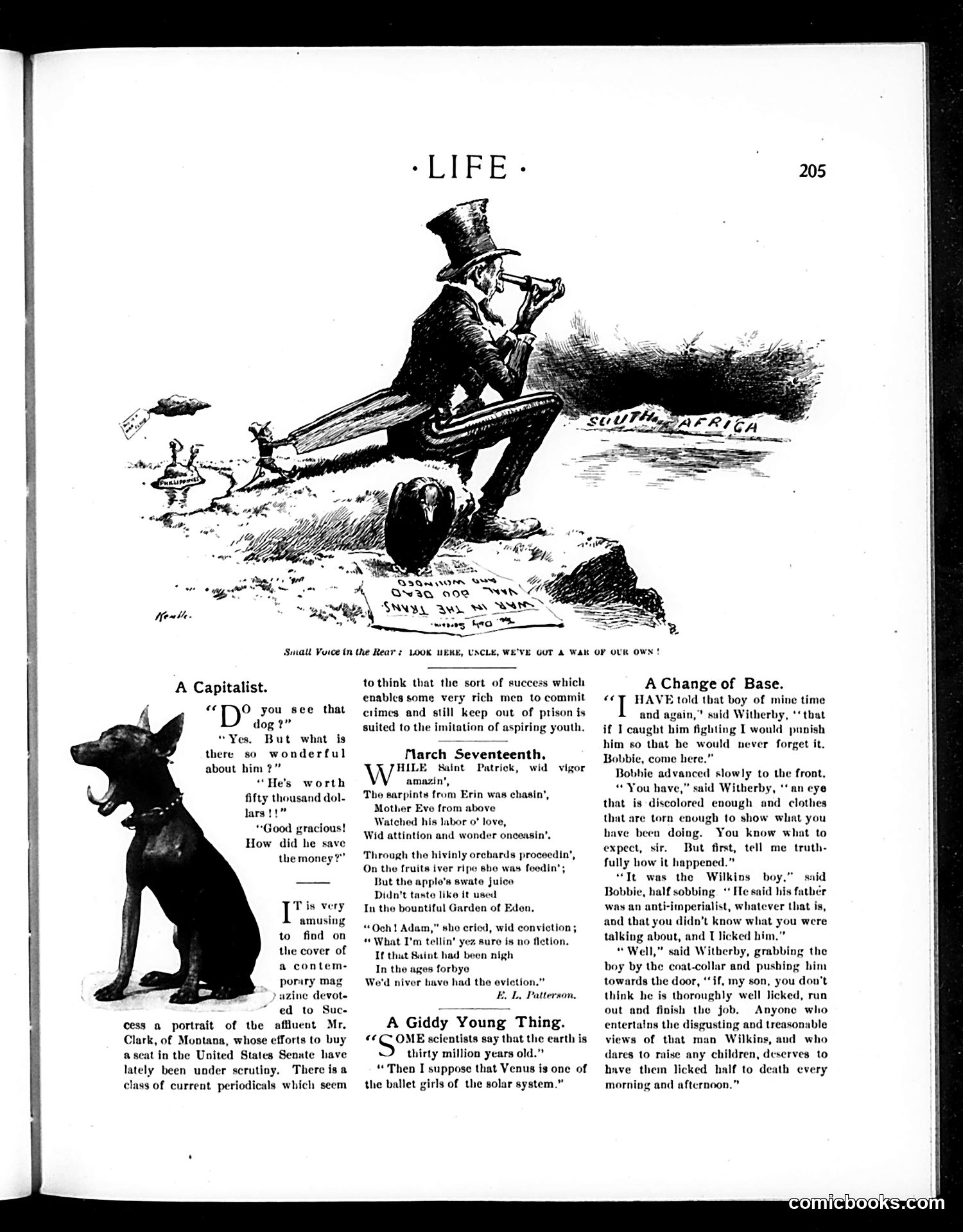
The main cartoon depicts a caricatured figure (appears to be Uncle Sam, based on top hat and American context) wielding a massive club labeled "SOUTH AFRICA," attacking what seems to be a smaller opponent or adversary. A "Small Voice in the Rear" caption reads: "LOOK HERE, UNCLE, WE'VE GOT A WAR OF OUR OWN!" This likely satirizes American intervention or military action regarding South Africa (possibly the Boer War era, early 1900s), suggesting the U.S. was distracted by foreign conflicts while domestic issues demanded attention. The smaller figure represents Americans concerned about domestic problems being ignored. The surrounding text includes unrelated humorous pieces ("A Capitalist," "A Change of Base," "A Giddy Young Thing"), typical of *Life* magazine's mixed-content satirical format.
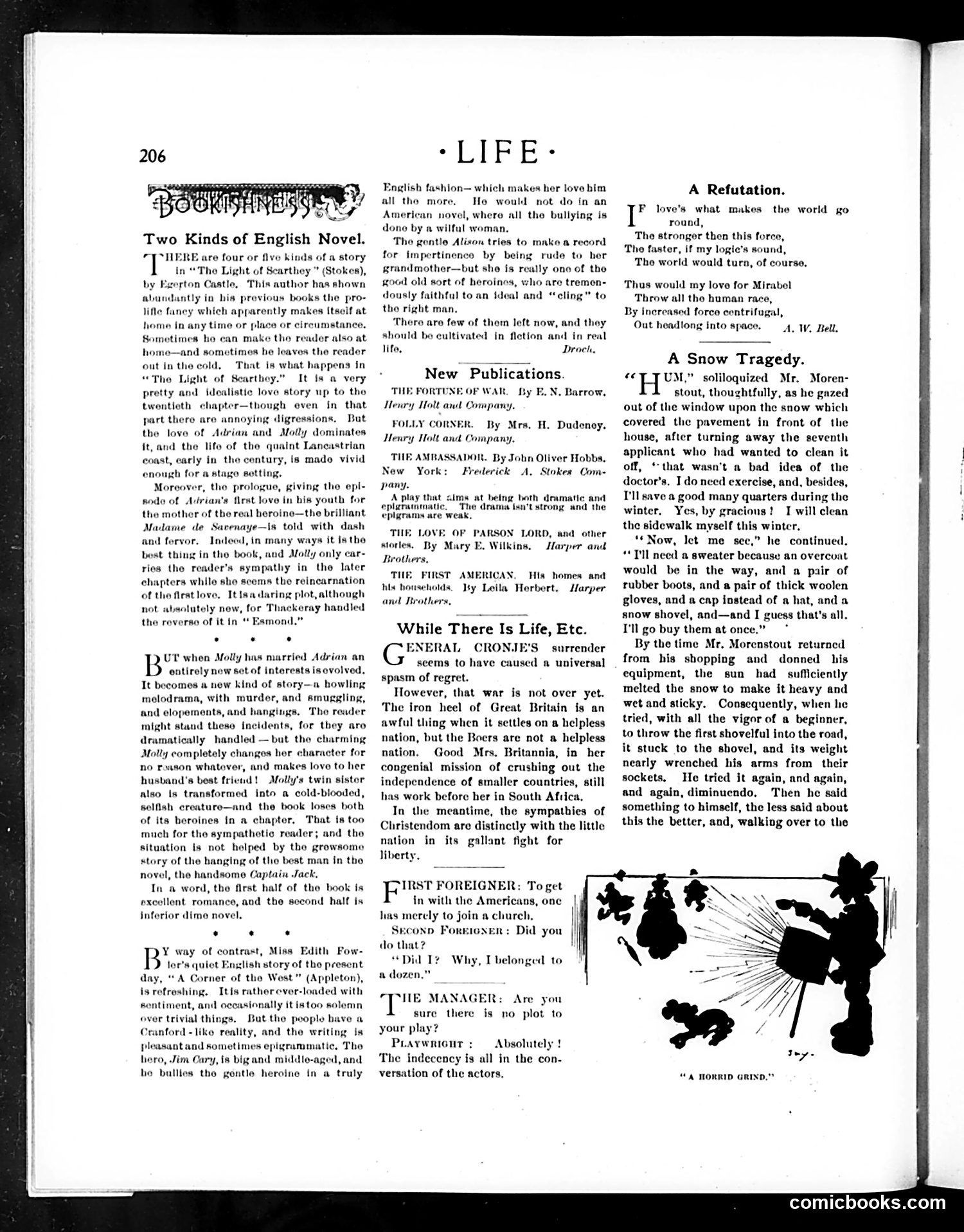
This cartoon depicts a figure being ground or crushed in what appears to be a mechanical grinder or mill. Based on the page's literary context discussing English novels and dramatic works, this likely satirizes the commercial publishing industry's treatment of authors or stories—suggesting they are processed mechanically and relentlessly, their creative work reduced to formulaic output for mass consumption. The title "A Horrid Grind" reinforces this message: the literary world "grinds" its subjects down through endless production demands. The cartoon critiques industrialized publishing's dehumanizing effects on writers, transforming their work into commodified products rather than genuine artistic expression—a concern relevant to early 20th-century debates about art versus commercialism.
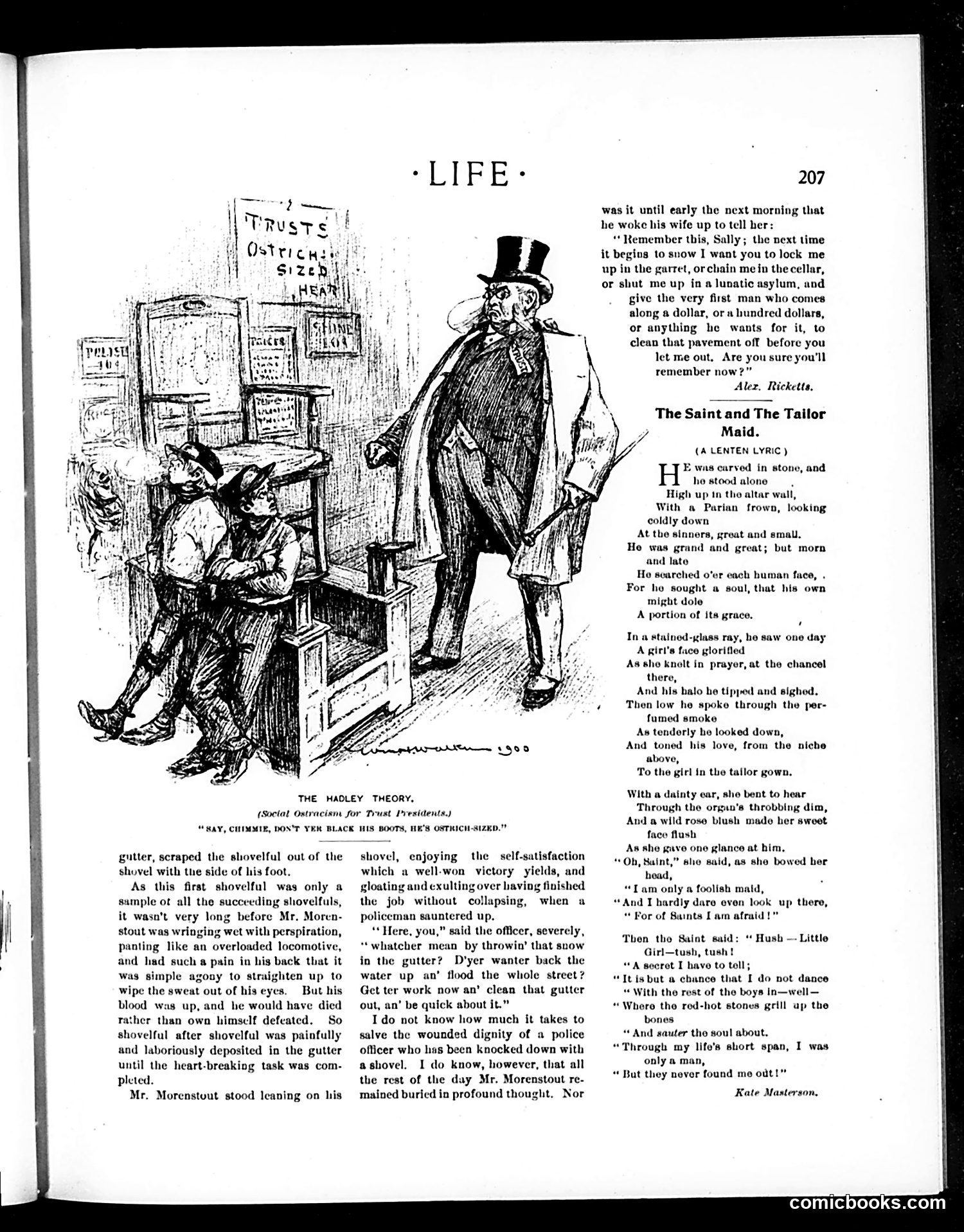
This cartoon satirizes corrupt trust presidents and their defense strategies. The illustration shows a wealthy, top-hatted businessman (representing a trust president) standing over a worker in a gutter, labeled "Social Ostracism for Trust Presidents." The caption reads: "Say, chums, don't yer blame me fer bein' ostracized" — a sarcastic defense. The cartoon critiques how wealthy industrialists, when caught in scandals or labor abuses, claimed they were merely following standard business practices ("the Hadley theory," though the specific reference is unclear from this page alone). The joke targets the hypocrisy of trust magnates: they exploit workers mercilessly, yet complain of social disapproval rather than accepting moral responsibility for their actions.
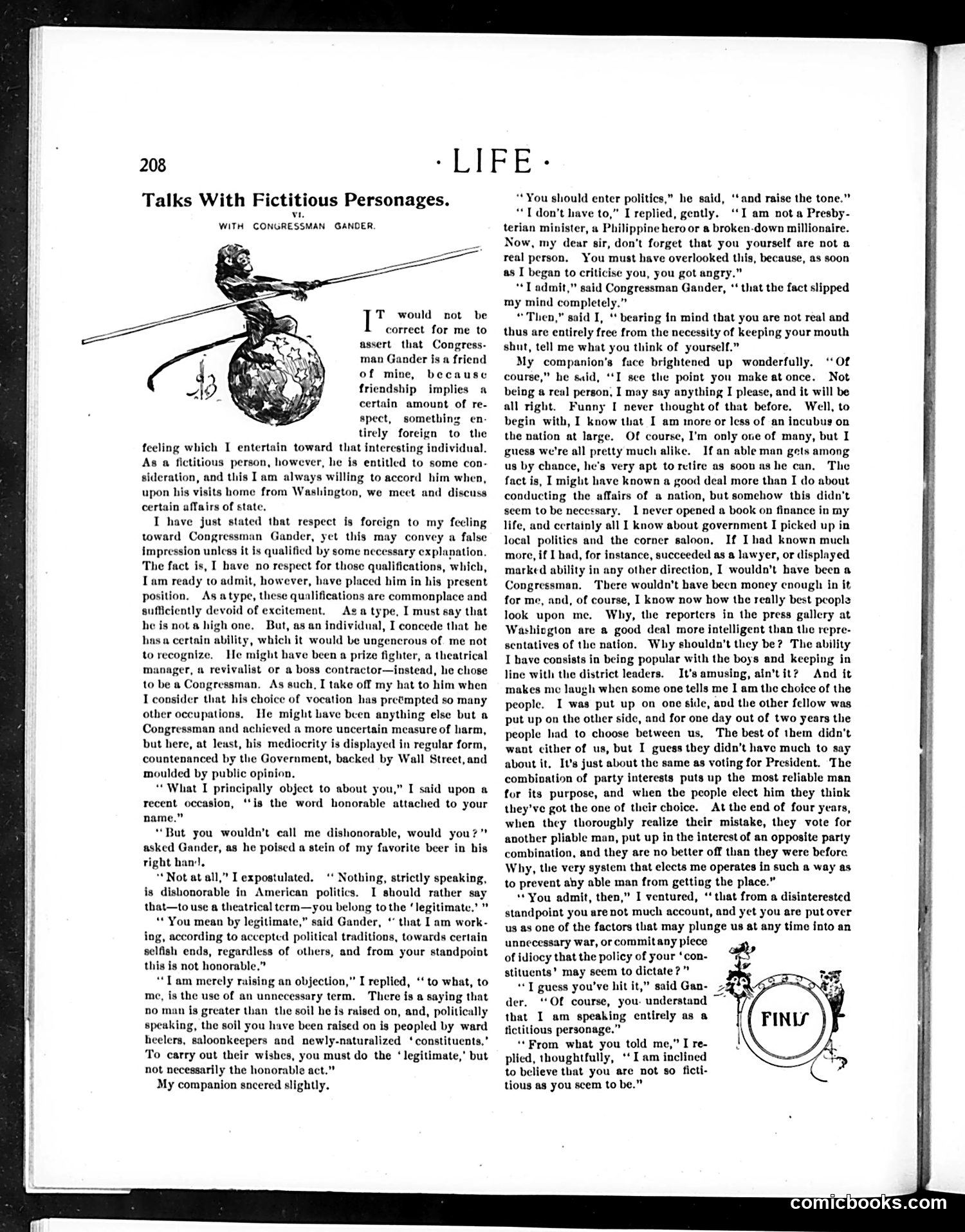
This page features a satirical dialogue between the author and **Congressman Gander** (a fictional character, as indicated by the title). The cartoon illustration depicts a figure balanced precariously on a globe, wielding a long pole—a visual metaphor for political precariousness and the balancing act of governance. The satire critiques the congressman's self-importance and political maneuvering. The author challenges Gander's claims to influence and respectability, arguing that congressmen like him are essentially interchangeable, neither particularly capable nor uniquely qualified. The dialogue mocks the congressman's belief that his position matters significantly while suggesting he's simply a tool serving party interests rather than genuine leadership. The satire targets political vanity and the illusion of congressional importance.
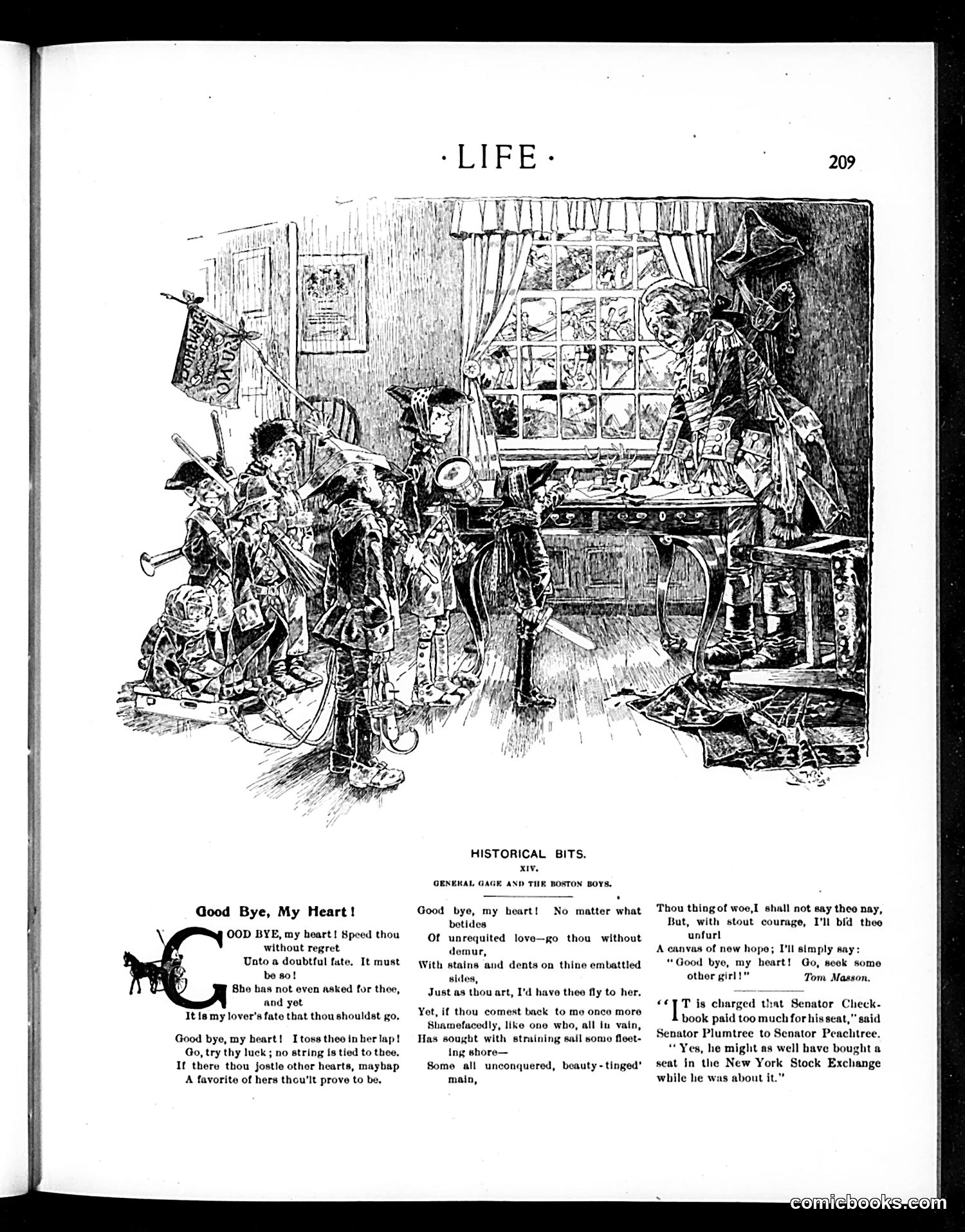
This satirical piece mocks British General Gage during the American Revolutionary period through a poem titled "Good Bye, My Heart!" The illustration shows colonial soldiers (the "Boston Boys") with military instruments confronting what appears to be a British officer in an interior setting. The poem uses mock-romantic language to parody Gage's relationship with Boston, treating his withdrawal or departure as a heartbroken lover's farewell. The satire criticizes Gage—likely for his perceived weakness or failure to control the colonists—by feminizing his emotional state and juxtaposing it against the martial resolve of the Boston resistance. A brief anecdote about Senator Plumtree and Senator Peacetree appears below, though its connection to the main illustration is unclear.
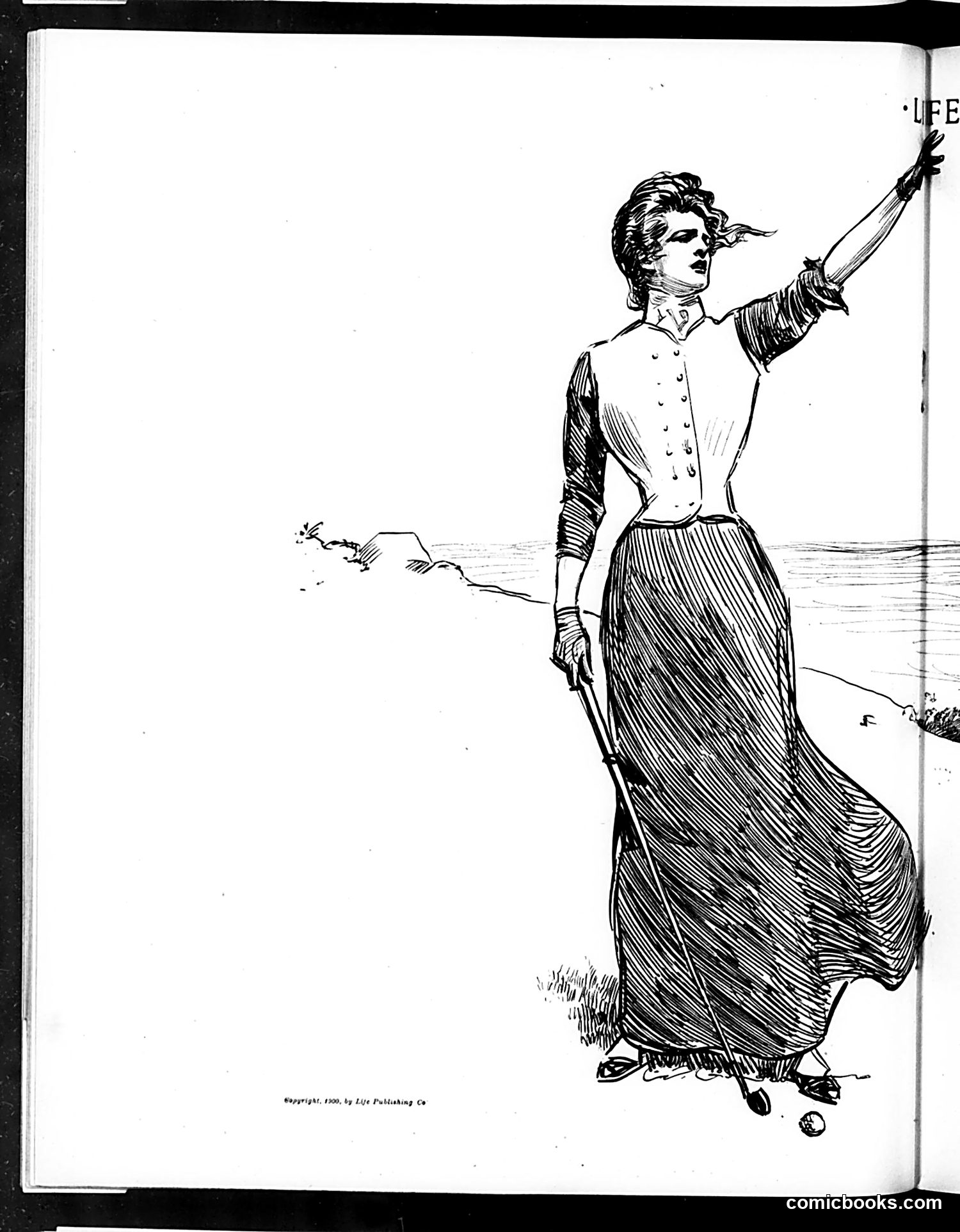
This is a black and white pen illustration from *Life* magazine (copyright 1906, per the footer). The image shows a woman in Edwardian dress with an upraised arm in a triumphant gesture, standing on what appears to be a shoreline or elevated ground. The figure likely represents an allegorical representation of American progress, liberty, or feminine empowerment—common *Life* magazine imagery of the early 1900s. The dramatic pose, flowing skirt, and confident bearing suggest optimism about a contemporary social or political development. Without additional caption text visible on this page, the specific historical reference remains unclear—it could relate to women's suffrage, American expansion, or industrial progress, all major *Life* satirical subjects of that era. The artistic style is typical of turn-of-century American editorial illustration.
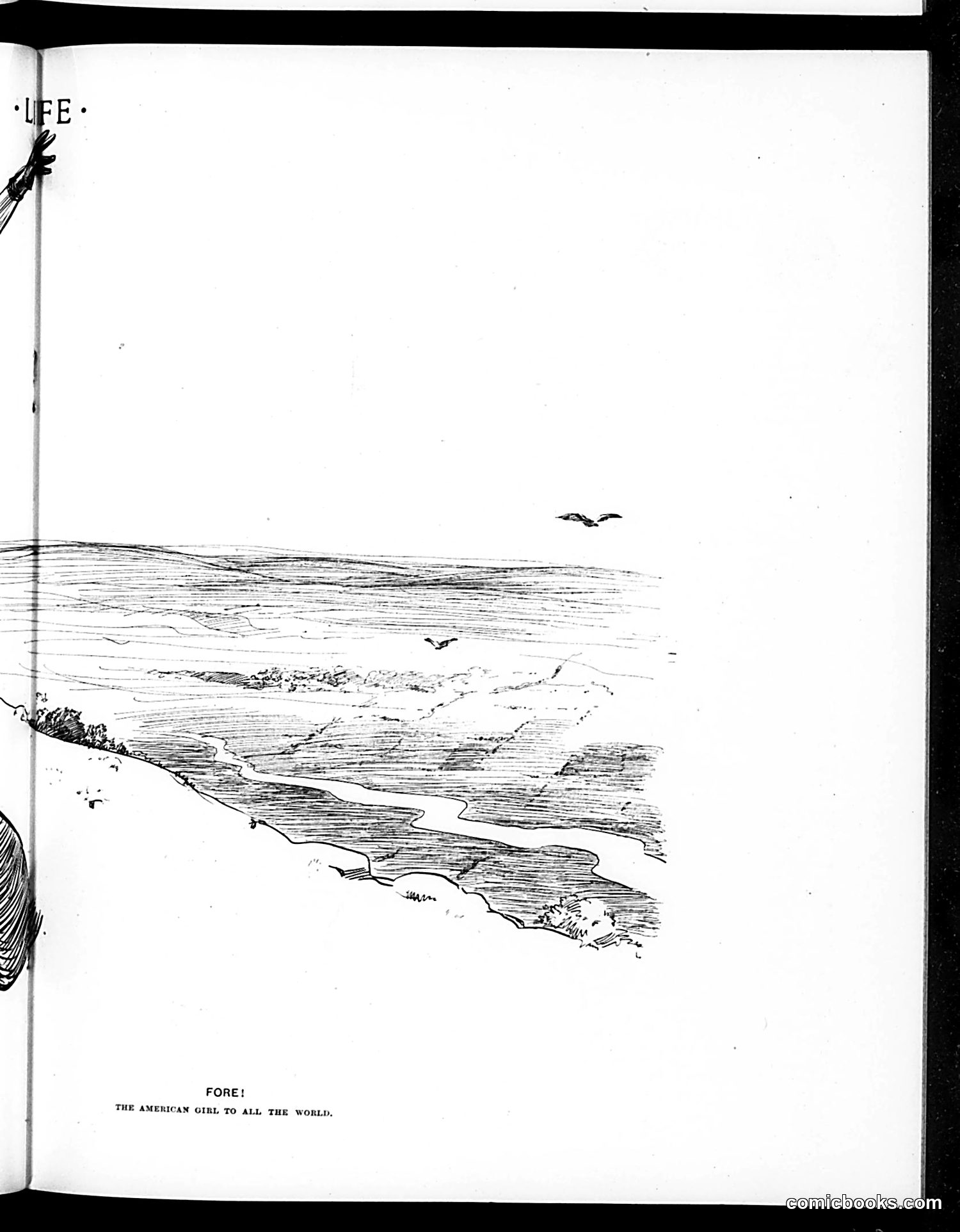
This is a title page or section opener for *Life* magazine. The illustration shows a landscape sketch with rolling terrain, a winding river or stream, and two birds flying overhead. The artistic style uses cross-hatching and line work typical of early-to-mid 20th century editorial illustration. The text reads "FORE!" and "THE AMERICAN GIRL TO ALL THE WORLD," suggesting this section celebrates American femininity or female identity as something being "introduced" or presented globally. The "FORE!" (a golf term warning of danger) may imply ironic commentary about American women's influence or impact. The sparse, elegant design and formal presentation indicate this likely introduces a feature article or satirical commentary about American women's cultural significance abroad, though the specific editorial context remains unclear from this image alone.
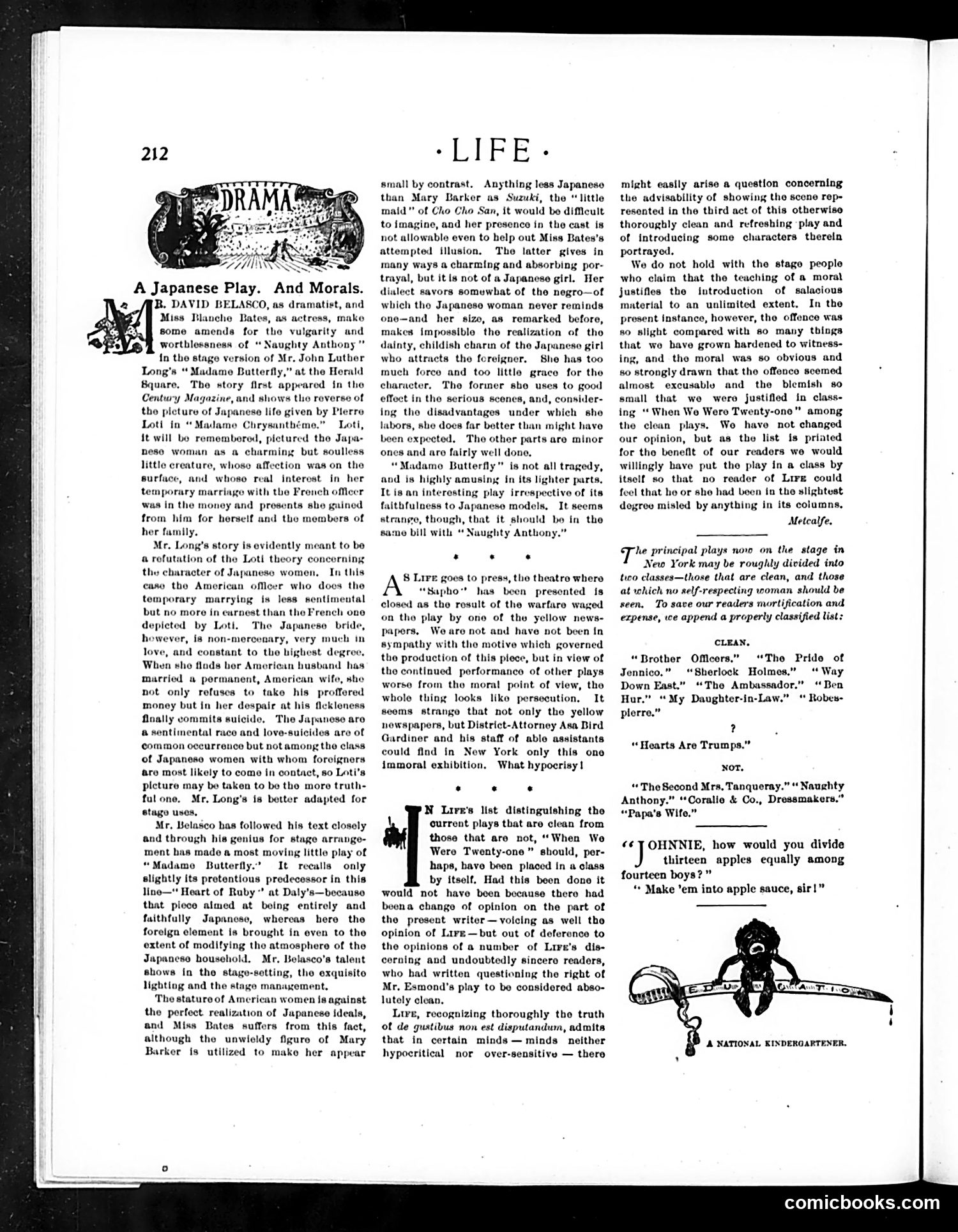
This page discusses theatrical productions, specifically critiquing a Japanese play called "Madame Butterfly" and David Belasco's "Naughty Anthony." The text praises the Japanese production for its authenticity and faithful portrayal of Japanese customs, contrasting it favorably with American theatrical attempts. At the bottom right is a cartoon titled "A National Kindergartener" depicting what appears to be a young child with an apple, likely satirizing American innocence or naiveté regarding foreign cultures—possibly commenting on American audiences' limited understanding of authentic Japanese theater versus Westernized adaptations. The overall critique suggests Life magazine's position that American productions oversimplified or sensationalized non-Western subjects, while authentic foreign performances offered superior cultural value and artistic integrity.
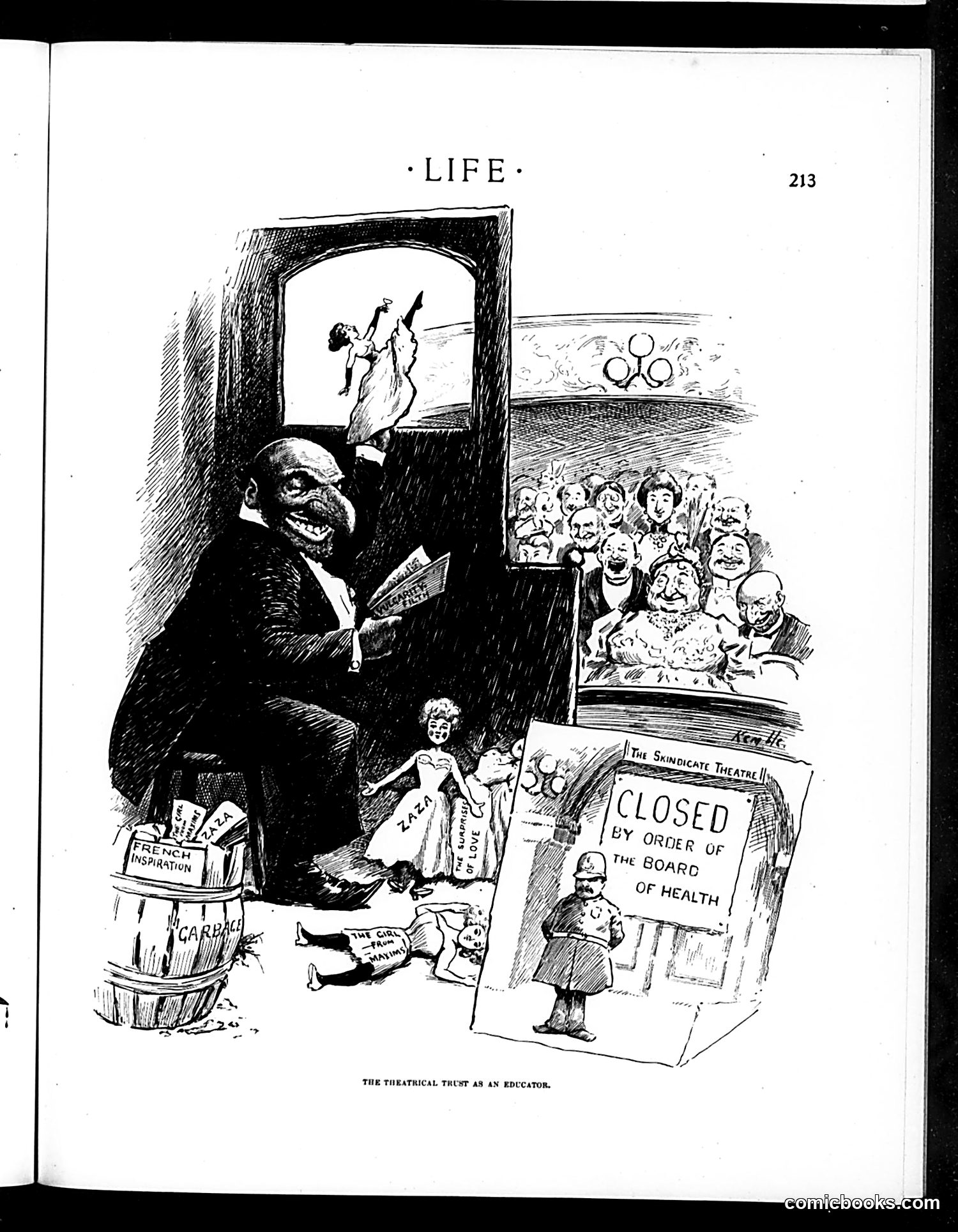
This satirical cartoon critiques the theatrical monopoly (the "Theatrical Trust") as a corrupting influence on children and society. A grotesque, ape-like figure—representing the Trust—sits in a theater doorway, reading to an eager audience of children and adults. The barrels labeled "French Inspiration" and "Cabbage" suggest morally questionable or worthless content being fed to audiences. A sign reading "Closed by Order of the Board of Health" indicates the theater was shut down for health/moral violations. The caricature's monstrous appearance emphasizes the Trust's predatory nature. The satire argues that theatrical monopolies, rather than educating audiences, corrupt them with degrading or obscene material. This reflects early 20th-century Progressive Era concerns about corporate monopolies controlling entertainment and their effects on public morality.
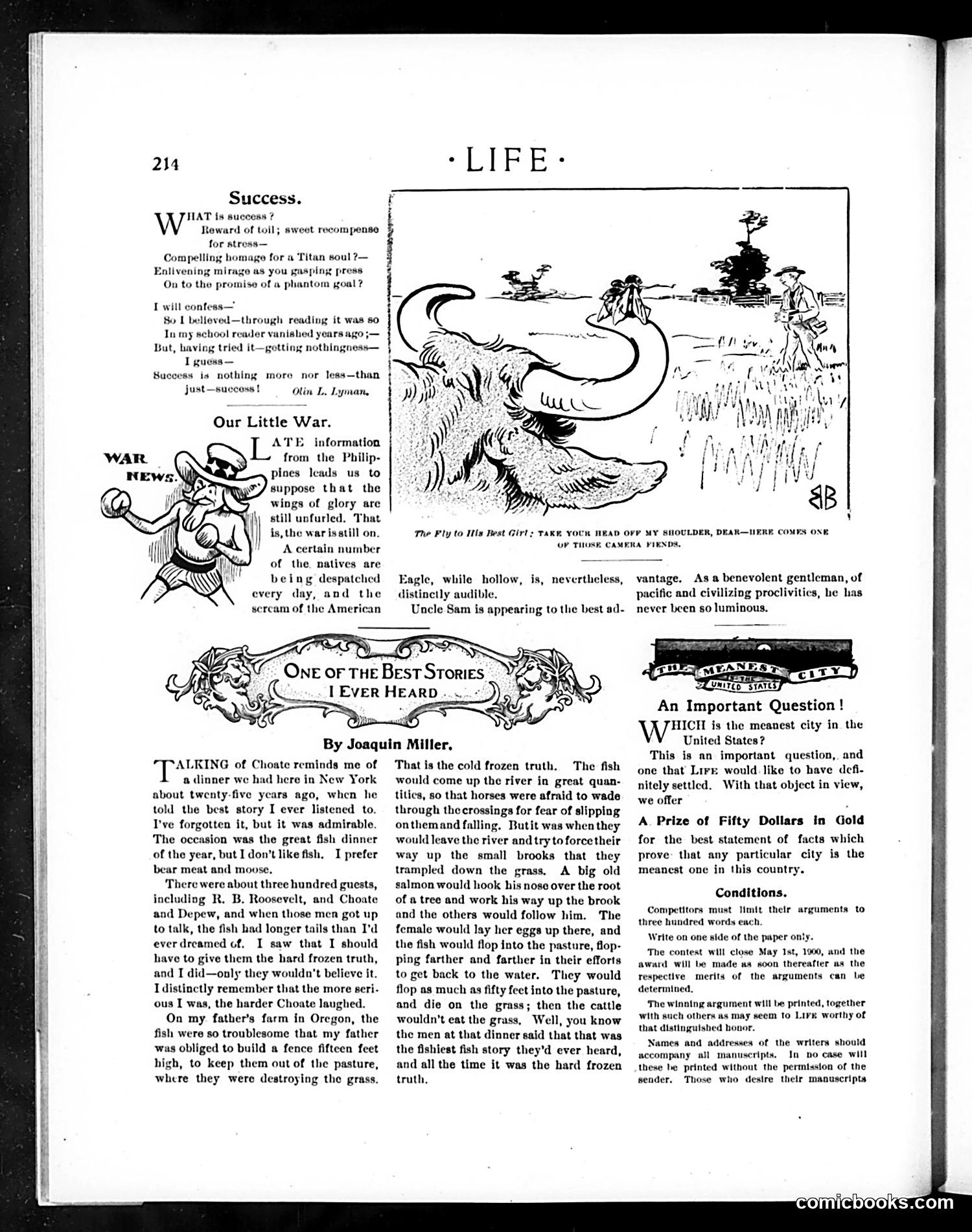
**Top Section - "Success" and "Our Little War":** The poem mocks the vague concept of "success" as meaningless—ultimately "success is nothing more nor less than just—success!" The cartoon labeled "Our Little War" satirizes the **Philippine-American War** (ongoing at this 1900 publication date). The caricatured figure appears to be Uncle Sam or American militarism personified, presented as a comic, aggressive character. The text notes natives are "being despatched every day" while "the scream of the American Eagle...is, nevertheless, distinctly audible"—bitterly mocking America's "civilizing" justifications for the brutal conflict. **Bottom Sections:** "One of the Best Stories Ever Heard" by Joaquin Miller is a tall tale about impossibly large fish destroying Oregon pastures—a humorous piece with no political content. **"An Important Question"** solicits reader responses about "the meanest city in the United States," offering $50 in gold for the best answer. This appears to be a genuine contest rather than satire.
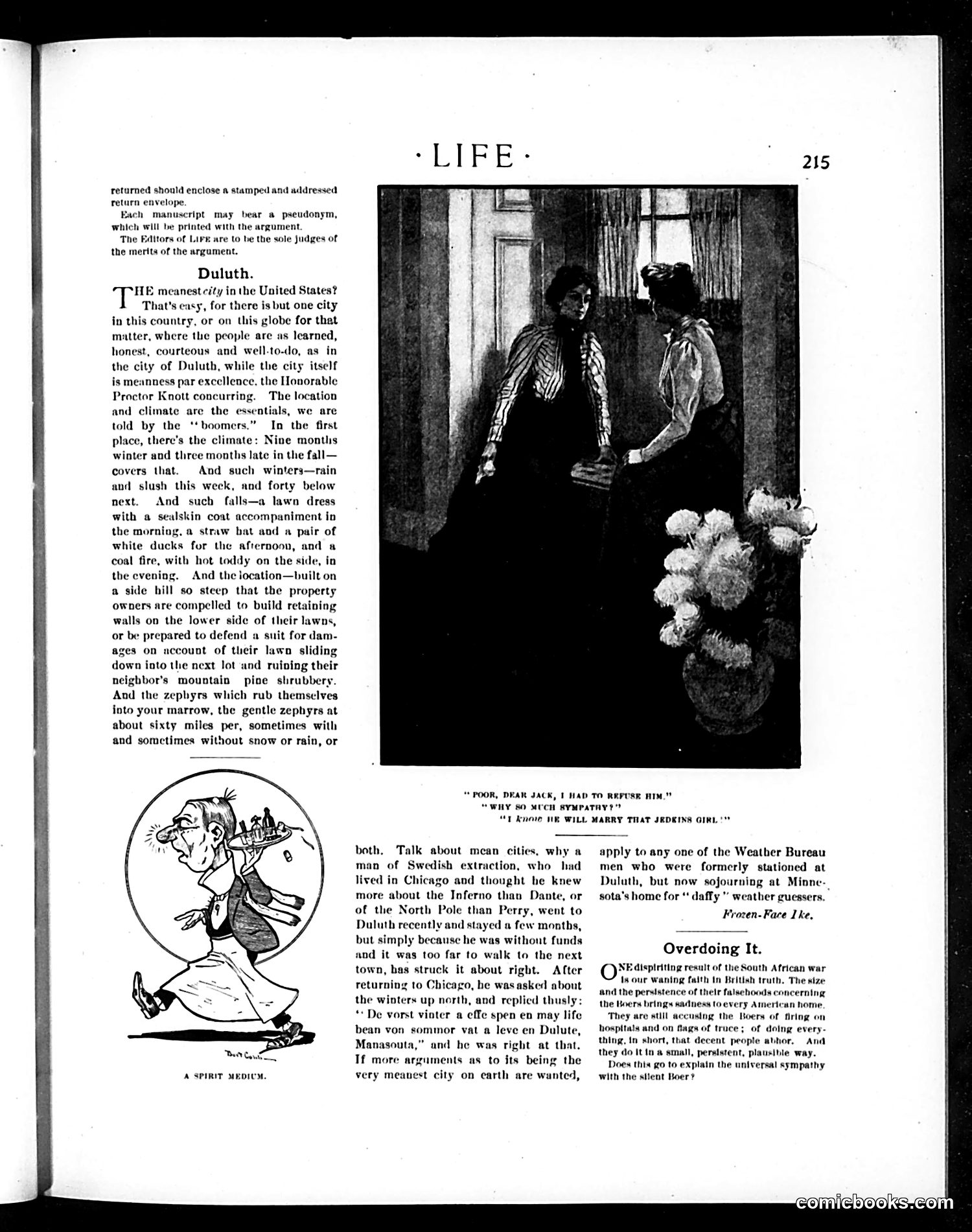
This page satirizes **Duluth, Minnesota** through two pieces: **Main Article ("Duluth")**: A backhanded compliment piece praising Duluth's residents while viciously mocking the city itself. The satire claims Duluth has the "meanest" climate and geography—nine-month winters with extreme temperature swings, steep hillsides causing property disputes, and devastating winds ("zephyrs at about sixty miles per"). A Swedish immigrant's quote ("De vorst vinter...") mocks the city's brutality. The piece appears referencing **Proctor Knott**, a real Minnesota figure known for earlier Duluth criticism. **"A Spirit Medium" Cartoon (left)**: A caricatured figure in a circular frame—likely satirizing spiritualism or fraudulent mediums popular in the era. **"Overdoing It" Section (right)**: Criticizes Britain's conduct in the **South African/Boer War**, accusing the British of persistent false propaganda against the Boers (claiming they fired on hospitals and surrender flags). The satire suggests British falsehoods have undermined American faith in British truthfulness and paradoxically created sympathy for the Boers.
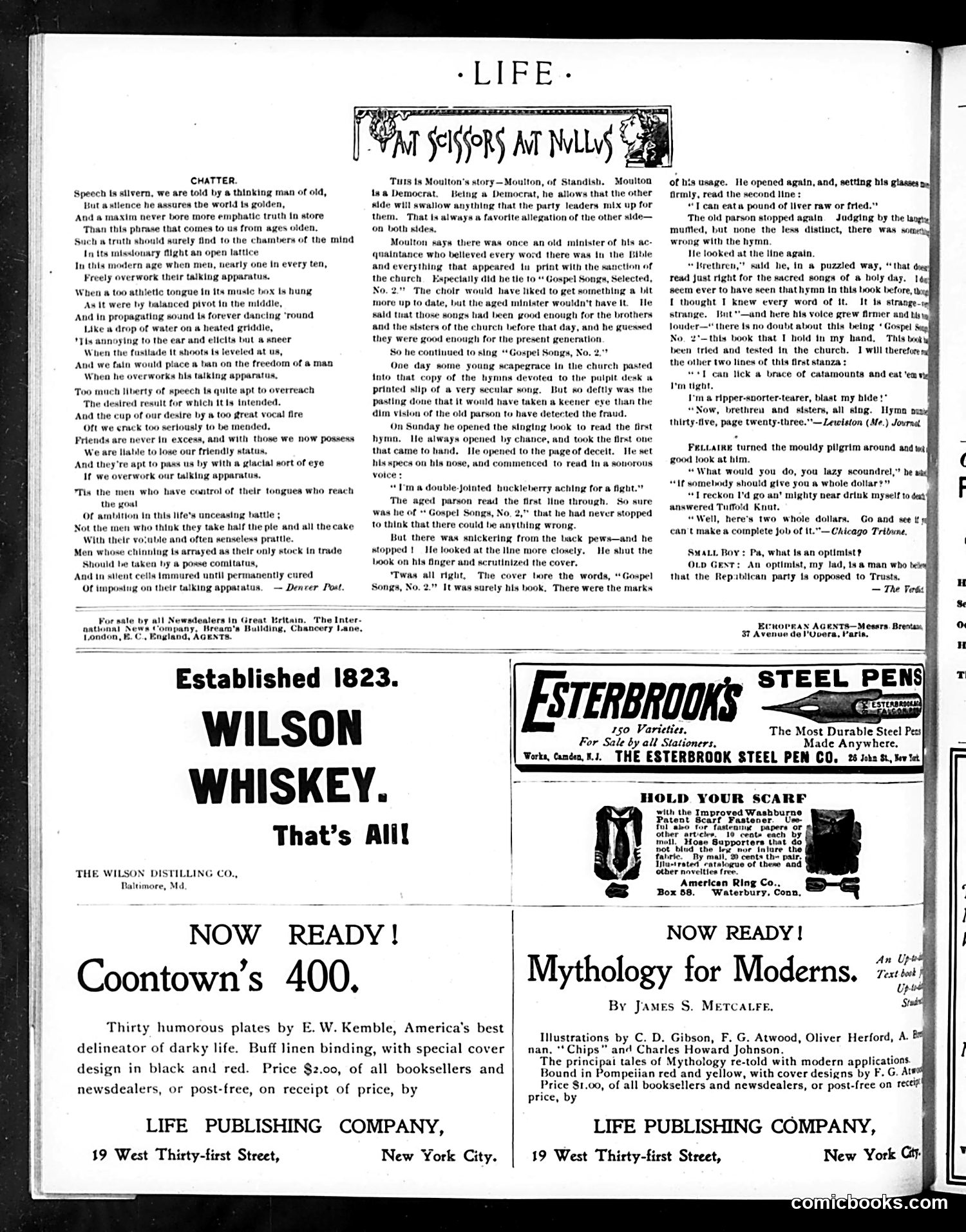
This page is primarily **advertisements and filler content** rather than editorial cartoons. The main text content consists of two pieces: 1. **"Chatter" (top)**: A moralizing poem about controlling excessive talking, arguing that silent people are more successful and likeable than those who "overwork their talking apparatus." This reflects early 20th-century concerns about propriety and self-restraint. 2. **"I'm Scissors at Nulls" (right column)**: A humorous anecdote about an elderly, literal-minded minister who unknowingly reads a secular song ("I'm a double-jointed buckleberry aching for a fight") from his hymnal after a church member plants it there as a prank. The joke mocks religious rigidity and credulousness. The bulk of the page features **period advertisements** for Wilson Whiskey, Esterbrook Steel Pens, a scarf-holding device, and books including "Coontown's 400" and "Mythology for Moderns." There are **no political cartoons** on this page—it's a typical Life magazine interior page mixing light social commentary, humor, and commercial advertisements.
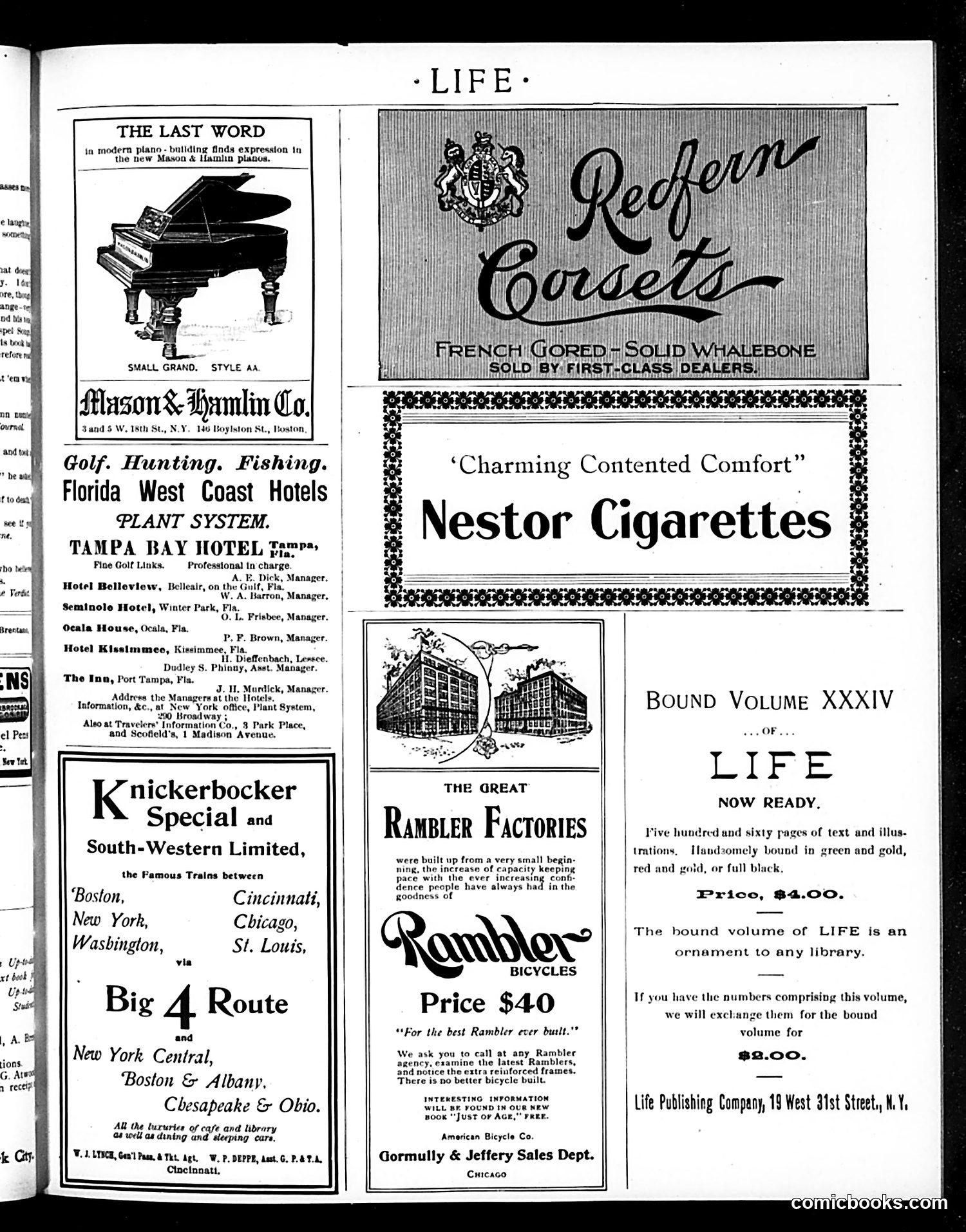
This is primarily an **advertising page** from Life magazine's bound volume XXXIV, not a satirical cartoon page. The top-left features a small advertisement for **Mason & Hamlin pianos**, showing a grand piano with the caption "The Last Word" — a common advertising trope claiming a product represents the pinnacle of modern design. The remaining advertisements showcase **turn-of-the-century American consumer goods and services**: Florida resort hotels, railway lines (Knickerbocker Special, Big 4 Route), **Rambler bicycles** ($40), **Nestor Cigarettes**, and **Redfern Corsets** (French-made, whalebone). The right side promotes the **bound volume itself** ($2.00, or free if you exchange individual issues). No political satire or editorial cartooning appears on this page—it's a commercial compilation reflecting Gilded Age luxury goods and leisure travel marketed to affluent readers.
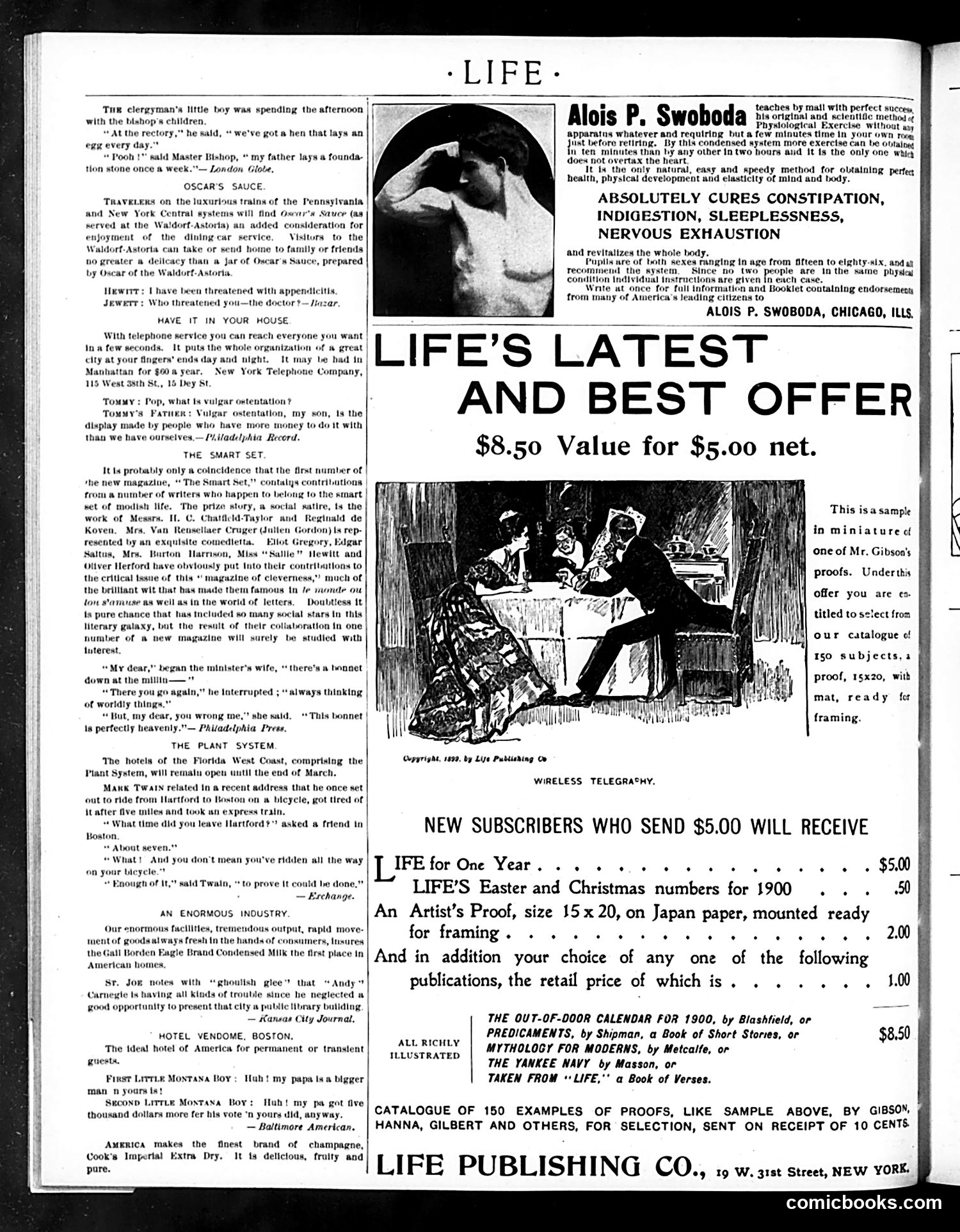
This page is primarily **advertisements and humorous anecdotes** rather than political cartoons. The content includes: **Main Advertisement:** Alois P. Swoboda promotes a mail-order health system claiming to cure constipation, indigestion, and nervousness through natural exercises. **Humor Section:** Brief jokes satirizing social pretension and professional hierarchies: - A clergyman's son boasts his father lays "foundation stones" while bishops only lay eggs (mocking clerical pretension) - A father defines "vulgar ostentation" as displays of wealth by people richer than himself (self-aware social commentary) - A minister's wife jokes about worldly concerns being "perfectly heavenly" (mild satire on religious hypocrisy) **Other Content:** Anecdotes about Mark Twain, railroad service, and product endorsements. The page reflects Edwardian-era concerns: class consciousness, emerging consumer culture, and gentle mockery of religious and social pretension—typical of Life magazine's satirical approach.
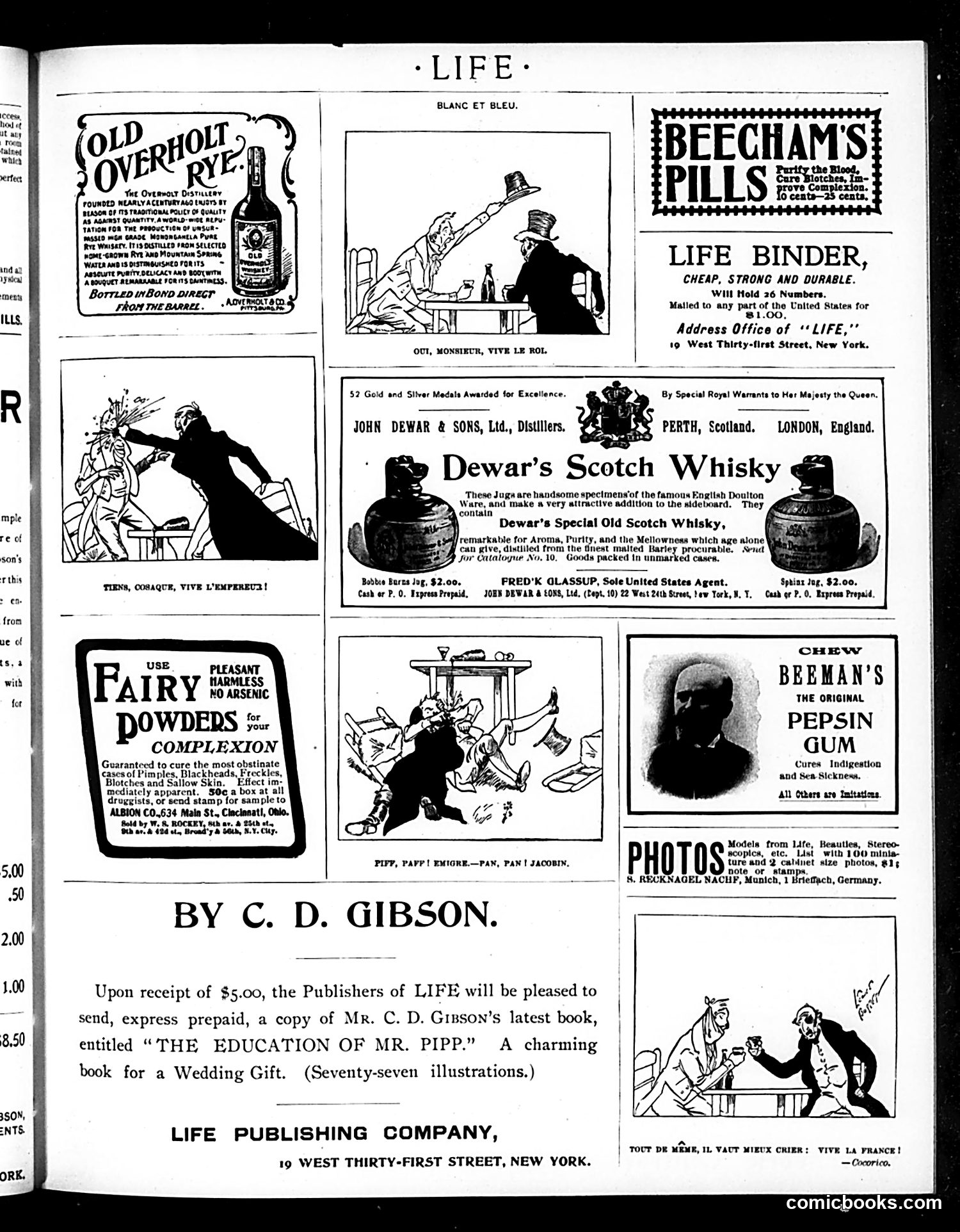
This is primarily an **advertising page** from Life magazine, circa early 1900s, featuring product ads and promotional content rather than editorial cartoons. The page includes small illustrated vignettes with French captions—"Blanc et Bleu" (White and Blue), "Oui, Monsieur, Vive le Roi" (Yes, Sir, Long Live the King), and "Tout de Même, il Vaut Mieux Crier: Vive la France!" (All the same, it's better to cry: Long Live France!)—which appear to be lighthearted social commentary, though the exact satirical targets are unclear without fuller context. The main content advertises spirits (Old Overholt Rye, Dewar's Scotch), Beecham's Pills, Fairy Powders for complexion, and Beeman's Pepsin Gum. A C.D. Gibson book promotion ("The Education of Mr. Pipp") appears at bottom—Gibson was Life's famous illustrator known for the "Gibson Girl." The French references and whisky ads suggest this targets an educated, cosmopolitan American audience with disposable income.
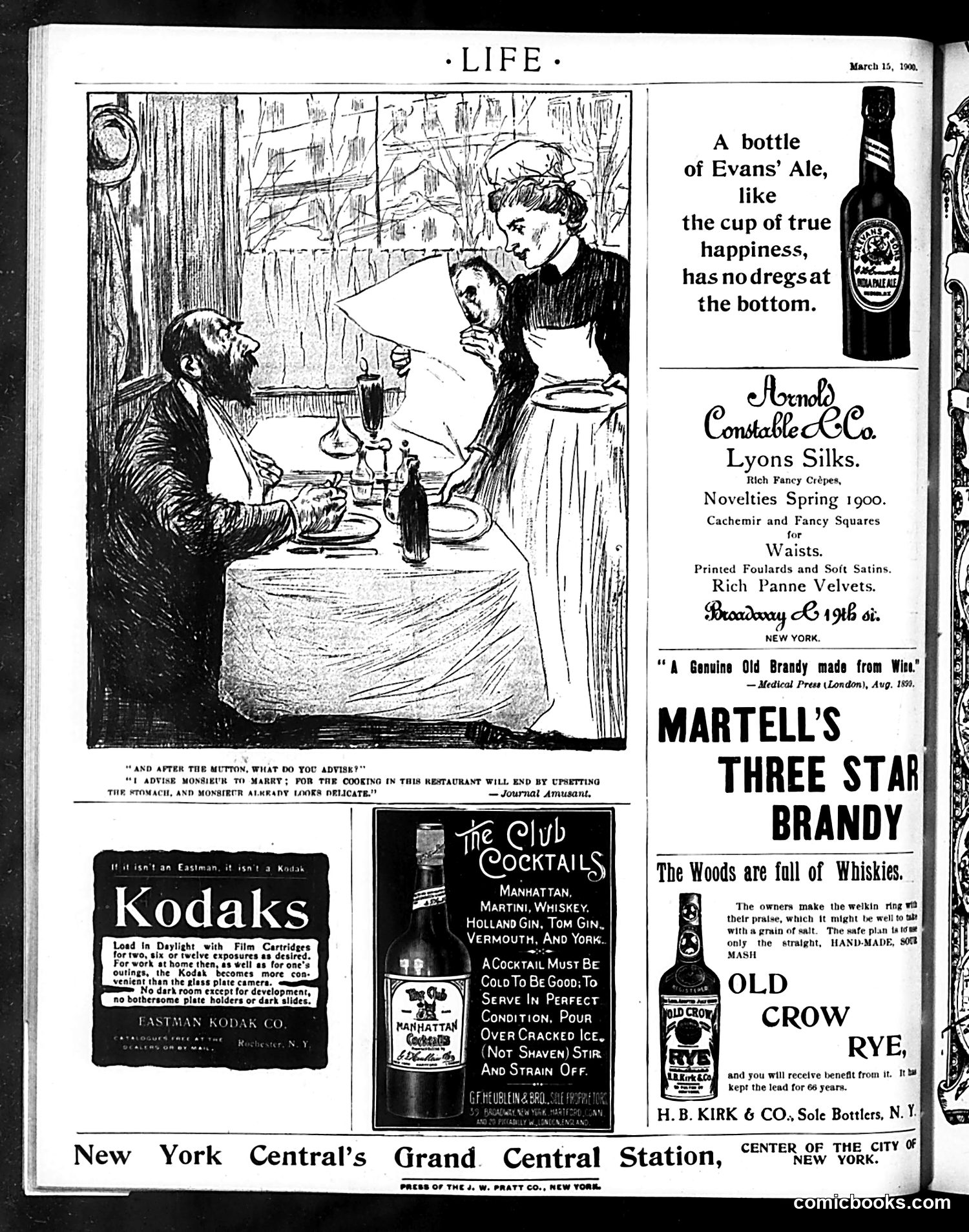
The main cartoon depicts a restaurant scene where a diner seeks advice from his companion after eating mutton. The companion humorously advises him to marry, joking that the restaurant's poor cooking will upset his stomach—and noting the diner "already looks delicate." The satire targets both questionable restaurant food quality and the stereotype of delicate male health in the era. The page is primarily **advertising**, promoting Evans' Ale, Kodak cameras, cocktail ingredients, brandies, and rye whiskey. One ad uses a medical quote claiming brandy is made from "wits"—likely satirizing dubious health claims attached to alcohol products. Arnold Constable & Co. advertises spring 1900 silk fashions for women's waists, demonstrating the magazine's commercial focus alongside satirical content. The overall tone reflects early 1900s concerns: dining out's reliability, photographic technology accessibility, and alcohol's supposed medicinal properties.