
Life, 1900-03-15 · page 6 of 20
Life — March 15, 1900 — page 6: what you’re looking at
What you’re looking at
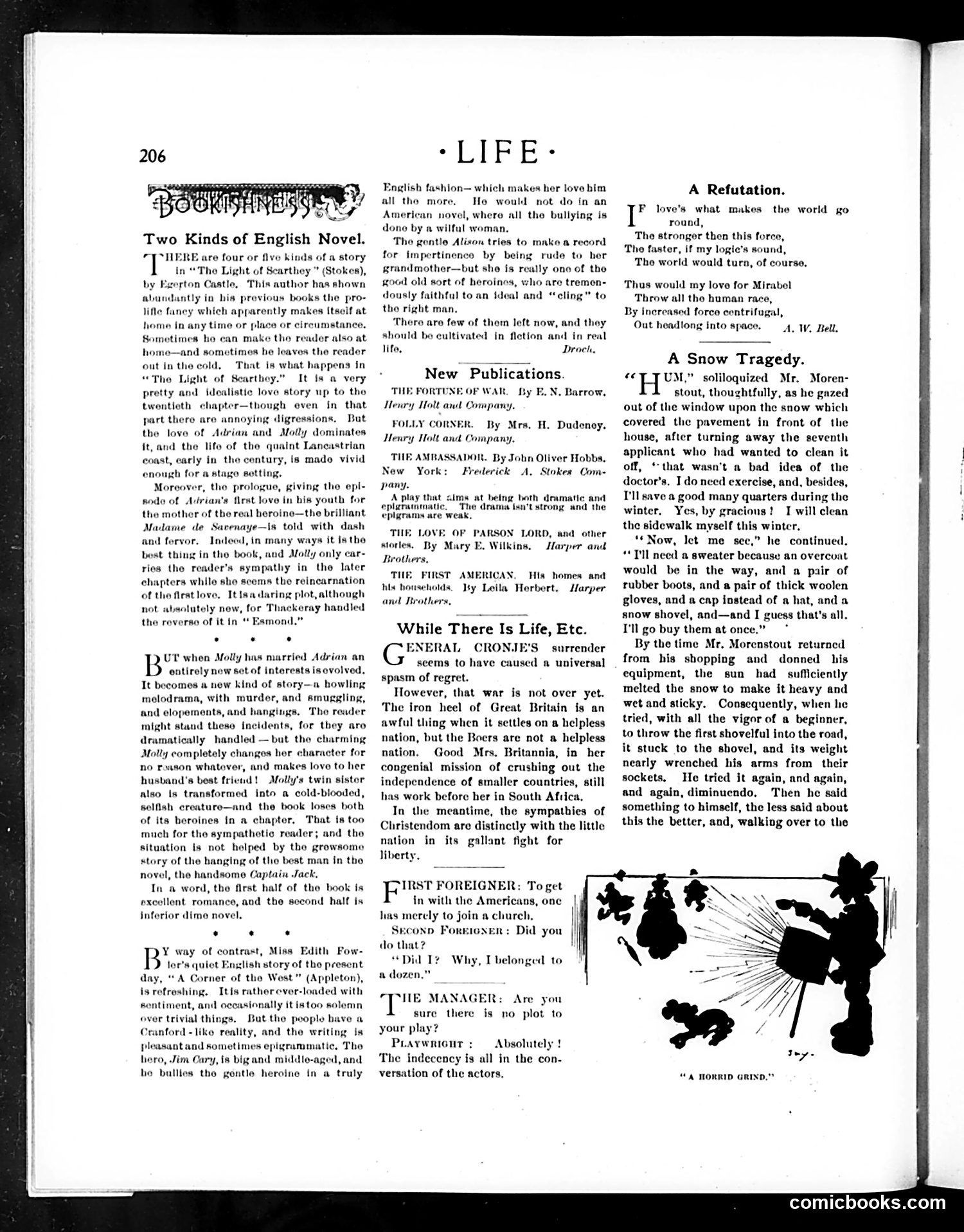
This cartoon depicts a figure being ground or crushed in what appears to be a mechanical grinder or mill. Based on the page's literary context discussing English novels and dramatic works, this likely satirizes the commercial publishing industry's treatment of authors or stories—suggesting they are processed mechanically and relentlessly, their creative work reduced to formulaic output for mass consumption. The title "A Horrid Grind" reinforces this message: the literary world "grinds" its subjects down through endless production demands. The cartoon critiques industrialized publishing's dehumanizing effects on writers, transforming their work into commodified products rather than genuine artistic expression—a concern relevant to early 20th-century debates about art versus commercialism.
📄 Transcribed text from this page (OCR, searchable)
Machine-transcribed from the original scan — historical spelling and the odd misread are preserved.
Two Kinds of English Novel. TT CHERE are four or five kinds of a story in “Tho Light of Scarthey egerton Castle, This author has shown auntly in his previous books the pro- iney whieh apparently makes Itself at in any time or place or circumstance. Sometimes ho can make tho reader also at home—and sometimes he leaves the reader out in the cold, That is what happens in “The Light of Scarthey.” It is a very pretty and idealistic love story up to the twentieth chapter—though even in that part there are annoying digressions, But the love of Adrian and Molly dominates ft, and the life of the quaint Lancastrian coast, early in tho century, is mado vivid enough for astago setting. Moreover, the prologue, giving the epl- odo of Adrian's frst love in bis youth for the mother of the real beroine—the brilliant. Madame de Savenaye—is told with dash and fervor, Indeed, in many ways it isthe best thing in the book, aud Molly only ear- ries the reader's sympathy in the lat aapters while she seems the reincarnation It tsadaring plot,although paolutely new, for Thackeray handled rao of itin Esmond,” . . . UT when Molly has married Adrian an entirely now set of Interests is ovolved, It becomes a new kind of story—a howling molodrama, with murder, and smuggling, and elopements, and hangings. ‘The reader might stand theso incidents, for they aro dramatically handled —but the charming Molly completely changos her character for no reason whatover, and makes love to her husband's best friend! Molly's twin sister also Is transformed into a cold-blooded, selfish creaturo—and the book loses both of its heroines in a chapter, That is too much for the sympathotic reader; and tho situation is not helped by the growsome story of the banging of the best man in the novel, the handsome Captain Jack. In a word, tho first half of the book is excellent romance, and the second half is inferior dimo no Y way of contrast, Miss Edith Fow- | lor's quict English story of the present day, “A Corner of the West” (Appleton), is refreshing. Itis rathorcvor-loaded with sentiment, and occasionally it istoo solemn over trivial things. But the people have a ford -like reality, and the writing is pleasant and sometimes epigrammatic, Tho horo, Jim Cary, is big and middle-aged, and ho bullies tho gontle heroine in a truly *LIP'E* English fashion— which makes her love bim all the more. He would not do in an American novel, where all the bullying is dono by a wilful woman, Tho gentle Alison tries to make a record for impertinenco by being rude to her grandmother—but sho is really ono of the good old sort of heroines, who are tremon- dously faithful to an ideal and “cling” to tho right man, ‘Thero aro few of thom left now, and thoy should be cultivated in fletion and in real life, Drock, New Publications. THE FORT! PWAR. By EN, Barrow, Holt aud Company. FOLLY CORNER. By Mra, H. Dudeney. Henry Holt and Company. THE AMBASSADOR. By Jobn Oliver Hobbs, New York: Frederick A, Stokes Com- pany. A play that cims at betng both dramatic and eplgnammatc. The drama isn't strong and the eplgrams are weak, THE LOVE OF PARSON LORD, and other stories. By Mary E. Wilkins. Harper and Brothers, THE FIRST his households. anil Brothers, While There Is Life, Etc. NERAL CRONJE'S — surrender seems to have caused a universal spasm of regret. However, that war is not over yet. The iron heel of Great Britain is an awful thing when it settles on a helpless nation, but the Bocrs are not a helpless nation. Good Mrs, Britannia, in her congenial mission of crushing out the independence of smaller countries, still has work before her in South Aftica, In the meantime, the sympathies of Christendom are distinctly with the little nation in its gallant fight for liberty. AMERICAN, Hia homes and Hy Leila Horbert. Harper IRST FOREIGNER: To get in with the Americans, one has merely to join a chureh, Srconp Forrioxer: Did you do that? “Did 17 a doze: Why, I belonged to Tt MANAGER: Are you sure there is no plot to your play? Praywriout : — Absolutely ! The indecency is all in the con- versation of the actors, A Refutation. I F love's what’ makes round, Tho atrongor then this force, The faster, if my logie’s sound, Tho world would turn, of course, the world go Thus would my love for Mirabel Throw all tho human race, By inercased forco centrifugal, Out headlong into space. 4, 1, Bell. A Snow Tragedy. ee UM,” soliloquized Mr. Moren- stout, thoughtfully, as he gazed out of the window upon the snow which covered the pavement in front of the house, after turning away the seventh applicant who had wanted to clean it off, ‘that wasn’t a bad idea of the doctor's. I do need exercise, and, besides, I'll save a good many quarters during the winter, Yes, by gracious! I will clean the sidewalk myself this winter, ‘*Now, let me see,” he continued. “Til need a sweater because an overcuat would be in the way, and a pair of rubber boots, and a pair of thick woolen gloves, and a cap instead of a hat, anda snow shovel, and—and I guess that’s all. I'll go buy them at once.” By the time Mr. Morenstout returned from his shopping and donned his equipment, the sun had sufficiently melted the snow to make it heavy and wet and sticky. Consequently, when he tried, with all the vigor of a beginner, to throw the first shovelful into the road, it stuck to the shovel, and its weight nearly wrenched his arms from their sockets, He tried it again, and again, and again, diminuendo, Then he said something to himself, the less said about this the better, and, walking over to the “A HORRID GRIND.” comicbooks.com