
Life, 1900-03-15 · page 8 of 20
Life — March 15, 1900 — page 8: what you’re looking at
What you’re looking at
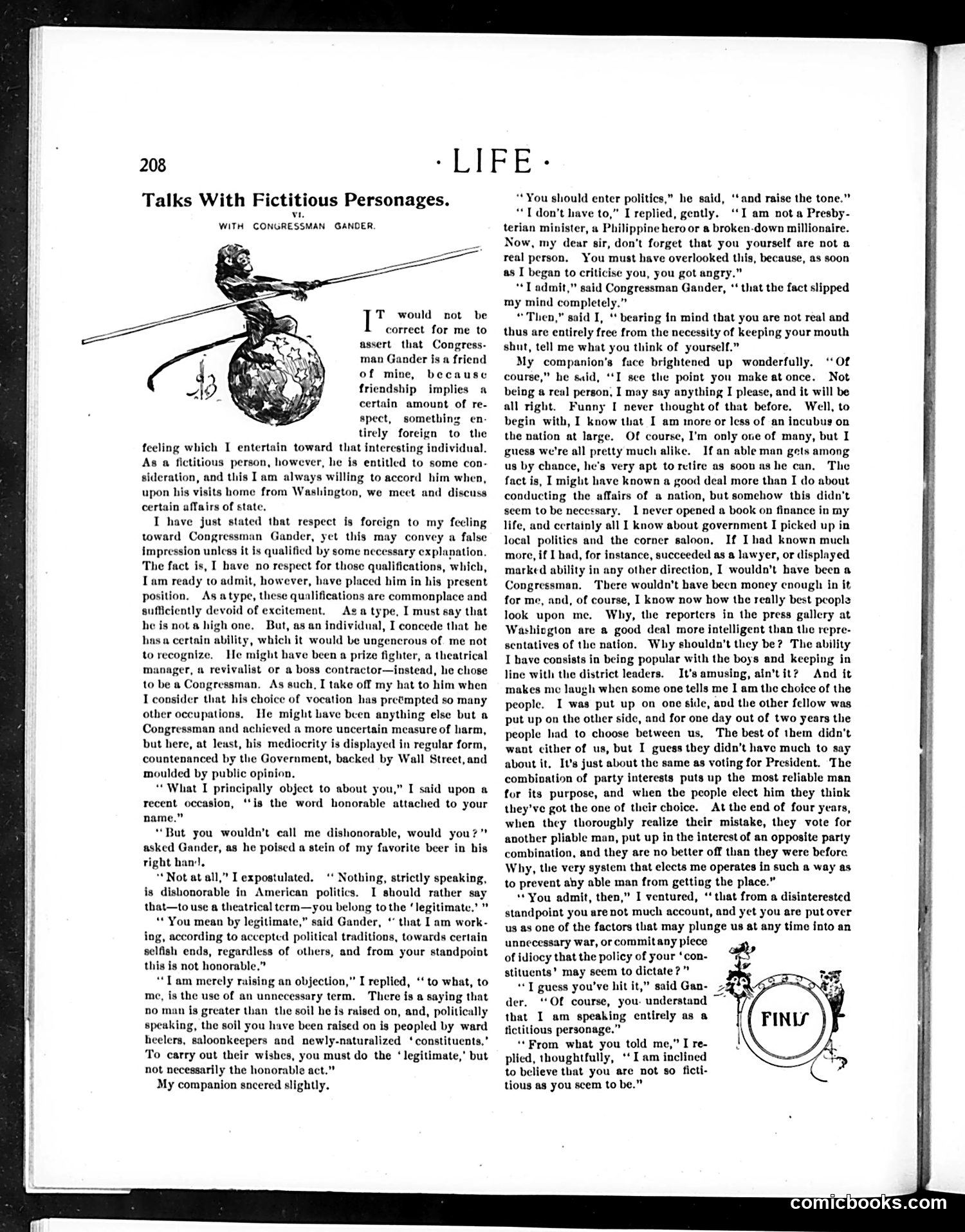
This page features a satirical dialogue between the author and **Congressman Gander** (a fictional character, as indicated by the title). The cartoon illustration depicts a figure balanced precariously on a globe, wielding a long pole—a visual metaphor for political precariousness and the balancing act of governance. The satire critiques the congressman's self-importance and political maneuvering. The author challenges Gander's claims to influence and respectability, arguing that congressmen like him are essentially interchangeable, neither particularly capable nor uniquely qualified. The dialogue mocks the congressman's belief that his position matters significantly while suggesting he's simply a tool serving party interests rather than genuine leadership. The satire targets political vanity and the illusion of congressional importance.
📄 Transcribed text from this page (OCR, searchable)
Machine-transcribed from the original scan — historical spelling and the odd misread are preserved.
208 Talks With Fictitious Personages. WITH CONGRESSMAN GANDER. T would not be correct for me to assert that Congress- man Gander is a friend of mine, because friendship implies certain amount of re- spect, something en- tirely foreign to the feeling which I entertain toward that interesting individual. As a fictitious person, however, he is entitled to some con- sideration, and this Iam always willing to accord him when, upon his visits home from Washington, we meet and discuss certain affairs of state, I have just stated that respect is forcign to my fecling toward Congressman Gander, yet this may convey a false impression unless it is qualified by some necessary explanation. The fact is, I have no respect for those qualifications, which, Tam ready to admit, however, have placed him in his present position. As atype, these qualifications are commonplace and sufficiently devoid of excitement. Aga type, I must say that he is nota high one, But, as an individual, I concede that be hasa certain ability, which it would be ungencrous of me not to recognize. He might have been a prize fighter, a theatrical manager, a revivalist or a boss contractor—instead, he chose to be a Congressman. As such, I take off my hat to him when I consider that his choice of vocation has pretmpted so many other occupations, He might have been anything else but a Congressman and achieved a more uncertain measure of harm, but here, at least, his mediocrity is displayed in regular form, countenanced by the Government, backed by Wall Street, and moulded by public opinion, “What I principally object to about you,” I said upon a recent occasion, “is the word honorable attached to your name.” “But you wouldn’t call me dishonorable, would you?” asked Gander, as he poised a stein of my favorite beer in bis right han‘, “Not at all,” I expostulated. ‘‘ Nothing, strictly speaking, is dishonorable in American politics. I should rather say that—to use a theatrical term—you belong to the ‘legitimate.’ * “You mean by legitimate,” said Gander, “ that I am work- ing, according to accepted political traditions, towards certain selfish ends, regardless of others, and from your standpoint this is not honorable,” “Tam merely raising an objection,” I replied, ‘‘ to what, to me, is the use of an unnecessary term. There is a saying that no man is greater than the soil he is raised on, and, politically speaking, the soil you have been raised on is peopled by ward heelers, saloonkeepers and newly-naturalized ‘constituents.’ To carry out their wishes, you must do the ‘legitimate,’ but not necessarily the honorable act.” My companion sncered slightly. -LIFE- ‘*You should enter politics,” he said, ‘and raise the tone.” “IT don’t have to,” I replied, gently. ‘I am nota Presby- terian minister, a Philippine hero or a broken-down millionaire. Now, my deur sir, don't forget that you yourself are not a real person, You must have overlooked this, because, as soon as I began to criticise you, you got angry.” “TL admit,” said Congressman Gander, ‘‘ that the fact slipped my mind completely.” “Then,” said I, ** bearing in mind that you are not real and thus are entirely free from the necessity of keeping your mouth shut, tell me what you think of yourself.” My companion’s face brightened up wonderfully. ‘Of course,” he said, “I sce the point you make at once. Not being a real person, I may say anything I please, and it will be all right. Funny I never thought of that before. Well, to begin with, I know that I am more or less of an incubus on the nation at large. Of course, I'm only one of many, but I guess we're all pretty much alike. If an able man gets among us by chance, he's very apt to retire as soon ashe can. The fact is, I might have known a good deal more than I do about conducting the affairs of a nation, but somehow this didn’t seem to be necessary. 1 never opened a book on finance in my life, and ccrtainly all I know about government I picked up in local politics and the corner saloon, If I had known much more, if I had, for instance, succeeded as a lawyer, or displayed marked ability in any other direction, I wouldn’t have been a Congressman, There wouldn't have been money enough in it for me, and, of course, I know now how the really best people look upon me. Why, the reporters in the press gallery at Washington are a good deal more intelligent than the repre- sentatives of the nation. Why shouldn't they be? The ability I have consists in being popular with the boys and keeping in line with the district leaders. It's amusing, ain't it? And it makes me laugh when some one tells me 1 am the choice of the people. I was put up on one side, and the other fellow was put up on the other side, and for one day out of two years the people had to choose between us, The best of them didn't want cither of us, but I guess they didn’t have much to say about it, It’s just about the same as voting for President. The combination of party interests puts up the most reliable man for its purpose, and when the people elect him they think they've got the one of their choice. At the end of four years, when they thoroughly realize their mistake, they vote for another pliable man, put up in the interest of an opposite party combination, and they are no better off than they were before. Why, the very system that elects me operates in such a way as to prevent any able man from getting the place.” ‘You admit, then,” I ventured, ‘that from a disinterested standpoint you are not much account, and yet you are put over us as one of the factors that may plunge us at any time into an unnecessary war, or commit any piece of idiocy that the policy of your ‘con- stituents’ may scem to dictate?” “I guess you've hit it,” said Gan- 7; der. ‘Of course, you. understand ~~ that I am speaking entirely as a tictitious personage.” ‘*From what you told me," I re- plied, thoughtfully, ‘I am inclined to believe that you are not so ficti- tious as you scem to be.” comicbooks.com