
Life, 1900-03-15 · page 12 of 20
Life — March 15, 1900 — page 12: what you’re looking at
What you’re looking at
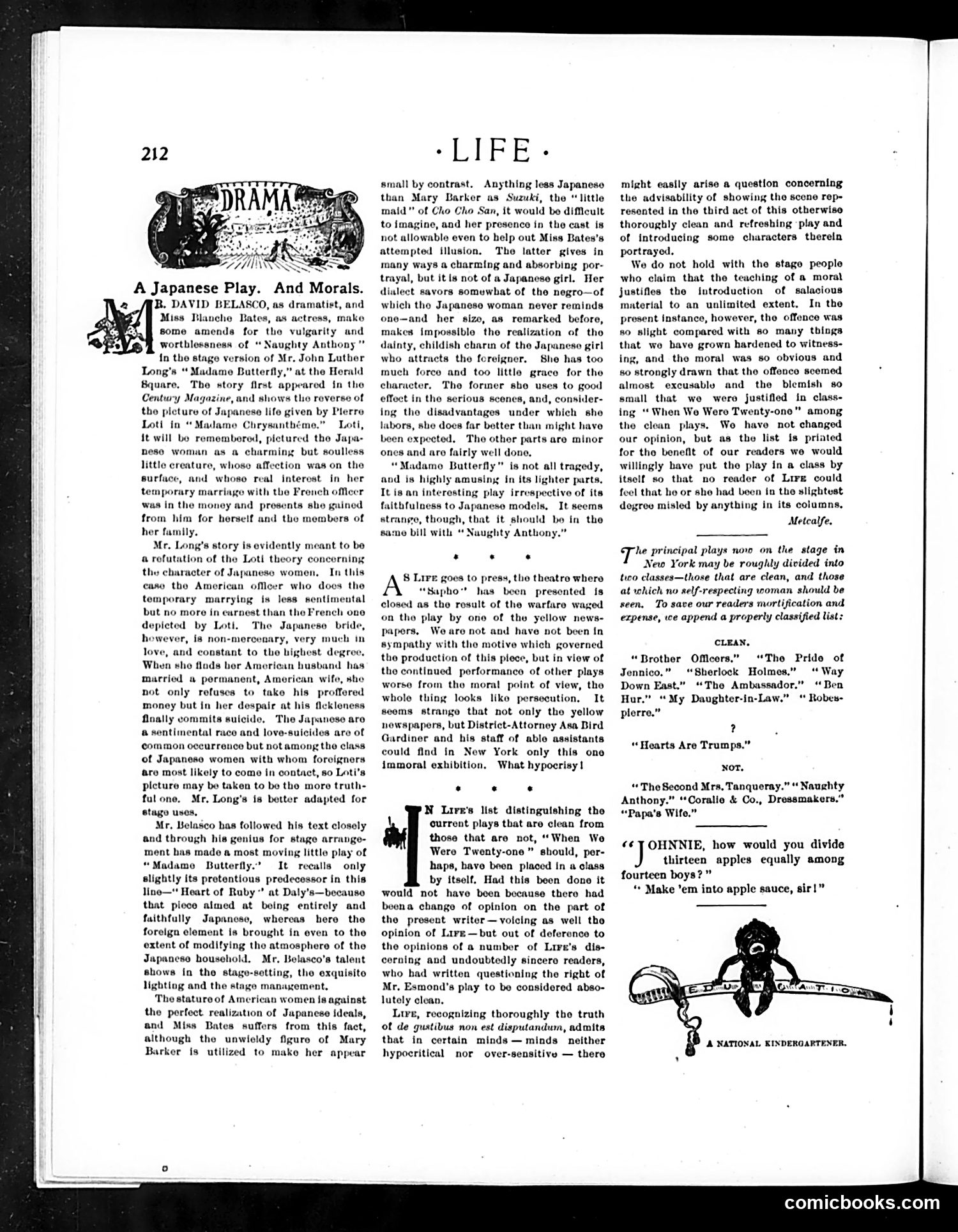
This page discusses theatrical productions, specifically critiquing a Japanese play called "Madame Butterfly" and David Belasco's "Naughty Anthony." The text praises the Japanese production for its authenticity and faithful portrayal of Japanese customs, contrasting it favorably with American theatrical attempts. At the bottom right is a cartoon titled "A National Kindergartener" depicting what appears to be a young child with an apple, likely satirizing American innocence or naiveté regarding foreign cultures—possibly commenting on American audiences' limited understanding of authentic Japanese theater versus Westernized adaptations. The overall critique suggests Life magazine's position that American productions oversimplified or sensationalized non-Western subjects, while authentic foreign performances offered superior cultural value and artistic integrity.
📄 Transcribed text from this page (OCR, searchable)
Machine-transcribed from the original scan — historical spelling and the odd misread are preserved.
A Japanese Play. And Morals. B. DAVID BELASCO, as dramatist, and Miss Blanche Bates, as actress, mako some amends for tho vulgarity and wortblossness of “Naughty Anthony” {n the stage version of Mr. John Luther Long's “ Madame Butterfly,” at the Horald Square, Tho story first appeared in the Century Magazine, and shows tho reverse of tho picture of Japanese life given by P Loti in “ Madame Shrysanthéme.” Ls it will bo remembered, pictured tho Japa- eso woman as a charming but soulless little creature, whose affection was on the surface, and whoso real interest in her temporary marriage with the Fronch ofeer was in the money and prosents she gained from him for herself and the members of her family. Mr. Long’s story is evidently meant to be a refutation of the Loti theory concerning the character of Japanese women, In this caso the American officer who doos the temporary marrying is less sentimental but no more in curnest than the French one depicted by Loti, The Japanese bride, however, i8 non-mercenary, very much in love, and constant to the bighest degree, When sho flads bor American husband has married a permanent, Amorican wife, she not only refuses to take his proffered money but in her despair at his Ackleness flnally commits suicide. The Japanese aro 4 sentimental raco and love-suicides are of common occurrence but not among the class of Japaneso women with whom forcigners ro most likely to como in contact, so Loti’s picture may be taken to be tho moro truth- fulone. Mr, Long's is better adapted for stage uses, Mr, Belasco has followed his text closely and through his genius for stage arrange- ment bas made a most moving little play of “Madamo Butterfly.’ It recalls only slightly its protentious predecessor in this, lne—" Heart of Ruby’? at Daly’s—becauso that piece almed at boing entirely and faithfully Japancse, whereas hero the foreign clement is brought in even to the extent of modifying the atmosphere of the Japanese household, Mr, Bolasco’s talent shows in tho stage-setting, the exquisite lighting and the stage management, ‘Tho staturoof American women is aguinst the perfect realization of Jupancse ideals, and Mixs Bates suffers from this fact, although the unwieldy figuro of Mary Barker {8 utilized to make her appear “LIFE = small by contrast. Anything less Japaneso than Mary Barker as Suzuki, the “little maid” of Cho Cho San, it would be difcult to imagine, and her presence in the cast is not allowable even to help out Miss Bates’s attempted illusion, The latter gives in many ways a charming and absorbing por- trayal, but it ls not of a Japanese girl. Her dialect savors somewhat of tho negro—ot which tho Jupaneso woman never reminds one—and her size, as remarked before, makes Impossible tho realization of tho dainty, childish charin of the Japaneso girl who attracts the foreigner. She has too much forco and too little grace for the character, Tho former sho uses to good effect in the serious scencs, and, consider- ing tho disadvantages under which sho labors, she docs far better than might havo been expected. Tho other parts are minor ones and aro fairly well done, “Madamo Butterfly" is not all tragedy, and is highly amusing in its lighter parts, It isan interesting play irrespective of its faithfulness to Japanese models, It seems strange, though, that it should be in the same bill with “ Naughty Anthony.” . . . 8 Lire goes to press, tho theatro where A Sapho"’ has been presented 1s closed as tho rosult of the warfare waged on tho play by one of the yellow news- Papers, Wo aro not and have not been tn sympathy with tho motive whieh governed the production of this piece, but in view of tho continued performance of other plays worse from tho moral point of view, tho whole thing looks like persecution, It seoms strango that not only tho yellow nowspapers, but District-Attorney Asa Bird Gardiner and his staff of ablo assistants could find in New York only this one immoral exhibition, What hypocrisy! N Live's list distinguishing tho \ current plays that are clean from * those that aro not, “When Wo Were Twenty-one” should, per- haps, bave been placed in a class by itself. Had this beon dono it would not havo been because thero had beena chango of opinion on the part of tho present writer—voicing as well tho opinion of Lire —but out of deference to the opinions of a number of Lirk’s dis- corning and undoubtedly sincero readers, who bad written questioning the right of Mr, Esmond’s play to be considered abso- lutoly clean. Lire, recognizing thoroughly the truth of de gustibus non est disputandum, admits that in certain minds — minds neither hypocritical nor over-sensitive — thero might easily arise a question concerning the advisability of showing the scene rep- resented in the third act of this otherwise thoroughly clean and refreshing “play and of Introducing some characters therein portrayed. We do not hold with tho stago people who claim that the teaching of a moral justifies the introduction of salacious muterial to an unlimited extent. In the present instance, however, the offence was 80 slight compared with so many things that wo bave grown hardened to witness- ing, and the moral was so obvious and so strongly drawn that tho offence seemed almost excusably and the blemish 80 small that wo were justified in class- ing “When We Wero Twenty-ono" among the clean plays. Wo have not changed our opinion, but as the list is priated for tho beneft of our readers we would willingly have put the play in a class by itself so that no reader of Lire could feel that he or she had been in the slightest dogree misled by anything in its columns, Metcalfe. Te principal plays novo on the stage in New York may be roughly divided into tio classes—those that are clean, and those at which no relf-respecting woman should be seen. To save our readers mortification and expense, we append a properly classified list: CLEAN. “Brother Officers." “The Pride of Jennico.” “Sherlock Holmes,” ‘ Way Down East.” “The Ambassador. Hur." “My Daughter-in-Law.’ plerre. ? “Hearts Are Trumps.” ‘NOT, “The Second Mrs, Tanqueray.” “Naughty Anthony.” “Coralie & Co., Dressmakers.” “Papa's Wife.” ¢¢]T OHNNIE, how would you divide thirteen apples equally among fourteen boys?” ‘“* Make 'em into apple sauce, sir!” comicbooks.com