
A complete issue · 20 pages · 1900
Life — February 22, 1900
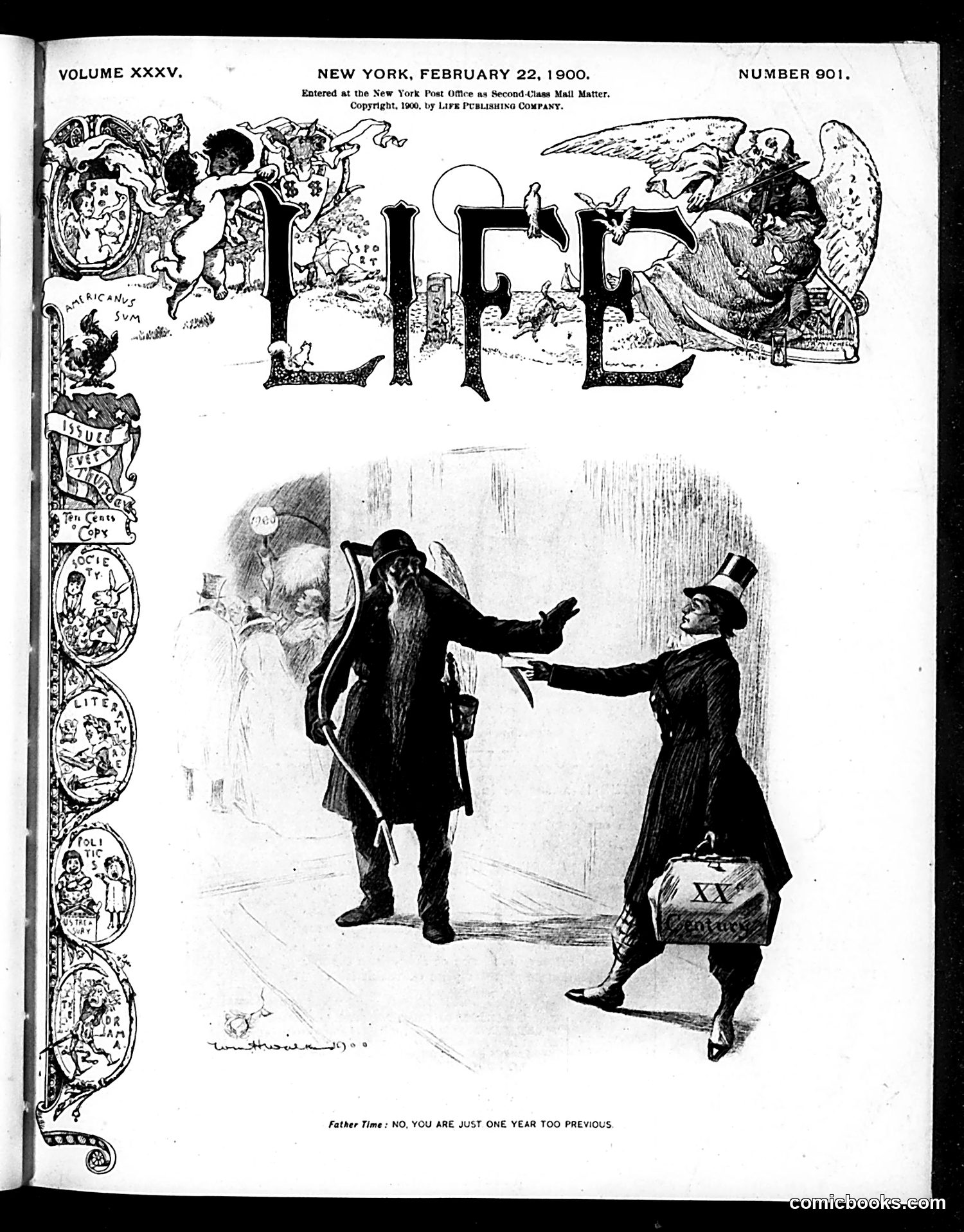
This page features a single cartoon titled "Father Time: 'NO, YOU ARE JUST ONE YEAR TOO PREVIOUS.'" The image depicts two figures: an elderly man with a long beard (representing Father Time, identifiable by traditional iconography) and a well-dressed gentleman in a top hat. The well-dressed man holds a bag marked "XX" and extends papers toward Father Time in a supplicating gesture. The satire appears to address someone's premature attempt to advance some plan or claim by one year—likely a political or social matter anticipated for 1901 rather than 1900. Father Time's rebuff suggests the figure is jumping ahead of schedule. Without additional context about specific 1900 events, the exact subject remains unclear, though it satirizes impatience or overconfidence about timing.
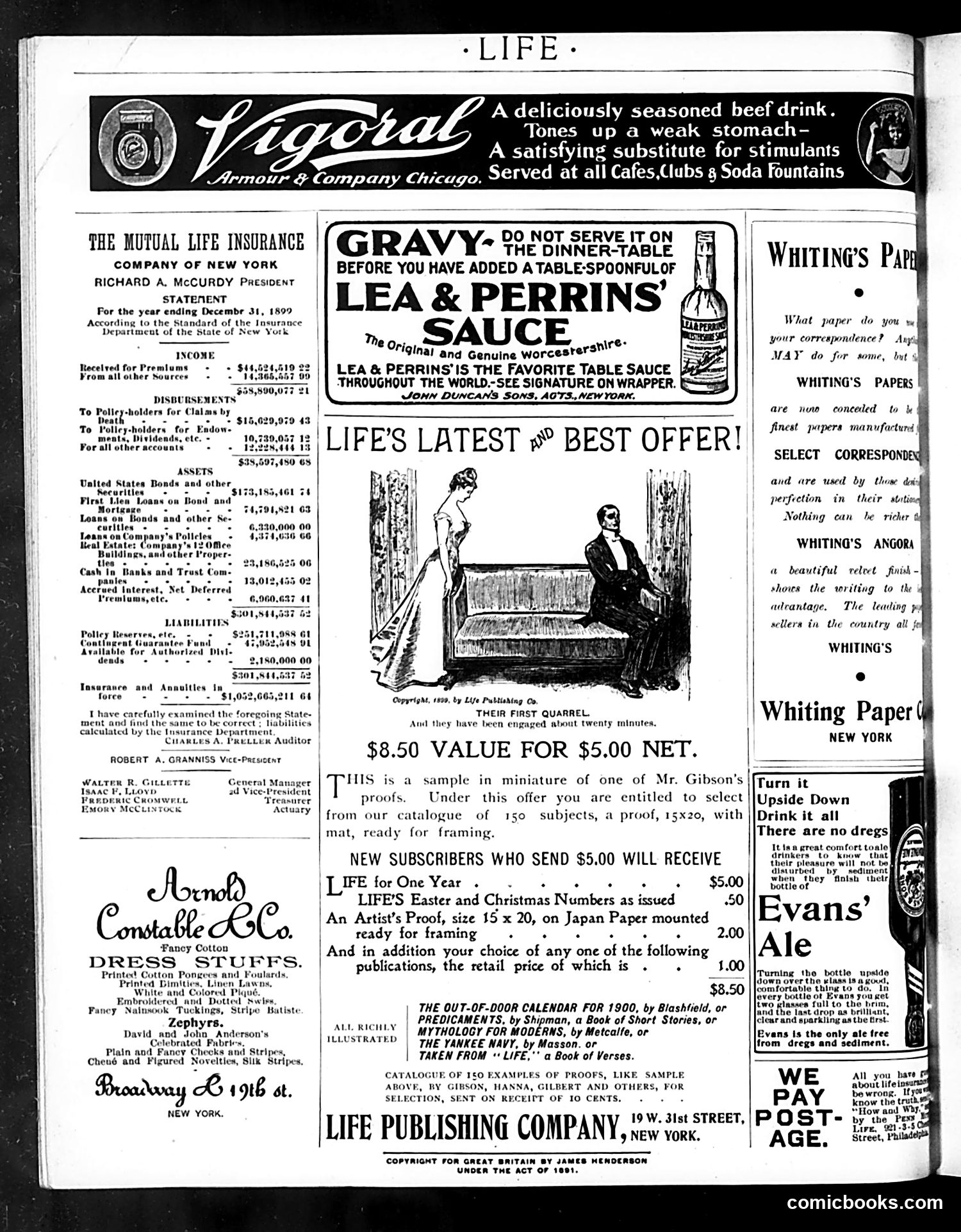
This page is primarily **advertising and business content** rather than political satire. The main cartoon illustrates "Their First Quarrel"—a domestic scene showing a couple in bed with a dispute, captioned "$8.50 VALUE FOR $5.00 NET." The image serves as an advertisement for Life Publishing Company's promotional offer: new subscribers paying $5.00 receive a year's subscription plus premium items including Gibson Girl proofs and publications. The cartoon's domestic subject matter is generic humor typical of early 1900s magazines, not political commentary. The page also advertises Vigoral beef drink, Lea & Perrins sauce, Arnold Constable clothing, Whiting's Paper, and Evans' Ale—standard period advertising with no apparent satirical intent toward these products or their makers.
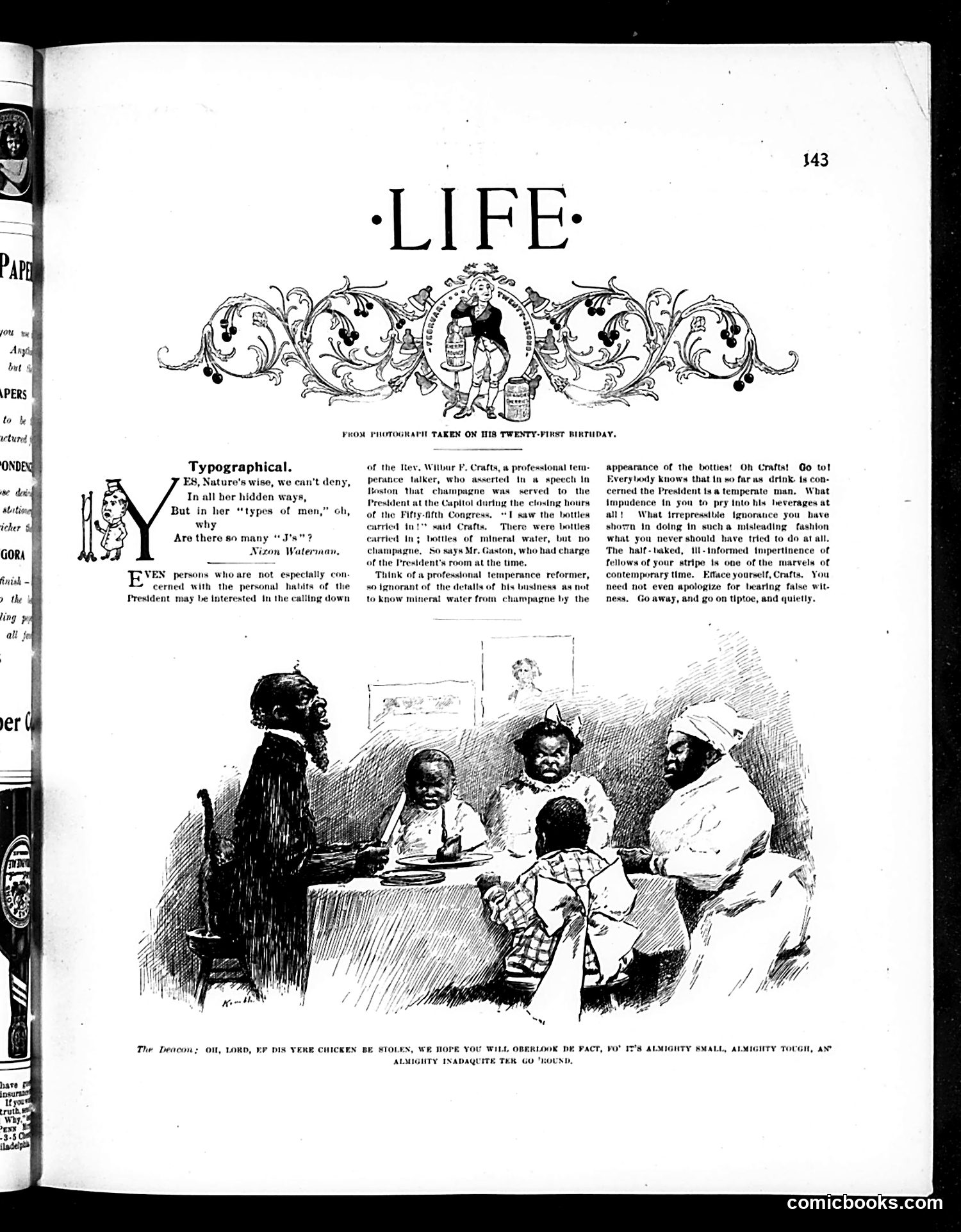
This page satirizes President Theodore Roosevelt's personal habits, specifically his consumption of bottled water. The heading "From Photograph Taken on His Twenty-First Birthday" is tongue-in-cheek, mocking Roosevelt's famously vigorous persona. The text section "Typographical" references Rev. Wilbur F. Crafts, a temperance advocate who boasted about serving only mineral water at a presidential reception. The satire ridicules both Crafts's self-righteousness about this detail and Roosevelt's own reputation for promoting "strenuous" living. The illustration below depicts what appears to be working-class figures discussing the incident, with the caption sarcastically suggesting they'll "overlook" the fact that such modest beverages are "almighty small, almighty tough, and almighty inadequate." The humor derives from contrasting Roosevelt's rugged public image with the prissy detail of his water choice.
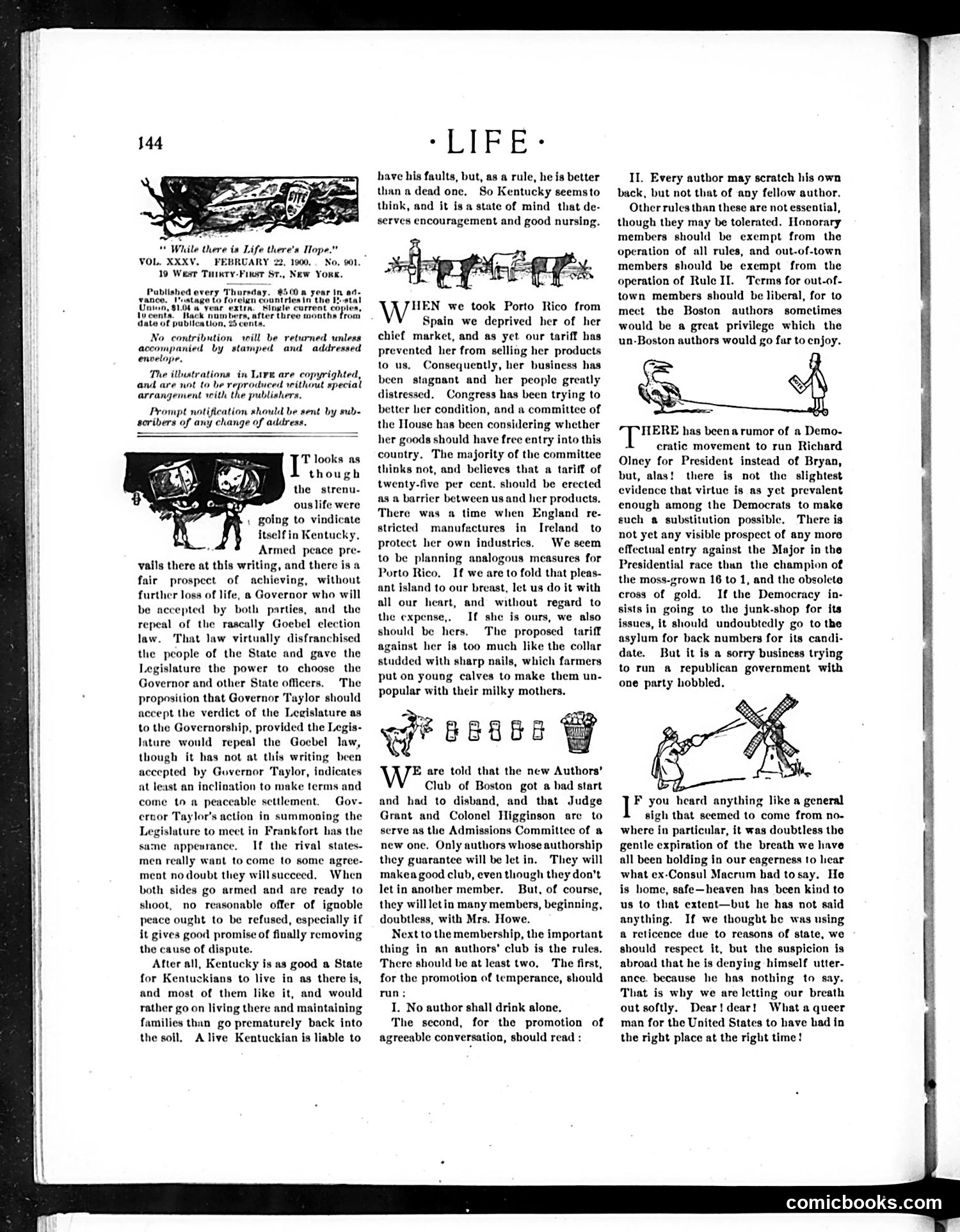
This page contains editorial commentary rather than political cartoons. The main text discusses **Porto Rico's tariff situation**—Congress debated whether to impose a 25% tariff on goods from the island, which the author opposes as economically harmful to Porto Rico's struggling market. The small illustrations appear to be decorative vignettes rather than satirical cartoons, showing rural/farming scenes. A separate section discusses the **new Authors' Club of Boston**, expressing skepticism that Judge Grant and Colonel Higginson's leadership will successfully unite authors "whose authorship they guarantee" despite quality concerns. The tone is skeptical of government policies affecting Porto Rico and somewhat cynical about literary institution-building—typical of *Life*'s satirical approach to contemporary political and social matters.
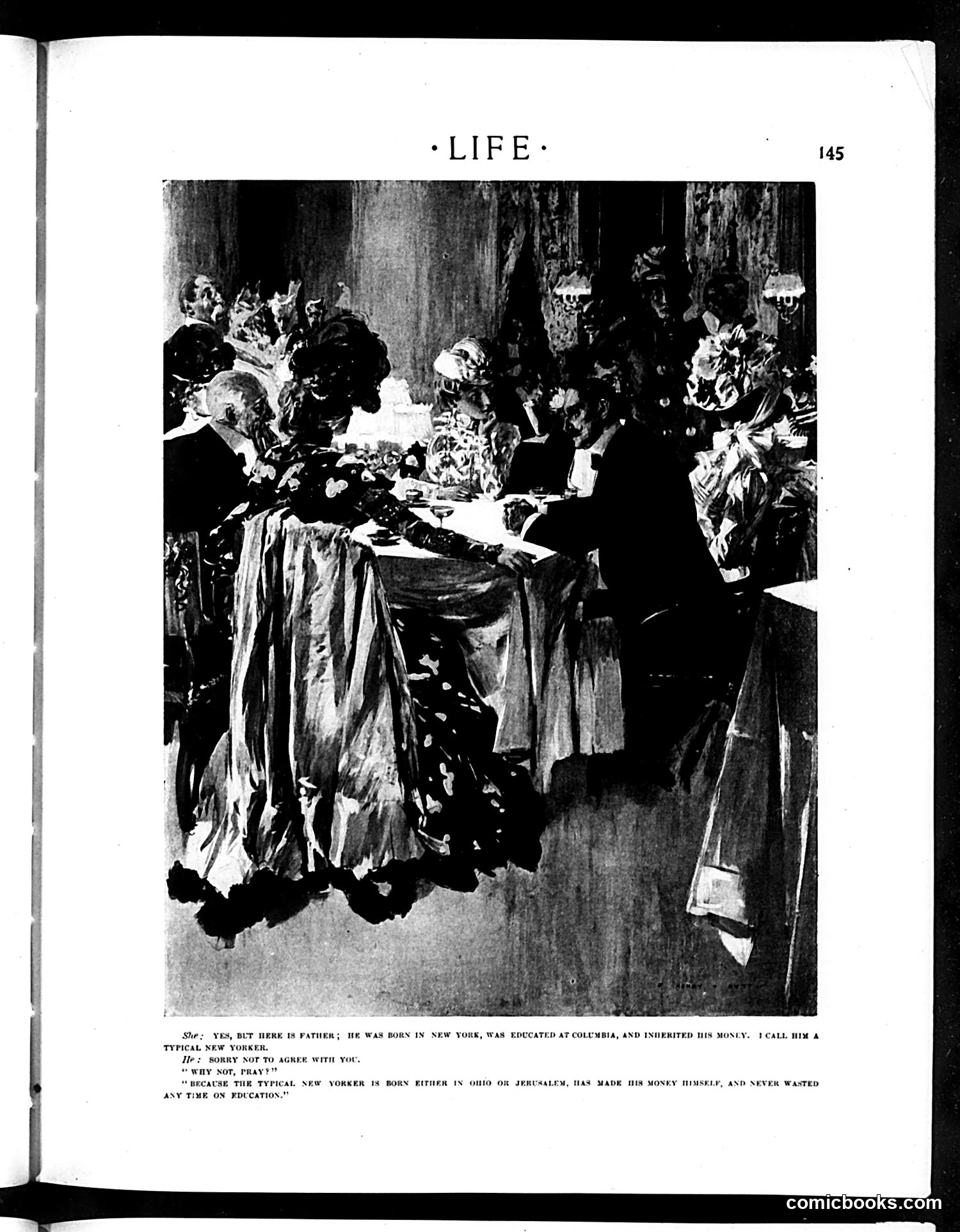
This page from *Life* magazine satirizes stereotypes about wealthy New Yorkers versus self-made men from other regions. The illustration depicts an elegant dinner party scene with fashionably dressed guests in what appears to be a wealthy New York setting. The caption contrasts two types of wealthy men: the typical New Yorker (educated at Columbia, inherited money) versus a self-made businessman from Ohio or Jerusalem who "made his money himself, and never wasted any time on education." The satire targets class pretensions and educational snobbery—mocking the assumption that inherited wealth and Ivy League education make someone superior to someone who achieved success through business acumen alone. It's a commentary on American attitudes about old money versus new money during the Gilded Age or similar prosperous period.
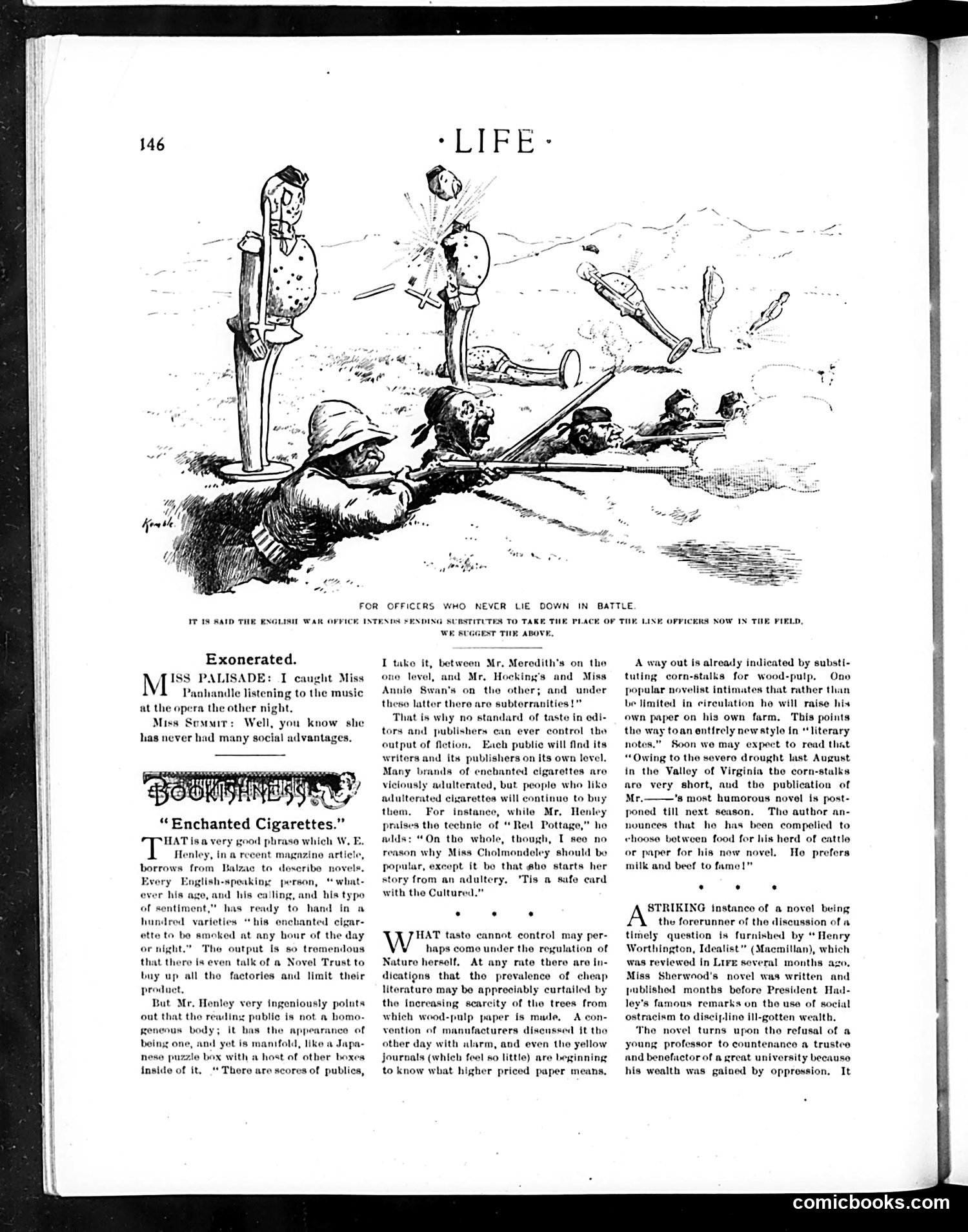
This cartoon satirizes British military leadership during what appears to be World War I. The image shows dead soldiers lying on a battlefield with wooden crosses marking graves, while uniformed officers stand safely behind the lines. The caption states: "FOR OFFICERS WHO NEVER LIE DOWN IN BATTLE. IT IS SAID THE ENGLISH WAR OFFICE INTENDS SENDING SUBSTITUTES TO TAKE THE PLACE OF THE LINE OFFICERS NOW IN THE FIELD. WE SUGGEST THE ABOVE." The satire mocks the proposal to replace frontline officers with substitutes—implying that actual officers avoid combat danger while sending others to die. The wooden grave markers emphasize the human cost of such decisions, critiquing what Life saw as cowardly or negligent military leadership.
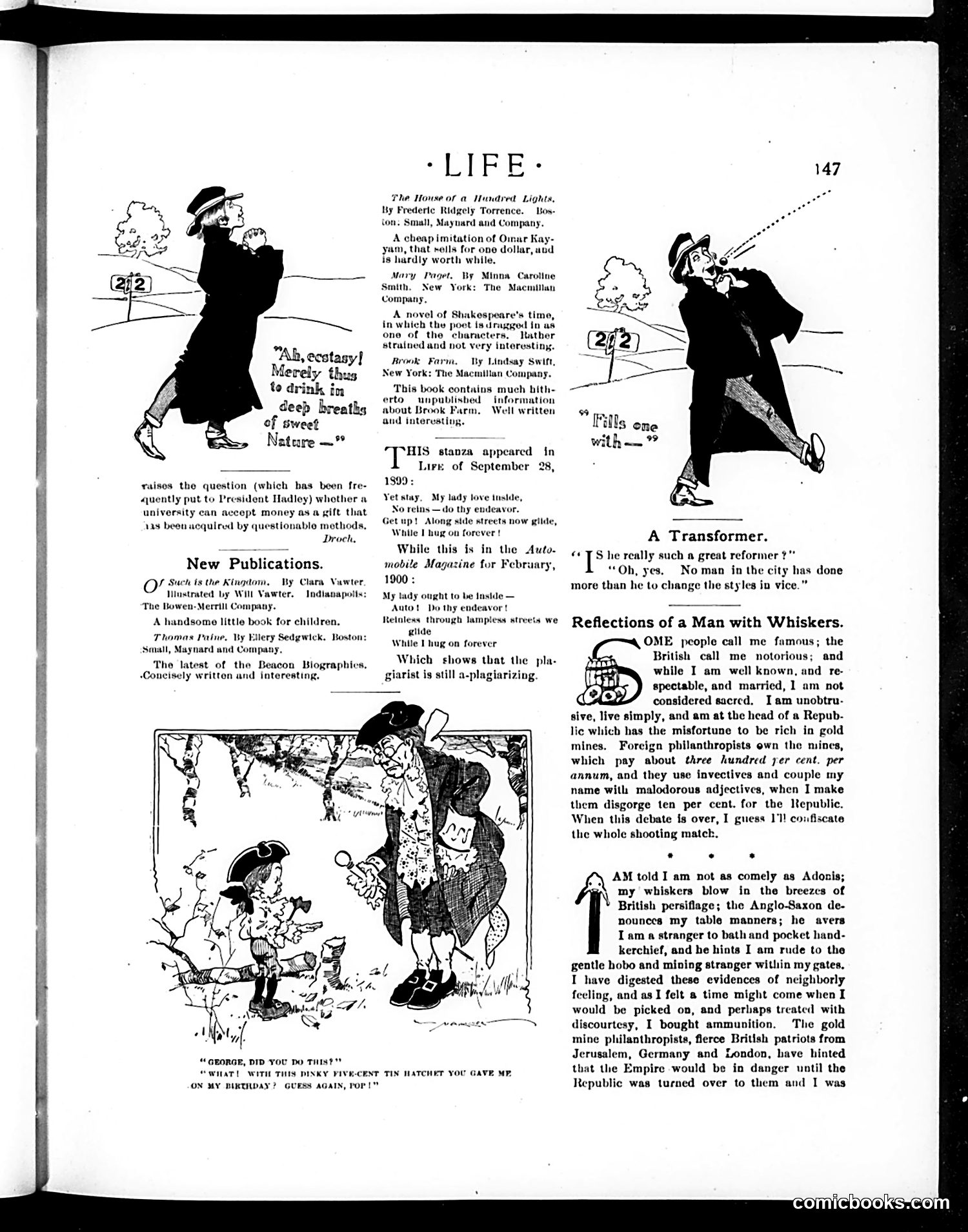
This page contains several satirical pieces typical of early 1900s *Life* magazine humor. **Top cartoons**: Two nearly identical silhouettes show a man exclaiming about drinking "sweet Nature" and another saying "This one will—" The jokes appear to reference temperance debates or concerns about alcohol consumption—likely mocking either prohibitionists or drinkers. **"A Transformer"**: A brief dialogue joke about a man changing fashion styles in the city. **"Reflections of a Man with Whiskers"**: The main text piece features a wealthy man complaining about being called "notorious" and defending himself against criticism regarding his foreign philanthropy and involvement with a Republic (likely Venezuela, given the "three hundred per cent" mine reference). The piece satirizes wealthy philanthropists' self-justifications and American foreign business interests. The lower illustration depicts a domestic scene, likely humorous commentary on family life.
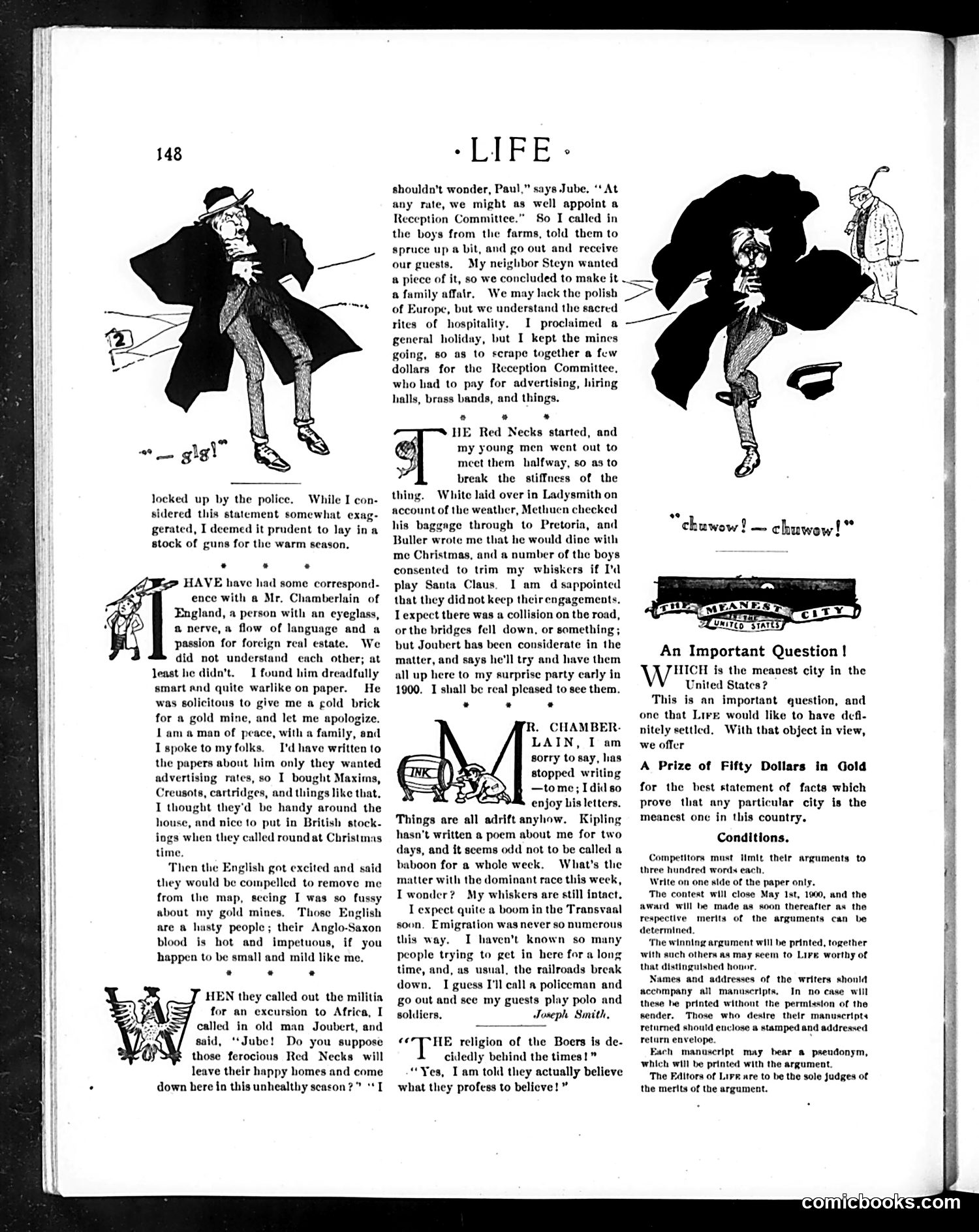
This page contains personal letters and commentary rather than political cartoons. The main content features Joseph Smith discussing social matters in South Africa, including references to: - **The Boer War context**: References to "Red Necks," "Anglo-Saxon blood," and militia excursions to Africa suggest tensions during or after the Boer War period - **Mining operations**: Discussion of mines and workers suggests the South African mining industry - **Social divisions**: Commentary on class ("hasty people") and racial attitudes ("dominant race") The illustrations are decorative figure drawings accompanying the text rather than editorial cartoons making specific political points. A sidebar announces **Life's contest**: a $50 gold prize for the best argument about "which is the meanest city in the United States"—satirizing American urban conditions and civic competition of the era. The satire is gentle, focused on social customs and personal observations rather than sharp political critique.
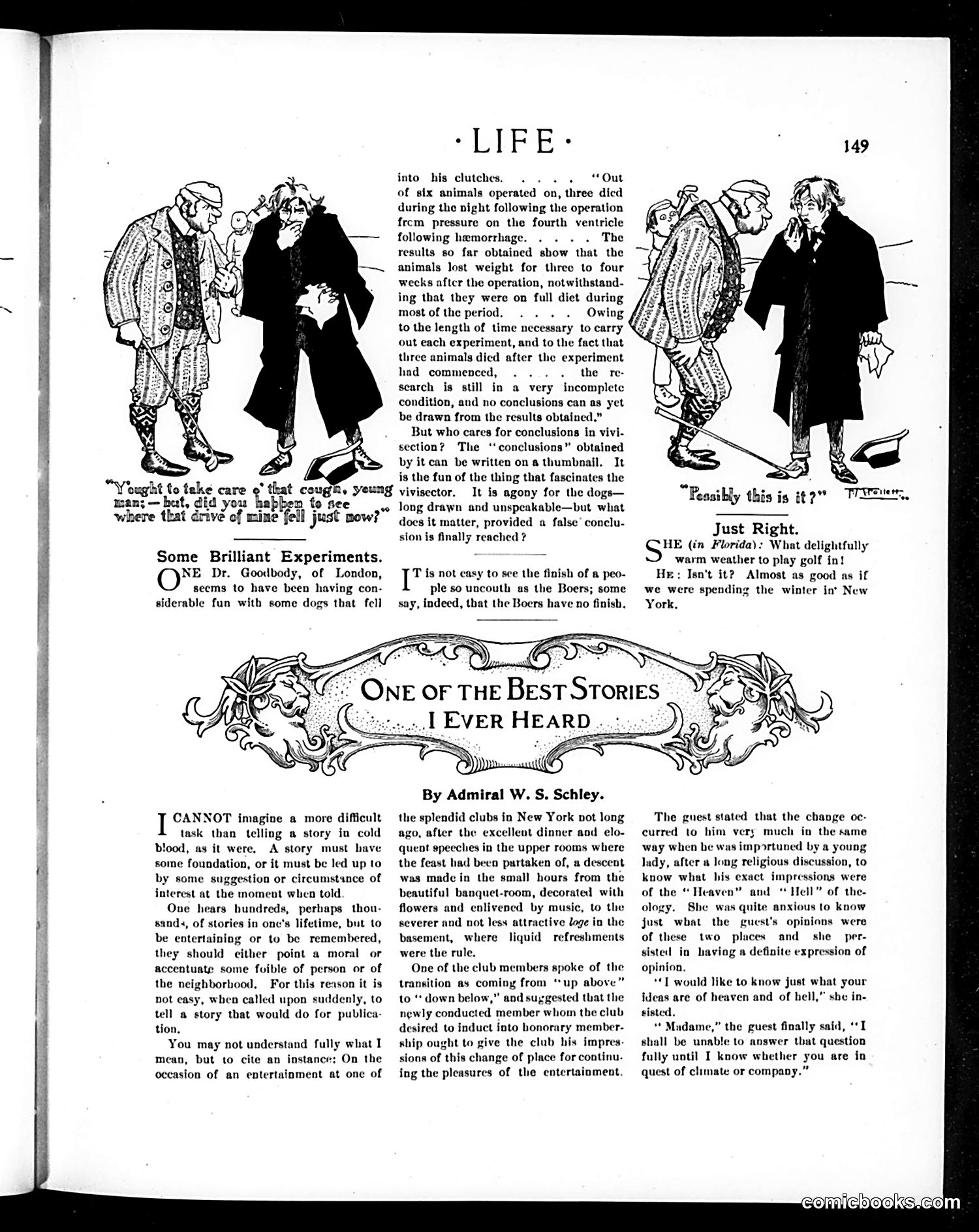
This page contains two separate items: 1. **Top cartoons**: Two illustrated panels showing men in early 20th-century dress discussing coughs and winter health. The humor concerns seasonal ailments and medical advice—likely satirizing hypochondria or ineffective remedies of the era. 2. **"Some Brilliant Experiments"**: A section header introducing a story about a Dr. Goodbody of London conducting experiments on dogs, with vivisection implications (animal testing for medical research). 3. **"One of the Best Stories I Ever Heard"**: The main article by Admiral W. S. Schley describes a social anecdote about club members debating whether a guest's impressions of "Heaven" and "Hell" represent actual religious theology or merely reflect personal preference. It's a humorous meditation on subjectivity and opinion-forming. The page reflects early 20th-century concerns: medical experimentation, seasonal health anxieties, and philosophical dinner-party debates.
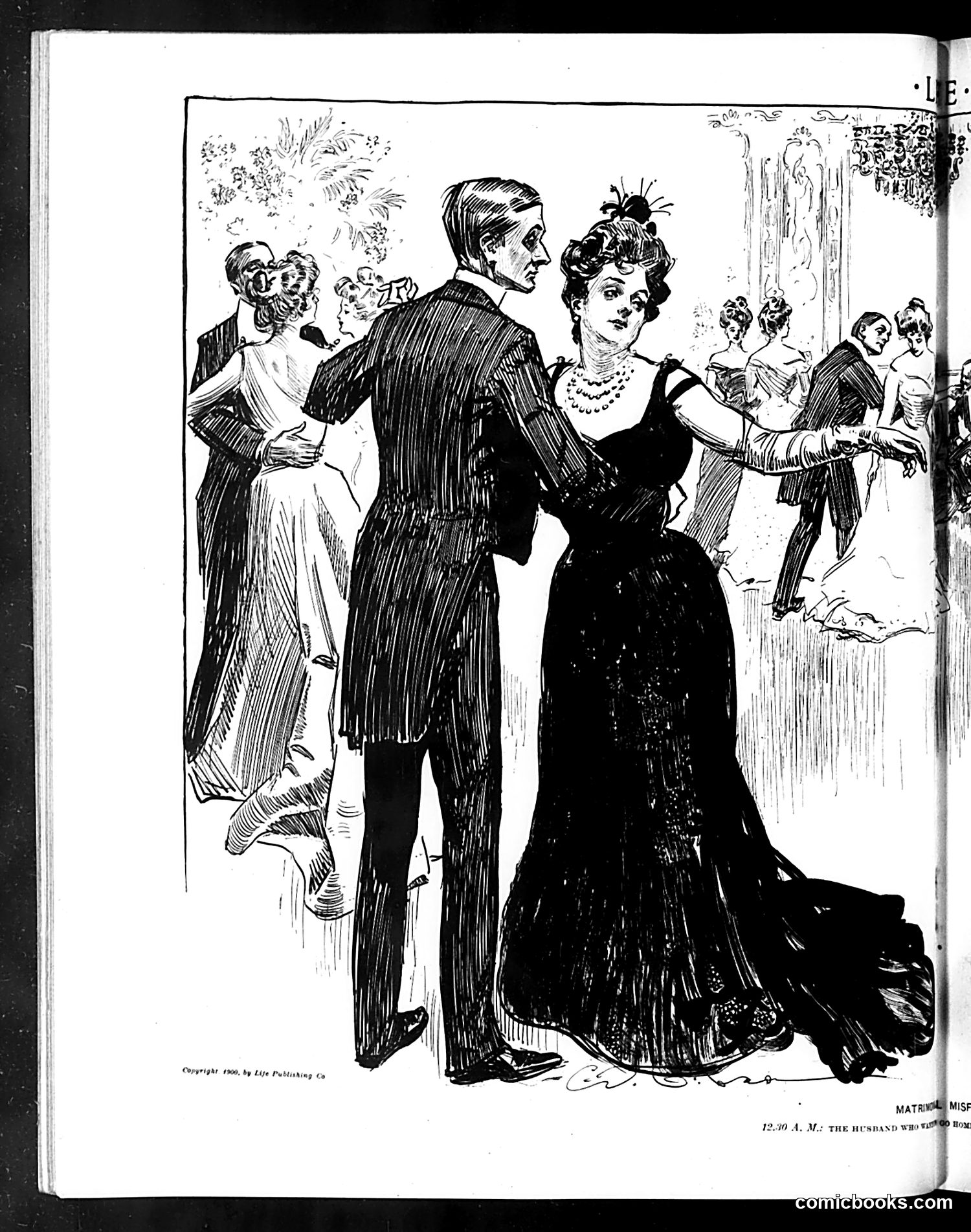
This illustration depicts a formal social gathering, likely from the early 1900s based on the artistic style and fashion. The caption reads "THE HUSBAND WHO LOST HIS VOICE," suggesting the cartoon satirizes a husband rendered silent or powerless in a social setting dominated by women. The central couple—a man in a pinstriped suit and a woman in an elegant black gown—are positioned prominently, while other well-dressed guests socialize in the background. The wife appears assertive and commanding, while the husband's posture and the caption suggest emasculation or loss of authority. This likely mocks contemporary anxieties about changing gender dynamics and women's growing social independence during the early suffrage era, presenting the "modern woman" as dominating the meek husband.
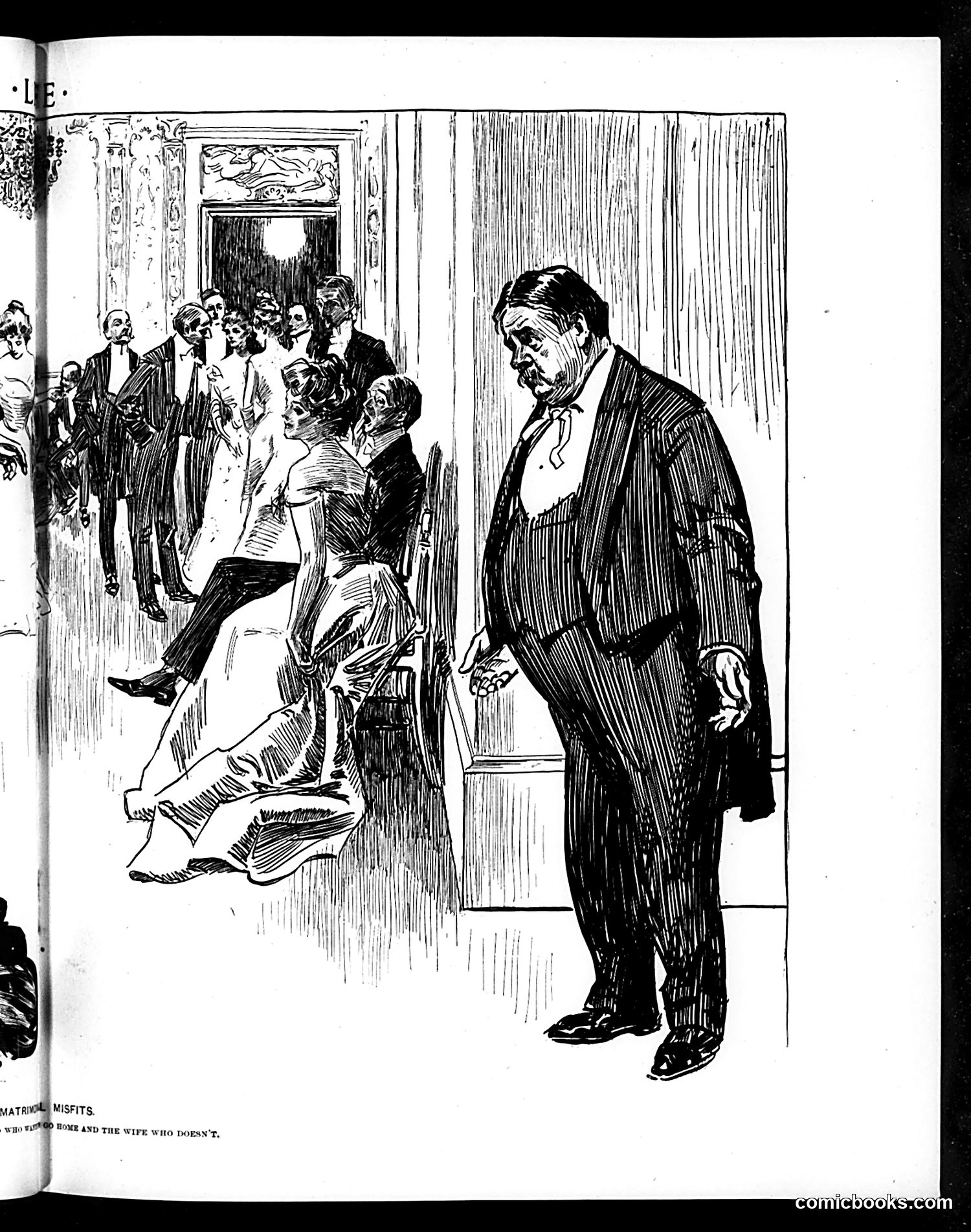
This illustration appears to be from Life magazine's satirical section on marriage mismatches. The caption reads "The Man Who Comes Home and the Wife Who Doesn't." The cartoon depicts a well-dressed gentleman arriving home to find his wife absent—shown barefoot and reclining with other women in what appears to be a social gathering or party. The satire critiques changing social dynamics of the era, likely the early 20th century, when women were increasingly gaining independence and engaging in social activities outside domestic duties. The joke targets traditional gender expectations: the husband expects a dutiful wife waiting at home, but instead finds her enjoying leisure time with her social circle. This reflects contemporary anxieties about evolving women's roles during the suffrage and progressive reform movements.
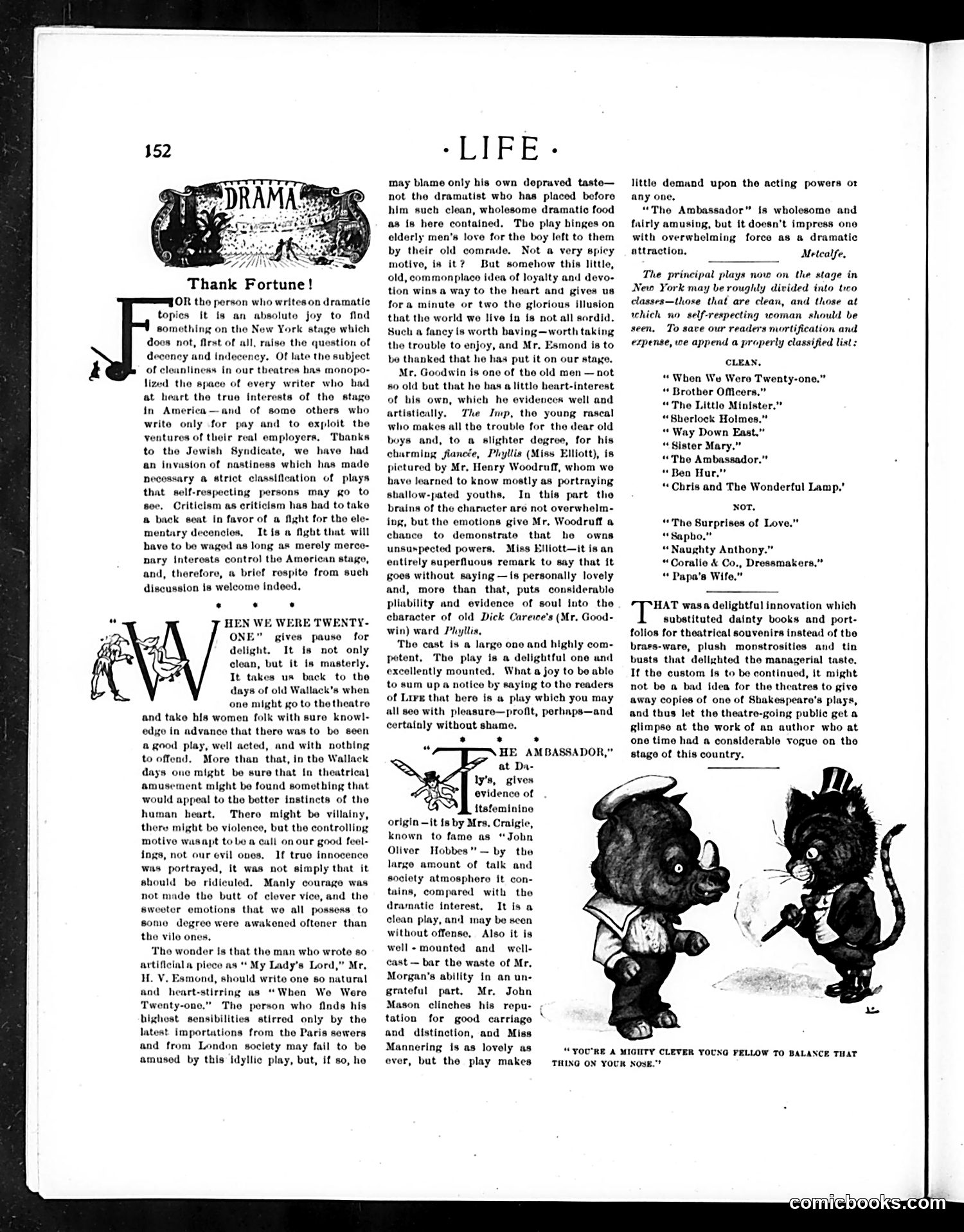
This page reviews several theatrical productions, primarily "Thank Fortune!" The main cartoon depicts two figures in formal dress performing an exaggerated balancing act, with one character standing on another's nose. The caption reads: "You're a mighty clever young fellow to balance that thing on your nose." The satire appears to mock theatrical performers or playwrights who engage in overly clever but ultimately superficial entertainment—"balancing acts" meant to impress rather than move audiences emotionally. The review criticizes plays prioritizing spectacle and technical skill over genuine dramatic substance and heart. The cartoon visually represents this critique through physical absurdity, suggesting such theatrical "cleverness" is ridiculous rather than admirable.
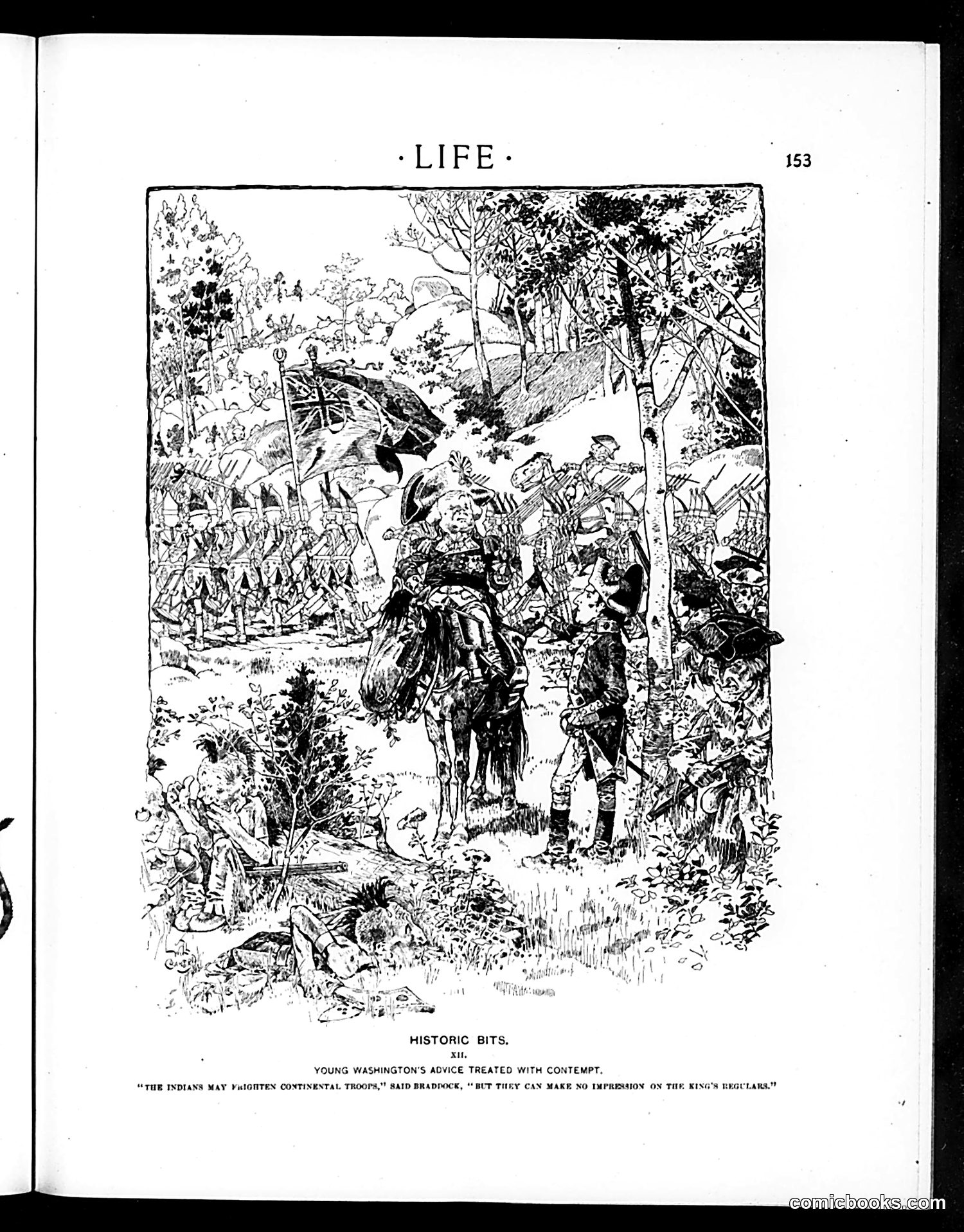
This satirical cartoon depicts a historical scene, likely from the French and Indian War era. The caption quotes British General Braddock dismissing young George Washington's warning about Native American fighting tactics, insisting that regular British troops cannot be defeated by Indians. The satire mocks Braddock's arrogance and failure to heed colonial military advice. The image shows mounted officers (presumably Braddock and Washington) amid soldiers and wilderness, illustrating the clash between European and irregular warfare strategies. The joke for contemporary readers: this represents Braddock's actual historical defeat in 1755 at the Monongahela River, where his conventional tactics proved disastrous against Indian guerrilla warfare—vindicating Washington's concerns and illustrating how British overconfidence and dismissal of colonial expertise led to military disaster.
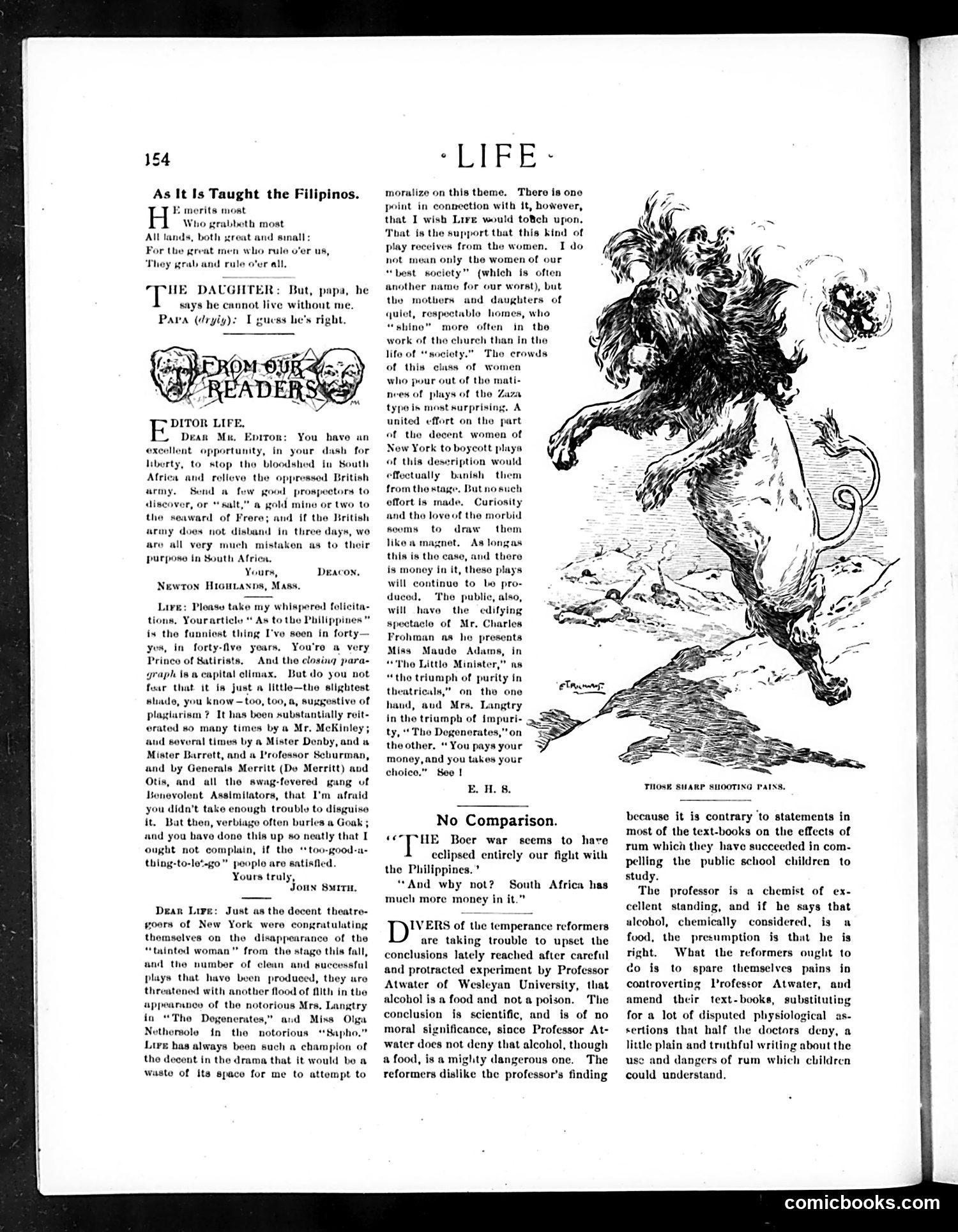
This page contains reader letters and short satirical pieces commenting on contemporary issues circa 1900. **"As It Is Taught the Filipinos"** (top) is a brief dialogue mocking American justifications for Philippine colonization. The poem suggests U.S. imperialists are teaching Filipinos that might makes right—"He merits most / Who grabbeth most"—while pretending moral superiority. The cartoon depicts a grotesque father figure (representing American imperialism) with his daughter, suggesting the hypocrisy of "civilizing" rhetoric masking economic exploitation. **Letters to the Editor** address: - The Boer War and imperial resource extraction - Theater morality: readers criticize women attending "immoral" plays like *The Degenerates*, suggesting respectable women shouldn't support such productions - A comparison between the Philippines conflict and South Africa, with one writer cynically noting Africa has "much more money in it" **The satire's point**: Life mocks American imperial expansion as transparently motivated by greed and territorial conquest rather than genuine "benevolent assimilation," while simultaneously critiquing American moral hypocrisy regarding social behavior.
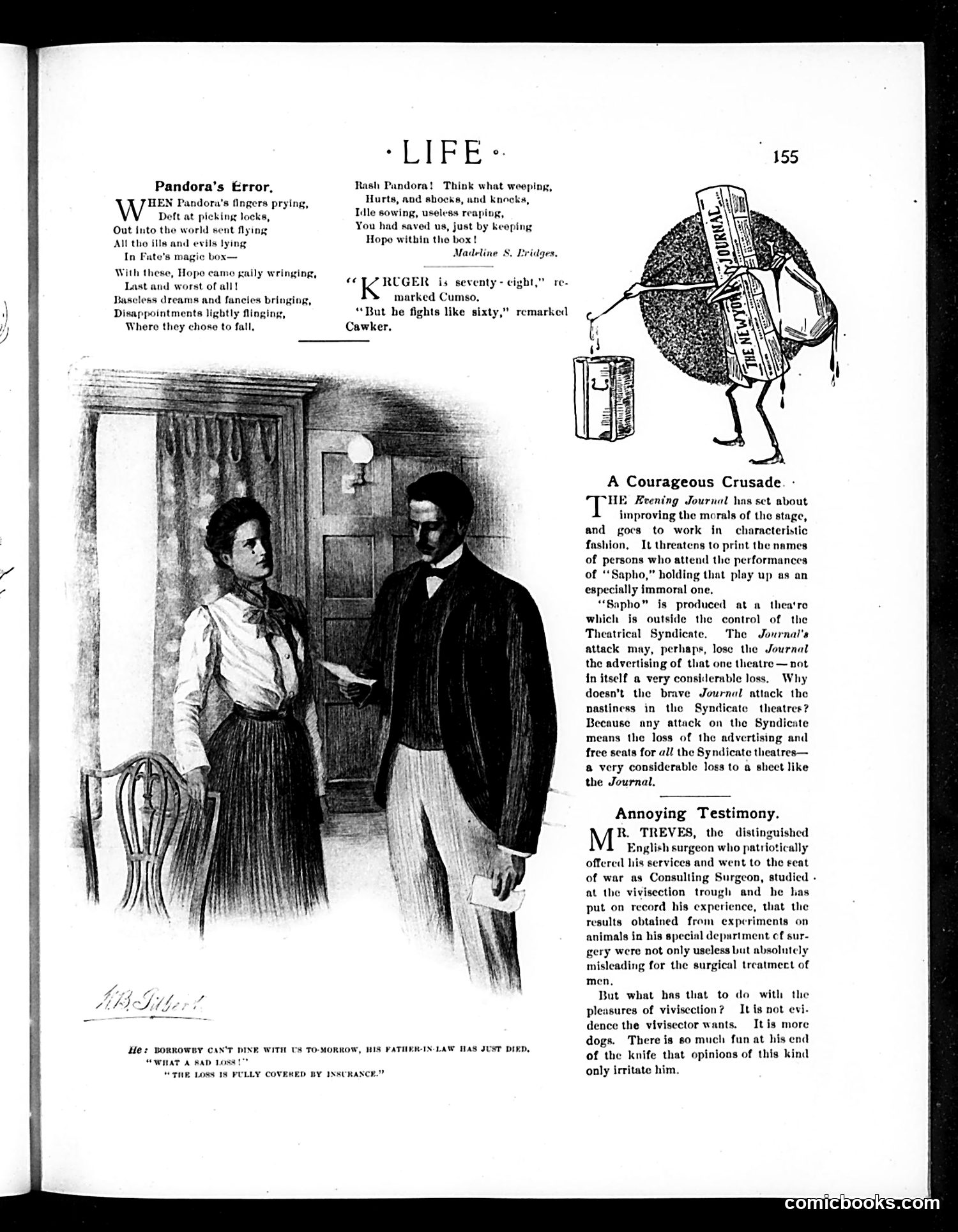
This page contains three distinct satirical pieces: **"Pandora's Error"** (left): A poem with accompanying illustration about Pandora's Box. The satire references the classical myth, suggesting that Hope—released alongside all evils—causes disappointment. The illustration shows two figures in what appears to be a domestic crisis. **"A Courageous Crusade"** (right, top): Mocks the *Evening Journal*'s moral crusade against the play "Sapho" for immorality. Life's satire is that the Journal only attacks independent theaters because attacking the Theatrical Syndicate would cost them advertising revenue—revealing the Journal's hypocrisy. It won't sacrifice profits for actual moral principle. **"Annoying Testimony"** (right, bottom): Criticizes vivisectionists (animal experimenters). Sir Frederick Treves, a distinguished surgeon, testified that animal experiments produced useless and misleading results for human surgery—yet vivisectors ignore this evidence because they enjoy the practice itself, not scientific truth. **Bottom cartoon**: A dark joke about insurance: a man claims his father-in-law's death is "fully covered by insurance," suggesting relief at inheriting money rather than genuine grief.
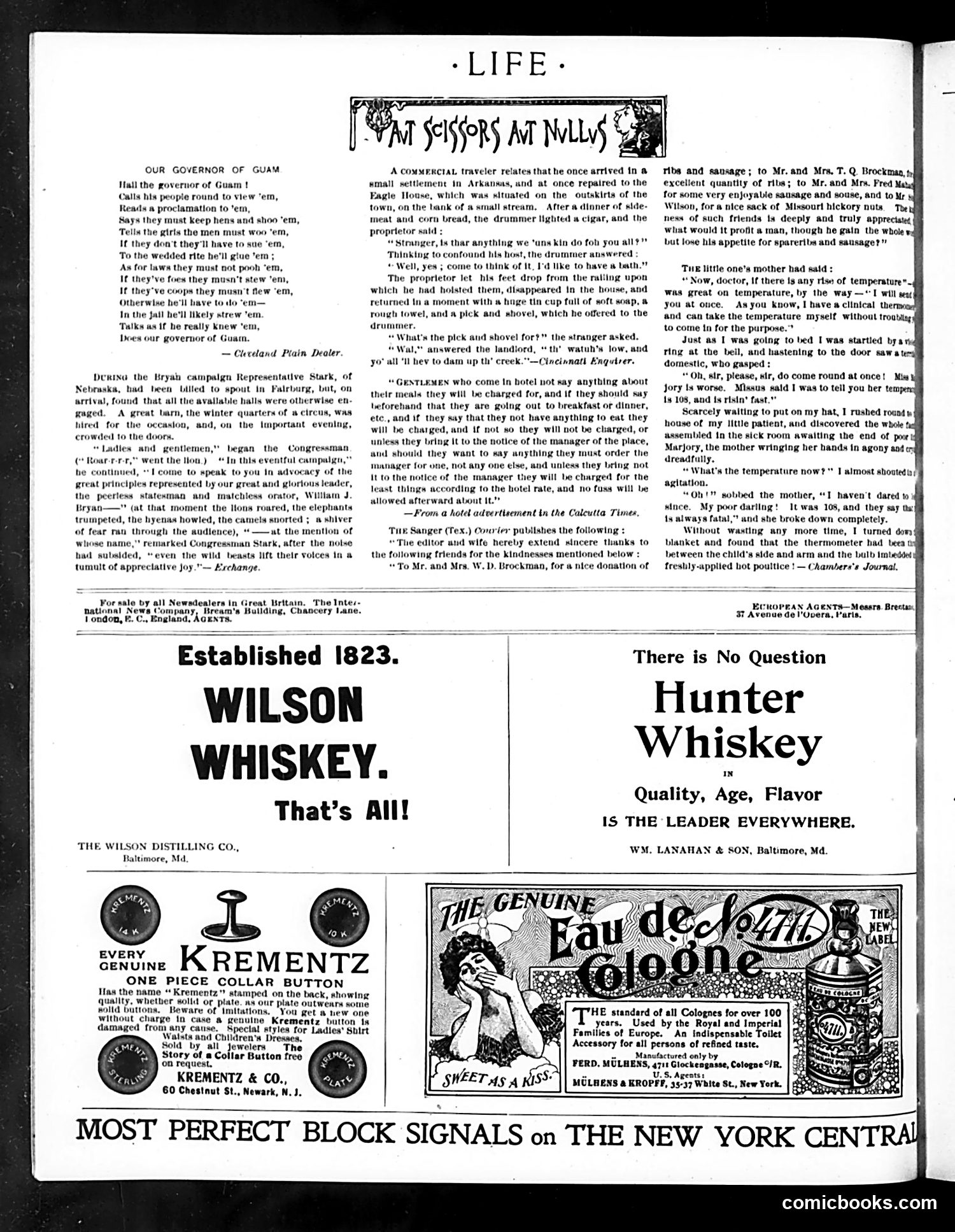
This page is primarily **advertising with humorous filler content**, typical of early 20th-century satirical magazines. The main cartoon content includes: 1. **"Our Governor of Guam"** — A satirical poem mocking the governor's autocratic proclamations about marriage, law, and behavior. This reflects American satirical commentary on U.S. colonial governance following the Spanish-American War (1898). 2. **"Bryan Campaign" anecdote** — A joke about a congressman attempting to campaign for William Jennings Bryan in a circus barn. When he mentions Bryan's name, the circus animals roar in response—satirizing both Bryan's controversial political position and the chaos of 1890s campaign politics. 3. **"Arkansas Bath House" story** — Crude humor about an Arkansas proprietor literally damming a creek to provide bathwater, mocking rural/frontier crudeness. 4. **Other brief anecdotes** — Including a hotel's confusing billing policy and a Texas newspaper's humorous thank-you list. The remainder is **paid advertising** for Wilson Whiskey, Hunter Whiskey, Krementz collar buttons, and eau de cologne—the primary revenue source for such publications.
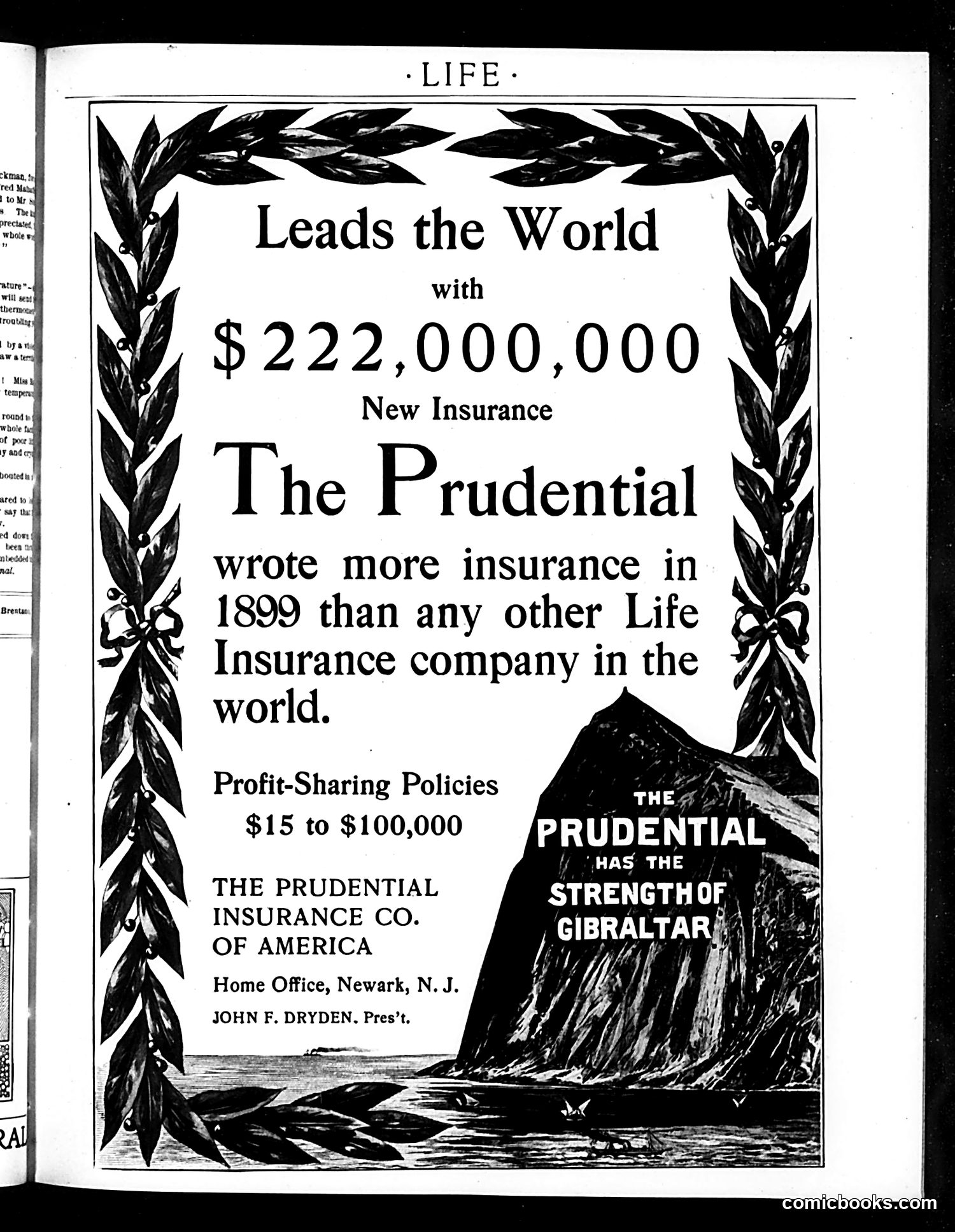
This is a **full-page advertisement**, not a cartoon or satire. It promotes The Prudential Insurance Company of America, headquartered in Newark, New Jersey, under president John F. Dryden. The ad claims Prudential "leads the world" with $222 million in new insurance written in 1899—more than any competitor. It advertises profit-sharing policies ranging from $15 to $100,000. The visual branding features the **Rock of Gibraltar**, shown as a cliff formation. The accompanying tagline—"The Prudential Has The Strength of Gibraltar"—became the company's famous slogan, using the famous rock as a metaphor for stability and reliability. This was standard corporate messaging of the Gilded Age era, reassuring customers that their insurer was financially solid and permanent. For modern readers: this reflects how early life insurance companies marketed themselves as trustworthy financial institutions during a period of rapid industrialization and economic uncertainty.
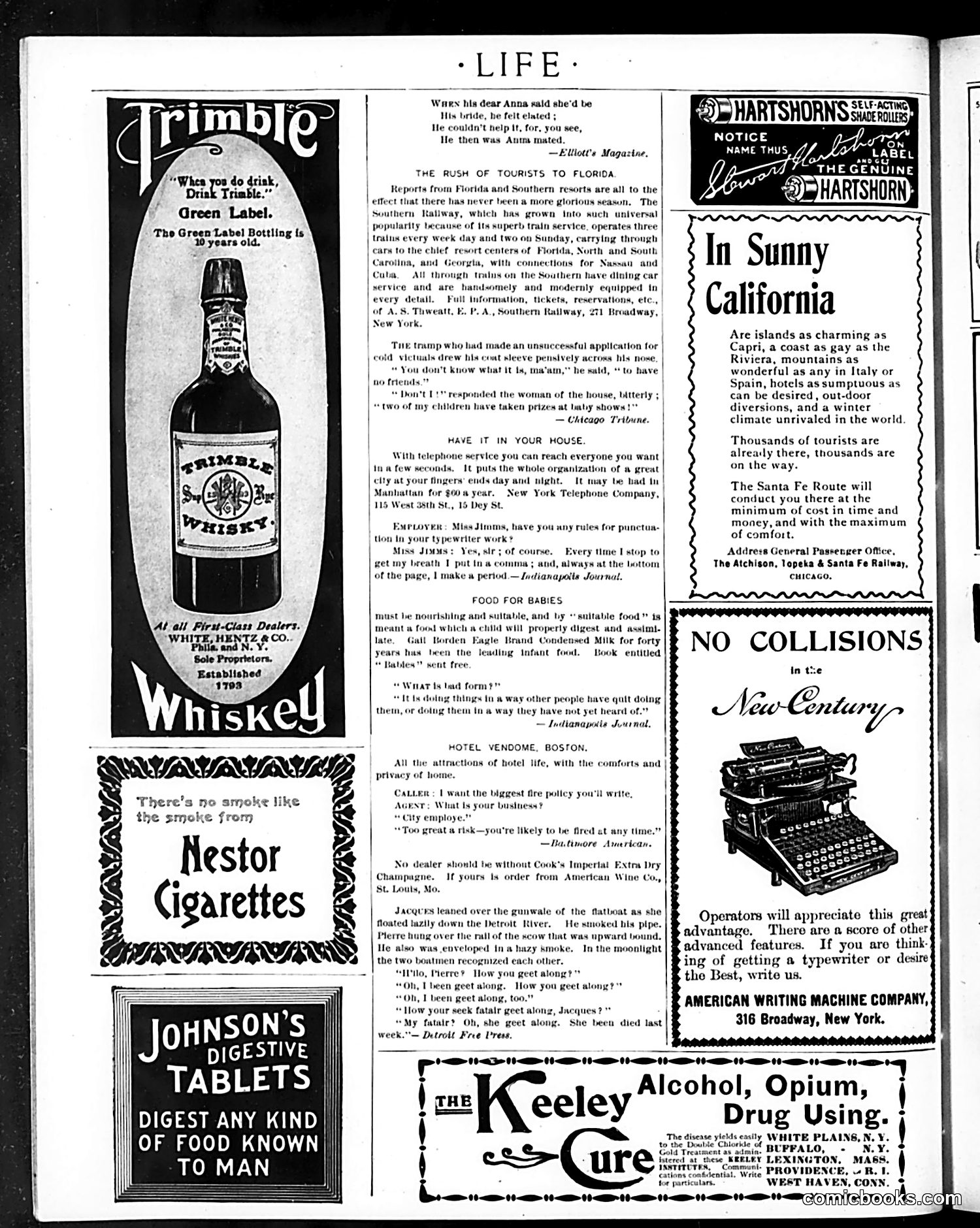
This is primarily an **advertising page** from Life magazine, not a satirical cartoon. The page features multiple product advertisements typical of early 20th-century publications: Trimble whiskey, Nestor cigarettes, Johnson's Digestive Tablets, and others. The small **textual humorous items** scattered throughout follow Life's format of brief jokes and anecdotes: - A joke about punctuation rules (a typist adds periods when she pauses for breath) - A tramp's unsuccessful panhandling attempt - An ironic exchange where a fire insurance agent refuses to insure a "city employee" as too risky - A sentimental riverboat scene with French-Canadian boatmen These represent **gentle, everyday humor** rather than political satire—jokes about modern conveniences (telephones), workplace absurdities, and social awkwardness. The page reflects Life's role as a humor magazine mixed with commercial content, aimed at middle-class readers amused by wordplay and domestic situations.
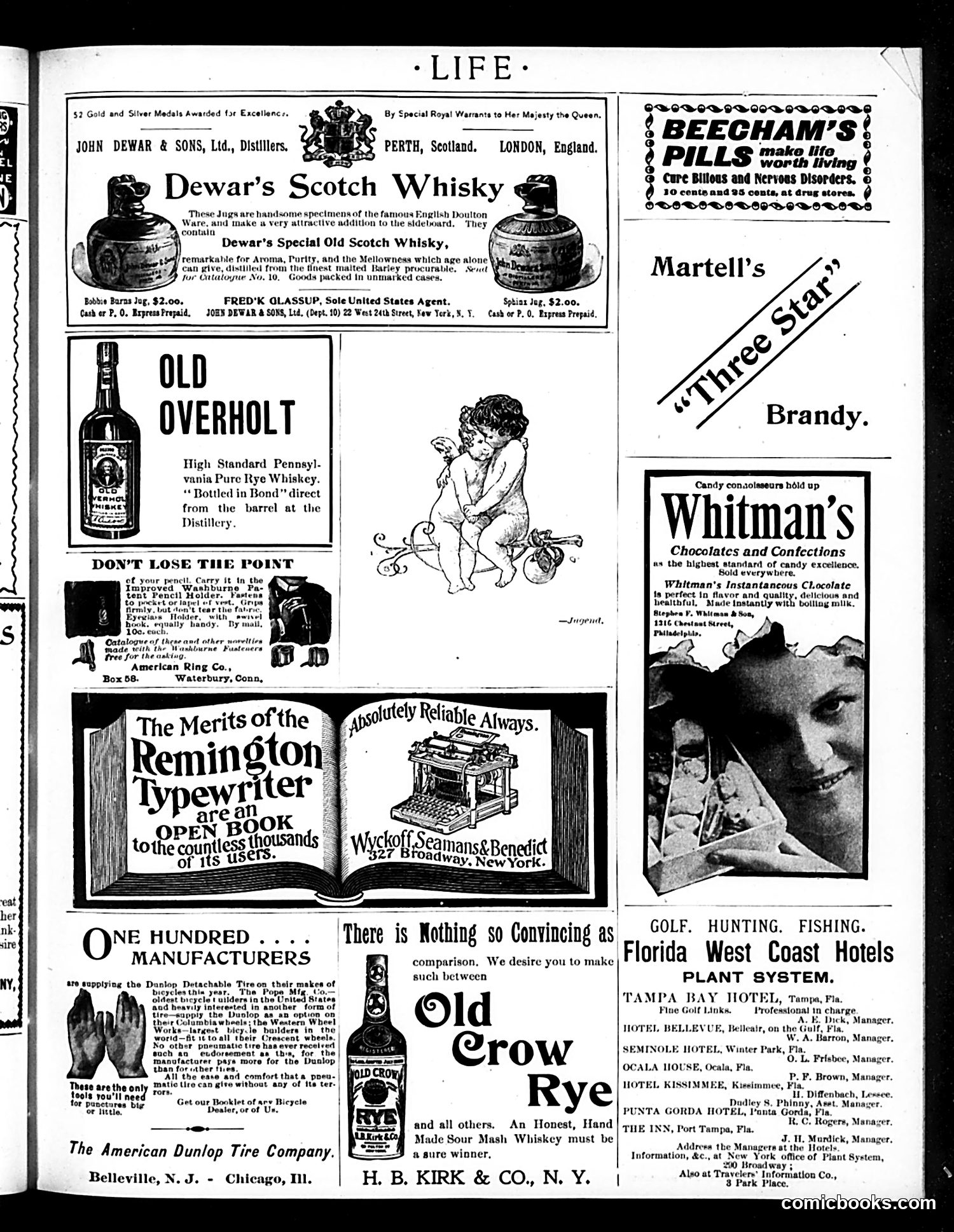
This is primarily an **advertising page** from *Life* magazine, not a satirical cartoon section. The page features product advertisements typical of the early 1900s, including: **Notable ads:** - **Dewar's Scotch Whisky** and **Old Overholt Rye** — prominent liquor advertisements - **Beecham's Pills** — patent medicine claiming to cure "billious and nervous disorders" - **Whitman's Chocolates** — luxury confection - **Remington Typewriter** — business equipment - **American Dunlop Tire Company** — bicycle tires - **Florida West Coast Hotels** — tourism **What's striking to modern readers:** The casual prominence of alcohol and patent medicines marketed without regulation. Beecham's Pills, for instance, makes vague health claims now considered fraudulent. The era's advertising standards were dramatically looser than today's FDA and FTC requirements. The central image appears to be a decorative cherub—typical *Art Nouveau* ornamentation common in period advertising.
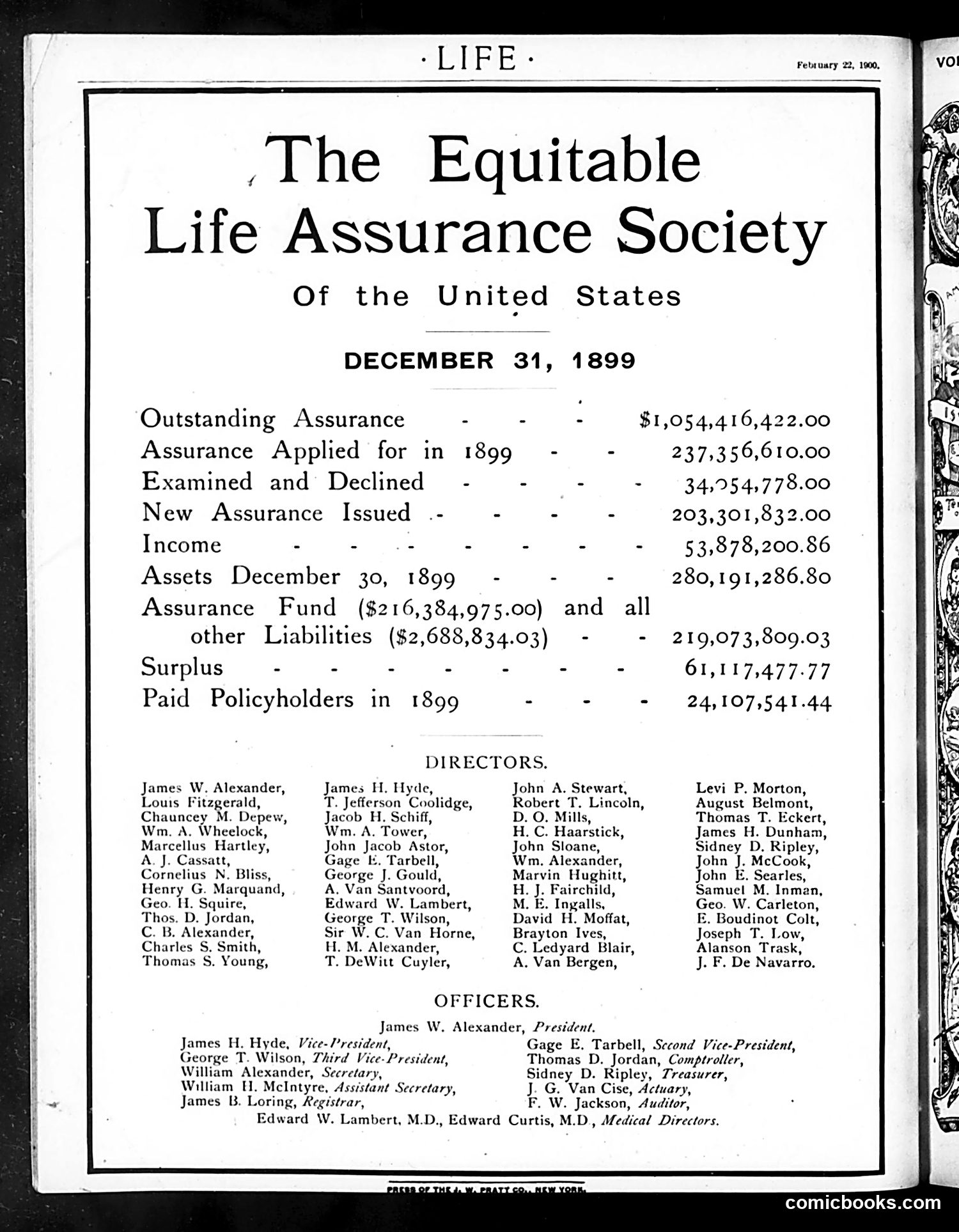
This is a full-page financial statement and corporate listing for the Equitable Life Assurance Society, published in *Life* magazine on February 22, 1900. It presents the company's assets, liabilities, and officer roster as of December 31, 1899. The page lists outstanding assurance of over $1 billion, substantial income, and a significant surplus. The directors and officers include prominent American industrialists and financiers of the era: John Jacob Astor, J.P. Morgan associate Jacob Schiff, railroad magnate Marvin Hughitt, and Vice President Chauncey Depew. There is no satire or political commentary visible here—it's straightforward corporate promotion, likely placed to reassure policyholders of the company's financial stability at the turn of the century. The Equitable was one of America's major insurance firms during this period.