
Life, 1900-02-22 · page 12 of 20
Life — February 22, 1900 — page 12: what you’re looking at
What you’re looking at
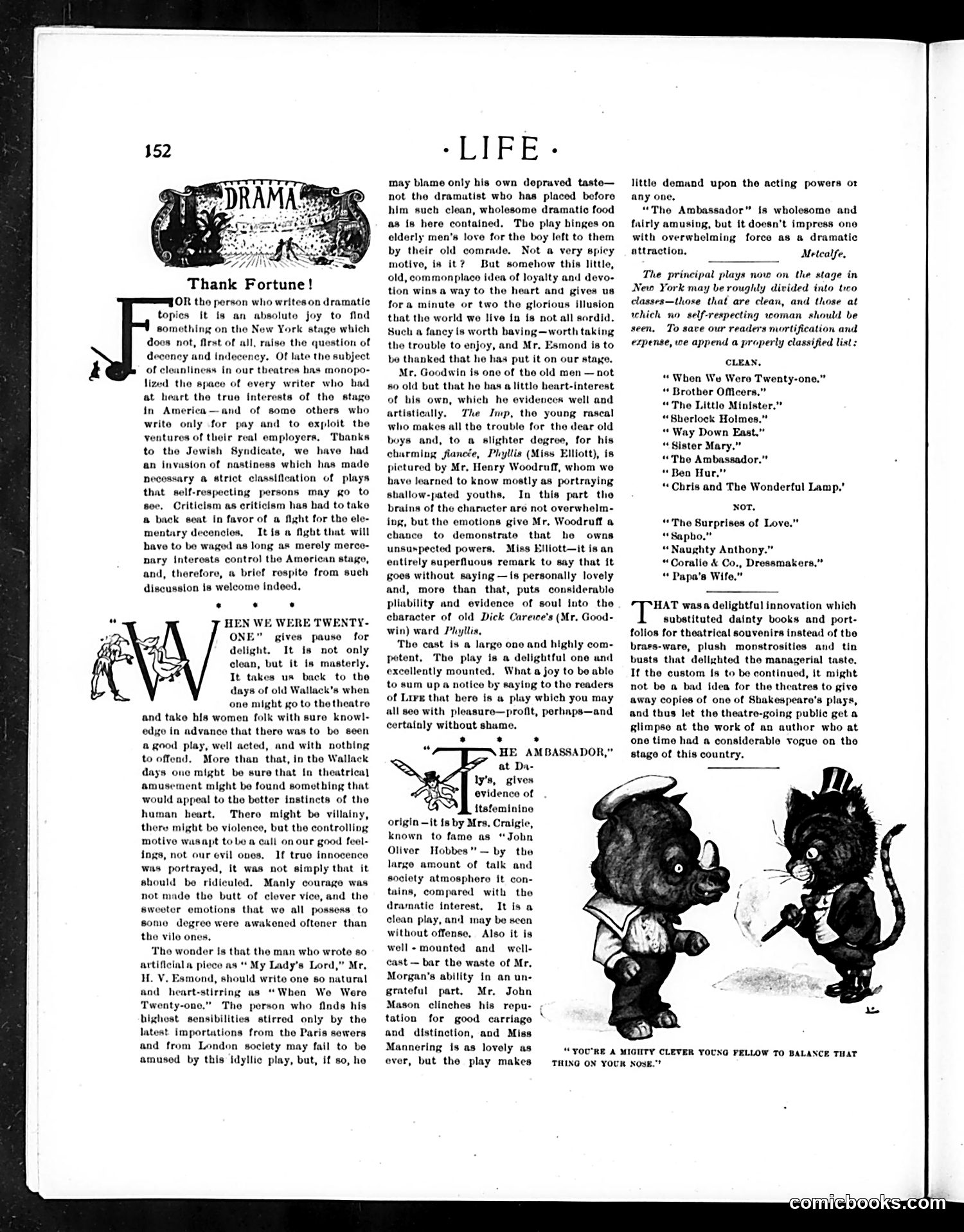
This page reviews several theatrical productions, primarily "Thank Fortune!" The main cartoon depicts two figures in formal dress performing an exaggerated balancing act, with one character standing on another's nose. The caption reads: "You're a mighty clever young fellow to balance that thing on your nose." The satire appears to mock theatrical performers or playwrights who engage in overly clever but ultimately superficial entertainment—"balancing acts" meant to impress rather than move audiences emotionally. The review criticizes plays prioritizing spectacle and technical skill over genuine dramatic substance and heart. The cartoon visually represents this critique through physical absurdity, suggesting such theatrical "cleverness" is ridiculous rather than admirable.
📄 Transcribed text from this page (OCR, searchable)
Machine-transcribed from the original scan — historical spelling and the odd misread are preserved.
Thank Fortune! OR tho person who writes on dramatic topics it is an absolute joy to find something on the New York stage which doos not, first of all, raise the question of decency and indecency, Of late the subject of cleanliness in our theatres has monopo- lized the space of every writer who had at heart the true Interests of the stage in America—and of some others who write only for pay and to exploit the ventures of their real employers, Thanks to the Jewish Syndicate, we have had an invasion of nastiness which has made necessary a strict classification of plays that self-respecting persons may go to see. Criticism as criticism has bad to take @ back seat In favor of a fight for tho ele- mentary decencles, It is a fight that will have to be waged as long as merely merco- nary Interests control the American stago, and, therefore, a brict respite from such discussion 1s welcome Indeed. WERE TWENTY- gives pauso for delight, It is not only clean, but it is masterly, It takes us back to the days of old Wallack’s when one might go to thetheatre and tako his women folk with sure knowl- edgo in advance that there was to be seen a good play, well acted, and with nothing to offend. More than that, in the Wallack days one might be sure that {n theatrical amusement might be found something that would appeal to the better instincts of the human heart. Thero might be villainy, there might be violence, but the controlling motive wasapt to be a cull on our good feel- ings, not our evil ones, If true innocence was portrayed, it was not simply that it should be ridiculed, Manly courage was je the butt of clever vice, and the sweeter emotions that wo all possess to somo degree were awakened oftoner than the vile ones. Tho wonder is that the man who wrote 80 artif piece as My Lady's Lord,” Mr, H. V. Esmond, should write one 60 natural and heart-stirring as “When Wo Wero Twenty-one.” The person who finds his highest sensibilities stirred only by tho latest importations from tho Paris sowers and from London society may fail to be amused by this fdyllic play, but, if so, ho -LIFE- may blame only his own depraved tasto— not the dramatist who has placed before him such clean, wholesome dramatic food as is here contained. The play hinges on elderly men’s love for the boy left to them by their old comrade. Not a very spicy motivo, is it? But somehow this little, old, commonplaco idea of loyalty and devo- tion wins a way to the heart and gives us fora minute or two tho glorious illusion that the world wo live fn 1s not all sordid. Sach a fancy is worth baving—worth taking the trouble to enjoy, and Mr, Esmond is to bo thanked that he has put it on our stage. Mr. Goodwin is ono of the old men — not 60 old but that he has a littlo beart-interest of bis own, which he evidences well and artistically. The Imp, the young rascal who makes all the trouble for the dear old boys and, to a slighter degree, for his charming flancée, Phyllis (Miss Elliott), is pictured by Mr. Henry Woodruff, whom wo have learned to know mostly as portraying shallow-pated youths. In this part tho brains of the character are not overwholm- ing, but the emotions give Mr, Woodruff a chance to demonstrate that he owns unsuspected powers, Miss Elliott—it is an entirely superfluous remark to say that it goes without saying —{s personally lovely and, more than that, puts considerable pliubility and evidence of soul Into the character of old Dick Carewe's (Mr. Good- win) ward Phyllis, Tho cast is a largo ono and highly com- petent, Tho play is a delightful one und excellently mounted, What a joy to be ablo to sum up a notice by saying to tho readers of Lire that bere is a play which you may all seo with pleasuro—proft, porhaps—and certainly without shame, * * * “ HE AMBASSADOR,” at Da- ly's, gives evidence of itefeminino origin —it {s by Mrs. Craigie, known to fame as “John Oliver Hobbes” — by the large amount of talk and society atmosphere it con- tains, compared with the dramatic interest, It is a clean play, and may be seen without offense, Also it is well - mounted and well- cast — bar the waste of Mr. Morgan's ability In an un- grateful part, Mr. John Mason clinches his repu- tation for good carriago ‘ and distinction, and Miss Mannering 1s as lovely as ever, but the play makes little demand upon the acting powers or any one. “Tho Ambassador” is wholesome and fairly amusing, but it doesn’t impress one with overwhelming force as a dramatic attraction, Metcalfe, The principal plays now on the stage in New York may be roughly divided into tro classrs—those that are clean, and those at which no self-respecting tcoman should be seen, To save our readers mortification and expense, we append a properly classified list: CLEAN, “ Whon We Were Twenty-one.” “ Brother Officers.” “The Littlo Minister.” “Sherlock Holmes.” “Way Down East.” “Sister Mary.” “Tho Ambassador.” “Ben Hur.” “Chris and The Wonderful Lamp.’ Nor. “Tho Surprises of Love.” “Sapho.” “Naughty Anthony.” “Coralie & Co., Dressmakers.” “ Papa's Wife.” HAT wasa delightful innovation which substituted dainty books and port- folios for theatrical souvenirs instead of the braes-ware, plush monstrosities and tin busts that delighted tho managerial taste. If the custom {a to be continued, It might not be a bad idea for the theatres to give away copies of one of Shakespeare's plays, and thus let the theatro-going public get a glimpso at the work of an author who at one timo had a considerable vogue on tho stago of this country. “YOU'RE A MIGHTY CLEVER YOUNG FELLOW TO BALANCE THAT THING ON YOUR NOSE."