
Life, 1900-02-22 · page 4 of 20
Life — February 22, 1900 — page 4: what you’re looking at
What you’re looking at
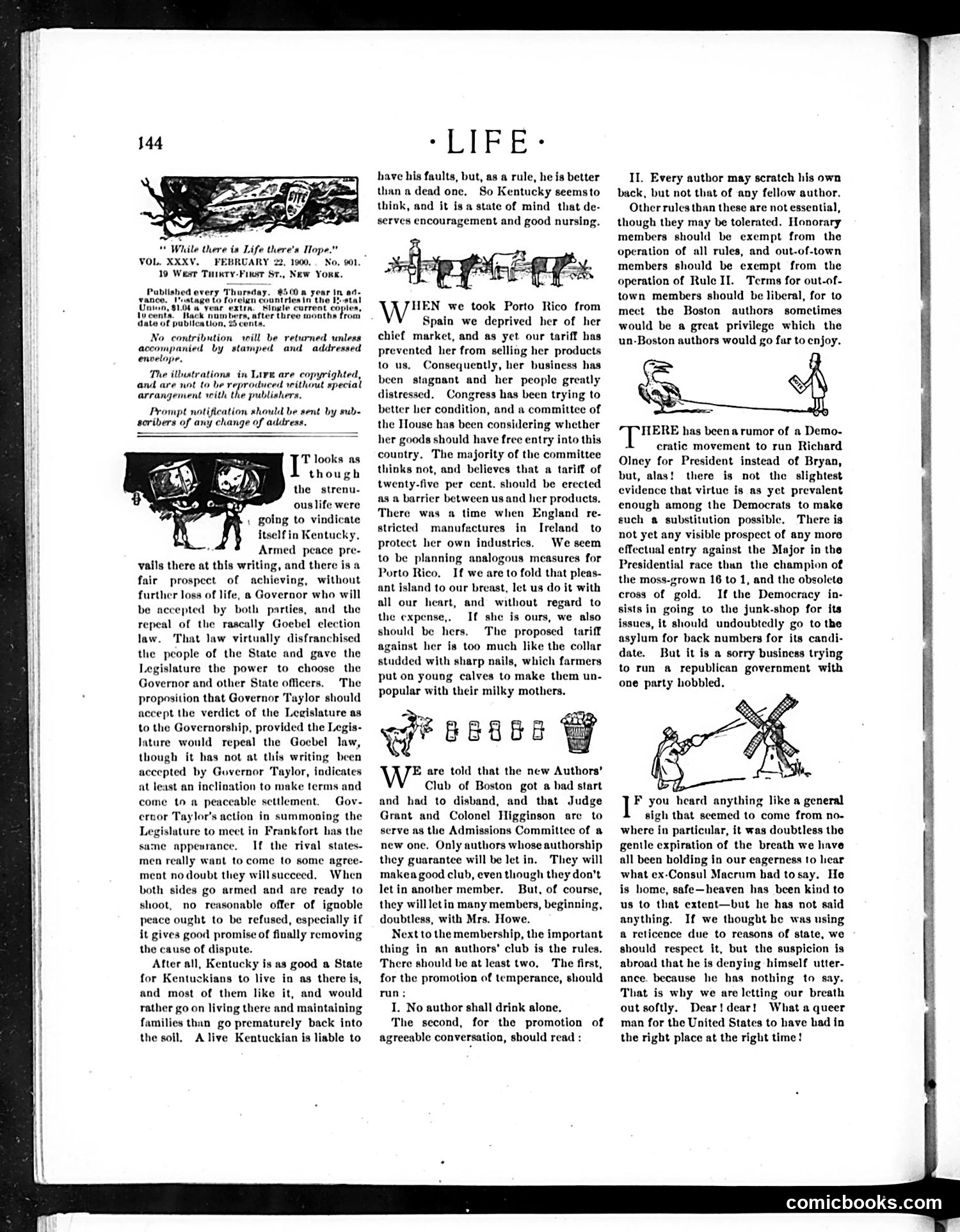
This page contains editorial commentary rather than political cartoons. The main text discusses **Porto Rico's tariff situation**—Congress debated whether to impose a 25% tariff on goods from the island, which the author opposes as economically harmful to Porto Rico's struggling market. The small illustrations appear to be decorative vignettes rather than satirical cartoons, showing rural/farming scenes. A separate section discusses the **new Authors' Club of Boston**, expressing skepticism that Judge Grant and Colonel Higginson's leadership will successfully unite authors "whose authorship they guarantee" despite quality concerns. The tone is skeptical of government policies affecting Porto Rico and somewhat cynical about literary institution-building—typical of *Life*'s satirical approach to contemporary political and social matters.
📄 Transcribed text from this page (OCR, searchable)
Machine-transcribed from the original scan — historical spelling and the odd misread are preserved.
“ While there is Life there's Hope.” VOL. XXXV. FEBRUARY 22, 1900, No. 901. 19 West Tuixty-Finst St., New York. covery Thursday. 8500 a year I age to forelgn countries in the Union, 91.064 veur extra, Single current copies, Wcents. “Hack numbers, after three months from date of publication, % cents. Publis! yan No contribution will be returned unless accompanied Ly stamped and addressed envelope. The illustrations in Live are copyrighted, and are not to be reproduced without speciat arrangement with the publishers, Prompt notification should be sent by sub- ‘of any change of address. Tr looks as though the strenu- ouslife were itself in Kentucky, Armed peace pre- vails there at this writing, and there is a fair prospect of achieving, without further loss of life, a Governor who will be accepted by both parties, and the repeal of the rascally Goebel election law. That Jaw virtually disfranchised the people of the State and gave the Legislature the power to choose the Governor and other State officers. The proposition that Governor Taylor should accept the verdict of the Legislature as to the Governorship, provided the Legis- Jature would repeal the Goebel law, though it has not at this writing been accepted by Governor Taylor, indicates at least an inclination to make terms and come to a peaceable settlement. Gov- crnor Taylor's action in summoning the Legislature to meet in Frankfort has the same appeurance. If the rival states- men really want to come to some agree- ment nodoubt they willsucceed. When both sides go armed and are ready to shoot, no reasonable offer of ignoble peace ought to be refused, especially if it gives good promise of fiually removing the cause of dispute. After all, Kentucky is as good a State for Kentuckians to live in as there is, and most of them like it, and would rather go on living there and maintaining families than go prematurely back into the soil. Alive Kentuckian is liable to : LITFB = have his faults, but, as a rule, he is better than a dead one, So Kentucky seemsto think, and it isa state of mind that de- serves encouragement and good nursing. HEN we took Porto Rico from Spain we deprived her of her chief market, and as yet our tariff has prevented her from selling her products to us. Consequently, her business has been stagnant and her people greatly distressed. Congress has been trying to better her condition, and a committee of the House has been considering whether her goods should have free entry into this country, The majority of the committee thinks not, and believes that a tariff of twenty-five per cent. should be erected asa barrier between us and her products. There was a time when England re- stricted manufectures in Ireland to protect her own industries, We seem to be planning analogous measures for Porto Rico, If we are to fold that pleas- ant island to our breast, let us do it with all our heart, and without regard to the expense,. If she is ours, we also should be hers. The proposed tariff against her is too much like the collar studded with sharp nails, which farmers put on young calves to make them un- popular with their milky mothers. ¢ BBSBB a E are told that the new Authors’ Club of Boston got a bad start and had to disband, and that Judge Grant and Colonel Higginson are to serve as the Admissions Committee of a new one. Only authors whose authorship they guarantee will be let in. They will makea good club, even though they don’t let in another member. But, of course, they willletin many members, beginning, doubtless, with Mrs. Howe. Next to the membership, the important thing in an authors’ club is the rules. There should be at least two, The first, for the promotion of temperance, should run: I. No author shall drink alone. The second, for the promotion of agreeable conversation, should read : II. Every author may scratch his own back, but not that of any fellow author. Other rules than these are not essential, though they may be tolerated. Honorary members should be exempt from the operation of all rules, and out-of-town members should be exempt from the operation of Rule II. Terms for out-of- town members should be liberal, for to mect the Boston authors sometimes would be a great privilege which the un-Boston authors would go fur to enjoy. MERE has been arumor of a Demo- cratic movement to run Richard Olney for President instead of Bryan, but, alas! there is not the slightest evidence that virtue is as yet prevalent enough among the Democrats to make such a substitution possible, There is not yet any visible prospect of any more effectual entry against the Major in the Presidential race than the champion of the moss-grown 16 to 1, and the obsolete cross of gold. If the Democracy in- sists in going to the junk-shop for its issues, it should undoubtedly go to the asylum for back numbers for its candi- date. But it is a sorry busincss trying to run a republican government with one party hobbled. I’ you heard anything like a general sigh that seemed to come from no- where in particular, it was doubtless the gentle expiration of the breath we have all been holding in our eagerness to hear what ex-Consul Macrum had tosay. He is home, safe—heaven has been kind to us to that extent—but he has not said anything. If we thought he was using a reticence due to reasons of state, we should respect it, but the suspicion is abroad that he is denying himself utter- ance. because he has nothing to say. That is why we are letting our breath out softly. Dear!dear! What a queer man for the United States to have had in the right place at the right time! comicbooks.com