
Life, 1900-02-22 · page 6 of 20
Life — February 22, 1900 — page 6: what you’re looking at
What you’re looking at
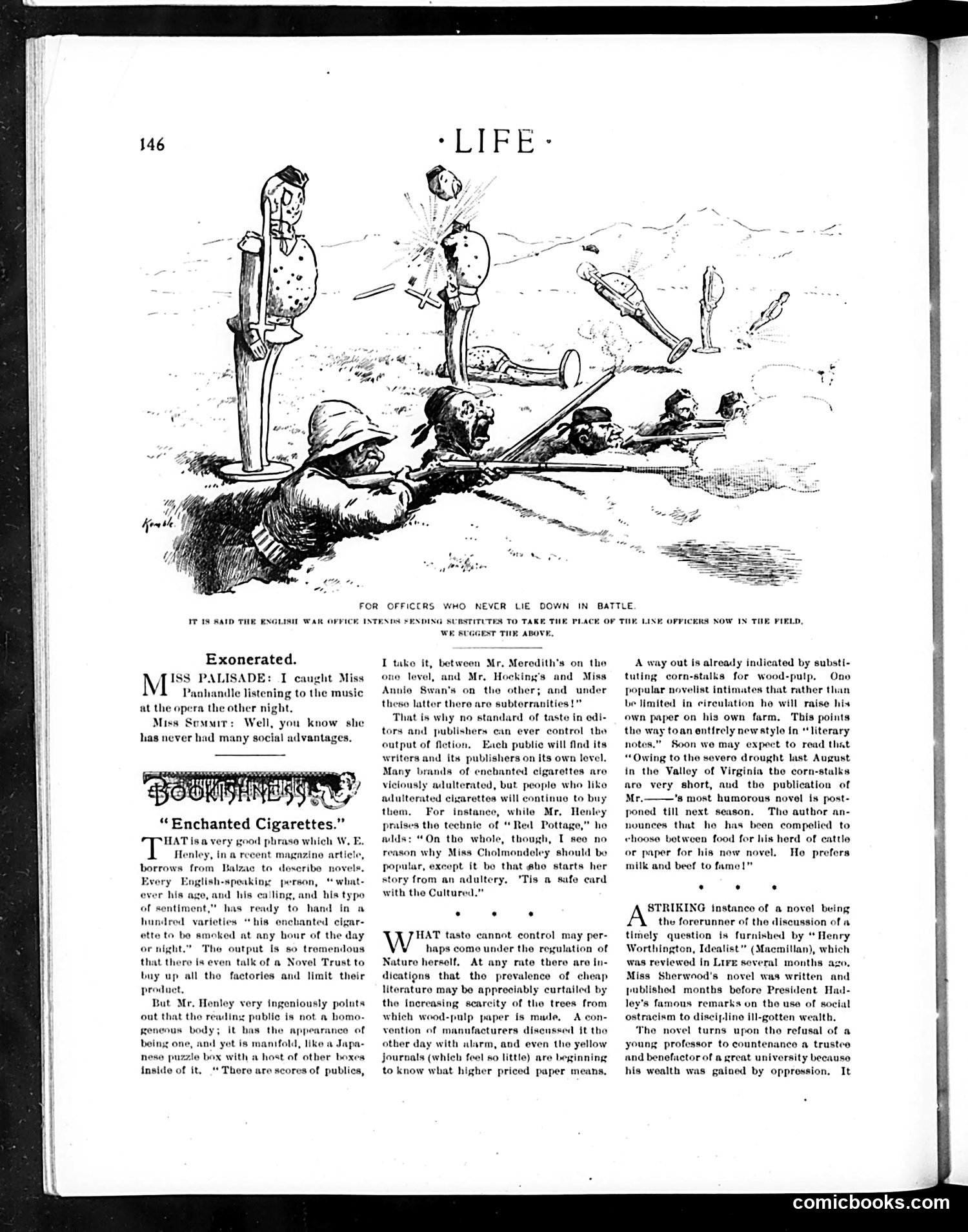
This cartoon satirizes British military leadership during what appears to be World War I. The image shows dead soldiers lying on a battlefield with wooden crosses marking graves, while uniformed officers stand safely behind the lines. The caption states: "FOR OFFICERS WHO NEVER LIE DOWN IN BATTLE. IT IS SAID THE ENGLISH WAR OFFICE INTENDS SENDING SUBSTITUTES TO TAKE THE PLACE OF THE LINE OFFICERS NOW IN THE FIELD. WE SUGGEST THE ABOVE." The satire mocks the proposal to replace frontline officers with substitutes—implying that actual officers avoid combat danger while sending others to die. The wooden grave markers emphasize the human cost of such decisions, critiquing what Life saw as cowardly or negligent military leadership.
📄 Transcribed text from this page (OCR, searchable)
Machine-transcribed from the original scan — historical spelling and the odd misread are preserved.
FOR OFFICERS WHO TT IS RAID THE ENGLISH WAK OFFICE INTENDS SENDING SUBST Iss PAL a Panhandle listening to the music at the opera the other night, Miss Somat: Well, you know she has never had many social advantages, “Enchanted Cigarettes.” HAT isa very good phraso which ina recent magazine arti Balzac to describe ne ry English-speaking person, what- or his age, and his calling, and his typo of sentiment,” has ready to hand in a hundred varieties “his enchanted cigar- otte to bo smoked at any bour of the day or night.” The output Is 0 tremendous at there is even talk of a Novel Trust to y up all tho factories and limit their product, But Mr. Henley very ingeniously points out that the reading public is not a bhomo- geneous body; It bas the appearance of being one, and yet is manifold, like a Jay nese puzzle box with a host of other boxes inside of it, ‘There are scores of publics, WE SUGGEST THE ABOVE. I take it, between Mr. Meredith's on the ono level, and Me, Hocking’s and Miss Annie Swan's on the other; and under theso latter there are subtorranities !" That is why no standard of taste in edi- tors and publishers can ever control the output of fiction, Each public will find its writers and its publishers on its own level. Many brands of enchanted cigarettes aro viciously adulterated, bat people who like adulterated elarettes will continue to buy them. For instance, while Mr. Henley praises the technic of Red Pottage,” ho alds: “On the whole, though, T seo no reason why Miss Cholmondeley should bo popular, exeept it be that #ho starts her story from an adultery, ’Tis a safe card with the Cultured.” . . . HAT tasto cannot control may per- haps come under tho regulation of Nature herself, At any rate thoro are in- dicatigns that tho prevalence of cheap literature may be appreciably curtailed by the Increasing scarcity of the trees from which wood-pulp paper is mude, A con- vention of manufacturers discussed it the other day with ularm, and even the yellow journals (which feel so little) are beginning to know what higher priced paper means. IN| BATTLE TS TO TAKE THE PLACE OF THK LINE OF1 A way out is already indicated by substi- tuting corn-stalks for wood-pulp. Ono popular novelist intimates that rather than. be limited in circulation ho will raise his own paper on his own farm. This points tho way toan entirely new style in ‘literary ” Soon we may expect to read that “Owing to the severo drought last August in the Valley of Virginia the corn-stalks aro very short, aud tho publication of Mr. ’s most humorous novel 1% post- poned till next season. Tho author an- nounces that he has been compolied to choose between food for his herd of cattle or paper for his now novel. Ho prefers milk and beef to fume!” . . . STRIKING instanco of a novol being A the forerunner of the discussion of a timely question is furnished by “Henry Worthington, Idealist” (Macmillan), which was reviewed in Lire several months a; Miss Sherwood's novel was written and published months before President Had- ley’s famous remarks on tho use of social ostracism to disciplino ill-gotten wealth, ‘The novel turns upon tho refusal of a young professor to countenance a trustee and benefactor of a great university becauso his wealth was gained by oppression, It comicbooks.com