
Life, 1900-02-22 · page 9 of 20
Life — February 22, 1900 — page 9: what you’re looking at
What you’re looking at
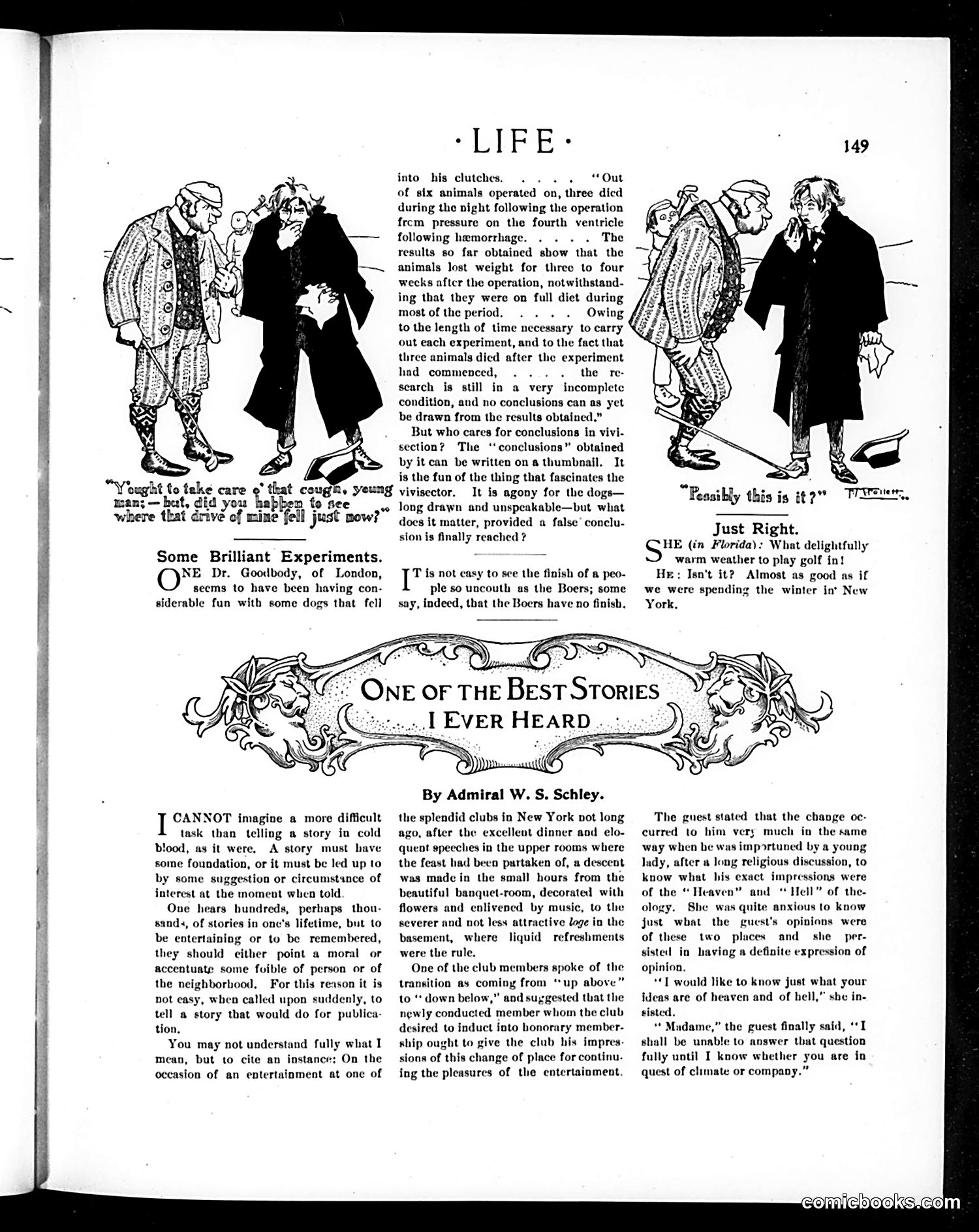
This page contains two separate items: 1. **Top cartoons**: Two illustrated panels showing men in early 20th-century dress discussing coughs and winter health. The humor concerns seasonal ailments and medical advice—likely satirizing hypochondria or ineffective remedies of the era. 2. **"Some Brilliant Experiments"**: A section header introducing a story about a Dr. Goodbody of London conducting experiments on dogs, with vivisection implications (animal testing for medical research). 3. **"One of the Best Stories I Ever Heard"**: The main article by Admiral W. S. Schley describes a social anecdote about club members debating whether a guest's impressions of "Heaven" and "Hell" represent actual religious theology or merely reflect personal preference. It's a humorous meditation on subjectivity and opinion-forming. The page reflects early 20th-century concerns: medical experimentation, seasonal health anxieties, and philosophical dinner-party debates.
📄 Transcribed text from this page (OCR, searchable)
Machine-transcribed from the original scan — historical spelling and the odd misread are preserved.
j 4 } 4 3 q 4 man; — bat, did you hab f ‘o where that drivé of mine fell just now? A “Y ought to teke care g that cough, yeung mn to see Some Brilliant Experiments. NE Dr. Goodbody, of London, seems to have been having con- siderable fun with some dogs that fell ONE OF « LIFE into his clutches. 2... ‘Out of six animals operated on, three dicd during the night following the operation frcm pressure on the fourth ventricle following hemorrhage. . . . . The results so far obtained show that the animals lost weight for three to four wecks aftcr the operation, notwithstand- ing that they were on full diet during most of the period. . . . . Owing to the length of time necessary to carry out each experiment, and to the fact that three animals died after the experiment had commenced, the re- scarch is still in a very incomplete condition, and no conclusions can as yet be drawn from the results obtained,” But who cares for conclusions in vivi- section? The ‘‘conclusions” obtained by it can be written on a thumbnail. It is the fun of the thing that fascinates the vivisector. It is agony for the dogs— long drawn and unspeakable—but what does it matter, provided a false’ conclu- sion is finally reached ? T is not casy to sce the finish of a peo- ple so uncouth as the Boers; some say, indeed, that the Boers have no finish, Just Right. HE (in Florida): What delightfully warm weather to play golf in! He: Isn't it? Almost as good as if we were spending the winter int New York, THE BEST STORIES CANNOT imagine a more difficult task than telling a story in cold Dlood, as it were, A story must have some foundation, or it must be led up to by some suggestion or circumstance of interest at the moment when told One hears hundreds, perhaps thou- sands, of stories in onc's lifetime, but to be entertaining or to be remembered, they should either point a moral or accentuate some foible of person or of the neighborhood. For this reason it is not easy, when called upon suddenly, to tell a story that would do for publica- tion. You may not understand fully what I mean, but to cite an instance: On the occasion of an entertainment at one of By Admiral W. S. Schley. the splendid clubs in New York not long ago, after the excellent dinner aod elo- quent speeches in the upper rooms where the feast bad been purtaken of, a descent was madc in the small hours from the beautiful banquet-room, decorated with flowers and enlivened by music, to the severer and not less attractive loge in the basement, where liquid refreshments were the rule, One of the club members spoke of the transition as coming from “up above” to ‘* down below,” and suggested that the newly conducted member whom the club desired to induct into honorary member- ship ought to give the club his impres- sions of this change of place for continu. ing the pleasures of the entertainment. The guest stated that the change oc- curred to him very much in the same way when be was importuned by a young lady, after a long religious discussion, to know what his exact impressions were of the “ Heaven” and “ Hell” of the- ology. She was quite anxious to know just what the guest's opinions were of these two places and she per- sisted in having a definite expression of opinion, “«T would like to know just what your ideas are of heaven and of hell,” she in- sisted. “Mudame,” the guest finally said, ‘I shall be unable to answer that question fully until I know whether you are in quest of climate or company.” “Peasibly this is ite” T7Euen.