
A complete issue · 20 pages · 1900
Life — February 15, 1900
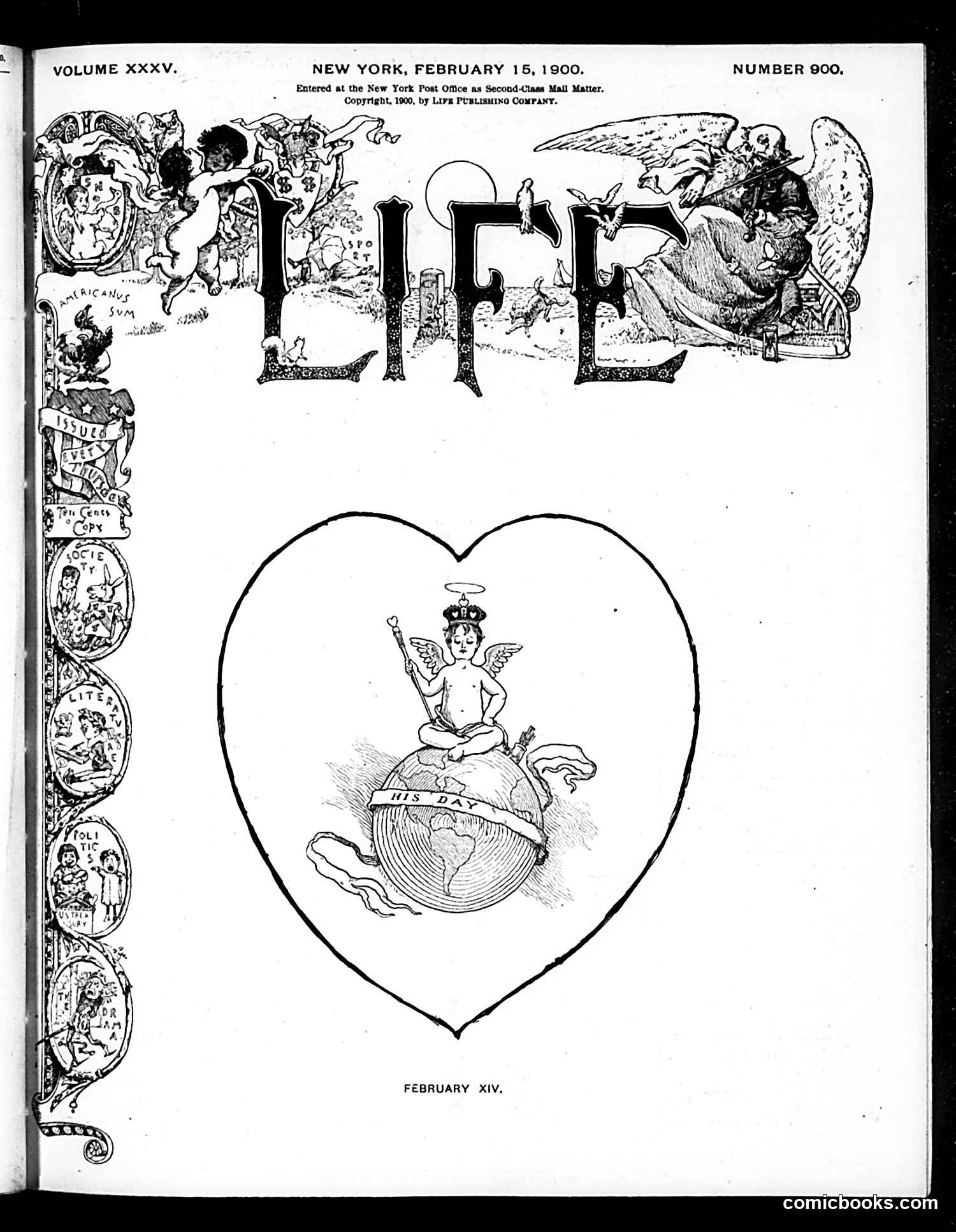
This page features Valentine's Day-themed content (noted "FEBRUARY XIV" at bottom). The main illustration is a large heart containing a cherub or cupid figure sitting atop a globe labeled "HIS DAY," suggesting romantic themes tied to global or imperial conquest. The decorative left border contains zodiac or astrological symbols in circular frames, typical of Life's ornamental style. The elaborate header with mythological figures and the word "LIFE" indicates this is the magazine's masthead or cover design. Without additional context from the OCR text or surrounding pages, the specific satirical targets remain unclear. The imagery suggests commentary on love, desire, or perhaps American expansionism during the imperialist era, though the exact reference cannot be definitively determined from the visual alone.
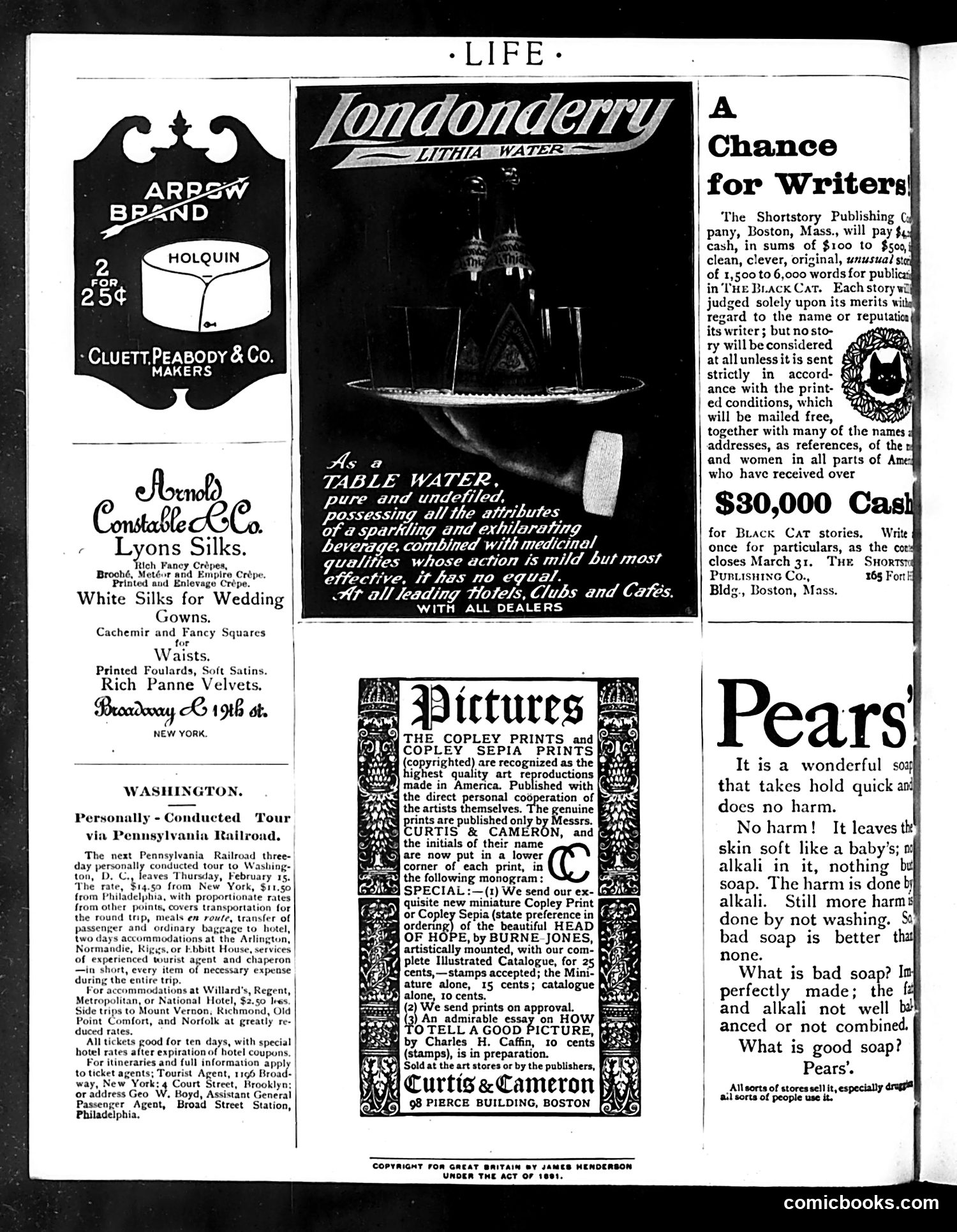
This page is **primarily advertising** from a 1918 Life magazine issue, with no political cartoons or satirical content visible. The ads include: - **Arrow Brand** holquin (a product) - **Arnold Constable & Co.** silk goods - **Londonderry Lithia Water** (center spread), marketed as a table water with "sparkling and exhilarating" properties - **Pears' Soap** advertisement - **Curtis & Cameron** art prints - A **Washington tourism section** promoting Pennsylvania Railroad excursions The only substantive non-advertising content is a "Chance for Writers" announcement offering $90,000 in cash for short stories for *The Black Cat* magazine, with a March 31 deadline. The page reflects 1918 consumer culture and publishing opportunities rather than political satire.
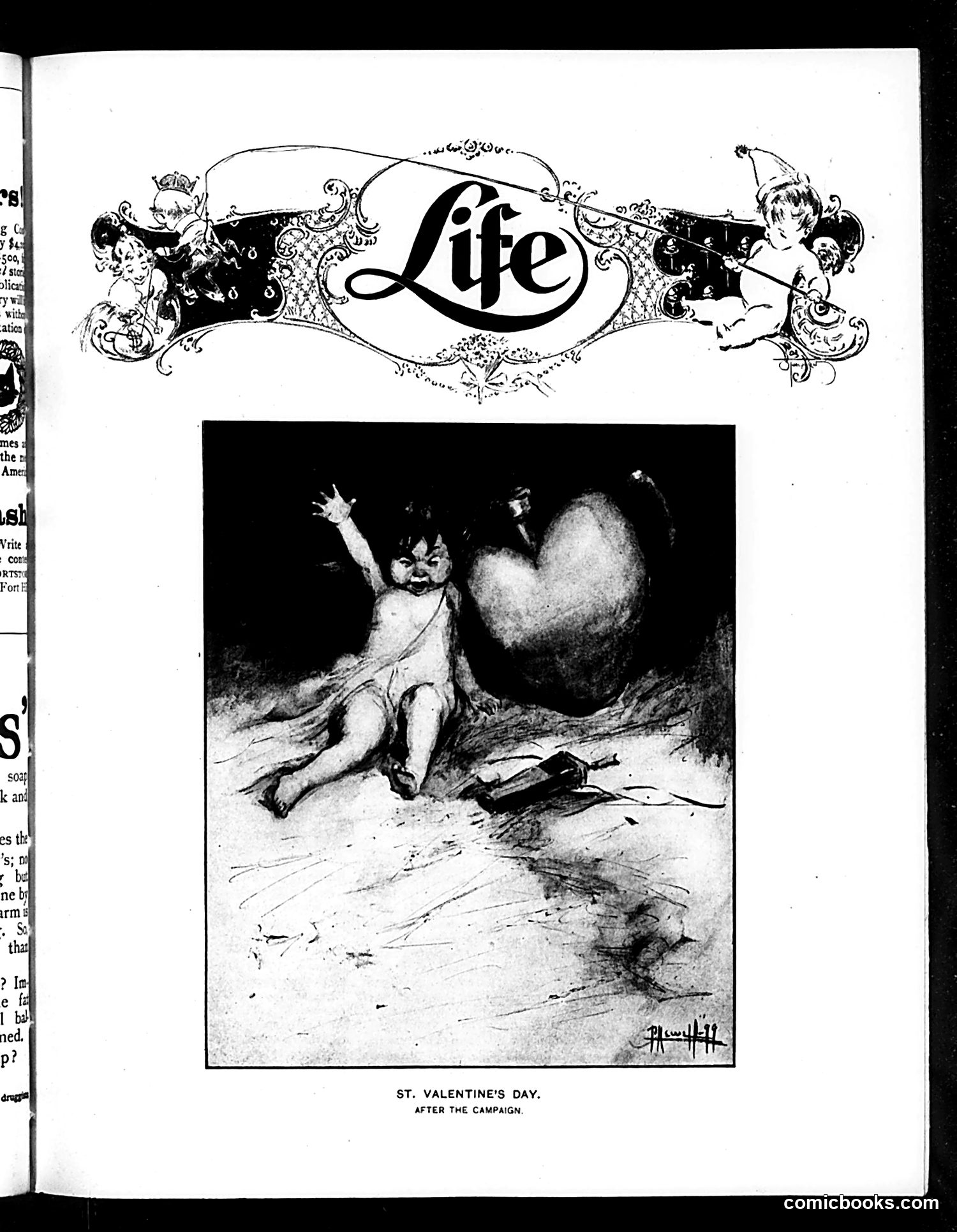
This page from *Life* magazine features a decorative header and a single illustration titled "St. Valentine's Day After the Campaign." The image depicts a cherub (Cupid) sitting amid battlefield detritus—scattered papers, debris, and what appears to be a large spherical object (possibly a bomb or cannon ball). The cherub, traditionally associated with love and Valentine's Day, looks distressed with one arm raised. The satire juxtaposes Cupid—the symbol of romance and St. Valentine's Day—with the devastation of warfare. "After the Campaign" likely references a recent military conflict, suggesting that even romantic ideals have been destroyed by war's brutality. The cartoon critiques how warfare destroys innocence and beauty, using the beloved figure of Cupid to emphasize the tragedy.
This page contains political commentary on early 1900s American politics and the Boer War. The text discusses Kentucky politics and Governor Goebel's assassination, expressing hope for justice and peaceful resolution. The right column critiques Governor Roosevelt's (later President Theodore Roosevelt's) selection as Republican Vice-Presidential candidate, arguing he's unsuitable for high office and should stick to his current role as New York Police Commissioner. The writer suggests Roosevelt is impulsive and makes poor decisions. The final section dismisses as absurd claims that women stenographers in these offices are "licensed to calmness," sarcastically suggesting Dr. Broughton's accusations against them are foolish. The small illustrations appear decorative rather than specifically satirical, depicting period-appropriate scenes.
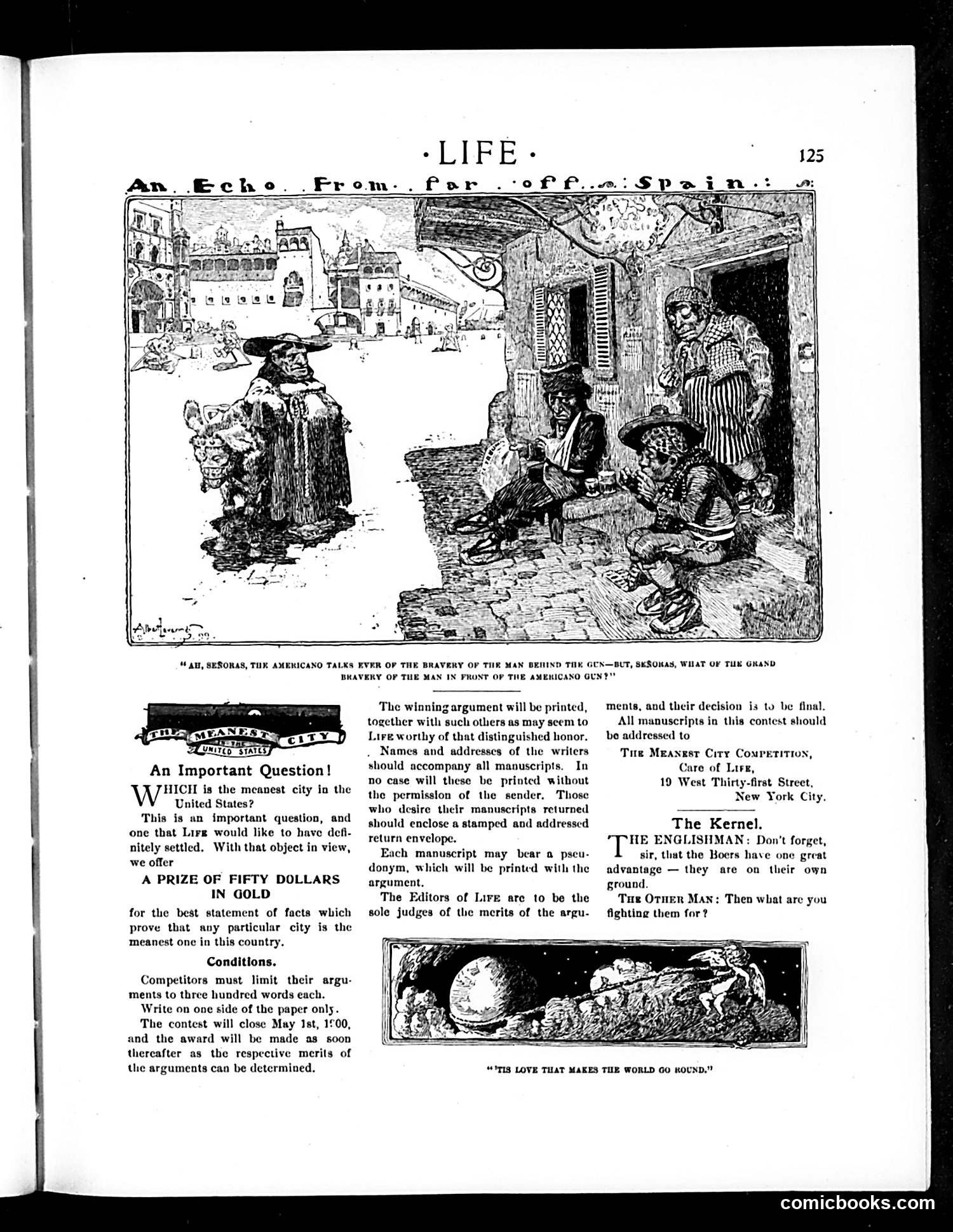
The main illustration depicts a scene titled "An Echo From Far-off Spain," showing a Spanish street setting with figures in period dress. The caption contrasts American and Spanish military courage, quoting: "Ah, Señors, the Americano talks ever of the bravery of the man behind the gun—but, Señors, what of the grand bravery of the man in front of the Americano gun?" This appears to reference the Spanish-American War (likely 1898), satirizing American boasting about military superiority. The image suggests Spanish skepticism toward American claims of valor, implying Americans relied on superior firepower rather than personal bravery. The page also contains an unrelated contest announcement: "An Important Question!" offering fifty dollars in gold for the best argument about which American city is "meanest." The satirical tone targets American urban culture and civic rivalry.
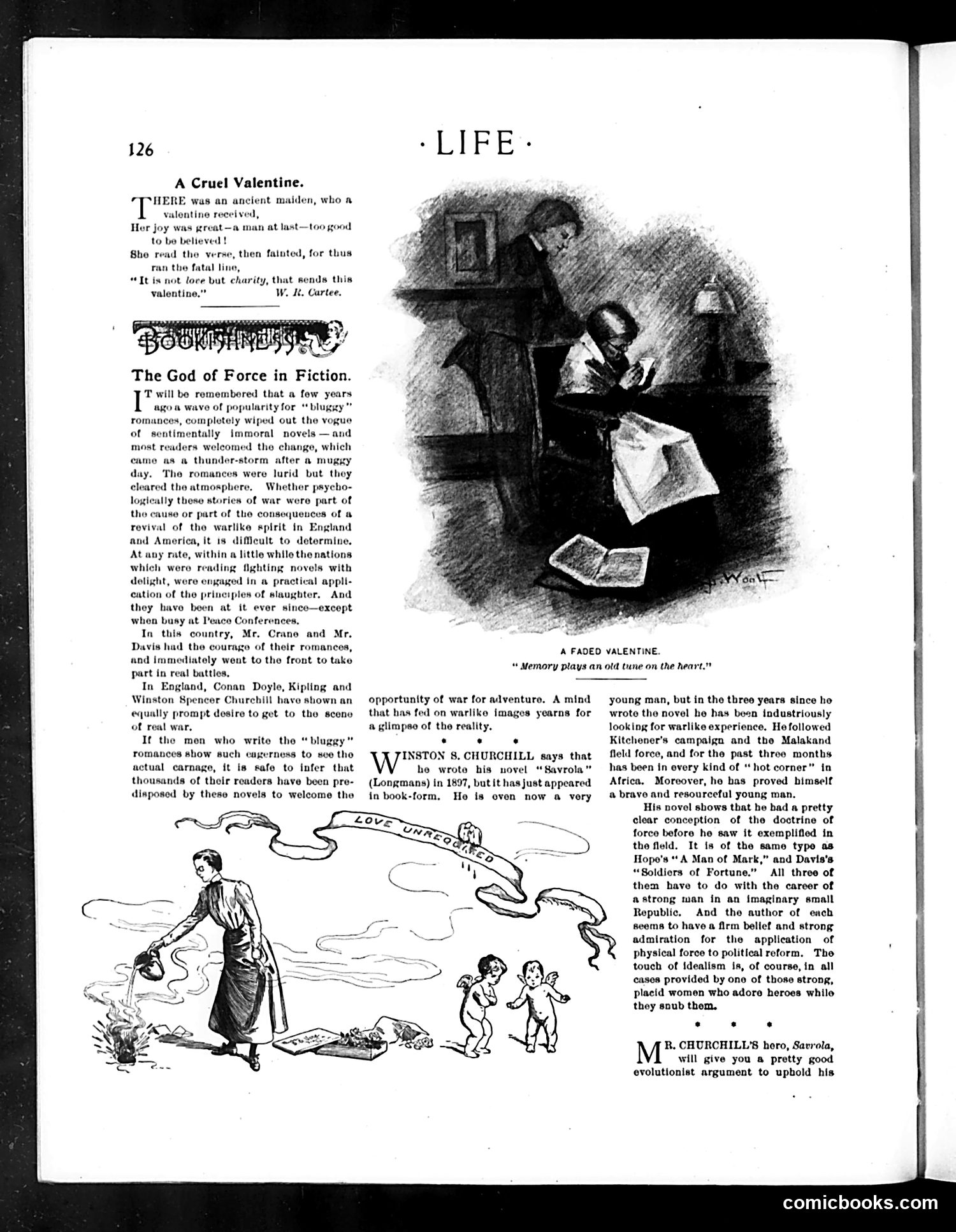
This page contains two distinct sections: **"A Cruel Valentine"** — A brief poem criticizing a Valentine's Day declaration that proved false, with the moral that true charity matters more than romantic gestures. **"The God of Force in Fiction"** — A literary critique discussing how "bluffy" adventure novels (featuring war and fighting) became popular in England and America. The article argues that writers like Conan Doyle, Kipling, Churchill, and others promoted narratives celebrating physical force and heroic combat, potentially influencing public enthusiasm for warfare. It specifically mentions Churchill's novel *Savrola* (1897) as an example of fiction glorifying forceful action and idealism applied to political reform. The accompanying illustration labeled **"A Faded Valentine"** shows a sentimental figure amid cherubs, likely satirizing romantic idealism—matching the opening poem's theme about hollow sentiments.
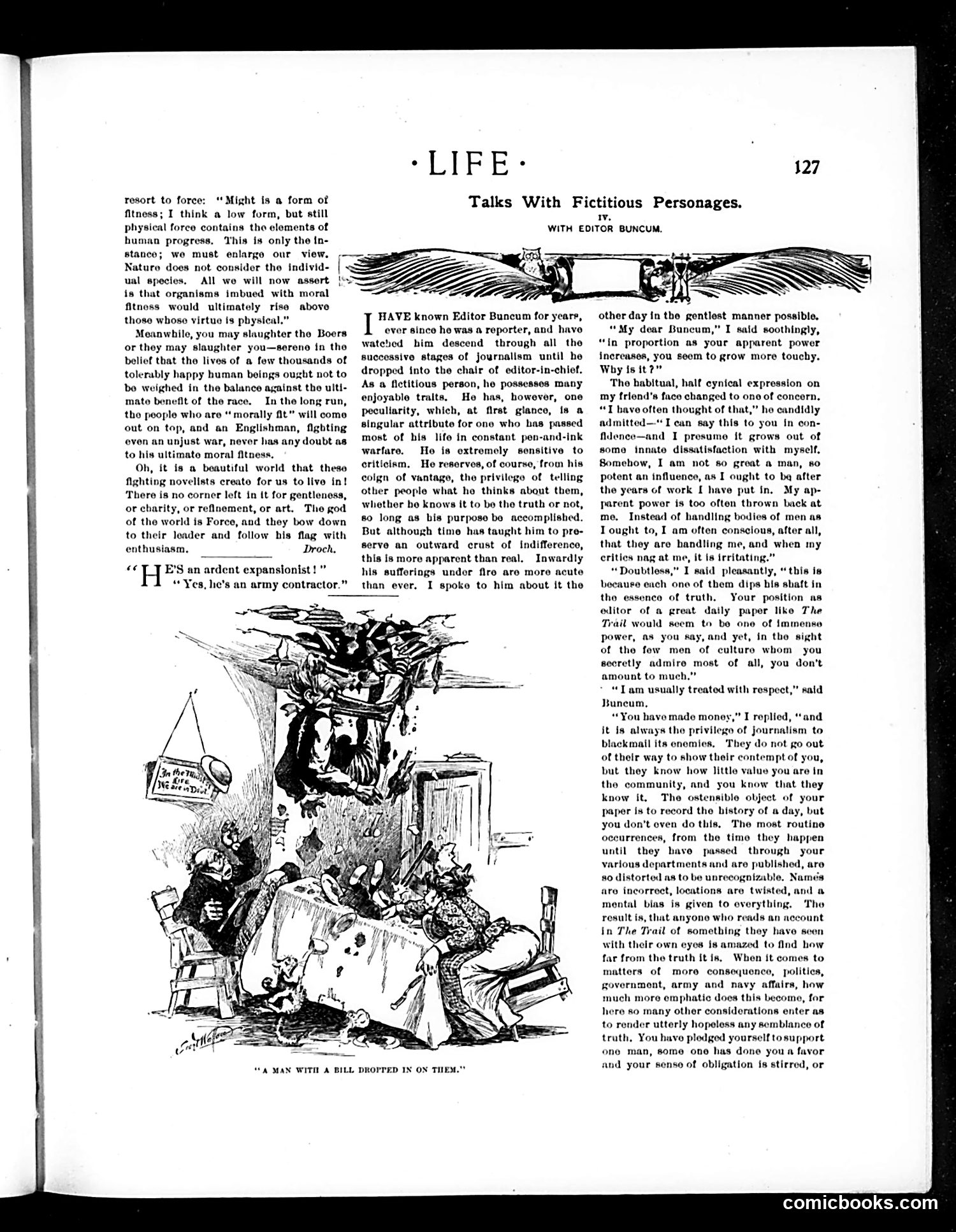
This satirical piece critiques **Editor Buncum** (a fictional character representing editors generally) through a dialogue about journalistic ethics. The accompanying cartoon shows a grotesque figure laden with bills and papers—literally embodying corruption and financial entanglement ("A Man With a Bill Bropped in on Them"). The text attacks editors for distorting facts to serve political or personal interests, sensationalizing news, and blackmailing opponents. The satire argues that editors misreport events, twist names and locations, and inject bias into coverage—all while claiming to record history objectively. The winged figure at the page's top suggests aspirational pretense undermined by the messy reality depicted below, mocking editors' claims to integrity while engaging in corrupt practices.
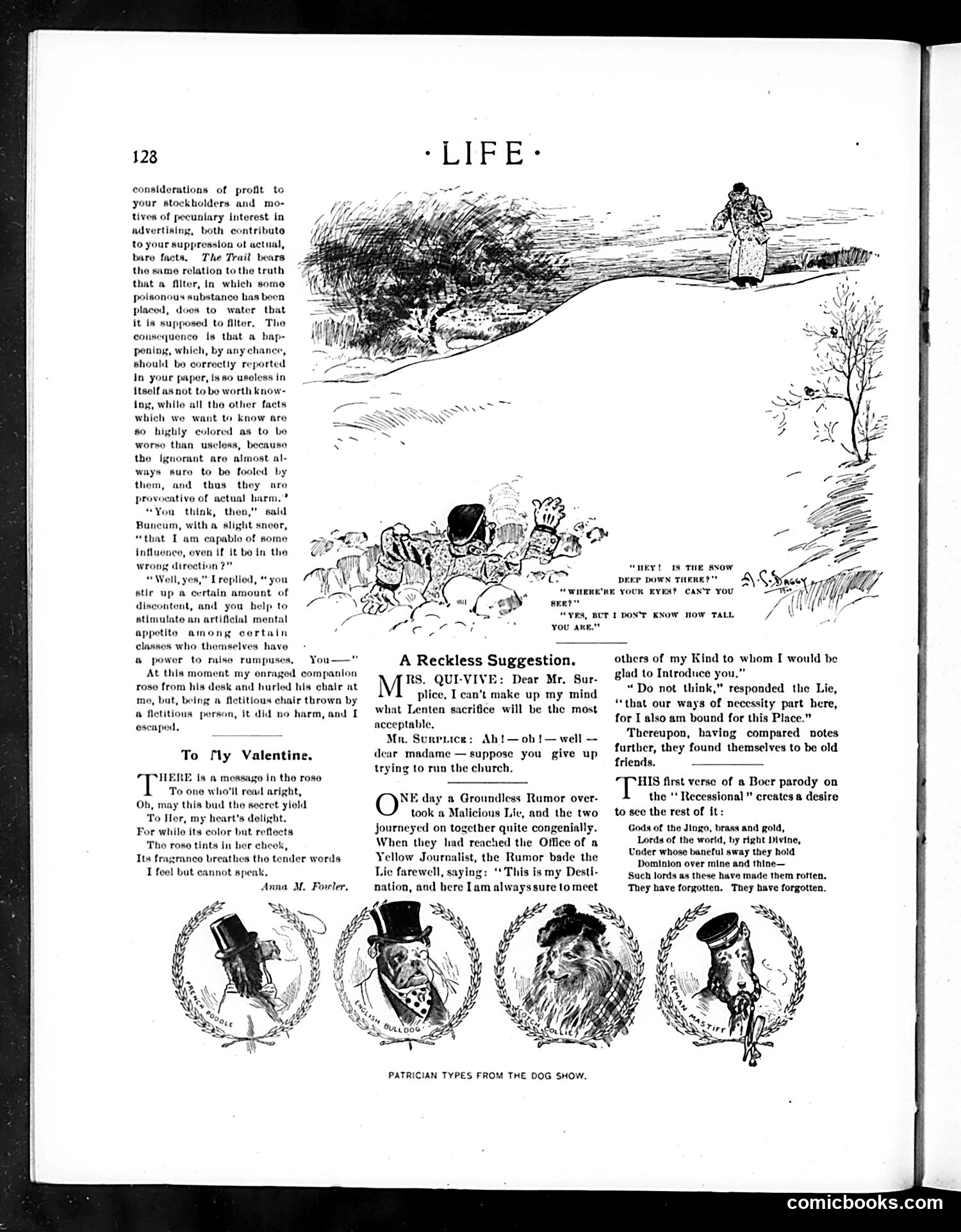
This page contains several distinct satirical pieces rather than a unified cartoon: 1. **"A Reckless Suggestion"** – A dialogue between Mrs. Quivivive and Mr. Surplice debating Lenten religious observance, satirizing Victorian religious pretense. 2. **"To Fly Valentine"** – A poem by Anna M. Forster about romantic longing, unrelated to satire. 3. **"Patrician Types from the Dog Show"** – Four portrait medallions at the bottom caricature dog show participants as having animal characteristics. This satirizes the pretentiousness of dog show enthusiasts by suggesting they resemble their own dogs, mocking upper-class affectation. 4. **Landscape sketches** showing figures in winter snow scenes. The page primarily targets Victorian social pretension through humor about religion and class-based hobbies.
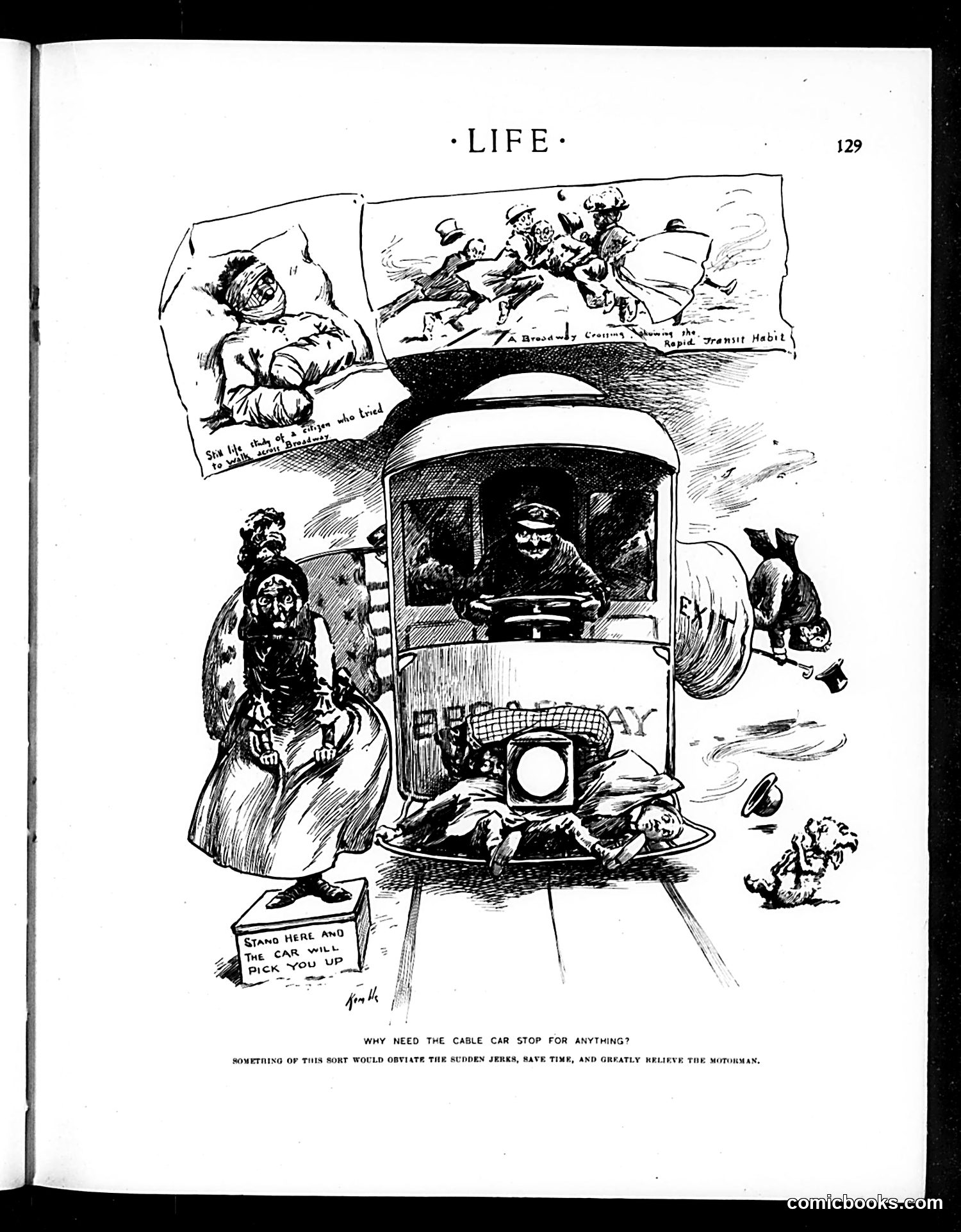
This cartoon satirizes cable car safety in what appears to be San Francisco. The central image shows a cable car with a motorman at the controls, surrounded by figures being thrown about violently—suggesting the jerky, dangerous operation of these vehicles. The caption reads: "WHY NEED THE CABLE CAR STOP FOR ANYTHING?" with a subtitle noting that stopping would "OBLIGE THE SUDDEN JERKS, SAVE TIME, AND GREATLY RELIEVE THE MOTORMAN." The joke is ironic: the cartoon proposes that since cable cars cause such violent jolts and sudden movements anyway, why stop at all? It mocks both the mechanical roughness of the transportation system and presumably the motormen's driving habits. The scattered passengers illustrate the cartoon's complaint about passenger safety and comfort.
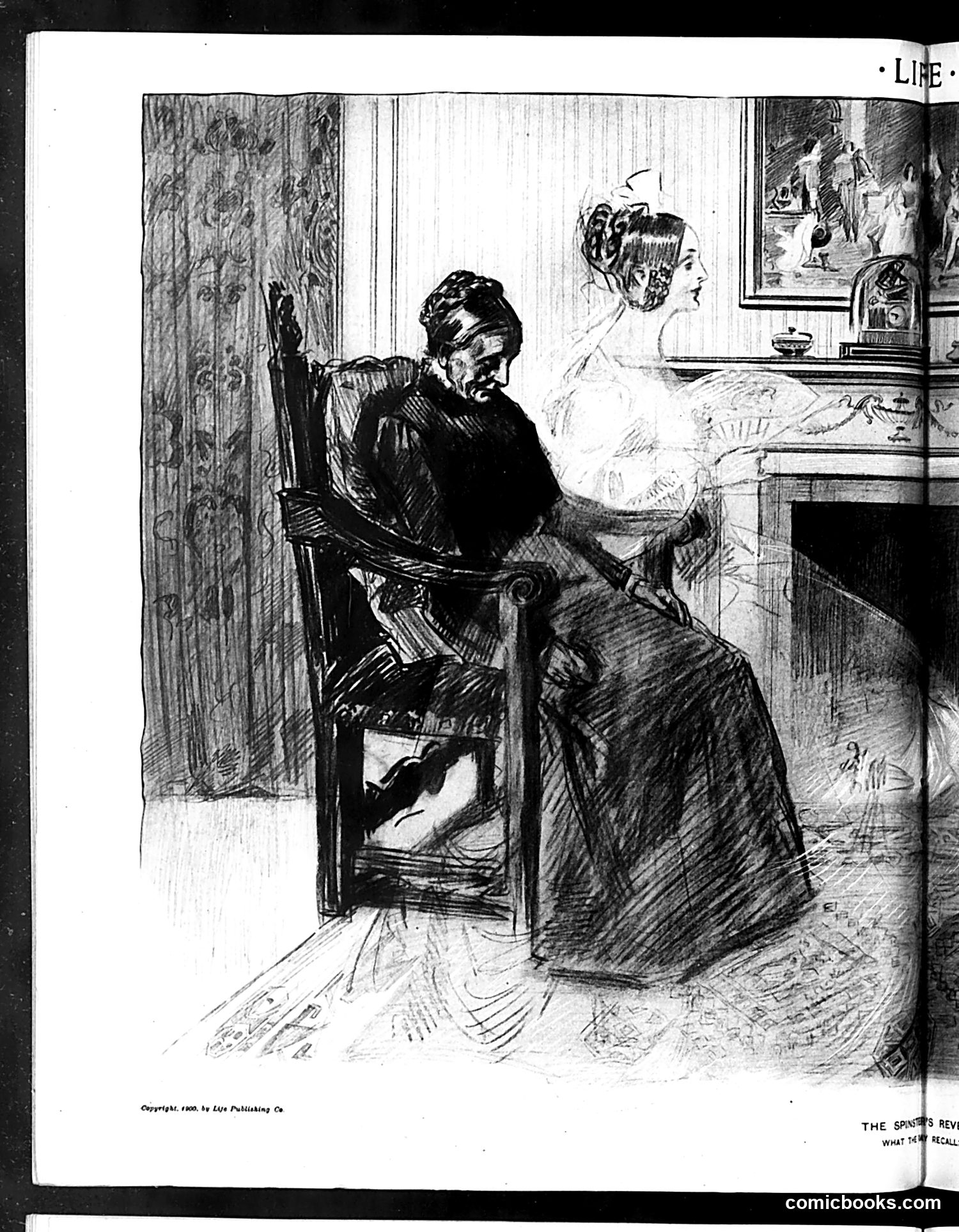
This appears to be a satirical illustration from *Life* magazine (copyright 1908, per the visible credit line). The sketch depicts an interior domestic scene with two figures: a woman seated at what appears to be a vanity or dressing table, and a man sitting in a chair nearby, observing her. The image likely satirizes gender dynamics or marital relationships of the Edwardian era—possibly commenting on women's vanity, grooming habits, or domestic roles. The man's watchful posture and the woman's absorbed focus at the mirror suggest commentary on either courtship rituals or married life. However, without the accompanying article text or caption (partially obscured as "THE SNOB'S REVI—" at bottom), the specific satirical target remains unclear. The sketch's style is characteristic of early 20th-century magazine illustration.
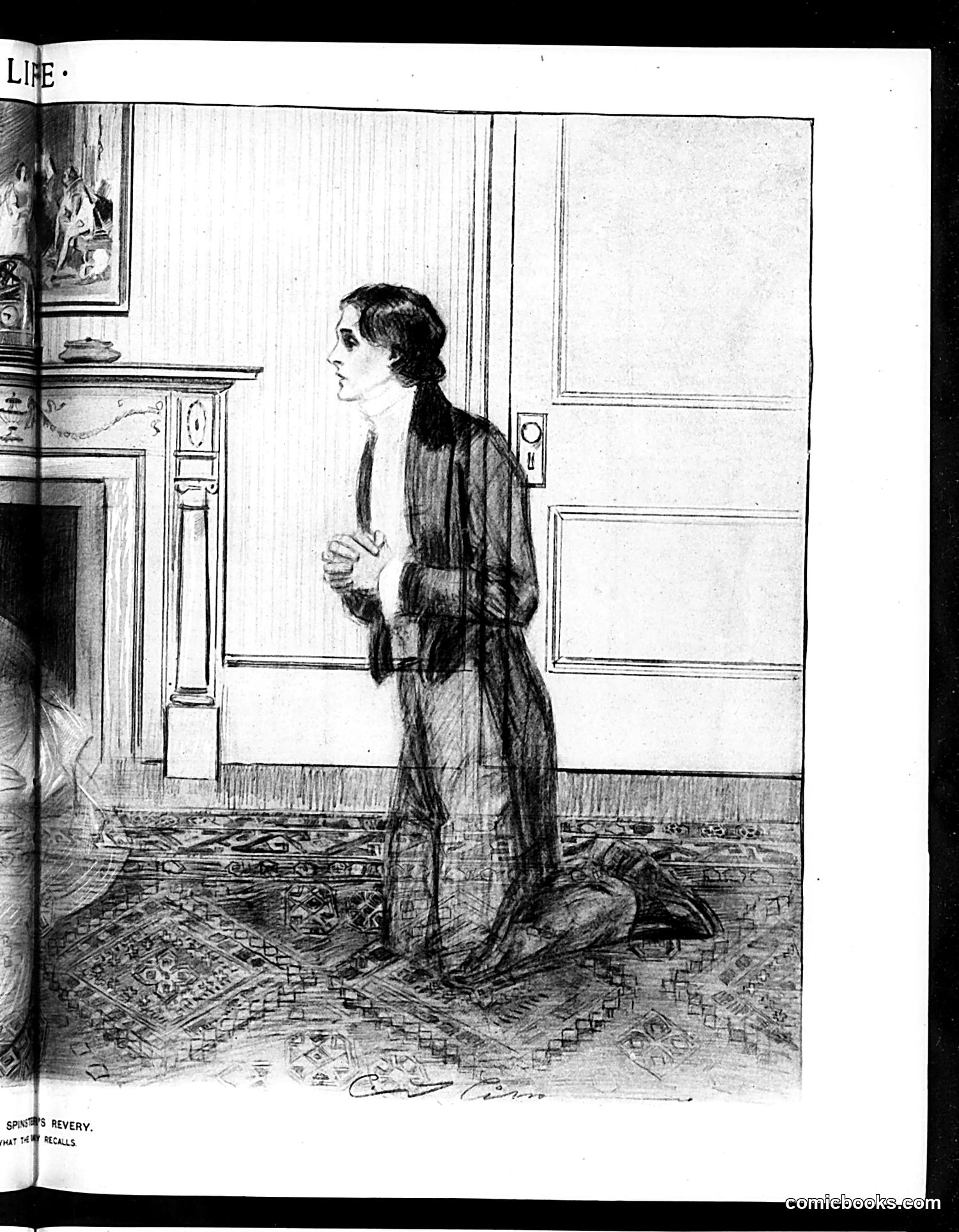
This appears to be an illustration from Life magazine titled "SPENCER'S REVERY, THAT 54 BF RECALLS" (OCR unclear on exact wording). The image shows a man in a robe standing alone in an elegant interior, gazing pensively toward a doorway. He appears to be lost in thought or memory. Without clearer text or additional context, I cannot definitively identify who "Spencer" is or what specific event this "revery" (reverie/daydream) references. The domestic, contemplative scene suggests either a literary reference or commentary on a notable public figure's private reflections, but the particular historical or social satire remains unclear from the visible elements alone.
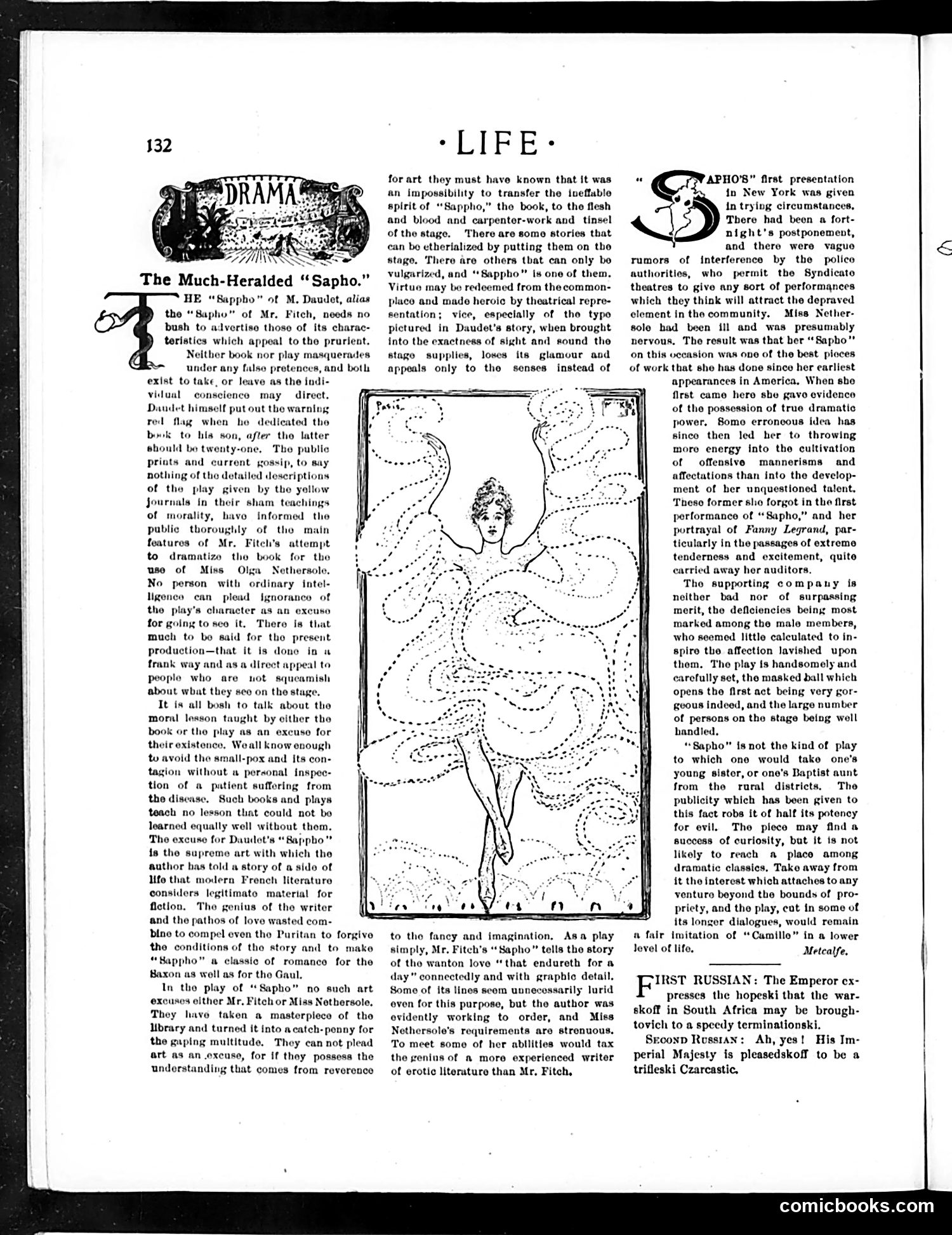
This page reviews Mr. Fitch's theatrical adaptation of "Sapho," a play based on French literature. The illustration depicts a reclining female figure in classical style. The review criticizes the play's pretensions: the text notes it was promoted as a daring artistic work but actually lacks genuine dramatic merit. The author argues the production uses the book "as an excuse for theatricalism" rather than serious art. Key complaint: the play offers "nothing of the detailed descriptions" found in the original novel and instead relies on spectacle—a "masked ball," "large number of persons on stage"—to distract audiences from weak dramatic content. The satire targets both the producers' overselling and the public's gullibility toward highbrow cultural claims masking shallow entertainment.
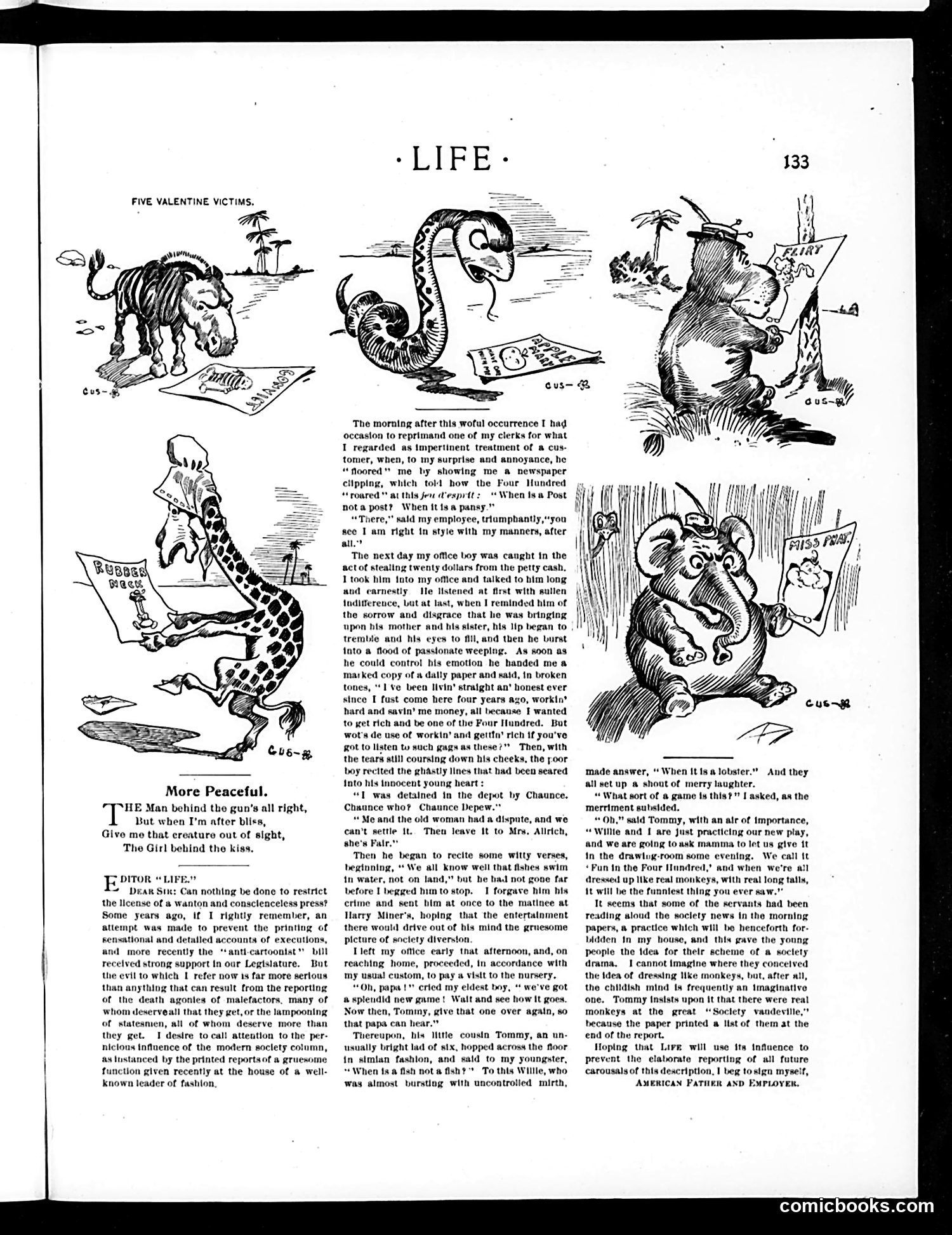
This page from *Life* magazine satirizes the corrupting influence of society gossip columns on American morality and behavior. The author complains that newspaper accounts of high-society witticisms—attributed to figures like Chauncey Depew (a prominent Gilded Age politician and railroad executive)—are causing widespread moral decay. The cartoons depicting "Five Valentine Victims" show animals and creatures corrupted or damaged, illustrating the satirist's point. The central narrative describes how his office clerk and later his young son have adopted crude jokes and behavior they learned from printed society gossip, apparently believing this makes them fashionable like "the Four Hundred" (the elite wealthy class). The satire targets both the irresponsible society press for printing trivial gossip and the public's uncritical absorption of it. The author argues this cultural influence is more socially damaging than sensational crime reporting—a critique of media's role in shaping lower-class aspiration and behavior through celebrity emulation.
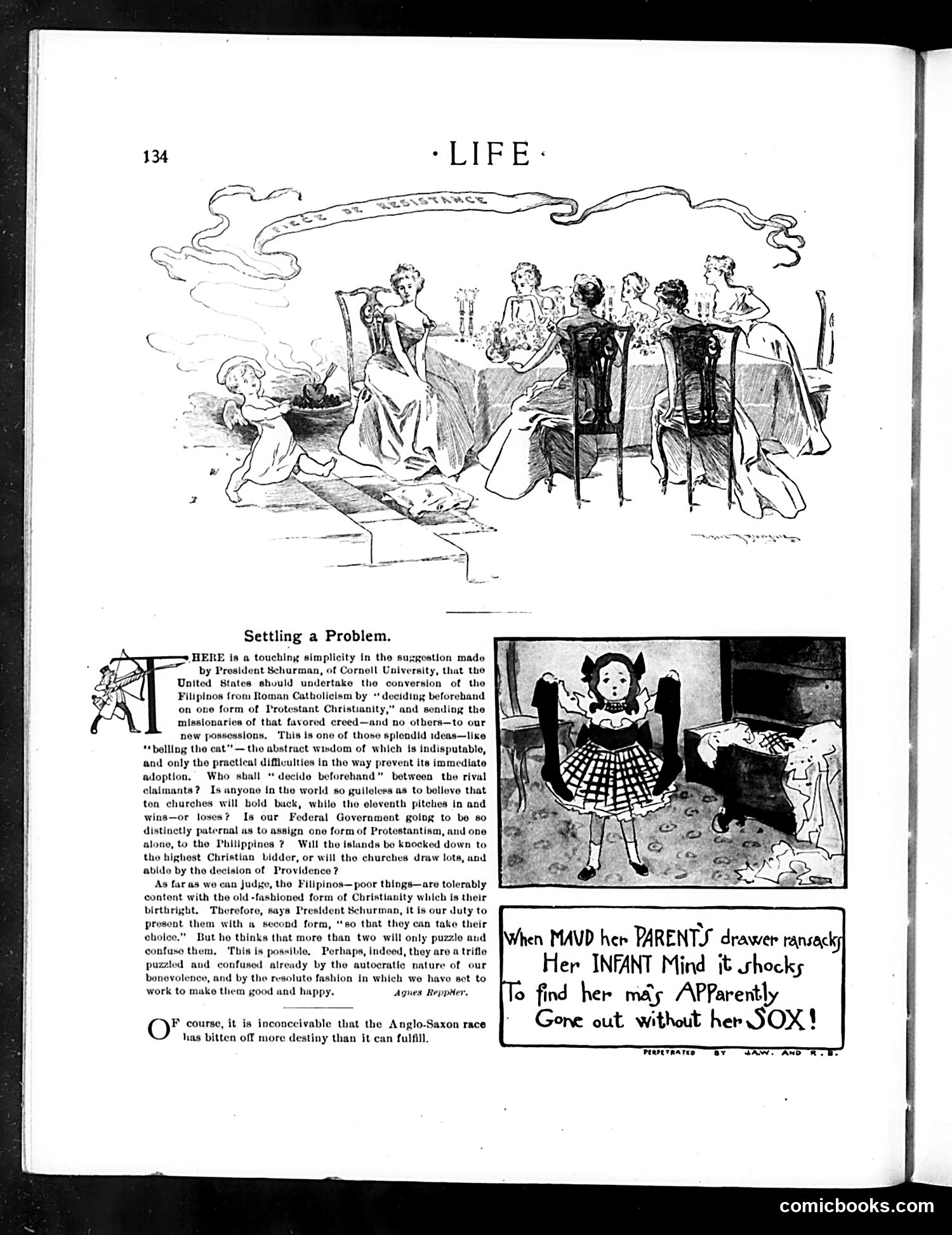
This page satirizes President Schurman of Cornell University's proposal to convert Filipino Catholics to a single, government-approved Protestant denomination following the U.S. acquisition of the Philippines (post-1898 Spanish-American War). The essay mocks the impracticality of the idea: How would the government choose which Protestant sect? Would rival churches accept exclusion? The satire exposes the paternalism of American "benevolence"—deciding Filipinos need conversion despite already having Christianity as their "birthright." The lower cartoon is unrelated: it depicts a child shocked to discover her mother left home without stockings—satirizing contemporary women's fashion conventions and propriety concerns. The closing line about "Anglo-Saxon race" biting off more destiny hints at American overreach in imperial ambitions. The piece criticizes religious imperialism masked as humanitarian uplift.
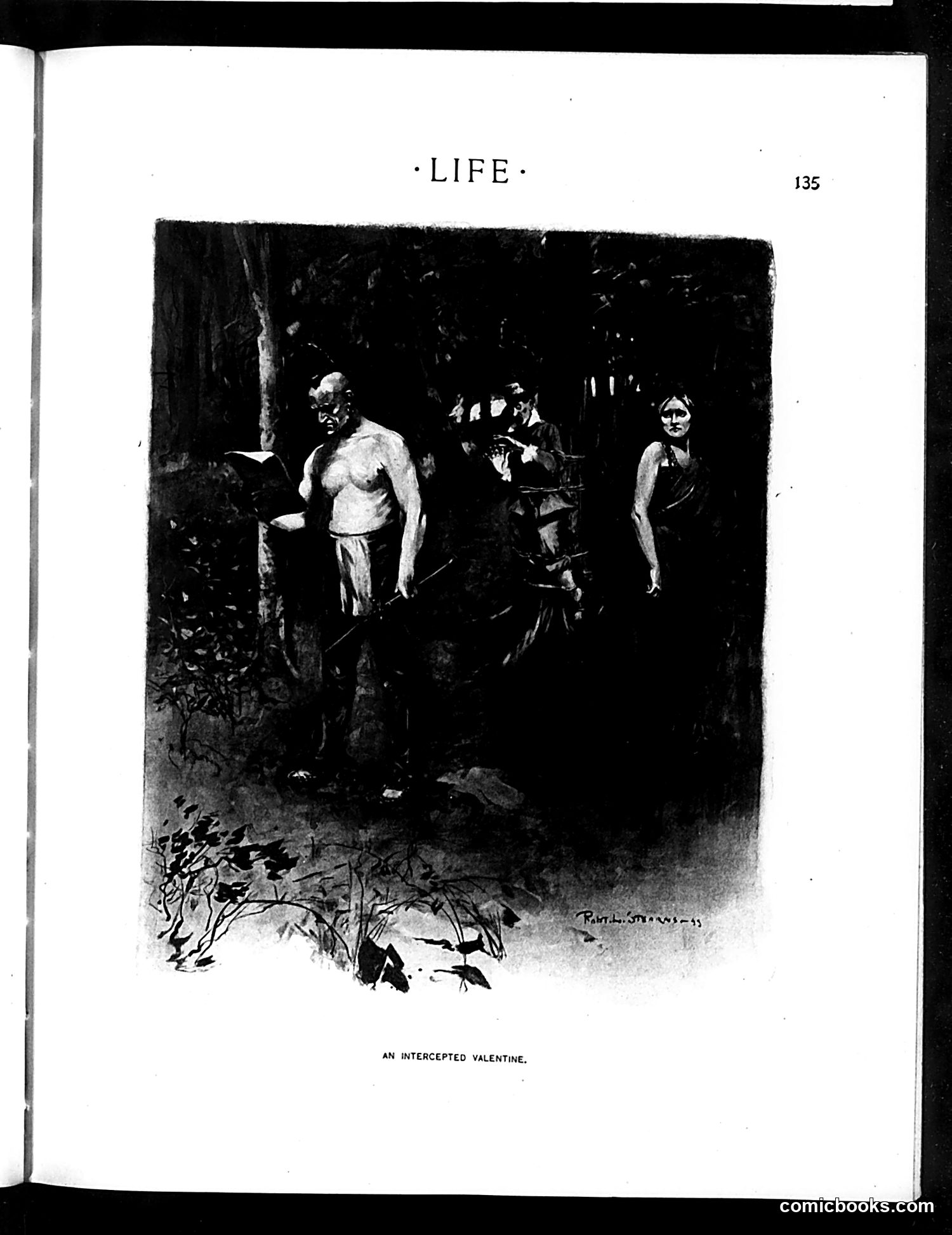
This illustration depicts a dramatic nocturnal scene with four figures in what appears to be a clandestine meeting. The title suggests romantic correspondence has been intercepted—likely a scandal involving a love letter. The central shirtless male figure appears to be confronted by others in a wooded setting. Given *Life* magazine's satirical nature and the theatrical staging, this likely mocks a contemporary scandal involving infidelity or illicit romance among notable figures. The "intercepted" element suggests spy intrigue or caught communication—common themes for early 20th-century political and social satire. Without additional context about the publication date, I cannot identify the specific individuals or scandal referenced. The drawing style and dramatic composition suggest this criticized wealthy or prominent people's private conduct as a matter of public amusement.
This page primarily contains **text-based satirical content** rather than visual cartoons. The main piece, "Mister Kipling," addresses **Rudyard Kipling**, the famous British author, using colloquial dialect verse. It satirizes Kipling for not writing patriotic war poetry during the **Boer War** (South African conflict). The poem mockingly lists British military figures (Buller, French, White, Gatacre) and urges Kipling to produce rousing verses celebrating their exploits, suggesting he's shirking his duty as a nationalist writer. Below appears an **anecdote about Senator Pomeroy** exposing corruption in Indian agencies—specifically how government officials could pocket profits by undercounting cattle delivered to reservations. The page also includes a **joke about smoking etiquette** and a newspaper advertisement notice. The satire targets Kipling's perceived political inconsistency: a celebrated imperialist poet seemingly silent during Britain's colonial military campaign. This would have resonated with contemporary readers following the Boer War closely.
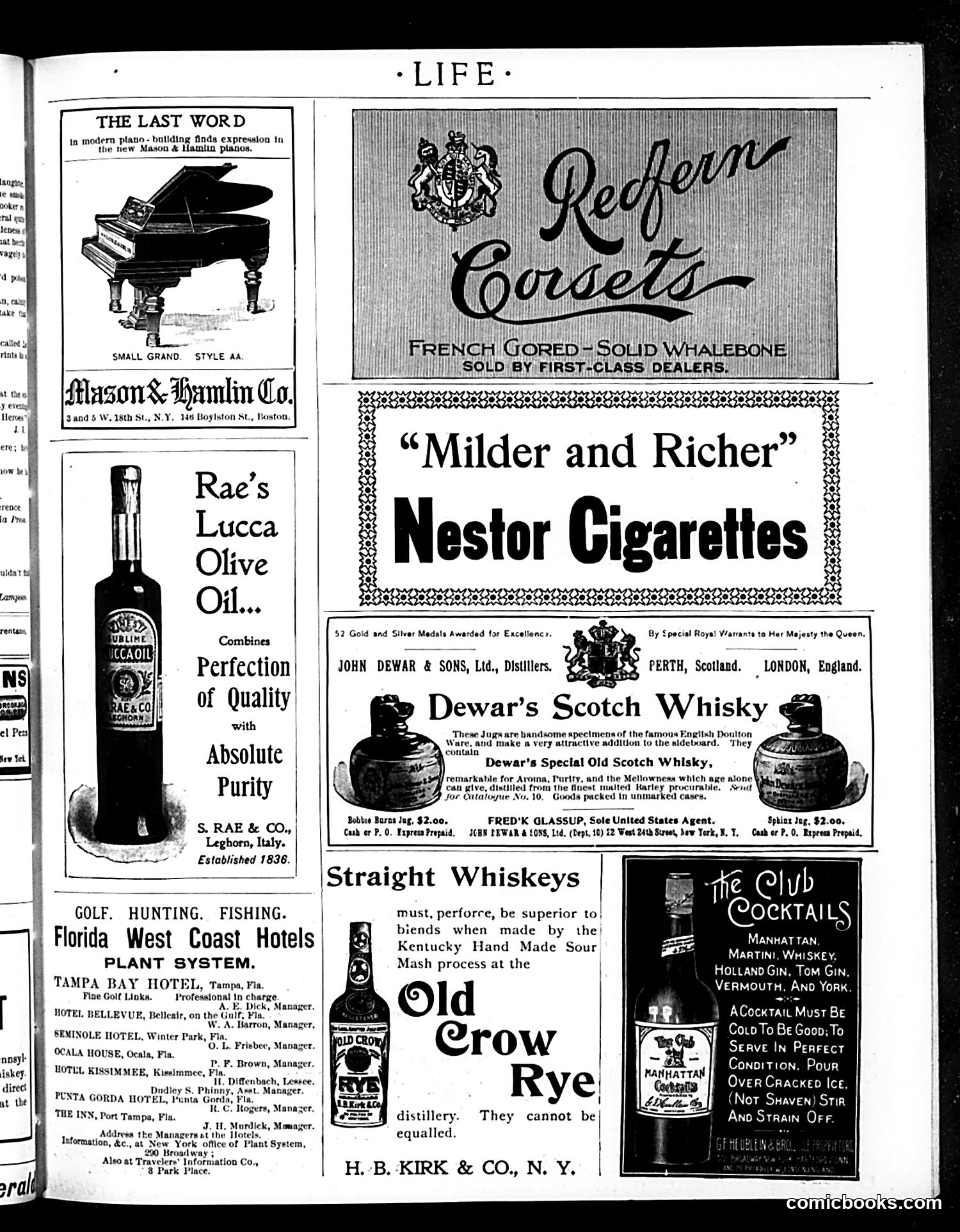
This is primarily a **commercial advertising page** from Life magazine, not a satirical cartoon page. The content consists of period product advertisements (circa 1900s-1920s based on styling): **Notable ads include:** - **Mason & Hamlin pianos** ("The Last Word in modern piano building") - **Rae's Lucca Olive Oil** emphasizing "Perfection of Quality" - **Florida West Coast Hotels** via Plant System railroad - **Dewar's Scotch Whisky** and other spirits - **Old Crow Rye** whiskey - **Nestor Cigarettes** ("Milder and Richer") - **Club Cocktails** bar guide The page reflects Gilded Age consumer culture and advertising methods. No political satire or caricature is present—it's a straightforward commercial section showing luxury goods and services marketed to affluent readers. The visual style and products date this to the pre-Prohibition era.
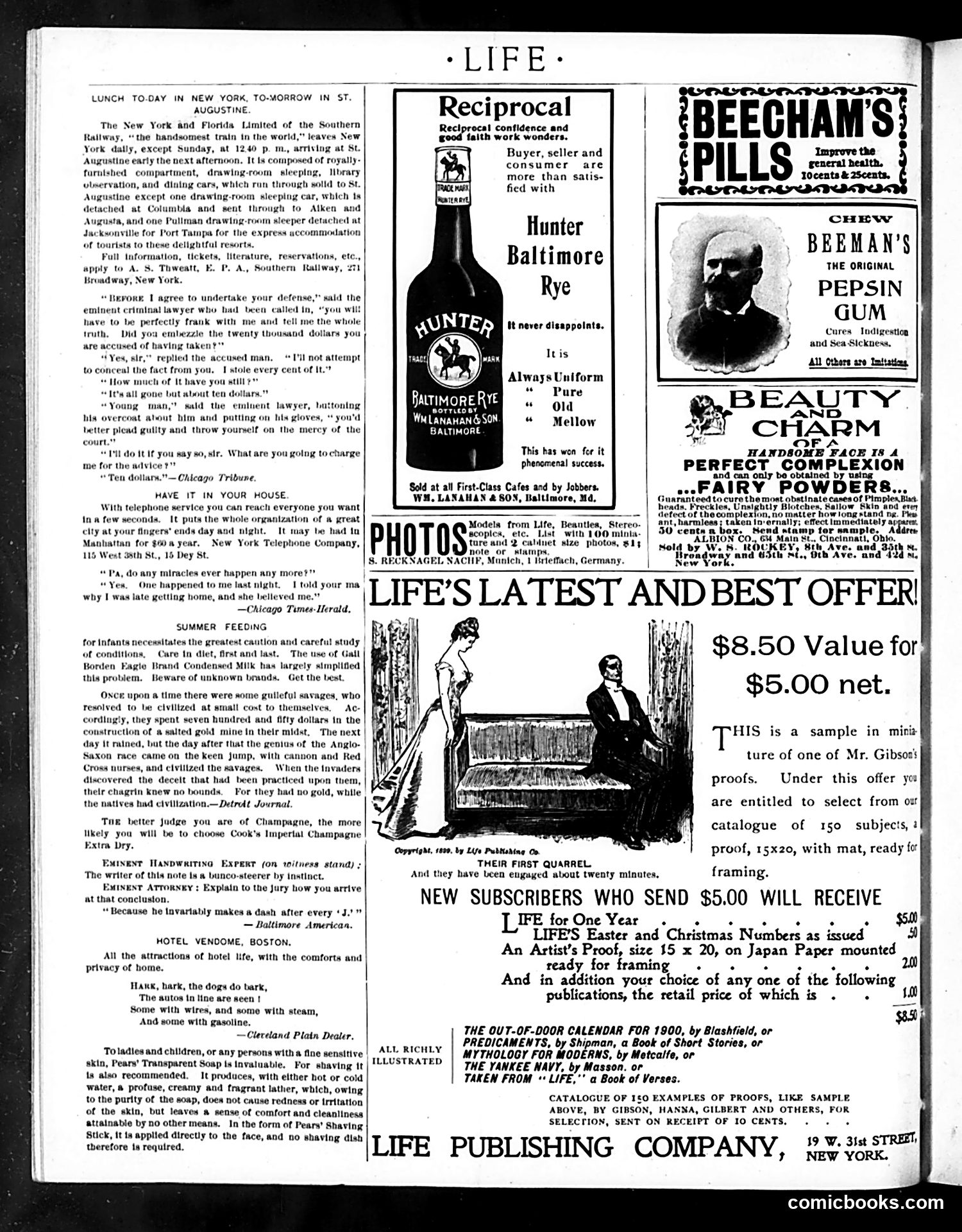
This page is primarily **advertising**, not political satire. The main content consists of product advertisements (Beecham's Pills, Beeman's Pepsin Gum, Fairy Powder) interspersed with brief humorous anecdotes. The sole cartoon shows a woman and man in what appears to be an intimate moment, captioned "And they had been engaged about twenty minutes." This is a mild joke about courtship customs of the era—likely satirizing either the speed of romantic progression or changing social conventions around engagement. The accompanying text snippets are lighthearted vignettes: one about a lawyer negotiating with a confessed embezzler, another about a father claiming he performed a "miracle" by convincing his wife of a late arrival. These are gentle humor pieces typical of Life's satirical voice, poking fun at everyday deceptions and social interactions rather than addressing political issues. No identifiable political figures or substantive social commentary appear on this page.
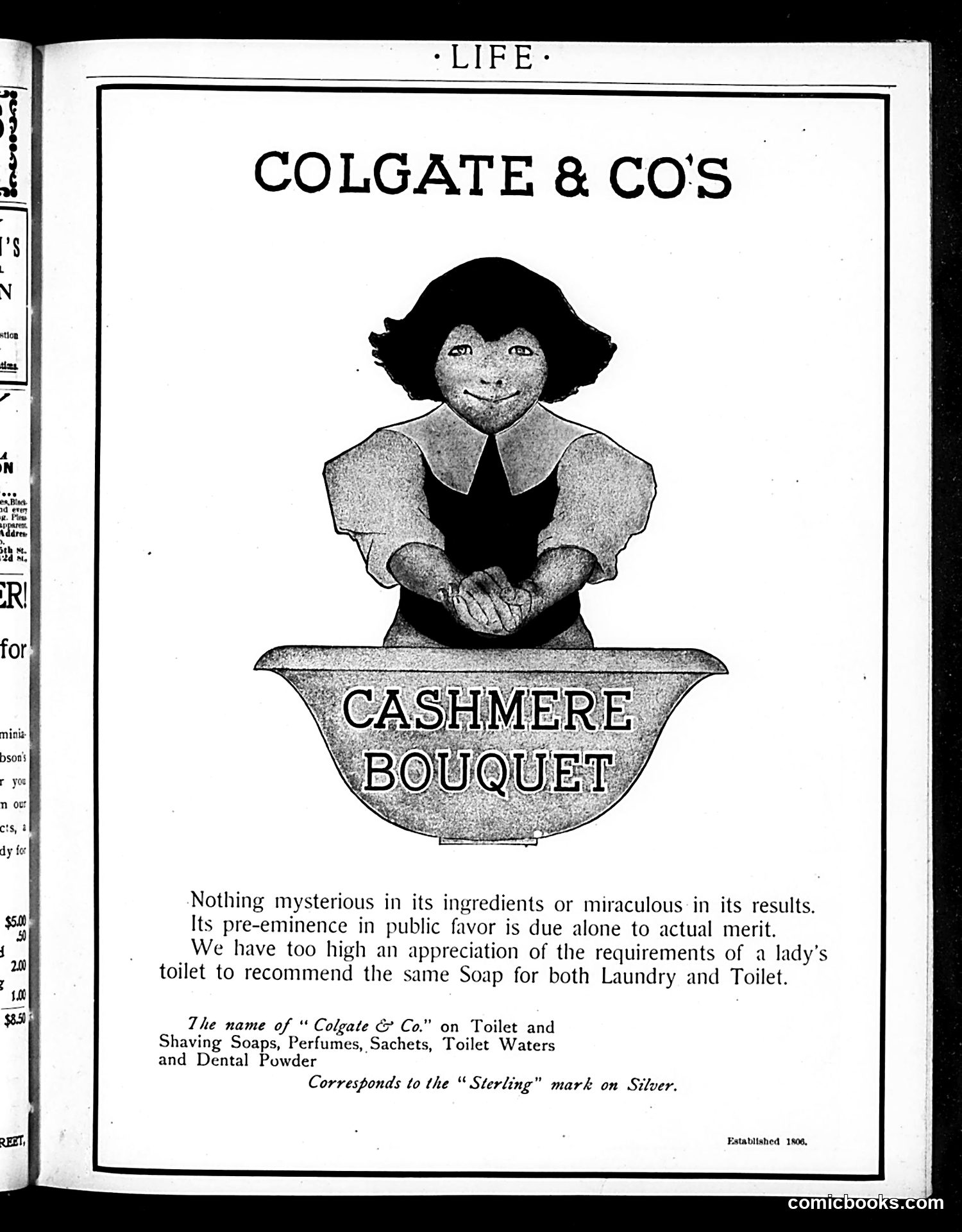
This is a **product advertisement**, not political satire. It appears from *Life* magazine (established 1806 per footer) promoting Colgate & Co's toiletries. The illustrated figure is a stylized, cheerful woman with a round face and bob haircut, presented as a mascot or brand representative. She displays the "Cashmere Bouquet" soap product. The advertisement's messaging emphasizes **quality and respectability**: - Claims the product's popularity stems from "actual merit," not mystery or false claims - Distinguishes between "laundry" and "toilet" soaps—asserting their premium soap is too refined for common washing - Compares the brand name to the "Sterling" mark on silver, suggesting guaranteed quality/authenticity - Emphasizes understanding "requirements of a lady's toilet" (personal hygiene/beauty) This reflects early 20th-century marketing strategies targeting middle/upper-class women by positioning products as sophisticated and trustworthy alternatives to cheaper, undifferentiated competitors.
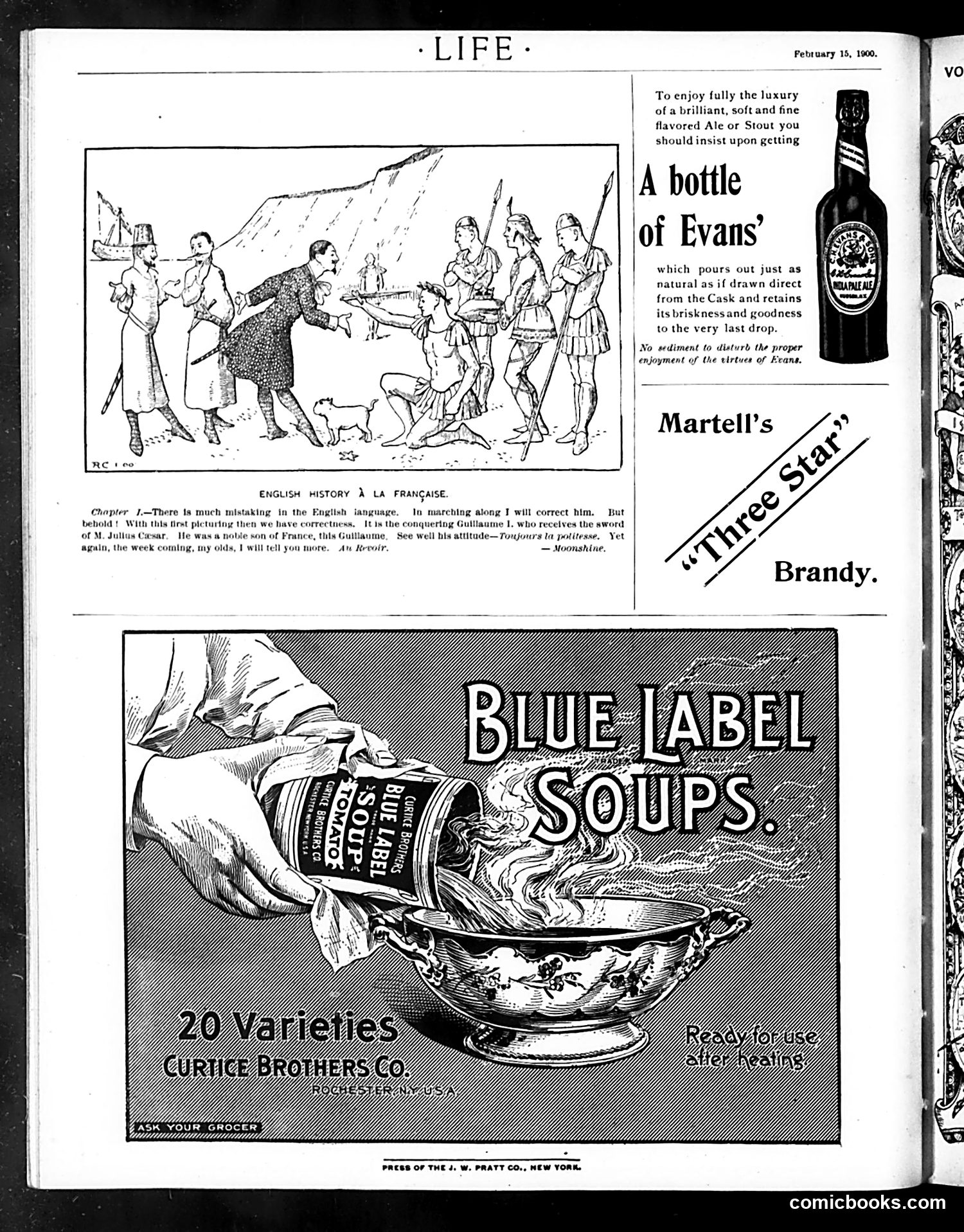
The main cartoon depicts a historical scene titled "English History à la Française," showing what appears to be a military confrontation. The caption references marching with Julius Caesar, a noble son of Rome named Gailiaume, and correcting English language misinterpretations—suggesting satirical commentary on how the French interpret or misrepresent English history. The cartoon likely mocks French historical accounts or propaganda, presenting a comedic revision of English military encounters. The specific identity of figures remains unclear without additional context. The page is primarily filled with period advertisements (Evans' ale, Martell's brandy, Blue Label Soups) typical of *Life* magazine's commercial content. These ads are historically interesting as examples of early 1900s marketing but are not satirical content themselves.