
Life, 1900-02-15 · page 12 of 20
Life — February 15, 1900 — page 12: what you’re looking at
What you’re looking at
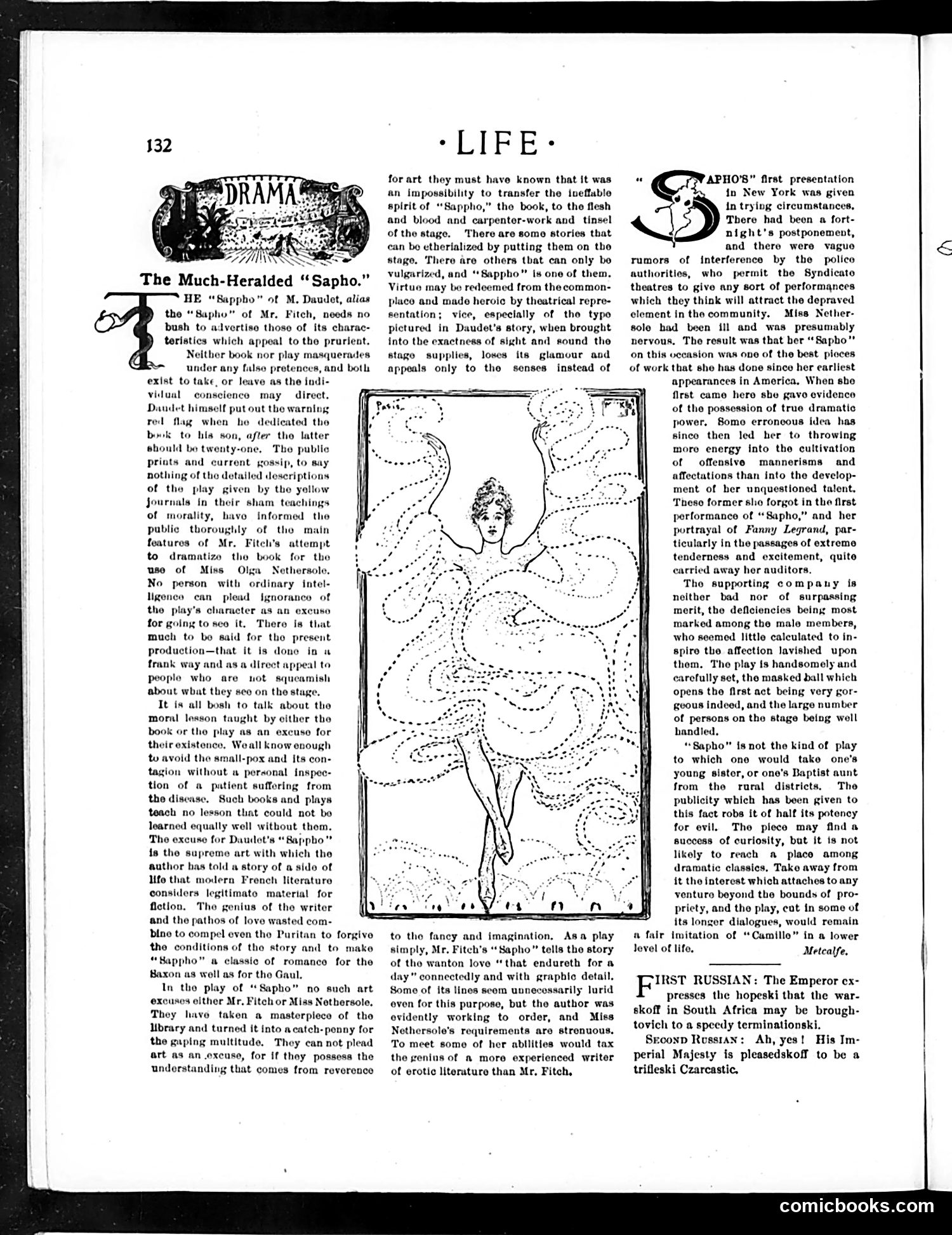
This page reviews Mr. Fitch's theatrical adaptation of "Sapho," a play based on French literature. The illustration depicts a reclining female figure in classical style. The review criticizes the play's pretensions: the text notes it was promoted as a daring artistic work but actually lacks genuine dramatic merit. The author argues the production uses the book "as an excuse for theatricalism" rather than serious art. Key complaint: the play offers "nothing of the detailed descriptions" found in the original novel and instead relies on spectacle—a "masked ball," "large number of persons on stage"—to distract audiences from weak dramatic content. The satire targets both the producers' overselling and the public's gullibility toward highbrow cultural claims masking shallow entertainment.
📄 Transcribed text from this page (OCR, searchable)
Machine-transcribed from the original scan — historical spelling and the odd misread are preserved.
The Much-Heralded “Sapho.” HE “Sappho” of M. Daudet, alias the “Saphu” of Mr. Fitch, needs no bush to advertise those of its charac- teristics which appeal to tho prurient. Neither book nor play masquerades under any false pretences, and both exist to take, or leave as the in vidual conscienco may direct. Daudet himself put out the warning red flag when ho dedicated tho book to bis son, afler tho latter should be twenty-one, The public prints and current gossip, to aay nothing of the detailed descriptions of the play given by the yellow Journals in their sham teachir of morality, havo informed the public thoroughly of the main features of Mr. Fitch’s attempt to dramatize the book for tho use of Miss Olga Nethersole, No person with ordinary intel- ligenco can plead ignorance of the play's character as an excuse for going to seo it, Thero is that much to bo said for tho present production—that it is dono in w frank way and as a direct appeal to people who are not squeamish about what they seo on the stage. It is all bosh to talk about tho moral lesson taught by either tho book or tho play as an excuso for their existence. Weall know enough tu avoid the small-pox and its con- tagion without a personal inspec- tion of a patient suffering from the disease, Such books and plays teach no lesson that could not bo learned equally well without them. The excuse for Daudet’s “ Bappho" {8 tho supreme art with which the author bas told a story of a sido of Ufo that modern French literature considers legitimate material for fiction. Tho genius of the writer and the pathos of love wasted com- bine to compel even tho Puritan to forgive tho conditions of tho story and to make “Sappho” a classic of romanco for the Baxon as woll as for tho Gaul, In tho play of “Sapho” no such art excuses elther Mr, Fitch or Mias Nethersole, They havo taken a masterpleco of tho Ubrary and turned it into acatch-ponny for the guping multitude. They can not plead art as an oxcuse, for if thoy possess the understanding that comes from reverence 3 * LIFE * for art they must have known that it was an Impossibility to transfer the iveffable spirit of “Sappho,” the book, to the flesh and blood and carpenter-work and tinsel of the stage. There are somo stories that can be etherialized by putting them on the stage. There are others tbat can only bo vulgarized, and “Sappho” Is one of them, Virtue may be redeemed from thecommon- placo and made heroic by theatrical repre- sentation; vice, especially of tho typo pictured in Daudet’s story, when brought into the exactness of sight and sound the stage supplies, loses {ts glamour and appeals only to the senses instead of to tho fancy and imagination, Asa play simply, Mr, Fiteh’s “Sapho” tells the story of the wanton love “that endureth for a day” connectedly and with graphic detail, Some of its lines seom unnecessarily lurid oven for this purpose, but the author was evidently working to order, and Miss Nethersole’s requirements are strenuous, To meet some of her abilities would tax the genius of a more experienced writer of erotic literature than Mr. Fitch, APHO’S” first presentation in New York was given ve in trying circumstances, There had been a fort- QS night's postponement, and there were vaguo rumors of interference by the polico authorities, who permit the Syndicato theatres to give any sort of performances which they think will attract the depraved clement in the community. Miss Nether- sole bad been ill and was presumably nervous. Tho result was that ber “Sapbo"’ on this uccasion was one of the best pieces of work that she has done since her earliest appearances in Amorica, When sho first camo hero she gavo evidence of the possession of true dramatic power. 8omo erroncous idea has sinco then led her to throwing moro energy into the cultivation of offensive mannerisms and affectations than into the develop- ment of her unquestioned talent. Theso former sho forgot in the first performance of “Sapho,” and her portrayal of Fanny Legrand, par- ticularly in the passages of extreme tenderness and excitement, quite carried away her auditors, Tho supporting company is neither bad nor of surpassing merit, the deficiencies being most marked among the male members, who seemed little calculated to in- spiro the affection lavished upon thom. The play ts handsomely and carefully set, the masked ball which opens tho first act being very gor- gvous indeed, and the large number of persons on the stage being well handled. “Sapho" {8 not the kind of play to which one would tako one’s young sistor, or one’s Baptist aunt from the rural districts, Tho publicity which has been given to this fact robs it of half its potency for evil. The piece may find a success of curiosity, but it 1s not likely to reach a place among dramatic classics, Take away from it the interest which attaches to any yenturo beyond the bounds of pro- pricty, and tho play, cut in some of its longer dialogues, would remain a fair imitation of “Camillo” in a lower level of life. Metcalfe, IRST RUSSIAN: The Emperor ex- presses the hopeski that the w skoff in South Africa may be brough- tovich to a speedy terminationski. Sroonp Russtan: Ah, yes! His Im- perial Majesty is pleasedskoff to be a trifleski Czarcastic, comicbooks.com