
Life, 1900-02-15 · page 4 of 20
Life — February 15, 1900 — page 4: what you’re looking at
What you’re looking at
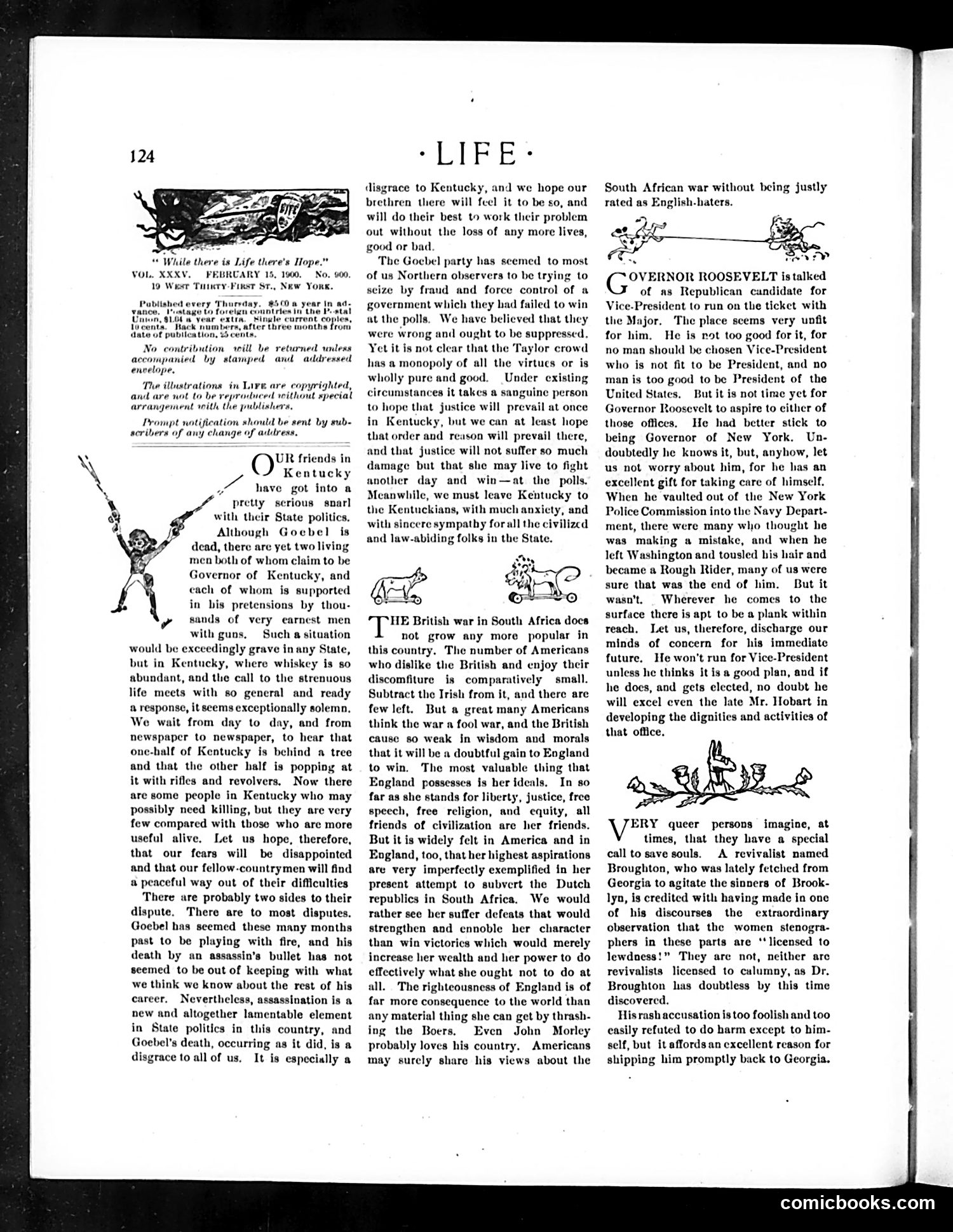
This page contains political commentary on early 1900s American politics and the Boer War. The text discusses Kentucky politics and Governor Goebel's assassination, expressing hope for justice and peaceful resolution. The right column critiques Governor Roosevelt's (later President Theodore Roosevelt's) selection as Republican Vice-Presidential candidate, arguing he's unsuitable for high office and should stick to his current role as New York Police Commissioner. The writer suggests Roosevelt is impulsive and makes poor decisions. The final section dismisses as absurd claims that women stenographers in these offices are "licensed to calmness," sarcastically suggesting Dr. Broughton's accusations against them are foolish. The small illustrations appear decorative rather than specifically satirical, depicting period-appropriate scenes.
📄 Transcribed text from this page (OCR, searchable)
Machine-transcribed from the original scan — historical spelling and the odd misread are preserved.
FEBRUARY 15, 1900, at Tuiery-Finst St., New Yous. ry Thurvday. 8500 a year in ad- W countries in the P.-stal at copies, paths from Publish: vance. Un date of publleatt No contribution will be returned unless accompanied by stamped and addressed envelope. The illustrations in Live are copyrighted, an are not to be reproduced without special arrangement with the publishers, Prompt notification should be sent by sub- scribers of any change of auibress, UR friends in ZY Kentucky 3; have got into a pretty serious snarl with their State politics. Although Goebel is dead, there are yet two living men both of whom claim to be Governor of Kentucky, and cach of whom is supported in bis pretensions by thou- sands of very earnest men with guns, Such a situation would be exceedingly grave in any State, but in Kentucky, where whiskey is so abundant, and the call to the strenuous life meets with so general and ready a response, it seems exceptionally solemn, We wait from day to day, and from newspaper to newspaper, to hear that one-half of Kentucky is behind a tree and that the other half is popping at it with rifles and revolvers, Now there are some people in Kentucky who may possibly need killing, but they are very few compared with those who are more useful alive, Let us hope, therefore, that our fears will be disappointed and that our fellow-countrymen will find a peaceful way out of their difficulties There are probably two sides to their dispute. There are to most disputes. Goebel has seemed these many months past to be playing with fire, and his death by an assassin’s bullet has not seemed to be out of keeping with what we think we know about the rest of his career. Nevertheless, assassination is a new and altogether lamentable element in State politics in this country, and Goebel’s death, occurring as it did, is a disgrace to all of us, It is especially a * LIFE * disgrace to Kentucky, and we hope our brethren there will feel it to be so, and will do their best to work their problem out without the loss of any more lives, good or bad The Goebel party has seemed to most of us Northern observers to be trying to seize by fraud and force control of a government which they had failed to win at the polls. We have believed that they were wrong and ought to be suppressed, Yet it is not clear that the Taylor crowd has a monopoly of all the virtues or is wholly pure and good. Under existing circumstances it takes a sanguine person to hope that justice will prevail at once in Kentucky, but we can at least hope that order and reason will prevail there, and that justice will not suffer so much damage but that she may live to fight another day and win—at the polls. Mcanwhile, we must leave Kentucky to the Kentuckians, with much anxicty, and with sincere sympathy forall the civilized and law-abiding folks in the State. sfeny ¥ SO HE British war in South Africa docs not grow any more popular in this country, The number of Americans who dislike the British and enjoy their discomfiture is comparatively small. Subtract the Irish from it, and there are few left. But a great many Americans think the war a fool war, and the British cause so weak in wisdom and morals that it will be a doubtful gain to England to win. The most valuable thing that England possesses is her ideals, In so far as she stands for liberty, justice, free speech, free religion, and equity, all friends of civilization are her friends. But it is widely felt in America and in England, too, that her highest aspirations are very imperfectly exemplified in her present attempt to subvert the Dutch republics in South Africa. We would rather see her suffer defeats that would strengthen and ennoble her character than win victorics which would merely increase her wealth and her power to do effectively what she ought not to do at all. The righteousness of England is of far more consequence to the world than any material thing she can get by thrash. ing the Boers, Even John Morley probably loves his country, Americans may surely share his views about the South African war without being justly rated as English-haters. Taw OVERNOR ROOSEVELT is talked of as Republican candidate for Vice-President to run on the ticket with the Major. The place scems very unfit for him. He is not too good for it, for no man should be chosen Vice-President who is not fit to be President, and no man is too good to be President of the United States, But it is not time yet for Governor Roosevelt to aspire to cither of those offices, He had better stick to being Governor of New York. Un- doubtedly he knows it, but, anyhow, let us not worry about him, for he has an excellent gift for taking care of himself. When he vaulted out of the New York Police Commission into the Navy Depart- ment, there were many who thought he was making a mistake, and when he left Washington and tousled his hair and became a Rough Rider, many of us were sure that was the end of him. But it wasn't. Wherever he comes to the surface there is apt to be a plank within reach. Let us, therefore, discharge our minds of concern for his immediate future. He won't run for Vice-President unless he thinks it is a good plan, and if he does, and gets elected, no doubt he will excel even the late Mr. Hobart in developing the dignities and activities of that office, ERY queer persons imagine, at times, that they have a special call to save souls. A revivalist named Broughton, who was lately fetched from Georgia to agitate the sinners of Brook- lyn, is credited with having made ia one of his discourses the extraordinary observation that the women stenogra- phers in these parts are ‘licensed to lewdness!” They are not, neither are revivalists licensed to calumny, as Dr. Broughton has doubtless by this time discovered. His rash accusation is too foolish and too easily refuted to do harm except to him- self, but it affordsan excellent reason for shipping him promptly back to Georgia. comicbooks.com