
Life, 1900-02-15 · page 7 of 20
Life — February 15, 1900 — page 7: what you’re looking at
What you’re looking at
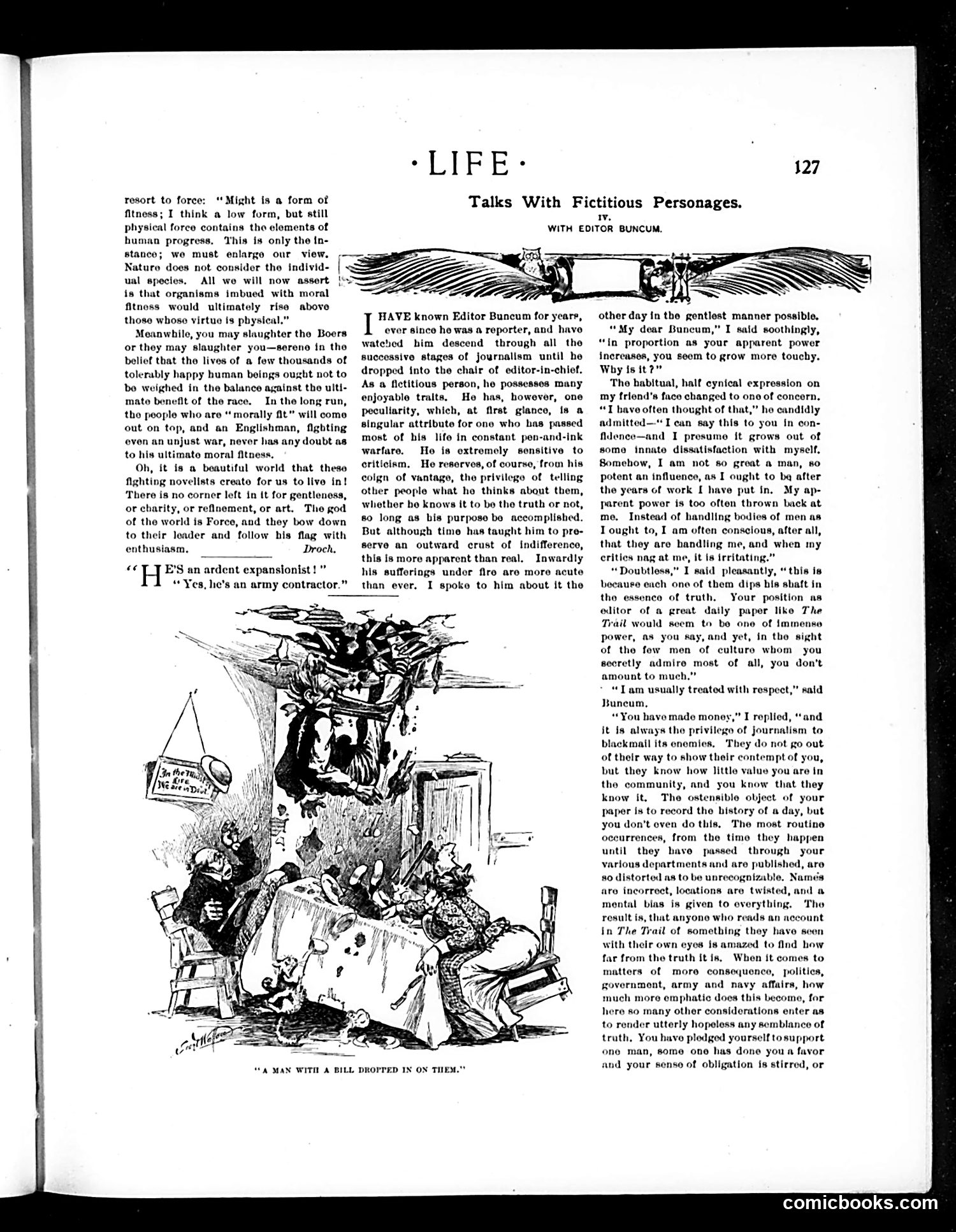
This satirical piece critiques **Editor Buncum** (a fictional character representing editors generally) through a dialogue about journalistic ethics. The accompanying cartoon shows a grotesque figure laden with bills and papers—literally embodying corruption and financial entanglement ("A Man With a Bill Bropped in on Them"). The text attacks editors for distorting facts to serve political or personal interests, sensationalizing news, and blackmailing opponents. The satire argues that editors misreport events, twist names and locations, and inject bias into coverage—all while claiming to record history objectively. The winged figure at the page's top suggests aspirational pretense undermined by the messy reality depicted below, mocking editors' claims to integrity while engaging in corrupt practices.
📄 Transcribed text from this page (OCR, searchable)
Machine-transcribed from the original scan — historical spelling and the odd misread are preserved.
resort to force: “Might is a form of fitness; I think a low form, but still physical force contains the elements of human progress. This is only the In- stanco; wo must enlargo our view. ; Nature does not consider the individ- | ual species, All wo will now assert | is that organisms imbued with moral fitnoss would ultimately rise above those whoso virtue 1s physical.” Meanwhile, you may slaughter the Boors or they may slaughter you—sereno in the belief that the lives of a few thousands of tolerably happy human beings ought not to bo weighed in tho balance against tho ult!- mato benefit of the race. In the long run, tho people who aro “morally ft” will como out on top, and an Englishman, fighting oven an unjust war, never has any doubt as to his ultimato moral fitness. Oh, it is a beautiful world that theso fighting novelists create for us to live in! ‘Thero is no corner left in It for gentleness, or cbarity, or reflnement, or art, Tho god of the world is Force, and they bow down to their leader and follow his flag with enthusiasm, Droch, ¢€ LJ E'S an ardent expansionist!" “Yes, he's an army contracto + LIFE * Talks With Fictitious Personages. Iv. WITH EDITOR BUNCUM. HAVE known Editor Buncum for yeare, ever since ho was a reporter, and havo watched him descend through all tho successive stages of journalism until he dropped into the chair of editor-in-chief. As a fictitious person, ho possesses many enjoyable traits, He has, however, one peculiarity, which, at firet glanco, {6 a singular attribute for ono who has passed most of his life in constant pon-and-ink warfare, Ho is extremely sensitive to criticism. He resorves, of course, from his colgn of vantage, the privilege of telling other people what ho thinks about them, whether be knows it to be the truth or not, 80 long as bis purpose bo accomplished. But although time has taught him to pre- serve an outward crust of indifferenco, this Is more apparent than real. Inwardly his sufferings under flro aro more acute than ever. I spoko to him about it the other day in tho gentlest manner possible. “My dear Buncum,” I said soothingly, “in proportion as your apparent power increases, you seem to grow more touchy. Why fs it?” ‘Tho habitual, halt cynical expression on my friend's faco changed to ono of concern, “I bave often thought of that,” ho candidly admitted— I can say this to you in con- fldence—and I presume it grows out of some innate dissatisfaction with myself, Bomehow, I am not 80 great a man, 80 potent an influence, as I ought to be after the years of work [ have put in. My ap- parent powor is too often thrown back at me. Instead of handling bodies of men as Tought to, I am often conscious, after all, that they are bandling me, and when my critics nag at me, it Is irritating.” “Doubtless,” I said pleasantly, “this is Decaure each one of them dips bis sbaft in tho essence of truth. Your position as oditor of a great daily paper like The Trail would seem to be one of immense rm as you say, and yet, in tho sight of the few men of culturo whom you secretly admire most of all, you don’t amount to much.” “Tam usually treated with respect,” sald Buneum, “You havo made money," I replied, “and it is always the privilego of journalism to blackmail its enemies, They do not go out of their way to show their contempt of you, but they know how little value you are in the community, and you know that they know it, The ostensible object of your paper is to record the history of a day, but you don’t oven do this, The most routine occurrences, from the timo they happen until they have passed through your various departments and aro published, aro so distorted as to be unrecognizable. Names are incorrect, locations are twisted, and a mental bias is given to everything, Tho result is, that anyono who reads an account in The Trail of something they have seen with their own eyos is amazed to find how far from the truth it is, When it comes to matters of more consequence, politics, governmont, army and navy affairs, how much more emphatic does this become, for here 80 many other considerations enter as to render utterly hopeless any semblance of truth, You havo pledged yourself tosupport one man, some one has done you a favor and your senso of obligation is stirred, or ‘A MAN WITIL A BILL DROPPED IN ON THES." comicbooks.com