
Life, 1900-02-15 · page 6 of 20
Life — February 15, 1900 — page 6: what you’re looking at
What you’re looking at
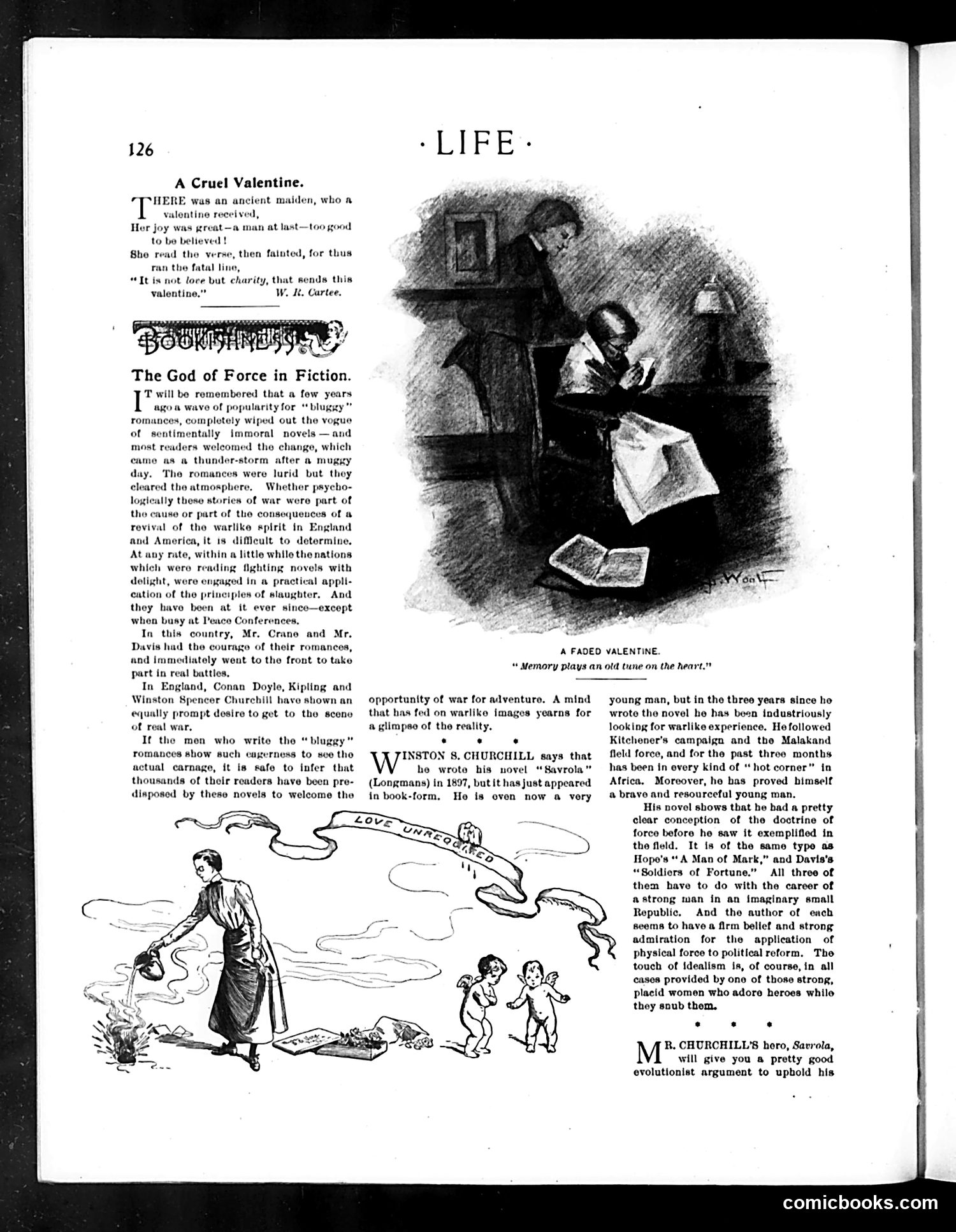
This page contains two distinct sections: **"A Cruel Valentine"** — A brief poem criticizing a Valentine's Day declaration that proved false, with the moral that true charity matters more than romantic gestures. **"The God of Force in Fiction"** — A literary critique discussing how "bluffy" adventure novels (featuring war and fighting) became popular in England and America. The article argues that writers like Conan Doyle, Kipling, Churchill, and others promoted narratives celebrating physical force and heroic combat, potentially influencing public enthusiasm for warfare. It specifically mentions Churchill's novel *Savrola* (1897) as an example of fiction glorifying forceful action and idealism applied to political reform. The accompanying illustration labeled **"A Faded Valentine"** shows a sentimental figure amid cherubs, likely satirizing romantic idealism—matching the opening poem's theme about hollow sentiments.
📄 Transcribed text from this page (OCR, searchable)
Machine-transcribed from the original scan — historical spelling and the odd misread are preserved.
126 A Cruel Valentine. CHERE was an ancient maides Hor joy was great— to be believed Bho read the verse, then fainted, for thus ran the fatal line, “It is not loce but charity, that sends this valentine.” Ht. Cartee, ved, man at last—too good The God of Force in Fiction. T will be remembered that a fow years ago a wave of popularityfor “ bluggy” romances, completely wiped out the vogue of sentimentally immoral novels — and most readers welcomed the change, which came as a thunder-storm after a muggy day. Tho romances were lurid but thoy cleared the atmosphere, Whether paycho- logically these stories of war were part of tho cause or part of the consequences of a revival of tho warlike spirit in England and America, it 18 diMcult to determine, At any rate, within a little while the nations which wero reading fighting novels with dolight, wore engaged in a practical appli- cution of tho principles of slaughter, And they havo been at it ever since—except when busy at Peace Conferences, In this country, Mr, Crane and Mr, Davis had the courago of their romances, and immediately went to the front to take part in real battles, In England, Conan Doyle, Kipling and Winston Spencer Churchill have shown an equally prompt desire to get to the scene of real war, If the men who write the “bluggy” romances show such eagerness to see tho actual carnage, it is safe to infer that thousands of their readers have been pre- disposed by these novels to welcome the A FADED VALENTINE. “ Memory plays an old tune on the heart." opportunity of war for adventuro. A mind that has fed on warlike images yearns for ‘a glimpso of the reality, . . . INSTON 8. CHURCHILL says that he wrote bis novel ‘Savrola” (Longmans) in 1897, but it has just appeared in book-form, Ho is oven now a vory young man, but in the three years since ho wrote tho novel he has been industriously looking for warlike experience, He followed Kitchener's campaign and tho Malakand fleld force, and for the past three months has been in overy kind of “hot corner” in Africa. Moreover, he bas proved bimself a brave and resourceful young man. His novel shows that he bad a pretty clear conception of the doctrine of force before he saw it exemplified in the fleld. It is of the same type as Hopo's A Man of Mark,” and Davis's “Soldiers of Fortune.” All three of them have to do with the career of astrong man in an imaginary small Republic, And the author of each seems to have a firm bellef and strong admiration for the application of physical force to political reform. The touch of Idealism is, of course, in all cases provided by ono of those strong, placid women who adore heroes whilo they snub them, . * . M R. CHURCHILL'S hero, Savrola, will give you @ pretty good evolutionist argument to upbold his comicbooks.com