
A complete issue · 20 pages · 1900
Life — February 1, 1900
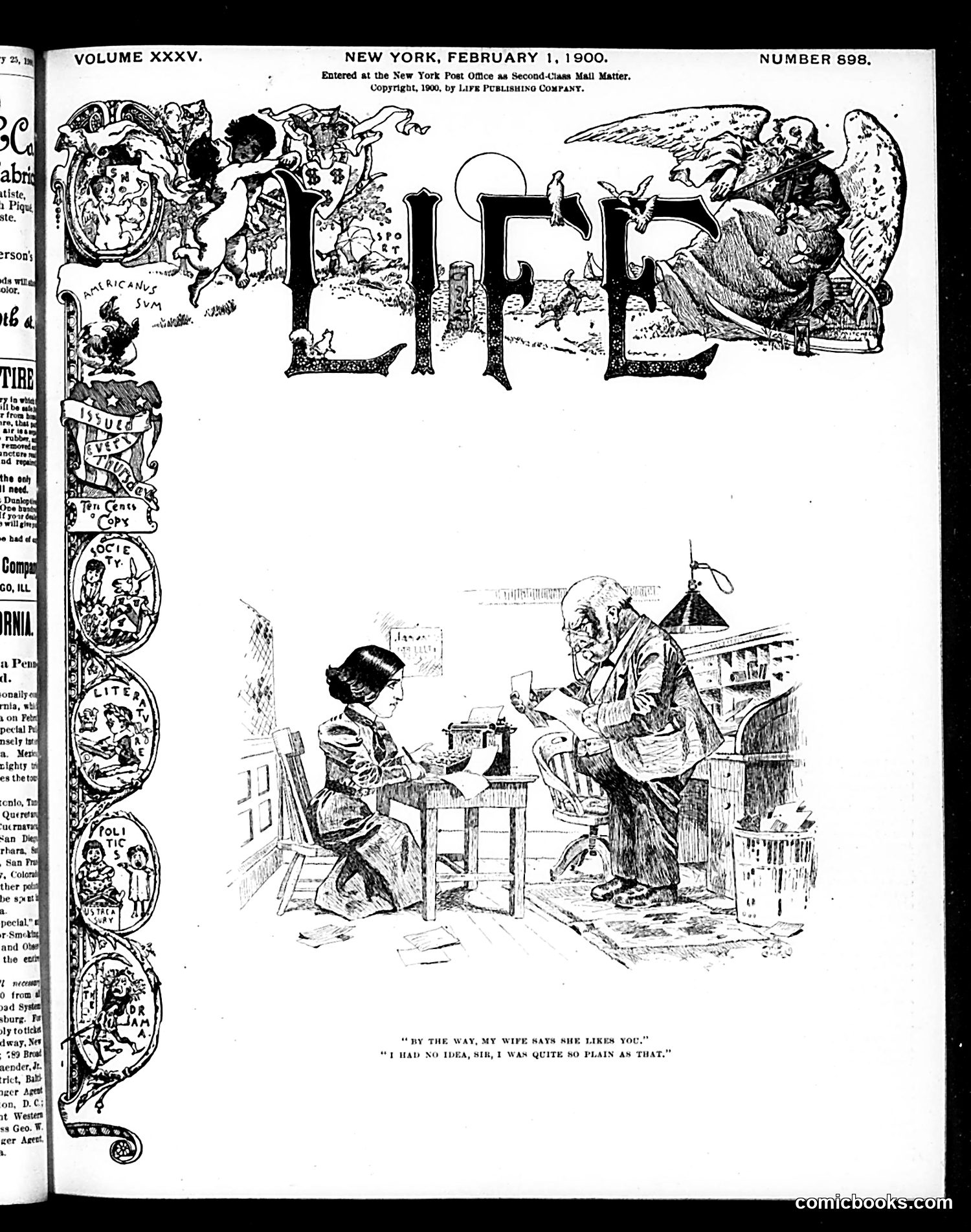
**The Main Cartoon:** The ornate header spells "LIFE" with elaborate decorative illustrations featuring cherubs, mythological figures, and allegorical scenes—typical of the magazine's ornate Victorian design aesthetic. **The Bottom Illustration:** This depicts a domestic scene with a man showing a woman what appears to be a document or letter. The caption reads: "BY THE WAY, MY WIFE SAYS SHE LIKES YOU." / "I HAD NO IDEA, SIR; I WAS QUITE SO PLAIN AS THAT." This is a genteel Victorian joke about social awkwardness—apparently a veiled compliment or misunderstanding between a man and his wife regarding another person's appearance or acceptability. The humor relies on the gentleman's self-deprecating or confused response to being complimented.
This page is primarily **advertising content** with no political cartoons or satire. The left column advertises **Arrow Brand Velsor collars** (2 for 25¢) by Cluett, Peabody & Co., makers. Below is a notice requesting subscribers to give one week's advance notice of address changes. The center features large advertisements for **insurance companies**: the Travelers of Hartford, Connecticut (offering life endowment and accident insurance) and the Bank of New Amsterdam in New York. The right side advertises **Pears' soap** (emphasizing gentle skin care) and **Arnold Constable & Co.** (laces and embroideries in New York). Bottom sections promote **Pennsylvania Railroad tours** to Mexico, California, and through California itself—popular leisure destinations for affluent readers of this era. This is a typical early 20th-century magazine page mixing editorial content with commercial advertisements.
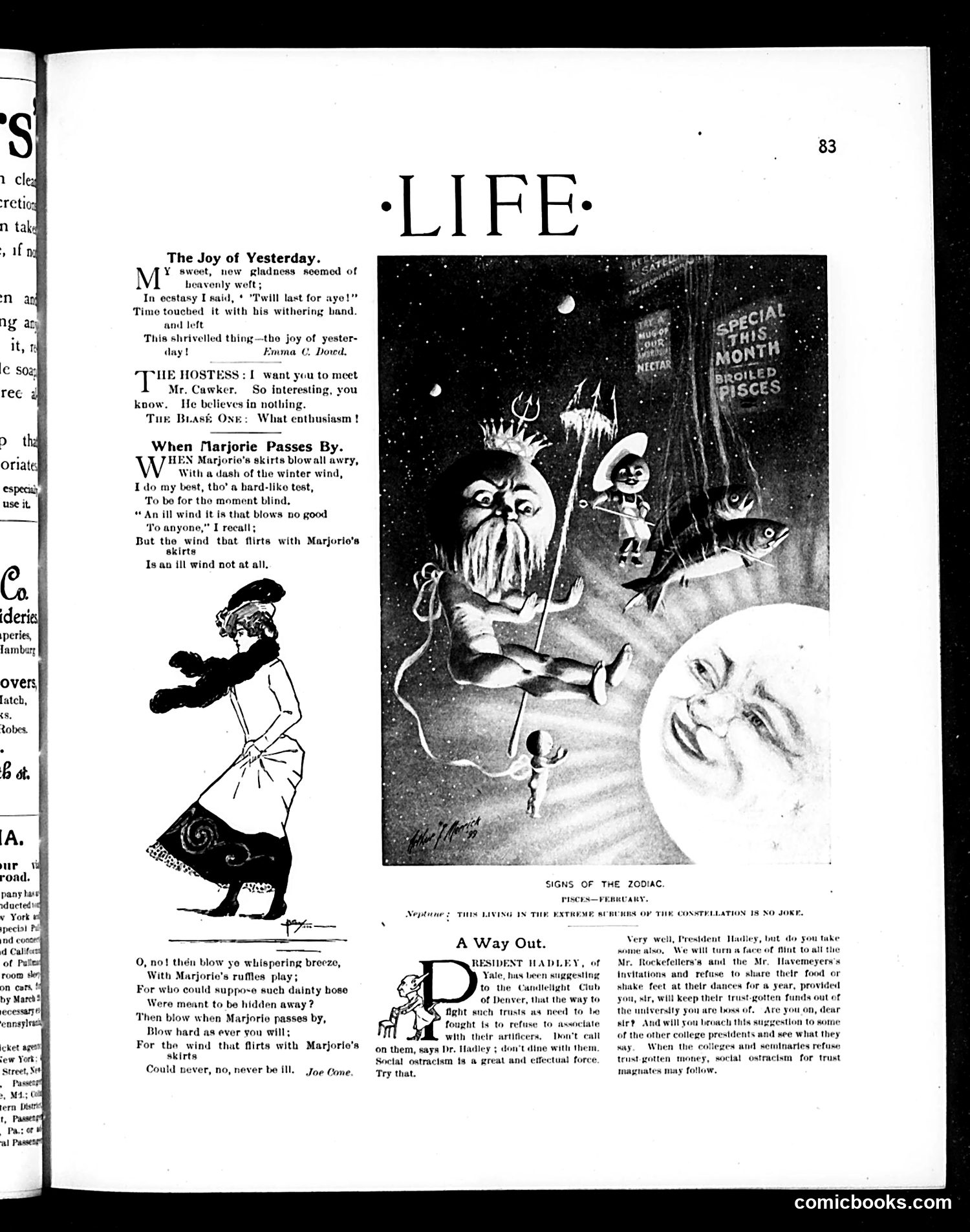
This page contains three satirical pieces typical of early 20th-century Life magazine: 1. **"The Joy of Yesterday"** and **"When Marjorie Passes By"** are humorous poems about nostalgia and attraction, accompanied by whimsical illustrations of a woman in fashionable dress. 2. **"Signs of the Zodiac"** (center image) shows zodiacal figures with a woman's face, captioned "Pisces—February," satirizing astrology's popular appeal during this period. 3. **"A Way Out"** features a dialogue between President Hadley and others discussing the Latch Club and social stratification. The satire targets wealthy institutions' exclusionary practices and suggests that social reform requires fundamental changes to trust and financial structures rather than superficial gestures. The overall tone mocks contemporary social pretensions and class divisions.
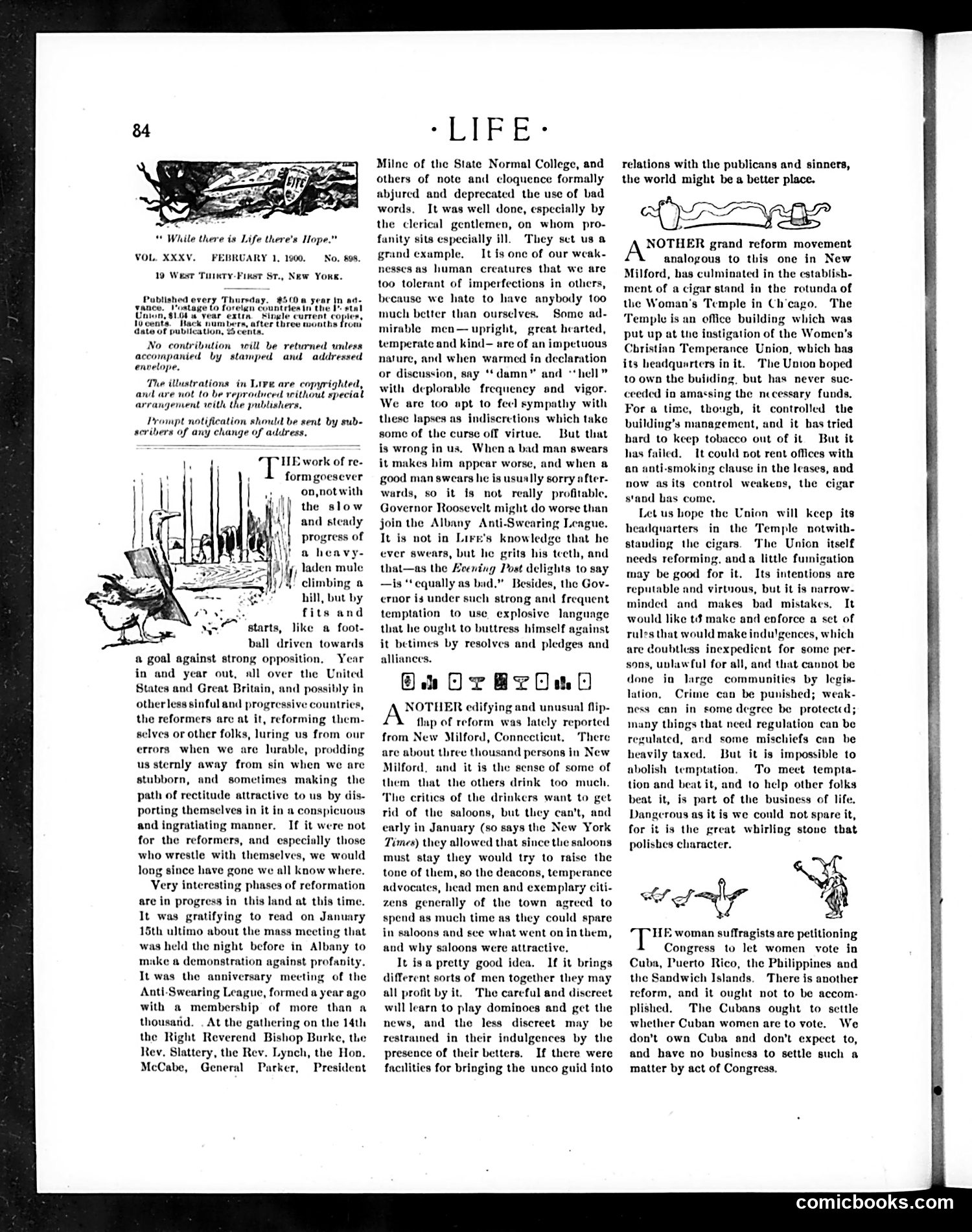
This page contains two editorial cartoons about reform movements of the era. The **first cartoon** (top left) depicts a figure climbing upward labeled as representing reformers' "progress." The text criticizes reform efforts as inconsistent and self-righteous—reformers attack others' moral failings while ignoring their own. The cartoon suggests their efforts resemble "a foot-ball driven towards a goal against opposing opposition" that goes "in and year out" across America. The **second cartoon** (bottom) appears to reference the **Anti-Swearing League** and **temperance advocates** in New Milford, Connecticut. The text mocks their hypocrisy: these "reformers" try eliminating saloons and bad language while themselves engaging in questionable behavior. Life satirizes their self-righteous crusades as ineffective and morally inconsistent. Both cartoons target early-20th-century reform movements as naive and hypocritical.
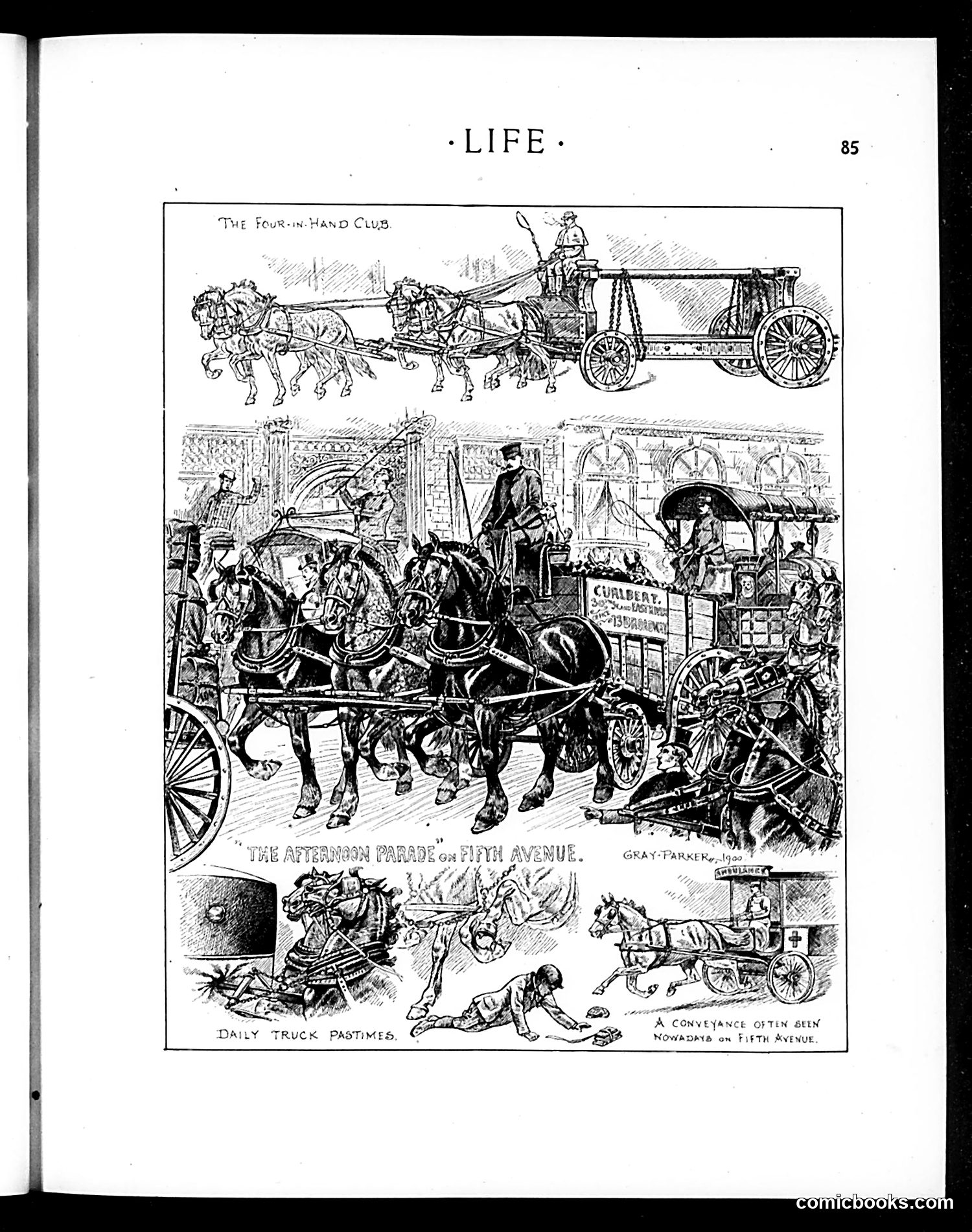
This page satirizes turn-of-the-century New York City traffic and street life. The four panels depict: 1. **"The Four-in-Hand Club"** - An elaborate horse-drawn carriage procession, likely mocking wealthy New Yorkers' ostentatious displays of fancy carriages and horses. 2. **"The Afternoon Parade on Fifth Avenue"** - A crowded street scene showing competing horse-drawn vehicles, including a commercial "Curlbeat" wagon, illustrating Fifth Avenue's congestion and chaos. 3. **"Daily Truck Pastimes"** - Shows horses and delivery vehicles in street traffic. 4. **"A Conveyance of Ten Men Nowadays on Fifth Avenue"** - Depicts street life and commerce. The satire targets New York's traffic congestion and the clash between wealthy carriage culture and working-class commercial transport on Fifth Avenue—a growing urban problem of the era.
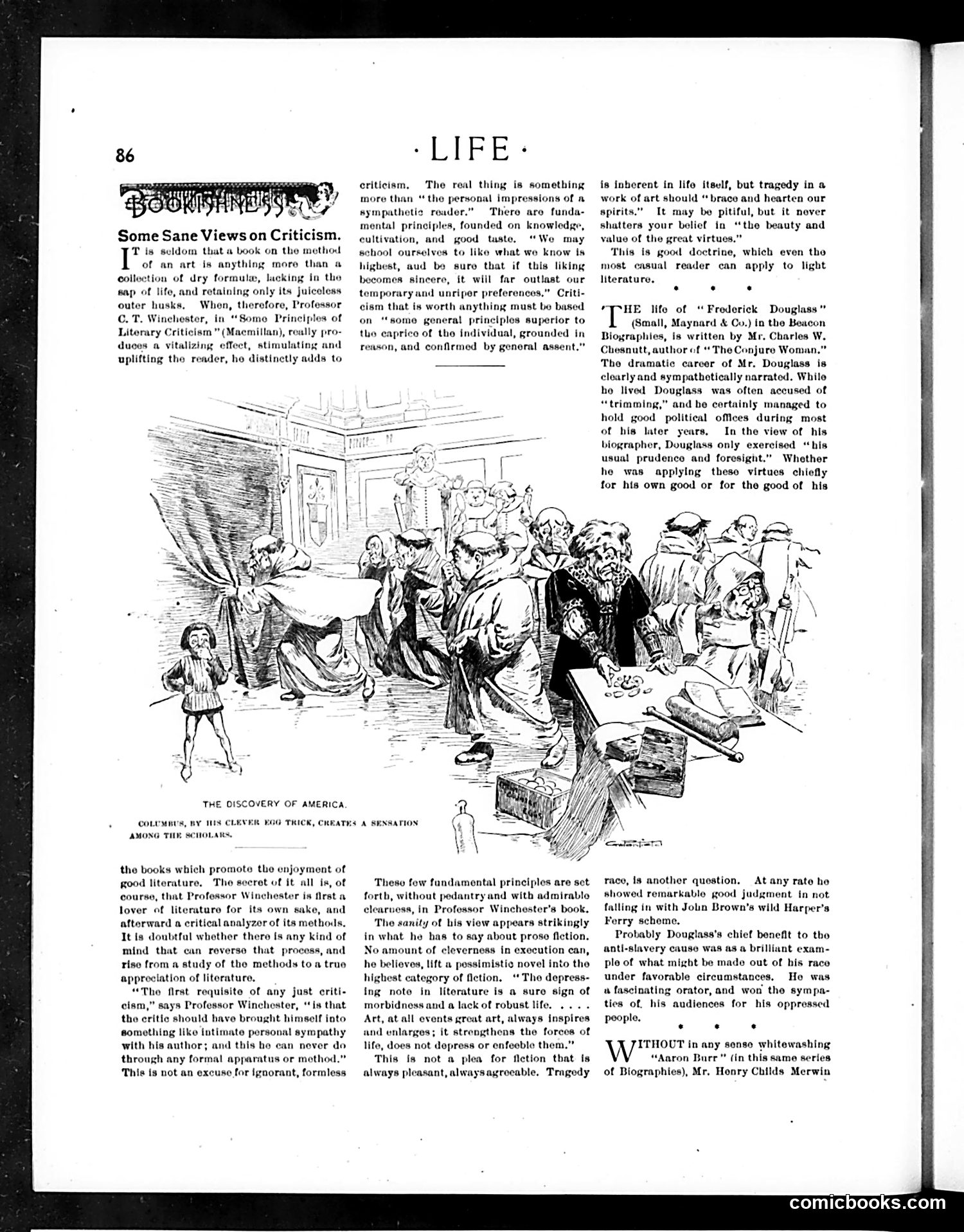
This satirical illustration mocks academic pretension and scholarly one-upmanship. The caption reads: "Columbus, by his clever egg trick, creates a sensation among the scholars." The cartoon references the famous legend of Columbus making an egg stand on end by tapping it flat—a trick supposedly demonstrating practical ingenuity over theoretical knowledge. Here, Life uses it to satirize scholars and academics who are easily impressed by simple tricks or clever rhetoric disguised as genuine discovery or insight. The gathering of well-dressed figures represents the intellectual establishment, depicted as gullible and susceptible to showmanship. The satire targets how academia can be swayed by presentation and cleverness rather than substantive merit—a criticism of both scholarly pomposity and the ease with which intellectuals accept superficial novelty as genuine achievement.
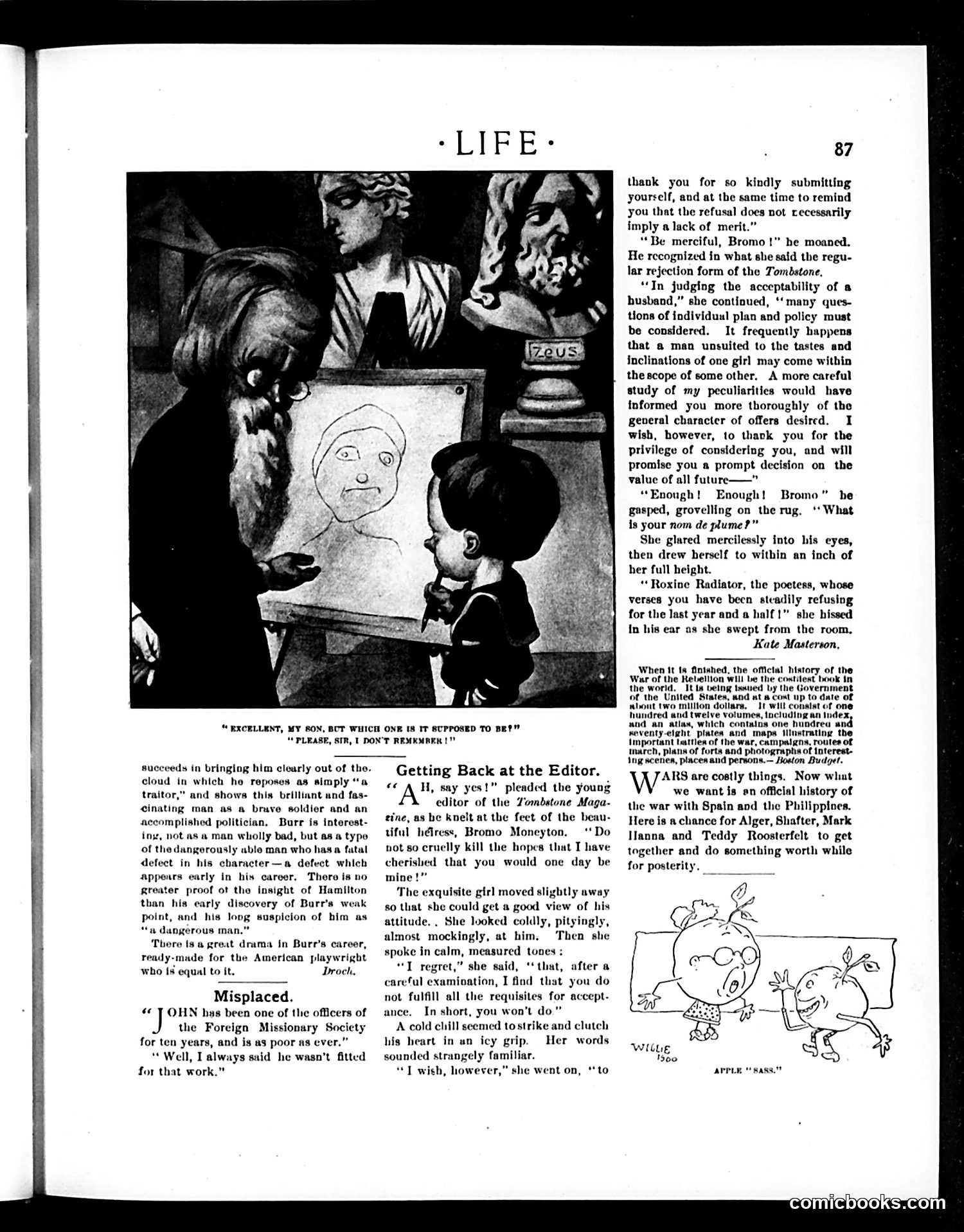
The main illustration depicts a scene of artistic judgment: a woman (labeled "Rosie Radiator") presents a crude portrait to what appears to be an editor or critic. The accompanying text, titled "Getting Back at the Editor," is a satirical story about a young editor of the *Tombstone Magazine* rejecting a woman's hopes while she attempts to win him over. Below this is a section titled "Misplaced," critiquing an officer named John in the Foreign Missionary Society who has served poorly for ten years despite claims otherwise. The small cartoon at bottom right shows children and is titled "Apple 'Sass'"—likely a pun about children's misbehavior. The page satirizes institutional inefficiency, romantic rejection, and editorial gatekeeping through humor and illustration.
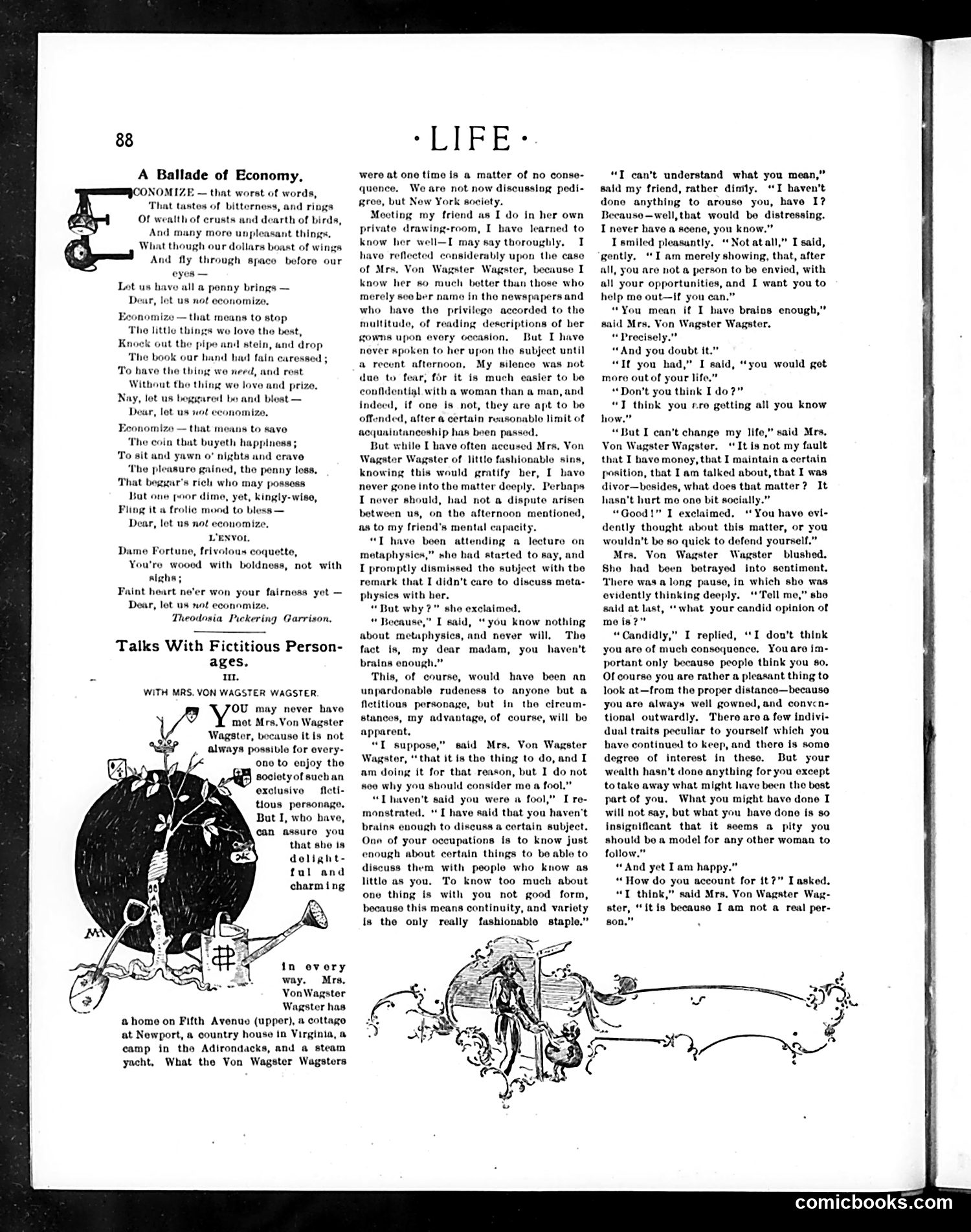
This page contains two main pieces: 1. **"A Ballade of Economy"**: A satirical poem mocking excessive frugality and penny-pinching, urging people to enjoy life's pleasures rather than obsess over saving money. 2. **"Talks With Fictitious Personages: With Mrs. Von Wagster Waggster" (Section III)**: A dialogue between the narrator and a wealthy society woman named Mrs. Von Wagster Waggster. The illustration shows her as a caricatured figure in an ornate setting. The conversation satirizes her pretensions, snobbish attitudes, and intellectual limitations—she's presented as shallow and vain despite her wealth and social status. The piece mocks upper-class women who prioritize fashion and social standing over substance and meaningful engagement with ideas. The overall theme addresses class, wealth, and social pretension in early 20th-century American society.
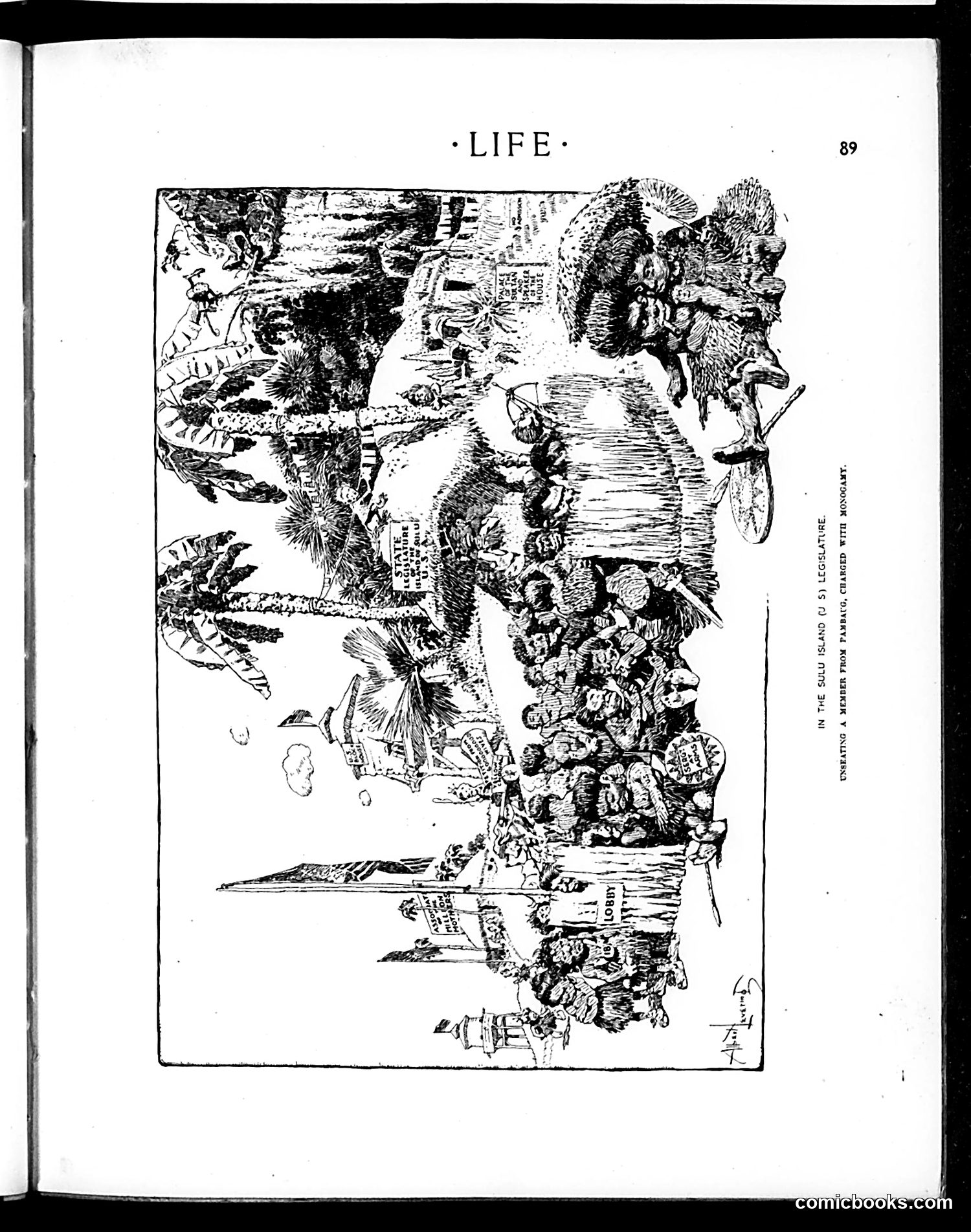
This page from *Life* magazine (page 89) contains a single detailed satirical illustration oriented sideways. The drawing depicts what appears to be a crowded scene with multiple figures and characters in a chaotic composition. While the image quality and orientation make precise identification difficult, the style is characteristic of early-to-mid 20th century political cartooning. The caption references "The Sulu Island" and mentions something "entered by stealth, carried by brains, cherished by ignorance"—suggesting commentary on colonial acquisition or political intrigue. However, without clearer text visibility or additional context, I cannot definitively identify the specific political figures, events, or satirical targets this cartoon addresses. The dense composition and caricatured style suggest social or political criticism typical of *Life*'s editorial cartooning.
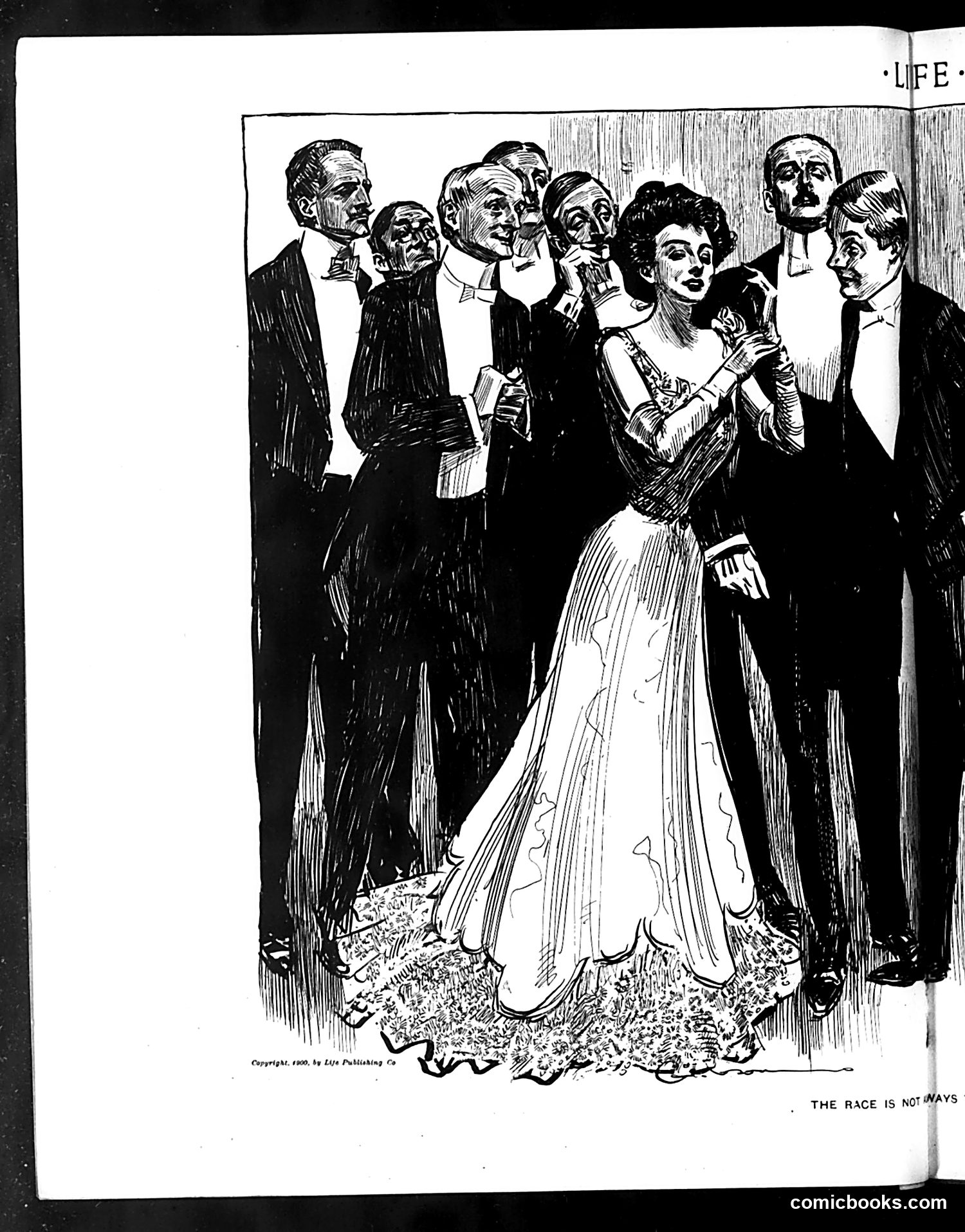
This is a satirical cartoon from *Life* magazine showing a formal evening social gathering. A woman in an elaborate white gown stands centrally surrounded by men in formal black-tie attire, all appearing to gaze at or admire her. The caption reads "THE RACE IS NOT ALWAYS..." The satire appears to comment on social competition and courtship dynamics among the upper classes. The incomplete caption suggests a play on the phrase "the race is not always to the swift"—here implying that in romantic or social pursuits, success isn't determined solely by speed or effort, but by other factors (likely appearance or status, given the woman's prominence and elegant dress). The cartoon mocks the superficiality of high-society social climbing and the competitive nature of finding advantageous romantic or matrimonial matches among the wealthy.
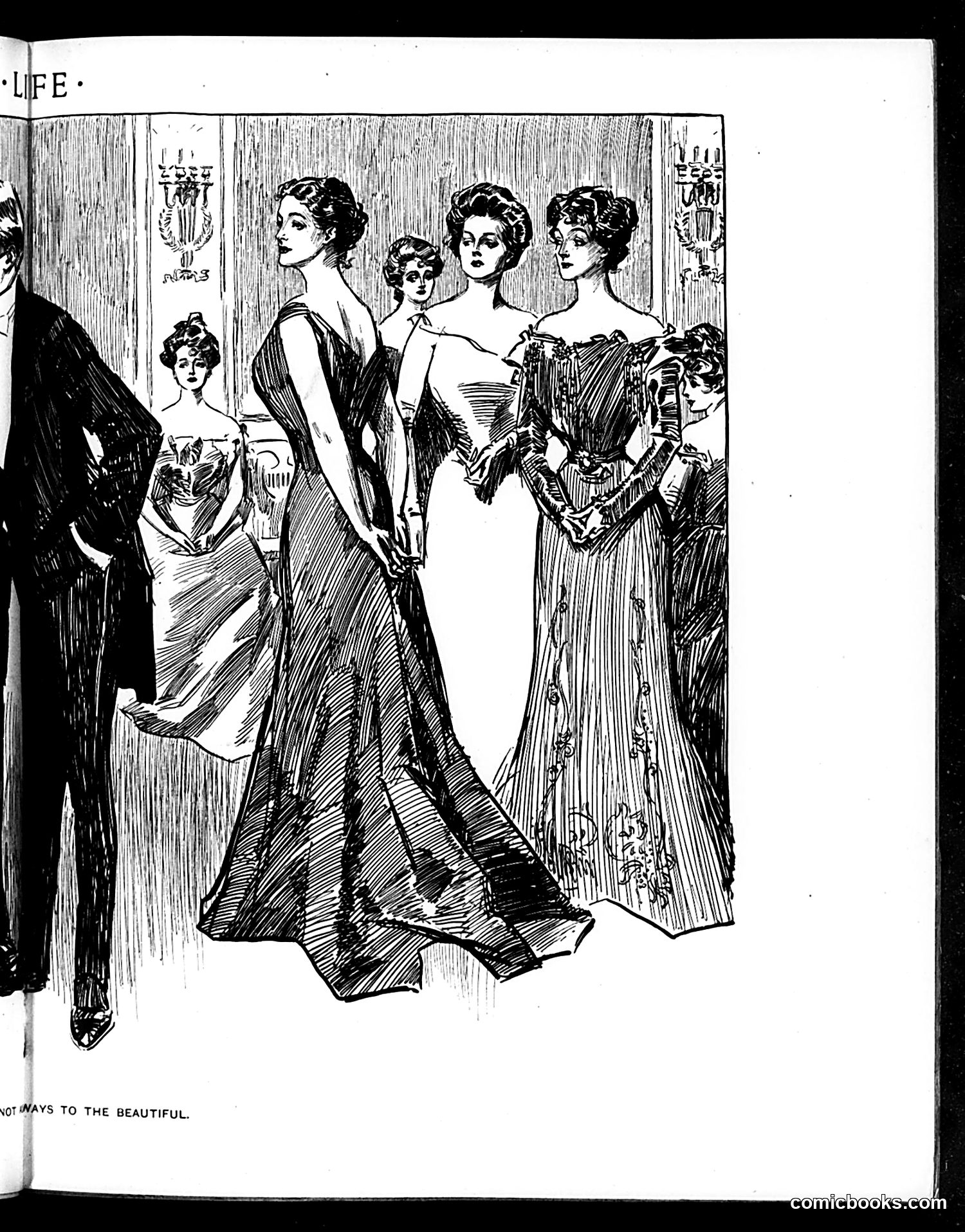
This page from *Life* magazine shows an illustration titled "NOT ALWAYS TO THE BEAUTIFUL" (visible at bottom). The image depicts an elegant social scene with well-dressed women in early 20th-century formal attire and at least one man in evening wear on the left. The caption suggests satirical commentary on beauty and social status—the phrase "not always to the beautiful" implies ironic commentary on how society values or rewards appearance. The formal setting and fashionable dress suggest this critiques elite social hierarchies or the superficiality of high society. Without additional text visible on the page, the specific satirical target remains unclear, though the composition suggests commentary on social pretension or the arbitrary nature of beauty standards in upper-class circles.
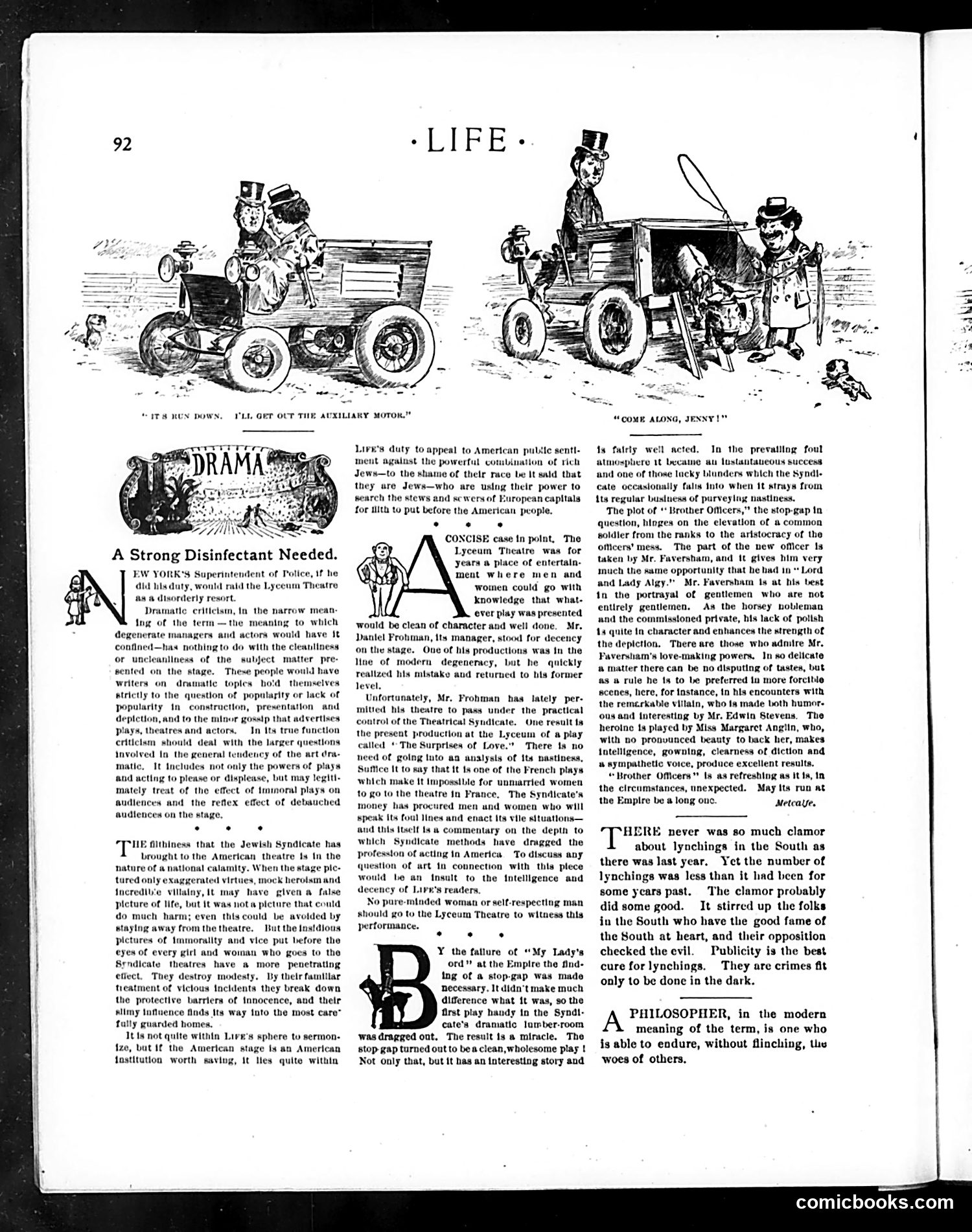
This page contains theatrical criticism and social commentary rather than political cartoons. The two illustrations at top show people with early automobiles, captioned "It's His Turn, I'll Get Out the Auxiliary Motor" and "Come Along, Jenny!" The main text critiques the Lyceum Theatre's management under David Frohman, arguing it has lost its former quality. The author advocates for stronger editorial oversight of theatrical productions, claiming current dramatic works lack substance. A secondary article discusses lynchings in the American South, arguing that publicity and public opposition—rather than darkness—provide the best deterrent to mob violence. This suggests lynching was a significant contemporary concern (appears to reference early 20th-century racial violence). The page reflects Progressive Era debates about theatrical standards and racial justice in America.
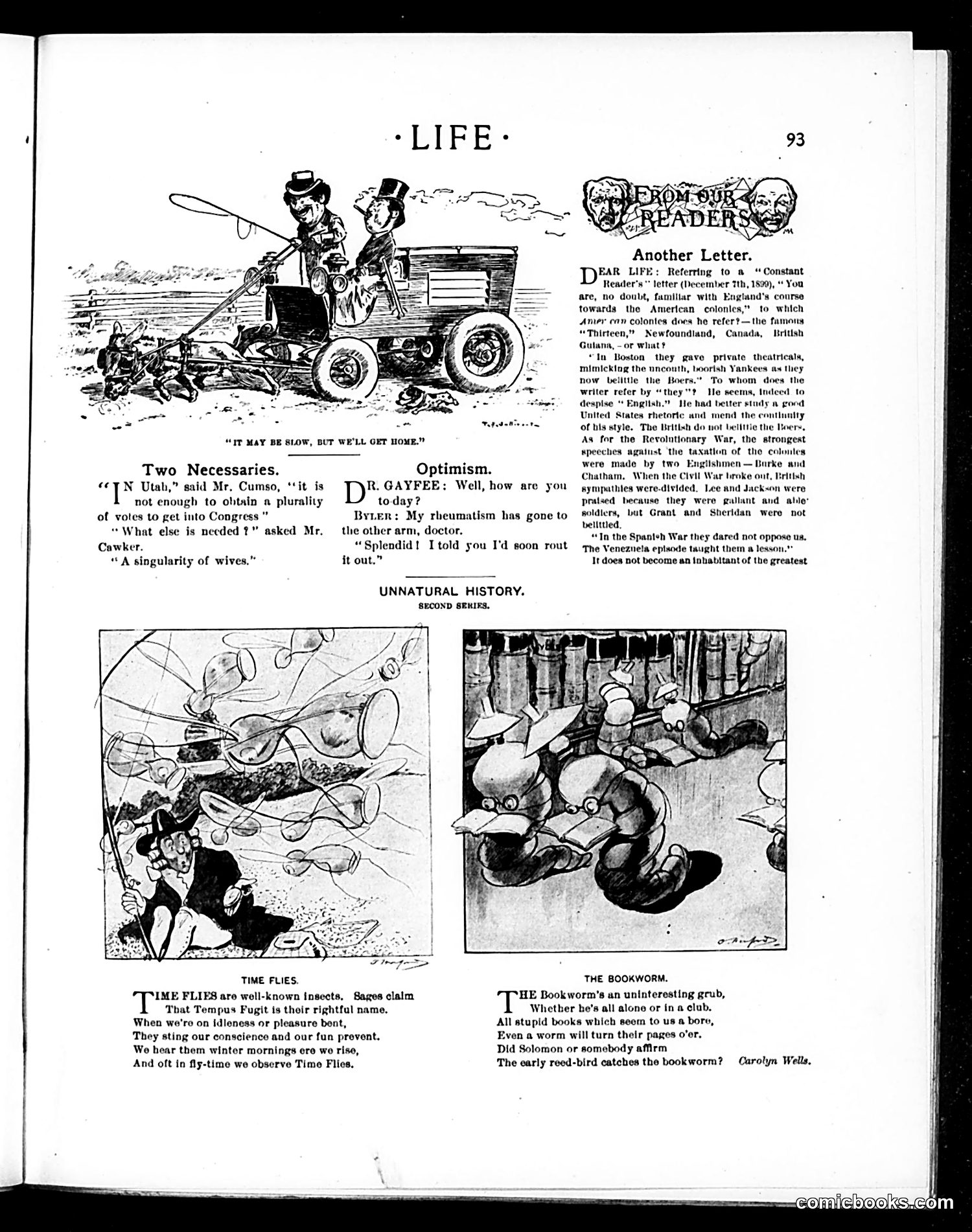
**"Two Necessaries"** satirizes polygamy in Utah. The joke plays on political terminology: obtaining a "plurality" of votes is standard for election, but Utah Territory's practice of polygamy requires a "singularity of wives"—a nonsensical phrase mocking the contradiction between democratic principles and the religious practice of polygamous marriage that scandalized 19th-century America. **The Doctor joke** is a simple pun: the doctor claimed he'd "rout out" the patient's rheumatism from one arm, and it merely migrated to the other—suggesting medical incompetence. **"Another Letter"** addresses reader correspondence critiquing previous articles about England's historical treatment of American colonies, the Boers, and Anglo-American relations. The magazine defends its earlier positions. **"Unnatural History,"** "Time Flies," and "The Bookworm"** are lighthearted illustrated humorous verses about insects and human nature—standard filler content for period magazines, unrelated to contemporary politics. The page reflects turn-of-the-century American anxieties about polygamy and Britain's imperial conduct.
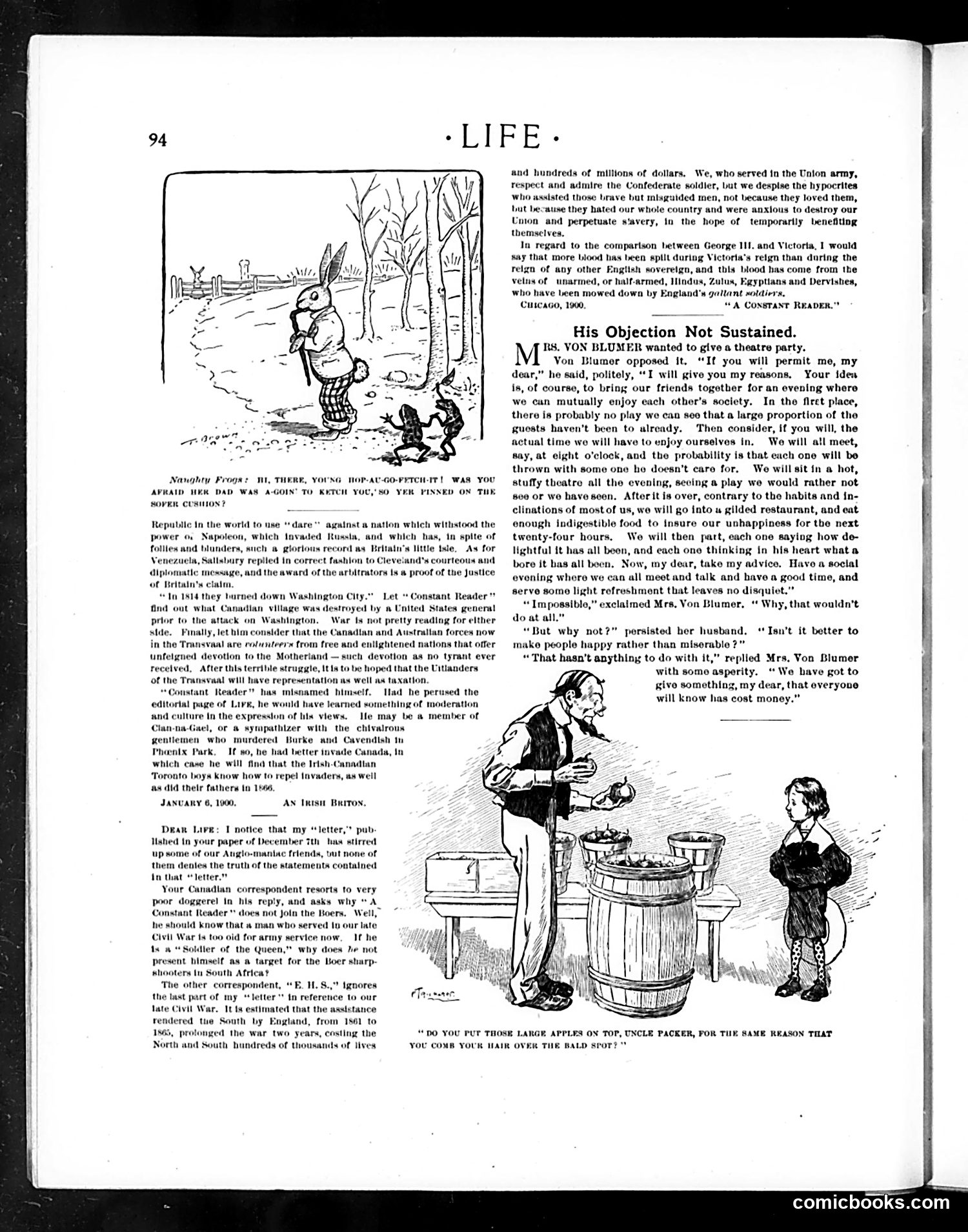
This page contains two distinct elements: **The Main Cartoon** (top and middle): "Naughty Frogs" depicts anthropomorphic frogs in conversation, likely a whimsical children's-style illustration with no apparent political meaning—just lighthearted animal humor typical of the era. **The Letters Section** (bottom half): Readers debate contemporary political issues, particularly British imperialism and the Boer War. A Union Army veteran ("A Constant Reader") criticizes Britain's support for the Confederacy during America's Civil War and condemns British military campaigns against indigenous peoples in India, Africa, and South Africa. He argues Queen Victoria's reign saw more bloodshed than King George III's. **The Theater Party Cartoon** (bottom right): Shows a man explaining to his wife why he opposes her theater party idea—a domestic satire about spousal disagreements and social pretense. The page reflects *Life*'s role as a satirical magazine addressing serious political controversies alongside lighter domestic humor.
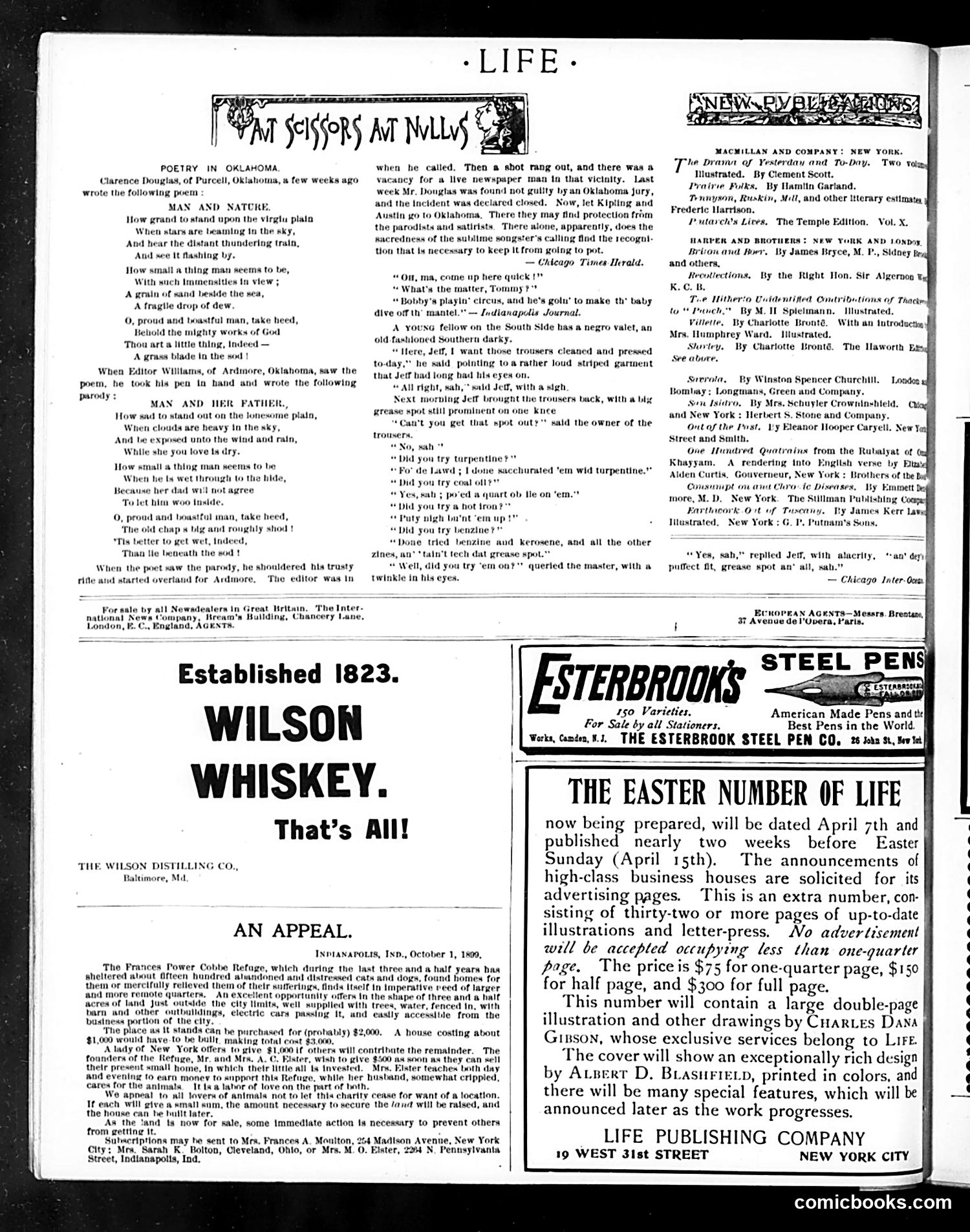
This page primarily contains **poetry and humorous anecdotes** rather than political cartoons. The main satirical content is a story about **Oklahoma poet Clarence Douglas**, who wrote a serious nature poem ("Man and Nature"). When newspaper editor Williams of Ardmore, Oklahoma published a mocking parody about a man getting soaked in the rain while his beloved stays dry, Douglas responded by shooting at Williams. Though acquitted, the incident satirizes the **sensitivity of poets to criticism**—the joke being that even obscure Oklahoma versifiers will resort to violence over ridicule. The piece mocks both Douglas's overreaction and implicitly critiques pretentious poetry. A second anecdote involves a **Southern Black servant (Jeff) and his white employer**, depicting stereotypical dialect humor about removing a grease stain. The punchline relies on racial stereotypes common to 1890s publications. The page is primarily filled with **book advertisements** and publishing announcements, including Wilson Whiskey and Esterbrook Steel Pens.
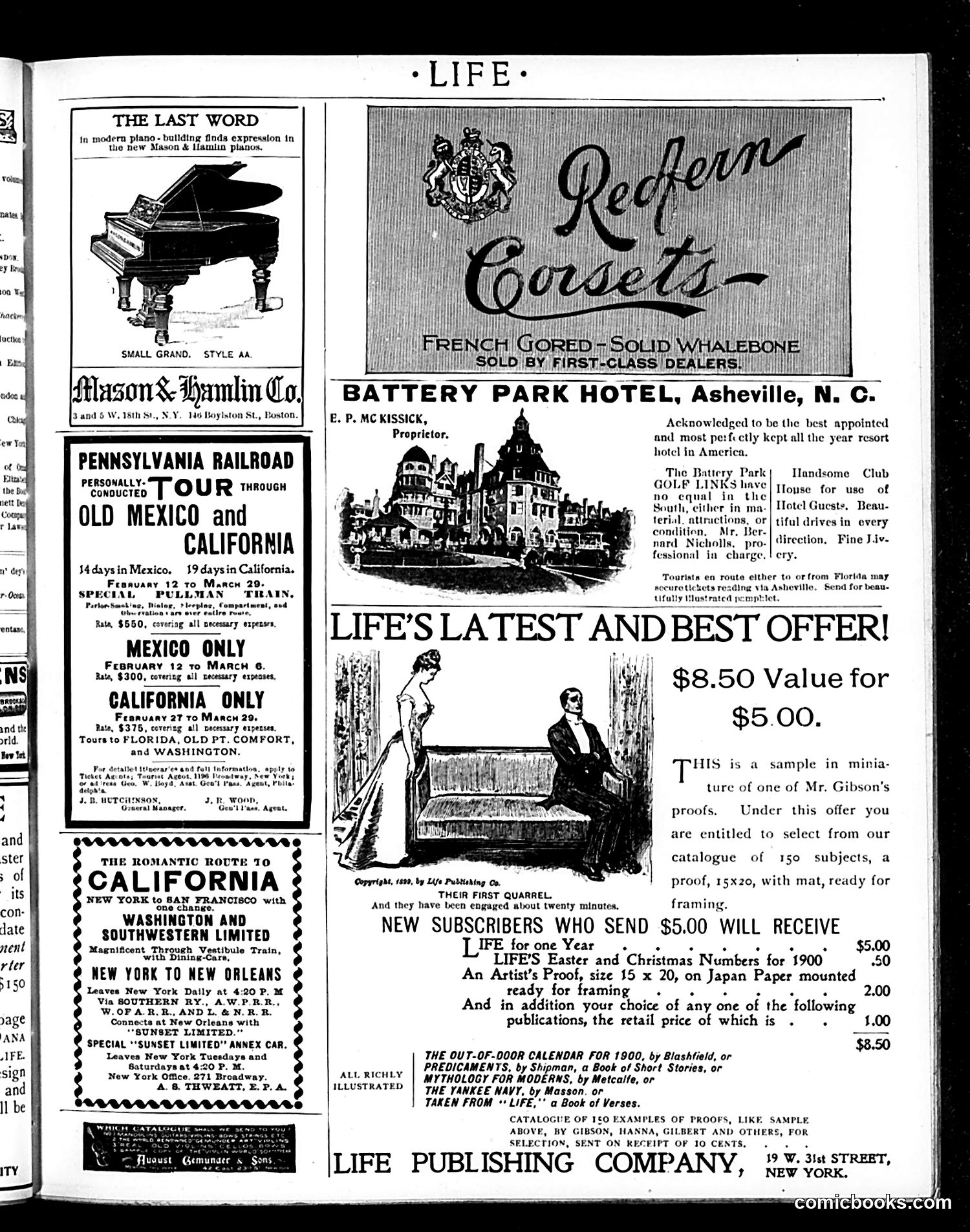
This page is primarily **advertising and subscription promotions**—not satirical political cartoons, despite Life's reputation for satire. The main content is: 1. **A small Gibson illustration** ("Their First Quarrel") showing an engaged couple, with the caption noting they've been "engaged about twenty minutes." This is a light domestic humor sketch typical of early-1900s magazines—the joke being the quick onset of romantic conflict in a new engagement. 2. **A major subscription offer** promoting Life magazine itself. For $5.00, new subscribers receive one year of Life, Easter and Christmas numbers, and a choice of bonus items (calendars, art proofs, books of verses or stories). 3. **Travel and product advertisements** for railroads, hotels, pianos, and corsets filling the remaining space. The page reflects turn-of-the-century magazine publishing: advertising and self-promotion dominate, with light humor supporting the commercial messaging rather than providing social or political commentary.
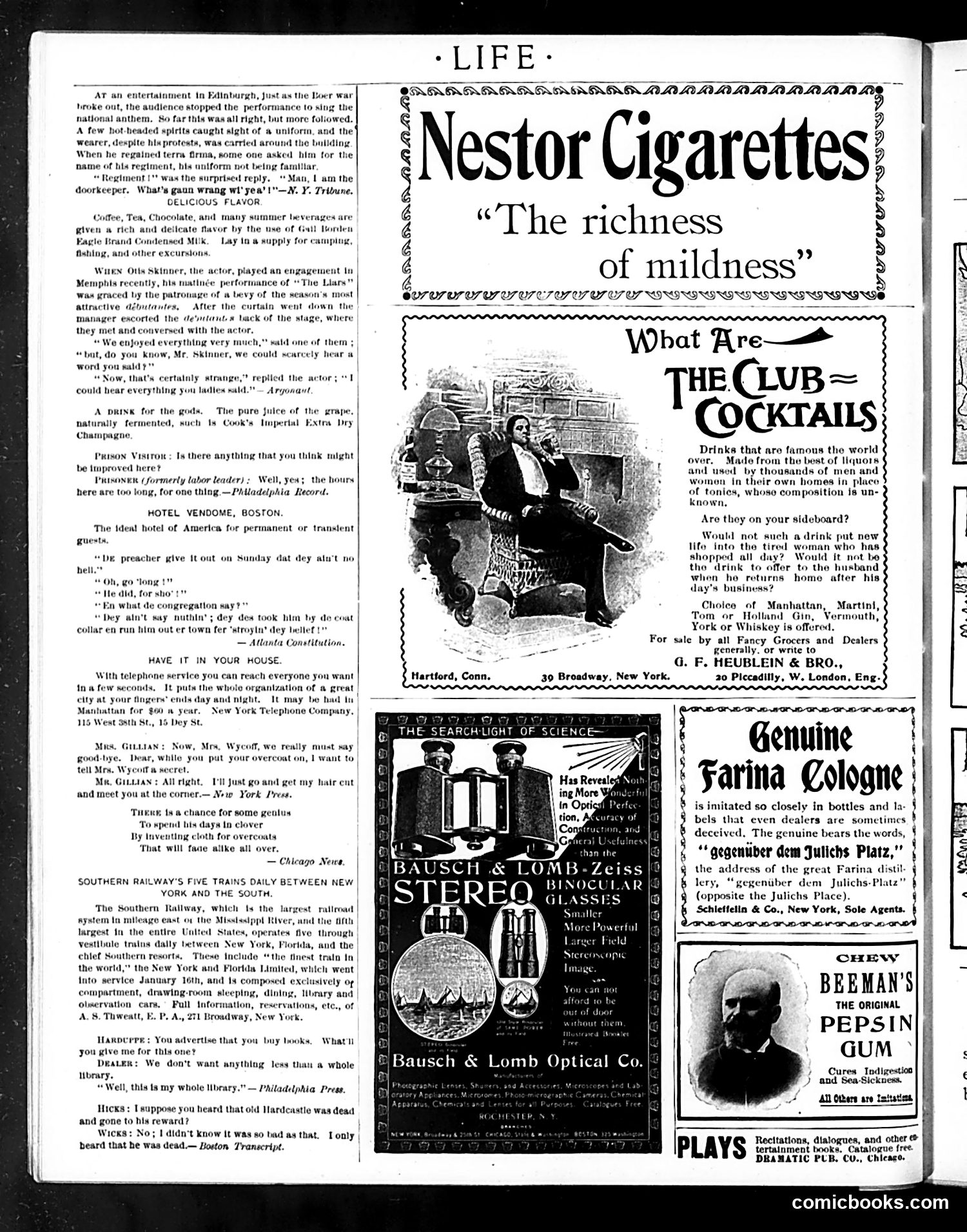
This page is primarily **advertisements and short humorous anecdotes** rather than political cartoons. The content includes: **Main Advertisement**: Nestor Cigarettes dominates the upper right, marketing "the richness of mildness"—typical early 20th-century cigarette advertising. **Humor Pieces**: The left column contains brief, self-contained jokes: - A Scottish doorkeeper mistaken for a soldier during the Boer War (topical reference) - An actor (Otis Skinner) unable to be heard despite audiences' claims otherwise - A preacher expelled from a Black congregation for condemning dancing **Other Advertisements**: Bausch & Lomb optical glasses, Farina Cologne, Beeman's Pepsin Gum, and various services fill remaining space. **Overall Purpose**: This is a typical early 1900s *Life* magazine page mixing light satire, social commentary through brief anecdotes, and commercial advertising—no complex political cartoons requiring historical context.
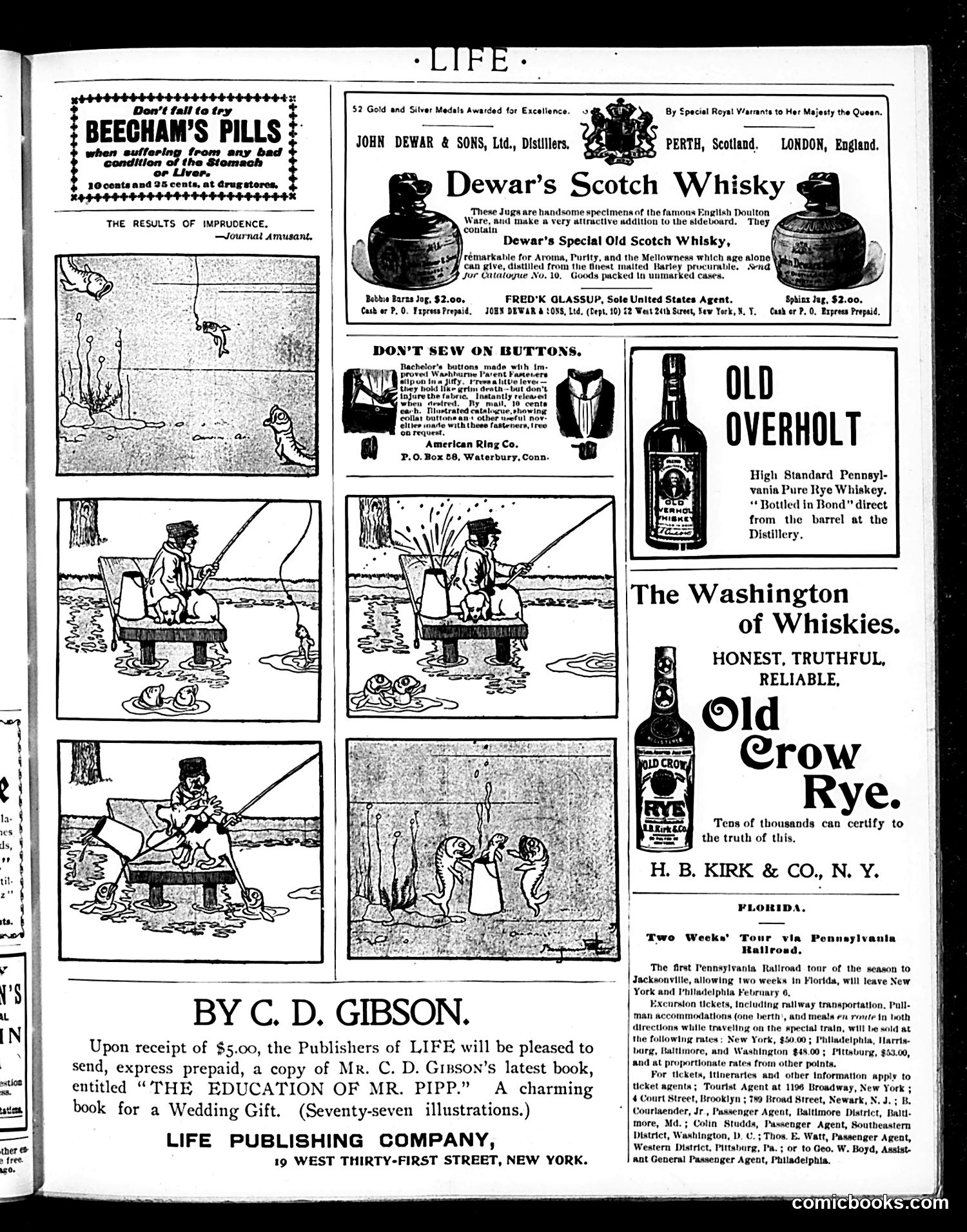
This satirical comic strip by Gibson (the famous illustrator) shows the consequences of sexual indiscretion. The sequence depicts a man fishing who catches increasingly larger fish—a visual metaphor for escalating complications arising from an affair or romantic transgression. The final panel suggests he's been "caught" himself, likely by an angry spouse or family member. The title references the Victorian moral framework where sexual conduct outside marriage was considered imprudent behavior with visible, humiliating consequences. Gibson's work often critiqued upper-class social hypocrisy, and this strip relies on the period's association between masculine leisure activities (fishing) and the dangers lurking beneath respectable surfaces. The joke reflects early-1900s anxieties about masculine conduct and social propriety.
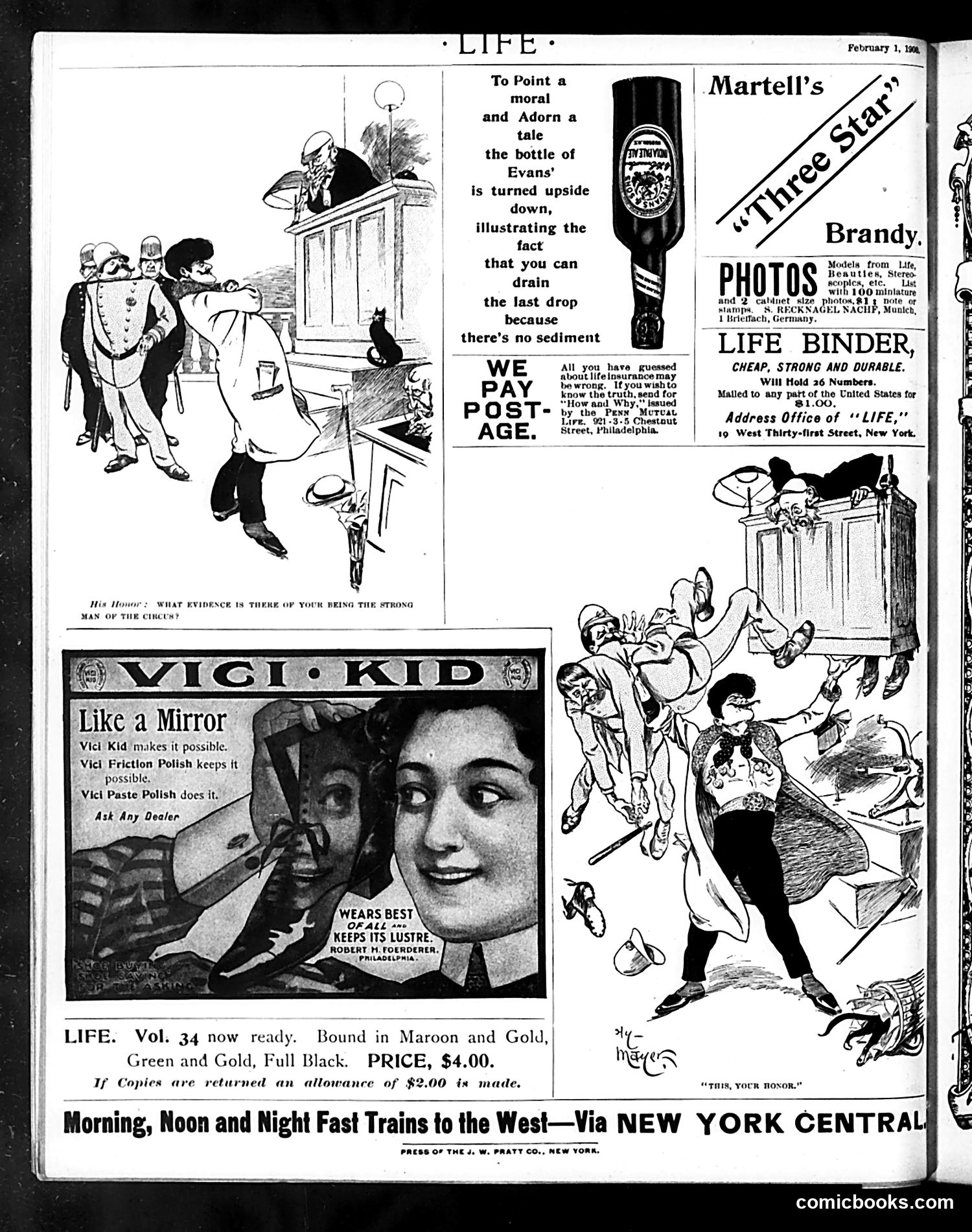
This is primarily an **advertising page** with two cartoon elements. The top-left cartoon shows a circus strongman being questioned by a judge ("His Honor"), with the caption asking what evidence proves he's "the strong man of the circus?" The joke appears to be visual irony—the figure looks unremarkable, undermining his claimed strength. The bottom-right cartoon labeled "This, Your Honor" depicts what appears to be a courtroom scene with exaggerated, comedic figures in chaotic poses, likely satirizing courtroom behavior or legal proceedings (the exact reference is unclear without additional context). The page is dominated by **product advertisements**: Evans' brandy (emphasizing no sediment), Vici Kid shoe polish, Martell's brandy, Life magazine binders, photo models, and New York Central railroad services. The "We Pay Postage" notice advertises Life's subscription offer. This reflects Life's function as a satirical magazine supported by advertising revenue, mixing editorial humor with commercial notices typical of early 20th-century periodicals.