
Life, 1900-02-01 · page 13 of 20
Life — February 1, 1900 — page 13: what you’re looking at
What you’re looking at
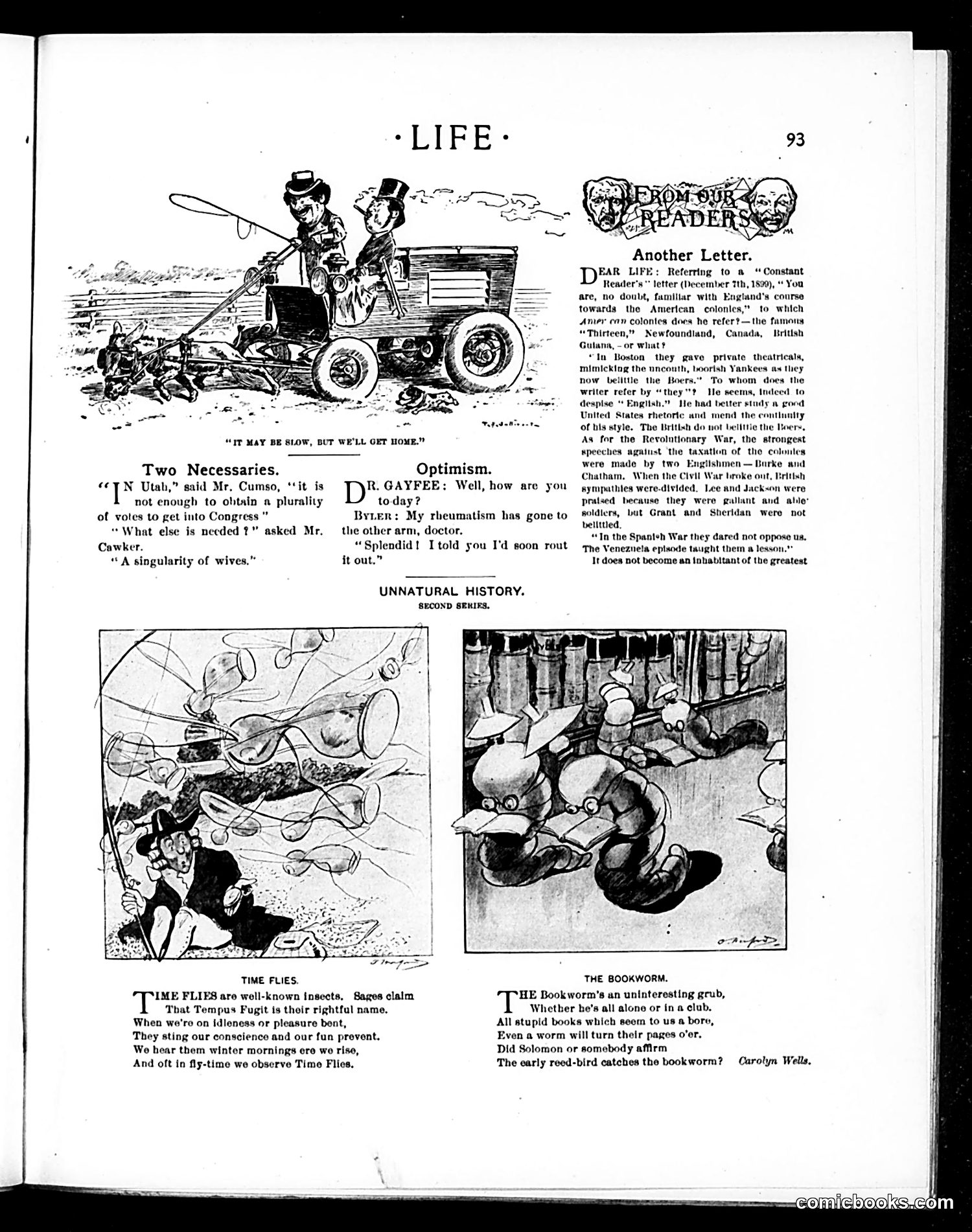
**"Two Necessaries"** satirizes polygamy in Utah. The joke plays on political terminology: obtaining a "plurality" of votes is standard for election, but Utah Territory's practice of polygamy requires a "singularity of wives"—a nonsensical phrase mocking the contradiction between democratic principles and the religious practice of polygamous marriage that scandalized 19th-century America. **The Doctor joke** is a simple pun: the doctor claimed he'd "rout out" the patient's rheumatism from one arm, and it merely migrated to the other—suggesting medical incompetence. **"Another Letter"** addresses reader correspondence critiquing previous articles about England's historical treatment of American colonies, the Boers, and Anglo-American relations. The magazine defends its earlier positions. **"Unnatural History,"** "Time Flies," and "The Bookworm"** are lighthearted illustrated humorous verses about insects and human nature—standard filler content for period magazines, unrelated to contemporary politics. The page reflects turn-of-the-century American anxieties about polygamy and Britain's imperial conduct.
📄 Transcribed text from this page (OCR, searchable)
Machine-transcribed from the original scan — historical spelling and the odd misread are preserved.
“IT MAY BE SLOW, BUT WE'LL GET HOME.” Two Necessaries. “J N Utah,” said Mr. Cumso, ‘it is not enough to obtain a plurality of votes to get into Congress “What else is necded 1” asked Mr. Cawker. “A singularity of wives.” R. GAYFEE: Well, how are you to-day? Byten: My rheumatism has gone to the other arm, doctor. “Splendid! Itold you I'd soon rout it out,” UNNATURAL HISTORY. Another Letter. EAR LIFE: Referring to a “Constant Reader's” letter (December th, 1899), * You are, no doubt, familar with England's course towards the American colonics,” to which Amer can colonies does he refer? —the famons “Thirteen,” Newfoundland, Canada, British Gutana, - or what? “In Boston they gave private theatricala, mimicking the nncouth, boorish Yankees as they now belittle the Boers." To whom does the writer refer by “they? He seems, tnileed to despise Hah” He had better study n good United States rhetorte and mend the conthunity of bis style. The British de not Toers, As for the Revolntionary War, the strongest apeeches against the taxation of the colontes were made by two Engilshmen—Burke and Chatham, When the Civil War broke out, Rritish sympathles weredivided, Ice and Jack«on were pratsed because they were gallant and able: soldiers, but Grant and Sheridan were not bellttled. “In the Spanish War they dared not oppose ua, ‘The Venezuela eptaode taught them a lesson." It does not become an inhabitant of the greatest TIME FLIES. IME FLIES aro woll-known Insects, Sages clalm That Tempus Fugit is thoir rightful name. When we'ro on idleness or pleasure bent, They sting our conscience and our fun provent. Wo hear thom winter mornings oro wo rise, And oft in fly-time we observe Timo Flies. THE BOOKWORM. HE Bookworms an uninteresting grub, Whether he’s all alono or ina club. All stupid books which seom to us a bore, Even a worm will turn thelr pages o'er. Did Solomon or somebody affirm ‘The early reed-bird catches the bookworm? Carolyn Wells,