
A complete issue · 20 pages · 1899
Life — December 21, 1899
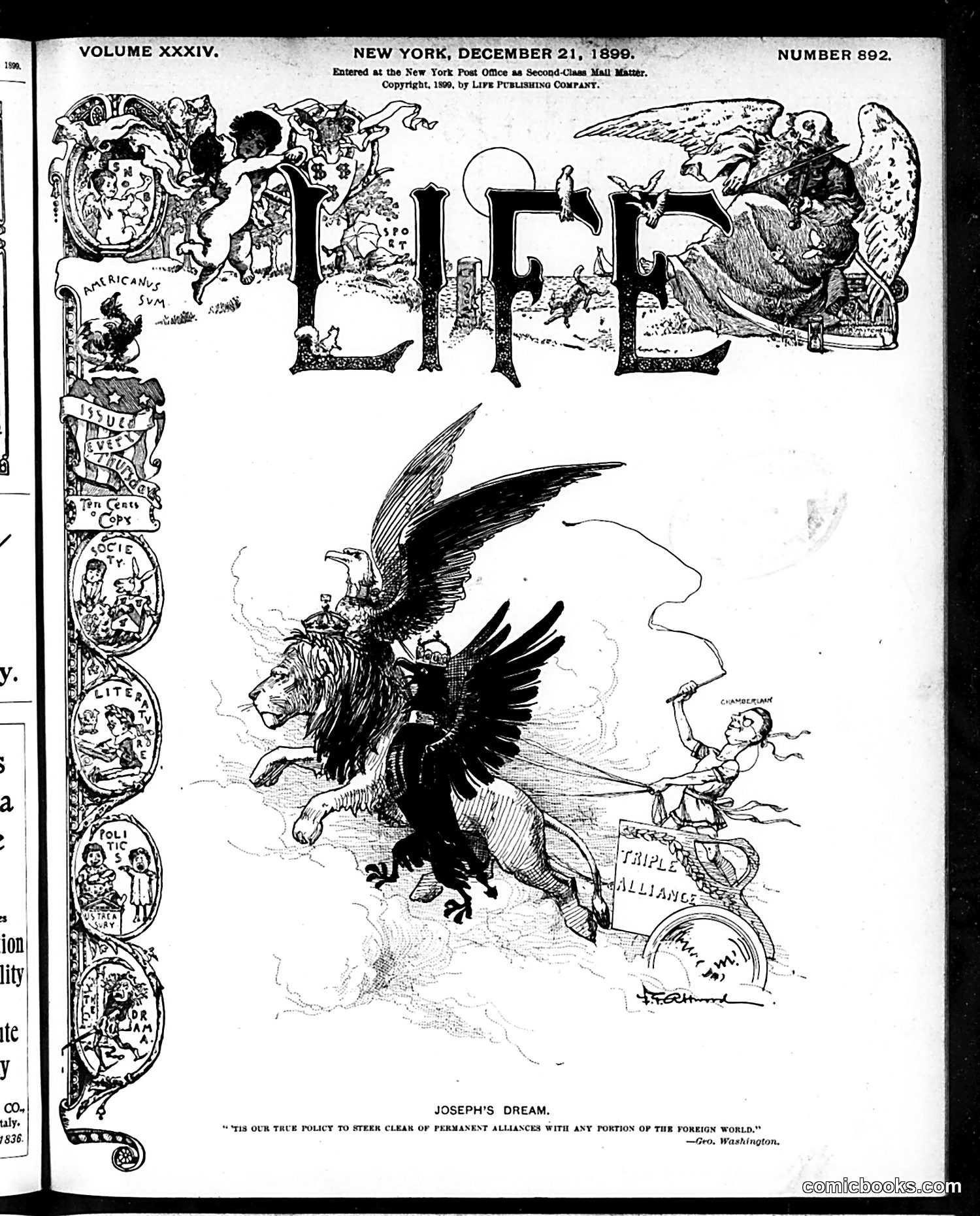
This political cartoon satirizes American foreign policy, specifically the debate over international alliances. The title references the biblical Joseph's dream, but inverts it: instead of ascending, a winged creature (representing a foreign power or "Triple Alliance"—likely Germany, Austria-Hungary, and Italy) descends menacingly toward a small figure labeled "Uncle Sam," who attempts to rein it in with a rope. The caption quotes President Washington's farewell address warning against "permanent alliances with any portion of the foreign world." The cartoon argues that the U.S. should maintain isolationism and independence from European entanglements, a dominant American political position in 1899. The grotesque winged beast symbolizes the dangers of foreign military coalitions threatening American interests.
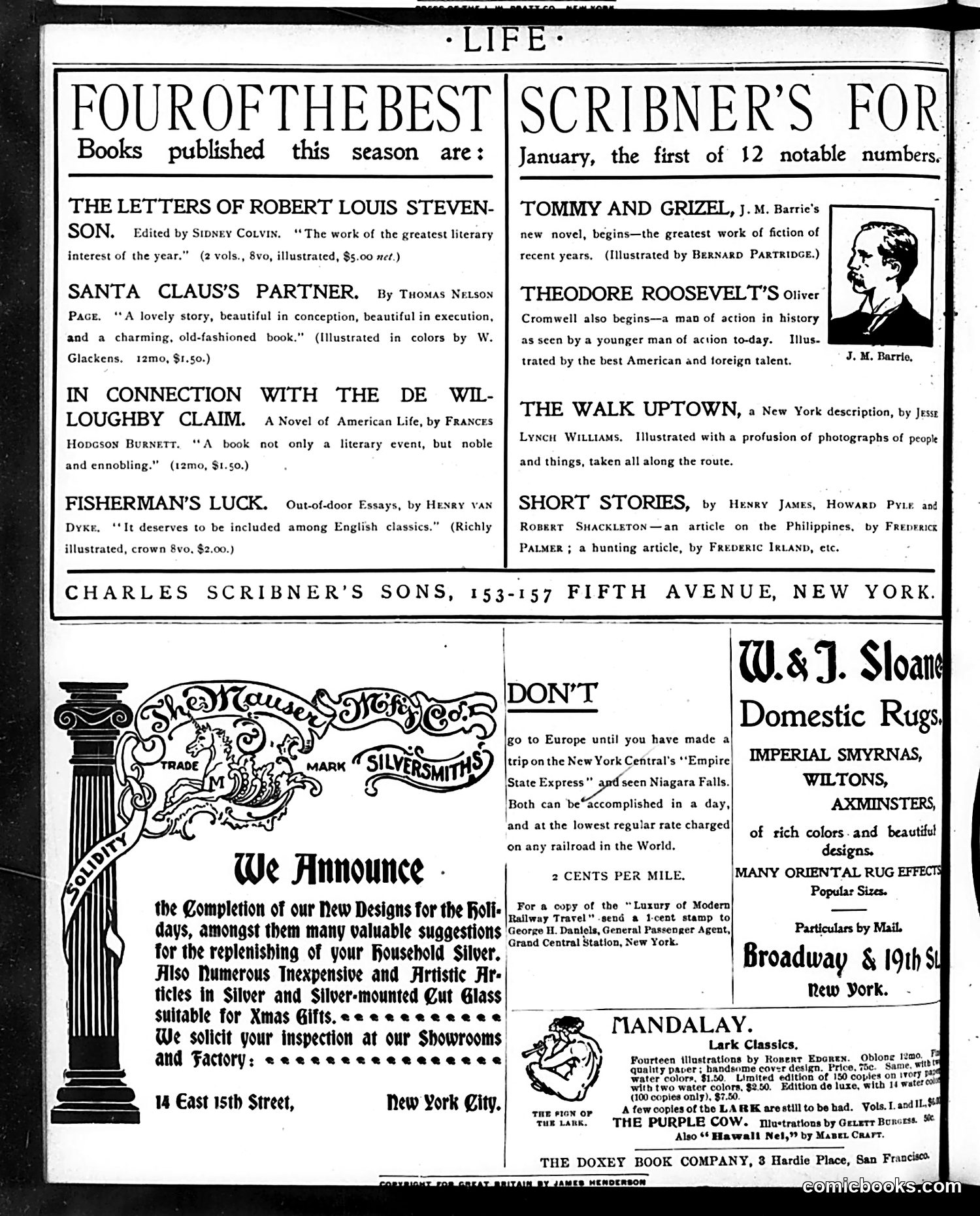
This page is primarily **advertising and book announcements** rather than political cartoons. The upper section lists four notable books published by Charles Scribner's Sons, including works by Robert Louis Stevenson and Thomas Nelson. The right column announces upcoming Scribner's publications for January, featuring J.M. Barrie's "Tommy and Grizel" and Theodore Roosevelt's "Oliver Cromwell." The lower half contains **commercial advertisements**: Sibersmith silverware announces new holiday designs, W. & J. Sloane advertises domestic rugs, and the Doxey Book Company promotes "Lark Classics" publications. There are **no political cartoons or satirical commentary** visible on this page. It represents typical early-20th-century Life magazine content mixing literature promotion with luxury goods advertising.
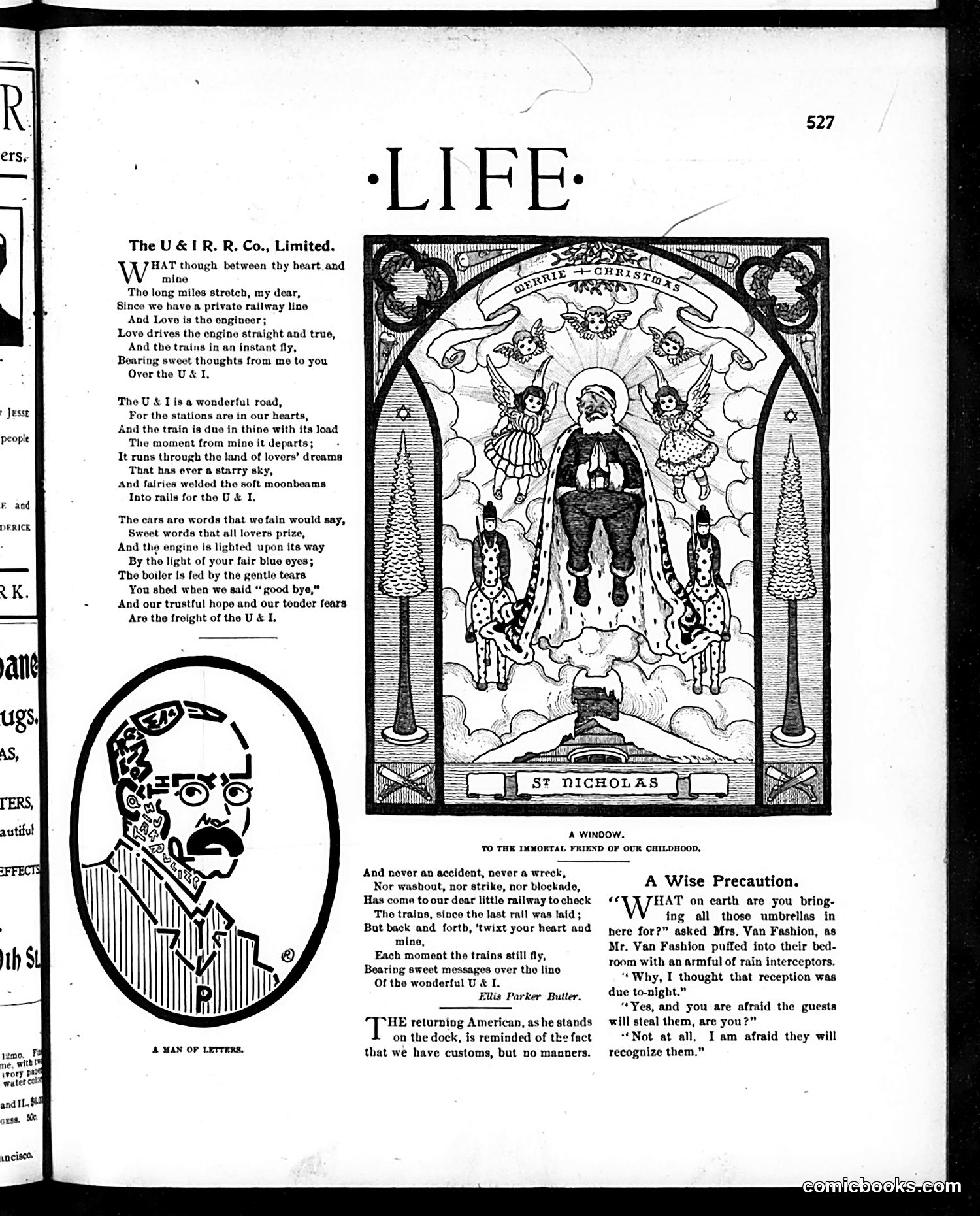
This page features content related to the U & I Railroad, a whimsical fictional railway. The main illustration shows "St. Nicholas" (Santa Claus) in a religious/heavenly scene with children and angels, captioned as "A Window to the Immortal Friend of Our Childhood." The poem celebrates the U & I Railroad as a metaphorical romantic journey, using coded language about love, trains, and travel. The sidebar portrait labeled "A Man of Letters" appears to be an advertisement or editorial illustration, though the specific person is unclear from the image alone. The lower section, "A Wise Precaution," presents dialogue about umbrellas and rain interceptors—likely a humorous domestic scene. The overall page combines sentimental Victorian imagery with gentle satire, typical of Life magazine's mix of whimsy and social commentary during this period.
This page contains no political cartoons but rather editorial commentary on military and social issues circa 1909. The main text discusses Secretary of War Root's report, praising his administrative reforms while debating military academy expansion and officer promotion standards. A secondary editorial addresses Bishop Doane's views on divorce, which the writer considers too restrictive. The piece argues that while divorce carries social stigma, the Church's influence on public opinion matters more than legal restrictions in controlling its frequency. The small decorative illustration at top left appears ornamental rather than satirical. Overall, this represents serious magazine journalism rather than visual satire or cartooning.
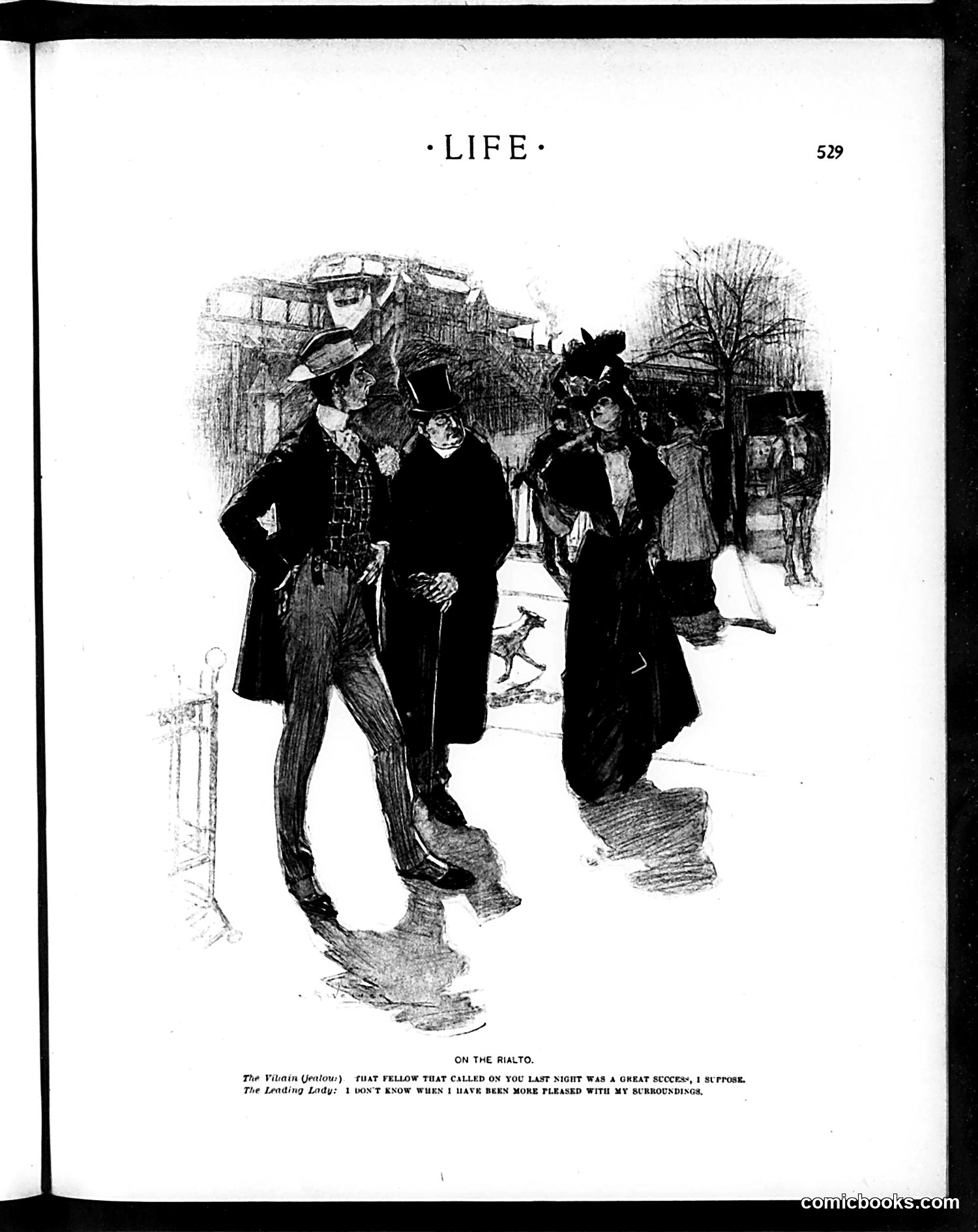
This sketch depicts a social scene on Venice's famous Rialto Bridge, showing well-dressed figures in conversation. The caption presents dialogue between characters identified as "The Villain (jealous)" and "The Leading Lady." The villain compliments the leading lady on a theatrical performance's success the previous night, but she responds that she's never been more pleased with her *surroundings* — suggesting her satisfaction derives from social admiration rather than artistic achievement. The satire targets vanity and superficiality among theater society, mocking how performers (particularly women) prioritize social approval and their fashionable appearance over genuine artistic merit. The Venetian setting adds cosmopolitan pretension to the critique.
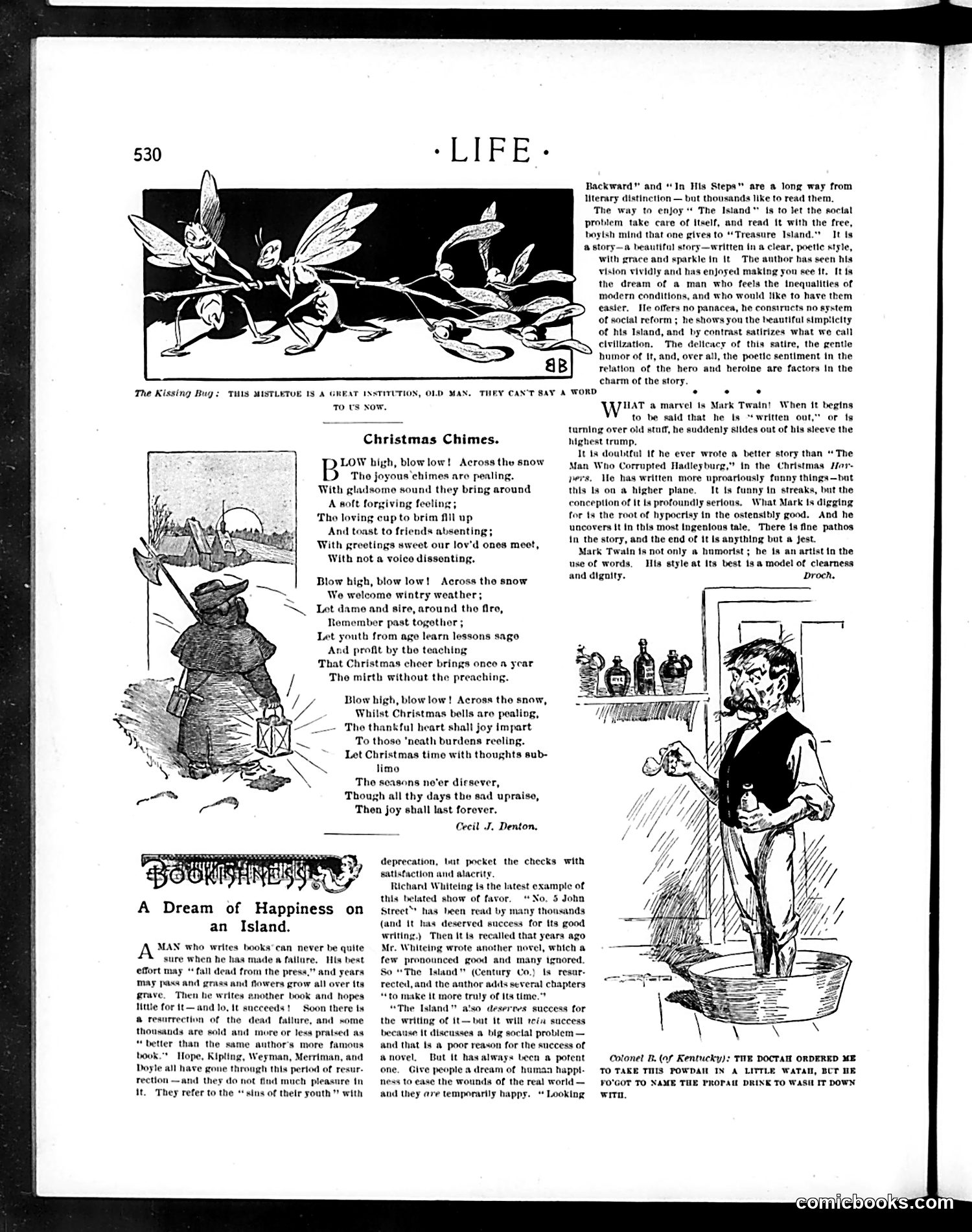
This page contains literary criticism and seasonal content rather than political satire. The main elements are: **"The Kissing Bug"** cartoon (top): A satirical illustration with mistletoe, captioned as "A GREAT INSTITUTION, OLD MAN. THEY CAN'T SAY A WORD TO US." This appears to reference the "kissing bug" phenomenon—likely a seasonal social custom or insect pest that was newsworthy at the time. **"Christmas Chimes"** poem: A sentimental seasonal verse by Oreil J. Denton celebrating Christmas traditions. **Book review**: Discussion of a novel called "The Island," praising Mark Twain's literary merit and his satirical critique of modern civilization through the story's protagonist seeking escape from societal constraints. The page is primarily cultural and literary commentary rather than political satire.
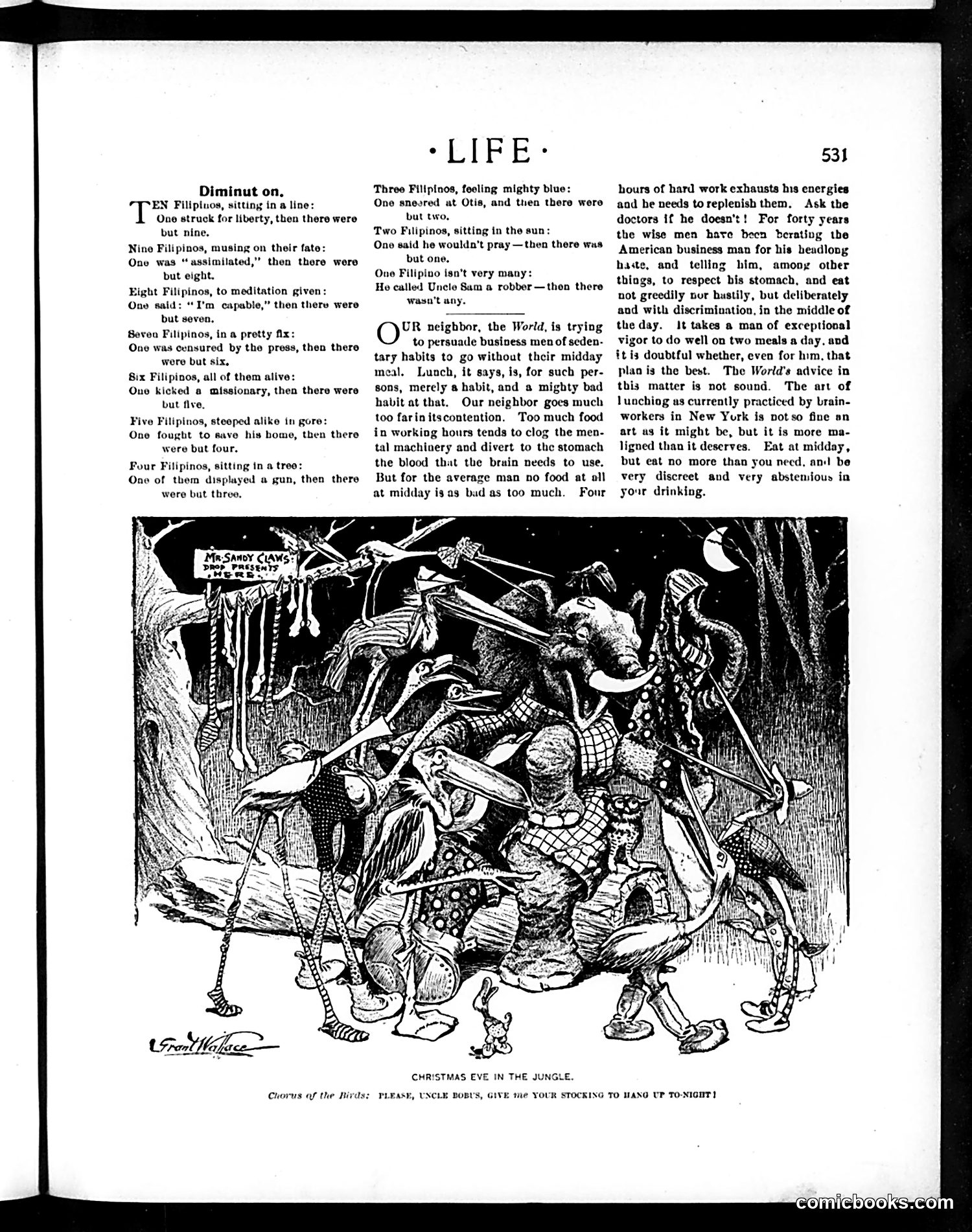
This satirical illustration by Ufred Wallace depicts anthropomorphized Filipino figures engaged in what appears to be a chaotic Christmas celebration. The accompanying text "Diminut on" presents a series of short, rhyming couplets about Filipinos with stereotypical characterizations—some described as lazy, drunk, or criminal. The cartoon's context reflects American colonial attitudes toward the Philippines following the 1898 Spanish-American War. It mocks Filipino culture through crude ethnic stereotyping while the "Chorus of the Birds" caption creates absurdist humor by having animals comment on the scene. The overall message reinforces early 20th-century American imperialist attitudes, portraying Filipinos as uncivilized and requiring American guidance—a common propaganda tool during U.S. occupation of the islands.
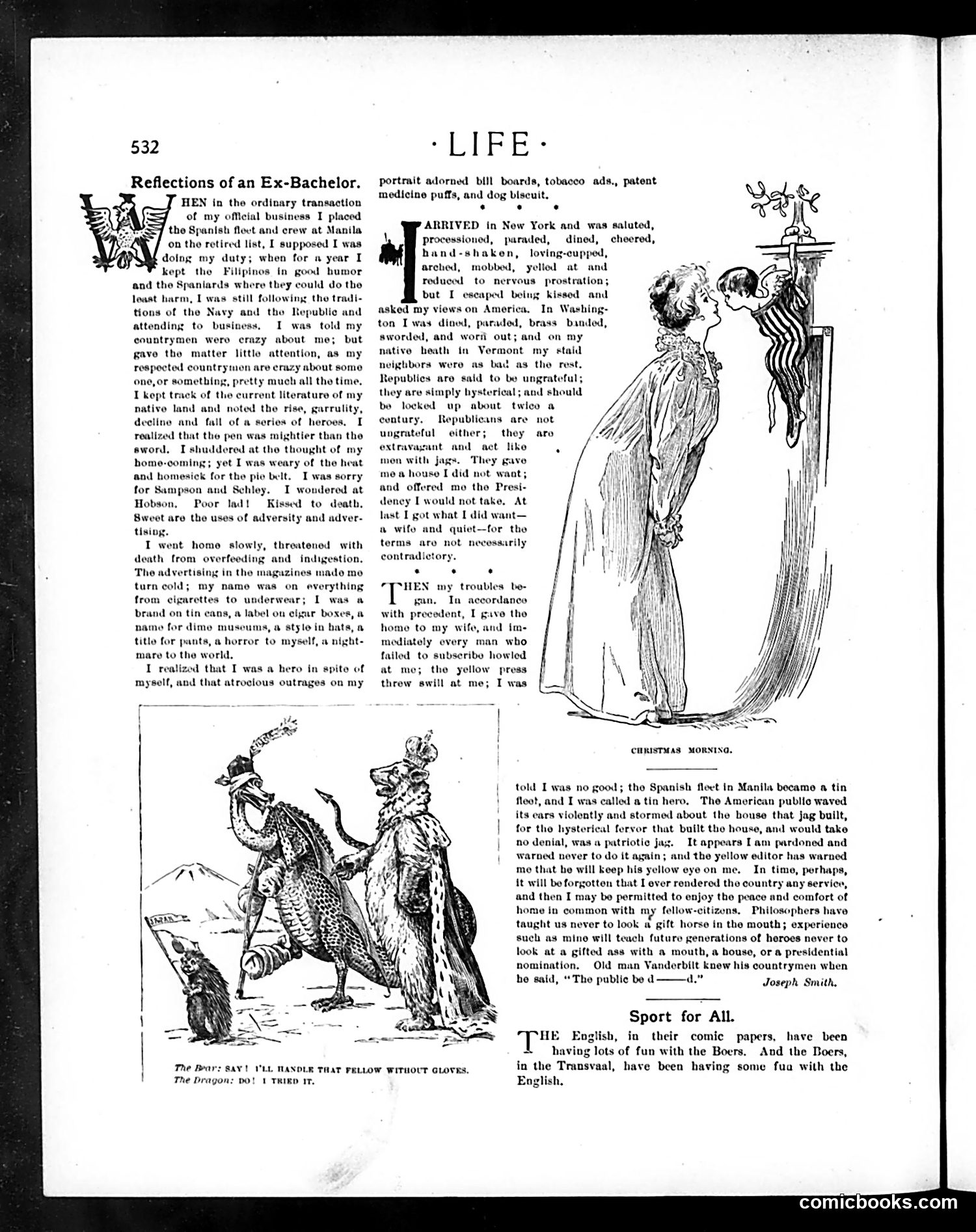
This satirical article recounts a man's experiences abroad and return to America. The accompanying cartoons mock his pretensions: The **camel cartoon** (bottom left) depicts someone attempting to handle a camel without gloves—labeled "The Boxer" claiming he'll manage it, while "The Dragon" admits he tried—likely satirizing travelers who boast of exotic adventures they're unprepared for. The **tall figure illustration** (right, titled "Christmas Morning") shows a man in elongated proportions, seemingly ridiculing his inflated self-importance upon returning home. The text mocks Republican politics and American hubris, suggesting the author wasted time abroad acquiring pretentious airs. The satire targets both masculine posturing and the perceived foolishness of Americans who travel and return self-aggrandized.
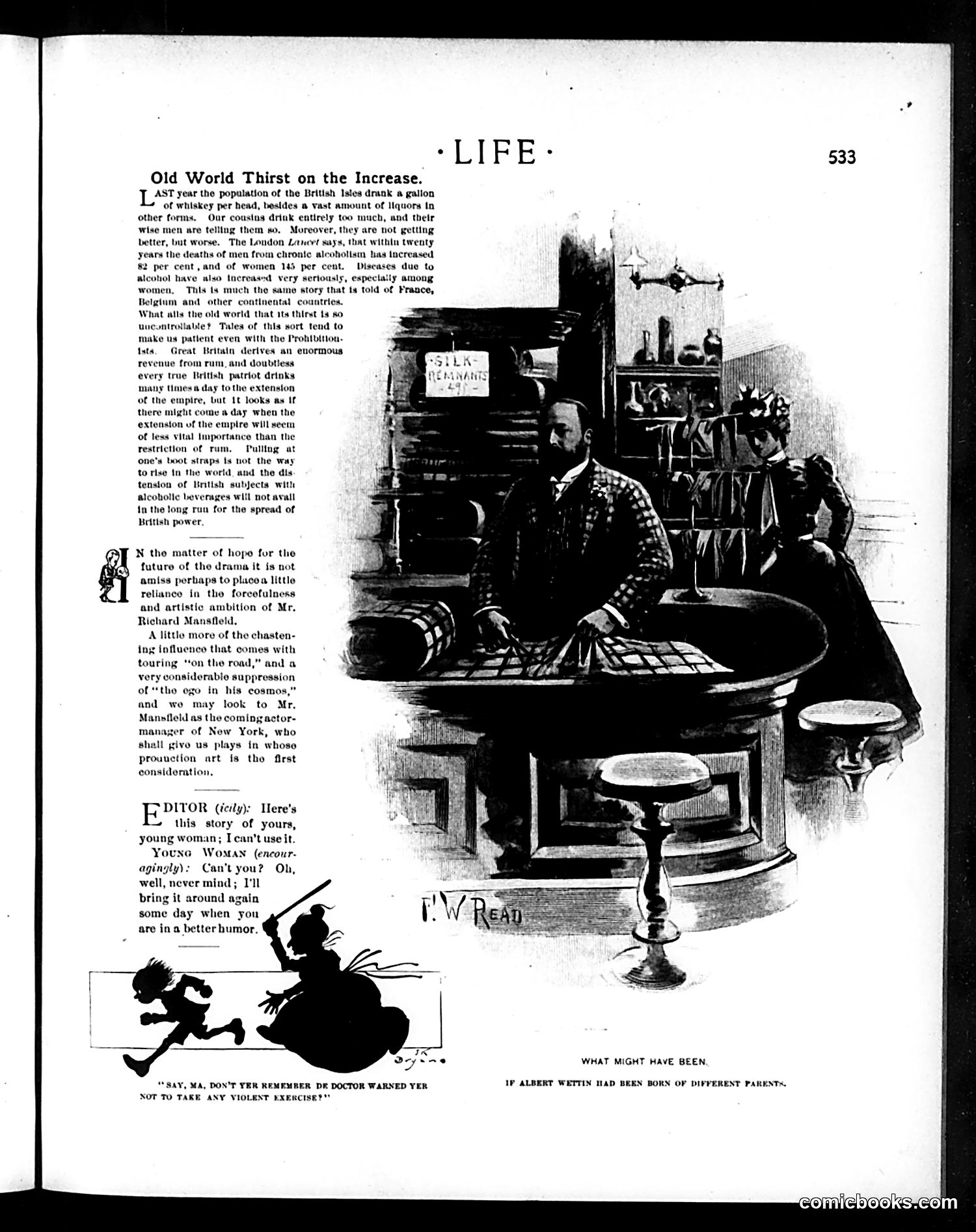
**Main Article**: "Old World Thirst on the Increase" discusses rising alcoholism in Britain and Europe, citing London *Lancet* statistics showing increased deaths from chronic alcoholism. The piece argues this undermines the Prohibition movement's claims. **Central Illustration**: Shows a man at what appears to be a bar or tavern counter, with patrons visible in background. This visually supports the article's theme of widespread drinking culture. **Small Cartoon (bottom)**: A humorous domestic scene where a mother tells a child not to exercise violently, as "Doctor warned ye not to take any violent exercise!" The joke plays on health concerns versus active childhood behavior. **Editorial Note**: References Richard Mansfield and theatrical prospects, suggesting contemporary entertainment industry discussion.
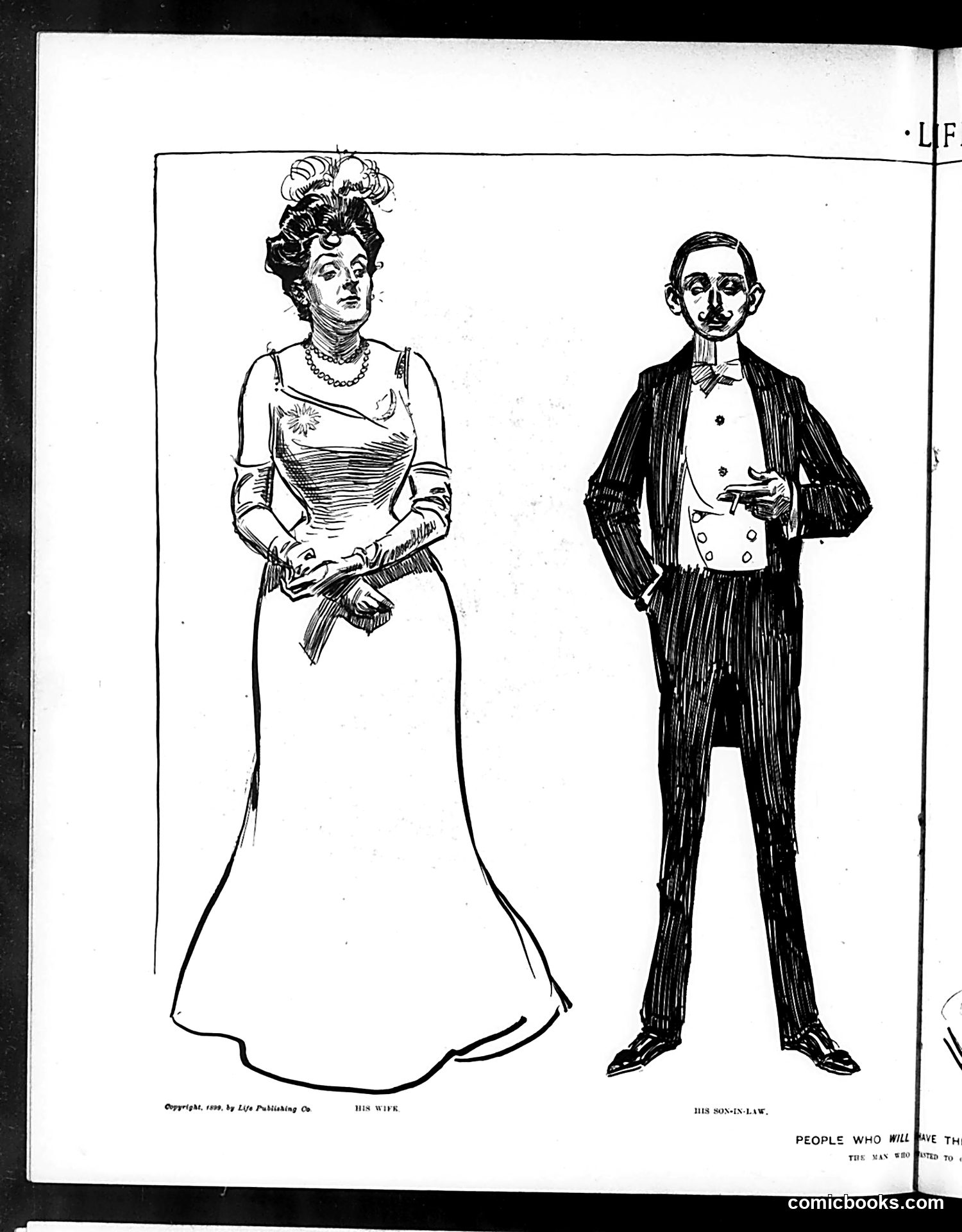
This illustration depicts two figures labeled "HIS WIFE" and "HIS SON-IN-LAW," presenting formal evening wear of the Edwardian era (early 1900s based on the copyright date visible). The woman wears an elegant gown with upswept hair and jewelry typical of upper-class fashion; the man wears white-tie formal attire. The partial text at bottom reads "PEOPLE WHO WILL HAVE TH[E]... THE MAN WHO [?]ED TO..." suggesting this page satirizes social hierarchies or family dynamics among the wealthy. Without the full caption or additional context, the specific satirical point remains unclear—it appears to mock pretension or social aspiration within upper-class family relationships, though the precise target is uncertain from this fragment alone.
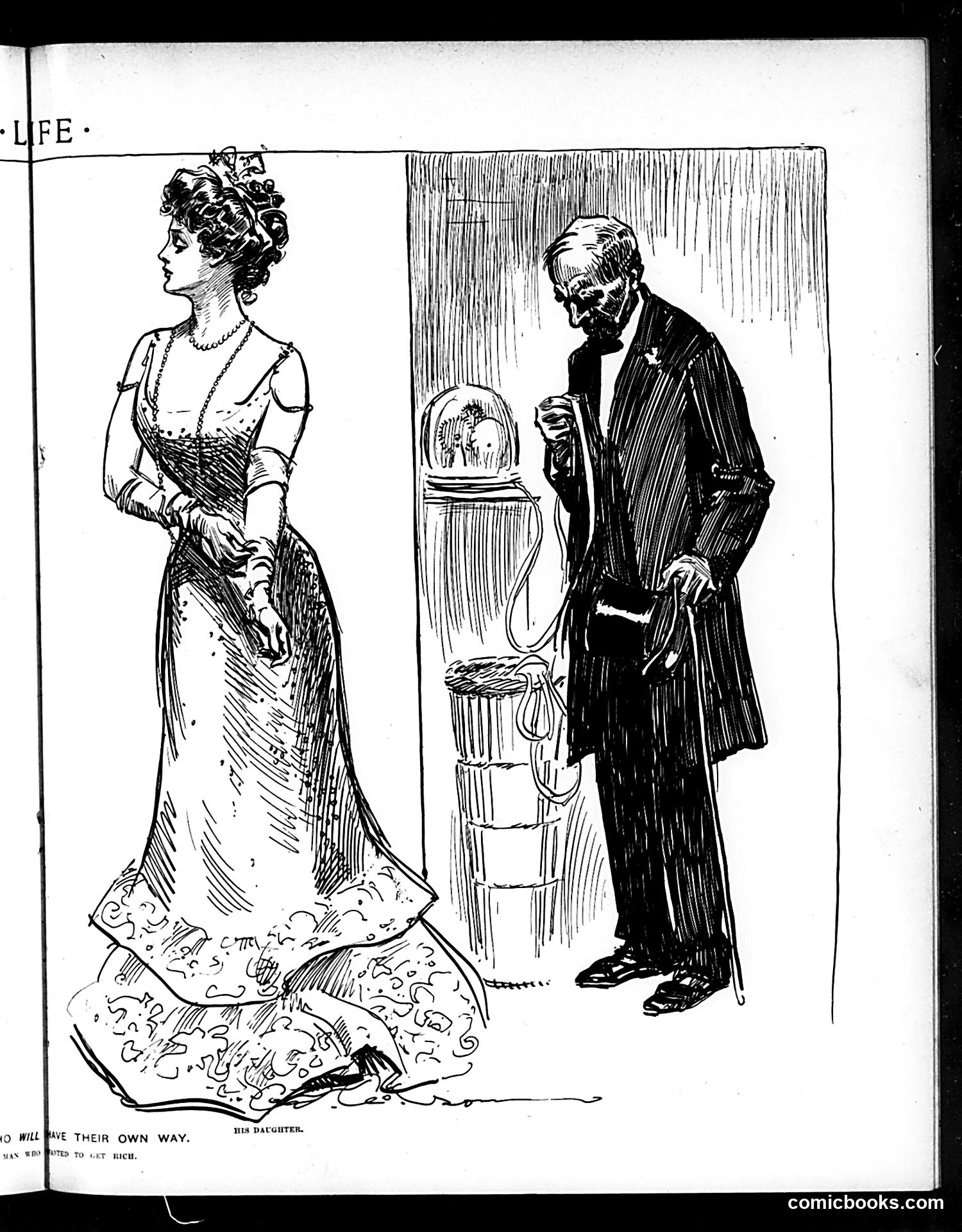
This cartoon depicts a wealthy older gentleman in formal attire examining a young woman's elaborate gown and train. The satire appears to critique conspicuous consumption and wealth display among the upper classes. The caption "His Daughter" suggests the cartoon comments on fathers' financial investment in their daughters' marriageability through expensive clothing and ornamentation. The ornate, heavily decorated train—rendered with exaggerated detail—likely mocks the excesses of Gilded Age fashion and the performance of wealth. The gentleman's inspecting posture implies he's evaluating his daughter as a commodity or investment. The satire targets both parental vanity and the social system where women's value correlates with their families' ability to display wealth through fashion. The partial visible text at bottom references getting "rich," reinforcing the wealth-acquisition theme.
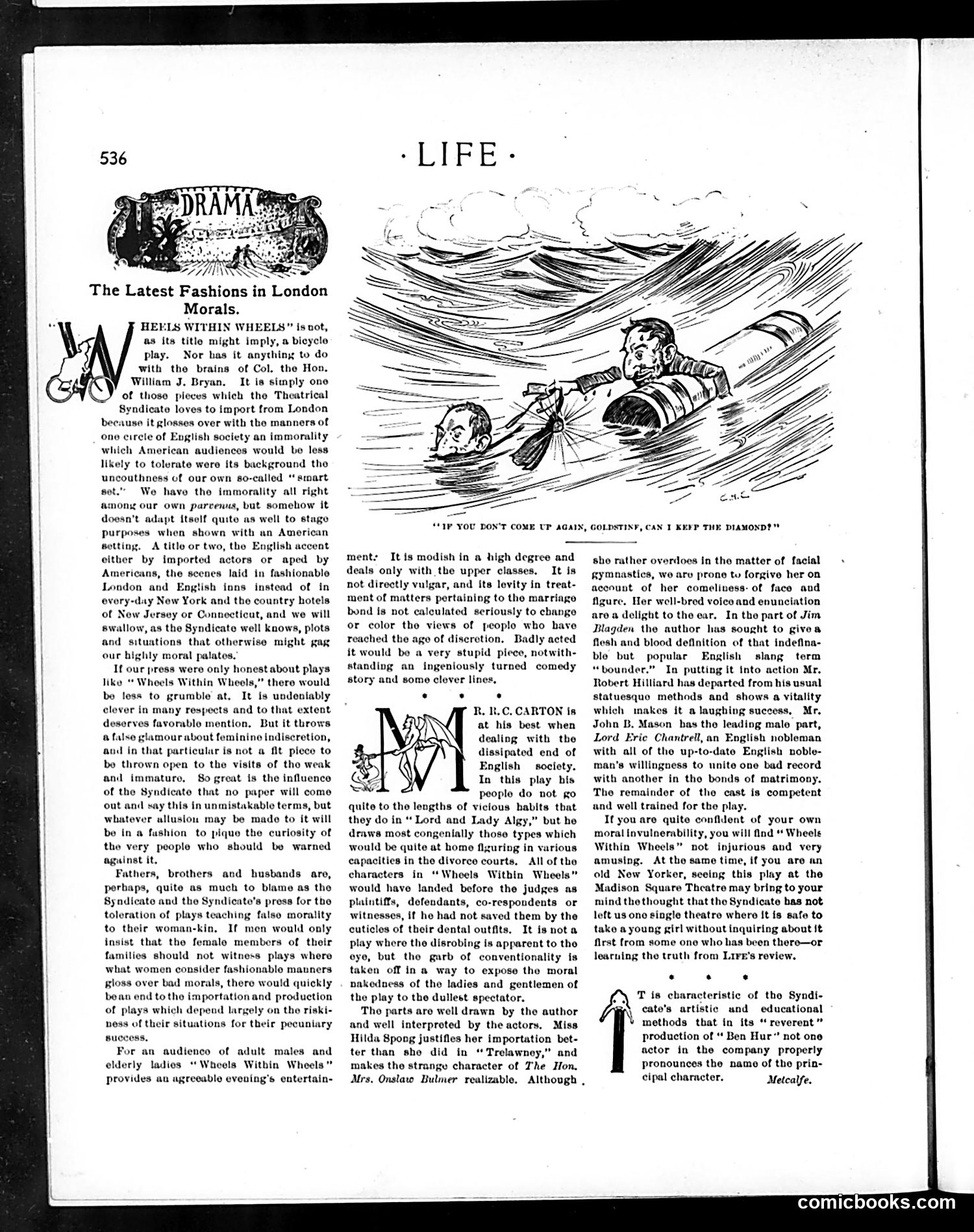
This page reviews a London theatrical production titled "Wheels Within Wheels." The illustration shows two figures in water or turbulent circumstances, with one saying "If you don't come up again, Goldstine, can I keep the diamond?" The review criticizes the play as a shallow work dealing with divorce and upper-class morality, lacking serious engagement with its subject matter. The author argues the play merely exposes surface-level scandals of London society rather than offering genuine insight. The satire targets both the play's pretentiousness and the Theatrical Syndicate's practice of importing such frivolous English comedies for American audiences—suggesting they mistake fashionable immorality for sophisticated entertainment.
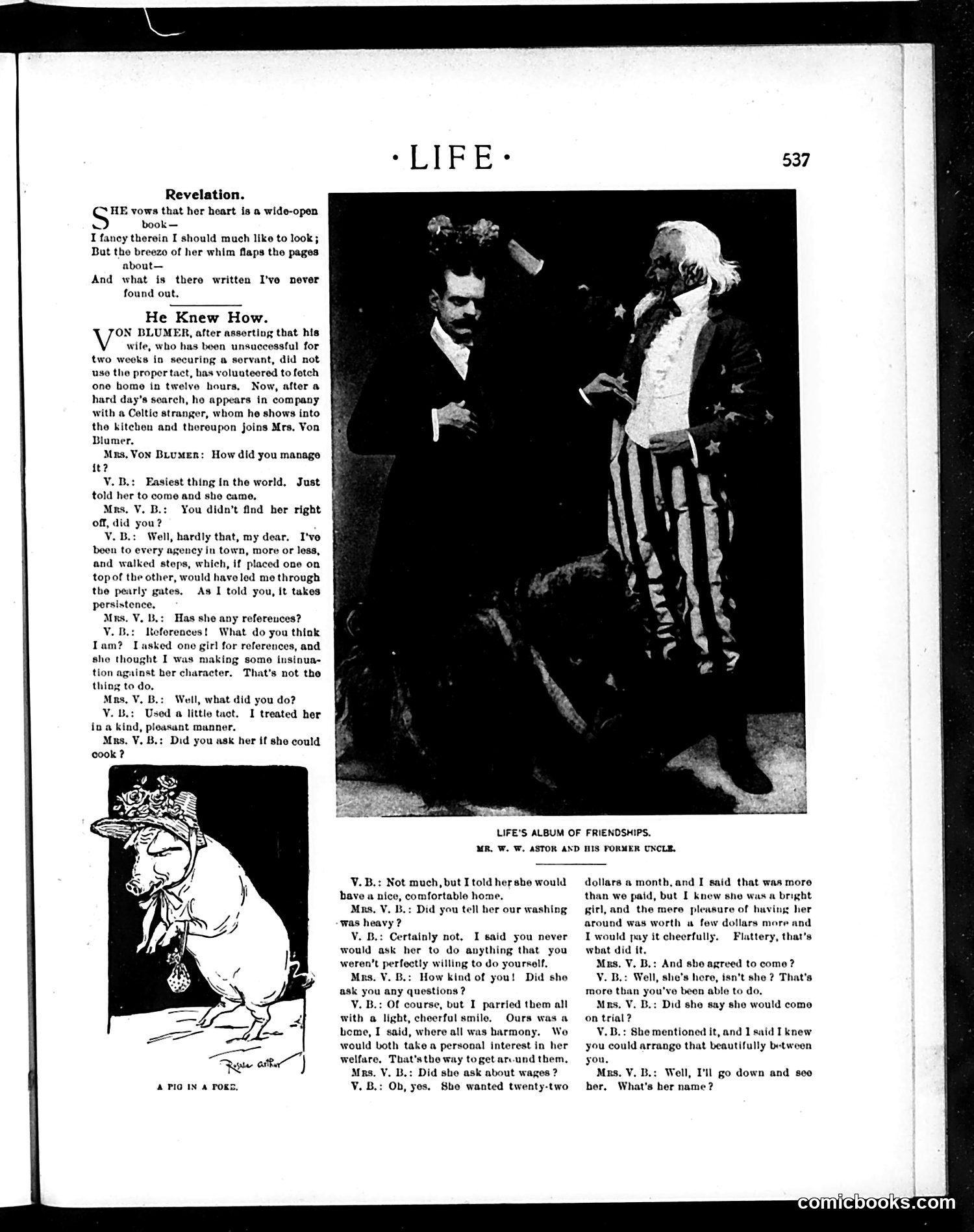
This page contains two satirical pieces from Life magazine: **"He Knew How"** mocks a husband (Von Blumer) who boasts he can succeed where his wife failed—hiring a domestic servant. Through dialogue, the satire reveals his manipulative tactics: flattery, false promises about working conditions, assurance of "harmony," and offering higher wages while pretending the money doesn't matter. The joke is that he uses transparent dishonesty disguised as "tact" to recruit a servant—suggesting both the difficulty of hiring household help in this era and the absurdity of his self-congratulation. **"Life's Album of Friendships"** appears to reference W.W. Astor and "his former uncle"—likely a society scandal involving the wealthy Astor family, though the specific incident isn't clear from this page alone. The small cartoon "A Pig in a Poke" makes a visual pun on the idiom (buying something without inspecting it first). All three pieces ridicule upper-class social pretense and domestic anxieties of the period.
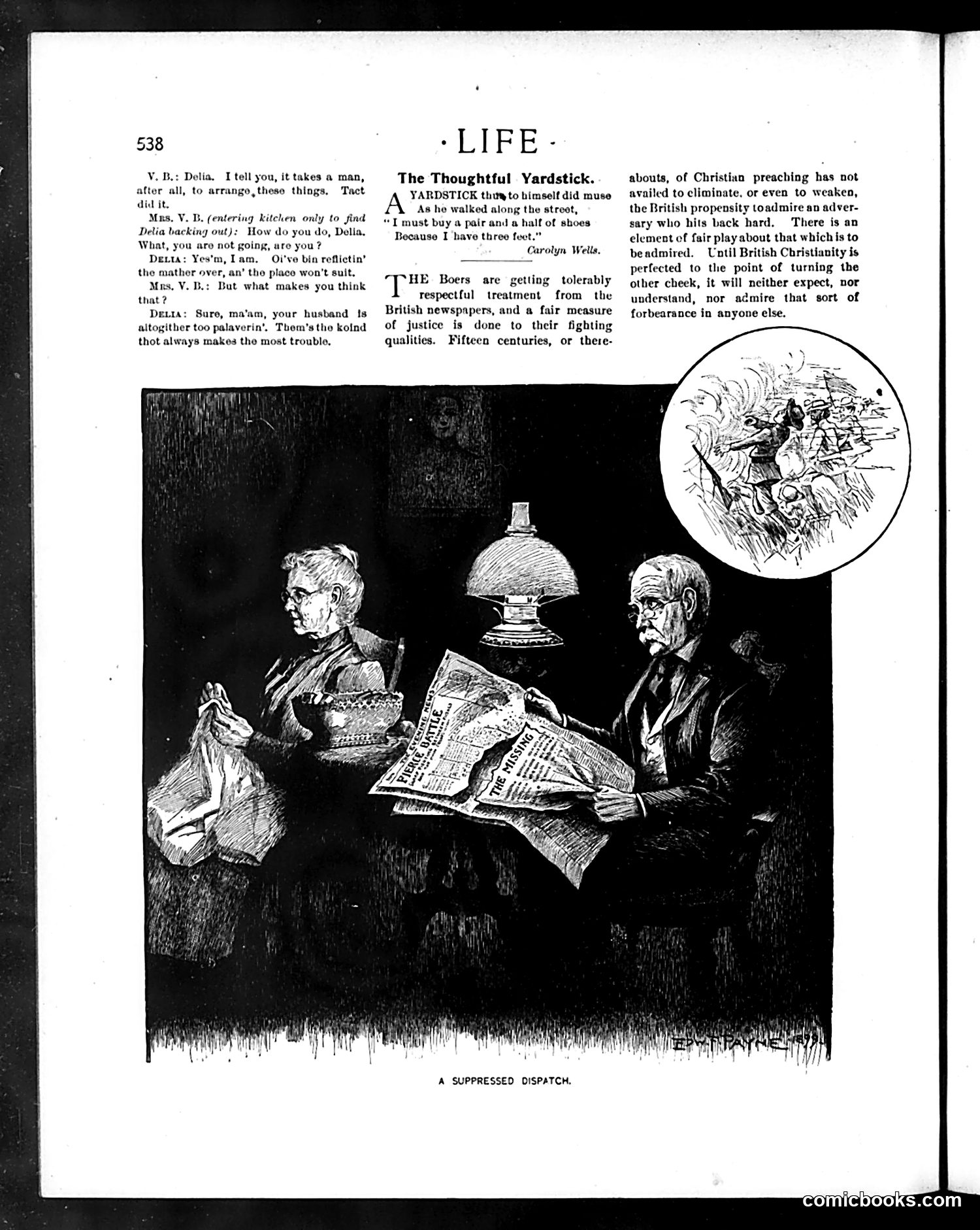
This page contains three separate pieces from *Life* magazine: 1. **"A Suppressed Dispatch"** (main cartoon): Two elderly men read newspapers by lamplight while a servant woman (Delia) departs, saying the husband is too "palaverin'" (talkative). The joke satirizes domestic discord caused by a man's excessive talk. 2. **"The Thoughtful Yardstick"**: A humorous poem about a yardstick pondering buying "a pair and a half of shoes" for its three feet—wordplay on the measurement unit. 3. **"The Thoughtful Yardstick"** (prose section): Commentary on the Boer War, praising British newspapers for fair coverage of Boer fighters. The author notes Britain's Christian culture paradoxically admires martial prowess and "hitting back"—a contradiction to Christian teachings about "turning the other cheek." This is gentle satire of British hypocrisy regarding Christian values versus imperial warrior culture. The circular inset illustration appears to depict battle action, likely referencing the ongoing conflict.
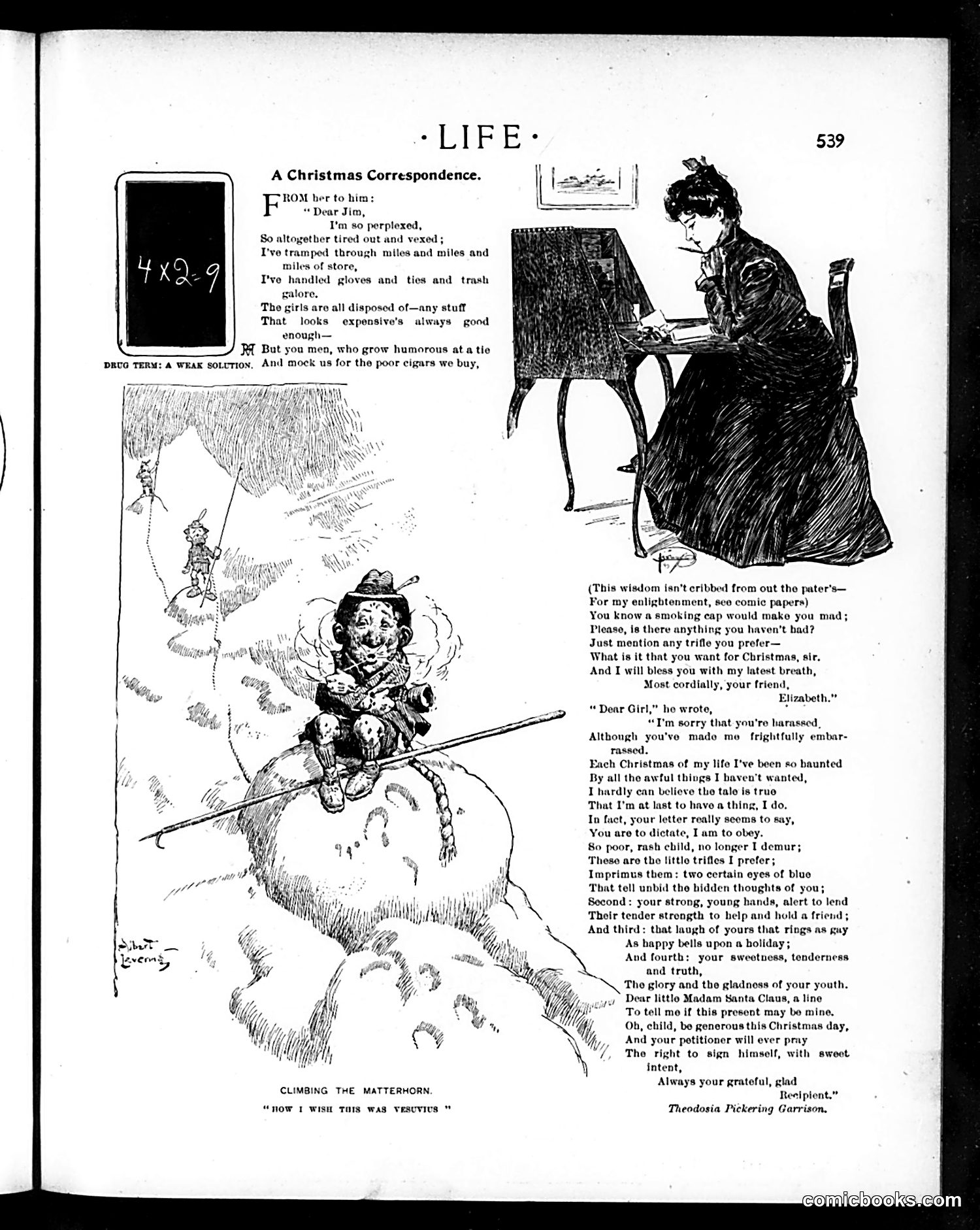
This page presents a romantic Christmas letter exchange between "Elizabeth" and "Jim." Elizabeth complains about shopping difficulties—she's easily satisfied the women on her list with expensive trinkets, but struggles to find gifts for men who mock practical presents like ties or smoking caps. Jim's reply subverts expectations. Rather than requesting material goods, he requests intangible qualities: her blue eyes, her strong helpful hands, her joyful laugh, and her sweetness and truth. He playfully signs himself her "petitioner," asking if she'll grant these "presents" by accepting his romantic devotion. The satire mocks both consumer culture (women buying expensive junk) and gender expectations. Jim's sentimental response—requesting love and companionship rather than merchandise—appears genuinely touching rather than purely satirical, suggesting the magazine valued sincere emotion alongside its social commentary. The accompanying illustration shows a woman writing at a desk, presumably Elizabeth composing her letter.
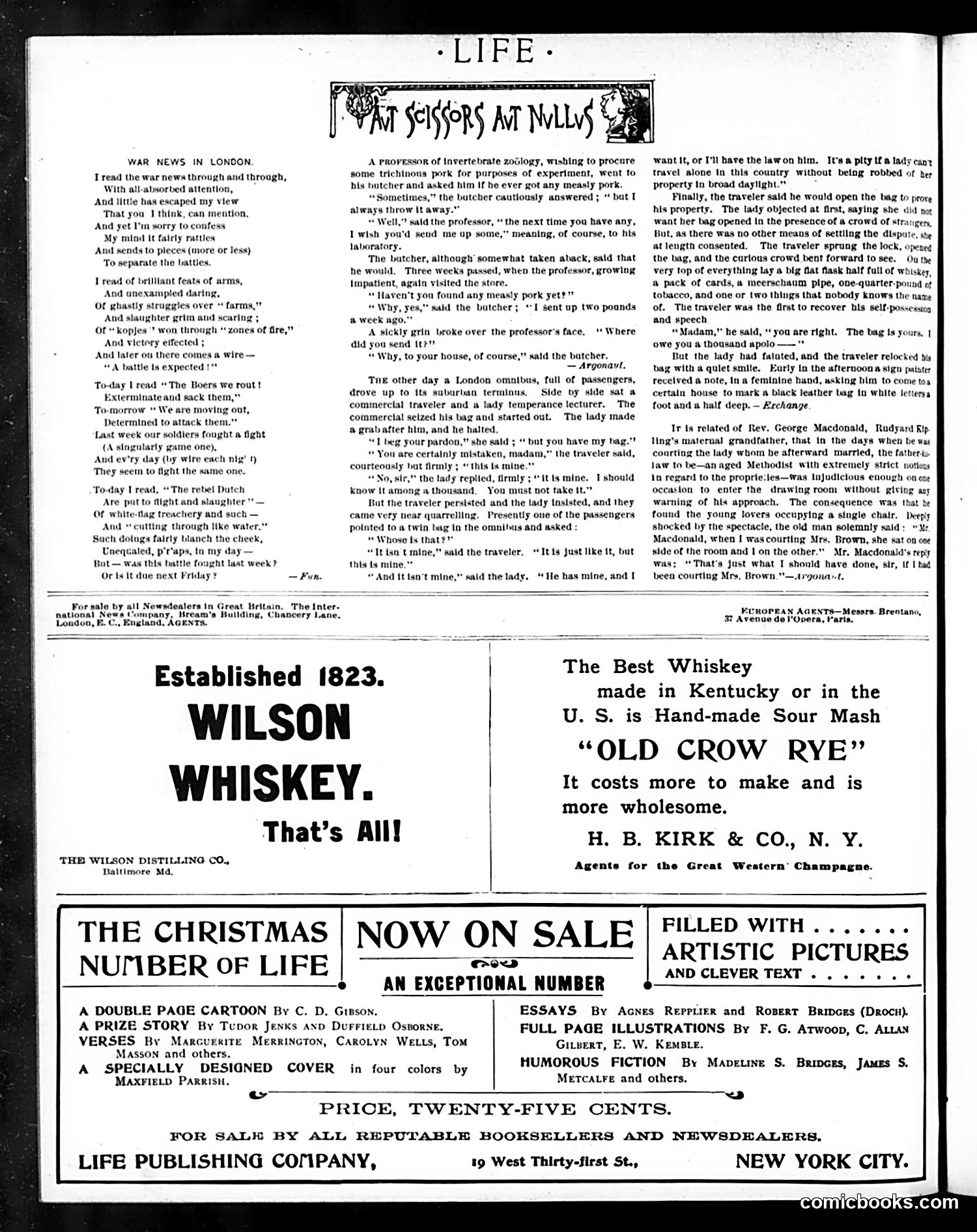
This page contains three satirical pieces from *Life* magazine (likely early 1900s, given Boer War references): **"War News in London"** (left column): A poem mocking the confusing, repetitive nature of war reporting during the Second Boer War. The poet complains that newspapers contradict themselves daily—one day "we rout the Boers," the next "we're retreating"—making it impossible to understand what's actually happening. The satire targets both military confusion and sensationalist journalism. **"At Scissors at Nullys"** (center): Three humorous anecdotes. The first involves a zoology professor requesting diseased pork from a butcher, who helpfully sends it—to his *home* instead of the lab. The second story satirizes a lady temperance lecturer and traveling salesman who argue over identical bags; when opened, the "proper lady's" bag reveals whiskey, cards, and tobacco—exposing her hypocrisy about morality. The satire mocks social pretension and moral inconsistency rather than politics specifically.
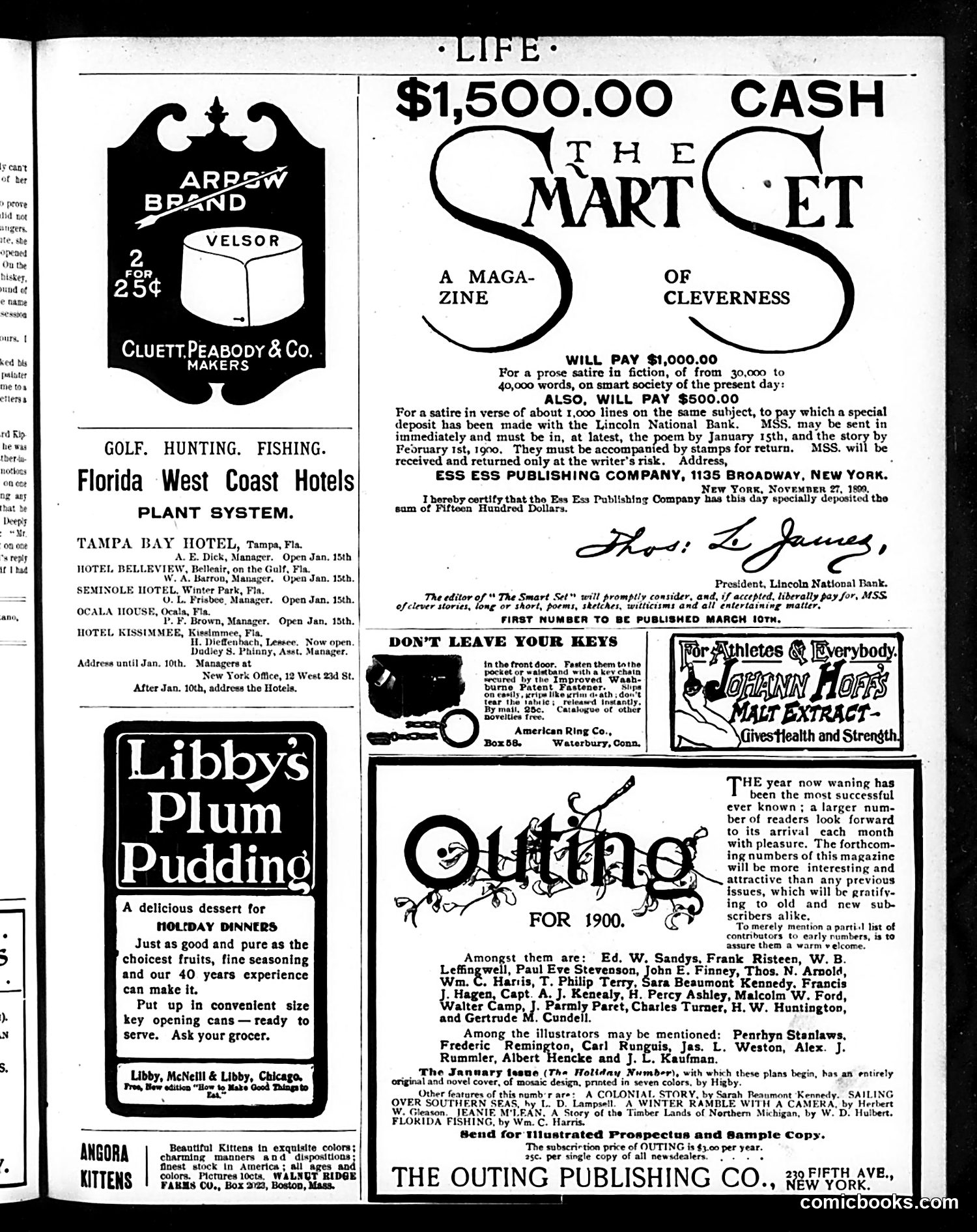
This is primarily a **magazine cover/advertising page** from Life, dated November 27, 1899, announcing the launch of a new publication called *The Smart Set* in March 1900. **Key Content:** The main feature is a **literary contest** offering $1,000 for a prose satire on "smart society of the present day" and $500 for verse satire—both clearly targeting the magazine's focus on satirizing upper-class social life. A $1,500 deposit with Lincoln National Bank guarantees prize money. **Surrounding advertisements** promote Florida hotels, holiday desserts (Libby's Plum Pudding), key chains, and kittens—typical period commercial content. **The Point:** *The Smart Set* positioned itself as a venue for clever social satire aimed at wealthy, fashionable society—a niche market for educated, affluent readers in 1900. The contest announcement was promotional strategy, drawing submissions while publicizing the magazine's satirical mission. The page itself contains **no political cartoons**—it's a practical publishing/advertising document reflecting turn-of-the-century magazine culture.
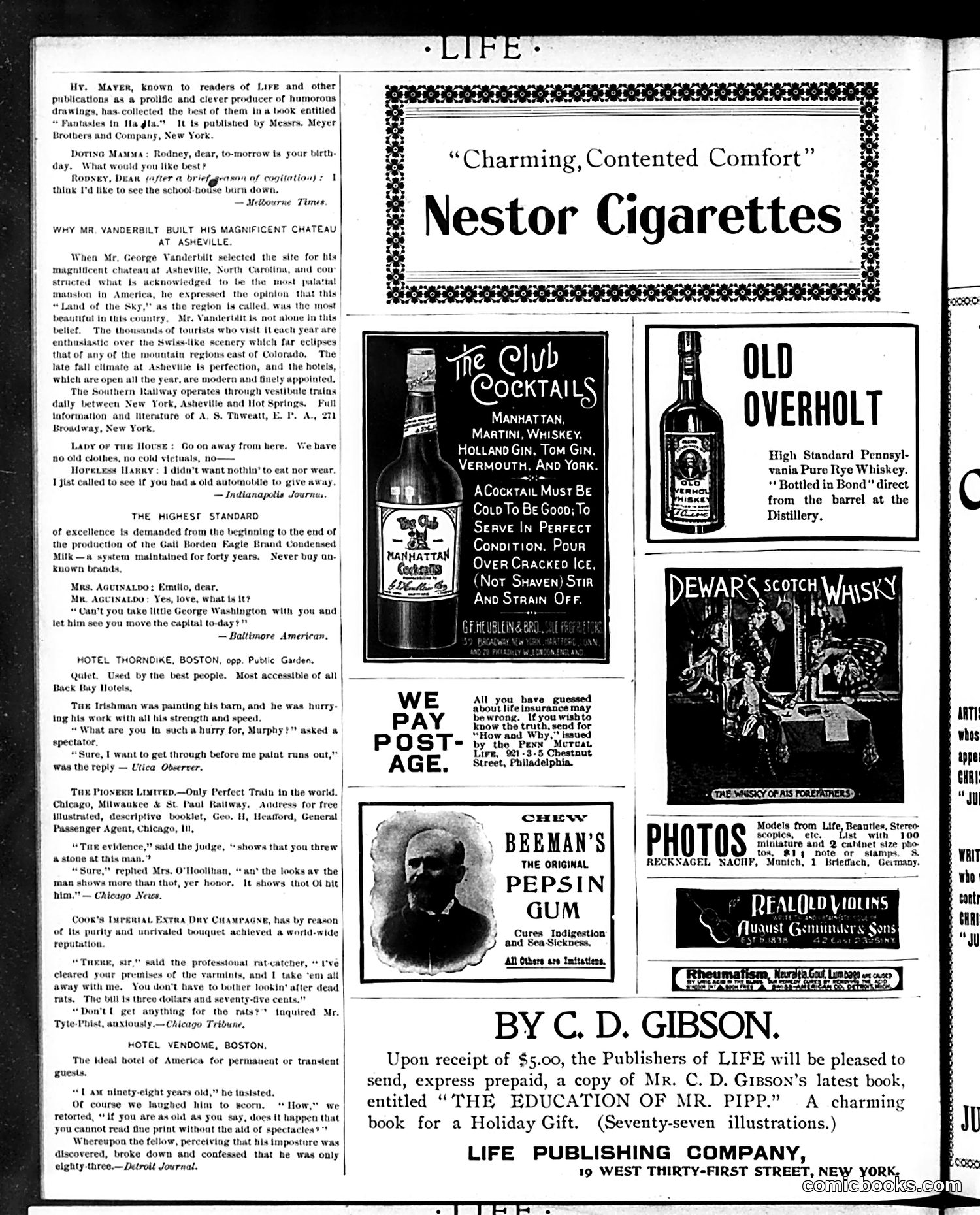
This page is primarily **advertising and humor miscellany**, not political cartooning. The content includes: **Advertisements** dominate: Nestor Cigarettes, Old Overholt whiskey, Dewar's Scotch, Beeman's gum, and various hotels and railroads occupy roughly half the page. **Humor section** comprises brief jokes and anecdotes—mostly genteel Victorian-era humor with no political content. Examples include a child wanting to see the schoolhouse burn down, an Irishman rushing to paint before his paint runs out, and an elderly man caught lying about his age. **One mild topical reference**: A caption mentioning "Mrs. Aguinaldo" and "little George Washington," likely alluding to Filipino General Aguinaldo (U.S. adversary during the Philippine-American War), making a satirical joke about moving a capital. Otherwise, this reflects Life's early function as a **genteel humor and lifestyle publication** aimed at middle/upper-class readers, mixing light satire with commercial advertising rather than sharp political commentary.
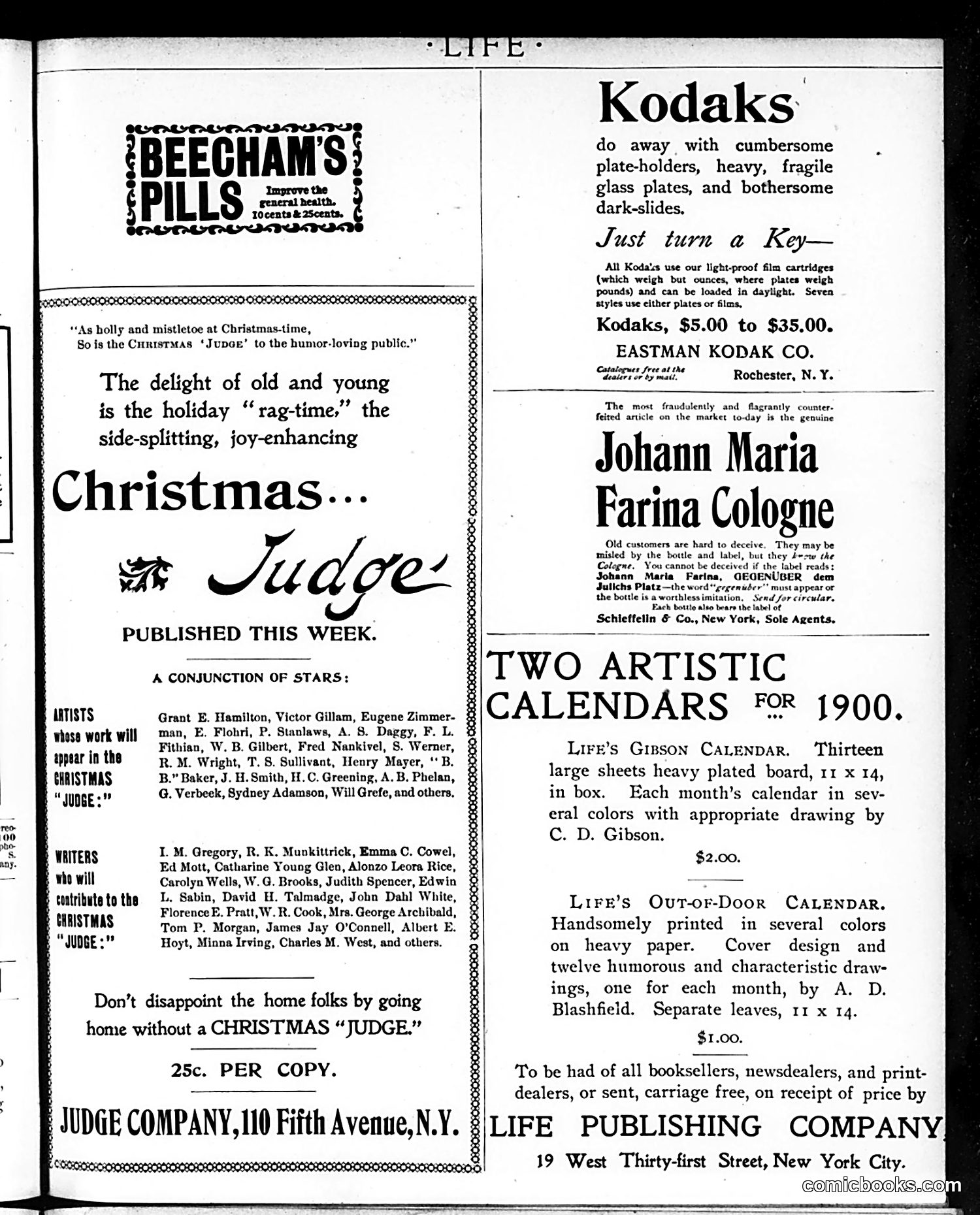
This is primarily an **advertising page** rather than a satirical cartoon page. The dominant content consists of: **Main Advertisement:** A large promotion for the Christmas issue of *Judge* magazine (a humor publication), featuring contributions from named artists and writers. The tagline compares *Judge* to "holly and mistletoe at Christmas-time." **Product Advertisements:** - **Kodaks** (cameras): Emphasizes new film cartridge technology replacing cumbersome glass plates—a genuine technological advance being marketed - **Johann Maria Farina Cologne**: A warning advertisement alerting consumers to widespread counterfeiting; urges buyers to verify authenticity through specific label text and the distributor's seal - **Two calendars for 1900**: Life Publishing Company markets Gibson and Blashfield artistic calendars **Historical Context:** The page reflects late-1890s consumer culture, emerging photography technology, and counterfeit product concerns. The *Judge* promotion indicates holiday magazine gifting was established practice. No political satire is evident on this page.
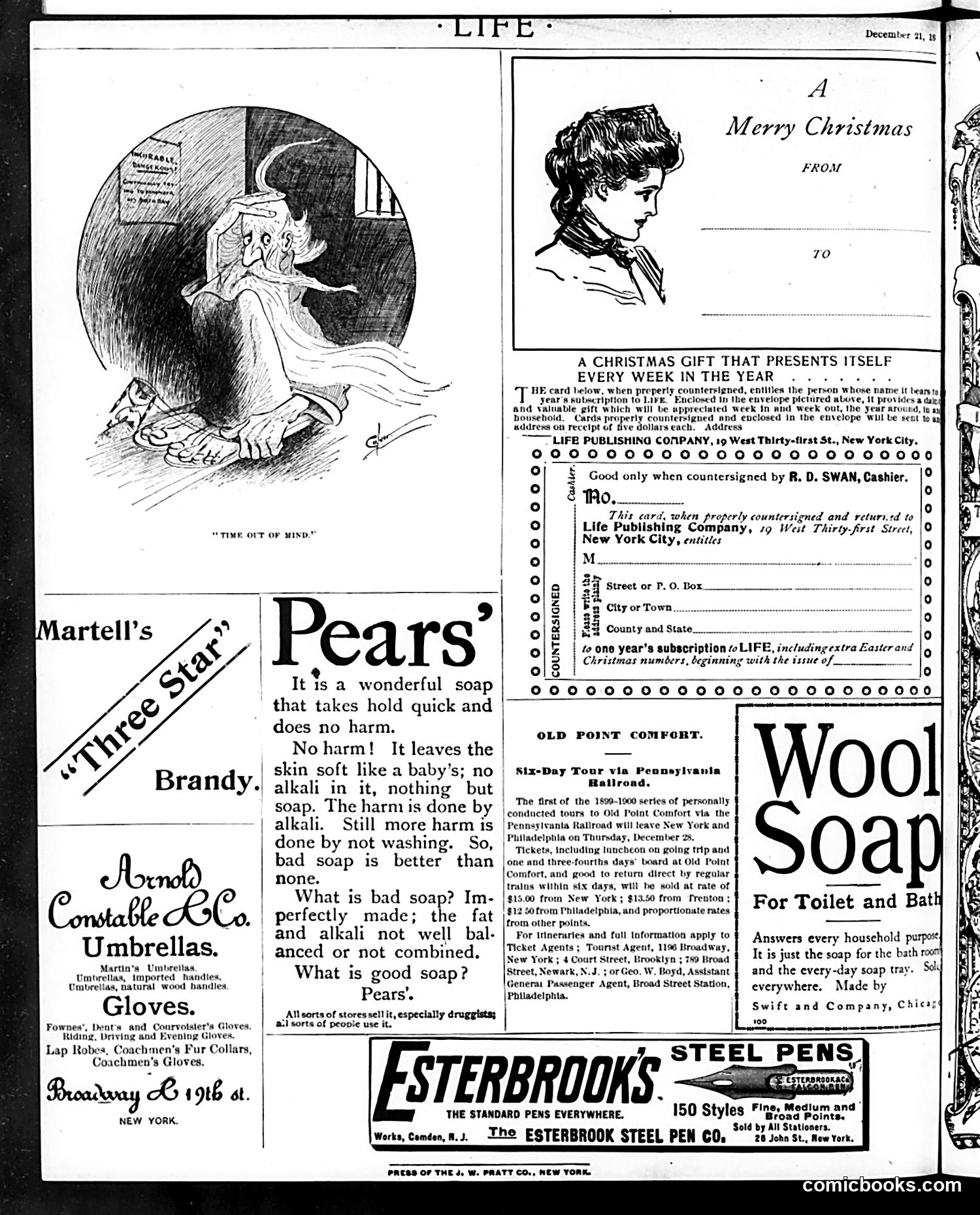
The main cartoon depicts a figure hunched over what appears to be a desk or workspace, labeled "TIME OUT OF MIND." The drawing uses exaggerated perspective and cross-hatching typical of early 20th-century editorial illustration. The specific subject and satirical point remain unclear from the image alone—it could reference a contemporary public figure, social trend, or cultural phenomenon of 1915, but without additional context or caption text visible in the cartoon itself, the precise target of satire cannot be determined. The page is primarily devoted to period advertisements (Pears' soap, Esterbrook pens, umbrellas, railroad tours) and includes a Life magazine subscription gift card—standard commercial fare for this publication. The cartoon appears secondary to the advertising content on this particular page.